a. Canada and Russia d. Brazil and Panama
b. Brazil and Mexico e. Mexico and Canada
c. Canada, Brazil, and Mexico
108. The World Trade Organization (WTO):
a. is an ecoterrorist group.
b. advocates for protection of domestic industries against cheap imports.
c. enforces international trade agreements.
d. protects consumers against exploitation by large multinational corporations.
e. protects workers against exploitation by large multinational corporations.
109. Bans on imports, import quotas, voluntary quotas, and tariffs on goods
a. sometimes increase equilibrium quantities, but not prices.
b. increase equilibrium quantities, but decrease prices.
c. increase equilibrium quantity and prices.
d. decrease equilibrium quantity and prices.
e. decrease equilibrium quantities, but increase prices.
110. A tax on imports is known as a(n)
a. import subsidy. d. voluntary quota.
b. nontariff trade barrier. e. quota.
c. tariff.
111. A tariff
a. is a strict enforcement of health laws.
b. is a voluntary agreement between two countries to limit exports.
c. is a tax on imports.
d. is a limit on the quantity of a good that can be imported into a country.
e. subsidizes the production of goods leaving the country.
112. A tariff is a tax imposed on ________ good.
a. an imported d. the most popular
b. a luxury e. a domestic
c. an illegal
113. There is a 5 percent average tax on imported goods in the United States. This tax is known as a(n)
a. income tax. d. quota.
b. sales tax. e. importer tax.
c. tariff.
114. An example of a tariff is
a. Japanese automobile manufacturers agreeing to limit exports to the United States.
b. a decision by the United States to limit South Korean television imports to 100,000 per year.
c. France charging an additional 10 percent tax on imports of Vietnamese clothing.
d. a decision by Saudi Arabia to reduce oil exports to India by 100,000 barrels.
e. Chinese toy manufacturers agreeing to reduce exports to the United States.
115. The United States feels that it has become too dependent on oil from Saudi Arabia, so it charges a
tax of $10 per barrel on oil that can be imported from Saudi Arabia. This is an example of a(n)
a. nontariff trade barrier. d. export subsidy.
b. import quota. e. import subsidy.
c. tariff.
116. Assume there is a 35 percent tariff on bananas imported into the United States. Also, assume that
the market competition is at its beginning and the law of one price is not in effect. If the domestic
market price of Hawaiian bananas is $1.00 per bunch, imported bananas will sell for ________ per
bunch.
a. $0.35 d. $1.35
b. $0.65 e. $1.65
c. $1.00
117. A limit imposed on the volume of total imports of a particular good is known as a(n)
a. quota. d. import subsidy.
b. tariff. e. export subsidy.
c. voluntary quota.
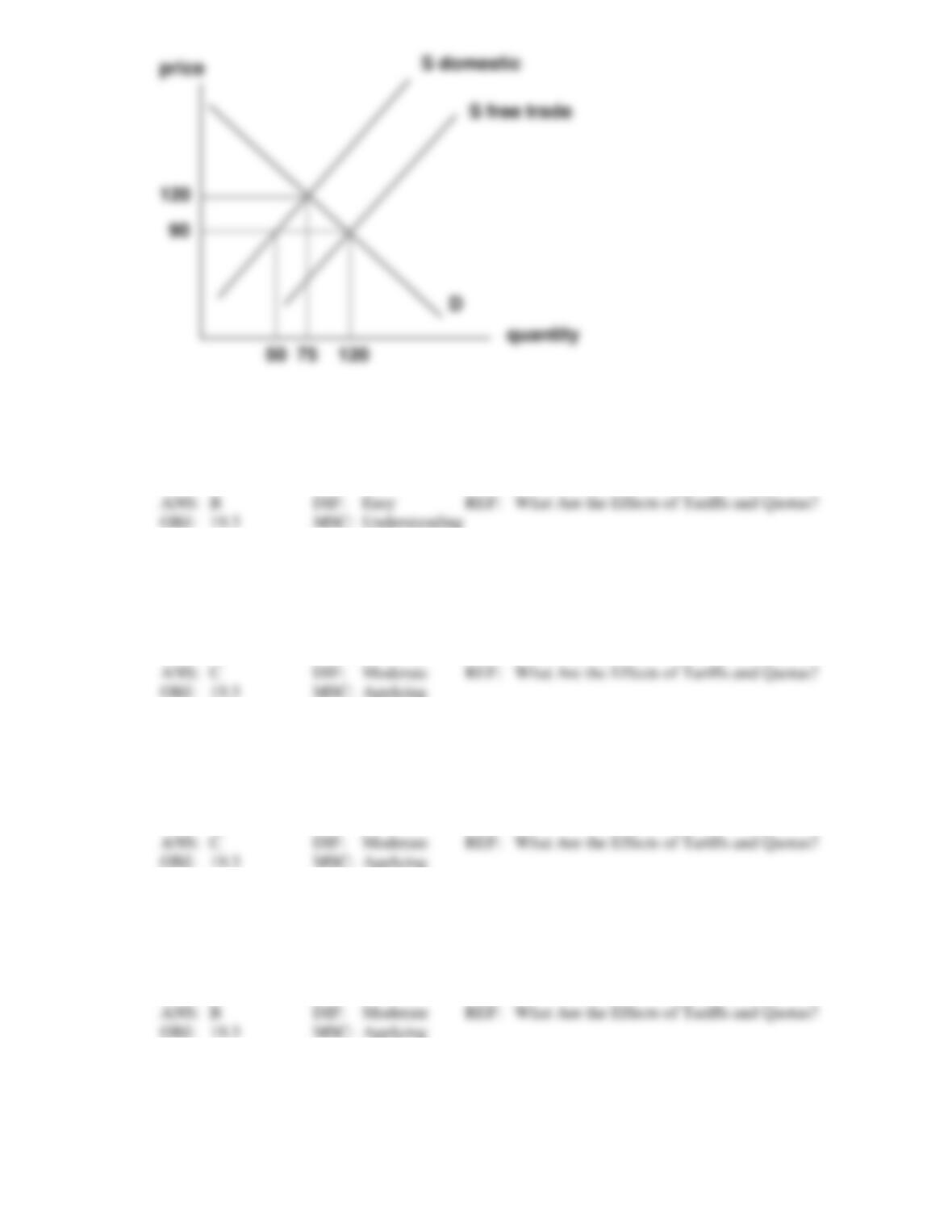
118. If this country does not engage in trade with other countries, then the price of shoes will be
________ and the quantity of shoes sold will be ________.
a. $120; 120 d. $90; 50
b. $120; 75 e. $90; 75
c. $90; 120
119. If this country engages in free trade with other countries, then the price of shoes will be ________
and the quantity of shoes sold to domestic consumers will be ________.
a. $120; 120 d. $90; 50
b. $120; 75 e. $90; 75
c. $90; 120
120. If this country engages in trade with other countries, then the quantity of shoes produced
domestically will be ________ and the quantity of shoes imported will be ________.
a. 50; 120 d. 75; 45
b. 120; 50 e. 75; 25
c. 50; 70
121. When a country decides to begin importing a good that they already produce domestically, then
there will be an increase in ________ and the market price will ________.
a. supply; increase d. demand; increase
b. supply; decrease e. supply and demand; decrease
c. demand; decrease
122. Country A decides to sign a trade agreement with Country B. Suppose Country B specializes in
producing electronics. We can expect the quantity of electronics imported from Country B to
________ and the price of electronics in Country A to ________.
a. increase; increase d. decrease; decrease
b. increase; remain unchanged e. decrease; increase
c. increase; decrease
123. When a country decides to impose a tariff on a good they are already importing, we can expect the
________ to decrease and the price of the good to ________.
a. supply; increase d. demand; increase
b. supply; decrease e. supply and demand; decrease
c. demand; decrease
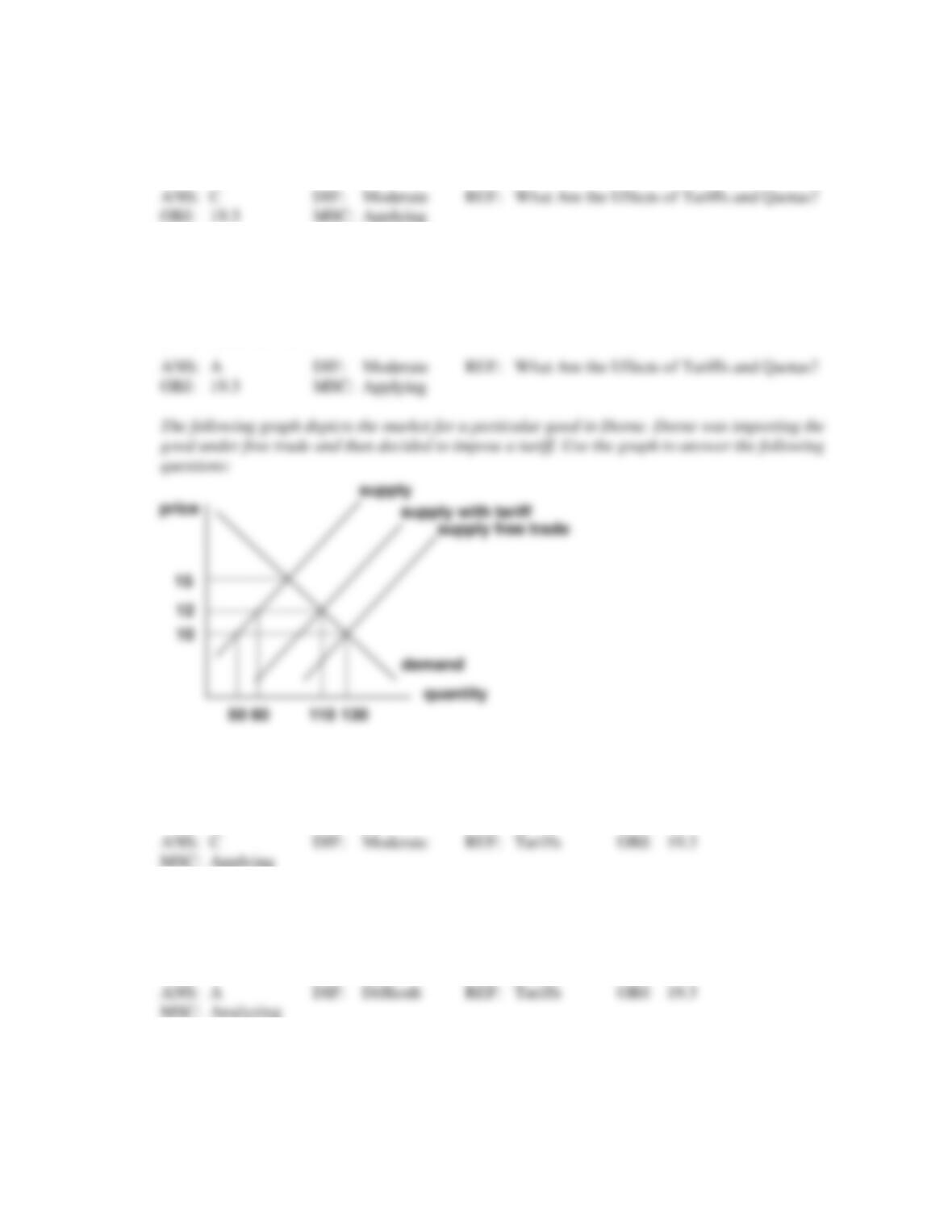
124. What is the value of the tariff?
a. 2 percent d. $3
b. $5 e. 25 percent
c. $2
125. How much revenue does the government earn from the tariff?
a. $100 d. $1,320
b. $600 e. $40
c. $220
126. When the tariff is imposed, imports will fall from
a. 130 to 110. d. 20 to 10.
b. 80 to 50. e. 130 to 60.
c. 60 to 50.
127. A quota
a. imposes a tax on goods entering the country.
b. limits the quantity of goods leaving the country.
c. subsidizes the production of goods leaving the country.
d. limits the quantity of goods entering the country.
e. is a tax on imports.
128. Limits on the quantity or total value of specific products imported to a nation are
a. import quotas. d. export subsidies.
b. protective tariffs. e. export quotas.
c. nontariff barriers.
129. An agreement by one country to limit the volume of exports to another country is known as a(n)
a. quota. d. import subsidy.
b. tariff. e. export subsidy.
c. voluntary quota.
130. The United States feels that it has become too dependent on oil from Saudi Arabia, so it places a
limit on the amount of oil that is imported from Saudi Arabia. This is an example of a(n)
a. nontariff trade barrier. d. export subsidy.
b. quota. e. import subsidy.
c. tariff.
131. An example of a nonvoluntary import quota is
a. Japanese automobile manufacturers agreeing to limit exports to the United States.
b. a decision by the United States to limit South Korean television imports to 100,000 per year.
c. France charging an additional 10 percent tax on imports of Vietnamese clothing.
d. a decision by Saudi Arabia to reduce oil exports to India by 100,000 barrels.
e. Chinese toy manufacturers agreeing to reduce exports to the United States.
132. The United States has placed a limit on the amount of oil that can be imported. This is an example
of a(n)
a. import quota. d. import subsidy.
b. tariff. e. export subsidy.
c. voluntary export restraint.
133. An example of a voluntary quota is
a. Venezuela charging an additional 20 percent tax on imported oil from Iran.
b. a decision by the United Kingdom to limit Malaysian shoe imports to 250,000 per year.
c. South Korean electronics manufacturers agreeing to limit exports to New Zealand.
d. France charging an additional 10 percent tax on imports of Vietnamese clothing.
e. a decision by the United States to limit South Korean television imports to 100,000 per year.
134. In the past, Canada has agreed to set an upper limit on the total amount of softwood lumber
exported to the United States. This is an example of a(n)
a. import quota. d. protective tariff.
b. export subsidy. e. revenue tariff.
c. voluntary quota.
135. An import quota
a. limits the amount of a good that can be imported, thus increasing prices.
b. is the same as a ban on imports.
c. increases the amount of a good imported, thus increasing prices.
d. increases the amount of a good imported, thus decreasing prices.
e. limits the amount of a good that can be imported, thus decreasing prices.
136. Exporting nations often agree to voluntary export restraints in an attempt to
a. increase global welfare.
b. employ more workers in the importing nation.
c. decrease inflation.
d. avoid more-restrictive trade policies.
e. increase inflation.
137. In the domestic market following the imposition of an import quota, imports ________, domestic
production ________, and prices ________.
a. decrease; increases; decrease
b. increase; increases; increase
c. decrease; increases; increase
d. increase; decreases; decrease
e. decrease; decreases; increase
138. In the domestic market following the imposition of a voluntary quota, imports ________, domestic
production ________, and prices ________.
a. decrease; increases, increase d. increase; increases, increase
b. increase; decreases, decrease e. decrease; increases, decrease
c. decrease; decreases, increase
139. In the domestic market following the removal of an import quota, imports ________, domestic
production ________, and prices ________.
a. increase; decreases; decrease. d. increase; increases; increase.
b. decrease; increases; decrease. e. decrease; increases; increase.
c. decrease; decreases; increase.
140. Which of the following is NOT one of the four main reasons given for the persistence of trade
barriers?
a. national security d. favors to special interests
b. protection of infant industries e. scarcity of natural resources
c. retaliation for dumping
141. Many people argue that certain industries, such as weapons, energy, and transportation, should be
protected by trade barriers in the interest of
a. national infrastructure.
b. national security.
c. the unemployment rate in those industries.
d. technological advancement.
e. economic independence.
142. The argument that calls for the trade protection of only newly developing industries is known as
the ________ argument.
a. autarky d. predatory dumping
b. infant industry e. learning by doing
c. developing nation
143. A possible explanation that a nation might offer for the imposition of a protectionist policy such as
a tariff is to
a. protect an infant industry from foreign competitors.
b. encourage specialization in the good in which the nation has a comparative advantage.
c. slow domestic production.
d. increase the level of imports.
e. give consumers more foreign-made options.
144. One argument for trade restriction that focuses on new industries is that
a. trade barriers must be used to protect all domestic workers.
b. tariffs imposed to aid new industries should never be removed.
c. new industries are usually capable of competing with established rivals.
d. new industries need to be shielded in their early stages.
e. trade barriers can be used to enhance national security.
145. When a foreign supplier sells a good below the price it charges in its home country, this is called
a. undercutting. d. dumping.
b. releasing. e. wholesaling.
c. expelling.
146. When a foreign supplier tries to “dump” goods into another country in order to gain a foothold in a
foreign market, this is often a result of ________ within the foreign country.
a. tariffs d. unemployment
b. restrictions e. changed preferences
c. subsidies
147. One of the reasons given for the imposition of a protectionist policy such as a tariff is to
a. aid other nations in developing their own industries.
b. increase the welfare of foreign consumers.
c. increase the welfare of domestic consumers.
d. protect domestic workers from foreign competition.
e. slow domestic production.
148. Why do politicians sometimes resist free trade and “globalization”?
a. Free trade does not benefit the economy as a whole.
b. Special interest groups may not benefit from free trade.
c. Free trade does not benefit the global economy.
d. Free trade usually hurts the consumers.
e. Only the rich benefit from free trade.
149. The trade-restriction view assumes that free trade is ________ and should be ________.
a. helpful for an economy; encouraged
b. helpful to the producers only; controlled
c. helpful to the poor only; controlled
d. harmful to domestic workers and producers; restricted
e. harmful to domestic consumers; restricted
150. A possible reason a nation might impose a restrictive policy such as a tariff is to
a. help domestic firms increase market share relative to their foreign competition.
b. increase the welfare of domestic consumers.
c. increase the level of imports.
d. encourage specialization in the good in which the nation has a comparative advantage.
e. give consumers more foreign-made options.
SHORT ANSWER
1. Consider a country that is open to trade. Although the country imports and exports goods and
services from more than 200 different nations, the bulk of its imports and exports tend to come
from the same eight nations. Identify some possible reasons why this country obtains the majority
of its imports and exports from only eight different nations as opposed to having the imports and
exports more evenly split across the 200 different nations that it conducts trade with.
2. Explain what is likely to happen to the value of the trade balance during the business cycle.
3. The following table presents data on imports and exports as a percentage of gross domestic product
(GDP) for select countries in 2015, based on data from the World Bank.
Country Exports as a Percentage of GDP Imports as a Percentage
of GDP
Australia 19.8 21.2
Belgium 84.4 82.7
Chile 30.1 30.3
China 22.4 18.8
South Korea 45.9 38.9
United States 12.6 15.5
Why might some of these countries tend to have much larger values for imports and exports as a
percentage of GDP in comparison to other countries?
4. What has happened to the real value of world merchandise trade over the past 40 years? Why has
this change happened?
5. The following table identifies the real value of exports, imports, and gross domestic product (GDP)
for a country for three different years, measured in billions of dollars.
Year Exports Imports GDP
1990 434.00 400.00 2,170.00
2000 499.10 480.00 2,712.50
2010 459.01 560.00 3,255.00
a. During this time period, what has happened to exports and imports as a percentage of GDP?
Calculate the values.
b. During this time period, what has happened to the trade balance? Calculate the values.
c. Provide a plausible explanation for why the values might have changed in the way they did.
6. What are some of the gains from trade?
7. When two countries decide to follow their comparative advantage and engage in specialization and
exchange, both countries experience gains from trade because they are able to consume at a point
beyond their production possibilities frontier. Illustrate and explain how this is possible.
8. Suppose two countries are each capable of producing cars and clothing. If they decide to specialize
and exchange, explain how they can determine a beneficial rate of exchange between cars and
clothing.
9. Italy and the Republic of Georgia both produce liters of wine and meters of cloth. In Italy, each
worker in an hour can produce either 5 liters of wine or 25 meters of cloth. In Georgia, each
worker in an hour can produce either 3 liters of wine of 12 meters of cloth. Each country has
constant opportunity cost of production and each has 300 hours of labor available.
Initially, the two countries do not trade. Italy allocates 100 hours of labor to wine production and
200 hours of labor to cloth production, so it produces a total of ________ liters of wine and
________ meters of cloth. Georgia allocates 100 hours of labor to wine production and 200 hours
of labor to cloth production, so it produces a total of ________ liters of wine and ________ meters
of cloth.
The two countries decide to specialize and then engage in trade. With specialization, Italy will
produce ________ liters of wine and ________ meters of cloth, and Georgia will produce
________ liters of wine and ________ meters of cloth. The two countries decide to trade 550 liters
of wine in exchange for 2,475 meters of cloth. After trade, Italy will consume ________ liters of
wine and ________ meters of cloth, and Georgia will consume ________ liters of wine and
________ meters of cloth.
After specialization and exchange, Italy is able to consume ________ more liters of wine and
________ more meters of cloth than it could before trade. Georgia is able to consume ________
more liters of wine and ________ more meters of cloth after specialization and exchange than it
could before specialization and exchange.
10. The following figure illustrates the production possibilities for two countries, Russia and Canada.
Assume that initially the two countries do not trade. Russia produces 40 cars and 5 tons of paper.
Canada produces 16 cars and 42 tons of paper. You can assume cars and paper are measured in
thousands of units.
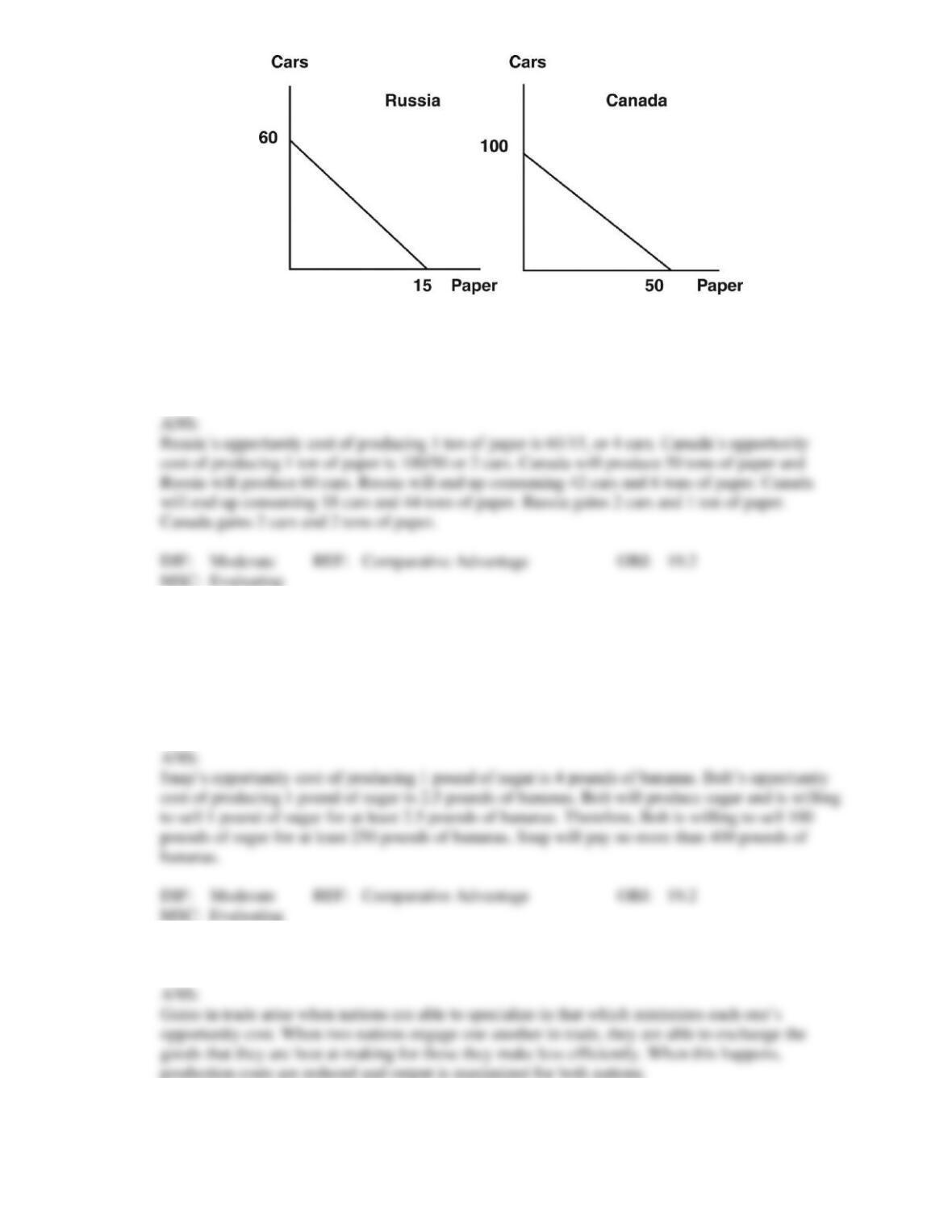
Suppose the two countries decide to completely specialize and trade. If they decide to trade 18 cars
in exchange for 6 tons of paper, then after trade, Russia will be able to consume ________ more
cars and ________ more paper. Canada will be able to consume ________ more cars and
________ more paper.
11. Snap and Bolt are two countries that both produce bananas and sugar. In Snap, each worker in a
one-hour period can produce either 12 pounds of bananas or 3 pounds of sugar. In Bolt, each
worker in a one-hour period can produce either 5 pounds of bananas or 2 pounds of sugar. Suppose
both countries have constant opportunity cost of production and decide to specialize and exchange.
The country that specializes in sugar is willing to sell 100 pounds of sugar for at least ________
pounds of bananas, and the other country will pay no more than ________ pounds of bananas.
12. What exactly is the advantage of the principle of comparative advantage?
13. Imagine two countries, Peteland and Arlenia. Peteland is producing everything at a lower absolute
cost than Arlenia. If the two countries trade, what is the reason?
14. Esther and Ebenezer produce hamburgers and hot dogs. Esther can produce six hamburgers per
hour or four hot dogs per hour. Ebenezer can produce three hamburgers per hour or one hot dog
per hour. Who has the absolute advantage or comparative advantage in the production of
hamburgers or hot dogs?
15. Shawna and Trevor produce cars and trucks. Shawna can produce 10 cars per hour and 5 trucks per
hour. Trevor can produce 12 cars per hour and 4 trucks per hour. Who has the absolute advantage
and comparative advantage in the production of cars and trucks?
16. List three trade-restrictive policies.
17. Briefly list and define the three major types of trade barriers most commonly used.
18. Describe what the market effects on a good would be in the face of a quota, a tariff, and a complete
ban on imports.
19. Would consumers benefit more from a tariff or a quota on imports?
20. Consider a country that produces shoes and does not engage in trade with other countries. Draw a
supply/demand graph to illustrate consumer surplus and producer surplus. Suppose the country
begins to import shoes. Draw a second graph to illustrate the new areas that represent consumer
surplus and producer surplus.
21. Suppose a country was freely trading electronics with other countries and now it has decided to
impose a tariff on imported electronics. Draw a graph to illustrate the change in consumer surplus,
the change in producer surplus, the deadweight loss, and the government revenue.
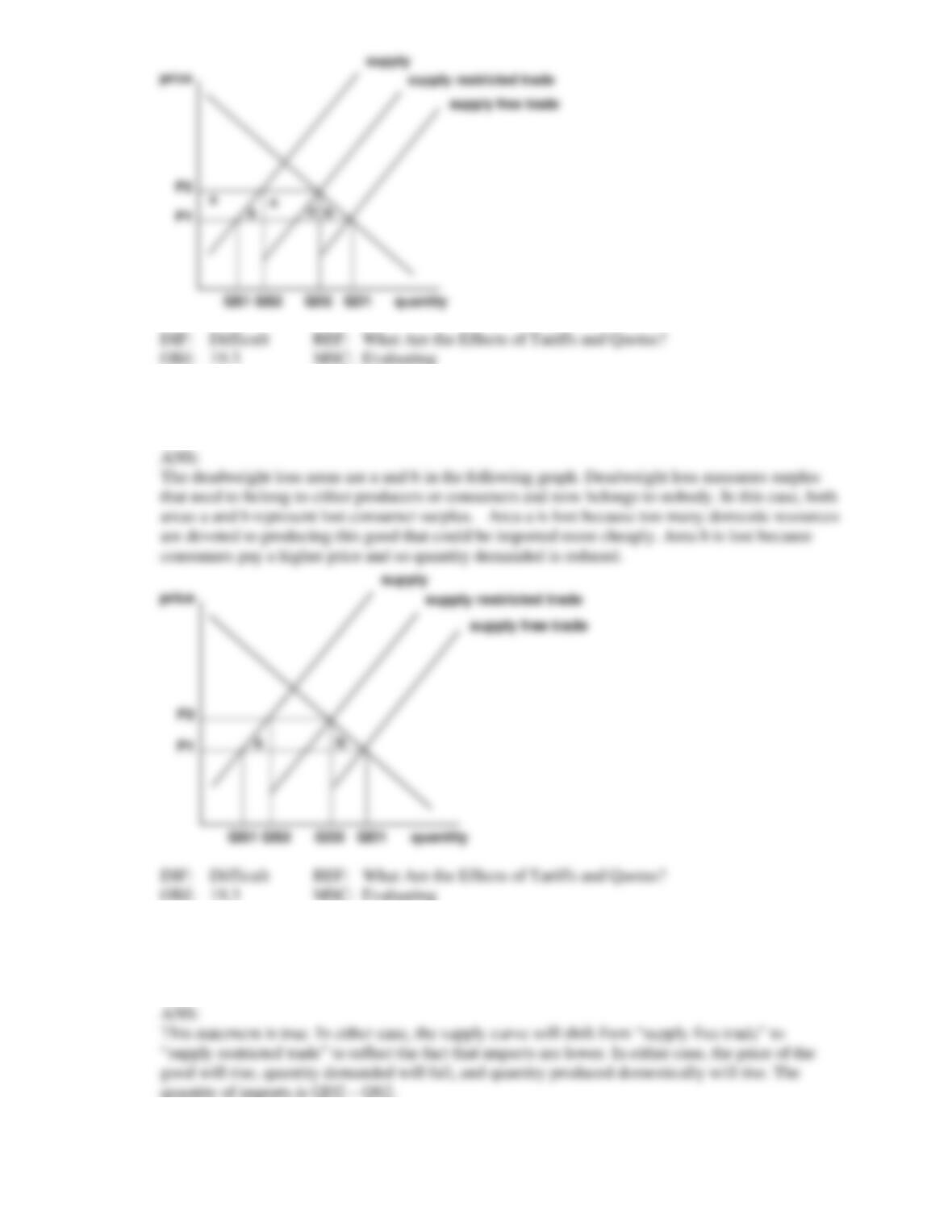
22. Graphically illustrate the deadweight loss that results when a country imposes a tariff. Explain the
meaning of the deadweight loss.
23. A country is trying to decide if it should impose a tariff or a quota on imports of some good. In
either case, the impact on the domestic price and the quantity of imports will be the same. True or
false, explain.
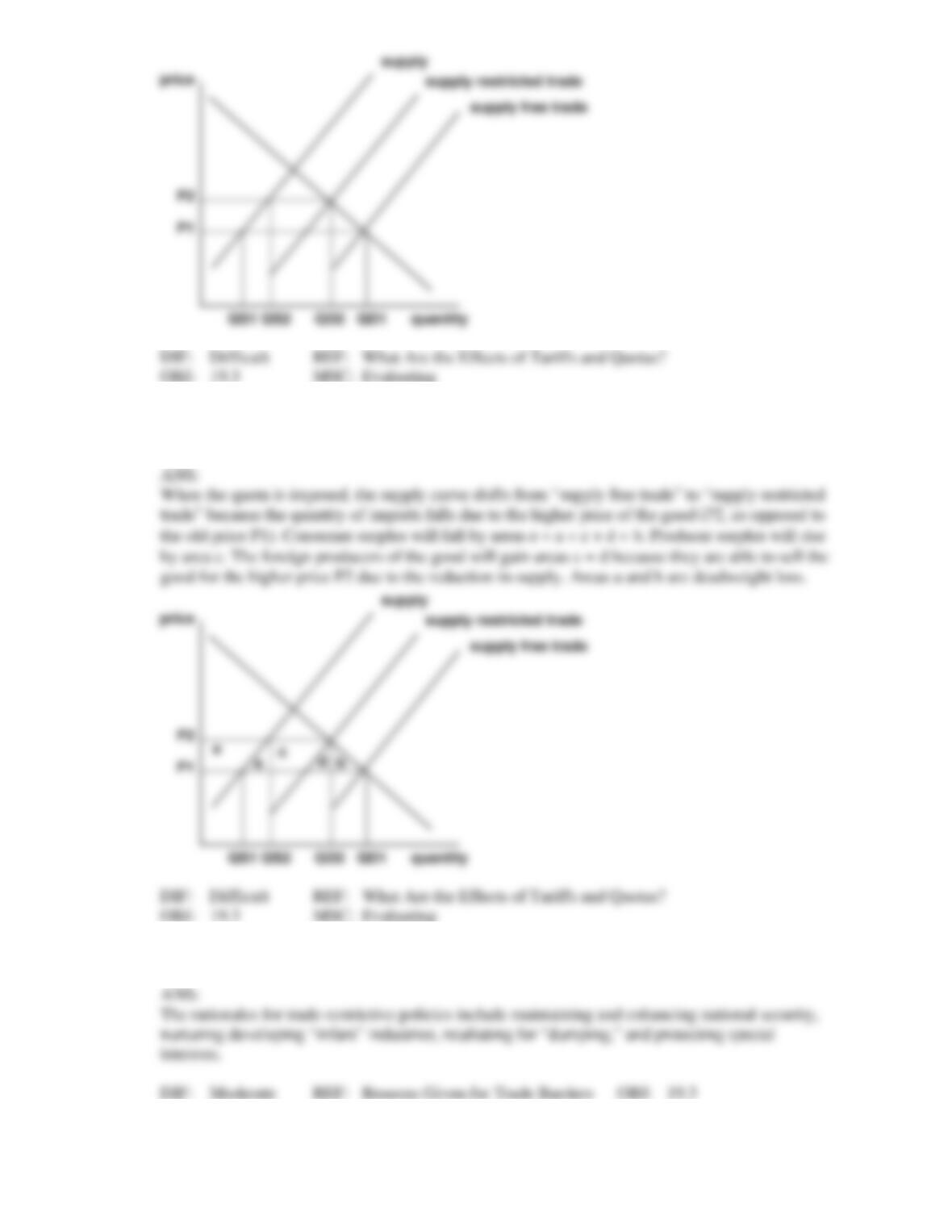
24. Graphically illustrate the lost consumer surplus associated with imposing a quota on imports. What
happens to this lost surplus?
25. What are the rationales for trade-restrictive policies?