CHAPTER 19: International Trade
MULTIPLE CHOICE
1. For country A, an export is a good produced in
a. country B and purchased by residents of country A.
b. country A and purchased by residents of country A.
c. country A and purchased by residents of country B.
d. country B and purchased by residents of country B.
e. any other country.
2. For country A, an import is a good produced in
a. country B and purchased by residents of country A.
b. country A and purchased by residents of country A.
c. country A and purchased by residents of country B.
d. country B and purchased by residents of country B.
e. the domestic economy.
3. Total world exports of goods and services are now about ________ the size of world GDP.
a. one-tenth d. one-third
b. one-eighth e. one-half
c. one-fourth
4. An economy that does not trade with the rest of the world is a(n) ________ economy.
a. open d. closed
b. command e. one-person
c. trade
5. An economy that trades with the rest of the world is a(n) ________ economy.
a. open d. closed
b. command e. autarky
c. trade
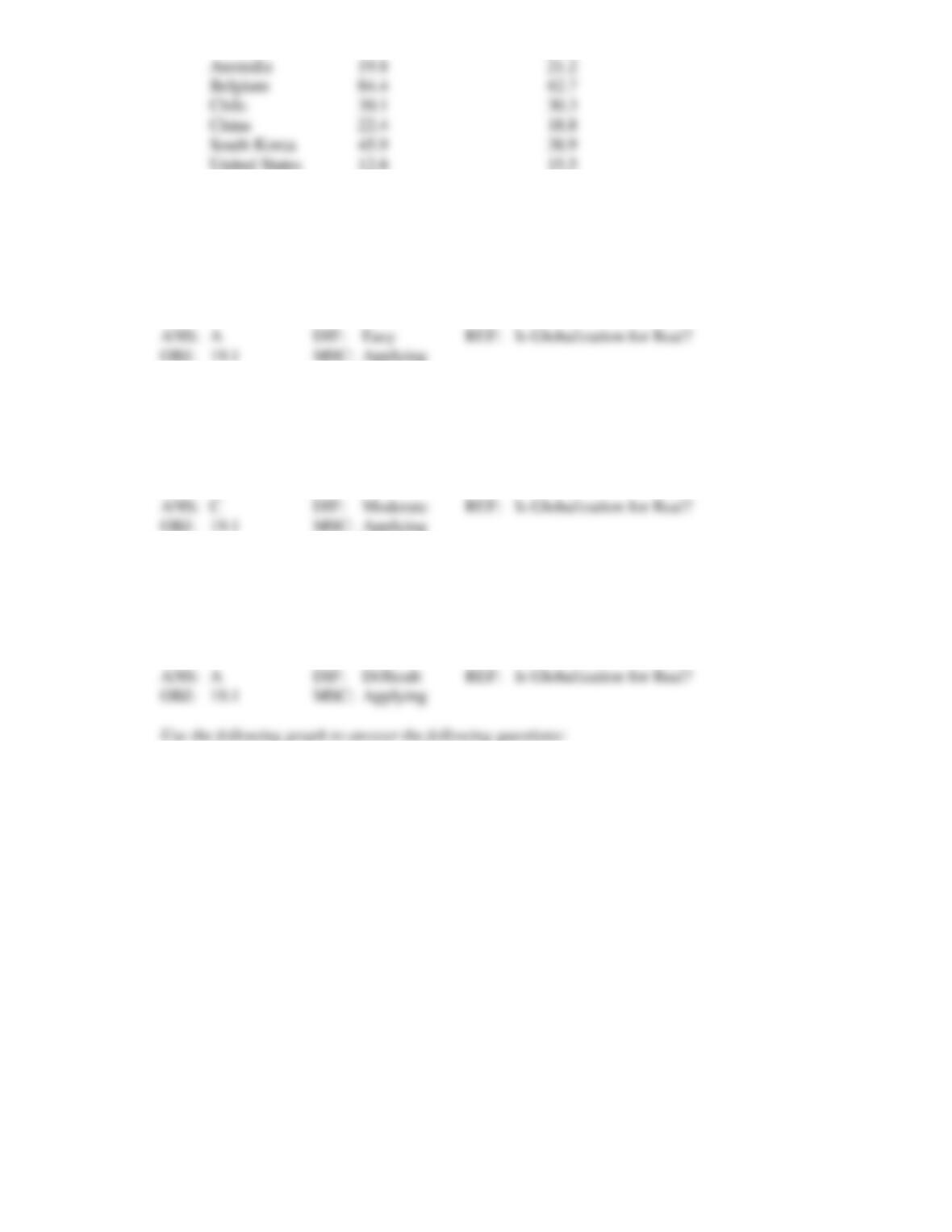
6. Based on data from the table, which countries had a trade deficit in 2015?
a. Australia, Chile, United States
b. Belgium, China, South Korea
c. Belgium, Chile, South Korea
d. Australia, China, United States
e. It is impossible to say because we need to know the dollar values of imports and exports.
7. Based on data from the table, which country had the largest trade deficit as a percentage of GDP in
2015?
a. Belgium d. South Korea
b. Chile e. Australia
c. United States
8. Suppose all countries in the world suddenly stop trading with each other. Which country in the
table is likely to be the most negatively affected?
a. Belgium d. South Korea
b. Chile e. Australia
c. United States
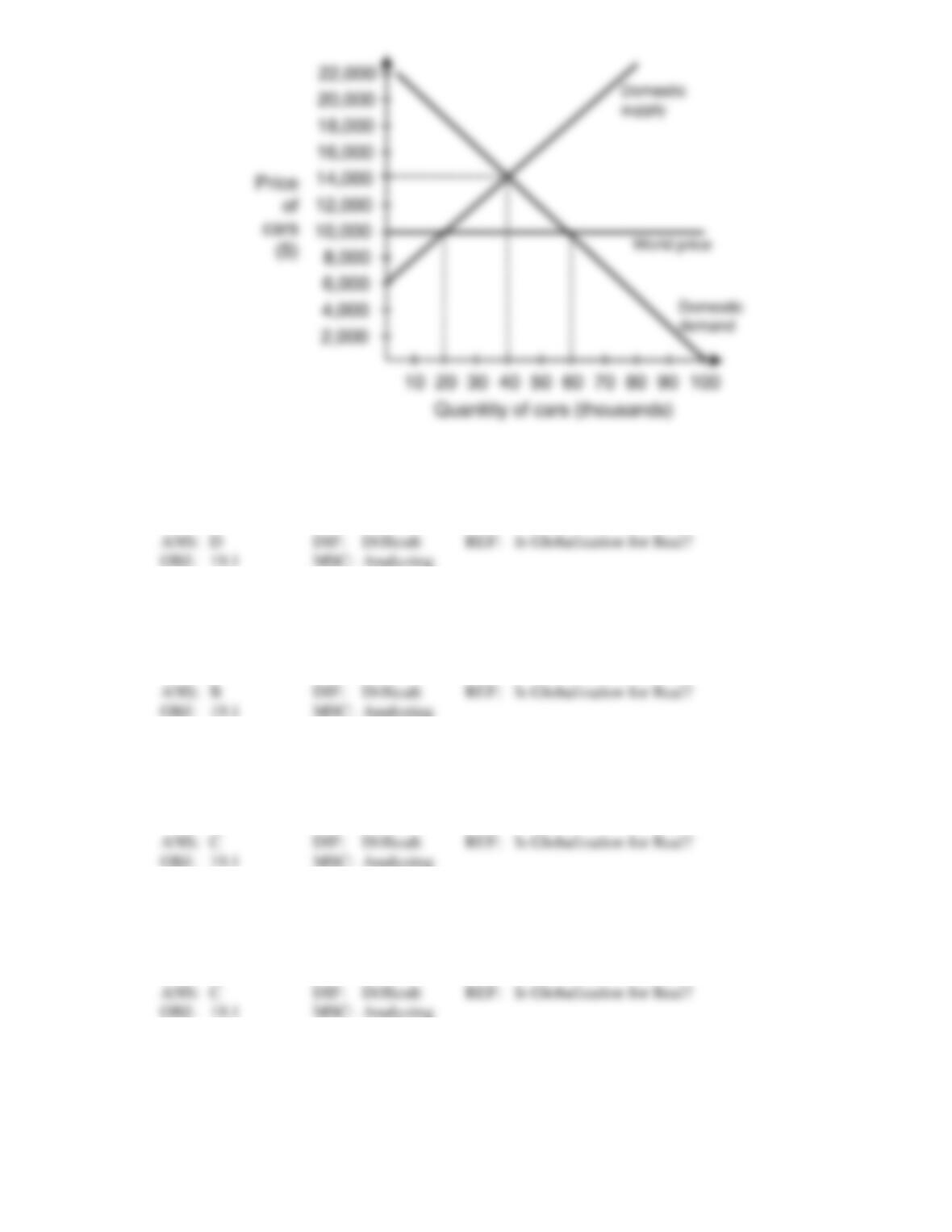
9. What is the price of a car if this is a nontrading (closed) economy?
a. $6,000 d. $14,000
b. $8,000 e. $24,000
c. $10,000
10. If this is a nontrading (closed) economy, how many cars (in thousands) will be exchanged?
a. 20 d. 80
b. 40 e. 100
c. 60
11. If this is a trading (open) economy, the price of a car will be
a. $6,000. d. $14,000.
b. $8,000. e. $24,000.
c. $10,000.
12. If this is a trading (open) economy, quantity demanded of cars (in thousands) will be
a. 20. d. 80.
b. 40. e. 100.
c. 60.
13. If this is a trading (open) economy, quantity supplied of cars (in thousands) by the domestic
producers will be
a. 20. d. 80.
b. 40. e. 100.
c. 60.
14. How many cars (in thousands) will this country import in a trading (open) economy situation?
a. 20 d. 80
b. 40 e. 100
c. 60
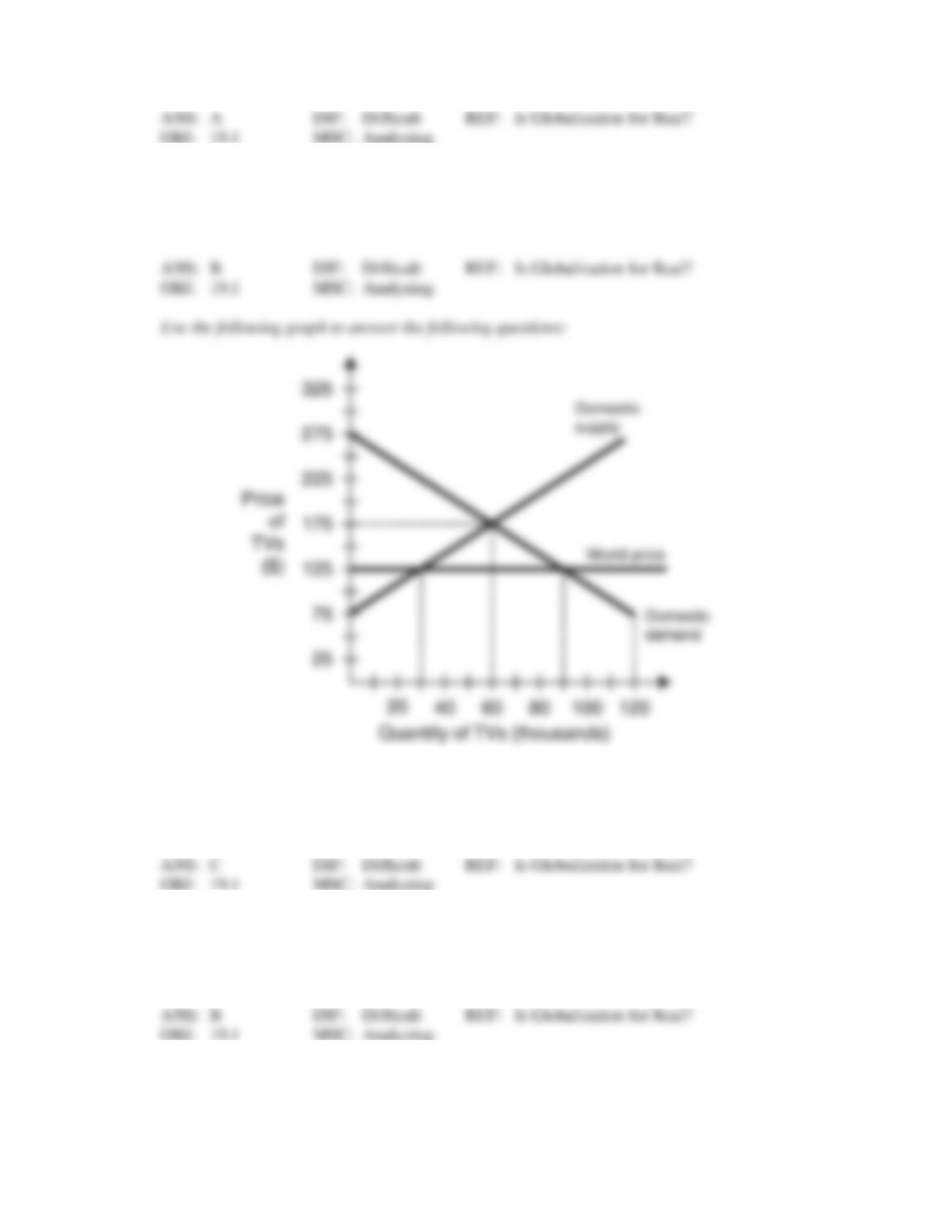
15. If this is a nontrading (closed) economy, the price of a TV will be
a. $75. d. $225.
b. $125. e. $275.
c. $175.
16. If this is a nontrading (closed) economy, the number of TVs exchanged (in thousands) will be
a. 30. d. 120.
b. 60. e. 150.
c. 90.
17. In a trading (open) economy, the price of a TV will be
a. $75. d. $225.
b. $125. e. $275.
c. $175.
18. In a trading (open) economy, the quantity demanded of TVs (in thousands) in the domestic market
will be
a. 30. d. 120.
b. 60. e. 150.
c. 90.
19. In a trading (open) economy, the quantity supplied of TVs (in thousands) in the domestic market
will be
a. 30. d. 120.
b. 60. e. 150.
c. 90.
20. In a trading (open) economy, how many TVs (in thousands) will this country import?
a. 30 d. 120
b. 60 e. 150
c. 90
21. If St. John has a closed economy, it ________ with other countries.
a. trades all of its goods
b. does not trade goods
c. prevents its citizens from traveling to other countries, but trades goods
d. trades both services and goods
e. trades only services and no goods
22. If Hong Kong has an open economy, it ________ with other countries.
a. trades all of its goods
b. does not trade its goods
c. only trades a few of its goods
d. trades both services and goods
e. trades only services and no goods
23. Free trade is ________, because it ________ the size of the pie available to the economy.
a. inefficient; decreases
b. inefficient; increases
c. good for developed countries only; unfairly changes
d. efficient; decreases
e. efficient; increases
24. Since 2000, world goods trade has
a. doubled. d. decreased by 10 percent.
b. tripled. e. decreased by 25 percent.
c. remained the same.
25. In the past decade, companies like Nike and Under Armour have set up manufacturing centers in
Nicaragua in part due to the country’s establishment of ________, allowing these companies to
avoid standard corporate tax rates.
a. “trade zones” d. “free zones”
b. “international zones” e. “tax zones”
c. “production zones”
26. Trade balance is
a. the sum of a nation’s total exports and total imports.
b. the difference between a nation’s total exports and total imports.
c. when a nation exports more than it imports.
d. when a nation imports more than it exports.
e. when a nation no longer feels it has the need for trade partners.
27. Trade surplus is
a. the sum of a nation’s total exports and total imports.
b. the difference between a nation’s total exports and total imports.
c. when a nation exports more than it imports.
d. when a nation imports more than it exports.
e. when a nation no longer feels it has the need for trade partners.
28. Trade deficit is
a. the sum of a nation’s total exports and total imports.
b. the difference between a nation’s total exports and total imports.
c. when a nation exports more than it imports.
d. when a nation imports more than it exports.
e. when a nation no longer feels it has the need for trade partners.
29. For nearly four decades, the United States has had a
a. trade balance. d. ban on imports.
b. trade surplus. e. ban on exports.
c. trade deficit.
30. Which country has the world’s biggest economy?
a. Japan d. China
b. Germany e. India
c. United States
31. According to the table, across the 60-year period, the real value of exports ________ and the real
value of exports as a percentage of GDP ________.
a. increased; decreased
b. increased; increased
c. increased; fluctuated up and down
d. decreased; increased
e. fluctuated up and down; fluctuated up and down
32. According to the table, across the 60-year period, the real value of imports ________ and the real
value of imports as a percentage of GDP ________.
a. increased; decreased
b. increased; increased
c. increased; fluctuated up and down
d. decreased; increased
e. fluctuated up and down; fluctuated up and down
33. According to the table, in the year 2000, the real value of exports as a percentage of GDP was
________ and the real value of imports as a percentage of GDP was ________.
a. 12.48; 15.45 d. 10.02; 13.82
b. 5.43; 6.12 e. 2.00; 1.30
c. 8.79; 10.68
34. Based on the table, the value of exports __________ and the value of exports as a percentage of
GDP __________.
a. increased; stayed the same d. decreased; increased
b. increased; increased e. decreased; stayed the same
c. increased; decreased
35. Based on the table, the value of exports ________, the value of imports ________, and the value of
the trade balance ________.
a. increased; increased; increased
b. increased; increased; decreased
c. increased; decreased; increased
d. decreased; decreased; increased
e. increased; decreased; decreased
36. Based on the table, the value of exports as a percentage of GDP ________, and the value of
imports as a percentage of GDP ________.
a. stayed the same; stayed the same
b. increased; decreased
c. decreased; increased
d. decreased; decreased
e. increased; increased
37. In recent years, the United States has
a. exported more services abroad than it has imported.
b. imported more services from abroad than it has exported.
c. had a small goods trade surplus with Japan.
d. had a large goods trade surplus with the rest of the world.
e. fallen to third behind Japan and Germany in the list of leading export nations (absolute volume
basis).
38. Which of the following trade agreements is a binding agreement to reduce trade barriers between
the United States and Mexico?
a. World Trade Organization
b. Asia Pacific Economic Cooperation
c. North American Free Trade Agreement
d. European Union
e. Central America Free Trade Agreement
39. In 2011, 60 percent of goods imported by the United States came from just seven nations. Which
of the following nations was NOT one of those seven?
a. Australia d. Mexico
b. South Korea e. Canada
c. Japan
40. In 2011, 60 percent of goods imported by the United States came from just seven nations. Which
of the following nations was one of those seven?
a. Australia d. India
b. United Kingdom e. France
c. Argentina
41. Which two countries buy the most U.S. exports?
a. China and Japan d. Canada and Japan
b. China and Mexico e. Mexico and Japan
c. Canada and Mexico
42. Which of the following international organizations, founded in 1995, facilitates trade disputes
between nations?
a. United Nations (UN)
b. North American Free Trade Agreement (NAFTA)
c. World Trade Organization (WTO)
d. European Union (EU)
e. Asia Pacific Economic Cooperation (APEC)
43. What does NAFTA stand for?
a. National Authorized Free Trade Agreement
b. North American Free Trade Agreement
c. North American Fair Trade Agreement
d. National Assembly for Free Trading Americas
e. National Authorized Free Trade Assembly
44. Which of the following trade agreements caused trade between the United States, Canada, and
Mexico to double?
a. World Trade Organization
b. Asia Pacific Economic Cooperation
c. North American Free Trade Agreement
d. European Union
e. Central America Free Trade Agreement
45. If a society’s consumption possibilities are identical to its production possibilities, that society has
a(n)
a. closed economy.
b. open economy.
c. one-person economy.
d. absolute advantage in both goods and services.
e. free trade policy.
46. Citizens can consume the largest quantities of goods and services in which of the following
situations?
a. autarky
b. closed economy
c. open economy
d. economy with few citizens
e. developed country
47. The ability of one person or nation to produce more of a good while using the same quantity of
resources as another is called a(n) ________ advantage.
a. market d. comparative
b. absolute e. specific
c. specialization
48. The ability of one person or nation to produce a good at a lower opportunity cost than another is
called a(n) ________ advantage.
a. market d. comparative
b. absolute e. specific
c. specialization
49. The combination of goods and services that Mexico’s citizens might feasibly consume is called
Mexico’s
a. total consumption. d. production possibilities.
b. total production. e. national output.
c. consumption possibilities.
50. Which country benefits from this free trade agreement?
a. Canada d. both of them
b. Mexico e. not enough information to determine
c. neither of them
51. Which country’s consumers will benefit from the free trade agreement?
a. neither country d. Mexico
b. Canada e. not enough information to determine
c. both countries
52. Florida’s nice beaches and subtropical climate give the state ________ in tourism.
a. a comparative advantage d. higher income than all other states
b. specialization e. self-sufficiency
c. a trade benefit
53. An individual or country that has a comparative advantage in the production of one good
a. may or may not have an absolute advantage in the good’s production.
b. must not have an absolute advantage in the production of the other good.
c. must not have an absolute advantage in the good’s production.
d. must have an absolute advantage in the good’s production.
e. must not have a specific advantage in the good’s production.
54. X has a comparative advantage over Y in producing a good if
a. X can produce more of the good than Y can in a given time period.
b. X has to trade off more than Y does to produce the good.
c. X has a lower opportunity cost of producing the good than does Y.
d. X has a higher opportunity cost of producing the good than does Y.
e. Y can produce more of the good than X can in a given time period.
55. A rich nation will trade with a poor nation (and vice versa) because the
a. rich nation has a comparative advantage in all products.
b. poor nation has an absolute advantage in all products.
c. rich nation has an absolute advantage in all products.
d. poor nation has a comparative advantage in a product.
e. poor nation does not have any comparative advantage.
56. According to the principle of comparative advantage, trade between two countries will benefit
a. neither country.
b. the country with lower production costs.
c. the country with higher production costs.
d. both countries.
e. all workers.
57. A society could achieve a higher level of productivity if
a. each person in the society is a jack-of-all-trades.
b. it takes advantage of each individual’s comparative advantage.
c. it does not trade with other nations.
d. it does not tax imported goods.
e. it does not limit exports.
58. In general, a nation can enjoy a higher standard of living by ________ than by being
self-sufficient.
a. increasing its versatility d. taxing imported goods
b. avoiding trade with other nations e. producing on the PPF curve
c. specializing and trading
59. Based on the scenario, Ebenezer’s opportunity cost of one hot dog is ________ hamburgers.
a. three d. four
b. one and a half e. eight
c. six
60. Based on the scenario, Ebenezer’s opportunity cost of one hamburger is ________ hot dog(s).
a. one-third of a d. four
b. one e. eight
c. six
61. Based on the scenario, Esther’s opportunity cost of one hot dog is ________ hamburgers.
a. three d. four
b. one and a half e. eight
c. six
62. Based on the scenario, Esther’s opportunity cost of one hamburger is ________ hot dog(s).
a. two-thirds of a d. four
b. one e. eight
c. six
63. If both Natasha and Jameson produce only cheese, how many pounds of cheese can they produce
per year?
a. 2,500 d. 10,000
b. 5,000 e. 12,500
c. 7,500
64. Natasha’s opportunity cost of producing one house is ________ pound(s) of cheese.
a. 1/250 of a d. 250
b. 1/20 of a e. 500
c. 20
65. Natasha’s opportunity cost of producing one pound of cheese is ________ house(s).
a. 1/250 of a d. 250
b. 1/20 of a e. 500
c. 20
66. Jameson’s opportunity cost of producing one house is ________ pound(s) of cheese.
a. 1/250 of a d. 250
b. 1/20 of a e. 500
c. 20
67. Jameson’s opportunity cost of producing one pound of cheese is ________ house(s).
a. 1/500 of a d. 250
b. 1/250 of a e. 500
c. 1/10 of a
68. Natasha has a comparative advantage in the production of ________, and Jameson has a
comparative advantage in the production of ________.
a. houses; houses d. both goods; houses
b. houses; cheese e. both goods; cheese
c. cheese; houses
69. By the principle of comparative advantage, Natasha should specialize in producing
a. both cheese and houses. d. neither cheese nor houses.
b. cheese. e. a little of both goods.
c. houses.
70. By the principle of comparative advantage, Jameson should specialize in producing
a. both cheese and houses. d. neither cheese nor houses.
b. cheese. e. a little of both goods.
c. houses.
71. If both Natasha and Jameson produce the good for which each has a comparative advantage, total
output of this economy will be
a. 10,000 pounds of cheese.
b. 30 houses.
c. 10,000 pounds of cheese and 30 houses.
d. 5,000 pounds of cheese.
e. 5,000 pounds of cheese and 20 houses.
72. If this economy produces more than 20 houses per year, the opportunity cost of a house will
________ because ________.
a. decrease; production will be specialized
b. increase; an input with a higher opportunity cost must be used
c. decrease; inputs will be obtained at lower cost
d. increase; all gains from trade have already been exploited
e. remain the same; Natasha and Jameson produce in constant ratios regardless of level of output
73. Based on the scenario, Rosa has
a. an absolute advantage in producing basketballs, but not footballs.
b. an absolute advantage in producing footballs, but not basketballs.
c. an absolute advantage in producing both goods.
d. an absolute advantage in producing neither good.
e. no comparative advantage.
74. Based on the scenario, Rosa has
a. a comparative advantage in producing basketballs, but not footballs.
b. a comparative advantage in producing footballs, but not basketballs.
c. a comparative advantage in producing both goods.
d. a comparative advantage in producing neither good.
e. no absolute advantage.
75. Based on the scenario, which of the following is true?
a. Rosa has both an absolute and a comparative advantage in basketball production.
b. Rosa has both an absolute and a comparative advantage in football production.
c. Rosa has neither an absolute nor a comparative advantage in basketball production.
d. Rosa has neither an absolute nor a comparative advantage in football production.
e. Dirk has both an absolute and a comparative advantage in basketball production.
76. Based on the scenario, Rosa’s opportunity cost of one football is ________ basketballs.
a. four d. three
b. one and a half e. eight
c. six
77. Based on the scenario, Rosa’s opportunity cost of one basketball is ________ football(s).
a. one-third of a d. four
b. one e. eight
c. six
78. Based on the scenario, Dirk’s opportunity cost of one football is ________ basketball(s).
a. three-quarters of a d. four
b. one and a third e. six
c. three
79. Based on the scenario, Dirk’s opportunity cost of one basketball is ________ football(s).
a. one and a third d. four
b. one e. three
c. three-quarters of a
80. Based on the scenario, which of the following is true?
a. Dirk has an absolute advantage in producing basketballs, but not footballs.
b. Dirk has an absolute advantage in producing footballs, but not basketballs.
c. Dirk has an absolute advantage in producing both goods.
d. Dirk has an absolute advantage in producing neither good.
e. Rosa has a comparative advantage in producing both goods.
81. Based on the scenario, Karl has
a. an absolute advantage in producing cars, but not trucks.
b. an absolute advantage in producing trucks, but not cars.
c. an absolute advantage in producing both goods.
d. an absolute advantage in producing neither good.
e. no comparative advantage.
82. Based on the scenario, Karl has
a. a comparative advantage in producing cars, but not trucks.
b. a comparative advantage in producing trucks, but not cars.
c. a comparative advantage in producing both goods.
d. a comparative advantage in producing neither good.
e. no absolute advantage.
83. Based on the scenario, which of the following is true?
a. Karl has both an absolute and a comparative advantage in car production.
b. Karl has both an absolute and a comparative advantage in truck production.
c. Karl has neither an absolute nor a comparative advantage in car production.
d. Karl has neither an absolute nor a comparative advantage in truck production.
e. Jager has both an absolute and a comparative advantage in truck production.
84. Based on the scenario, Karl’s opportunity cost of one truck is ________ cars.
a. four d. three
b. one and a half e. eight
c. two
85. Based on the scenario, Karl’s opportunity cost of one car is ________ truck(s).
a. one-quarter of a d. four
b. one-half of a e. six
c. two
86. Based on the scenario, Jager’s opportunity cost of one truck is ________ car(s).
a. three-quarters of a d. four
b. one and a third e. six
c. three
87. Based on the scenario, Jager’s opportunity cost of one car is ________ truck(s).
a. two-thirds of a d. four
b. one-third of a e. three
c. three-quarters of a
88. Based on the scenario, which of the following is true?
a. Jager has an absolute advantage in producing cars, but not trucks.
b. Jager has an absolute advantage in producing trucks, but not cars.
c. Jager has an absolute advantage in producing both goods.
d. Jager has an absolute advantage in producing neither good.
e. Karl has a comparative advantage in producing both goods.
89. If Smith and Ricardo each spent half of his time producing computers and the other half producing
smartphones, what would be the total output per day?
a. 4 computers and 12 smartphones d. 8 computers and 22 smartphones
b. 5 computers and 14 smartphones e. 10 computers and 28 smartphones
c. 6 computers and 16 smartphones
90. The opportunity cost for Smith to produce one computer is ________ smartphone(s).
a. one-quarter of a d. two
b. one-half of a e. four
c. one
91. The opportunity cost for Ricardo to produce one computer is ________ smartphone(s).
a. one-quarter of a d. two
b. one-half of a e. four
c. one
92. The opportunity cost for Smith to produce one smartphone is ________ computer(s).
a. one-quarter of a d. two
b. one-half of a e. four
c. one
93. The opportunity cost for Ricardo to produce one smartphone is ________ computer(s).
a. one-quarter of a d. two
b. one-half of a e. four
c. one
94. ________ has the comparative advantage in computers and ________ has the comparative
advantage in smartphones.
a. Smith; Smith d. Ricardo; Ricardo
b. Smith; Ricardo e. Neither Smith nor Ricardo; Smith
c. Ricardo; Smith
95. To maximize total output, Smith should specialize in producing ________, whereas Ricardo
should specialize in producing ________.
a. computers; smartphones
b. smartphones; computers
c. computers; computers
d. smartphones; smartphones
e. smartphones and computers; neither good
96. What is the maximum number of each item that can be produced if each worker fully specializes
and produces according to his comparative advantage?
a. 4 computers and 12 smartphones
b. 5 computers and 14 smartphones
c. 6 computers and 16 smartphones
d. 8 computers and 22 smartphones
e. 10 computers and 28 smartphones
97. Based on the scenario, Raven has
a. an absolute advantage in producing baseballs, but not golf balls.
b. an absolute advantage in producing golf balls, but not baseballs.
c. an absolute advantage in producing both goods.
d. an absolute advantage in producing neither good.
e. no comparative advantage.
98. Based on the scenario, Raven has
a. a comparative advantage in producing baseballs, but not golf balls.
b. a comparative advantage in producing golf balls, but not baseballs.
c. a comparative advantage in producing both goods.
d. a comparative advantage in producing neither good.
e. no absolute advantage.
99. Based on the scenario, which of the following is true?
a. Raven has both an absolute and a comparative advantage in baseball production.
b. Raven has both an absolute and a comparative advantage in golf ball production.
c. Raven has neither an absolute nor a comparative advantage in baseball production.
d. Raven has neither an absolute nor a comparative advantage in golf ball production.
e. Drew has both an absolute and a comparative advantage in baseball production.
100. Based on the scenario, which of the following is true?
a. Drew has an absolute advantage in producing baseballs, but not golf balls.
b. Drew has an absolute advantage in producing golf balls, but not baseballs.
c. Drew has an absolute advantage in producing both goods.
d. Drew has an absolute advantage in producing neither good.
e. Raven has a comparative advantage in producing both goods.
101. Countries engaged in international trade to specialize in production based on
a. relative levels of GDP.
b. comparative advantage.
c. relative exchange rates.
d. relative inflation rates.
e. relative unemployement rates.
102. International trade and the associated increase in international competition has forced American
businesses to
a. raise production costs. d. redistribute income to workers.
b. improve productivity. e. reduce productivity.
c. be less efficient.
103. While comparative advantage is the biggest reason many nations engage in trade, two other
important reasons are
a. economies of scale and increased competition.
b. economies of scale and decreased competition.
c. increased competition and increased production costs.
d. increased production costs and access to smaller markets.
e. decreased competition and access to smaller markets.
104. When a smaller country with fewer resources specializes its production and gains access to larger,
international markets, this can create
a. a smaller distribution network. d. economies of scale.
b. increased per-unit costs. e. inefficiencies.
c. decreased sales.
105. Which of the following groups of countries are members of NAFTA?
a. United States, Canada, and Mexico
b. United States, France, and Germany
c. United States, Japan, and Mexico
d. United States, Canada, and Chile
e. Japan, Canada, and Mexico
106. The members of NAFTA are the United States, Canada, and
a. Japan. d. Chile.
b. France. e. the United Kingdom.
c. Mexico.
107. The North American Free Trade Agreement (NAFTA) was intended to increase U.S. trade with
which other countries?