1. Globalization can be defined as:
a.
the attitude or policy of placing the interests of the entire world above those of individual nations.
b.
viewing the entire world as a proper sphere for one nation to project political influence.
c.
a period in history that has witnessed a dramatic change in world political thought and the balance of power.
d.
an increased cross-border flow of trade in goods, services, and financial assets, along with an increased
international mobility of technology, information, and individuals.
e.
a social movement that supports global cooperation and interaction, but which opposes the negative effects of
economic development across nations.
2. Which of the following is not a defining characteristic of globalization?
a.
Increased cross-border flow of trade in goods
b.
Increased cross-border flow of trade in services
c.
Increased international mobility of information
d.
Increased frequency of wars
e.
Increased mobility of individuals across borders
Moderate
MACR.BOYE.16.91 – ch. 18, 1
United States – Analytic – BB-Legal
United States – International Trade and Finance
The Meaning of Globalization
Knowledge
3. In its most basic form, globalization has existed ever since:
a.
the creation of the Internet, which enables people to sell their products overseas.
b.
the end of World War II.
c.
the creation of the International Monetary Fund (IMF), which establishes the rules for all countries to follow
as they trade.
d.
the fall of the Berlin wall which marked the end of communism and thus, the beginning of truly “global”
times.
e.
primitive societies began to engage in trade.
Easy
MACR.BOYE.16.91 – ch. 18, 1
The Meaning of Globalization
Easy
MACR.BOYE.16.91 – ch. 18, 1
The Meaning of Globalization
4. In this era of globalization, one of the main reasons why some countries have remained closed to the rest of the world
is:
a.
the fact that their governments follow policies that explicitly work against economic integration.
b.
racial discrimination.
c.
the fact that their governments impose extremely high mortgage taxes.
d.
the establishment of minimum wages.
e.
the fact that they are too poor to trade anything with the rest of the world.
5. Which of the following multinational agreements allows the international movement of workers?
a.
NATO
b.
The European Union
c.
The group of G-8
d.
NAFTA
e.
The United Nations Accords
b
Easy
MACR.BOYE.16.91 – ch. 18, 1
The Meaning of Globalization
Knowledge
6. Which of the following is a direct consequence of the development of faster and cheaper computers?
a.
The development of double-entry bookkeeping
b.
The enhanced ability of managers of business operations to deal with complex transactions in far-flung
locations
c.
The creation of money
d.
The decrease in workers’ productivity, because more computers need fewer people to operate them
e.
A decline in the rate of inflation
b
Easy
MACR.BOYE.16.91 – ch. 18, 1
United States – Analytic – BB-Legal
United States – International Trade and Finance
The Meaning of Globalization
Knowledge
7. Countries that enjoy long distance flows of goods, capital, and services as well as information and perceptions that
accompany market exchanges would be categorized under _____ globalization.
a.
ethical
Easy
MACR.BOYE.16.91 – ch. 18, 1
The Meaning of Globalization
Knowledge
b.
cultural
c.
social
d.
economic
e.
political
8. Countries in which one would see a spread of ideas, information, images, and people would be categorized under _____
globalization.
a.
economic
b.
social
c.
ethical
d.
cultural
e.
political
b
Moderate
MACR.BOYE.16.91 – ch. 18, 1
Knowledge
9. Countries that have a large number of embassies, have memberships to international organizations, and participate in
UN peace missions would be categorized under _____ globalization.
a.
cultural
b.
social
c.
political
d.
economic
e.
ethical
Moderate
MACR.BOYE.16.91 – ch. 18, 1
The Meaning of Globalization
Knowledge
10. Which of the following is a measure of political globalization (one of the three categories used by the KOF Swiss
Economic Institute)?
a.
Participation in U.N. peace missions
b.
Spread of ideas
c.
Flow of information
d
Moderate
MACR.BOYE.16.91 – ch. 18, 1
The Meaning of Globalization
Knowledge
d.
Limits on externalities
e.
Progressive taxation
11. Which of the following statements is true?
a.
World trade as a fraction of world GDP is much less than it was at the end of the 19th century.
b.
War decreases the pace of globalization.
c.
Large countries such as the U.S., Russia, and Japan have high scores in economic integration when measured
against the criteria of Foreign Policy magazine.
d.
Poor countries tend to have high scores in the personal contact area when measured against the criteria of
Foreign Policy magazine.
e.
The U.S. increased its international investments after the September 11, 2001 terrorist attacks to revive their
economy.
MACR.BOYE.16.91 – ch. 18, 1
United States – Analytic – BB-Legal
The Meaning of Globalization
12. Which of the following measures of globalization was not affected during the aftermath of the terrorist attacks in the
United States on September 11, 2001?
a.
World trade
b.
Global foreign direct investment
c.
International travel and tourism
d.
International telephone calls
e.
Political engagement
MACR.BOYE.16.91 – ch. 18, 1
United States – Analytic – BB-Legal
United States – International Trade and Finance
The Meaning of Globalization
13. _____ is the argument that with globalization, countries compete for international investment by offering low or no
environmental regulations or labor standards.
a.
“Free rider problem“
b.
“Tragedy of the commons”
MACR.BOYE.16.91 – ch. 18, 1
United States – Analytic – BB-Legal
United States – International Trade and Finance
The Meaning of Globalization
c.
“Race to the bottom”
d.
“Flag of convenience“
e.
“Enlightened self-interest”
14. Which of the following is not considered a criticism of globalization?
a.
International corporations serve only the interests of the corporations.
b.
Globalization promotes “free” but not “fair” trade.
c.
Globalization encourages harmful labor practices.
d.
Globalization promotes only trade based on comparative, and not absolute advantage.
e.
Globalization occurs at the cost of environmental quality.
d
MACR.BOYE.16.92 – ch. 18, 2
Globalization Controversy
15. Which of the following international organizations do globalization critics claim is serving the interests of large
multinational corporations?
a.
NATO
b.
The World Bank
c.
The Fed
d.
The United Nations
e.
The International Labor Organization
b
MACR.BOYE.16.92 – ch. 18, 2
Globalization Controversy
16. Which of the following is entrusted with the responsibility of settling trade disputes between countries?
a.
The European Union
b.
The International Monetary Fund
c.
The World Trade Organization
d.
The International Labor Organization
e.
The United Nations Organization
Moderate
MACR.BOYE.16.91 – ch. 18, 1
United States – International Trade and Finance
Globalization Controversy
Knowledge
17. Supporters of globalization argue that increased globalization will lead to:
a.
increased living standards.
b.
decreased budget deficits.
c.
decreased trade deficits.
d.
currency appreciation.
e.
monetary stability.
MACR.BOYE.16.93 – ch. 18, 3
United States – Analytic – BB-Legal
United States – International Trade and Finance
Globalization Controversy
18. Which of the following arguments is not used by promoters of globalization as one of the reasons why free trade and
international investment result in higher standards of living?
a.
Free trade helps developing countries.
b.
International organizations represent governments and people, not the interests of corporations.
c.
There is no convincing evidence that globalization occurs at the expense of the environment.
d.
There is no convincing evidence that globalization occurs by encouraging harmful labor practices.
e.
Globalization brings better cultural practices to countries that have obsolete cultural traditions.
MACR.BOYE.16.93 – ch. 18, 3
United States – Analytic – BB-Legal
United States – International Trade and Finance
Globalization Controversy
19. What has been one of the results of globalization experienced by Eastern European nations after the fall of their
socialist regimes?
a.
All traces of their traditional culture have disappeared.
b.
These countries have attracted foreign investment from industrialized countries, which have transferred
cleaner technologies and thus, improved environmental quality.
c.
These countries have not yet adapted to capitalism, and a majority support a new movement to return to
communism.
d.
Most national forests have been destroyed by multinational companies.
e.
Many new diseases have been introduced because of increased contact with the West.
MACR.BOYE.16.92 – ch. 18, 2
United States – Analytic – BB-Legal
United States – International Trade and Finance
Global Business Insight – The World Trade Organization
20. Which of the following statements accurately expresses evidence that globalization does not encourage a “race to the
bottom” in labor standards?
a.
The wages paid by multinational firms to their poor countries’ subsidiaries are higher than the wages paid in
rich countries.
b.
Poor countries that participate in globalization have quickly become rich.
c.
Multinational firms tend to pay higher wages than local firms, but they tend to provide lower benefits than
existed in the country prior to globalization.
d.
Multinational firms must sign contracts with the IMF stating that they will offer exceptional worker benefits.
e.
Multinational firms tend to pay higher wages than local firms and tend to provide greater benefits for workers
than existed in the country prior to globalization.
MACR.BOYE.16.93 – ch. 18, 3
United States – International Trade and Finance
United States – Reflective Thinking
Globalization Controversy
21. Which of the following is one of the main reasons why China has recently received large amounts of foreign direct
investment?
a.
The prospect that multinational firms have of selling to the massive Chinese market
b.
The lack of environmental standards under the communist government of China
c.
The prospect of using forced child labor for cheaper production in this country
d.
The relative strength of the Chinese currency, which makes any investment there worthwhile
e.
The advanced southeast Asian highway system, which makes transportation extremely efficient
MACR.BOYE.16.93 – ch. 18, 3
United States – Analytic – BB-Legal
United States – International Trade and Finance
Globalization Controversy
22. It is a known fact that the same multinational company may pay lower wages to its workers in a developing country
than to those in an industrialized country. Why is this not considered an evidence of worker exploitation?
a.
Rich people deserve higher pay.
b.
The workers in developing countries have lower consumption levels than those in developed countries, thus
they get lower wages.
c.
Local wages in developing countries are generally lower than in industrialized countries, with or without
globalization.
MACR.BOYE.16.93 – ch. 18, 3
United States – International Trade and Finance
United States – Reflective Thinking
Globalization Controversy
d.
Workers in developing countries have higher benefits, making the overall wages about the same in both kinds
of countries.
e.
Most workers in developing countries are comparatively younger, and they get lower wages because of their
lack of experience.
23. Which of the following is an argument for globalization?
a.
Poor countries compete for multinational firms by allowing lax environmental standards.
b.
Multinational firms tend to pay lower wages than local firms.
c.
The benefits of globalization to all consumers greatly outweigh the loss of jobs to international competition.
d.
Removal of restrictions against agricultural products would cause workers in rich countries to lose their jobs.
e.
The increased integration of the world’s economies has been associated with lax environmental and labor
standards in most countries.
MACR.BOYE.16.93 – ch. 18, 3
United States – International Trade and Finance
United States – Reflective Thinking
Globalization Controversy
24. What happened to the so-called Asian tigers in the 1960s and 1970s?
a.
They underwent a period in which their economies turned into mild communism.
b.
The literacy rates of these countries declined in this time period (that is, a smaller percentage of the people
could read).
c.
They all became part of the First World.
d.
They became the most technologically advanced countries in the world.
e.
They underwent the process of opening their economies and experienced rapid economic growth.
MACR.BOYE.16.94 – ch. 18, 4
United States – Analytic – BB-Legal
United States – International Trade and Finance
Globalization, Economic Growth, and Incomes
25. The Asian tigers have experienced rapid economic growth in recent times. Hence, these countries are sometimes
referred to as:
a.
first-world countries.
b.
newly industrialized countries.
MACR.BOYE.16.93 – ch. 18, 3
United States – International Trade and Finance
Globalization Controversy
c.
the globalization limelight.
d.
second-world countries.
e.
the G-8 nations.
26. Identify the correct statement.
a.
Between the 1960s and the 1990s, per capita GDPs grew faster in nonglobalizing countries.
b.
Between the 1960s and the 1990s, per capita GDPs grew faster in globalizing countries than in industrialized
countries.
c.
Between the 1960s and the 1990s, per capita GDP growth rates in the industrialized world increased.
d.
Between the 1960s and the 1990s, per capita GDP in the industrialized world decreased.
e.
Between the 1960s and the 1990s, per capita GDP in all developing countries increased.
b
Easy
MACR.BOYE.16.94 – ch. 18, 4
United States – International Trade and Finance
Globalization, Economic Growth, and Incomes
Revised
27. Average growth of per capita GDP of the post-1980 globalizers increased from 1.4 percent per year in the 1960s to
_____ percent in the 1990s.
a.
6.4
b.
5.0
c.
3.5
d.
7.8
e.
2.9
b
Easy
MACR.BOYE.16.94 – ch. 18, 4
Globalization, Economic Growth, and Incomes
Knowledge
28. The World Bank tracked the performance of countries that had undergone varying degrees of globalization since the
1960s. Which of the following was a conclusion of the study?
a.
The process of globalization widened the gap between rich countries and poor countries.
b.
The growth rates of globalizing countries were higher than the growth rates of nonglobalizers.
c.
The fraction of the very poor increased in newly globalized economies.
b
Easy
MACR.BOYE.16.94 – ch. 18, 4
United States – International Trade and Finance
Globalization, Economic Growth, and Incomes
Knowledge
d.
Globalization increased income inequality.
e.
Unemployment increased in newly globalized countries.
29. Which of the following is one of the most important causes for the recent increase in income inequality in China?
a.
The introduction of free markets while imposing restrictions on internal migration
b.
The introduction of regulations that do not allow families to have more than one child
c.
Globalization
d.
The increase in pollution as a result of industrialization
e.
Tougher government controls on the banking system
Moderate
MACR.BOYE.16.94 – ch. 18, 4
Globalization, Economic Growth, and Incomes
Knowledge
30. According to evidence from around the world, the real losers in globalization of the world economy are:
a.
non-government organizations.
b.
environmental activists.
c.
skilled laborers in the globalizing nations.
d.
countries that have not participated in the globalization process.
e.
the poorest people in the globalized developing countries.
Easy
MACR.BOYE.16.94 – ch. 18, 4
Globalization, Economic Growth, and Incomes
Knowledge
31. Which of the following stands true for income inequality?
a.
The benefits of increased economic growth are widely shared in the First World countries.
b.
As a result of globalization, income inequality in China has decreased.
c.
The decrease in income inequality in China is an effect of socialist policies in that country.
d.
The gap between rich countries and globalized developing countries has shrunk.
e.
Internal migration has played a big role in reducing the income inequality in China.
Moderate
MACR.BOYE.16.94 – ch. 18, 4
United States – International Trade and Finance
Globalization, Economic Growth, and Incomes
Knowledge
32. What has happened to countries that did not participate in the globalization of the world economy?
a.
The fraction of the population living below the poverty line in these countries has decreased.
b.
These countries have been mired in a low-growth path and are experiencing high poverty rates.
c.
The socialist policies in these countries have caused a big change in the income distribution, something that
globalization could not have achieved.
d.
The growth rate of these countries is stronger than the First World countries.
e.
The domestic industries in these countries have experienced robust growth.
b
Easy
MACR.BOYE.16.94 – ch. 18, 4
United States – International Trade and Finance
Globalization, Economic Growth, and Incomes
Knowledge
Revised
33. Which of the following countries went through a financial crisis in 1997?
a.
Russia
b.
Canada
c.
Italy
d.
India
e.
Korea
Easy
MACR.BOYE.16.95 – ch. 18, 5
United States – International Trade and Finance
Financial Crises and Globalization
Knowledge
34. Which of the following countries had a major financial crisis in 1994?
a.
Malaysia
b.
Russia
c.
Mexico
d.
The United States
e.
Singapore
d
Moderate
MACR.BOYE.16.94 – ch. 18, 4
United States – Analytic – BB-Legal
United States – International Trade and Finance
Globalization, Economic Growth, and Incomes
Knowledge
35. The primary international reserve asset is foreign currency, mainly _____.
a.
Japanese yen
b.
eurobonds
c.
ringgit
d.
U.S. dollars
e.
Chinese yuan
Easy
MACR.BOYE.16.95 – ch. 18, 5
Financial Crises and Globalization
Knowledge
Revised
36. The financial crises of the 1990s pointed out that small developing countries have a vulnerability to globalization in
terms of _____.
a.
environment
b.
labor standards
c.
international capital flows
d.
the judicial system
e.
child labor
Moderate
MACR.BOYE.16.95 – ch. 18, 5
United States – International Trade and Finance
Financial Crises and Globalization
Knowledge
37. Which of the following is true of the crises experienced in the 1990s?
a.
Most of the economic crises occurred in Mexico.
b.
Each of the countries affected by the crisis in Southeast Asia owed substantial long-term debt to foreigners.
c.
During this time, bank loans were a sizable fraction of GDP in all the crisis countries except Mexico.
d.
Stock prices dropped by an amount ranging from 21 percent in Malaysia to 35 percent in Korea.
e.
Exchange rate against the U.S. dollar dropped substantially in the Philippines.
Moderate
MACR.BOYE.16.95 – ch. 18, 5
United States – International Trade and Finance
MACR.BOYE.16.95 – ch. 18, 5
Financial Crises and Globalization
38. Which of the following is true of the crises witnessed by the southeast Asian countries in the 1990s?
a.
The crises were sparked by the conversion from a fixed exchange rate regime to a flexible exchange rate
regime.
b.
The crises occurred because among all countries, Malaysia owed the maximum short-term debt to foreigners.
c.
The consumption of petroleum products grew at an uncontrolled rate in Indonesia.
d.
Indonesia was the only country that owed a substantial long-term debt to the US.
e.
The stock prices dropped by 26 percent in Korea and by 57 percent in Malaysia.
MACR.BOYE.16.95 – ch. 18, 5
United States – Analytic – BB-Legal
United States – International Trade and Finance
Financial Crises and Globalization
Revised
39. Which of the following would be part of the Thai demand for U.S. dollars?
a.
A Thai street seller trying to sell a shirt to an American tourist
b.
A Thai bank selling dollars it possesses in exchange for euros
c.
An American exchanging dollars for Thai bahts that she will spend on her next vacation to Bangkok
d.
A Thai export company selling its products in the American markets
e.
A Thai importer who wants to buy a Caterpillar tractor
MACR.BOYE.16.95 – ch. 18, 5
United States – International Trade and Finance
United States – Reflective Thinking
Financial Crises and Globalization
The figure given below shows the demand curves for dollars arising out of Thai demand for U.S. goods and services and
the supply of dollars arising out of the U.S. demand for Thai goods, services, and financial assets. D1 and S1 are the
original demand and supply curves.
Figure 18.1
Financial Crises and Globalization
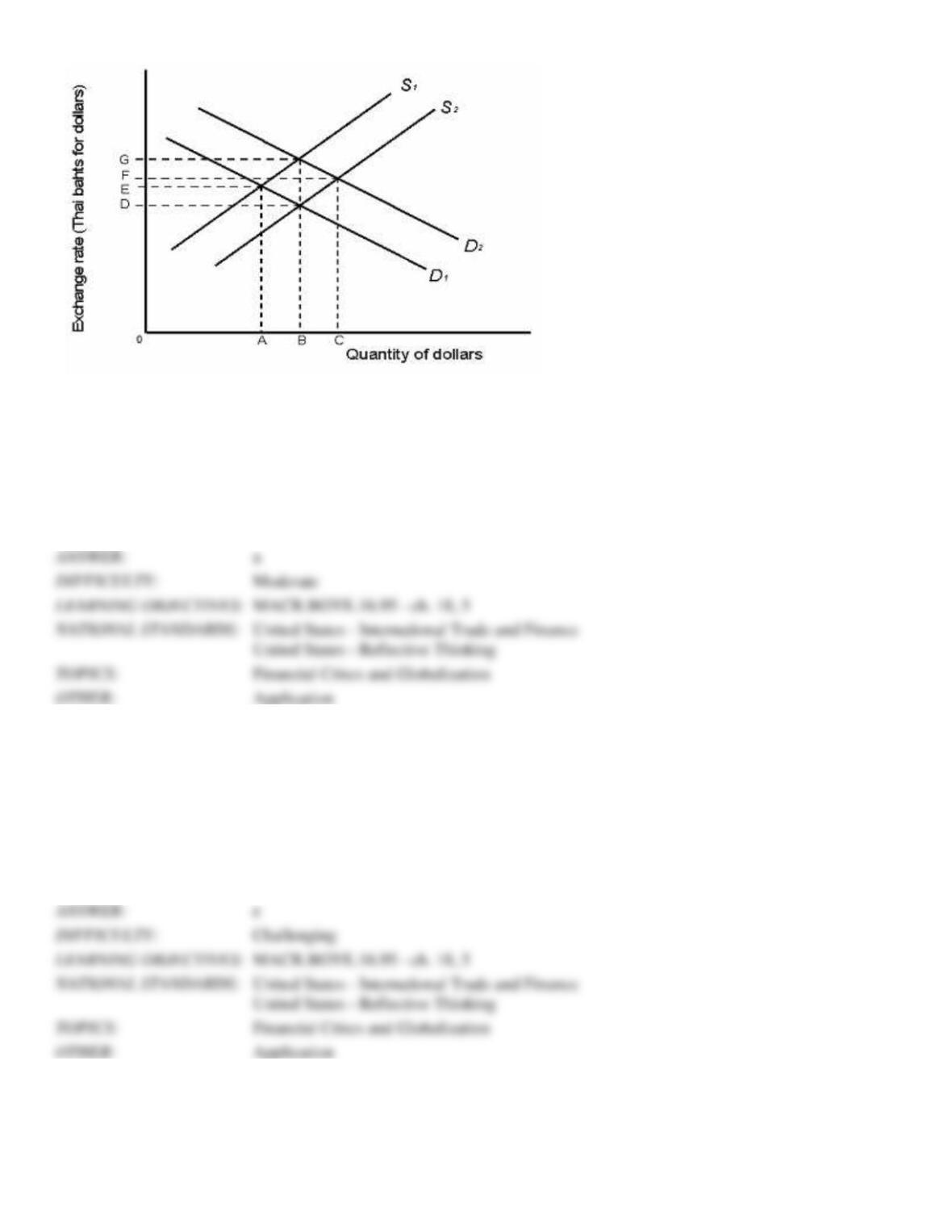
40. Refer to Figure 18.1. The original equilibrium exchange rate is _____.
a.
E
b.
G
c.
A
d.
D
e.
B
41. Refer to Figure 18.1. If there were a perception that the value of Thai assets would decrease, the equilibrium exchange
rate would move to _____.
a.
A
b.
B
c.
F
d.
E
e.
G
Challenging
MACR.BOYE.16.95 – ch. 18, 5
Financial Crises and Globalization
Application
42. Refer to Figure 18.1. What would happen to the value of the U.S. dollar if there were a perception that the value of
Thai assets would decrease?
a.
The dollar would depreciate against the baht.
Moderate
MACR.BOYE.16.95 – ch. 18, 5
Financial Crises and Globalization
Application