KEYWORDS:
BLOOM’S: Comprehension
121. If the rate of interest increases, firms will most likely respond by
a.
increasing investment.
b.
decreasing investment.
c.
not changing investment.
d.
increasing capital stock.
ANSWER:
POINTS:
DIFFICULTY:
Easy
DISC: Supply and demand
United States – BPROG: Analytic
United States – OH – Default City – Supply and demand
Supply and demand
TOPICS:
Investment, Capital, and Interest
KEYWORDS:
BLOOM’S: Comprehension
122. On January 1, 2006, a consumer borrowed $10,000 for a term of one year at an interest rate of 12 percent. How much
principal and interest will the consumer pay back on January 1, 2007?
a.
$10,000
b.
$1,200
c.
$8,929
d.
$11,200
ANSWER:
POINTS:
DIFFICULTY:
Easy
United States – BPROG: Analytic
Understanding and applying econo – Understanding and applying economic models
TOPICS:
Investment, Capital, and Interest
KEYWORDS:
BLOOM’S: Comprehension
123. On January 1, 2010, a homeowner borrowed $5,000 for a term of six months to complete some home improvements,
paying an annual interest rate of 8 percent. How much principal and interest will the homeowner pay back on July 1,
2010?
a.
$2,500
b.
$2,900
c.
$5,200
d.
$5,400
ANSWER:
c
POINTS:
DIFFICULTY:
Moderate
Models
United States – BPROG: Analytic
and applying economic models
Understanding and applying econo – Understanding and applying economic models
Investment, Capital, and Interest
124. Firms will borrow to finance capital expansion until the MRP of the investment equals the
a.
MRP of labor.
b.
marginal cost of the finished good.
c.
marginal physical product of capital.
d.
interest payment charged for borrowing.
DISC: Equilibrium
United States – BPROG: Analytic
United States – OH – Default City – Equilibrium
Investment, Capital, and Interest
125. The interest rate is determined by
a.
government pronouncements.
b.
market forces of supply and demand.
c.
banks and lenders.
d.
managers of large corporations.
DISC: Supply and demand
United States – BPROG: Analytic
United States – OH – Default City – Supply and demand
Supply and demand
Investment, Capital, and Interest
126. Which of the following is not a loan of funds?
a.
home mortgage
b.
government bond
c.
corporate stock
d.
corporate bond
DISC: The study of economics, an – DISC: The study of economics, and definitions in
United States – BPROG: Analytic
The study of economics, and defi – The study of economics, and definitions of economics
Investment, Capital, and Interest
127. The demand curve for loanable funds is downward sloping because
a.
people save more at higher interest rates.
b.
more investments are profitable at low interest rates than at high interest rates.
c.
future income is more valuable now at higher interest rates than at low interest rates.
d.
usury laws increase the quantity of funds demanded at low interest rates but do not affect the quantity of funds
demanded at high interest rates.
DISC: Supply and demand
United States – BPROG: Reflective Thinking – BPROG: Analysis
United States – OH – Default City – Supply and demand
Supply and demand
Investment, Capital, and Interest
128. If the interest rate on borrowing falls,
a.
the demand curve for loans will shift out.
b.
the discounted value now of money to be received in the future will fall.
c.
some previously unprofitable prospective investments will become profitable.
d.
All of the above are correct.
DISC: Supply and demand
United States – BPROG: Analytic
United States – OH – Default City – Supply and demand
Supply and demand
Investment, Capital, and Interest
129. The demand curve for funds is downward sloping because
a.
the value of the MRP in terms of today’s money shrinks as the interest rate rises.
b.
future returns must be discounted more when the interest rate rises.
c.
as the interest rate rises, more and more investments become unprofitable.
d.
All of the above are correct.
Moderate
DISC: Supply and demand
United States – BPROG: Analytic
United States – OH – Default City – Supply and demand
Supply and demand
Investment, Capital, and Interest
130. The demand for borrowed funds is
a.
directly related to the interest rate.
b.
inversely related to the growth in gross domestic product.
c.
a derived demand.
d.
leads to derived demand for capital goods.
c
Moderate
DISC: Supply and demand
United States – BPROG: Analytic
United States – OH – Default City – Supply and demand
Supply and demand
Investment, Capital, and Interest
131. If savers do not have fixed savings goals, the supply curve of loanable funds will generally be
a.
horizontal.
b.
downward sloping.
c.
vertical.
d.
upward sloping.
Moderate
DISC: Supply and demand
United States – BPROG: Analytic
United States – OH – Default City – Supply and demand
Supply and demand
Investment, Capital, and Interest
132. In the United States, the money for loans to businesses comes mainly from
a.
corporate profits.
b.
the federal government.
c.
savings held in lending institutions.
d.
state and local governments.
c
Easy
DISC: Supply and demand
United States – BPROG: Analytic
United States – OH – Default City – Supply and demand
Supply and demand
Investment, Capital, and Interest
133. The loan supply curve has a positive slope
a.
for all savers.
b.
only for savers with fixed accumulation targets.
c.
for all savers except those with fixed accumulation goals.
d.
only for those contemplating retirement.
DISC: Supply and demand
United States – BPROG: Reflective Thinking – BPROG: Analysis
United States – OH – Default City – Supply and demand
Supply and demand
Investment, Capital, and Interest
134. The supply curve for funds
a.
is generally positively sloped.
b.
depends upon people’s savings plans.
c.
is a function of the interest rate.
d.
All of the above are correct.
DISC: Supply and demand
United States – BPROG: Analytic
United States – OH – Default City – Supply and demand
Supply and demand
Investment, Capital, and Interest
135. Equilibrium in the market for funds occurs when the
a.
lenders and borrowers are mutually satisfied at some interest rate.
b.
marginal revenue product of investment using the funds equals the interest rate.
c.
demand curve for funds and the supply curve for funds intersect.
d.
All of the above are correct.
DISC: Equilibrium
United States – BPROG: Reflective Thinking – BPROG: Analysis
United States – OH – Default City – Equilibrium
Investment, Capital, and Interest
136. Usury laws typically regulate
a.
interest rates paid on savings.
b.
interest rates charged on loans.
c.
rents charged on land.
d.
economic rent earned in all factor markets.
DISC: The role of government
United States – BPROG: Analytic
United States – OH – Default City – The role of government
The role of government
Investment, Capital, and Interest
137. Usury laws tend to hurt whom?
a.
suppliers of loans
b.
consumers who cannot get credit
c.
bank stockholders
d.
All of the above are correct.
DISC: The role of government
United States – BPROG: Analytic
United States – OH – Default City – The role of government
The role of government
Investment, Capital, and Interest
138. Usury laws that set maximum interest rates
a.
are designed to protect the consumer.
b.
interfere with the market allocation process.
c.
have an effect only if the market rate is higher than the legal maximum.
d.
All of the above are correct.
DISC: The role of government
United States – BPROG: Analytic
United States – OH – Default City – The role of government
The role of government
Investment, Capital, and Interest
139. Usury laws carry the potential of hurting
a.
borrowers.
b.
lenders.
c.
borrowers and lenders.
d.
government.
c
Easy
DISC: The role of government
United States – BPROG: Analytic
United States – OH – Default City – The role of government
The role of government
Investment, Capital, and Interest
140. A ceiling on interest rates is likely to lead to
a.
an increase in lending activity.
b.
more rapid capital formation by business.
c.
increases in hiring of labor.
d.
a shortage of loanable funds.
Moderate
DISC: The role of government
United States – BPROG: Analytic
United States – OH – Default City – Supply and demand
The role of government
Investment, Capital, and Interest
141. Usury laws are often politically popular because
a.
few people sympathize with banks and other lenders who are suspected of price gouging.
b.
consumers are in favor of the lower lending rates.
c.
those concerned with affordable housing for the poor favor ceilings on mortgage rates.
d.
All of the above are correct.
Moderate
DISC: The role of government
United States – BPROG: Reflective Thinking – BPROG: Analysis
United States – OH – Default City – The role of government
The role of government
Investment, Capital, and Interest
142. If the equilibrium rate of interest would be 10 percent, but the usury law sets 8 percent,
a.
the quantity of funds supplied would be greater than the quantity demanded.
b.
economic efficiency would be promoted.
c.
some applicants for loans would likely be turned down.
d.
lenders would be able to fund fully all requests for loans.
1
DISC: Equilibrium
United States – BPROG: Analytic
United States – OH – Default City – Equilibrium
Investment, Capital, and Interest
143. A usury ceiling will be effective depending on
a.
whether the usury rate is above 10 percent.
b.
whether the usury rate is above 8 percent.
c.
whether that rate is below what the equilibrium rate of interest would have been in a free market.
d.
how well organized the lending institutions are.
1
DISC: Equilibrium
United States – BPROG: Analytic
United States – OH – Default City – Equilibrium
Investment, Capital, and Interest
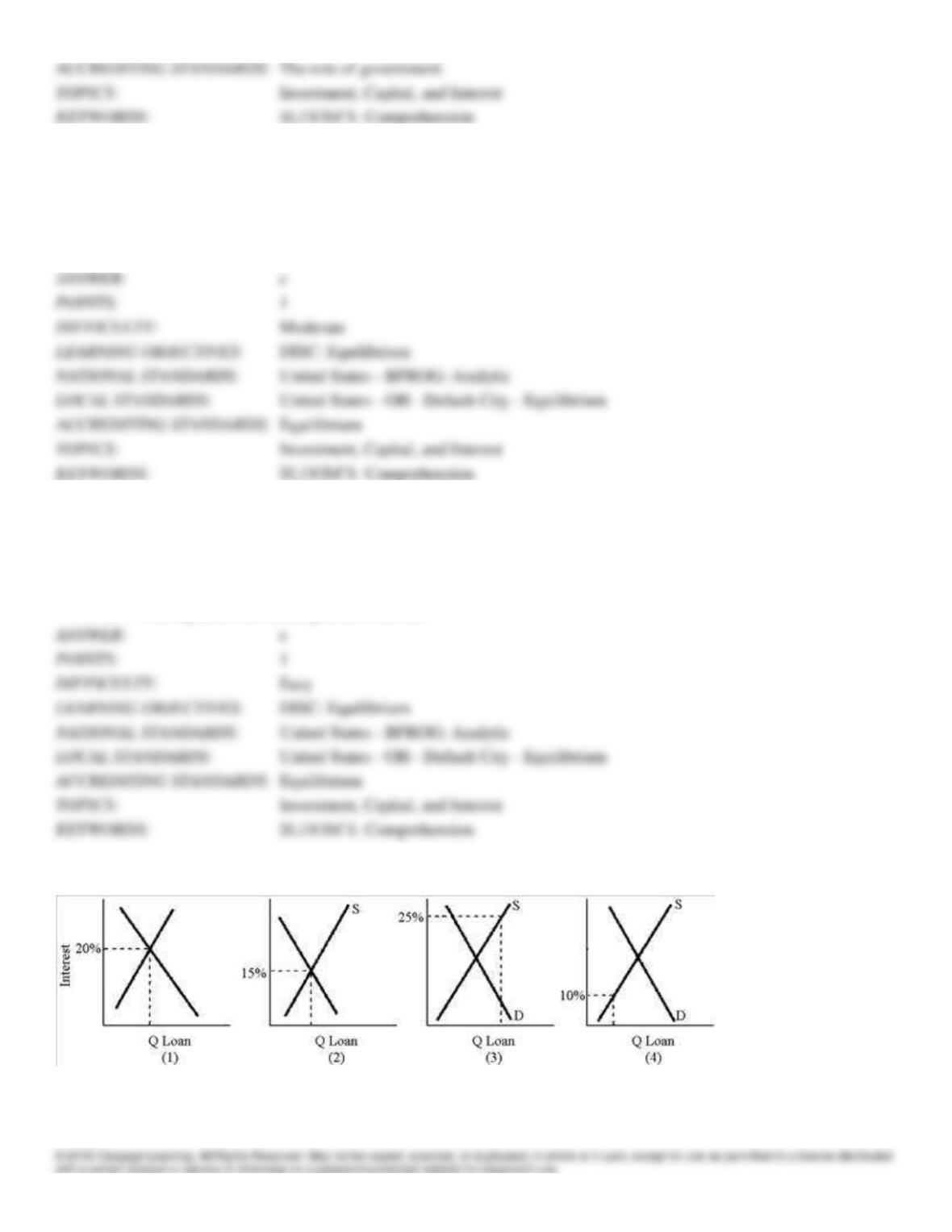
Figure 19-3
144. Which panel in Figure 19-3 represents the case of an effective usury law?
a.
1
b.
2
c.
3
d.
4
d
1
DISC: Reading and interpreting g – DISC: Reading and interpreting graphs
United States – BPRPOG: Analysis
United States – OH – Default City – The role of government
Reading and interpreting graphs
Investment, Capital, and Interest
BLOOMS: Application
145. The distinguishing feature of the land market is that the
a.
supply is highly inelastic.
b.
supply is highly elastic.
c.
demand is highly inelastic.
d.
demand is highly elastic.
1
DISC: Elasticity
United States – BPROG: Analytic
United States – OH – Default City – Elasticity
146. If the demand for land shifts upward, rents will be
a.
earned by some land that was formerly unprofitable.
b.
lost to many landowners.
c.
diminished for society as a whole.
d.
taxed away to help pay the costs of government.
1
DISC: Supply and demand
United States – BPROG: Analytic
United States – OH – Default City – Supply and demand
Supply and demand
The Determination of Rent
147. All the land in a California valley is owned by one person. The supply of land is fixed and is rented each year to
farmers who bid for it in an open auction. Given the rents they must pay, the farmers barely earn subsistence. Sympathy
for the poor farmers leads the state to bring in irrigation facilities to raise the productivity of the farms and raise the
farmers’ income. The most likely outcome is
a.
the farmers will prosper.
b.
the farmers and the landlord will share the new prosperity.
c.
only the landlord will prosper.
d.
no one will prosper.
DISC: Supply and demand
United States – BPRPOG: Analysis
United States – OH – Default City – Supply and demand
Supply and demand
The Determination of Rent
148. When determination of rent is left to the market,
a.
that rent price is almost entirely determined by the supply side.
b.
that price can settle at politically unpopular levels.
c.
land is fairly distributed among the members of society.
d.
the supply of land will be perfectly elastic.
DISC: Supply and demand
United States – BPROG: Analytic
Supply and demand
The Determination of Rent
149. Economic rents are earned whenever
a.
demand for a factor is perfectly inelastic.
b.
a factor receives a reward that exceeds its cost.
c.
a factor earns a reward that is greater than the amount needed to keep the factor in its present employment.
d.
a factor’s supply curve intersects its demand curve at a point where demand is inelastic.
DISC: Supply and demand
United States – BPROG: Reflective Thinking – BPROG: Analysis
United States – OH – Default City – Supply and demand
Supply and demand
150. The market level of rent
a.
is entirely determined by the demand side.
b.
is determined by its elastic supply.
c.
is difficult to determine because of shifts on the supply side.
d.
generally settles at levels below any rent controls favored politically.
a
Difficult
DISC: Supply and demand
United States – BPROG: Reflective Thinking – BPROG: Analysis
United States – OH – Default City – Supply and demand
Supply and demand
The Determination of Rent
151. Marginal land is land on the borderline of
a.
producing revenue.
b.
being used profitably.
c.
producing economic rent.
d.
a facility that produces output.
Moderate
United States – BPROG: Analytic
The study of economics, and defi – The study of economics, and definitions of economics
The Determination of Rent
152. If mining companies are indifferent between operating and not operating a quarry, that quarry is
a.
discounted.
b.
usurious.
c.
marginal.
d.
nonexcludable.
c
Moderate
economics
United States – BPROG: Analytic
The study of economics, and defi – The study of economics, and definitions of economics
The Determination of Rent
153. The equilibrium rent for marginal land
a.
equals zero.
b.
depends on the supply and demand of land.
c.
exceeds the opportunity cost of the land.
d.
is always greater than the equilibrium rent for nonmarginal land.
a
Moderate
United States – BPROG: Analytic
The study of economics, and defi – The study of economics, and definitions of economics
The Determination of Rent
154. Marginal land is land
a.
that is unprofitable under any circumstances.
b.
that is the most productive in the area.
c.
that is on the borderline of profitability.
d.
of average productivity.
c
Easy
United States – BPROG: Analytic
The study of economics, and defi – The study of economics, and definitions of economics
The Determination of Rent
155. The rent earned on marginal land is
a.
zero.
b.
the average of all qualities of land.
c.
above the average of all qualities of land.
d.
below the average of all qualities of land.
a
Easy
United States – BPROG: Analytic
economics, and definitions of economics
The study of economics, and defi – The study of economics, and definitions of economics
The Determination of Rent
156. Suppose that 19th-century politicians had succeeded in their attempt to impose a “single tax”-a tax on suppliers of
land (i.e., landlords). Most of the economic burden of the tax would have been borne by
a.
renters, because the demand for land is generally less elastic than its supply.
b.
renters, because the demand for land is generally more elastic than its supply.
c.
landlords, because the demand for land is generally less elastic than its supply.
d.
landlords, because the demand for land is generally more elastic than its supply.
DISC: Elasticity
United States – BPROG: Reflective Thinking – BPROG: Analysis
United States – OH – Default City – Elasticity
The Determination of Rent
157. When an economist says a change in the market for land causes a farmer to use his land more intensively, he means
that the farmer
a.
produces more output than before, so the marginal product of his land falls.
b.
produces less output than before, so the marginal product of his land rises.
c.
uses greater amounts of nonland inputs than before, so the marginal revenue product of his land rises.
d.
uses smaller amounts of nonland inputs than before, so the marginal revenue product of his land falls.
DISC: Marginal costs & benefits
United States – BPROG: Analytic
United States – OH – Default City – Marginal costs & benefits
Marginal costs & benefits
The Determination of Rent
158. A landlord will supply her land for rental only if in equilibrium
a.
she receives economic rent on the land.
b.
she is paid at least the opportunity cost of using the land herself.
c.
her land is marginal.
d.
her rate of return on her investment in the land is zero.
Moderate
DISC: Marginal costs & benefits
United States – BPROG: Analytic
United States – OH – Default City – Marginal costs & benefits
Marginal costs & benefits
The Determination of Rent
159. In 1862, the Homestead Act made land available to farmers at zero cost. Yet many farmers preferred to purchase land
along the rail line from the railroad. The farmers
a.
were duped by the railroads.
b.
knew the soil was better near the railroads.
c.
realized that crops would be less costly to grow and transport on land near the railroads.
d.
were exploited by the railroads.
c
Moderate
DISC: Marginal costs & benefits
United States – BPROG: Analytic
United States – OH – Default City – Marginal costs & benefits
Marginal costs & benefits
The Determination of Rent
160. California passed a law called “Proposition 2 1/2″ that limited property taxes to 2.5 percent of property value.
Naturally this reduced taxes on many properties, and apartment landlords had more money at the end of the year at given
rents. This windfall could be called an economic rent only if
a.
we push the definition of economic rent too far.
b.
the supply of rental units can be expanded.
c.
the supply of rental units is fixed.
d.
competitors can build housing at costs that yield the return that was earned before the tax cut.
c
Difficult
DISC: Marginal costs & benefits
United States – BPROG: Reflective Thinking – BPROG: Analysis
United States – OH – Default City – Marginal costs & benefits
Marginal costs & benefits
The Determination of Rent
161. The difference between the cost of production on a piece of land less the cost of production on marginal land is
called
a.
usury.
b.
profit.
c.
rent.
d.
interest.
c
Moderate
economics, and definitions of economics
The study of economics, and defi – The study of economics, and definitions of economics
The Determination of Rent
162. The cost of production on the “bottom forty” is $100,000 for a given size crop. On the “north forty,” due to erosion of
the soil, the cost is $150,000. If both are being farmed by tenants, we would expect the rent on the “bottom forty” to be
a.
$50,000 below the rent on the north forty.
b.
$50,000 above the rent on the north forty.
c.
different from that on the north forty by an indeterminable amount.
d.
$50,000, and the rent on the north forty is $50,000.
Moderate
DISC: Marginal costs & benefits
United States – BPROG: Analytic
United States – OH – Default City – Marginal costs & benefits
Marginal costs & benefits
The Determination of Rent
163. In sophisticated analysis of rent differences
a.
quality of land is assumed away.
b.
quality of land is recognized and considered.
c.
rates of return are assumed away.
d.
returns on land and capital are assumed to be similar.
Moderate
United States – BPROG: Analytic
The study of economics, and defi – The study of economics, and definitions of economics
The Determination of Rent
164. An increase in rent will ordinarily lead to
a.
an increase in usage of land that was formerly idle.
b.
a decrease in total land employed.
c.
less-intensive usage of land.
d.
a decrease in the income of landlords.
a
Moderate
DISC: Supply and demand
United States – BPROG: Reflective Thinking – BPROG: Analysis
United States – OH – Default City – Supply and demand
Supply and demand
The Determination of Rent
165. The theory of land rent holds that
a.
capital invested on any plot of land must yield the same return as capital invested on any other plot of land.
b.
the difference between the costs of producing on any two pieces of land must equal the difference between
their rents.
c.
marginal land earns no rent.
d.
All of the above are correct.
Moderate
United States – BPROG: Analytic
The study of economics, and defi – The study of economics, and definitions of economics
The Determination of Rent
166. Plots of land differ in
a.
quality of soil.
b.
topography.
c.
proximity to marketplaces.
d.
All of the above are correct.
Easy
United States – BPROG: Analytic
The study of economics, and defi – The study of economics, and definitions of economics
The Determination of Rent
167. The theory of land rent holds that
a.
all plots of land are identical.
b.
all land yields a positive rent return.
c.
rent on any piece of land will equal the difference between the cost of producing the output on that land and
the cost of producing it on marginal land.
d.
competition for superior plots of land will force the rent on those lands to a marginal return of zero.
United States – BPROG: Analytic
The study of economics, and defi – The study of economics, and definitions of economics
The Determination of Rent
168. An outward shift in the demand curve for land will
a.
make previously zero-rent land profitable.
b.
induce people to begin to use land more extensively.
c.
force reductions in rents.
d.
be accompanied by a shift in the supply of land.
DISC: Supply and demand
United States – BPROG: Analytic
United States – OH – Default City – Supply and demand
Supply and demand
The Determination of Rent
169. A “single tax” on land was proposed in the nineteenth century by
a.
Lloyd George.
b.
Henry George.
c.
George Washington.
d.
George Sands.
DISC: The study of economics, an – DISC: The study of economics, and definitions in
economics
United States – BPROG: Analytic
The study of economics, and defi – The study of economics, and definitions of economics
The Determination of Rent
170. The market level (magnitude) of economic rent is determined by the
a.
supply side of the market.
b.
demand side of the market.
c.
intersection of supply and demand.
d.
elasticity of demand for land.
Moderate
DISC: Supply and demand
United States – BPROG: Analytic
United States – OH – Default City – Supply and demand
Supply and demand
The Determination of Rent
171. Critics of the huge net returns on, for example, oil production will claim that the returns are
a.
interest on the capital investment.
b.
rents on a natural resource.
c.
profits on entrepreneurial activity.
d.
exorbitant and should be taxed away.
Moderate
United States – BPROG: Reflective Thinking – BPROG: Analysis
economics, and definitions of economics
The study of economics, and defi – The study of economics, and definitions of economics
The Determination of Rent
172. The only circumstance under which a factor will earn no rent is when the factor’s supply curve is
a.
vertical.
b.
upward sloping.
c.
perfectly horizontal.
d.
kinked.
c
1
United States – BPROG: Reflective Thinking – BPROG: Analysis
The study of economics, and defi – The study of economics, and definitions of economics
The Determination of Rent
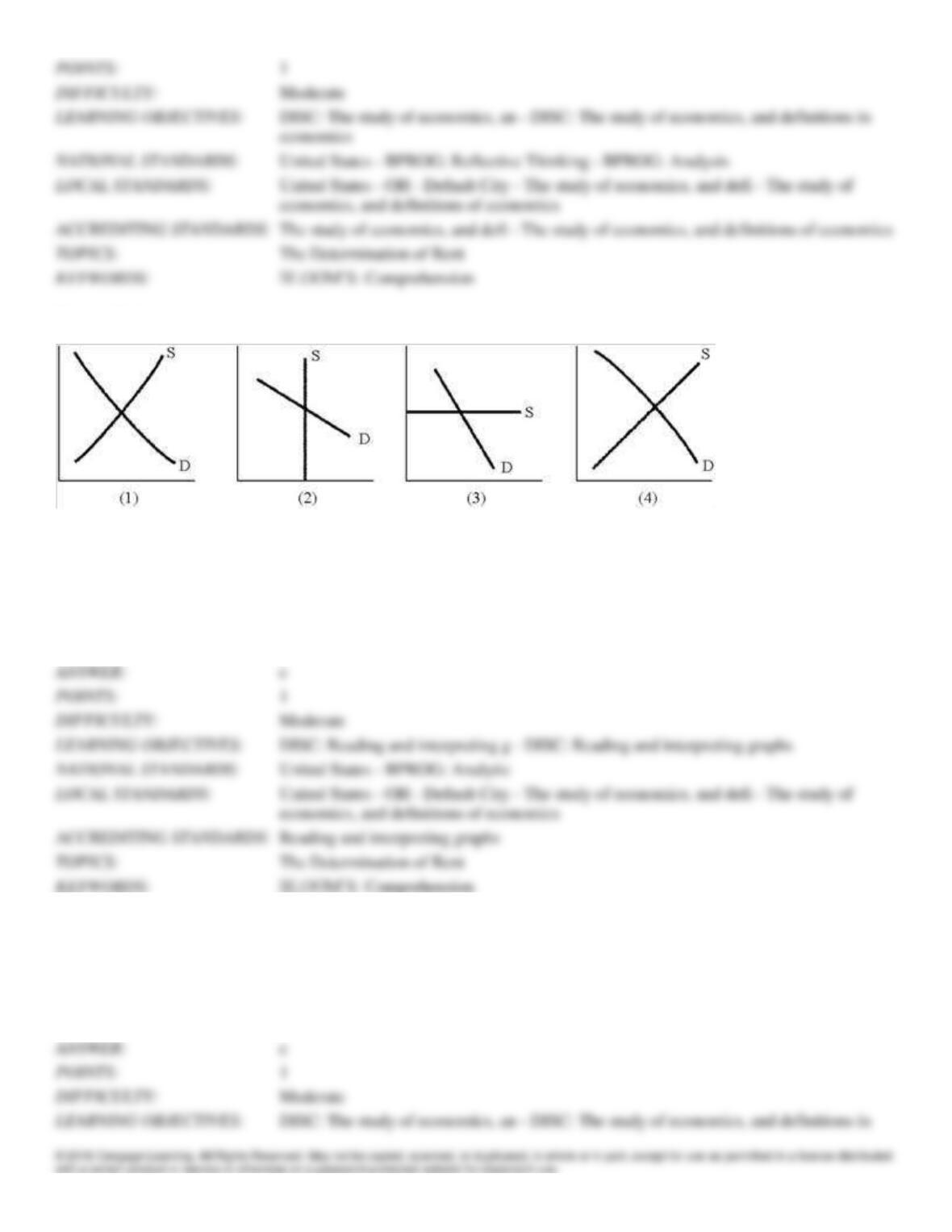
Figure 19-4
173. The panels in Figure 19-4 represent the supply and demand conditions for a factor of production. In which case is the
factor not earning any rent?
a.
1
b.
2
c.
3
d.
4
1
DISC: Reading and interpreting g – DISC: Reading and interpreting graphs
United States – BPROG: Analytic
Reading and interpreting graphs
The Determination of Rent
174. The economic rent analysis does not apply to any factor
a.
except land.
b.
whose supply curve is vertical.
c.
whose supply curve is horizontal.
d.
whose quantity supplied is fixed.
1
DISC: The study of economics, an – DISC: The study of economics, and definitions in
economics
United States – BPROG: Analytic
The study of economics, and defi – The study of economics, and definitions of economics
The Determination of Rent
175. Which of the following activities is most likely to be considered rent seeking?
a.
buying an apartment building
b.
hiring a lobbyist
c.
voting for a politician who supports government spending
d.
buying common stock
Moderate
United States – BPROG: Analytic
The study of economics, and defi – The study of economics, and definitions of economics
The Determination of Rent
176. Rent-seeking activity by firms
a.
often wastes economic resources.
b.
increases economic efficiency.
c.
continues even when an industry is in long-run competitive equilibrium.
d.
increases the total amount of economic rent available.
a
Moderate
United States – BPROG: Analytic
The study of economics, and defi – The study of economics, and definitions of economics
The Determination of Rent
177. When a few rival groups spend money in competition for a license that grants them a monopoly for the provision of
cable TV for an area, economists label this activity
a.
perfect competition.
b.
oligopoly.
c.
monopolistic competition.