35) All the following would be a possible loan that the International Monetary Fund might make
EXCEPT
A) a loan to a private firm.
B) long-term loans to a nation’s government which support growth promoting projects.
C) short-term loans to a nation’s government.
D) long-term loans to countries which are having problems in repaying existing debts.
36) Which of the following statements is TRUE about the success of the World Bank?
A) The World Bank has been very successful in promoting economic growth because loans have
been primarily made to countries that have trouble attracting private funds.
B) The World Bank has not been successful because many loans have been made to countries
that can attract private funds.
C) The World Bank has been successful because it has focused on its primary function of making
loans to governments.
D) The World Bank has not been successful because it has focused on making loans to
governments where there has been a loss of confidence in a nation’s financial system.
37) If the World Bank makes loans to nations that can attract private funds
A) the increase in growth in that nation will spill over to other nations that are developing.
B) these loans will interfere in the private market for capital goods and can lead to inefficient
investment.
C) the World Bank’s loans will crowd out the private funds made to developing nations to
encourage economic growth.
D) the presence of the World Bank’s loans will lead to even more private funds being attracted to
that country.
38) It is believed that in order to promote growth, a top priority of the World Bank and the
International Monetary Fund is to
A) promote the increase of dead capital.
B) make more loans.
C) focus on basic market foundations of guaranteeing property and contract rights.
D) join forces and merge into one unit.
39) Because of the problems of adverse selection and moral hazard, it has been suggested that
the World Bank and International Monetary Fund
A) make loans to the riskiest nations so that private investors will not be tempted to take a risk.
B) loan only to countries that have free elections.
C) not make loans to risky nations because there is a high demand for funds from safer nations.
D) impose tougher preconditions on borrowers.
40) The World Bank
A) determines the price level in each of its member nations.
B) determines the labor force participation rate in each of its member nations.
C) mediates contracts regarding minimum prices for various globally-traded commodities.
D) extends long-term loans for capital investment projects to developing nations.
41) Where does the World Bank get its funds?
A) from printing its own money
B) from tariffs collected on goods traded internationally
C) from governments of the wealthiest nations and from private financial markets
D) from seizing dead capital in developing nations and selling it at auction
42) The World Bank is
A) composed of five separate institutions.
B) composed of large private banks among developed nations.
C) the official name of the International Monetary Fund.
D) the central bank of the United Nations.
43) Special drawing rights are
A) the reserves held by members of the European Union to back their accounts with the
European Central Bank.
B) credit accounts held by individual stockholders with portfolio investments in other countries.
C) international units of account held by the International Monetary Fund for member countries.
D) the estimated level of oil reserves remaining in OPEC countries.
44) How did the original focus of the IMF differ from that of the World Bank?
A) The IMF provided short-term loans and the World Bank provided long-term loans.
B) The IMF assisted wealthy nations and the World Bank assisted developing nations.
C) The IMF gave grants to developing countries and the World Bank made loans.
D) The IMF dealt in North and South America only, and the World Bank dealt with the rest of
the world.
45) The official mission of the World Bank is to
A) fight global inflation.
B) advise member nations on the appropriate levels of taxation.
C) establish exchange rates between the currencies of member nations.
D) provide funding for needed development projects that would have difficulty attracting private
investment.
46) Those who advocate a role for the World Bank in establishing systems of well-defined
property and contract rights in developing nations would argue that
A) such changes would eliminate the need for long-term capital funding.
B) such changes would eliminate the need for short-term loans.
C) such changes would make these economies more productive.
D) asymmetric information is currently not a problem in these countries.
47) The World Bank was formed in
A) 1919.
B) 1945.
C) 1960.
D) 1980.
48) The World Bank specializes in making loans to
A) industrialized nations.
B) communist nations.
C) developing nations.
D) African nations.
49) Most of the loanable funds available to the World Bank to lend to developing nations come
from
A) the sale of oil.
B) developing nations.
C) the world’s wealthiest nations.
D) the sale of international bonds that are issued by the World Bank.
50) One of the major criticisms of the World Bank is that it lends funds
A) to impoverished nations.
B) to countries which could easily borrow funds from other sources.
C) to industrialized nations.
D) to terrorist groups not affiliated with any country.
51) The World Bank primarily engages in
A) short-term lending aimed at helping developing nations repay debt accumulated in past years.
B) short-term lending aimed at helping developing nations repay loans from the International
Monetary Fund.
C) long-term lending aimed at helping developing nations’ governments and central banks keep
exchange rates from varying.
D) long-term lending aimed at helping developing nations’ governments and businesses make
investments that will contribute to economic growth.
52) The goal of the World Bank is to
A) supervise exchange rate stability.
B) supervise the activities of the central banks of member nations.
C) sell the government securities of member nations on the open market.
D) help finance economic development.
53) The ________ specializes in making long-term loans for capital investment projects that do
NOT have private financial support.
A) International Monetary Fund
B) European Central Bank
C) World Bank
D) Federal Reserve Bank
54) A multinational agency that specializes in making loans to a larger number of developing
nations to promote long-term development and growth is
A) the International Bank.
B) the World Bank.
C) the International Monetary Fund.
D) the World Monetary Fund.
55) If the government of a developing country is having difficulty selling bonds to build an
irrigation system, it could go to the
A) World Bank.
B) Federal Reserve Bank.
C) United Nations International Bank.
D) International Monetary Organization.
56) An international organization formed with the aim of promoting world economic growth
through financial stability is called
A) the World Bank.
B) the International Development Association.
C) the International Finance Corporation.
D) the International Monetary Fund (IMF).
57) Which of the following countries has the largest quota subscription at the IMF?
A) Japan
B) Russia
C) United States
D) India
58) The International Monetary Fund was created to achieve each of the following goals
EXCEPT
A) lend funds to countries with international payment problems.
B) finance large government infrastructure projects.
C) monitor and offer advice on the exchange rate policies of member nations.
D) encourage free convertibility of the currencies of member nations.
59) When a nation’s currency suddenly loses value, the ________ may step in to buy the afflicted
currency.
A) World Bank
B) International Monetary Fund
C) World Trade Organization
D) United Nations
60) A nation’s account with the International Monetary Fund is measured in an international unit
known as
A) international reserves.
B) special drawing rights.
C) gold reserves.
D) monetary deposits.
61) A nation’s account with the International Monetary Fund is known as
A) a quota subscription.
B) special drawing rights.
C) gold standard.
D) international reserves.
62) A multinational organization that aims to promote world economic growth through more
financial stability is
A) the World Monetary Fund.
B) the International Bank.
C) the International Monetary Fund.
D) the Impossible Mission Force.
63) The international unit of accounting used by the IMF is the
A) euro.
B) gold standard.
C) special drawing right.
D) dollar.
64) Both the International Monetary Fund and the World Bank were established
A) at the end of World War I.
B) at the end of World War II.
C) at the end of Korean War.
D) in the 1970s.
65) Voting power in the IMF is determined by
A) the population size of member states.
B) the quota subscription size.
C) the length of membership.
D) the size of the member nation’s trade surplus.
66) Both the World Bank and the IMF typically
A) make loans for less than 5 years only.
B) impose stringent preconditions that the borrowers must meet.
C) charge lower than average loan rates to ensure repayment.
D) charge higher than average loan rates.
67) The “currency” of the IMF is the
A) International Currency Unit.
B) Special Drawing Right.
C) IMF Dollar.
D) U.S. dollar.
68) Each country’s IMF quota subscription is determined by
A) the relative size of its national income.
B) the size of its population.
C) the size of world trade.
D) how much a country wants to contribute.
69) After the financial crisis in the 1990s many economists criticized the IMF and the World
Bank. Some suggestions for reform are to
A) create a board of directors made up of finance ministers for the IMF.
B) eliminate both the institutions.
C) increase private-sector lending by governments providing tax breaks to lenders.
D) all of the above.
70) When a nation joins the IMF, it deposits funds into an account. These funds have a value
based on a weighted average of
A) the euro, the British pound sterling, the Japanese yen, and the U.S. dollar.
B) the euro, the British pound sterling, the Chinese yuan, and the U.S. dollar.
C) the Russian ruble, the British pound sterling, the Japanese yen, and the U.S. dollar.
D) the Russian ruble, the British pound sterling, the Chinese yuan, and the U.S. dollar.
71) Which organization functions as a lender of last resort for national governments?
A) the World Bank
B) the U.S. Treasury
C) the Federal Reserve Bank
D) the International Monetary Fund
72) Which of the following is NOT a function of the International Monetary Fund?
A) serve as lender of last resort for national governments
B) administer an international foreign exchange system
C) establish the SDR system nations utilize to settle international payment obligations
D) establish and administer each nation’s fiscal and monetary policies
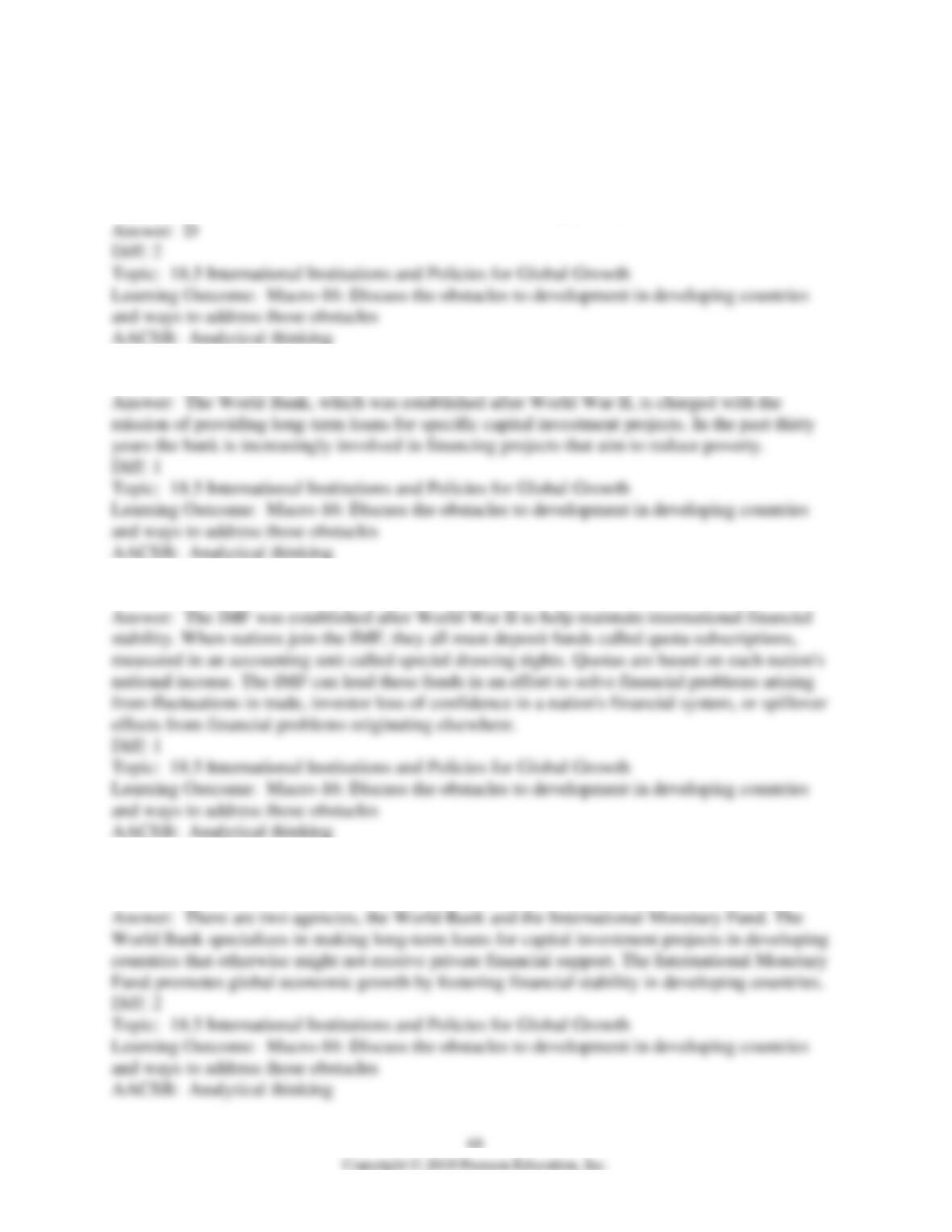
73) What is the mission of the World Bank?
74) What is the mission of the International Monetary Fund (IMF)?
75) Name the two international institutions that have been formed to attain higher rates of global
economic growth and briefly discuss what each of the agencies does.
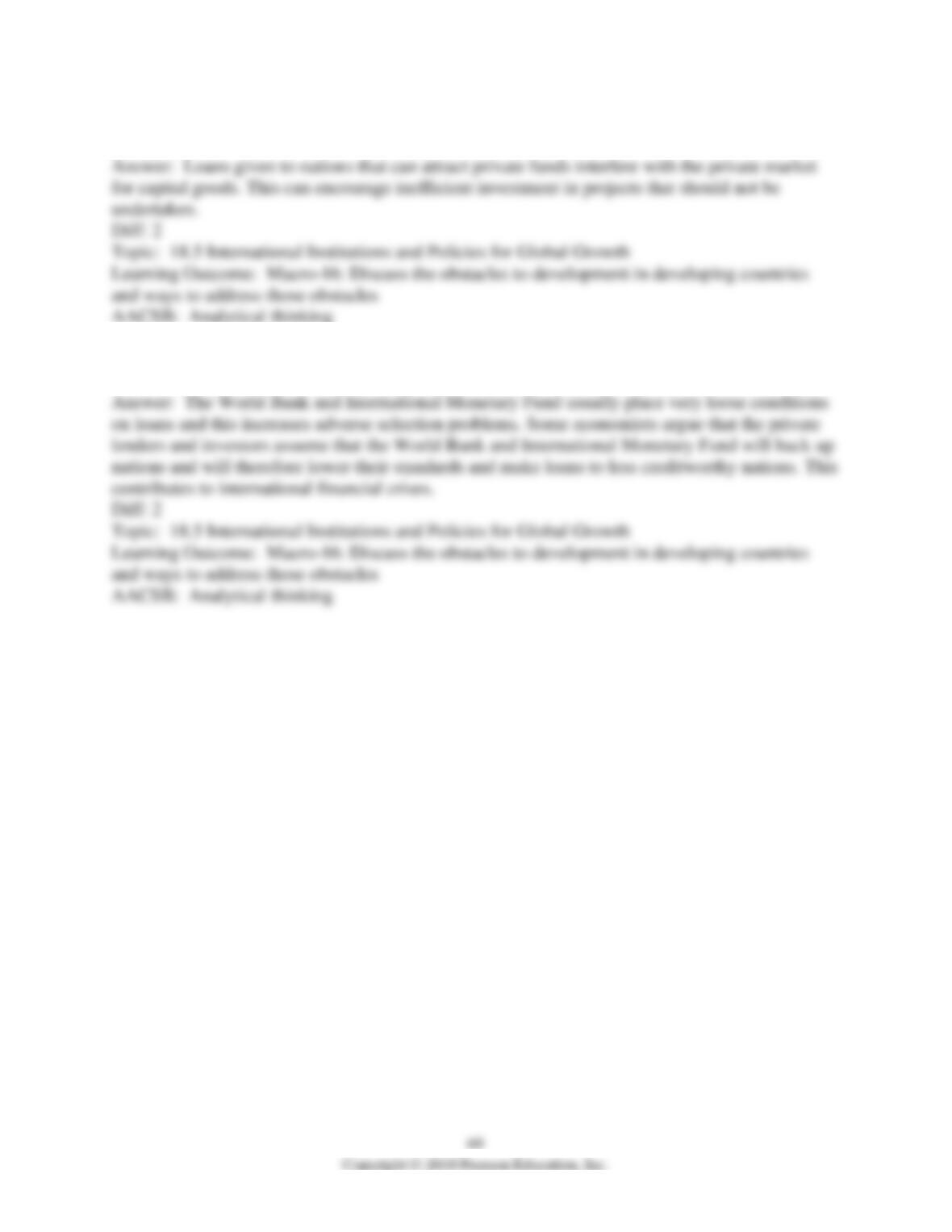
76) Discuss why the World Bank has been criticized for making loans to nations that can attract
private funds.
77) What are some of the criticisms that have been levied on the World Bank and the
International Monetary Fund concerning adverse selection and moral hazard?