44) The late Hugo Chavez, Venezuela’s former president, proposed that the independence of the
Venezuelan central bank be eliminated. Given the research on the relationship between central bank
independence and inflation, we should expect this event to cause inflation to ________ and the real
exchange rate to ________ between the two counties. (Assume the nominal exchange does not change,
and that the United States is the domestic country).
A) rise in Venezuela relative to the United States; fall
B) fall in Venezuela relative to the United States; fall
C) rise in Venezuela relative to the United States; rise
D) fall in Venezuela relative to the United States; rise
45) Assuming no change in the nominal exchange rate, how will a higher rate of inflation in the United
States relative to France affect the real exchange rate between the two countries? (Assume the United
States is the “domestic” country.)
A) The real exchange rate will rise.
B) The real exchange rate will fall.
C) The real exchange rate will be unaffected.
D) The impact on the real exchange rate cannot be predicted.
46) Assuming no change in the nominal exchange rate, how will a decrease in the price level in the
United States relative to France affect the real exchange rate between the two countries? (Assume the
United States is the “domestic” country.)
A) The real exchange rate will rise.
B) The real exchange rate will fall.
C) The real exchange rate will be unaffected.
D) The impact on the real exchange rate cannot be predicted.
47) The price of domestic goods in terms of foreign goods is referred to as
A) the nominal exchange rate.
B) the relative inflation rate.
C) the current account balance.
D) the real exchange rate.
48) How does a decrease in value of a country’s currency relative to other currencies affect its balance of
trade?
A) A decrease in value of a country’s currency relative to other currencies raises imports, reduces
exports, and reduces the balance of trade.
B) A decrease in value of a country’s currency relative to other currencies reduces imports, raises
exports, and reduces the balance of trade.
C) A decrease in value of a country’s currency relative to other currencies reduces imports, raises
exports, and increases the balance of trade.
D) A decrease in value of a country’s currency relative to other currencies raises imports, reduces
exports, and increases the balance of trade.
49) In international exchange markets, a rise in interest rates in the United States will cause the demand
for dollars to ________ and the supply of dollars to ________.
A) increase; increase
B) increase; decrease
C) decrease; increase
D) decrease; decrease
43
50) Ceteris paribus, a rise in interest rates in the United States will cause the yen price of the dollar in
international exchange markets to ________. I.e., the dollar ________ in value against the yen.
A) increase; appreciates
B) increase; depreciates
C) decrease; depreciates
D) decrease; appreciates
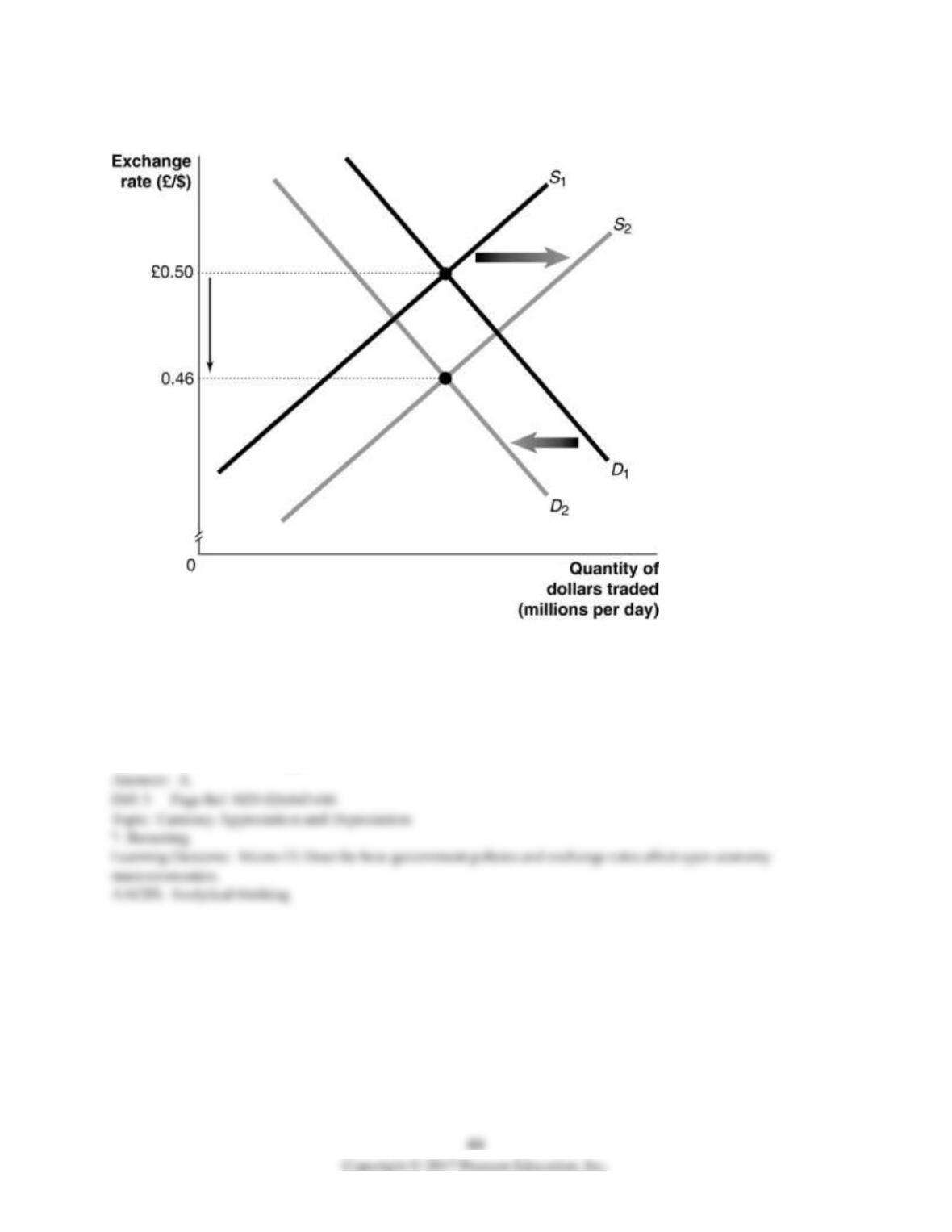
Figure 18-2
51) Refer to Figure 18-2. Which of the events below cause the shifts in the supply and demand curves in
the market for dollars against the British pound shown in the graph above?
A) Interest rates rise in England.
B) Interest rates rise in the United States.
C) Real income rises in the United States.
D) Real income falls in England.
52) Refer to Figure 18-2. Consider the market for U.S. Dollars against the British pound shown in the
graph above. From this graph we can conclude that the dollar price of a British pound has ________ to
________ dollars per pound
A) decreased; 0.46
B) increased; 2.17
C) decreased; 2.00
D) increased; 0.50
53) How does an increase in the relative price of a country’s goods in terms of foreign goods, or real
exchange rate, affect its balance of trade?
A) An increase in the real exchange rate raises imports, reduces exports, and reduces the balance of
trade.
B) An increase in the real exchange rate reduces imports, raises exports, and reduces the balance of
trade.
C) An increase in the real exchange rate reduces imports, raises exports, and increases the balance of
trade.
D) An increase in the real exchange rate raises imports, reduces exports, and increases the balance of
trade.
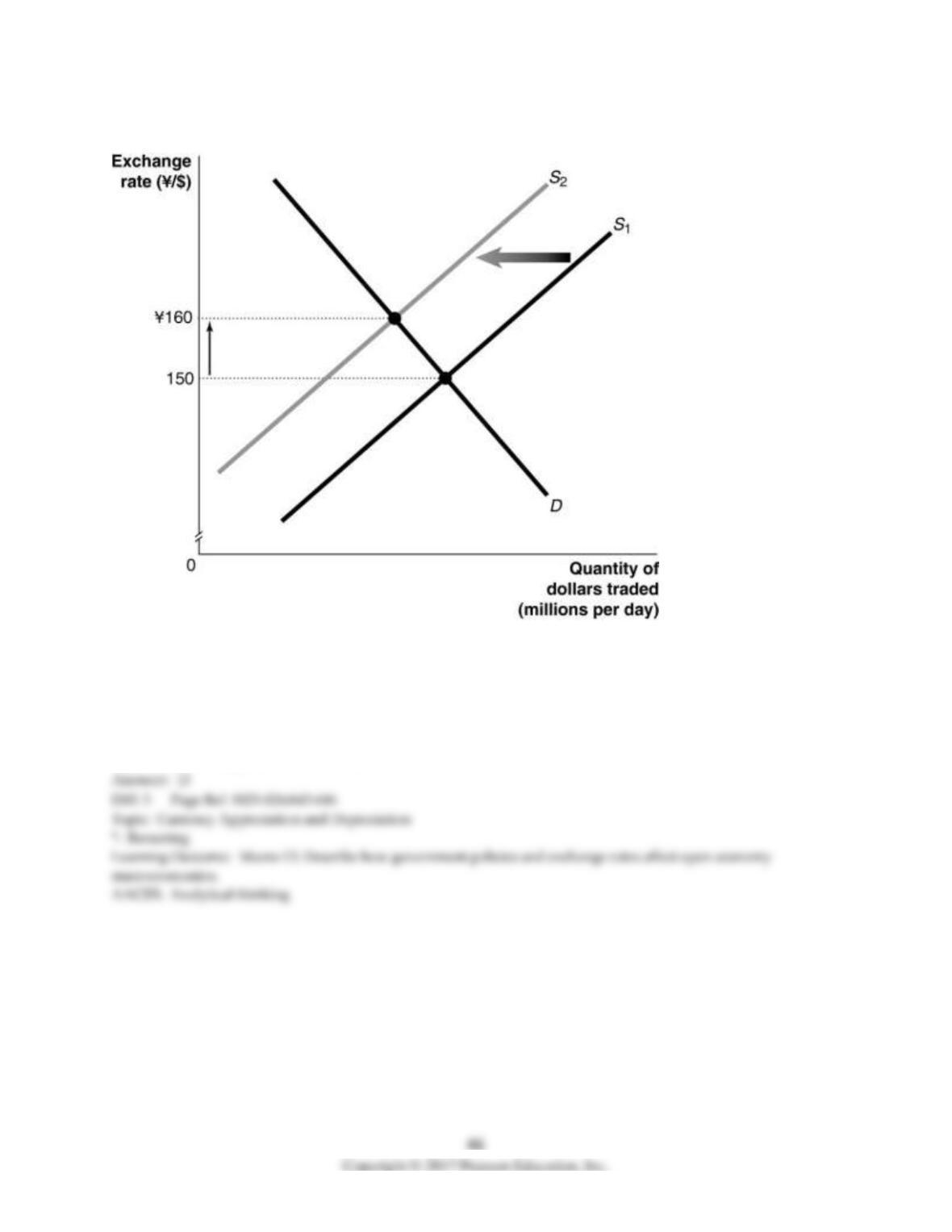
Figure 18-3
54) Refer to Figure 18-3. Consider the market for U.S. dollars against the Japanese yen shown above. An
event which could have caused the changes shown in the graph would be
A) an increase in U.S. real income.
B) speculators expect the dollar to depreciate in value in the near future.
C) an economic expansion in the United States.
D) a decrease in Japanese interest rates.
55) If the nominal exchange rate between the American dollar and the New Zealand dollar is 1.36 New
Zealand dollars per American dollar, how many American dollars are required to buy a product that
costs 3.50 New Zealand dollars?
A) $2.14
B) $2.24
C) $2.57
D) $4.76
56) You’re traveling in Japan and are thinking about buying a new kimono. You‘ve decided you’d be
willing to pay $175 for a new kimono, but kimonos in Japan are all priced in yen. If the exchange rate is
89 yen per dollar, what is the highest price in yen you’d be willing to pay for a kimono? (Assume no
taxes or duties are associated with the purchase.)
A) 1.97 yen
B) 330.75 yen
C) 15,575 yen
D) 19,425 yen
57) You’re traveling in Japan and are thinking about buying a new kimono. You’ve decided you’d be
willing to pay $175 for a new kimono, but kimonos in Japan are all priced in yen. If the kimono you’re
looking at costs 14,000 yen, under which of the following exchange rates would you be willing to
purchase the kimono? (Assume no taxes or duties are associated with the purchase.)
A) 24.5 yen per dollar
B) 65 yen per dollar
C) 80 yen per dollar
D) You would purchase the new kimono at any of the above exchange rates.
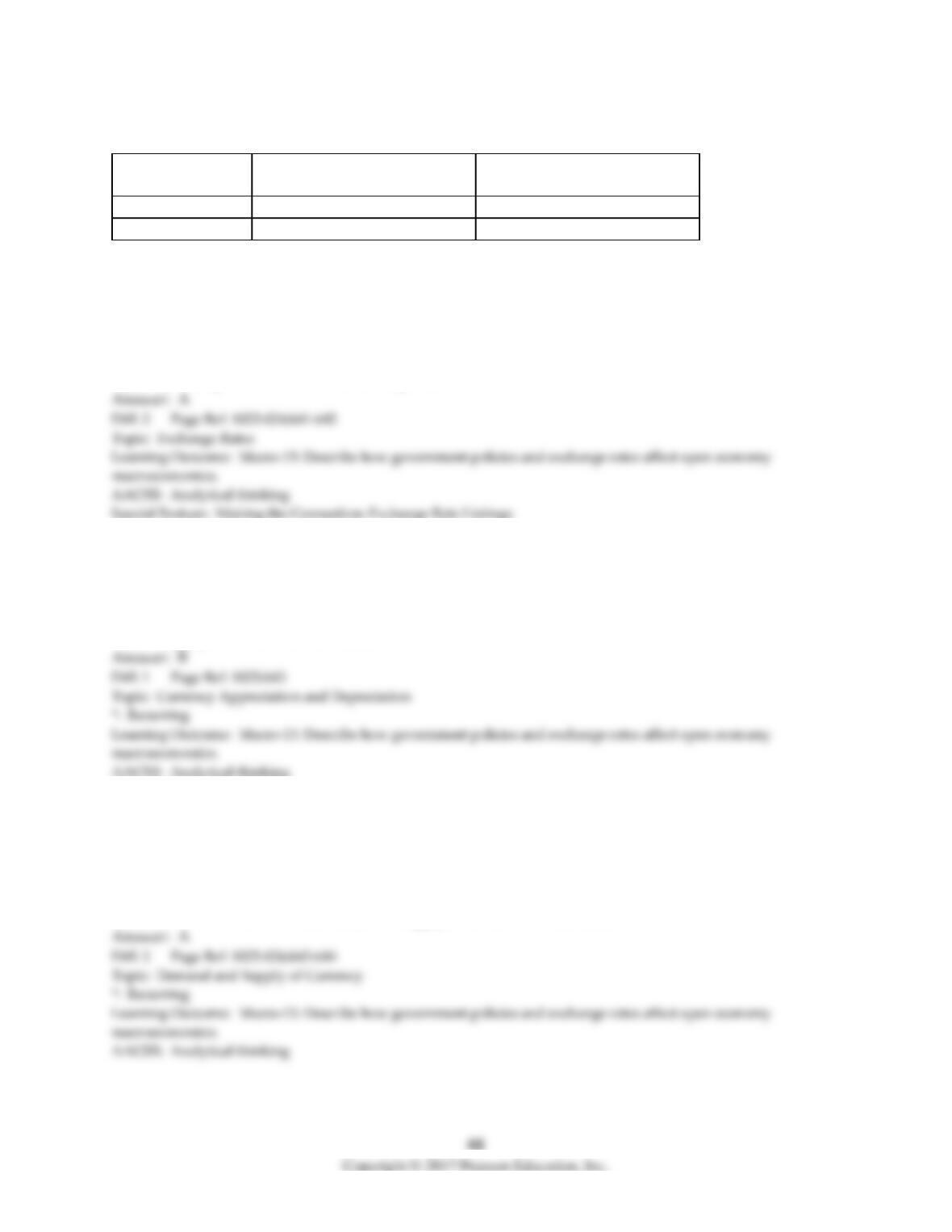
Table 18-3
Country
Units of Foreign Currency
per U.S. Dollar
U.S. Dollars per Unit of
Foreign Currency
Danish krone
5.00
EU euro
0.70
58) Refer to Table 18-3. Given the following exchange rates in the above table, what are the exchange
rates stated as U.S. dollars per Danish krone and U.S. dollars per EU euro respectively?
A) 0.20 dollars per krone and 1.43 dollars per euro
B) 2.00 dollars per krone and 7.14 dollars per euro
C) 0.02 dollars per krone and 0.70 dollars per euro
D) 0.05 dollars per krone and 1.30 dollars per euro
59) When the market value of the dollar falls relative to other currencies around the world, we say that
A) the dollar has appreciated.
B) the dollar has depreciated.
C) the demand for dollars has decreased.
D) the supply of dollars has decreased.
60) Currency traders expect the value of the dollar to rise. What effect will this have on the demand for
dollars and the supply of dollars in the foreign exchange market?
A) Demand for dollars will increase, and supply of dollars will decrease.
B) Demand for dollars will increase, and supply of dollars will increase.
C) Demand for dollars will decrease, and supply of dollars will increase.
D) Demand for dollars will decrease, and supply of dollars will decrease.
61) If there is currently a shortage of dollars, which of the following would you expect to see in the
foreign exchange market?
A) The dollar will appreciate.
B) The dollar will depreciate.
C) There will be an increase in the demand for dollars.
D) There will be an increase in the supply of dollars.
62) Currency traders expect the dollar to depreciate. What impact will this have on equilibrium in the
foreign exchange market?
A) The dollar will appreciate, and the equilibrium quantity of dollars will decrease.
B) The dollar will depreciate, and the equilibrium quantity of dollars exchanged will decrease.
C) The dollar will appreciate, and the equilibrium quantity of dollars will increase.
D) The dollar will depreciate, and the change in the equilibrium quantity of dollars exchanged cannot
be determined.
63) Which of the following would cause the dollar to depreciate?
A) an increase in the demand for dollars
B) a decrease in the demand for dollars
C) a decrease in the supply of dollars
D) a decrease in the demand for imports from foreign countries
64) If the demand for the yen increases relative to the dollar, which of the following would occur?
A) The dollar will appreciate.
B) The yen will depreciate.
C) The dollar will depreciate.
D) The demand for the dollar will increase.
Article Summary
In an effort to decrease an outflow of capital which has threatened to extend the country’s economic
slowdown, China’s central bank sold $94 billion U.S. dollars in an attempt to support its currency,
the yuan. The move followed the largest devaluation of the yuan in more than 20 years. According to
analyst Li Miaoxian, “If the central bank continues its intervention, China’s foreign-exchange
reserves will continue to shrink — the heavier the intervention, the deeper the fall. It’s “inevitable”
the nation will see continuous capital outflows and yuan depreciation pressure in the coming
months. Over the past decade, the Chinese central bank had purchased dollars in an effort to stem
the appreciation of the yuan during a period of a growing trade surplus. Now facing an increasing
sell-off of the yuan, Bloomberg economists note that “The fear is that today’s data will reinforce the
market view that the only way for the yuan to go is down, and further accelerate capital outflows.”
Source: “China’s Currency Stash Drops By $94 Billion After Devaluation,” bloomberg.com,
September 7, 2015.
65) Refer to the Article Summary. All else equal, a depreciation of the Chinese yuan relative to a
currency such as the U.S. dollar should ________ Chinese exports and ________ imports to China.
A) increase; increase
B) increase; decrease
C) decrease; increase
D) decrease; decrease
66) Refer to the Article Summary. All else equal, a depreciation of the Chinese yuan relative to a
currency such as the U.S. dollar should ________ the current account balance in China and therefore
________ the financial account balance in China.
A) increase; increase
B) increase; decrease
C) decrease; increase
D) decrease; decrease
67) A decrease in the demand for American-made goods will
A) increase the supply of dollars in the foreign exchange market.
B) decrease the supply of dollars in the foreign exchange market.
C) increase the demand for dollars in the foreign exchange market.
D) decrease the demand for dollars in the foreign exchange market.
68) How will an interest rate increase in the United States affect equilibrium in the market for dollars
against foreign currencies? (Assume the exchange rate is stated in terms of foreign currency per U.S.
dollar.)
A) The equilibrium exchange rate will increase, and the equilibrium quantity of dollars traded cannot be
determined.
B) The equilibrium exchange rate will decrease, and the equilibrium quantity of dollars traded cannot
be determined.
C) The equilibrium exchange rate cannot be determined, and the equilibrium quantity of dollars traded
will increase.
D) The equilibrium exchange rate will increase, and the equilibrium quantity of dollars traded will
increase.
69) Which of the following will shift the demand for the euro to the right?
A) an increase in interest rates in the European Union
B) an increase in incomes in countries that buy goods from the European Union
C) expectations among speculators that the price of the euro will rise in the future
D) All of the above will shift the demand for the euro to the right.
70) When Americans decrease their demand for Japanese goods,
A) the demand for dollars will rise, and the demand for yen will rise.
B) the demand for dollars will fall, and the demand for yen will rise.
C) the supply of dollars will rise, and the demand for yen will rise.
D) the supply of dollars will fall, and the demand for yen will fall.
71) If a country has a ________ exchange rate, its central bank must buy and sell its holdings of
currencies to maintain a given exchange rate.
A) floating
B) flexible
C) fixed
D) all of the above
72) When exchange rates are ________, we say that the country’s exchange rate is fixed.
A) determined in the market
B) set by a country’s central bank
C) determined by supply and demand
D) relatively stable
73) If the exchange rate changes from $2.00 = 1 euro to $1.98 = 1 euro then
A) the dollar has depreciated.
B) the dollar has appreciated.
C) the euro has appreciated.
D) the euro has stayed constant in value.
74) If the exchange rate changes from $0.08 = 1 mexican peso to $0.09 = 1 mexican peso, then
A) both the peso and dollar have appreciated.
B) both the peso and dollar have depreciated.
C) the peso has appreciated and the dollar has depreciated.
D) the peso has depreciated and the dollar has appreciated.
75) If the dollar depreciates against the Indian rupee,
A) Indian imports to the U.S. become less expensive.
B) U.S. exports to India become less expensive.
C) U.S. exports to India become more expensive.
D) The value of Indian imports to the United States does not change.
76) If the price level in the United States is 110, the price level is 135 in Mexico, and the nominal
exchange rate is 12.5 pesos per dollar, what is the real exchange rate from the U.S. perspective?
A) 8.8
B) 10.2
C) 10.8
D) 11.4
77) Assume the United States is the “domestic” country and Switzerland is the “foreign” country. Which
of the following might decrease the real exchange rate between the United States and Switzerland?
A) a depreciation of the franc
B) an appreciation of the dollar
C) a decrease in the price level in the United States
D) a decrease in the price level in Switzerland
78) Assuming the United States is the “domestic” country, if the real exchange rate between the United
States and Russia decreases from 28 to 23,
A) the prices of U.S. goods and services have decreased by 5% relative to Russia.
B) the prices of U.S. goods and services have increased by 25.5% relative to Russia.
C) the prices of U.S. goods and services have decreased by 18% relative to Russia.
D) the prices of U.S. goods and services have increased by 22% relative to Russia.
79) Assuming no change in the nominal exchange rate, how will a lower rate of inflation in the United
States relative to Canada affect the real exchange rate between the two countries? (Assume the United
States is the “domestic” country.)
A) The real exchange rate will rise.
B) The real exchange rate will fall.
C) The real exchange rate will be unaffected.
D) The impact on the real exchange rate cannot be predicted.
80) The price of ________ in terms of ________ is referred to as the real exchange rate.
A) foreign goods; foreign services
B) domestic goods; the domestic currency
C) domestic goods; domestic services
D) domestic goods; foreign goods
81) An increase in capital inflows will
A) increase net foreign investment.
B) increase capital outflows.
C) decrease capital outflows.
D) increase the value of the domestic currency.
82) If the dollar appreciates, how will aggregate demand in the United States be affected?
A) Aggregate demand will increase as exports increase and imports decrease.
B) Aggregate demand will increase as imports increase and exports decrease.
C) Aggregate demand will decrease as imports increase and exports decrease.
D) Aggregate demand will decrease as exports increase and imports decrease.
83) Holding all else constant, a rise in interest rates in the United States will cause the dollar to
appreciate in international exchange markets.
84) Holding all else constant, an economic expansion in Mexico should decrease the demand for U.S.
dollars.
85) If currency speculators decide that the value of the dollar should rise in the future relative to the
yen, this will increase the demand for dollars and decrease the supply of dollars.
86) The relative price of a country’s goods and services in terms of foreign goods and services is the real
exchange rate.
87) A real appreciation of the dollar is caused by either a nominal appreciation of the dollar, a rise in the
foreign price level, or a fall in the U.S. price level.
88) A rise in the dollar price of the Chinese yuan signals an appreciation of the yuan and a depreciation
of the dollar.
89) Ceteris paribus, a real depreciation of the dollar will decrease net exports in the United States.
90) What’s the difference between the nominal exchange rate and the real exchange rate?
91) What are the three main sets of factors that cause the supply and demand curves in the foreign
exchange market to shift?
92) If the exchange rate between the Mexican peso and the U.S. dollar expressed in terms of pesos per
dollar is 13.5 pesos = 1 dollar, what is the exchange rate when expresses in terms of dollars per peso?
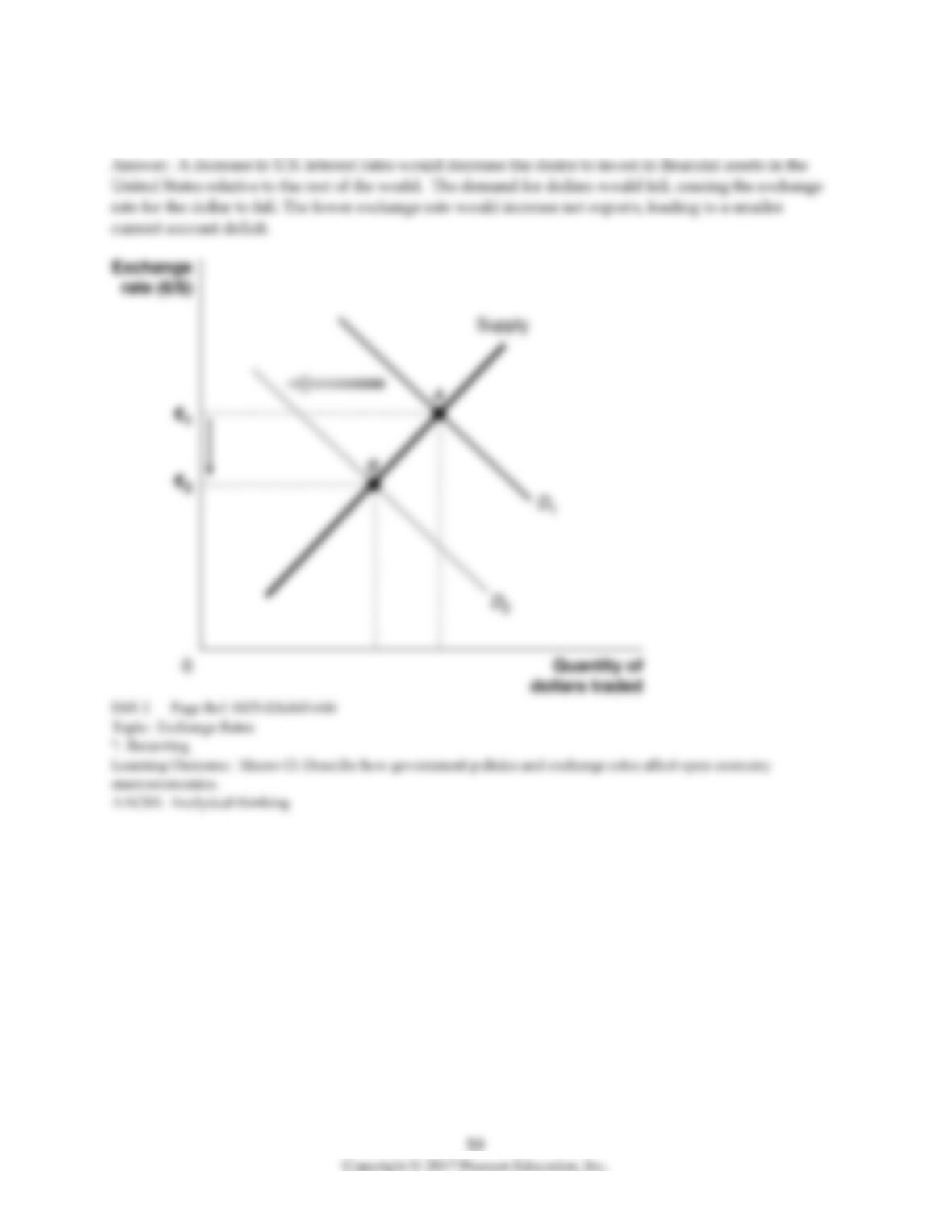
93) Explain and show graphically the effect of a decrease in U.S. budget deficits that decrease U.S.
interest rates on the demand and supply of U.S. dollars for euros.
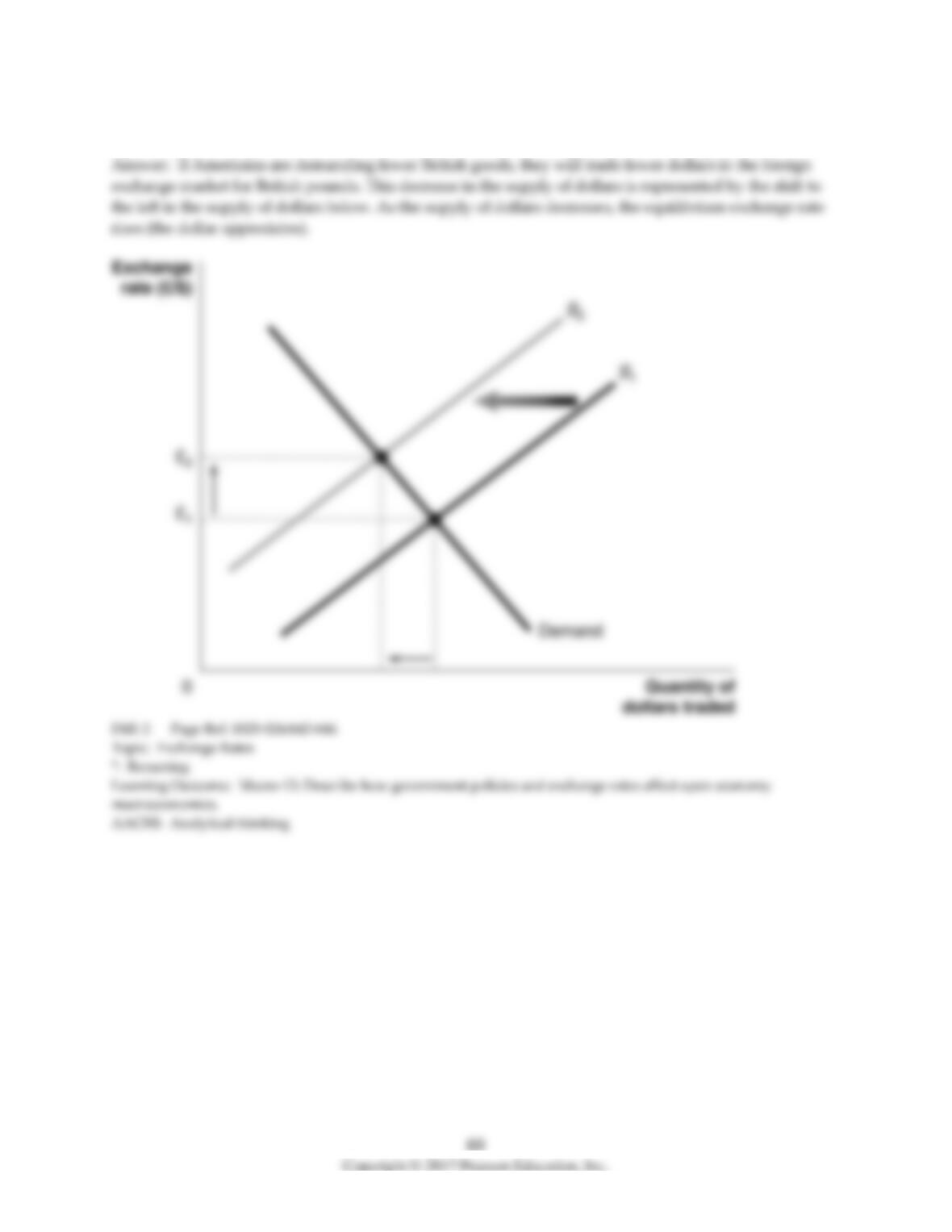
94) If American demand for purchases of British goods has decreased, how would you expect the
equilibrium exchange rate in the market for dollars to respond? Support your answer graphically.