60) If the current account is in surplus and the capital account is zero, then
A) the financial account must be in deficit.
B) the balance of trade must be in deficit.
C) the balance of payments must be in deficit.
D) there is a capital inflow.
E) the balance of services must be in deficit.
61) If the balance on the current account in the United States is $750 billion, which of the following is
most likely to be true?
A) The balance on the financial account is negative.
B) The trade balance is negative.
C) Net foreign investment is negative.
D) The balance on the capital account is positive.
62) The United States has a closed economy.
63) The current account balance equals the value of net exports.
64) A country which incurs a current account deficit will most likely have a financial or capital account
surplus.
65) In recent decades the United States has incurred overall balance of payments deficits.
66) The purchase of foreign stocks and bonds by a U.S. brokerage firm is an example of capital inflows
to the United States.
67) Net exports equals the balance of trade surplus.
68) Net foreign investment is a measure of net capital outflows, equal to capital outflows minus capital
inflows in a given period of accounting.
69) What is the relationship between the balance of trade and the current account balance?
70) Explain how “net capital flows” are related to “net foreign investment,” “net foreign direct
investment,” and “net foreign portfolio investment.”
71) Why is the balance of payments always zero?
72) Explain why economies with financial account surpluses usually have current account deficits.
73) What is the difference between net exports and the current account balance?
74) Why is the U.S. trade deficit almost always larger than the U.S. current account deficit?
75) What is the relationship among the current account, the financial account, and the balance of
payments?
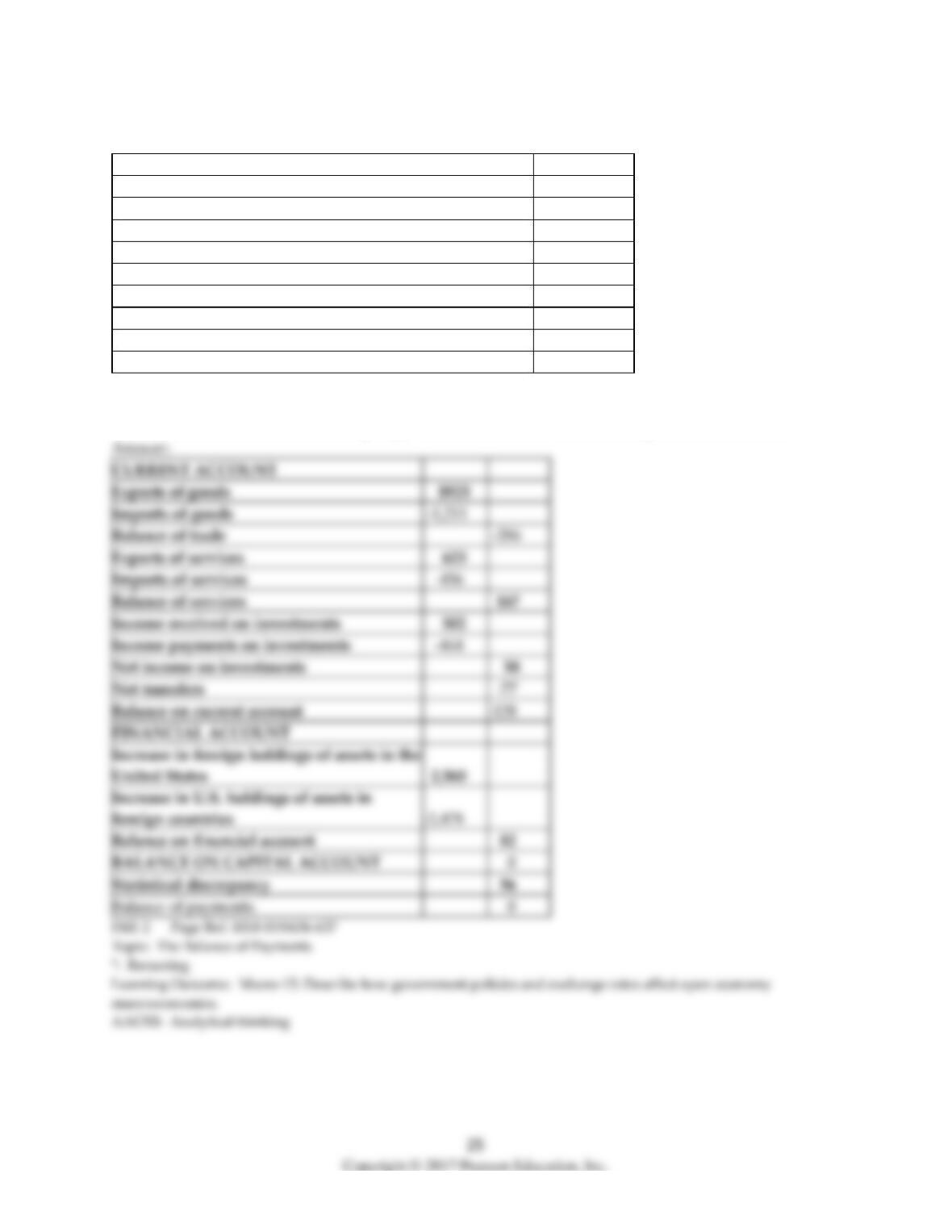
Table 18-1
Increase in foreign holdings of assets in the United States
$2,560
Exports of goods
925
Imports of services
-456
Statistical discrepancy
?
Net transfers
–77
Exports of services
623
Imports of goods
-1,211
Income payments on investments
-444
Increase in U.S. holdings of assets in foreign countries
-2,478
Income received on investments
502
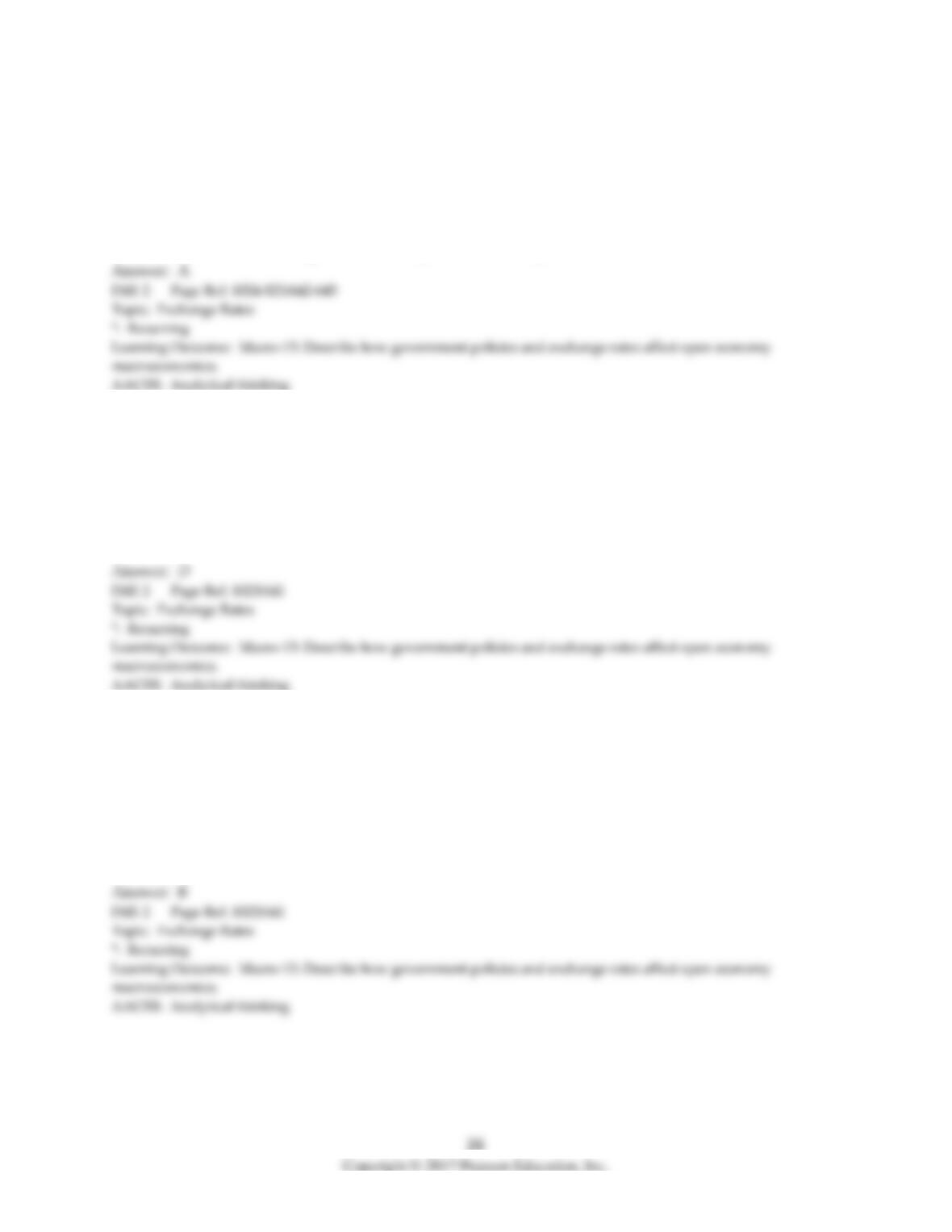
76) Refer to Table 18-1. Use the information in the table to prepare a balance of payments account and
find the value of the statistical discrepancy. Assume that the balance on the capital account is zero.
-2,478
0
Balance of payments
0
18.2 The Foreign Exchange Market and Exchange Rates
1) How does an increase in a country’s exchange rate affect its balance of trade?
A) An increase in the exchange rate raises imports, reduces exports, and reduces the balance of trade.
B) An increase in the exchange rate reduces imports, raises exports, and reduces the balance of trade.
C) An increase in the exchange rate reduces imports, raises exports, and increases the balance of trade.
D) An increase in the exchange rate raises imports, reduces exports, and increases the balance of trade.
2) If the nominal exchange rate between the American dollar and the Canadian dollar is 0.89 Canadian
dollars per American dollar, how many American dollars are required to buy a product that costs 2.5
Canadian dollars?
A) $1.32
B) $2.23
C) $2.75
D) $2.81
3) You’re traveling in Ireland and are thinking about buying a new digital camera. You’ve decided
you’d be willing to pay $125 for a new camera, but cameras in Ireland are all priced in euros. If the
exchange rate is 0.85 euros per dollar, what’s the highest price in euros you’d be willing to pay for a
camera?
A) 105 euros
B) 106.25 euros
C) 110.15 euros
D) 147 euros
4) You’re traveling in Ireland and are thinking about buying a new digital camera. You’ve decided
you’d be willing to pay $125 for a new camera, but cameras in Ireland are all priced in euros. If the
camera you’re looking at costs 115 euros, under which of the following exchange rates would you be
willing to purchase the camera? (Assume no taxes or duties are associated with the purchase.)
A) 0.56 euros per dollar
B) 0.89 euros per dollar
C) 0.92 euros per dollar
D) You would purchase the new camera at any of the above exchange rates.
5) If the dollar appreciates against the Mexican peso,
A) Mexican imports to the U.S. become more expensive.
B) U.S. exports to Mexico become less expensive.
C) U.S. exports to Mexico become more expensive.
D) The value of Mexican imports to the United States does not change.
Table 18-2
Country
Units of Foreign Currency
per U.S. Dollar
U.S. Dollars per Unit of
Foreign Currency
Mexican peso
10.00
British pound
0.50
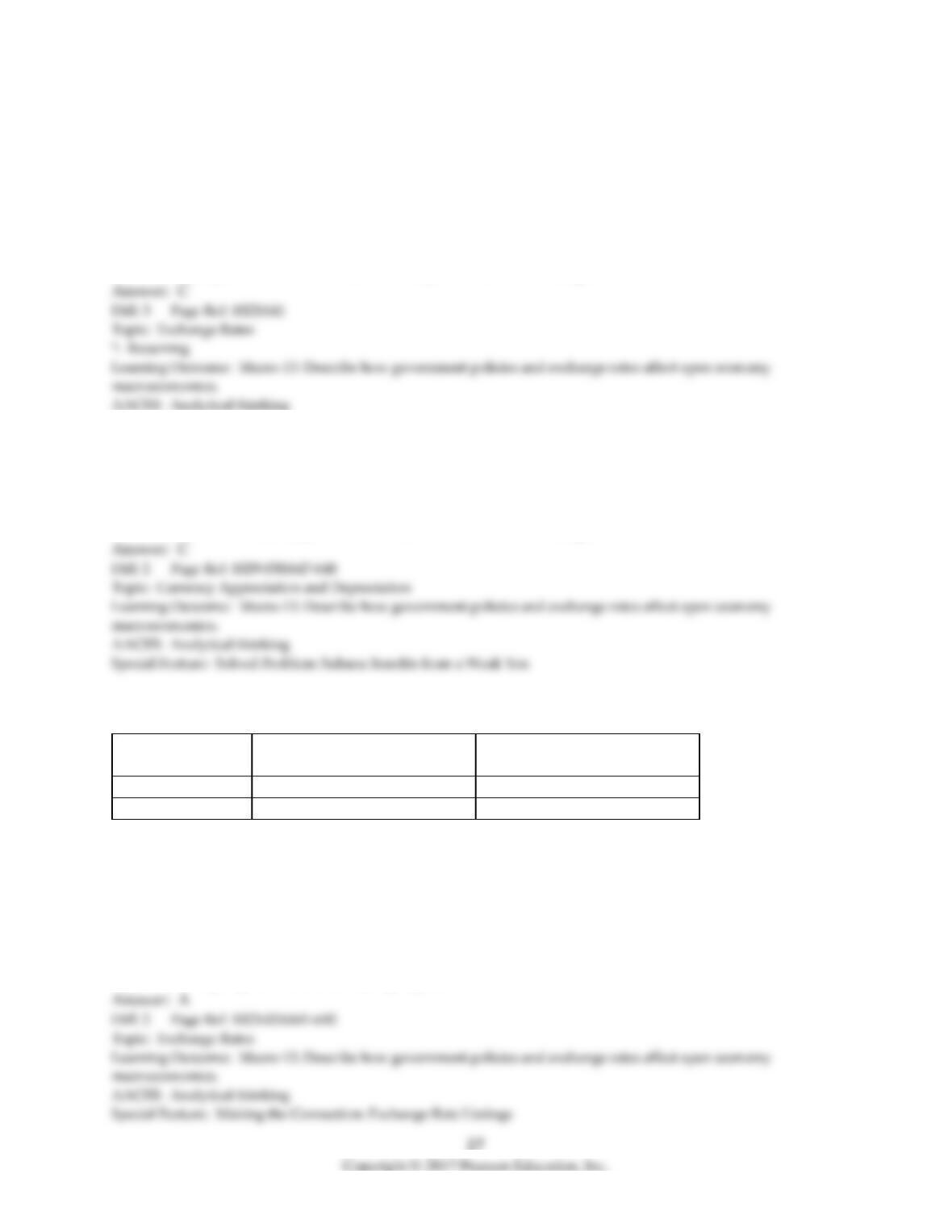
6) Refer to Table 18-2. Given the following exchange rates in the above table, what are the exchange
rates stated as U.S. dollars per Mexican peso and U.S. dollars per British pound respectively?
A) 0.10 dollars per peso and 2.00 dollars per pound
B) 1.00 dollars per peso and 20.00 dollars per pound
C) 0.01 dollars per peso and 0.20 dollars per pound
D) 0.10 dollars per peso and 5.00 dollars per pound
E) 0.01 dollars per peso and 0.50 dollars per pound
28
7) When the market value of the dollar rises relative to other currencies around the world, we say that
A) the dollar has appreciated.
B) the dollar has depreciated.
C) the demand for dollars has increased.
D) the supply of dollars has increased.
8) Currency traders expect the value of the dollar to fall. What effect will this have on the demand for
dollars and the supply of dollars in the foreign exchange market?
A) Demand for dollars will increase, and supply of dollars will decrease.
B) Demand for dollars will increase, and supply of dollars will increase.
C) Demand for dollars will decrease, and supply of dollars will increase.
D) Demand for dollars will decrease, and supply of dollars will decrease.
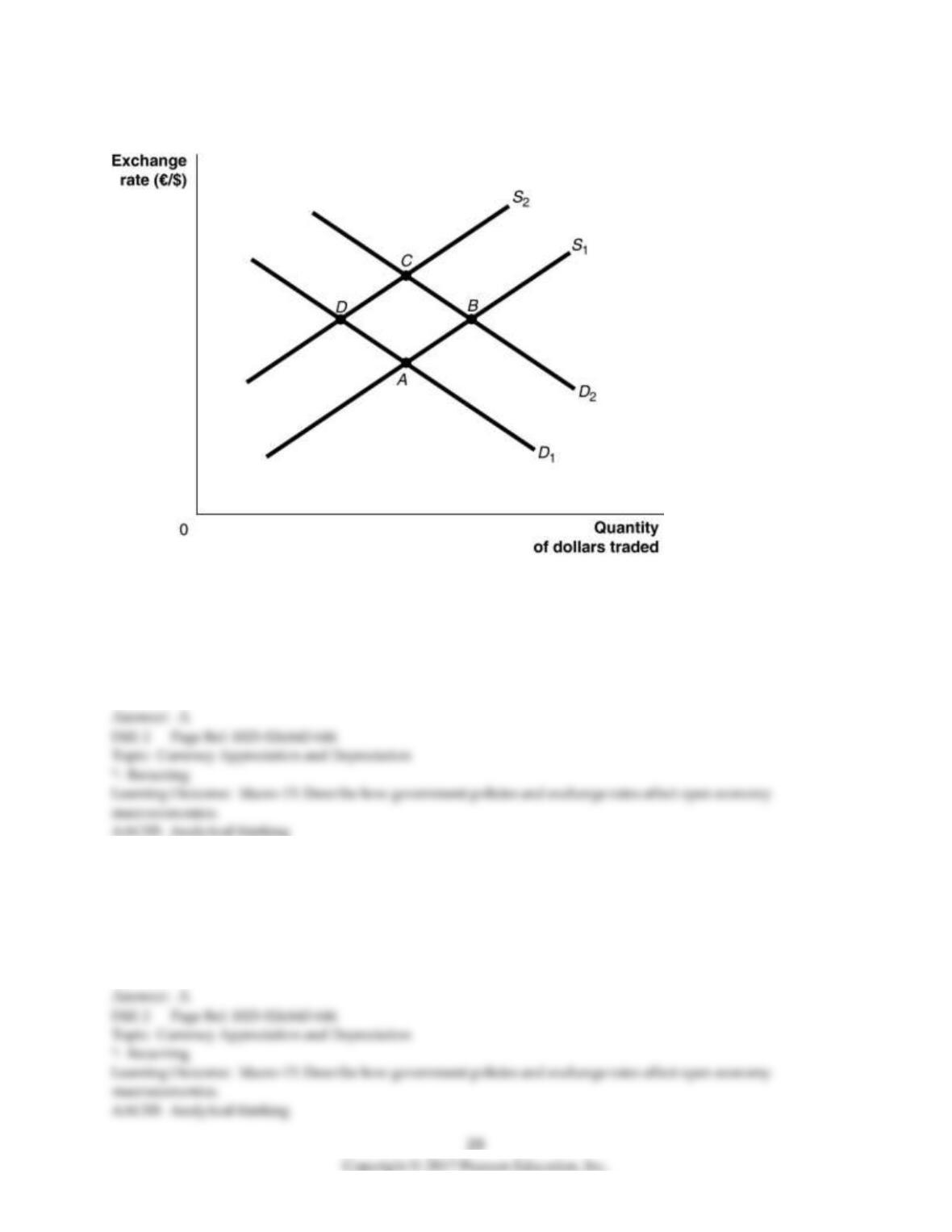
Figure 18-1
9) Refer to Figure 18-1. The depreciation of the dollar is represented as a movement from
A) B to A.
B) D to C.
C) B to C.
D) A to C.
E) A to B.
10) Refer to Figure 18-1. The appreciation of the euro is represented as a movement from
A) D to A.
B) D to C.
C) B to C.
D) A to C.
E) A to B.
11) Refer to Figure 18-1. The French fall in love with California wines and triple their purchases of this
beverage. Assuming all else remains constant, this would be represented as a movement from
A) B to A.
B) C to D.
C) B to C.
D) A to D.
E) A to B.
12) Refer to Figure 18-1. Europe suffers a recession. Assuming all else remains constant, this would be
represented as a movement from
A) D to A.
B) C to D.
C) B to C.
D) A to D.
E) A to B.
13) Refer to Figure 18-1. Currency speculators believe that the value of the euro will increase relative to
the dollar. Assuming all else remains constant, how would this be represented?
A) Supply would decrease, demand would decrease and the economy moves from B to C to D.
B) Supply would increase, demand would decrease and the economy moves from C to B to A.
C) Supply would decrease, demand would increase and the economy moves from A to D to C.
D) Supply would increase, demand would increase and the economy moves from D to A to B.
14) Refer to Figure 18-1. Suppose that the U.S. government deficit causes interest rates in the United
States to rise relative to those in the European Union. Assuming all else remains constant, how would
this be represented?
A) Supply would decrease, demand would decrease and the economy moves from B to C to D.
B) Supply would increase, demand would decrease and the economy moves from C to B to A.
C) Demand would increase and the economy moves from A to B.
D) Demand would decrease and the economy moves from B to A.
15) Refer to Figure 18-1. The appreciation of the dollar is represented as a movement from
A) B to A.
B) D to C.
C) C to B.
D) C to A.
16) Refer to Figure 18-1. The depreciation of the euro is represented as a movement from
A) D to A.
B) C to D.
C) B to C.
D) B to A.
17) Refer to Figure 18-1. Italians cut back on smoking and cut their demand for American cigarettes in
half. Assuming all else remains constant, this would be represented as a movement from
A) B to A.
B) D to C.
C) B to C.
D) A to D.
18) Refer to Figure 18-1. Europe experiences an economic boom. Assuming all else remains constant,
this would be represented as a movement from
A) D to A.
B) D to C.
C) C to B.
D) B to A.
19) Refer to Figure 18-1. Currency speculators believe that the value of the euro will decrease relative to
the dollar. Assuming all else remains constant, how would this be represented?
A) Supply would decrease, demand would decrease and the economy moves from B to C to D.
B) Supply would increase, demand would decrease and the economy moves from C to B to A.
C) Supply would decrease, demand would increase and the economy moves from A to D to C.
D) Supply would increase, demand would increase and the economy moves from D to A to B.
20) Refer to Figure 18-1. Suppose that the U.S. government deficit decreases, causing interest rates in
the United States to fall relative to those in the European Union. Assuming all else remains constant,
how would this be represented?
A) Supply would decrease, demand would increase and the economy moves from A to D to C.
B) Demand would decrease and the economy moves from B to A.
C) Demand would increase and the economy moves from A to B.
D) Supply would increase, demand would increase and the economy moves from D to A to B.
21) If there is currently a surplus of dollars, which of the following would you expect to see in the
foreign exchange market?
A) The dollar will appreciate.
B) The dollar will depreciate.
C) There will be a decrease in the demand for dollars.
D) There will be a decrease in the supply of dollars.
22) Currency traders expect the dollar to appreciate. What impact will this have on equilibrium in the
foreign exchange market?
A) The dollar will appreciate, and the equilibrium quantity of dollars will decrease.
B) The dollar will depreciate, and the equilibrium quantity of dollars exchanged will decrease.
C) The dollar will appreciate, and the equilibrium quantity of dollars will increase.
D) The dollar will appreciate, and the change in the equilibrium quantity of dollars exchanged cannot
be determined.
23) Which of the following would cause the dollar to appreciate?
A) an increase in the demand for dollars
B) a decrease in the demand for dollars
C) an increase in the supply of dollars
D) an increase in the demand for imports from foreign countries
24) An increase in the demand for American-made goods will
A) increase the supply of dollars on the foreign exchange market.
B) decrease the supply of dollars on the foreign exchange market.
C) increase the demand for dollars on the foreign exchange market.
D) decrease the demand for dollars on the foreign exchange market.
25) If the exchange rate changes from $2.00 = £1 to $2.01 = £1 then
A) the dollar has depreciated.
B) the dollar has appreciated.
C) the British pound has depreciated.
D) the British pound has stayed constant in value.
26) If the exchange rate changes from $1.45 = 1 euro to $1.37 = 1 euro, then
A) both the euro and dollar have appreciated.
B) both the euro and dollar have depreciated.
C) the euro has appreciated and the dollar has depreciated.
D) the euro has depreciated and the dollar has appreciated.
27) An increase in capital inflows will
A) increase net foreign investment.
B) increase capital outflows.
C) decrease capital outflows.
D) increase the equilibrium exchange rate.
28) An expansionary monetary policy in the United States should
A) decrease the foreign currency price of U.S. exports.
B) cause the dollar to appreciate.
C) decrease the dollar price of imports.
D) decrease net exports.
29) How will an interest rate decrease in the United States affect equilibrium in the foreign exchange
market?
A) The equilibrium exchange rate will increase, and the equilibrium quantity of dollars traded cannot be
determined.
B) The equilibrium exchange rate will decrease, and the equilibrium quantity of dollars traded cannot
be determined.
C) The equilibrium exchange rate cannot be determined, and the equilibrium quantity of dollars traded
will increase.
D) The equilibrium exchange rate will increase, and the equilibrium quantity of dollars traded will
increase.
30) How will contractionary monetary policy in Japan affect the demand and supply of the yen in the
foreign exchange market?
A) The demand for the yen will fall, and the supply of the yen will increase.
B) The demand for the yen will increase, and the supply of the yen will fall.
C) The demand for the yen will fall, and the supply of the yen will fall.
D) The demand for the yen will increase, and the supply of the yen will increase.
31) Which of the following will not shift the demand for the euro to the right?
A) an increase in interest rates in the European Union
B) an increase in incomes in countries that buy goods from the European Union
C) expectations among speculators that the price of the euro will rise in the future
D) a decrease in the demand for European goods
32) When Americans increase their demand for Japanese goods,
A) the demand for dollars will rise, and the demand for yen will rise.
B) the demand for dollars will fall, and the demand for yen will rise.
C) the supply of dollars will rise, and the demand for yen will rise.
D) the supply of dollars will fall, and the demand for yen will fall.
33) If the dollar appreciates, how will aggregate demand in the United States be affected?
A) Aggregate demand will shift to the right as exports increase.
B) Aggregate demand will shift to the right as imports increase.
C) Aggregate demand will shift to the left as imports increase.
D) Aggregate demand will shift to the left as exports increase.
34) What effect does a depreciation of the dollar have on real GDP in the United States in the short run?
A) Real GDP will fall.
B) Real GDP will rise.
C) Real GDP will be unaffected by the depreciation of the dollar.
D) Real GDP will be unchanged, but nominal GDP will rise.
35) The recession of 2007-2009 decreased the demand for imports in Japan, which caused the ________
curve for the yen to shift to the ________, increasing the exchange rate and the value of the yen.
A) supply; right
B) supply; left
C) demand; right
D) demand; left
36) An appreciating yen makes Japanese products
A) more expensive in foreign markets.
B) less expensive in foreign markets.
C) more expensive in the Japanese market.
D) more expensive in both foreign markets and the Japanese market.
37) In late 2014 and 2015 the value of the U.S. dollar increased relative to the currencies of most of its
major trading partners. This rise in the price of the dollar against the other currencies was ________ for
companies that exported to the United States and ________ for U.S. companies that exported to other
countries.
A) good; good
B) bad; good
C) good; bad
D) bad; bad
38) The decline in the value of the yen in 2014 and 2015 occurred as a result of the Japanese central bank,
the Bank of Japan, following an expansionary monetary policy. Investors expected that the result would
be lower nominal Japanese interest rates and a higher inflation rate. In response, investors ________,
causing the value of the yen to decline against the dollar.
A) sold Japanese yen and bought U.S. dollars
B) sold Japanese yen and sold U.S. dollars
C) bought Japanese yen and sold U.S. dollars
D) bought Japanese yen and bought U.S. dollars
39) If a country has a fixed exchange rate,
A) the equilibrium exchange rate in that market does not respond to changes in supply and demand for
currency.
B) central banks have more control over real GDP in the economy.
C) central banks must buy and sell their holdings of currencies to maintain a given exchange rate.
D) the exchange rate is allowed to fluctuate in response to changes in the supply and demand for
currency.
40) When exchange rates are not determined in the market but are instead set by a country’s central
bank, we say that the country’s exchange rate is
A) flexible.
B) fixed.
C) a nominal exchange rate.
D) a real exchange rate.
41) If the price level in the United States is 110, the price level is 120 in Mexico, and the nominal
exchange rate is 140 pesos per dollar, what is the real exchange rate from the U.S. perspective?
A) 94
B) 115
C) 128
D) 153
42) Assume the United States is the “domestic” country and China is the “foreign” country. Which of the
following might increase the real exchange rate between the United States and China?
A) an appreciation of the yuan
B) a depreciation of the dollar
C) an increase in the price level in the United States
D) an increase in the price level of China
43) Assuming the United States is the “domestic” country, if the real exchange rate between the United
States and France increases from 1.5 to 1.8,
A) the prices of U.S. goods and services have increased by 53% relative to France.
B) the prices of U.S. goods and services have increased by 3% relative to France.
C) the prices of U.S. goods and services have decreased by 16% relative to France.
D) the prices of U.S. goods and services have increased by 20% relative to France.