CHAPTER 18—DERIVATIVES AND RISK MANAGEMENT
Multiple Choice: Conceptual
4/17/2014 5:07 PM
11/12/2014 4:32 PM
22. Which of the following statements regarding factors that affect call option prices is CORRECT?
a.
The longer the time until the call option expires the smaller its value and the smaller its premium.
b.
An option on an extremely volatile stock is worth less than one on a very stable stock.
c.
The price of a call option increases as the risk-free rate increases.
d.
Two call options on the same stock will have the same value even if they have different strike prices.
e.
If you observe that a put option on a stock increases in value, then a call option on that same stock also
increases in value.
Multiple Choice
FOFM.BRIG.16.18.00 – Comprehensive
United States – BUSPROG.FOFM.BRIG.16.03 – Analytic skills
United States – OH – DISC.FOFM.BRIG.16.09 – Derivatives
Option concepts
Multiple Choice: Conceptual
4/17/2014 5:07 PM
11/12/2014 4:32 PM
23. Which of the following statements is CORRECT?
a.
An option’s value is determined by its exercise value, which is the market price of the stock less its strike
price. Thus, an option can’t sell for more than its exercise value.
b.
As a stock’s price increases, the premium portion of an option on that stock increases because the difference
between the stock price and the fixed strike price increases.
c.
If the company is consistently profitable, its call options will always be in the money.
d.
The market value of an option depends in part on the option’s length of time until expiration and on the
variability of the underlying stock’s price.
CHAPTER 18—DERIVATIVES AND RISK MANAGEMENT
e.
The potential loss on an option decreases as the option sells at higher and higher prices because the profit
margin becomes larger.
CHALLENGING
18-3 Options
Multiple Choice
False
FOFM.BRIG.16.18.03 – Options
United States – BUSPROG.FOFM.BRIG.16.03 – Analytic skills
United States – OH – DISC.FOFM.BRIG.16.09 – Derivatives
Options
Multiple Choice: Conceptual
4/17/2014 5:07 PM
11/12/2014 4:33 PM
JFND-GO4R-ER3U-1TJW
4OTI-GO4W-NQNBEE
24. Warnes Motors’ stock is trading at $20 a share. Three-month call options with an exercise price of $20 have a price of
$1.50. Which of the following will occur if the stock price increases 10% to $22 a share?
a.
The price of the call option will increase by $2.
b.
The price of the call option will increase by less than $2, but the percentage increase in price will be more than
10%.
c.
The price of the call option will increase by less than $2, and the percentage increase in price will be less than
10%.
d.
The price of the call option will increase by more than $2.
e.
The price of the call option will increase by more than $2, but the percentage increase in price will be less than
10%.
CHALLENGING
18-3 Options
Multiple Choice
False
FOFM.BRIG.16.18.03 – Options
United States – BUSPROG.FOFM.BRIG.16.03 – Analytic skills
United States – OH – DISC.FOFM.BRIG.16.09 – Derivatives
Option value
Multiple Choice: Conceptual
4/17/2014 5:07 PM
CHAPTER 18—DERIVATIVES AND RISK MANAGEMENT
25. A riskless hedge can best be defined as
a.
A situation in which aggregate risk can be reduced by derivatives transactions between two parties.
b.
A hedge in which an investor buys a stock and simultaneously sells a call option on that stock and ends up
with a riskless position.
c.
Standardized contracts that are traded on exchanges and are “marked to market” daily, but where physical
delivery of the underlying asset is virtually never taken.
d.
Two parties agree to exchange obligations to make specified payment streams.
e.
Simultaneously buying and selling a call option with the same exercise price.
CHALLENGING
18-4 Introduction to Option Pricing Models
Multiple Choice
False
FOFM.BRIG.16.18.04 – Introduction to Option Pricing Models
United States – BUSPROG.FOFM.BRIG.16.03 – Analytic skills
United States – OH – DISC.FOFM.BRIG.16.09 – Derivatives
Riskless hedge
Multiple Choice: Conceptual
4/17/2014 5:07 PM
11/12/2014 4:38 PM
JFND-GO4R-ER3U-1T1N
4OTI-GO4W-NQNBEE
26. A 6-month call option on Romer Technologies’ stock has a strike price of $45 and sells in the market for $8.25.
Romer’s current stock price is $48. What is the exercise value of the option?
a.
$3.00
b.
$3.75
c.
$4.69
d.
$5.86
e.
$7.32
Strike price
Option value
Stock price
11/12/2014 4:36 PM
JFND-GO4R-ER3U-1T1B
CHAPTER 18—DERIVATIVES AND RISK MANAGEMENT
27. A 6-month call option on Meyers Inc.’s stock has a strike price of $45 and sells in the market for $8.25. Meyers’
current stock price is $48. What is the option premium?
a.
$4.25
b.
$4.73
c.
$5.25
d.
$5.78
e.
$6.35
c
MODERATE
18-3 Options
False
EASY
18-3 Options
False
JFND-GO4R-ER3U-1TT3
CHAPTER 18—DERIVATIVES AND RISK MANAGEMENT
28. A 6-month put option on Makler Corp.’s stock has a strike price of $45 and sells in the market for $8.90. Makler’s
current stock price is $41. What is the exercise value of the option?
a.
$2.62
b.
$2.92
c.
$3.24
d.
$3.60
e.
$4.00
e
MODERATE
False
JFND-GO4R-ER3U-1T1G
29. A 6-month put option on Smith Corp.’s stock has a strike price of $45 and sells in the market for $8.90. Smith’s current
stock price is $41. What is the option premium?
a.
$4.41
b.
$4.90
c.
$5.39
JFND-GO4R-ER3U-1TTA
CHAPTER 18—DERIVATIVES AND RISK MANAGEMENT
d.
$5.93
e.
$6.52
MODERATE
18-3 Options
False
JFND-GO4R-ER3U-1T1F
30. Lissa Co.’s stock price is currently $30.25. A 6-month call option on Lissa’s stock has a strike price of $25 and has an
expected volatility of 40% (i.e., expected standard deviation = 40%). The risk-free rate is 6%. According to the Black-
Scholes option pricing model, what is the value of the option?
a.
$5.06
b.
$5.62
c.
$6.24
d.
$6.94
e.
$7.63
CHAPTER 18—DERIVATIVES AND RISK MANAGEMENT
31. Looking at The Wall Street Journal you observe that the settlement price on a hypothetical 10-year, semiannual
payment, 6% coupon Treasury note is 105-21. If the note has a $1,000 par value, what is the implied Treasury note rate?
a.
5.27%
b.
5.53%
c.
5.80%
d.
6.10%
e.
6.40%
a
Years
Periods/Yrs.
Quote:
N
I/YR/2
MODERATE
18-5 The Black-Scholes Option Pricing Model (OPM)
False
Black-Scholes–Use Excel
JFND-GO4R-ER3U-1T1D
4OTI-GO4W-NQNBEE
CHAPTER 18—DERIVATIVES AND RISK MANAGEMENT
32. Suppose a CBOT 10-year U.S. Treasury note futures contract has a quoted price of 89–09. What is the implied annual
interest rate inherent in this futures contract?
a.
6.81%
b.
7.17%
c.
7.55%
d.
7.92%
e.
8.32%
c
Years
Periods/Yrs.
Quote:
N
I/YR/2
MODERATE
18-6 Forward and Futures Contracts
False
MODERATE
18-6 Forward and Futures Contracts
False
JFND-GO4R-ER3U-1T1R
4OTI-GO4W-NQNBEE
CHAPTER 18—DERIVATIVES AND RISK MANAGEMENT
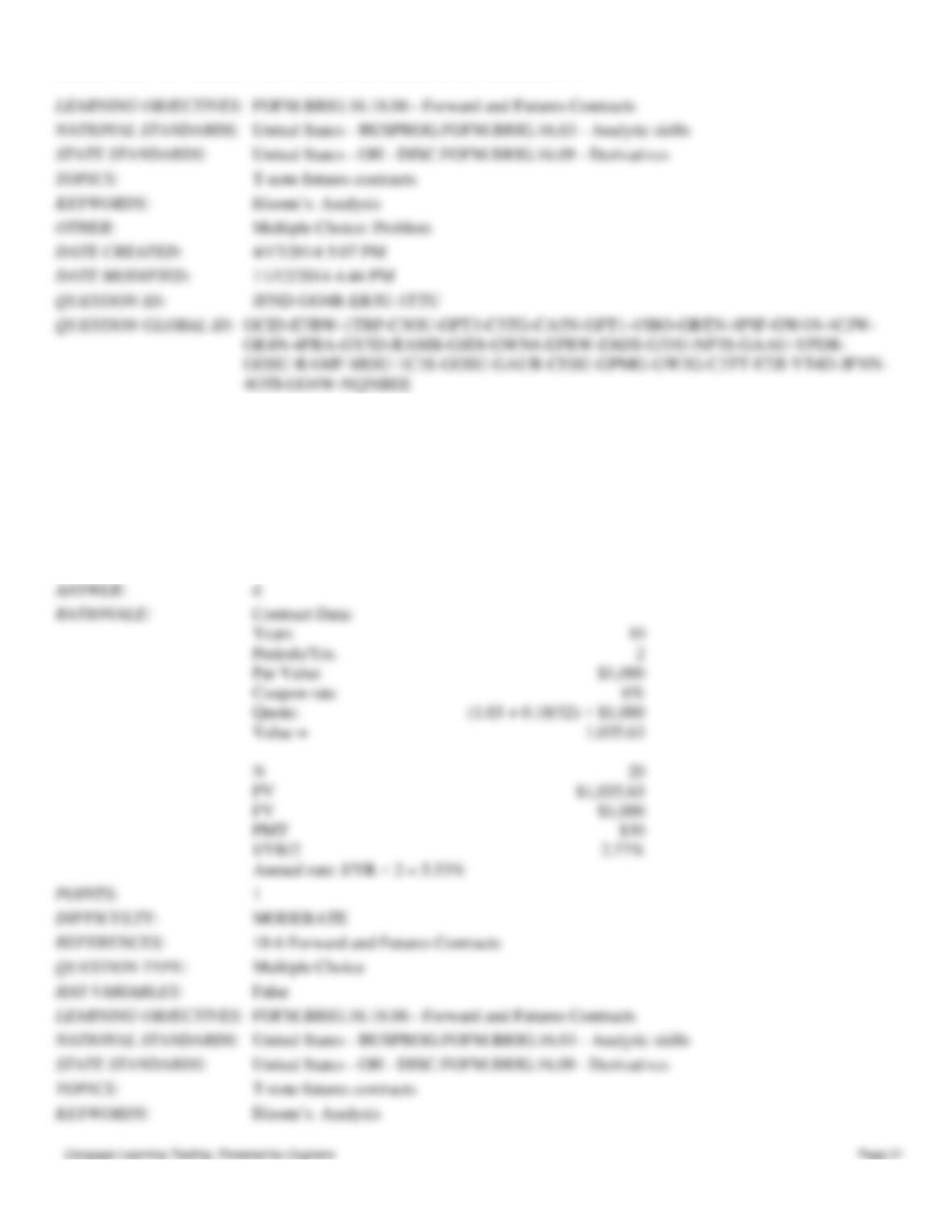
33. Suppose a CBOT 10-year U.S. Treasury note futures contract has a quoted price of 103-18. What is the implied annual
interest rate inherent in the futures contract?
a.
4.74%
b.
4.99%
c.
5.25%
d.
5.53%
e.
5.81%
Years
Periods/Yrs.
Quote:
N
I/YR/2
MODERATE
18-6 Forward and Futures Contracts
False
JFND-GO4R-ER3U-1TTU
CHAPTER 18—DERIVATIVES AND RISK MANAGEMENT
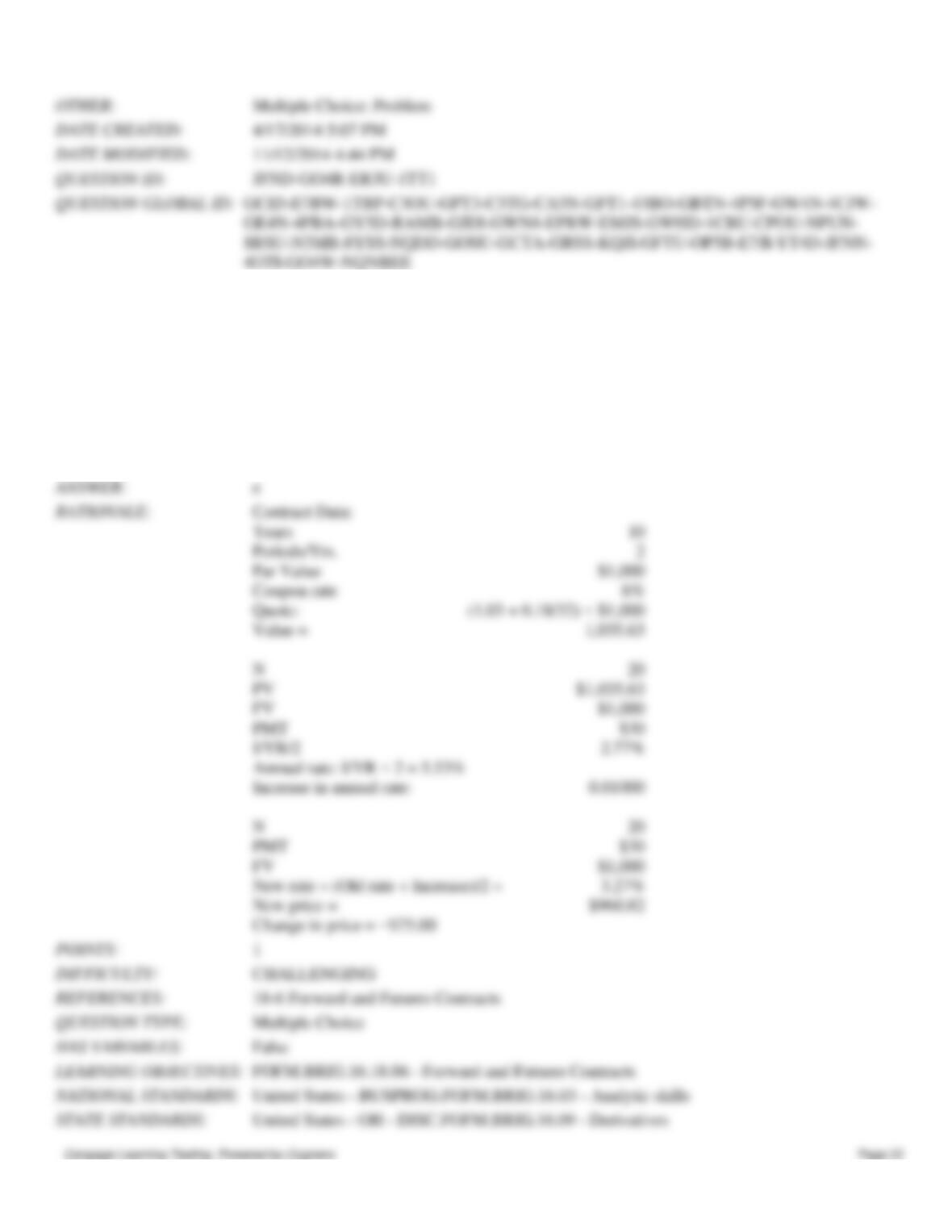
34. Suppose a CBOT 10-year U.S. Treasury note futures contract has a quoted price of 103-18. If annual interest rates go
up by 1.00 percentage point, what is the gain or loss on the futures contract? (Assume a $1,000 par value, round the new
interest rate to 4 decimal places when written as a decimal, and round the change in price up to the nearest whole dollar.)
a.
−$61.00
b.
−$64.00
c.
−$67.00
d.
−$71.00
e.
−$75.00
18-6 Forward and Futures Contracts
CHAPTER 18—DERIVATIVES AND RISK MANAGEMENT
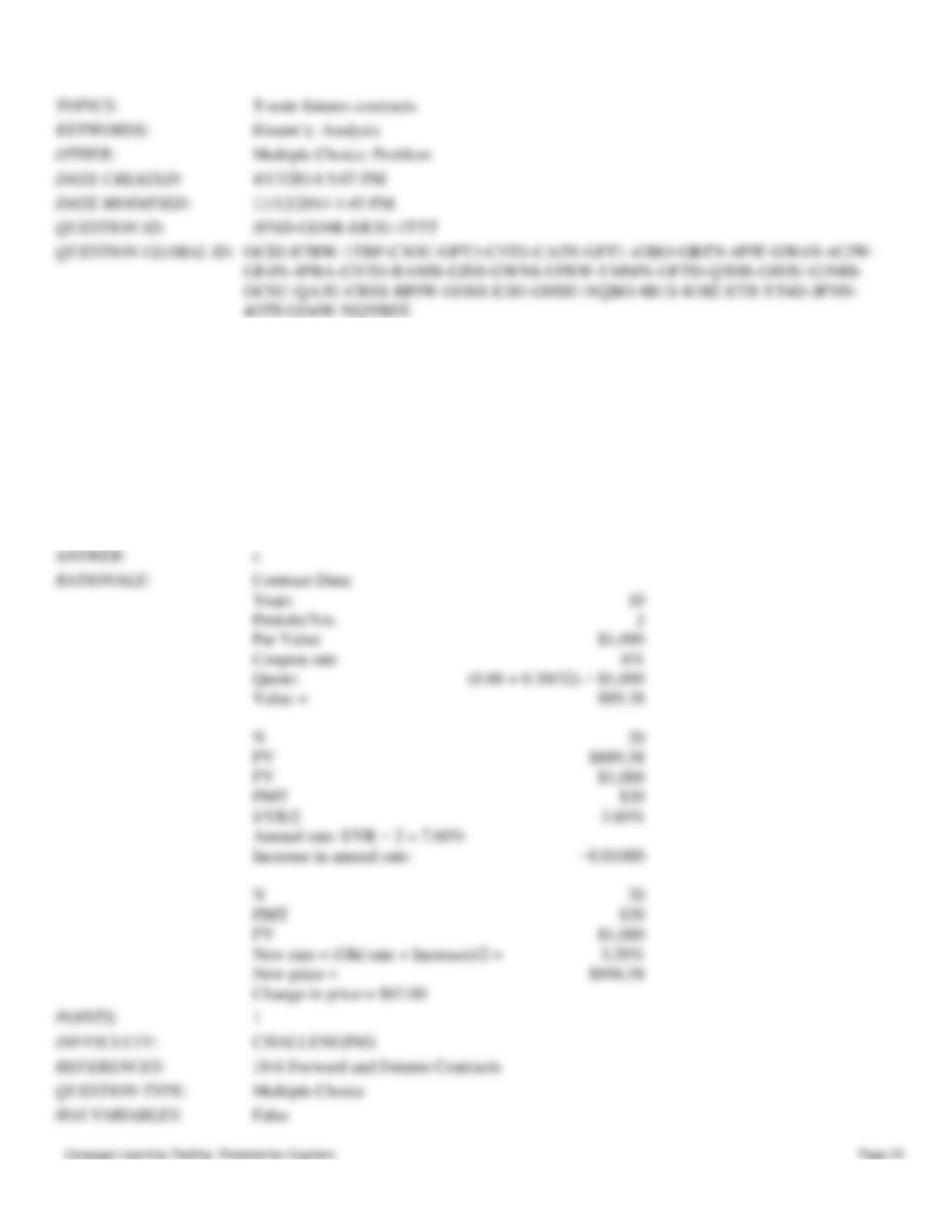
35. Suppose a CBOT 10-year U.S. Treasury note futures contract has a quoted price of 88–30. If annual interest rates go
down by 1.00 percentage point, what is the gain or loss on the futures contract? (Assume a $1,000 par value, round the
new interest rate to 4 decimal places when written as a decimal, and round the change in price up to the nearest whole
dollar.)
a.
$63.00
b.
$65.00
c.
$67.00
d.
$69.00
e.
$71.00
c
Years
Periods/Yrs.
Quote:
N
I/YR/2
N
CHALLENGING
18-6 Forward and Futures Contracts
False
JFND-GO4R-ER3U-1TTT
CHAPTER 18—DERIVATIVES AND RISK MANAGEMENT