
CHAPTER 18: THE MANAGEMENT OF ACCOUNTS RECEIVABLE AND
INVENTORIES
1. Possible sources of relevant information about a credit applicant include
a. financial statements submitted by the applicant
b. credit reporting organizations
c. U.S. Department of Commerce
d. the applicant’s financial statements and credit reporting agencies
2. The credit policy variables that a firm can use to exercise control over its level of receivables investment
include
a. credit standards
b. credit terms
c. collection effort
d. credit standards, credit terms, and collection effort
3. are useful in monitoring the status and composition of a firm’s accounts receivable.
a. Numerical credit scoring systems
b. Aging of accounts schedules
c. Seasonal datings
d. Aging of accounts schedules and seasonal datings
4. The measures the promptness with which customers repay their credit obligations.
a. bad-debt loss ratio
b. average collection period
c. credit term
d. cash discount
5. Which of the following is(are) not related to the extension of credit to customers?
a. compensating balances
b. cash discounts
c. quantity discounts
d. compensating balances and quantity discounts

Chapter 18: The Management of Accounts Receivable and Inventories
6. The average collection period measures the:
a. number of days between when a typical credit sale is made and when the firm receives the payment
b. number of days it takes a typical check to “clear” through the banking system
c. number of days beyond the end of the credit period before a typical customer payment is received
d. number of days before a typical account becomes delinquent
7. Relaxing (i.e., lowering) the firm’s credit standards is likely to result in
a. lower sales
b. smaller bad-debt losses
c. a shorter average collection period
d. possible higher pre-tax profits
8. Which of the following is not a cost related to the extension of credit to customers?
a. bad-debt losses
b. cash discounts
c. quantity discounts
d. collection costs
9. The primary objective of offering a cash discount is to
a. reduce the firm’s level of receivables investment
b. reduce the number of bad checks received from customers
c. encourage customers to place their orders prior to the peak selling period
d. avoid just-in–time orders
10. Lengthening the credit period is likely to result in all of the following except
a. higher sales
b. more cash sales
c. larger investment in receivables
d. longer average collection period
11. The objective of offering seasonal datings to customers is to
a. encourage customers to place their orders prior to the peak selling period
b. speed up the collection of accounts receivable
c. increase the firm’s inventory storage costs
d. reduce the number of bad checks received from customers

Chapter 18: The Management of Accounts Receivable and Inventories
12. For the firm with a seasonal sales pattern, offering seasonal datings to its customers is likely to result in
a. increased sales
b. higher inventory investment and warehousing costs
c. lower receivables investment cost
d. an offer of a cash discount
13. The most widely known credit reporting organization is:
a. Moody’s
b. Standard and Poor’s
c. National Association of Credit Management
d. Dun and Bradstreet
14. Capacity, which is one of the traditional “five Cs” of credit analysis, refers to
a. the general economic climate and its effect on the applicant’s ability to pay
b. the willingness of the applicant to meet its financial obligations
c. the financial strength of the applicant (i.e., net worth)
d. the ability of an applicant to meet its financial obligations
15. Character, which is one of the traditional “five Cs” of credit analysis, refers to
a. the ability of the applicant to meet its financial obligations (i.e., liquidity and cash flow)
b. the general economic climate and its effect on the applicant’s ability to pay
c. the financial strength of the applicant (i.e., net worth)
d. the willingness of the applicant to meet its financial obligations
16. Potential losses can occur in the credit evaluation process when
a. credit is denied to a credit-worthy customer
b. the credit decision is delayed too long
c. credit is denied to a customer who is not credit worthy
d. credit is denied to a credit-worthy customer and the credit decision is delayed too long

Chapter 18: The Management of Accounts Receivable and Inventories
17. The effect of a change in a firm’s credit terms from “net 30” to “2/10, net 30” on its customer’s balance sheets
is likely to be
a. decreased accounts receivable
b. increased accounts receivable
c. decreased accounts payable
d. increased accounts payable
18. The effect of a change in a firm’s credit terms from “net 30” to “2/10, net 30” on its own balance sheet is likely
to be
a. decreased accounts receivable
b. increased accounts receivable
c. decreased accounts payable
d. increased accounts payable
19. The primary goal of accounts receivable management should be
a. minimizing lost sales
b. maximizing shareholder wealth
c. increasing market share
d. minimizing receivables investment
20. Traditional discussion of guidelines for examining credit worthiness include “the five Cs of credit.” Each of the
following is one of the “five Cs” except
a. capacity
b. cooperation
c. character
d. conditions
21. All other things being equal, the application of a seasonal dating to the terms of credit offered by the firms
below would be expected to generate additional sales for each firm except
a. a Christmas novelty manufacturer
b. an agricultural implements manufacturer
c. a wholesale frozen food supplier
d. a swimsuit manufacturer

Chapter 18: The Management of Accounts Receivable and Inventories
22. Increasing collection expenditures is likely to result in
a. a shorter average collection period
b. reduced bad-debt losses
c. higher accounts receivable balances
d. a shorter average collection period and reduced bad-debt losses
23. are the criteria the firm uses to screen credit applicants in order to determine which of its customers
should be offered credit and how much.
a. Credit terms
b. Credit standards
c. Seasonal datings
d. Credit extension policies
24. All the following are assumptions of the basic EOQ model except:
a. annual demand known with certainty
b. ordering costs fluctuate
c. demand is uniform throughout the year
d. orders are filled instantaneously
25. The is the inventory level at which an order should be placed for replenishment of an item.
a. nonzero inventory level
b. safety stock
c. reorder point
d. inventory quantity
26. The types of inventories that manufacturing firms generally hold include all the following except:
a. raw materials
b. working stock
c. finished goods
d. work-in-process

Chapter 18: The Management of Accounts Receivable and Inventories
27. In general, the a firm’s production cycle, the its work-in-process inventory.
a. longer, larger
b. longer, smaller
c. shorter, larger
d. length of cycle is not related to amount of work-in-process
28. When an order is placed for an item that is manufactured internally within a company, ordering costs consist
primarily of .
a. storage and handling costs
b. deterioration costs
c. production set-up costs
d. carrying costs
29. All of the following are components of carrying costs except:
a. insurance
b. storage costs
c. handling costs
d. set-up costs
30. The cost of funds invested in inventories is measured by the .
a. cost of insuring the inventory
b. stockout costs
c. required rate of return
d. rate of interest on borrowed funds
31. To minimize the possibility of running out of inventory, most companies add a to their inventory.
a. safety stock
b. lead time stock level
c. few days
d. replenishment factor

Chapter 18: The Management of Accounts Receivable and Inventories
32. Safety stock is needed to absorb
a. changes in accounts receivables
b. cyclical changes
c. random fluctuations in sales
d. annual model changes
33. The reorder point is
a. the lead time multiplied by the daily usage plus safety stock
b. the EOQ plus safety stock
c. the lead time multiplied by the annual usage
d. a product of daily usage and the lead time
34. Mace Auto Parts Company sells to retail auto supply stores on credit terms of “net 60.” Annual credit sales are
$300 million (spread evenly throughout the year) and its accounts average 28 days overdue. The firm’s
variable cost ratio is 0.75 (i.e., variable costs are 75 percent of sales). When converting from annual to daily
data or vice versa, assume there are 365 days per year. Determine Mace’s average collection period.
a. 88 days
b. 44 days
c. 74 days
d. 60 days
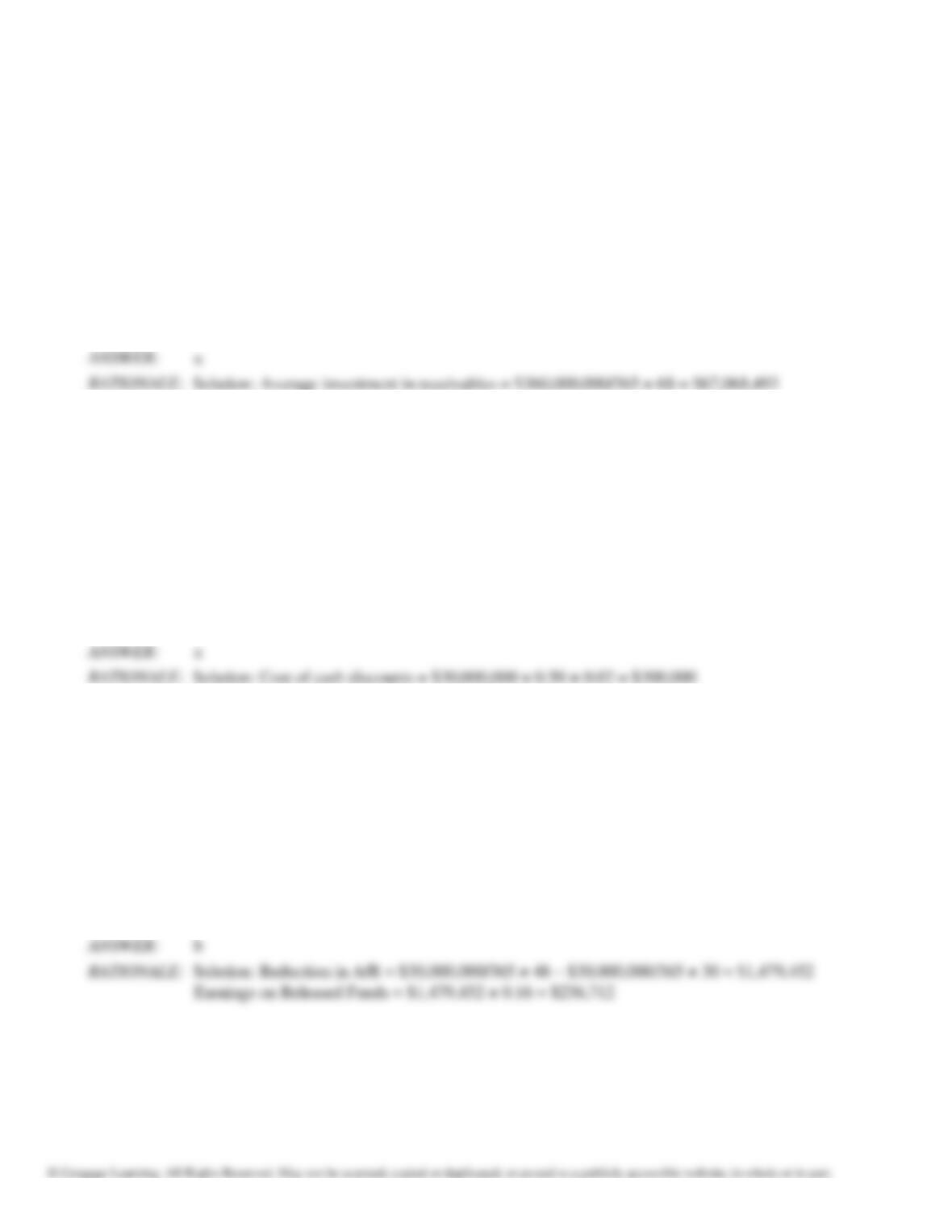
35. Mace Auto Parts Company sells to retail auto supply stores on credit terms of “net 60.” Annual credit sales are
$300 million (spread evenly throughout the year) and its accounts average 28 days overdue. The firm’s
variable cost ratio is 0.75 (i.e., variable costs are 75 percent of sales). When converting from annual to daily
data or vice versa, assume there are 365 days per year. Determine Mace’s average investment in receivables.
a. $821,918
b. $3,409,091
c. $72,328,767
d. $82,192
Chapter 18: The Management of Accounts Receivable and Inventories
36. Mace Auto Parts Company sells to retail auto supply stores on credit terms of “net 60.” Annual credit sales are
$300 million (spread evenly throughout the year) and its accounts average 28 days overdue. The firm’s
variable cost ratio is 0.75 (i.e., variable costs are 75 percent of sales). When converting from annual to daily
data or vice versa, assume there are 365 days per year. Suppose that Mace’s sales are expected to increase by
20 percent next year and, through more effective collection methods, the firm is able to reduce its average
collection period by 20 days. Determine the firm’s average investment in receivables for next year under these
conditions.
a. $67,068,493
b. $56,666,667
c. $5,294,118
d. $98,630
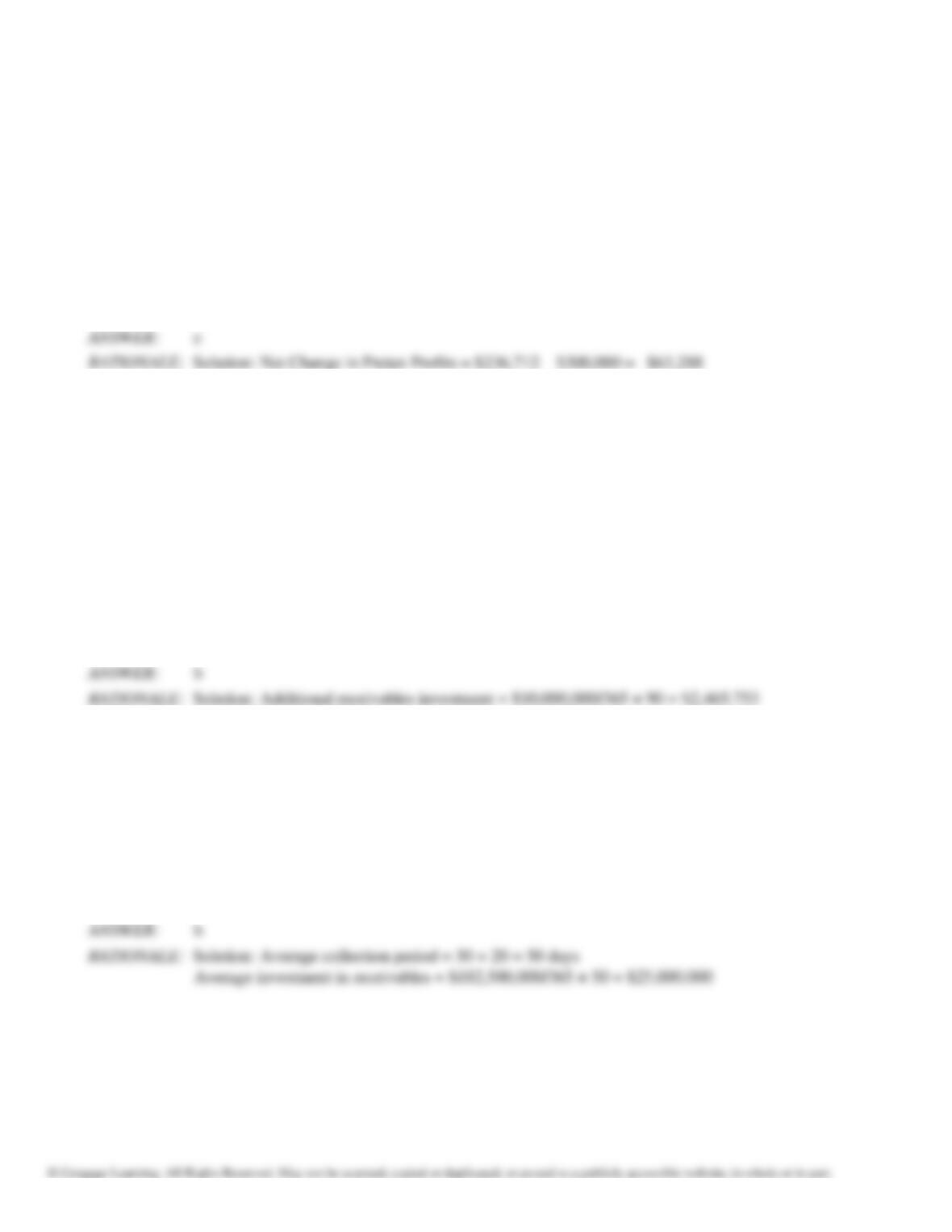
37. Warren Motor Company sells $30 million of its products to wholesalers on terms of “net 30.” Currently, the
firm’s average collection period is 48 days. In an effort to speed up the collection of receivables, Warren is
considering offering a cash discount of 2 percent if customers pay their bills within 10 days. The firm expects
50 percent of its customers to take the discount and its average collection period to decline to 30 days. The
firm’s required pretax return (i.e., opportunity cost) on receivables investment is 16 percent. Determine the cost
of the cash discounts to Warren.
a. $300,000
b. $60,000
c. $40,000
d. $48,000
38. Warren Motor Company sells $30 million of its products to wholesalers on terms of “net 30.” Currently, the
firm’s average collection period is 48 days. In an effort to speed up the collection of receivables, Warren is
considering offering a cash discount of 2 percent if customers pay their bills within 10 days. The firm expects
50 percent of its customers to take the discount and its average collection period to decline to 30 days. The
firm’s required pretax return (i.e., opportunity cost) on receivables investment is 16 percent. Determine
Warren’s pretax earnings on the funds released from the reduction in receivables. (Assume a 365 day year.)
a. $1,479,452
b. $236,712
c. $266,667
d. $1,082,191
Chapter 18: The Management of Accounts Receivable and Inventories
39. Warren Motor Company sells $30 million of its products to wholesalers on terms of “net 30.” Currently, the
firm’s average collection period is 48 days. In an effort to speed up the collection of receivables, Warren is
considering offering a cash discount of 2 percent if customers pay their bills within 10 days. The firm expects
50 percent of its customers to take the discount and its average collection period to decline to 30 days. The
firm’s required pretax return (i.e., opportunity cost) on receivables investment is 16 percent. Determine the net
effect on Warren’s pretax profits of offering a 2 percent cash discount.
a. $300,000
b. $236,712
c. –$63,288
d. –$236,712
40. Bluegrass Distilleries, Inc. refuses to extend credit to any wholesale distributors who have a history of being
delinquent in repaying credit extended to them. This policy results in lost sales of $10 million annually. Based
on past experience with these types of customers, the firm estimates that the average collection period would
be 90 days and that the bad-debt loss ratio would be 6 percent. The firm’s variable cost ratio is 0.80, making its
profit contribution ratio 0.20. Bluegrass Distilleries’ required pretax return (i.e., opportunity cost) on
receivables investments is 20 percent. When converting from annual to daily or vice versa, assume there are
365 days per year. If Bluegrass Distilleries extends credit to these (previously delinquent) customers, determine
the increase in the investment in receivables.
a. $27,397
b. $2,465,753
c. $111,111
d. $125,000
41. Whirlwind Company sells to retail appliance stores on credit terms of net 30. Annual credit sales are
$182,500,000 spread evenly throughout the year and its accounts average 20 days overdue. The firm’s variable
cost ratio is 0.70. Determine Whirlwind’s average investment in receivables. (Assume 365 days per year an all
calculations.)
a. $17,500,000
b. $25,000,000
c. $15,000,000
d. cannot be determined from the information provided

Chapter 18: The Management of Accounts Receivable and Inventories
42. If a lawn mower assembly plant orders 25,000 frames per year at a price of $27 each, what is the EOQ if the
ordering cost per order is $35 and the annual inventory carrying cost is 12 percent?
a. 735
b. 255
c. 567
d. 520
43. What is the optimal length of one inventory cycle for a firm that has an economic order quantity of 750 units,
average daily demand of 68 units, and a price of $30 per unit?
a. 25 days
b. 11 days
c. 2.7 days
d. 331 days
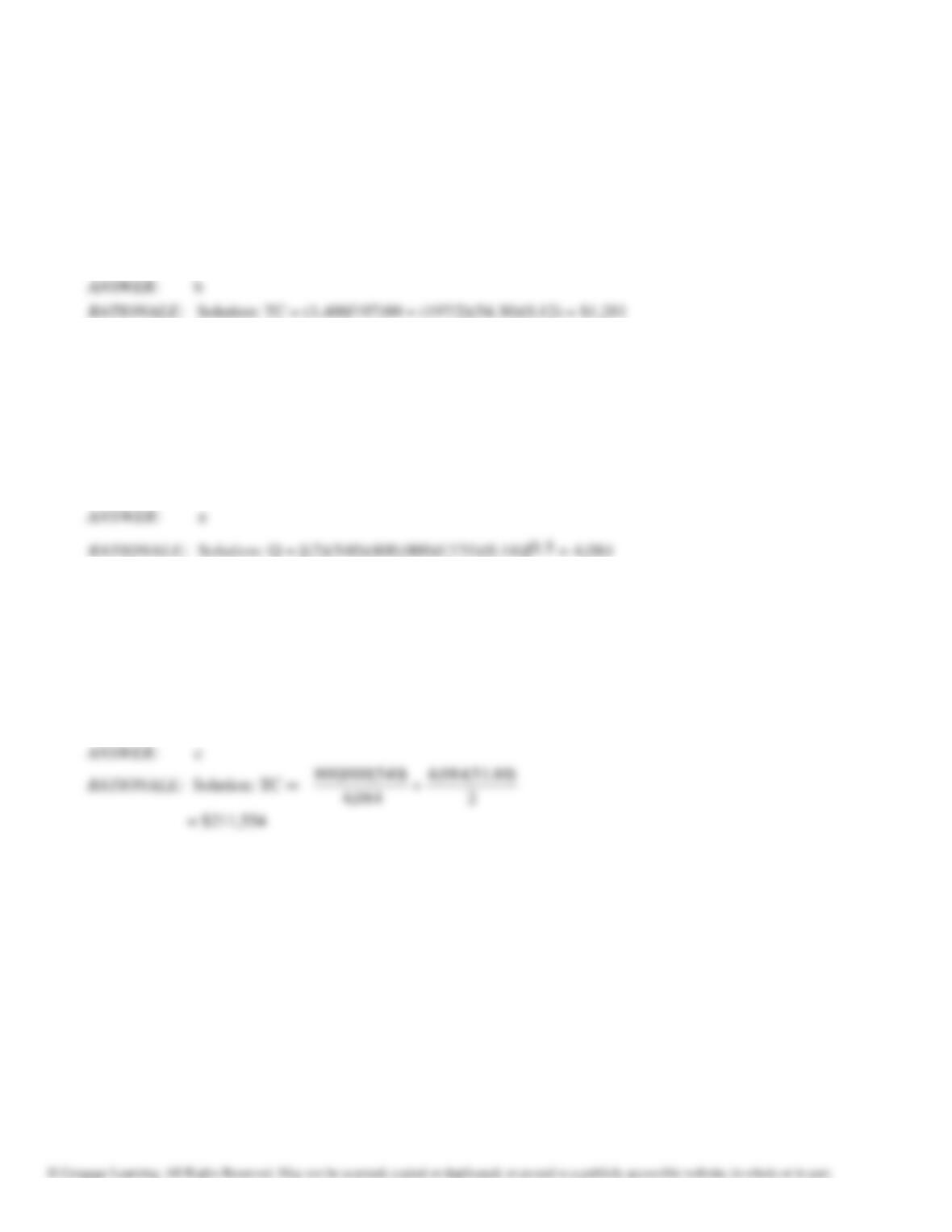
44. Tool Mart sells 1,400 electronic water pumps every year. These pumps cost $54.30 each. If annual inventory
carrying costs are 12% and the cost of placing an order is $90, what is the firm’s EOQ?
a. 139
b. 122
c. 197
d. 148
45. Tool Mart sells 1,400 electronic water pumps every year. These pumps cost $54.30 each. If annual inventory
carrying costs are 12% and the cost of placing an order is $90, what is the optimal ordering frequency?
a. 37 days
b. 32 days
c. 40 days
d. 51 days
Chapter 18: The Management of Accounts Receivable and Inventories
46.
Tool Mart sells 1,400 electronic water pumps every year. These pumps cost $54.30 each. If annual
inventory
carrying costs are 12% and the cost of placing an order is $90, what is the total annual
inventory costs?
a. $1,923
b. $1,281
c. $3,406
d. $3,762
47.
Haulsee Inc. builds 800,000 golf carts a year and purchases the electronic motors for these carts for $370
each. Ordering costs are $540 and Haulsee’s inventory carrying costs average 14% of the inventory value.
What is the
EOQ for Hau1see?
a. 4,084
b. 1,528
c. 2,890
d. 572
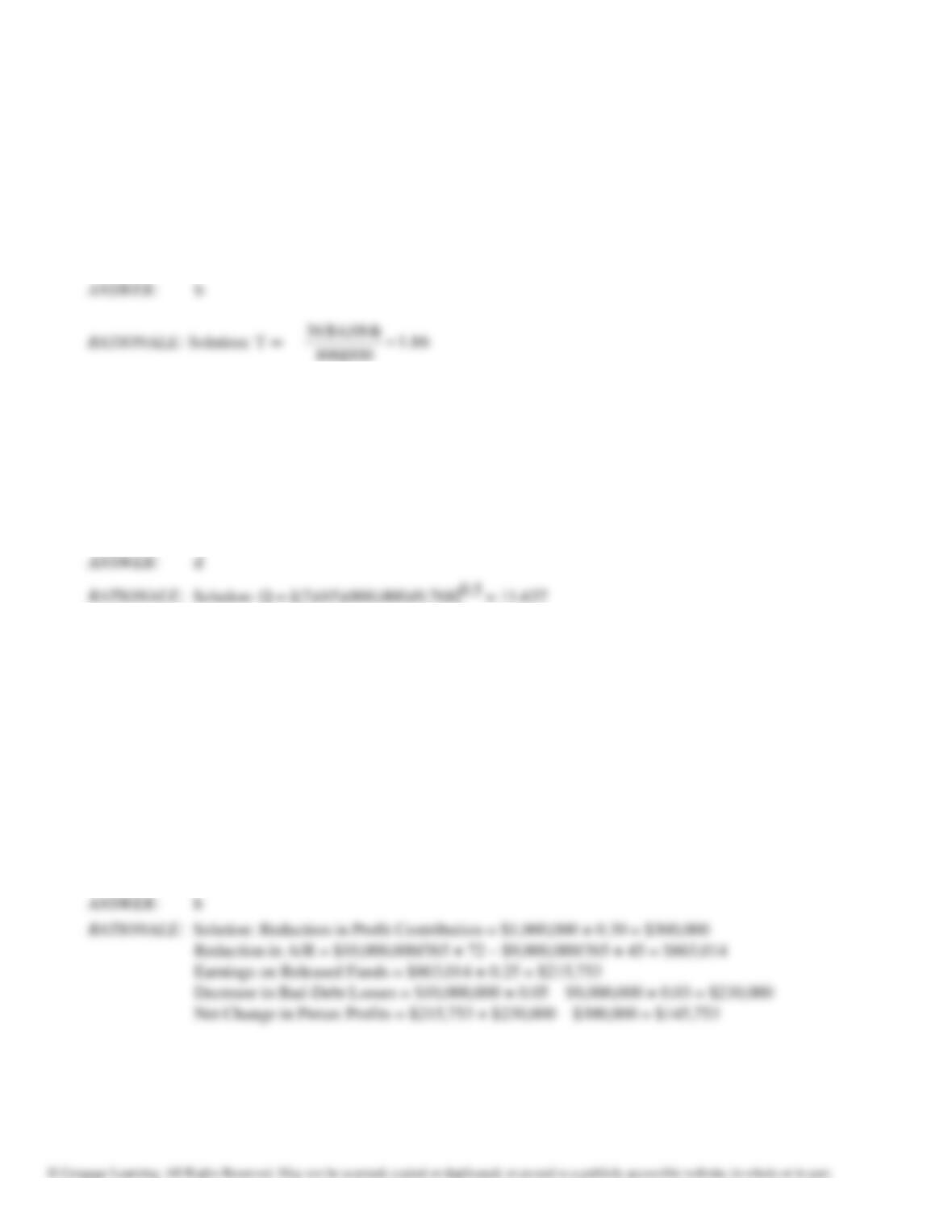
48.
Haulsee Inc. builds 800,000 golf carts a year and purchases the electronic motors for these carts for $370
each. Ordering costs are $540 and Haulsee’s inventory carrying costs average 14% of the inventory value.
What is the total inventory costs?
a. $565,445
b. $224,331
c. $211,555
d. $21,155,120
Chapter 18: The Management of Accounts Receivable and Inventories
49.
Haulsee Inc. builds 800,000 golf carts a year and purchases the electronic motors for these carts for $370
each.
Ordering costs are $540 and Haulsee’s inventory carrying costs average 14% of the inventory value.
What is the optimal ordering frequency?
a.
0.70 days
b.
1.86 days
c.
5.18 days
d.
8.64 days
50.
Technico manufactures about 800,000 solar calculators per year. The computer chip used in the calculator
cost $4.80 each and the cost of placing an order is $65. If the carrying costs are 16%, what is the EOQ for
the chips?
a.
25,495
b.
3,162
c.
8, 229
d.
11,637
51.
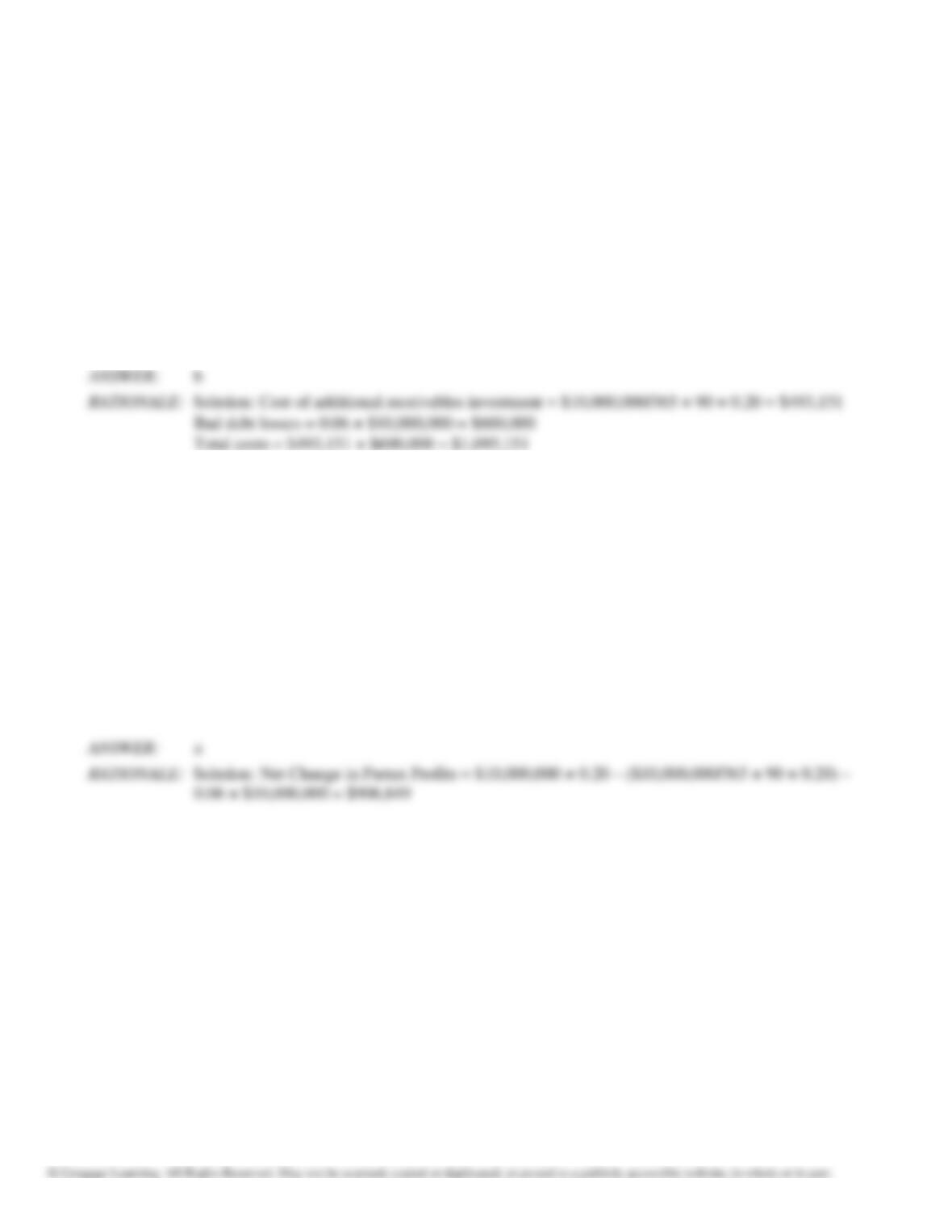
Willoughby Industries, Inc. is considering whether to discontinue offering credit to customers who are more
than 10 days overdue on repaying the credit extended to them. Current annual credit sales are $10 million on
credit terms of “net 30”. Such a change in policy is expected to reduce sales by 10 percent, cut the firm’s bad-
debt losses from 5 to 3 percent, and reduce its average collection period from 72 days to 45 days. The firm’s
variable cost ratio is 0.70 (profit contribution ratio is 0.30) and its required pretax return (i.e., opportunity cost)
on receivables investments is 25 percent. Determine the net effect of this credit tightening policy on the pretax
profits of Willoughby. When converting from annual to daily data or vice versa, assume that there are 365 days
per year.
a.
–$863,014
b.
$145,753
c.
–$70,000
d.
$300,000
Chapter 18: The Management of Accounts Receivable and Inventories
52.
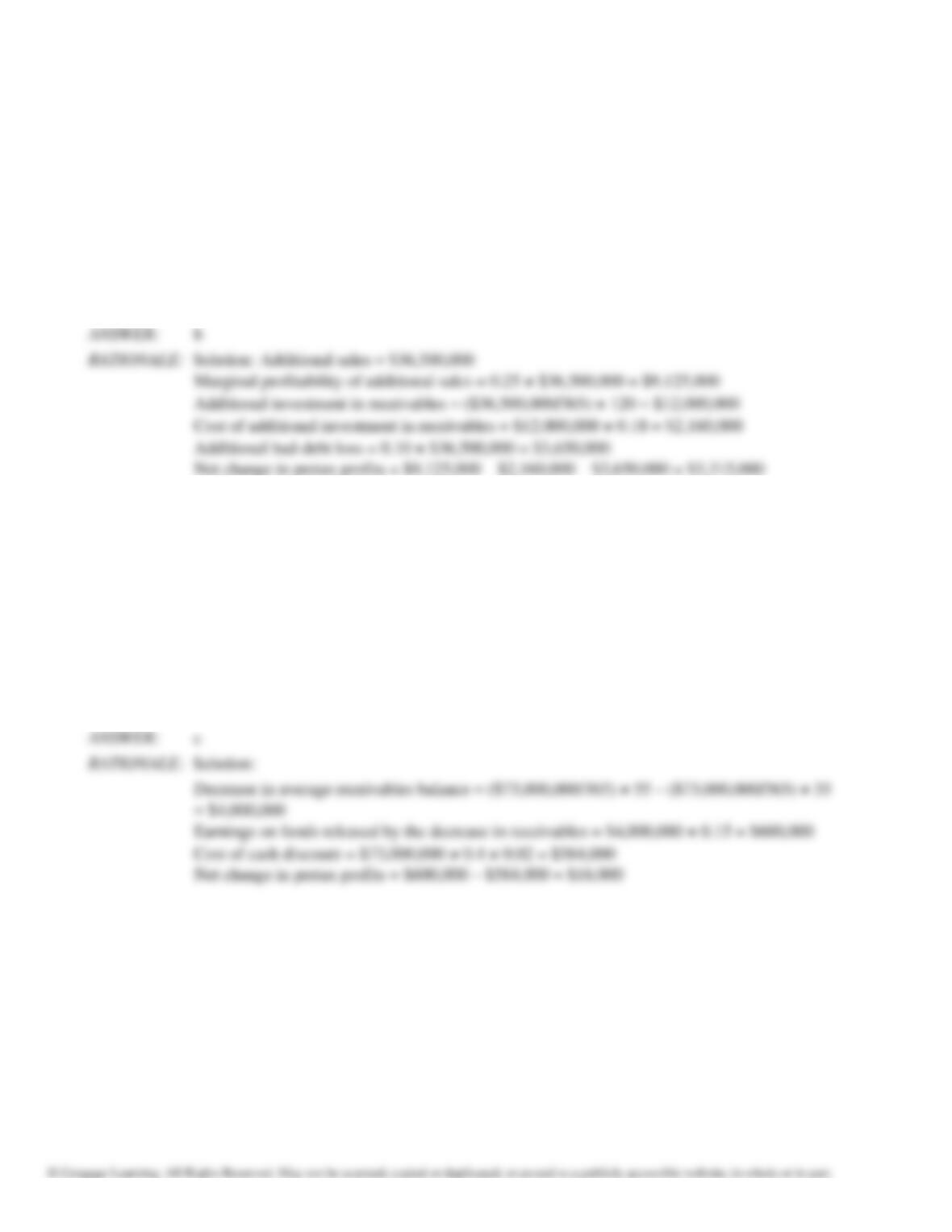
Bluegrass Distilleries, Inc. refuses to extend credit to any wholesale distributors who have a history of being
delinquent in repaying credit extended to them. This policy results in lost sales of $10 million annually. Based
on past experience with these types of customers, the firm estimates that the average collection period would
be 90 days and that the bad-debt loss ratio would be 6 percent. The firm’s variable cost ratio is 0.80, making its
profit contribution ratio 0.20. Bluegrass Distilleries’ required pretax return (i.e., opportunity cost) on
receivables investments is 20 percent. When converting from annual to daily data or vice versa, assume there
are 365 days per year. If Bluegrass extends full credit to these (previously delinquent) customers, determine the
total increase in credit-related costs.
a.
$1,000,000
b.
$1,093,151
c.
$400,000
d.
$600,000
53.
Bluegrass Distilleries, Inc. refuses to extend credit to any wholesale distributors who have a history of being
delinquent in repaying credit extended to them. This policy results in lost sales of $10 million annually. Based
on past experience with these types of customers, the firm estimates that the average collection period would
be 90 days and that the bad-debt loss ratio would be 6 percent. The firm’s variable cost ratio is 0.80, making its
profit contribution ratio 0.20. Bluegrass Distilleries’ required pretax return (i.e., opportunity cost) on
receivables investments is 20 percent. When converting from annual to daily data or vice versa, assume there
are 365 days per year. Determine the net effect on Bluegrass Distilleries’ pretax profits of extending credit to
these (previously delinquent) customers
a.
$906,849
b.
$2,000,000
c.
$306,849
d.
$1,500,000
Chapter 18: The Management of Accounts Receivable and Inventories
54.
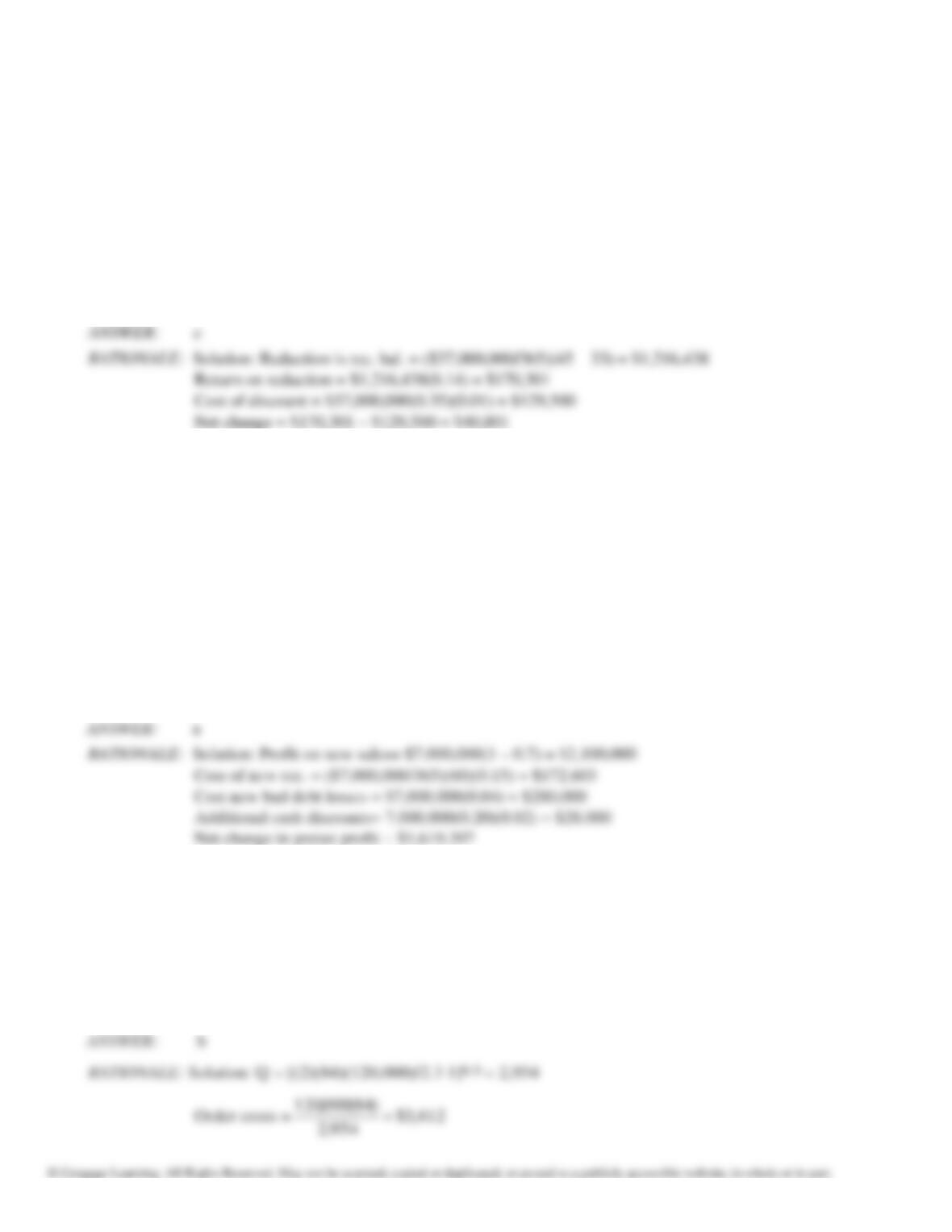
The United Shoe Company (USC) does not extend credit to any retail shoe store with a “Fair” or “Limited”
Dun and Bradstreet credit rating. As a result of this policy the company loses $36,500,000 in sales each year.
Based on prior experience with these types of customers, USC estimates that the average collection period
would be 120 days and the bad-debt loss ratio would be 10%. The firm’s variable cost ratio is 0.75. USC’s
required pretax return on receivables investments is 18%. Determine the net change in pretax profits of
extending credit to these retail shoe stores. (Assume 365 days per year in any calculations.)
a.
$9,125,000
b.
$3,315,000
c.
–$1,095,000
d.
$2,160,000
55.
Wallace Company sells $73 million of its products to retailers on credit terms of “net 30.” Its average
collection period is 55 days. To speed up the collection of receivables, the company is considering changing its
credit terms to “2/10, net 30.” The company expects 40% of its customers to take the cash discount and its
average collection period to decline to 35 days. Wallace’s required pretax rate of return on receivables
investments is 15%. Determine the net effect on Wallace’s pretax profits of the change in credit terms.
(Assume 365 days per year in any calculations.)
a.
–$860,000
b.
$600,000
c.
$16,000
d.
$584,000
Chapter 18: The Management of Accounts Receivable and Inventories
56.
RCMP has annual credit sales of $37 million. The credit terms are “net 30” and the current average collection
period is 45 days. RCMP is considering changing its terms to 1/10, net 30 in an effort to reduce the average
collection period. RCMP believes that 35% of its customers will take the discount, reducing the average
collection period to 33 days. Should RCMP offer the discount? Assume the firm’s required rate of return on its
receivables investment is 14%.
a. No, pretax profits decrease $88,700
b. Yes, pretax profits increase $53,600
c. Yes, pretax profits increase $40,801
d. No, pretax profits decrease $40,801
57.
Covers, Inc. (CI) sells its stainless steel products on terms of “2/10, net 40.” CI is considering granting credit
to
retailers with total assets as low as $500,000. Currently the lowest asset limit is $750,000. CI believes sales
will
increase $7 million from the new credit group
but
the average collection period for this new group will be
60 days versus the current average collection period of35 days. If management estimates that 20% of the new
customers will take the cash discount but 4% of the new business will be written off as a bad–debt loss, should
CI lower its
credit standards? Assume Cl’s variable cost ratio is 0.7 and its required pretax rate of return on
receivables investment is 15%.
a.
Yes, pretax profits increase $1,619,397
b.
Yes, pretax profits increase $1,703,397
c.
Yes, pretax profits increase $1,755,178
d.
No, Pretax profits will decrease
58.
Cycles de Oro produces 120,000 high-tek bikes a year and orders the brake assembly from IKON for $15.40
each. The order cost is $84 and Cycles estimates their inventory carrying costs are 15%. What is their total
ordering cost per year?
a.
$7,968
b.
$3,412
c.
$4,118
d.
$6,437

Chapter 18: The Management of Accounts Receivable and Inventories
59.
Accounts receivable consist of the credit of the business.
It
can take the form of which of the following?
I.
Trade credit
II.
Consumer cred it
a.
I only
b.
II only
c.
Both I and IT
d.
Neither I nor II
60. When a company measures its marginal costs and marginal returns it is developing:
a. target capital structure
b. optimal credit extension policy
c. required rate of return
d. a financing decision
61. The proportion of the total receivables volume a company never collects is the:
a. bad-debt loss ratio
b. mismanaged accounts payable
c. uncollectable bills
d. recorded debts
62. All of the following are possible solutions to a large bad-debt loss ratio EXCEPT:
a. Loosening credit
b. Offering cash discounts for prompt payment
c. Seasonal datings
d. Determine creditworthiness of customers
63. All of the following are reliable sources of the creditworthiness of a customer EXCEPT:
a. Credit reporting organizations
b. Company’s experience
c. Banks
d. General credit application

Chapter 18: The Management of Accounts Receivable and Inventories
64. A numerical credit scoring system may rate all of the following EXCEPT:
a. D & B credit rating
b. location of the business
c. financial characteristics of the applicant
d. current ratio of the applicant
65. serves as a buffer between the various phases in the procurement-production-sales cycle of a
manufacturing firm.
a. cash
b. accounts receivable
c. notes payable
d. inventories
66. Maximizing shareholder wealth by investing in accounts receivables is considered when:
I. Marginal costs are exceeded by marginal returns.
II. The cost of the funds invested are exceeded by expected marginal returns.
a. I only
b. II only
c. Both I and II
d. Neither I nor II
67. Examples of credit-related marginal costs are all of the following EXCEPT:
a. Advertising costs associated with promoting the company’s credit policy.
b. Opportunity costs associated with supporting a higher level of receivables.
c. Labor costs associated with checking new credit accounts and collecting receivables.
d. Bad-debt expenses.
68. The likelihood that a customer will fail to repay credit extended to it is referred to as:
a. default risk
b. maturity risk
c. bad-debt loss ratio
d. opportunity cost

Chapter 18: The Management of Accounts Receivable and Inventories
69. Cash discounts are offered for which of the following reasons?
I. Speed up collection of accounts receivable
II. Reduce a company’s level of receivables investment and associated costs.
a. I only
b. II only
c. Both I and II
d. Neither I nor II
70. Seasonal datings are offered to specific retailers. These retailers:
a. Do not have the capacity to make sales without seasonal dating.
b. Do not have the ability to finance a buildup of inventory in advance of the peak selling period.
c. Are known to be credit-risky.
d. Are considered a distributive subsidiary of the parent company
71. The most widely known credit-reporting organization is:
a. Phelps Credit Services
b. Dun & Bradstreet Credit Services
c. Equitable Credit Services
d. Creditreport.com
72. In determining the creditworthiness of a customer from financial statements, the statements can indicate all of
the following EXCEPT:
a. Financial strength
b. Ability to repay credit obligations
c. Length of time needed to repay on credit
d. Proposed budgetary expenses for the near future
73. Inventory related costs are all of the following EXCEPT:
a. Ordering costs
b. Product advertising costs
c. Carrying costs
d. Stockout costs
Chapter 18: The Management of Accounts Receivable and Inventories
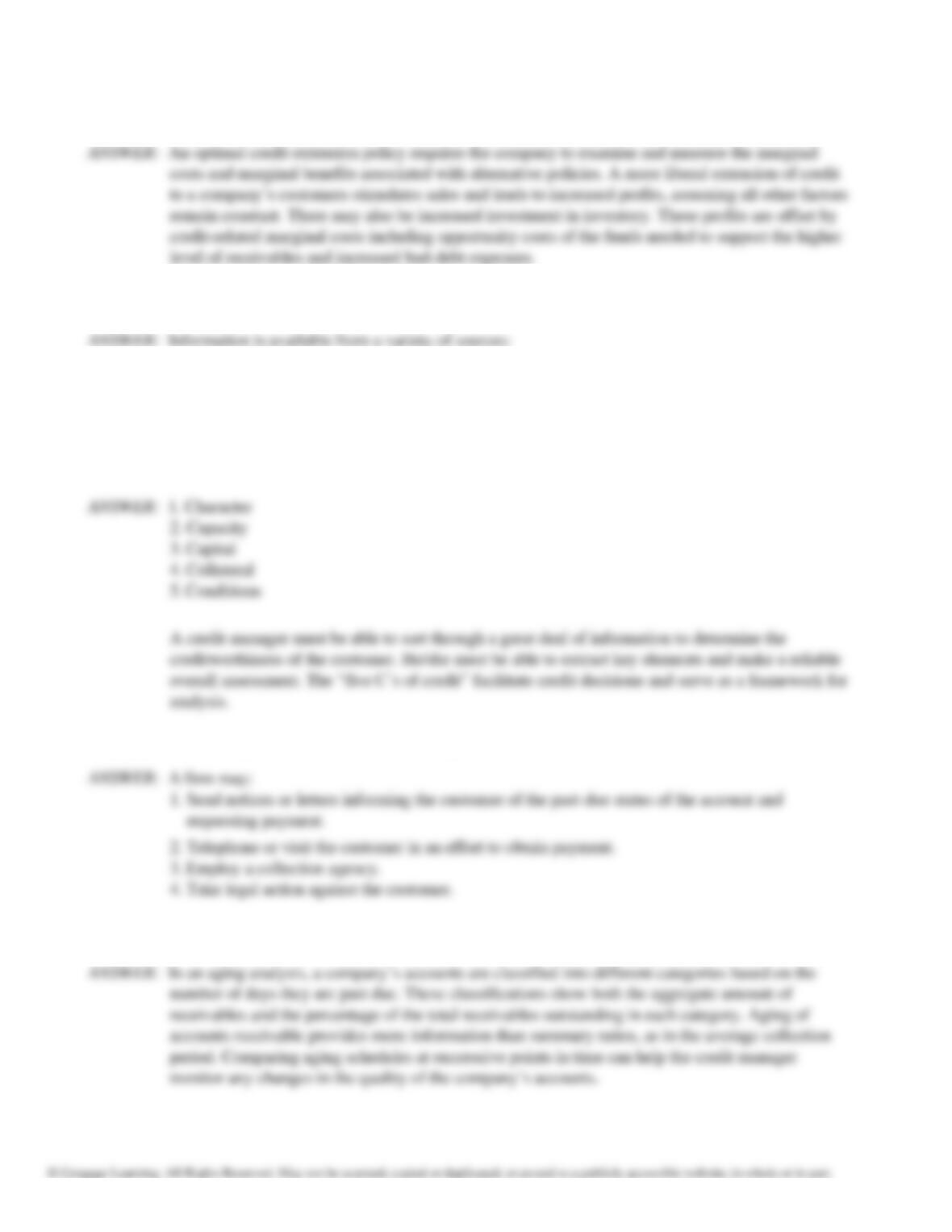
74. How does an optimal credit extension policy impact a company’s accounts receivables?
75. What information could be used to judge the credit worthiness of a customer?
1. Financial statements submitted by the customer.
2. Credit reporting organizations
3. Banks
4. A company’s own past experience with the customer
76. What are the “five Cs of credit” and how are they used?
77. In trying to collect on past-due accounts, the firm may use several methods. List them.
78. Describe how an aging of accounts is a useful monitoring technique for accounts receivable.
Chapter 18: The Management of Accounts Receivable and Inventories
79. How can a company use its credit period to affect sales and inventory?
80. What are seasonal datings as it applies to credit terms?