United States – BPROG: Analytic
United States – OH – Default City – Measuring the Economy
Measuring the Economy
The Principle of Marginal Productivity
67. In 2013 ____ of national factor income consisted of employee compensation.
a.
90 percent
b.
50 percent
c.
60 percent
d.
70 percent
DISC: Measuring the Economy
United States – BPROG: Analytic
United States – OH – Default City – Measuring the Economy
Measuring the Economy
The Principle of Marginal Productivity
68. The basic principle that explains the demand for a factor of production is the
a.
principle of marginal productivity.
b.
Hotelling principle.
c.
principle of opportunity cost.
d.
Ramsey pricing principle.
United States – BPROG: Analytic
The study of economics, and defi – The study of economics, and definitions of economics
The Principle of Marginal Productivity
69. The marginal productivity theory of distribution holds that
a.
each factor is paid what it deserves.
b.
the owner of each factor is paid the amount that the factor contributes to earnings.
c.
each factor’s income depends on how hard it works.
d.
each factor receives an equal share of the revenue from production.
United States – BPROG: Analytic
The study of economics, and defi – The study of economics, and definitions of economics
The Principle of Marginal Productivity
70. A worker can always build a chair in four hours. If a chair sells for $40 in a perfectly competitive market, then the
equilibrium wage per hour in a perfectly competitive labor market is
a.
$4.
b.
$10.
c.
$40.
d.
$160.
Moderate
DISC: Labor markets
United States – BPROG: Analytic
United States – OH – Default City – Labor markets
Labor markets
The Principle of Marginal Productivity
BLOOMS: Application
71. If a ton of steel sells for $15,000 and a car made from a ton of steel sells for $30,000, then if all markets are perfectly
competitive, how many cars can be made from the last ton of steel used by a profit-maximizing firm?
a.
1/3 car
b.
1/2 car
c.
1 car
d.
1.5 cars
Moderate
Models
United States – BPROG: Analytic
Understanding and applying econo – Understanding and applying economic models
The Principle of Marginal Productivity
BLOOMS: Application
72. The marginal productivity principle says that a profit-maximizing firm should
a.
hire capital until its marginal product is zero.
b.
hire labor until another worker costs more to hire than she can earn for the firm.
c.
hire the quantities of capital and of labor at which their marginal products are equal.
d.
hire capital until its marginal product is negative.
Moderate
economics, and definitions of economics
The study of economics, and defi – The study of economics, and definitions of economics
The Principle of Marginal Productivity
73. When factor markets are competitive, it always pays a profit-maximizing firm to
a.
use more of the factor.
b.
bid very low prices for inputs.
c.
reduce the use of all inputs.
d.
use that quantity of input that makes MRP equal to the price of the input.
Moderate
United States – BPROG: Analytic
Understanding and applying econo – Understanding and applying economic models
The Principle of Marginal Productivity
74. Marginal productivity analysis shows that a drop in the price of the product will cause input use to
a.
increase.
b.
decrease.
c.
stay the same.
d.
The information is insufficient to provide an answer.
Easy
United States – BPROG: Analytic
The study of economics, and defi – The study of economics, and definitions of economics
The Principle of Marginal Productivity
75. The distribution of income in a market economy is determined by
a.
the level of employment and prices of the factors of production.
b.
the prices of factors of production.
c.
largely unknown forces which economists seek to discover.
d.
decisions of government offices related to distribution.
a
Moderate
United States – BPROG: Analytic
The study of economics, and defi – The study of economics, and definitions of economics
The Principle of Marginal Productivity
76. In 2013, interest payments were about ____ percent of national income.
a.
0.51/2
b.
1.29
c.
3.2
d.
4.0
c
Moderate
DISC: Measuring the Economy
United States – BPROG: Analytic
United States – OH – Default City – Measuring the Economy
Measuring the Economy
The Principle of Marginal Productivity
77. According to the principle of marginal productivity, if
a.
the product price is less than MRP, the firm is using too little of the input.
b.
the price of an input rises, the quantity demanded of the input will increase.
c.
MRP is greater than product price, the firm should reduce the use of the input.
d.
price of the input equals MRP, the firm is maximizing profit.
Moderate
United States – BPROG: Analytic
economics, and definitions of economics
The study of economics, and defi – The study of economics, and definitions of economics
The Principle of Marginal Productivity
78. The marginal productivity principle implies that
a.
quantity demanded of an input normally declines as the input price falls.
b.
at equilibrium, profit from the last unit of input will be zero.
c.
for maximizing profit, marginal revenue product should be greater than price.
d.
marginal productivity of inputs increase when price of inputs increase.
United States – BPROG: Analytic
The study of economics, and defi – The study of economics, and definitions of economics
The Principle of Marginal Productivity
79. The marginal revenue product
a.
tells how many dollars the marginal physical product is worth.
b.
is the marginal physical product times price of the product under perfect competition.
c.
is the marginal physical product times marginal revenue.
d.
All of the above are correct.
United States – BPROG: Analytic
The study of economics, and defi – The study of economics, and definitions of economics
The Principle of Marginal Productivity
80. The demand curve for capital is
a.
its entire marginal physical product curve.
b.
the downward-sloping portion of its marginal physical product curve.
c.
its entire marginal revenue product curve.
d.
the downward-sloping portion of its marginal revenue product curve.
DISC: The study of economics, an – DISC: The study of economics, and definitions in
economics
United States – BPROG: Analytic
The study of economics, and defi – The study of economics, and definitions of economics
Inputs and Their Derived Demand Curves
81. Which of the following is not held constant along a demand curve for labor by a firm?
a.
the firm’s technology of production
b.
the price of the firm’s output
c.
the marginal product of labor for the firm
d.
the price of substitutes for the firm’s output
c
Moderate
United States – BPROG: Analytic
The study of economics, and defi – The study of economics, and definitions of economics
Inputs and Their Derived Demand Curves
82. According to the principle of marginal productivity, the quantity of an input demanded depends on the
a.
price of the input.
b.
price of outputs in which the input is used.
c.
technology of production.
d.
All of the above are correct.
Moderate
United States – BPROG: Analytic
The study of economics, and defi – The study of economics, and definitions of economics
Inputs and Their Derived Demand Curves
83. A ptomaine poisoning scare causes a decrease in the demand for canned tuna fish. Everything else equal, the demand
curve for aluminum cans will
a.
become steeper.
b.
become flatter.
c.
fall.
d.
rise.
c
Moderate
DISC: Supply and demand
United States – BPROG: Analytic
United States – OH – Default City – Supply and demand
Supply and demand
Inputs and Their Derived Demand Curves
84. If the demand for softballs increases, one could expect the demand for leather to increase. This is attributable to the
a.
opportunity cost of producing softballs.
b.
marginal productivity principle.
c.
reduction in the cost of production of softballs.
d.
derived demand for an input.
Moderate
DISC: Supply and demand
United States – BPROG: Analytic
United States – OH – Default City – Supply and demand
Supply and demand
Inputs and Their Derived Demand Curves
85. The principle of marginal productivity
a.
is the same as the principle of marginal cost.
b.
helps explain the demand for each input.
c.
differs from industry to industry.
d.
allows the world’s food to be grown in a flower pot.
Moderate
economics
United States – BPROG: Analytic
The study of economics, and defi – The study of economics, and definitions of economics
Inputs and Their Derived Demand Curves
86. Marginal physical product is
a.
the increase in input usage resulting from an increase in revenue.
b.
the same as marginal revenue product.
c.
equal to average physical product when a monopoly firm is in equilibrium.
d.
the increase in output stemming from a one-unit increase in input.
Easy
United States – BPROG: Analytic
The study of economics, and defi – The study of economics, and definitions of economics
Inputs and Their Derived Demand Curves
87. The demand curve for a factor is that part of the MRP where marginal product is
a.
rising.
b.
falling.
c.
positive.
d.
negative.
Easy
DISC: Supply and demand
United States – BPROG: Analytic
United States – OH – Default City – Supply and demand
Supply and demand
Inputs and Their Derived Demand Curves
88. Which of the following best describes the concept of “derived demand?”
a.
The price of corn land determines the price of corn.
b.
The price of corn land has nothing to do with the price of corn.
c.
The price of corn determines the price of the land on which corn is grown.
d.
Cheap labor means cheap corn.
c
Moderate
DISC: Supply and demand
United States – BPROG: Analytic
United States – OH – Default City – Supply and demand
Supply and demand
Inputs and Their Derived Demand Curves
89. Demand for labor is
a.
derived demand.
b.
highly elastic.
c.
dependant on its supply.
d.
directly proportional to capital employed.
DISC: Supply and demand
United States – BPROG: Analytic
United States – OH – Default City – Supply and demand
Supply and demand
Inputs and Their Derived Demand Curves
90. An employer would never operate on the upward-sloping part of an MRP curve because
a.
he would not be maximizing profits.
b.
he would be hiring workers at wages above MRP.
c.
the number of workers is too large to get economies of scale.
d.
he would then have too little capital per worker.
DISC: Marginal costs & benefits
United States – BPROG: Analytic
United States – OH – Default City – Marginal costs & benefits
Inputs and Their Derived Demand Curves
91. The derived demand curve for loans slopes downward because as interest rates
a.
fall, future income becomes less valuable.
b.
fall, investors develop pessimistic expectations.
c.
fall, future income becomes more valuable.
d.
rise, investors become pessimistic.
DISC: Supply and demand
United States – BPROG: Reflective Thinking – BPROG: Analysis
United States – OH – Default City – Supply and demand
Supply and demand
Inputs and Their Derived Demand Curves
92. Mr. Calhoun owned a worn-out piece of farmland for growing cotton, which he had been unable to rent for years.
Suddenly he was getting offers from cotton farmers to lease his land. What is the most likely explanation of this?
a.
The price of cotton went down.
b.
The physical productivity of the land went up.
c.
Taxes on land went up.
d.
The price of cotton went up.
d
1
DISC: Supply and demand
United States – BPROG: Reflective Thinking – BPROG: Analysis
United States – OH – Default City – Supply and demand
Supply and demand
Inputs and Their Derived Demand Curves
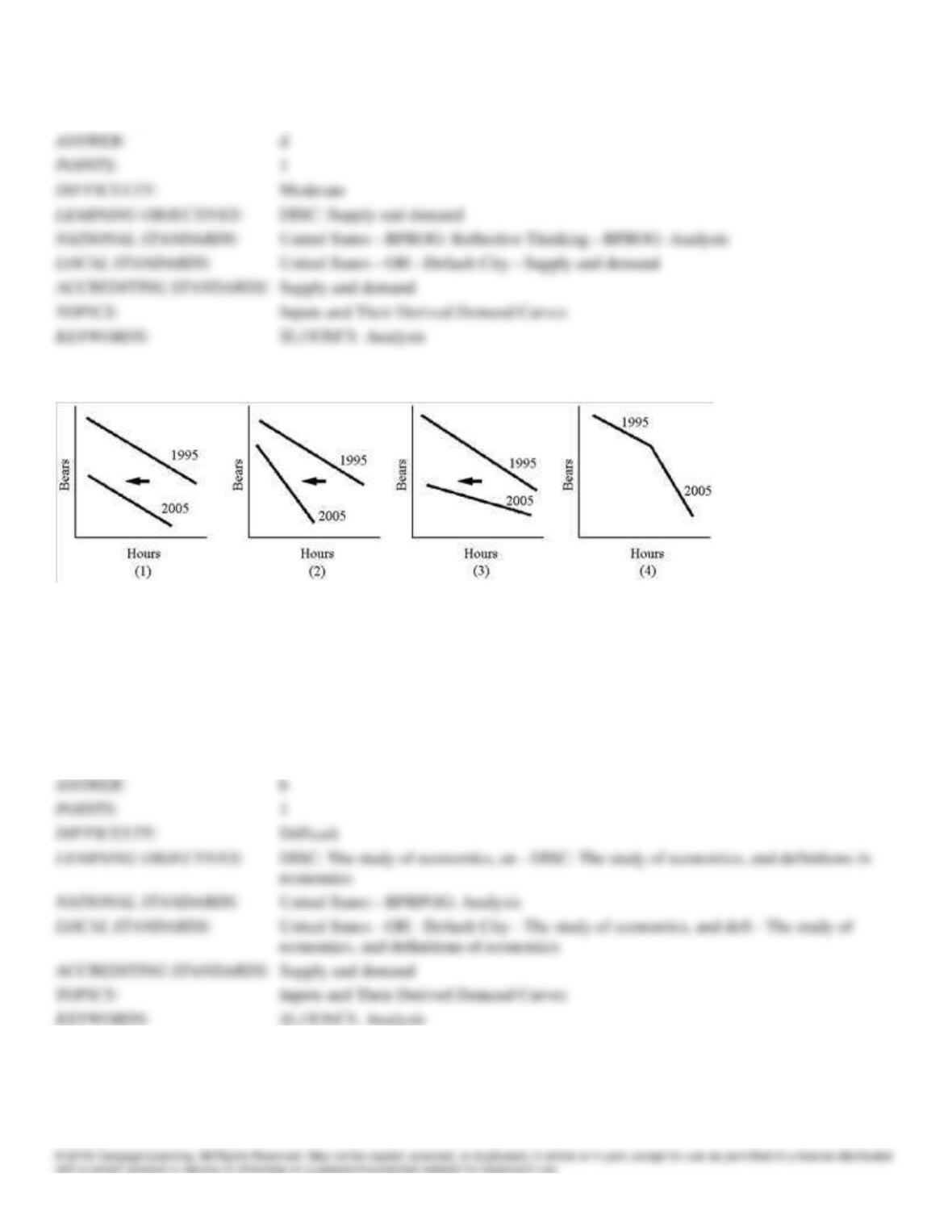
Figure 19-1
93. Mr. Paque is a bear hunter for timber companies that want to diminish damage to trees done by bears in the spring.
Due to a reduction in the bear population between 1995 and 2005, Mr. Paque finds fewer bears each year and additional
hours spent hunting produce fewer additional bears. The change in Mr. Paque’s MPP curve between 1995 and 2005 is best
illustrated by which panel in Figure 19–1?
a.
1
b.
2
c.
3
d.
4
b
1
United States – BPRPOG: Analysis
Supply and demand
Inputs and Their Derived Demand Curves
94. Mr. Paque is a bear hunter for timber companies that want to diminish damage to trees done by bears in the spring.
Due to a reduction in the bear population between 1995 and 2005, Mr. Paque finds fewer bears each year and additional
hours spent hunting produce fewer additional bears. With the information given and noting that the bounty on bears has
risen, one can conclude that (i) Mr. Paque’s income per hunting hours will fall; (ii) the derived demand for Mr. Paque’s
services will shift left.
a.
i and ii
b.
i not ii
c.
ii not i
d.
neither i nor ii
DISC: Supply and demand
United States – BPRPOG: Analysis
United States – OH – Default City – Supply and demand
Supply and demand
Inputs and Their Derived Demand Curves
95. Mr. Paque is a bear hunter for timber companies that want to diminish damage to trees done by bears in the spring.
Due to a reduction in the bear population between 1995 and 2005, Mr. Paque finds fewer bears each year and additional
hours spent hunting produce fewer additional bears. This means that Mr. Paque’s (i) overall productivity has fallen; (ii)
marginal product has fallen.
a.
i and ii
b.
i not ii
c.
ii not i
d.
neither i nor ii
DISC: Marginal costs & benefits
United States – BPROG: Reflective Thinking – BPROG: Analysis
United States – OH – Default City – Marginal costs & benefits
Marginal costs & benefits
Inputs and Their Derived Demand Curves
96. Demand for inputs is a derived demand because
a.
it is derived from the need for income.
b.
it corresponds to the derived supply of the inputs.
c.
producers want the input to produce the finished good.
d.
it is downward sloping.
DISC: Supply and demand
United States – BPROG: Analytic
United States – OH – Default City – Supply and demand
Supply and demand
Inputs and Their Derived Demand Curves
97. A recent decline in interest rates made home construction more affordable for many families. The consequent increase
in construction produced a rightward shift in the demand curves for construction materials. Economists would say that the
change in demand for materials is due to
a.
the principle of marginal productivity.
b.
rent seeking.
c.
diminishing marginal returns.
d.
derived demand.
DISC: Supply and demand
United States – BPROG: Analytic
United States – OH – Default City – Supply and demand
Supply and demand
Inputs and Their Derived Demand Curves
98. It is true of the demand side of the market for input pricing that
a.
the same marginal productivity principle serves as the foundation for the demand schedule for each type of
input.
b.
the demand schedule for one input cannot be determined independently of demand schedules for other inputs.
c.
the demand curve is the complete MRP curve.
d.
any inward shift in demand for a commodity will result in outward shifts in the demand curves for the inputs
used to produce the commodity.
DISC: Supply and demand
United States – BPROG: Analytic
United States – OH – Default City – Supply and demand
Supply and demand
Inputs and Their Derived Demand Curves
Figure 19-2
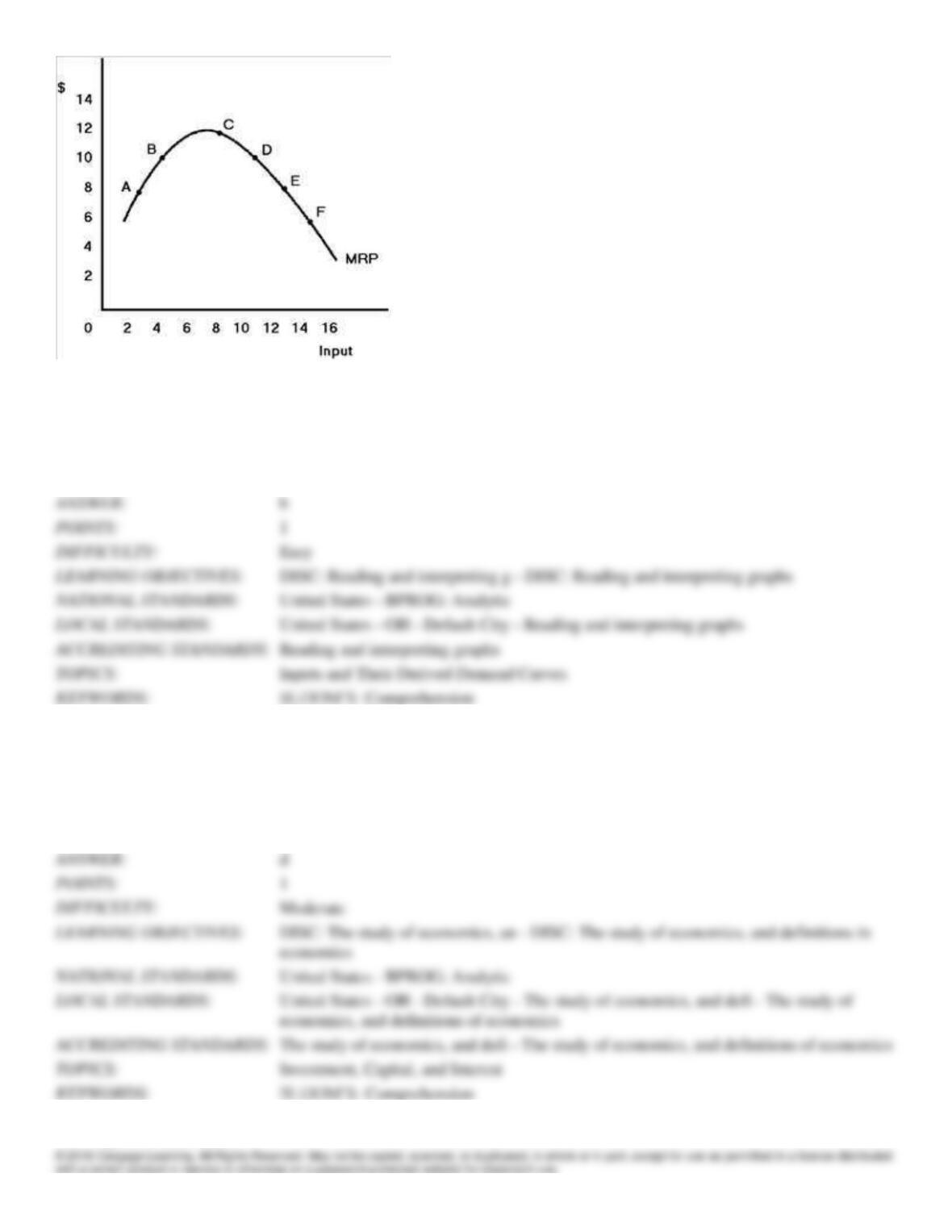
99. The demand curve for the input in Figure 19-2 is
a.
ABCD.
b.
CDEF.
c.
BCDE.
d.
EF.
Easy
DISC: Reading and interpreting g – DISC: Reading and interpreting graphs
United States – BPROG: Analytic
United States – OH – Default City – Reading and interpreting graphs
Reading and interpreting graphs
Inputs and Their Derived Demand Curves
100. Capital is the
a.
flow of new equipment that a firm acquires over the course of a year.
b.
amount of increase in a firm’s equipment over a year.
c.
amount of money that a firm has on hand at a given time.
d.
stock of plant, equipment, and other productive resources held by a firm.
Moderate
United States – BPROG: Analytic
The study of economics, and defi – The study of economics, and definitions of economics
101. Capital is defined as
a.
a flow of money into a business to buy various inputs.
b.
automated production processes which require little or no labor.
c.
interest payments to owners of companies.
d.
an inventory of plant, equipment and other productive resources held by a firm.
Moderate
economics
United States – BPROG: Analytic
The study of economics, and defi – The study of economics, and definitions of economics
Investment, Capital, and Interest
102. Capital is to investment as
a.
hard is to soft.
b.
a flow is to a stock.
c.
a stock is to a flow.
d.
paper is to metal.
c
Moderate
United States – BPROG: Reflective Thinking – BPROG: Analysis
The study of economics, and defi – The study of economics, and definitions of economics
Investment, Capital, and Interest
103. Investment is the amount by which ____ grows.
a.
portfolio
b.
income
c.
earnings
d.
capital
Moderate
United States – BPROG: Analytic
The study of economics, and defi – The study of economics, and definitions of economics
Investment, Capital, and Interest
104. The process of building up capital includes
a.
acquiring funds from banks and other sources.
b.
use of borrowed funds to hire inputs to build factories, warehouses, etc.
c.
completion of the investment process by adding machinery and inventory.
d.
All of the above are correct.
Moderate
DISC: Productivity and growth
United States – BPROG: Analytic
United States – OH – Default City – Productivity and growth
Productivity and growth
Investment, Capital, and Interest
105. The one feature of capital that makes it unlike most inputs is that it is
a.
durable.
b.
productive.
c.
an economic good.
d.
used to produce only consumer goods.
a
Moderate
United States – BPROG: Analytic
The study of economics, and defi – The study of economics, and definitions of economics
Investment, Capital, and Interest
106. Capital is appropriately classified as a
a.
flow.
b.
process.
c.
stock.
d.
growth rate.
c
Moderate
United States – BPROG: Analytic
economics, and definitions of economics
The study of economics, and defi – The study of economics, and definitions of economics
Investment, Capital, and Interest
107. If investment is zero, the capital stock
a.
continues to flow.
b.
falls to zero.
c.
remains constant.
d.
grows steadily.
United States – BPROG: Analytic
Investment, Capital, and Interest
108. Which of the following is usually a durable good?
a.
a unit of labor
b.
the interest rate
c.
a depletable resource
d.
a capital good
United States – BPROG: Analytic
economics, and definitions of economics
The study of economics, and defi – The study of economics, and definitions of economics
Investment, Capital, and Interest
109. Each firm’s capital stock is fixed in the short run. Therefore, if the price of capital increases, then in the short run the
market demand curve for labor in a perfectly competitive market will
a.
shift inward.
b.
be unaffected.
c.
shift outward.
d.
change slope.
United States – BPROG: Analytic
The study of economics, and defi – The study of economics, and definitions of economics
Investment, Capital, and Interest
110. Which of the following is an example of an investment?
a.
A company placing cash reserves in a bank.
b.
A company buying Yahoo shares.
c.
A company augmenting its production capacity.
d.
A company issuing bonus shares.
DISC: Productivity and growth
United States – BPROG: Reflective Thinking – BPROG: Analysis
United States – OH – Default City – Productivity and growth
Productivity and growth
Investment, Capital, and Interest
111. The interest rate is the
a.
rate of investment.
b.
price of credit.
c.
rate of return on investment in capital goods.
d.
expected rate of inflation.
United States – BPROG: Analytic
The study of economics, and defi – The study of economics, and definitions of economics
Investment, Capital, and Interest
112. Interest is the payment for the use of
a.
borrowed funds.
b.
natural resources.
c.
labor.
d.
any factor of production.
a
Easy
United States – BPROG: Analytic
The study of economics, and defi – The study of economics, and definitions of economics
Investment, Capital, and Interest
113. The interest rate is determined by
a.
the supply and demand of loanable funds.
b.
the supply and demand of land.
c.
the supply and demand of marginal land.
d.
None of the above is correct.
a
Easy
DISC: Supply and demand
United States – BPROG: Analytic
United States – OH – Default City – Supply and demand
Supply and demand
Investment, Capital, and Interest
114. Discounting allows comparisons of
a.
money values and physical values.
b.
interest payments on borrowed funds and interest payments on loaned funds.
c.
money values received at different times.
d.
the quantities of outputs produced by different types of capital goods.
c
Easy
United States – BPROG: Analytic
Understanding and applying econo – Understanding and applying economic models
Investment, Capital, and Interest
115. A sum of money received at a future date
a.
is worth less than the same sum of money received today.
b.
is worth more than the same sum of money received today.
c.
has the same value as the same sum of money received today.
d.
is worth less than the same sum of money received yesterday.
United States – BPROG: Analytic
The study of economics, and defi – The study of economics, and definitions of economics
Investment, Capital, and Interest
116. Suppose that the rate of interest increases. What will happen to the discounted present value of an investment?
a.
It will increase.
b.
It will decrease.
c.
It will remain unchanged.
d.
It depends on the magnitude of the change.
United States – BPROG: Analytic
economics, and definitions of economics
The study of economics, and defi – The study of economics, and definitions of economics
Investment, Capital, and Interest
117. Which of the following statements is correct?
a.
The demand for capital is derived from the demands for outputs.
b.
The demands for output are derived from the demand for capital.
c.
The demand for capital is derived from the demand for rent.
d.
The demand for rent is derived from the demand for capital.
DISC: Supply and demand
United States – BPROG: Analytic
United States – OH – Default City – Supply and demand
Supply and demand
Investment, Capital, and Interest
118. The demand for capital is
a.
directly related to the interest rate.
b.
inversely related to the interest rate.
c.
unrelated to the interest rate.
d.
first falls, and then rises, in relation to the interest rate.
DISC: Supply and demand
United States – BPROG: Analytic
United States – OH – Default City – Supply and demand
Supply and demand
Investment, Capital, and Interest
119. At high levels of interest, borrowers will borrow ____ and suppliers will supply ____.
a.
more; less
b.
less; more
c.
less; less
d.
more; more
DISC: Supply and demand
United States – BPROG: Analytic
United States – OH – Default City – Supply and demand
Supply and demand
Investment, Capital, and Interest
120. Firms should stop borrowing funds
a.
as soon as the bank raises the interest rate.
b.
when the MRP of borrowed funds is equal to the cost of borrowing.
c.
whenever the future of the firm looks gloomy.
d.
if their debts are more than 25 percent of the value of the firm.
DISC: Marginal costs & benefits
United States – BPROG: Analytic
United States – OH – Default City – Marginal costs & benefits
Marginal costs & benefits
Investment, Capital, and Interest