b.
The dollar would appreciate against the baht.
c.
The dollar would remain at the same value against the baht.
d.
The dollar would appreciate depending on the elasticity of demand for bahts.
e.
The dollar would depreciate depending on the elasticity of demand for bahts.
43. Refer to Figure 18.1. Assume that there is a market perception that the value of Thai assets will decrease in the near
future. This affects the current equilibrium exchange rate. What can the Thai central bank do to restore the previous value
of the baht?
a.
Increase the demand for U.S. dollars
b.
Sell Thai bahts in the foreign exchange market
c.
Sell dollars in the foreign exchange market
d.
Appeal to the WTO for help
e.
Buy back outstanding Thai bonds in open market operations
MACR.BOYE.16.95 – ch. 18, 5
United States – Reflective Thinking
Financial Crises and Globalization
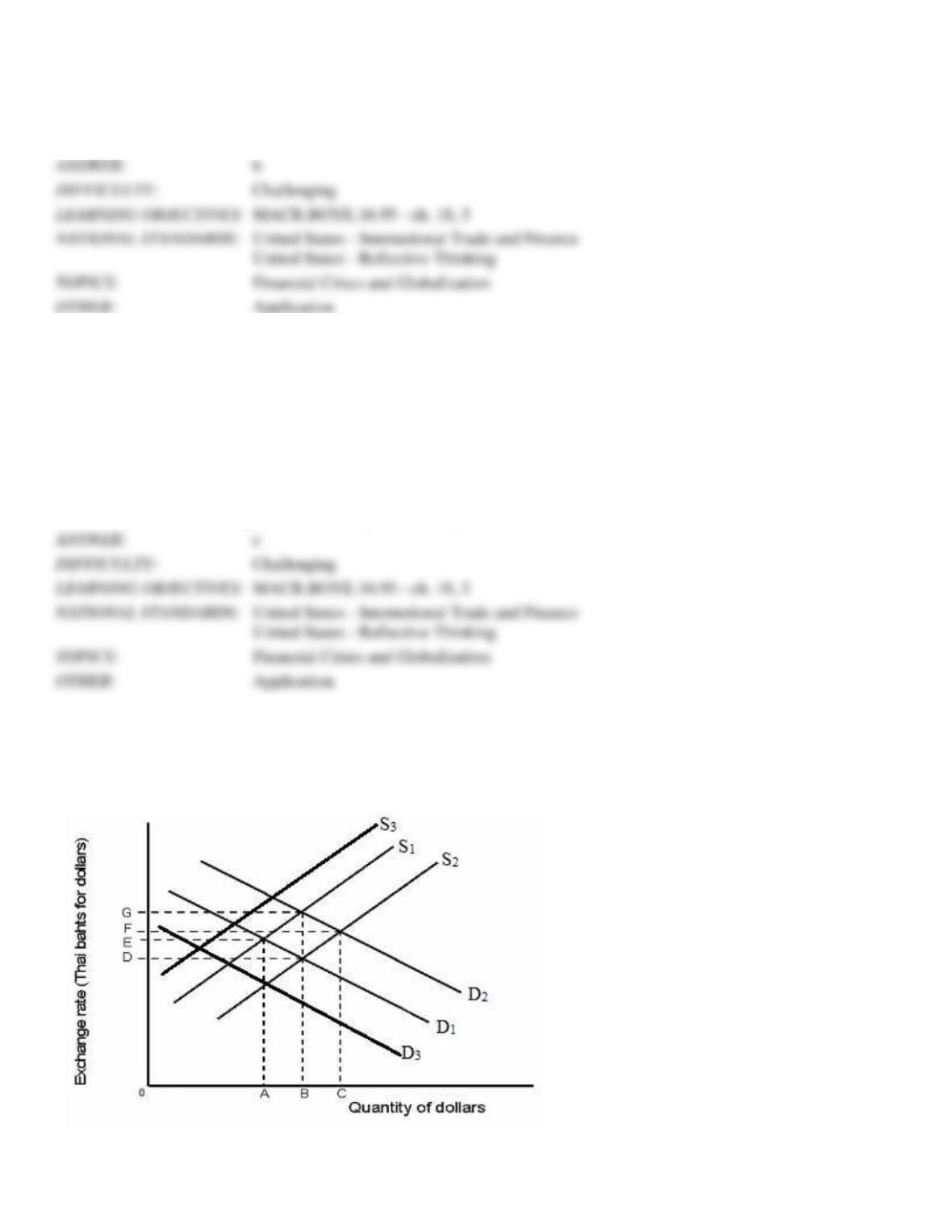
The figure given below shows the demand curves for dollars arising out of Thai demand for U.S. goods and services and
the supply of dollars arising out of the U.S. demand for Thai goods, services, and financial assets. D1 and S1 are the
original demand and supply curves.
Figure 18.2
44. Refer to Figure 18.2. Suppose investors predict that the value of Thai assets will decrease in the near future. This
MACR.BOYE.16.95 – ch. 18, 5
Financial Crises and Globalization
affects the current equilibrium exchange rate. To restore the original equilibrium, the Thai government intervenes in the
foreign exchange market. How will this government action appear on the graph?
a.
As a shift in the demand curve from D2 to D1
b.
As a shift in the demand curve from D1 to D3
c.
As a shift in the supply curve from S1 to S3
d.
As a shift in the supply curve from S1 to S2
e.
As a shift in the demand curve from D2 to D3
45. Refer to Figure 18.2. Assume that the foreign exchange market is initially at equilibrium when the demand and supply
curves are D1 and S1 respectively. When the demand curve shifts from D1 to D2, the Thai government intervenes to
restore the original equilibrium. If Figure 18.2 describes these changes, which of the following will be true?
a.
The baht depreciates slightly, as the equilibrium exchange rate goes down from E to F.
b.
The baht depreciates, as the equilibrium exchange rate goes up from E to G.
c.
The baht appreciates, as the equilibrium exchange rate goes down from E to D.
d.
The equilibrium exchange rate goes up from D to G.
e.
The baht appreciates slightly, as the equilibrium exchange rate goes up from E to F.
MACR.BOYE.16.95 – ch. 18, 5
Financial Crises and Globalization
46. To counteract the depreciation of the national currency against the U.S. dollar, the central bank of a country can
intervene in the foreign exchange market. Which of the following imposes a restriction on this ability of the central banks
to maintain a fixed exchange rate?
a.
The central banks have a limited amount of international reserve.
b.
The central banks have a limited amount of domestic currency.
c.
Unrestricted sale of foreign currency will cause inflation in the domestic economy.
d.
The supply of dollars is perfectly elastic in the foreign exchange market.
e.
The central banks need to maintain a certain amount of its assets in the form of gold.
MACR.BOYE.16.95 – ch. 18, 5
Financial Crises and Globalization
MACR.BOYE.16.95 – ch. 18, 5
47. Suppose, before the Asian financial crisis, the Thai baht was fixed against the dollar at a rate of 26 bahts for one U.S.
dollar. If the exchange rate were allowed to float freely, the market would then set the rate at 35 bahts for one dollar.
Under these circumstances, we say that the baht was:
a.
about to appreciate.
b.
fixed below its par value.
c.
overvalued.
d.
undervalued.
e.
revalued.
Moderate
MACR.BOYE.16.95 – ch. 18, 5
Financial Crises and Globalization
Application
48. As the Asian financial crisis of 1997 began to spread, it became obvious to investors that Korean investments would
provide lower returns than expected. What was the impact of such a realization on the foreign exchange market?
a.
The supply of Korean won decreased as people tried to withdraw their Korean investments.
b.
The price of dollar in terms of Korean currency decreased as people invested more in U.S. assets.
c.
The demand for dollars decreased as investors realized that there is a worldwide crisis going on.
d.
The demand for dollars increased as investors put their money in U.S. and other foreign assets.
e.
The demand for Korean won increased as investors decided to invest in Korean assets.
d
Challenging
MACR.BOYE.16.95 – ch. 18, 5
United States – International Trade and Finance
United States – Reflective Thinking
Financial Crises and Globalization
Application
49. Which of the following is an example of a speculative attack on a currency?
a.
National governments decide to engage in competitive devaluations against a given country.
b.
International organizations such as the WTO and the IMF attempt to reorder the currency’s system.
c.
Private investors sell domestic currency and buy foreign currency, betting that the domestic currency will soon
be devaluated.
d.
Casinos in Las Vegas allow the proliferation of bets for and against a given currency.
e.
A country is at war, and the enemy country “freezes” all the accounts denominated in the local currency.
Moderate
MACR.BOYE.16.95 – ch. 18, 5
United States – Analytic – BB-Legal
United States – International Trade and Finance
Knowledge
Revised
50. After a speculative attack has been successful, and a country is forced to devalue its currency, it is common to see
many local business firms driven to bankruptcy. This most commonly occurs because _____.
a.
nobody ever wants to invest in a country that just suffered a devaluation
b.
many local firms took foreign loans (denominated in, say, dollars), and they cannot repay them at the new
exchange rate
c.
the WTO forces troubled firms to show profits or make way for new, more efficient firms
d.
local firms cannot compete with their foreign competitors at the new prices after the devaluation
e.
many local firms do not know how to deal with the complicated financial operations involved in a speculative
attack
51. Generally, which of the following is the most common reason why countries that experienced a financial crisis could
not maintain their fixed exchange rate?
a.
They were exporting too many commodities.
b.
The rates they had established were not in accordance with directives from the IMF.
c.
The exchange rate parities established were inconsistent with their corresponding macroeconomic policies.
d.
The general public refused to participate.
e.
The parities established made their currencies undervalued.
MACR.BOYE.16.95 – ch. 18, 5
United States – Analytic – BB-Legal
United States – International Trade and Finance
Financial Crises and Globalization
52. There are certain variables that are so obviously related to past crises that they may serve as warning indicators of
potential future crises. Identify one such variable from the following.
a.
Barriers to trade
b.
Short-term international investment
c.
Flexible exchange rates
d.
Rising international reserves
e.
Fluctuating share prices
MACR.BOYE.16.95 – ch. 18, 5
Financial Crises and Globalization
MACR.BOYE.16.95 – ch. 18, 5
Financial Crises and Globalization
53. Which of the following is a probable consequence of the presence of accounting rules that allow firms to hide the
financial impact of actions that would harm investors?
a.
Investors may be able to enforce market efficiency.
b.
The WTO will disenfranchise the country that allows this to happen.
c.
Investors will immediately organize a speculative attack and the price of stocks will inflate.
d.
The balance-of-payments deficit will increase, leading the economy into a debt trap.
e.
Investors may not be able to adequately judge when the risk of investing in a firm rises.
MACR.BOYE.16.95 – ch. 18, 5
Financial Crises and Globalization
54. Which of the following increases the possibility of depreciation of the domestic currency in the foreign exchange
market?
a.
An increase in the demand for domestic goods in the foreign market
b.
A decrease in total imports made by the domestic country
c.
A decrease in the interest rates in the domestic country
d.
An increase in the short-term foreign investments
e.
An increase in domestic production of import substitutes
MACR.BOYE.16.95 – ch. 18, 5
Financial Crises and Globalization
55. Which of the following resulted in the financial crisis in 2007-08?
a.
Falling international reserves
b.
Short-term investments made by China in the US
c.
Lack of transparency
d.
Bad loans on U.S. mortgages
e.
Fixed rates of interest
MACR.BOYE.16.95 – ch. 18, 5
United States – International Trade and Finance
Financial Crises and Globalization
56. The financial crisis of 2007-2008 illustrated how important the integration of international financial markets could be
in contributing to the spread of financial problems from one country to another. What solution is cited to curb the spread
of financial problems from one country to another?
a.
Better regulation of financial institutions to ensure prudent risk taking
b.
Lowering the fiscal budget
c.
Reducing international investment
d.
Paying off debts from the Federal Reserve
e.
Mitigating lack of government transparency
57. The deleveraging of financial institutions led to the financial crisis of 2007-2008 sometimes also referred to as the
_____.
a.
stock crisis
b.
debt crisis
c.
stock market bubble
d.
bank run
e.
credit crisis
Easy
MACR.BOYE.16.95 – ch. 18, 5
United States – International Trade and Finance
Financial Crises and Globalization
Knowledge
58. Globalization is an economic issue and does not involve political and social dimensions.
a.
True
b.
False
False
MACR.BOYE.16.91 – ch. 18, 1
The Meaning of Globalization
Knowledge
59. Globalization benefits all the participating nations equally.
a.
True
b.
False
Moderate
MACR.BOYE.16.95 – ch. 18, 5
Financial Crises and Globalization
Knowledge
Revised
60. International trade constantly increased throughout the twentieth century.
a.
True
b.
False
False
Easy
MACR.BOYE.16.91 – ch. 18, 1
Financial Crises and Globalization
Knowledge
61. Barriers to immigration are much higher in most countries today, than it was in the twentieth century.
a.
True
b.
False
True
Easy
Knowledge
62. Family, language, and customs tie people to particular areas, so that the fact that people have the right to migrate does
not mean that large numbers of them will actually do so.
a.
True
b.
False
True
Easy
MACR.BOYE.16.91 – ch. 18, 1
United States – International Trade and Finance
The Meaning of Globalization
Knowledge
63. An overall decline in communication and transportation costs have facilitated global interactions in the twentieth and
the twenty first century.
a.
True
b.
False
True
MACR.BOYE.16.91 – ch. 18, 1
MACR.BOYE.16.91 – ch. 18, 1
The Meaning of Globalization
Knowledge
64. Poor and developing countries are ranked on the top of the list of globalized countries by the KOF Swiss Economic
Institute.
a.
True
b.
False
False
Easy
MACR.BOYE.16.91 – ch. 18, 1
The Meaning of Globalization
Knowledge
65. Larger countries tend to be more globalized, because their large internal markets allow them to export a wide range of
products.
a.
True
b.
False
False
Moderate
MACR.BOYE.16.91 – ch. 18, 1
The Meaning of Globalization
Knowledge
66. Critics of globalization argue that international trade agreements represent roadblocks to democratic decision making,
because power is decentralized from large international institutions to the local communities in the process.
a.
True
b.
False
False
Easy
MACR.BOYE.16.92 – ch. 18, 2
United States – International Trade and Finance
Globalization Controversy
Knowledge
67. The phrase “race to the bottom” refers to the situation in which globalization results in countries competing for
international investment by imposing low or no environmental regulations or labor standards.
a.
True
b.
False
Easy
Knowledge
68. Globalization does not reward countries that follow good economic policies with greater access to the savings of the
rest of the world to help finance growth and development.
a.
True
b.
False
False
Easy
MACR.BOYE.16.92 – ch. 18, 2
Globalization Controversy
Comprehension
69. Supporters of globalization believe that free trade and international investment result in all countries raising their
living standards.
a.
True
b.
False
True
Easy
MACR.BOYE.16.93 – ch. 18, 3
Globalization Controversy
Knowledge
70. Without the presence of international organizations such as the World Bank, the United Nations, and the WTO,
transfers of funds from rich to poor countries would not exist in an ongoing manner.
a.
True
b.
False
True
Easy
MACR.BOYE.16.93 – ch. 18, 3
United States – International Trade and Finance
Globalization Controversy
Knowledge
71. Evidence exists that countries with the most open economies tend to have more stringent environmental regulations.
a.
True
b.
False
Easy
MACR.BOYE.16.92 – ch. 18, 2
Globalization Controversy
Knowledge
72. Supporters of globalization argue that multinational firms pay higher wages than local firms, and provide greater
benefits for workers than existed in the country prior to globalization.
a.
True
b.
False
True
Easy
MACR.BOYE.16.93 – ch. 18, 3
Globalization Controversy
Knowledge
Revised
73. Any movement to reduce the globalization of the world’s economies will make workers in the poorest countries worse
off than they would otherwise be.
a.
True
b.
False
True
Easy
MACR.BOYE.16.93 – ch. 18, 3
United States – International Trade and Finance
Globalization Controversy
Knowledge
74. India is one of the countries that did not participate in the process of globalization.
a.
True
b.
False
False
Easy
MACR.BOYE.16.94 – ch. 18, 4
United States – International Trade and Finance
Globalization, Economic Growth, and Incomes
Knowledge
75. In the last two decades, income inequality has increased in China.
a.
True
b.
False
Easy
MACR.BOYE.16.93 – ch. 18, 3
Globalization Controversy
Knowledge
76. It has been proved empirically that globalization increases economic growth without increasing income
inequality within nations.
a.
True
b.
False
True
Easy
MACR.BOYE.16.94 – ch. 18, 4
Globalization, Economic Growth, and Incomes
Knowledge
77. Globalization had to be put into effect to revive developed economies after the financial crises of the 1990s.
a.
True
b.
False
False
Easy
MACR.BOYE.16.95 – ch. 18, 5
Financial Crises and Globalization
Knowledge
78. In the financial crises of the 1990s, investors lost huge amounts of wealth as a consequence of the rapid drop in values
of local firms in each country.
a.
True
b.
False
True
Easy
United States – International Trade and Finance
Financial Crises and Globalization
Knowledge
79. An increase in the supply of U.S. dollars in the foreign exchange market would cause the dollar to appreciate with
respect to other currencies.
a.
True
b.
False
Moderate
MACR.BOYE.16.94 – ch. 18, 4
Globalization, Economic Growth, and Incomes
Knowledge
80. In the financial crises of the 1990s, countries lost international reserves trying to maintain the parity of their
currencies.
a.
True
b.
False
True
Moderate
United States – International Trade and Finance
Financial Crises and Globalization
Knowledge
81. Because of the large amounts of resources devoted to understanding the nature of financial crises, researchers now feel
comfortable making forecasts and do not expect to have any more surprises in the future.
a.
True
b.
False
False
Easy
MACR.BOYE.16.95 – ch. 18, 5
United States – International Trade and Finance
Financial Crises and Globalization
Knowledge
82. Investors may be caught by surprise when devaluation occurs, particularly if the government does not disclose its
international reserve position in a timely and informative manner.
a.
True
b.
False
True
Easy
MACR.BOYE.16.95 – ch. 18, 5
Financial Crises and Globalization
Knowledge
83. The smaller the amount of short-term money invested in a country, the greater the potential for a crisis if investors lose
confidence in the country.
a.
True
b.
False
MACR.BOYE.16.95 – ch. 18, 5
Financial Crises and Globalization
Application
Revised
84. The financial crises of the 1990s have conclusively proved that globalization causes financial crises.
a.
True
b.
False
False
Easy
United States – International Trade and Finance
Knowledge
85. Short-term international investment helps to create a greater level of liquidity, more stable exchange rates, and
therefore a decreased likelihood of financial crisis.
a.
True
b.
False
False
MACR.BOYE.16.95 – ch. 18, 5
United States – International Trade and Finance
Knowledge
True
Easy
MACR.BOYE.16.95 – ch. 18, 5
United States – International Trade and Finance
Knowledge