Macroeconomics: Policy and Practice, 2e (Mishkin)
Chapter 18 Consumption and Saving
18.1 The Relationship Between Consumption and Saving
1) Consumption spending comprises what percentage of total spending?
A) 0.7 percent
B) 7 percent
C) 70 percent
D) 700 percent
2) A theory of saving is necessarily a theory of consumption, because ________.
A) by definition, any unit of disposable income that is not a consumption expenditure is a unit of
saving
B) consumption decisions are made after saving has occurred
C) private saving is equal to private investment
D) the goal of consumption choices is to achieve the desired level of savings
3) Gross income net of taxes is known as ________.
A) Gross Domestic Product, or GDP
B) disposable income
C) Gross Domestic Product per capita
D) retained earnings
4) The after-tax income received by the household sector is known as ________.
A) disposable income
B) retained earnings
C) net national product per capita
D) Gross Domestic Product
5) Disposable income represents ________.
A) the income received by firms, e.g. corporations
B) an increase in GDP
C) a decrease in GDP
D) the after-tax income received by the household

2
6) In the equation S = Y – C, in order to interpret Y as disposable income, it is necessary to
interpret S as ________ saving.
A) private
B) national
C) government
D) business
18.2 Intertemporal Choice and Consumption
1) An intertemporal budget constraint ________.
A) describes how much time an individual consumer has to spend their disposable net national
product
B) is independent of the real interest rate and wealth of the household
C) divides consumption spending into three categories: spending on durables, non-durables and
services
D) describes how much a person can consume today versus tomorrow
2) An intertemporal budget constraint is downward sloping due to ________.
A) the trade-off between current and future consumption
B) the law of diminishing marginal productivity
C) the law of supply
D) the law of demand
3) The theory of intertemporal choice was presented by ________.
A) Adam Smith in 1776
B) Alfred Marshall in 1871
C) Irving Fisher in 1930
D) John Maynard Keynes in 1936
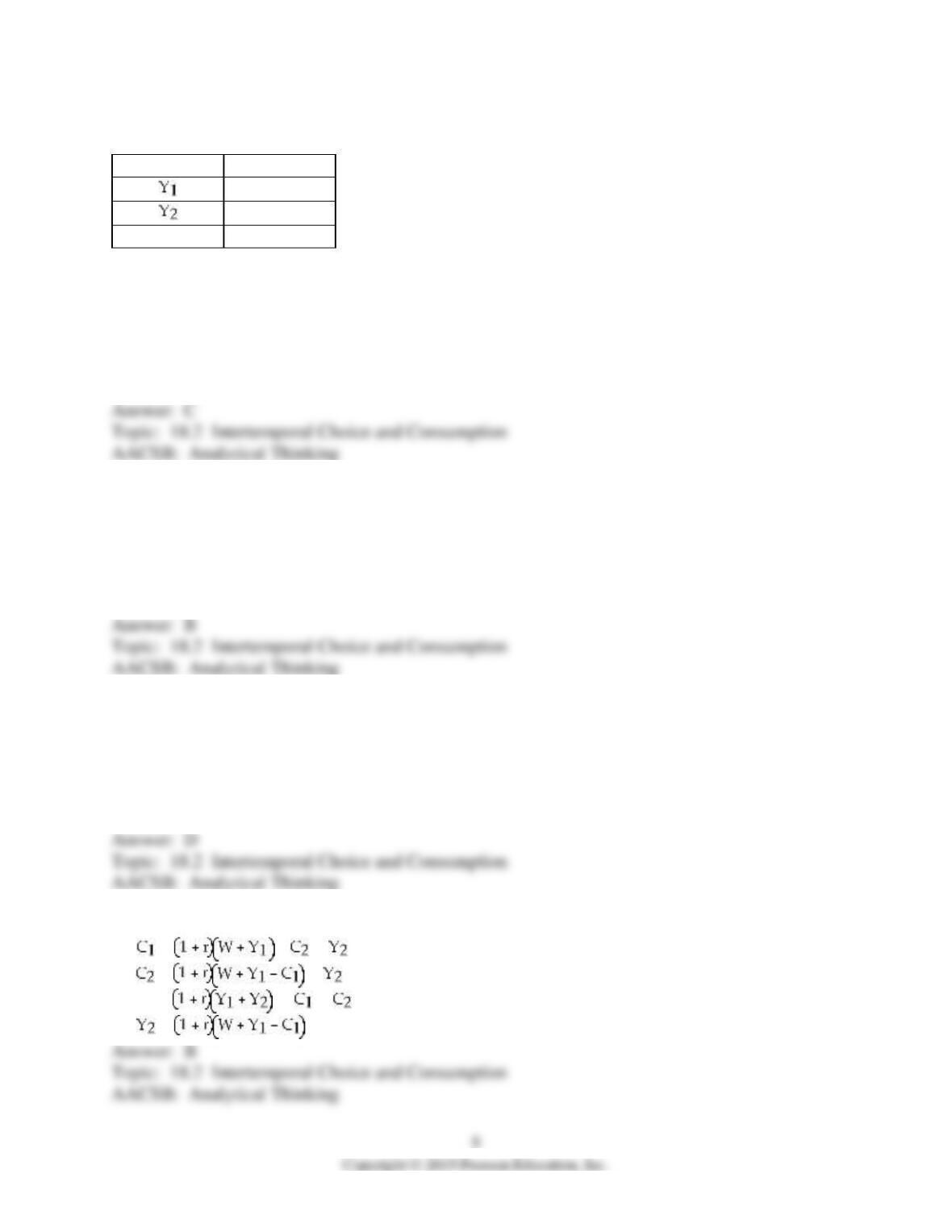
Intertemporal Budget Constraint
r
0.04
$10,000
$40,000
W
$20,000
4) Referring to the table above, if consumption in period one is zero, then consumption in period
two cannot be greater than ________.
A) $72,800
B) $70,400
C) $71,200
D) $70,800
5) Referring to the table above, if consumption in period one is $20,000, then consumption in
period two cannot be greater than ________.
A) $52,800
B) $50,400
C) $49,600
D) $50,000
6) Referring to the table above, the present discounted value of initial wealth plus total income is
________.
A) $67,308
B) $71,200
C) $70,400
D) $68,462
7) Which of the following is the correct statement of an intertemporal budget constraint?
A) = – +
B) = +
C) W = – ( + )
D) =

4
8) Discounting involves dividing next-period income by ________.
A) one plus the real rate of interest
B) the nominal rate of interest
C) current income
D) the real rate of interest
9) Assuming no bequests, with a real interest rate of 10 percent, wealth of $60,000, current
income of $70,000, current consumption of $30,000 and future income of $100,000, future
consumption equals ________.
A) $30,000
B) $70,000
C) $100,000
D) $210,000
10) Assuming no bequests, with a real rate of interest of 10 percent, wealth of $60,000, current
income of $70,000, future income of $180,000 and future consumption of $158,000, current
consumption must equal ________.
A) $158,000
B) $150,000
C) $152,000
D) $130,000
11) The farther an indifference curve lies from the origin ________.
A) the greater the level of individual income
B) the lower its utility
C) the lower the level of individual income
D) the higher its utility

12) Which of the following is not true of all indifference curves?
A) they slope downward
B) the point at which one indifference curve intersects another represents an optimal
consumption basket
C) they are bowed toward the origin
D) they can intersect with a budget constraint one or more times
13) If an indifference curve intersects the budget constraint at two points, then ________.
A) the consumer would be equally happy at either of those two points
B) optimal consumption is found by moving to a lower indifference curve
C) optimal consumption is found by moving to a lower budget constraint
D) the consumer will choose the point that minimizes consumption expenditure
14) The optimal level of consumption is achieved when ________.
A) consumption in one period is equal to consumption in the next period
B) utility in one period is equal to utility in the next period
C) all income and wealth has been spent
D) the slope of the indifference curve is equal to the slope of the budget line
15) Indifference curves tend to be convex because ________.
A) they are bowed inwards toward the origin
B) consumers dislike large fluctuations in consumption from one period to the next
C) of the gap between real and nominal interest rates
D) the marginal rate of substitution exceeds the price effect
16) Along any single indifference curve the ________.
A) consumer is equally satisfied with any of the combinations of goods
B) level of current income is unchanged
C) level of future income is unchanged
D) level of current and future income is unchanged

17) Indifference curves describe ________.
A) the relationship between current and future income
B) the utility received by an individual consumer
C) the relationship between utility and income
D) productivity levels
18) The rate at which a consumer is willing to give up consumption in one period for additional
consumption in another is known as ________.
A) the marginal propensity to save
B) the marginal propensity to consume
C) the marginal rate of substitution
D) the average propensity to consume
19) The equation MRS = 1 + r means that ________.
A) consumers prefer to avoid fluctuations in consumption
B) at the margin, consumption grows at the real interest rate
C) any movement along the budget constraint would cause a decrease in the consumer’s utility
D) consumer utility is a positive function of the real interest rate
18.3 The Intertemporal Choice Model in Practice: Income and Wealth
1) A rightward shift in the intertemporal budget line would be caused by ________.
A) an increase in future income and wealth
B) an increase in future income and a decrease in wealth
C) a decrease in future income and an increase in wealth
D) a decrease in future income and wealth
2) Consumption smoothing is a logical consequence of ________.
A) basing decision-making on real rather than nominal interest rates
B) the convexity of indifference curves and the ability to borrow and lend
C) the negative slope fo the intertemporal budget constraint
D) rational expectations
7
3) Consumption smoothing refers to ________.
A) the impact of future income on current consumption and of current income on future
consumption
B) the constancy of consumption over time
C) the impact of current consumption on future income and of future consumption on current
income
D) the tendency of consumers to adopt similar spending habits
4) Typically, consumers respond to an increase in (expected) future income by ________.
A) shifting the budget constraint to the left
B) increasing both current and future consumption
C) saving more to increase future wealth
D) waiting until the income is received before changing their consumption behavior
5) Assuming a real interest rate of four percent, which of these causes the largest increase in the
present value of lifetime resources?
A) a winning lottery ticket that pays $9,600 today
B) an additional $10,000 of income in the future period
C) a salary increase of $5,000 both today and in the future period
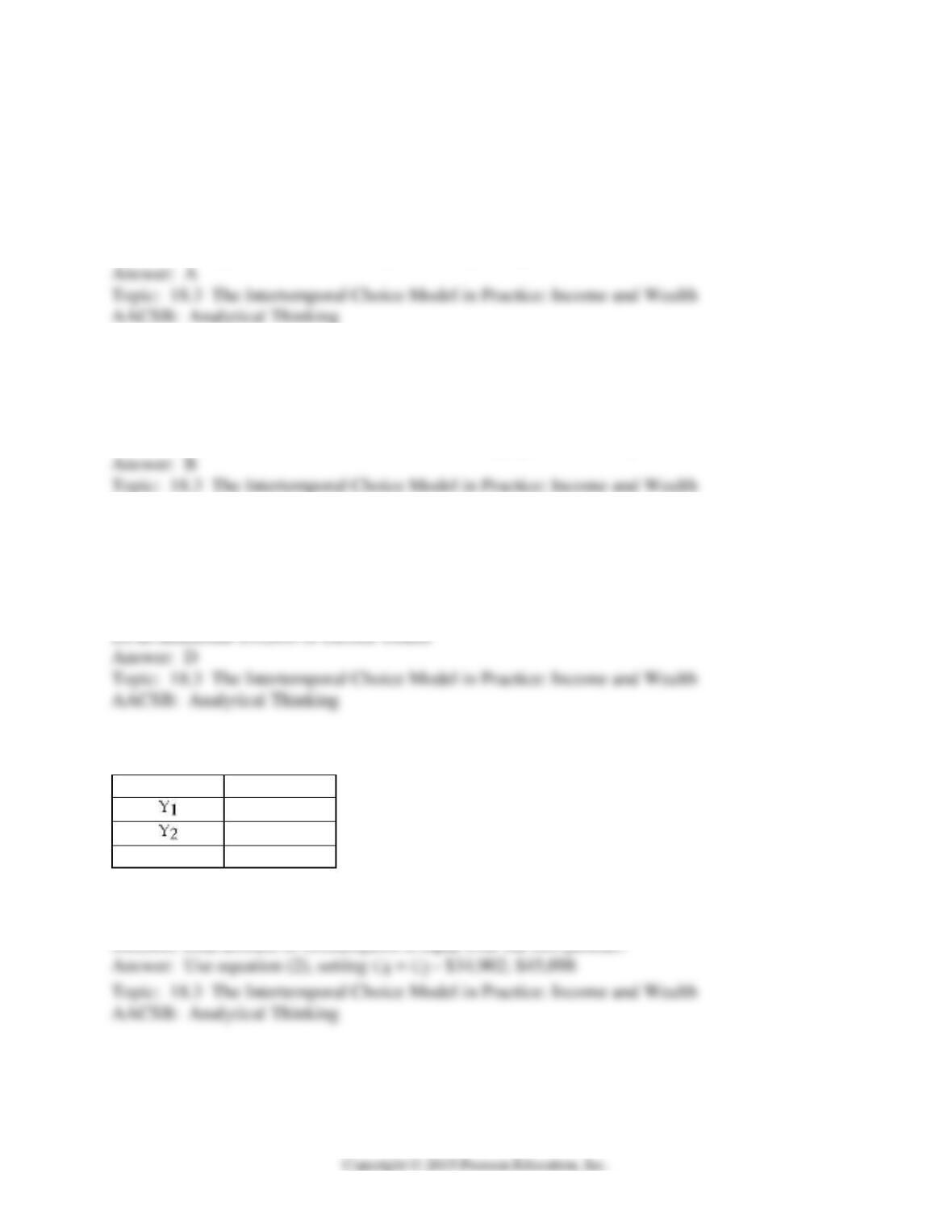
Intertemporal Budget Constraint
r
0.04
$10,000
$40,000
W
$20,000
6) Using the table above, and assuming no bequest, what amount of consumption is chosen in
period 1, if the consumer wants consumption in the two periods to be equal? If initial wealth is
8
18.4 The Intertemporal Choice Model in Practice: Interest Rates
1) ________ will increase current consumption, saving, and future consumption.
A) an increase in future income
B) an increase in initial wealth
C) an increase in current income
D) a decrease in the real interest rate
2) Real world economic data supports the view that higher interest rates are associated with
________.
A) higher saving and consumption
B) lower saving and higher consumption
C) higher saving and lower consumption
D) lower saving and consumption
3) The substitution effect that occurs when interest rates change involves a change in
consumption that develops from ________.
A) a change in the general level of prices
B) a period of increasing productivity
C) a change in the level of income
D) a change in the relative prices of consumption in the two periods
4) In practice, it is usual to assume that, in explaining the impact of a change in interest rates
________.
A) the substitution effects outweigh the income effects
B) the income effect outweighs the substitution effect
C) the income and substitution effects cancel out with one another
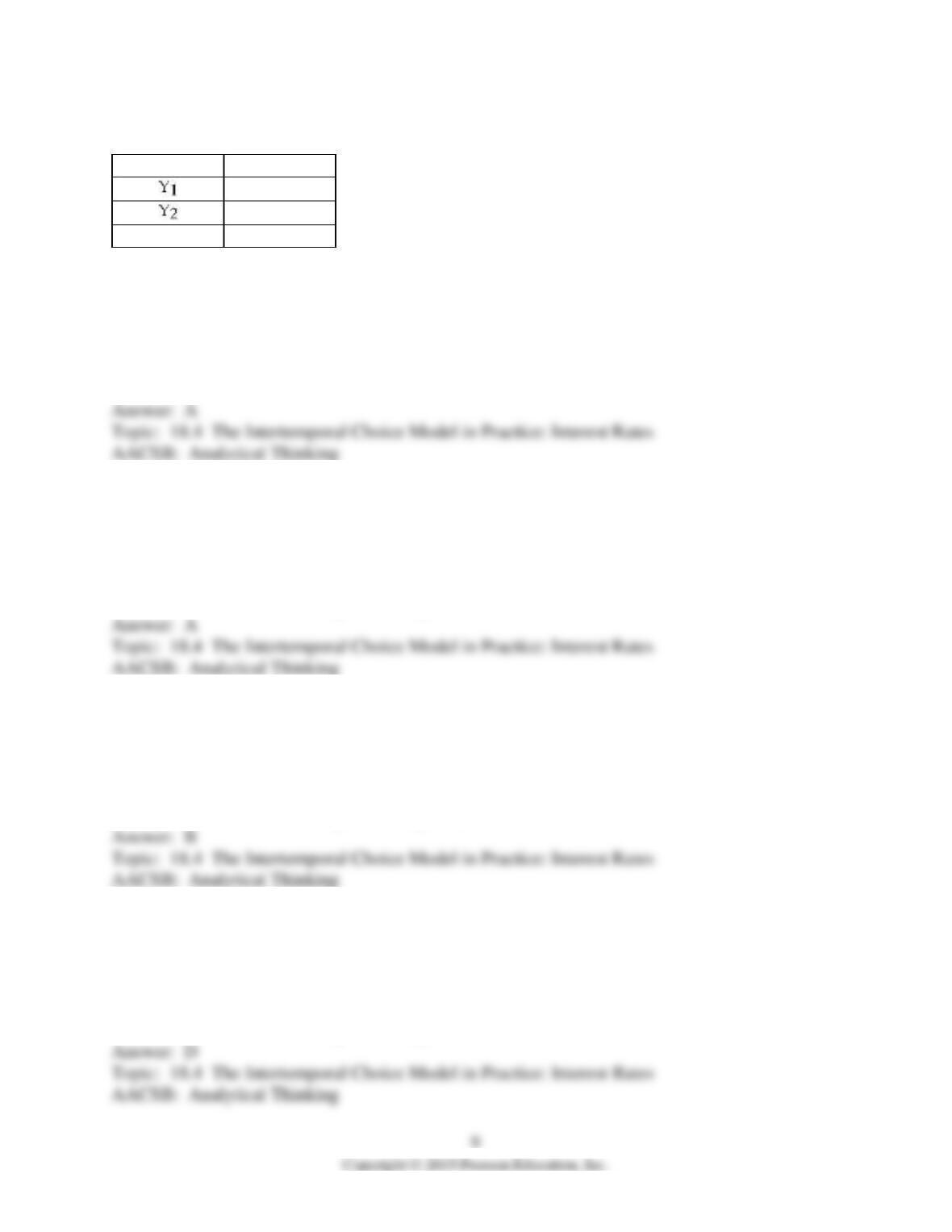
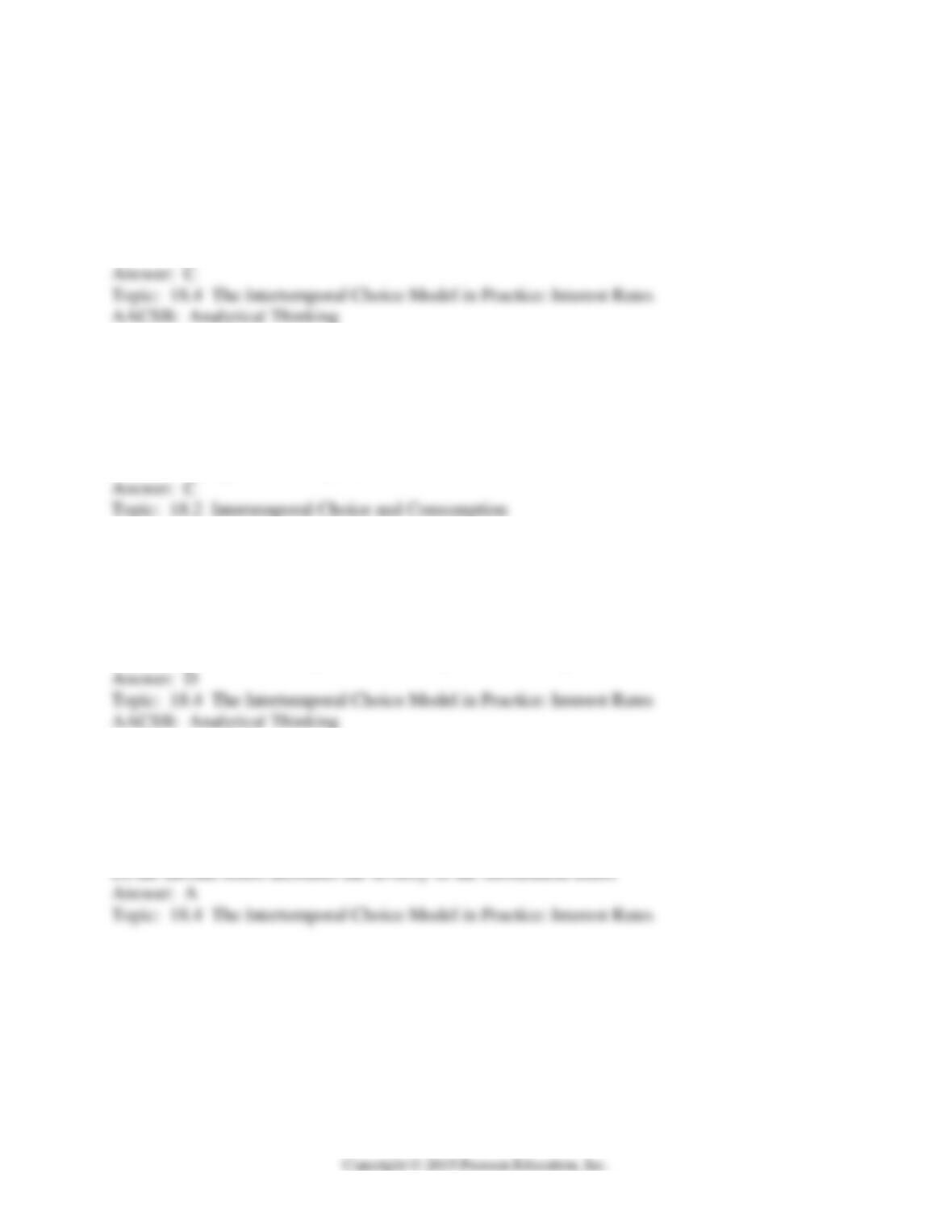
Intertemporal Budget Constraint
r
0.04
$10,000
$40,000
W
$20,000
5) Given the table above, the present value of lifetime resources ________ when the real interest
rate rises to five percent.
A) falls by $367
B) rises by $200
C) rises by $300
D) falls by $275
6) Given the table above, suppose consumption in period two is $35,000. Then, the interest rate
rises to five percent, and period-two consumption falls to $34,900. We may infer that ________.
A) the income effect is stronger than the substitution effect
B) the substitution effect is stronger than the income effect
C) the substitution and income effects cancel out
D) this consumer has a binding borrowing constraint
7) Given the table above, suppose consumption in period two is $40,000. Then, the interest rate
rises to five percent, and period-two consumption rises to $41,050. We may infer that ________.
A) the income effect is stronger than the substitution effect
B) the substitution effect is stronger than the income effect
C) the substitution and income effects cancel out
D) this consumer has a binding borrowing constraint
8) Given the table above, suppose consumption in period two is $40,000. Then, the interest rate
rises to five percent, and period-two consumption does not change. We may infer that ________.
A) the income effect is stronger than the substitution effect
B) the substitution effect is stronger than the income effect
C) the substitution and income effects cancel out
D) this consumer has a binding borrowing constraint
9) For the majority of the U.S. population ________.
A) consumption is driven solely by current income
B) consumption smoothing is possible
C) a change in lifetime resources will not change current consumption
D) a change in lifetime resources will not change future consumption
10) For consumers with a binding borrowing constraint, a decrease in the real interest rate
________.
A) decreases consumption now, and in the future
B) increases consumption now, and in the future
C) decreases consumption now, and increases future consumption
D) has no impact on consumption
11) When the borrowing constraint is binding, ________.
A) wealth is zero
B) current consumption is lower than future consumption
C) future consumption is lower than current consumption
D) consumption smoothing is not possible
12) When the borrowing constraint is binding, ________.
A) wealth is zero
B) =
C) =
D) current and future consumption are equal
13) ________ might cause the borrowing constraint to become non-binding, even though the
consumer still cannot borrow.
A) An increase in future (expected) income
B) An increase in the real interest rate
C) A decrease in current income
D) A decrease in the real interest rate
14) For many consumption activities — skiing, for example — the activity becomes more
enjoyable as the consumer becomes more experienced. Assuming that “training consumption” is
inexpensive relative to “proficient consumption,” do such activities make it more or less likely
that a borrowing constraint will be binding?
15) Use the intertemporal budget constraint — equation (2) — to explain how an increase in the
real interest rate causes two distinct effects, an income effect and a substitution effect, and how
those effects differ depending on whether the consumer is a saver or a borrower.
16) During the 2007-2009 financial crisis, many households found themselves with negative
wealth (debts to repay) and a binding borrowing constraint. Describe the income and substitution
effects of a decrease in the real interest rate.
17) How might consumers for whom the borrowing constraint is binding benefit from access to
relatively expensive forms of credit (e.g., pawn shops and “payday” loans)?
18.5 The Keynesian Theory of Consumption
1) The ratio of consumption to income is known as ________.
A) the average propensity to consume
B) the borrowing constraint
C) the marginal propensity to consume
D) subprime accommodation
2) The marginal propensity to consume describes ________.
A) the tendency to consume fringe, or unusual items
B) the impact of a change in spending on income
C) the impact on consumption resulting from a change in income
D) lifetime consumption resources
3) The value of the marginal propensity to consume is ________.
A) equal to one
B) between zero and one
C) greater than one
D) less than zero
4) The schedule describing the Keynesian consumption function will become steeper with an
increase in ________.
A) consumption spending
B) autonomous consumption
C) the marginal propensity to consume
D) the marginal propensity to save
5) In the Keynesian consumption function, if current income is equal to zero, consumption
spending is equal to ________.
A) the marginal propensity to consume
B) the average propensity to save
C) autonomous consumption
D) exogenous consumption

13
6) If high incomes inspire more saving than low incomes ________.
A) the average propensity to consume falls as income rises
B) the marginal propensity to consume rises as income rises
C) autonomous consumption falls as income rises
D) the average propensity to consume rises as wealth rises
7) The Keynesian consumption function does not display consumption smoothing, because
________.
A) the average propensity to consume rises with income
B) the marginal propensity to consume is constant
C) consumption is not affected by the real interest rate
D) consumption is not affected by future income
8) The Keynesian consumption function and the theory of intertemporal choice are consistent for
households ________.
A) with a binding budget constraint
B) with little or no initial wealth
C) whose consumption remains positive, even if income is zero
D) whose consumption cannot exceed current income
9) Autonomous consumption is 700 and the marginal propensity to consume is 0.6. Calculate the
average propensity to save when disposable income is (a) 10,000, (b) 12,000, and (c) 15,000.
18.6 The Permanent Income Hypothesis
1) According to the permanent income hypothesis, consumption spending depends largely on
________.
A) current income
B) the savings rate
C) a consumer’s lifetime resources
D) the level of current income plus the value of the assets owned by the household
2) The permanent income hypothesis highlights the phenomenon of ________.
A) the intertemporal budget constraint
B) a binding borrowing constraint
C) autonomous consumption
D) consumption smoothing
3) According to the permanent income hypothesis, permanent income is to ________ as
transitory income is to ________.
A) consumption; saving
B) certain; hypothetical
C) wealth; gambling
D) saving; borrowing
4) If households come to believe that permanent income has not changed ________.
A) the impact of a change in taxes on spending will be limited
B) they will consume on the basis of their current income
C) their life-cycle will be affected
D) the impact of a given change in taxes on spending will be enhanced
5) In the permanent income hypothesis, income that does not persist for a long period of time is
known as ________.
A) current income
B) transitory income
C) insufficient income
D) limited income
15
6) In the permanent income hypothesis, income is divided into ________.
A) current and future income
B) future and transitory income
C) transitory and permanent income
D) permanent and current income
7) According to the permanent income hypothesis, the impact of ________.
A) a change in permanent income on consumption is greater than the impact resulting from a
change in transitory income
B) a change in transitory income on consumption is greater than the impact resulting from a
change in permanent income
C) a change in transitory income is felt primarily through changes in the total tax revenue paid to
the federal government
D) a change in permanent income on consumption is larger than the impact resulting from a
change in future income
8) Intertemporal choice theory is more consistent with ________.
A) Keynesian theory than the permanent income hypothesis of Friedman
B) the permanent income hypothesis than Keynesian theory
C) Keynesian theory than the life-cycle hypothesis
D) Keynesian theory than the Gini coefficient theory
9) The effect of the February 2008 tax rebate on spending was reduced due to ________.
A) the simultaneous missteps in monetary policy
B) the negative impact of the policy on saving rates
C) the recognition that the rebate did not constitute a permanent change in income
D) the small size of the program
16
10) During the 2007-2009 financial crisis, many households found themselves with debts to
repay. How might this explain the consumer response to the 2008 Tax Rebate?
18.7 The Life-Cycle Hypothesis
1) According to the life-cycle hypothesis ________.
A) households consume on the basis of their current income and liabilities
B) household consumption as a percentage of income varies over one’s lifetime
C) current income is a function of future income
D) cycling to work everyday allows one to live a longer life
2) According to the life-cycle hypothesis, as consumers get older ________.
A) the marginal propensity to consume out of wealth and income rise
B) the marginal propensity to consume out of wealth falls and the marginal propensity to
consume out of income rises
C) the marginal propensity to consume out of wealth rises and the marginal propensity to
consume out of income falls
D) the marginal propensity to consume out of wealth and income fall
3) According to the life-cycle hypothesis, as people grow older ________.
A) their wealth grows before and after retirement
B) their wealth declines before and after retirement
C) their wealth grows before retirement, then declines after retirement
D) their wealth falls before retirement, then rises after retirement
4) Suppose consumers anticipate that their wealth will grow over time, because of interest
earnings and capital gains. According to the life-cycle hypothesis, such optimism should cause
current consumption to be ________.
A) relatively low
B) relatively insensitive to changes in income
C) rising as individuals near retirement age
D) relatively high
5) The life-cycle hypothesis applies the concept of ________ to retirement.
A) income & substitution effects
B) transitory income
C) autonomous consumption
D) consumption smoothing
6) The life-cycle hypothesis predicts what consequence of aging of the overall population? [That
is, an increase in T, relative to R & L.]
A) a decrease in the marginal propensity to consume out of wealth
B) an increase in aggregate saving
C) a decrease in the marginal propensity to consume out of income
D) an increase in aggregate wealth
7) The recession of 2008-2009 demonstrated that ________.
A) consumption is especially sensitive to changes in the retirement age
B) changes in wealth can be a major source of fluctuations in consumption
C) as consumers get older, they tend to exhaust all their savings
D) permanent income is something of a misnomer
8) In 2008, the wealth of U.S. households fell by ________.
A) $11 million
B) $11 billion
C) $11 trillion
D) $11 gajillion
18
9) Current estimates of the marginal propensity to consume out of wealth are in the
neighborhood of ________.
A) three and one-half cents per dollar of wealth
B) 45 cents per dollar of wealth
C) 98 cents per dollar of wealth
D) $4.87 per dollar of wealth
10) Advances in medical practice have increased both expected lifespans and medical
expenditures. What does the life-cycle hypothesis predict as the macroeconomic consequences?
18.8 Two Modifications Of The Theory: The Random Walk Hypothesis and Behavioral
Economics
1) The observation that changes in an economic variable are unpredictable suggests that the
relevant variable follows ________.
A) a random walk
B) tertiary unpredictability
C) the life-cycle hypothesis
D) the Tequila effect
2) The theory of intertemporal choice, and the life-cycle and permanent income hypotheses have
in common the assumption that ________.
A) consumption decisions are affected by current expectations about lifetime resources
B) consumption decisions are based on all available information
C) current income, rather than expected income, has the greater influence on consumption
decisions
D) decisions to borrow and save are influenced much more by immediate circumstances than by
long-term consequences
19
3) According to rational expectations, expectations will only change in the event that ________.
A) wealth changes
B) current income changes
C) permanent income changes
D) unanticipated new information arises
4) The idea that consumers will not consistently discount the future over time is known as
________.
A) intertemporal choice
B) tertiary inversion
C) hyperbolic discounting
D) antediluvian Machiavellianism
5) Consumers who do not consistently discount the future over time behave in a fashion that is
most consistent with ________.
A) the theory of intertemporal choice
B) the Keynesian theory of consumption
C) the permanent income hypothesis
D) the life-cycle hypothesis
6) Consumers who do not consistently discount the future over time are likely to ________.
A) under-report their taxable income
B) be unprepared financially for retirement
C) opt in to employer-sponsored savings plans
D) make excessive sacrifices on behalf of their children
20
7) The view that the choices consumers face should be limited for their own good is known as
________.
A) Keynesian theory
B) institutionalist theory
C) rational adaptations
D) libertarian paternalism
8) ________ is to the random walk hypothesis as ________ is to behavioral economics.
A) Sober calculation; paternal guidance
B) Surprise; gratification
C) Rational ignorance; studied optimization
D) Unpredictability; regret
9) How consistent is the Keynesian consumption function with the random walk hypothesis?
10) Would the Keynesian consumption function work well in a world of libertarian paternalists?