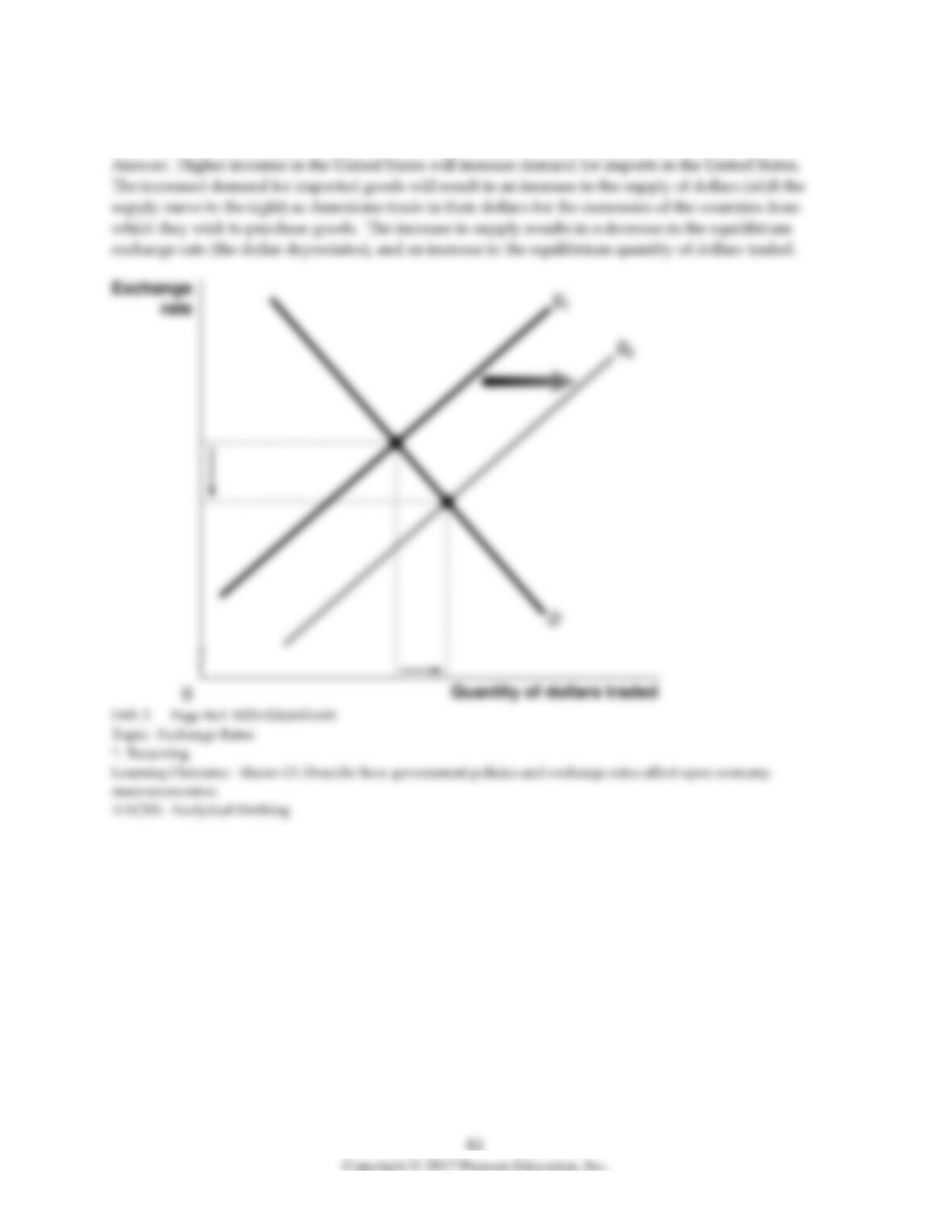
95) Explain and show graphically how an increase in incomes in the United States will affect
equilibrium in the foreign exchange market?
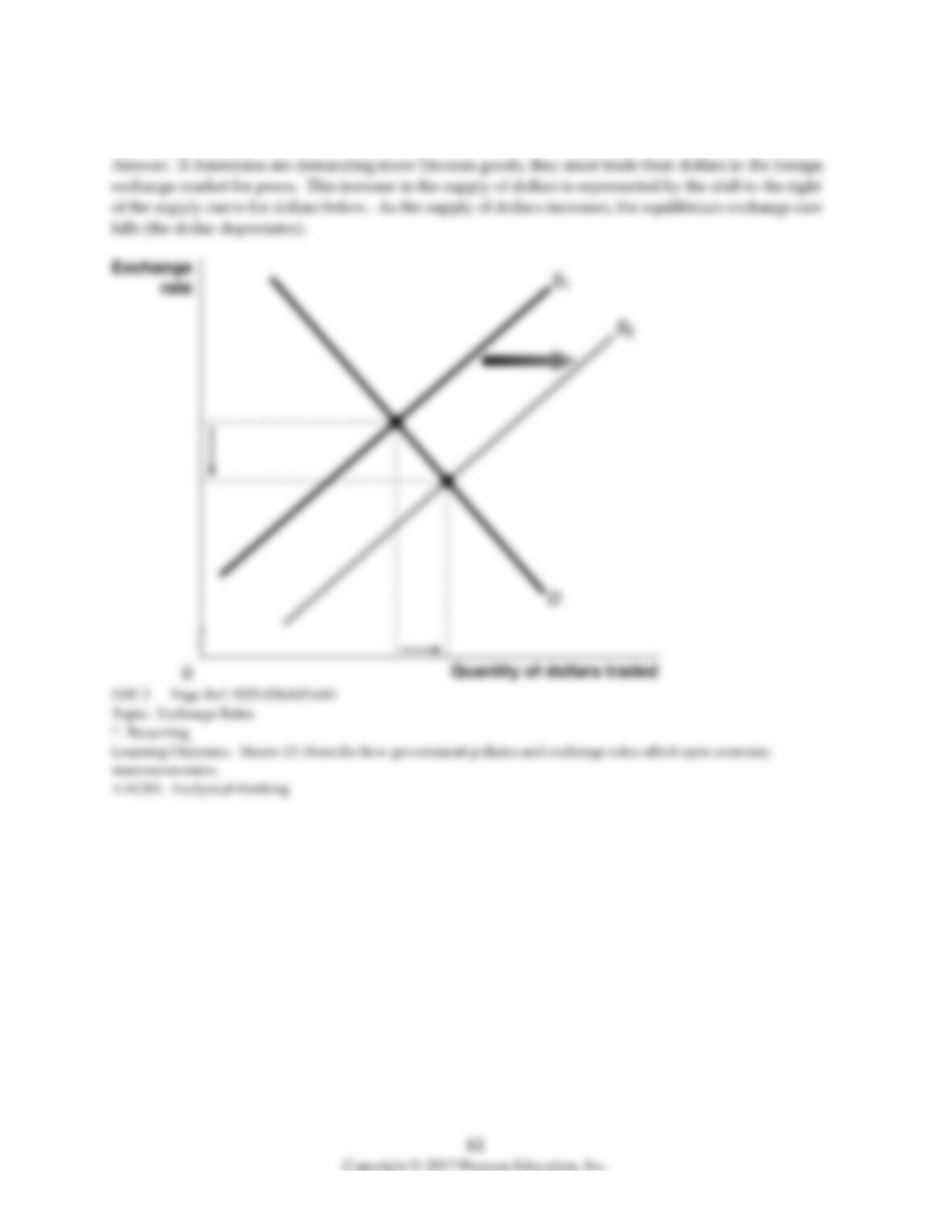
96) If American demand for purchases of Mexican goods has increased, how would you expect the
equilibrium exchange rate in the market for dollars to respond? Support your answer graphically.
18.3 The International Sector and National Saving and Investment
1) If net exports are positive,
A) net foreign investment is also positive.
B) capital inflows must be greater than capital outflows.
C) net foreign investment is negative.
D) Both A and B are correct.
2) Suppose that domestic investment in Japan is 20.2% of GDP, and Japanese national savings is 24% of
GDP. What is Japan’s foreign investment as a percentage of GDP?
A) 1.19%
B) 3.8%
C) 27.8%
D) 44.2%
3) If net exports are equal to net foreign investment, which of the following is not true?
A) The balance of payments is zero.
B) The current account balance is equal to the negative of the financial account balance.
C) Net capital inflows are equal to imports minus exports.
D) The balance on the financial account is zero.
4) If the United States has a net export surplus, which of the following must be true?
A) The balance on the financial account must equal the balance on the current account.
B) Net foreign investment must be positive as well.
C) Domestic private saving must be greater than net foreign investment.
D) Domestic public saving must be greater than net foreign investment.
5) According to the saving and investment equation, if net foreign investment rises by $60 million,
A) national saving will increase by $60 million.
B) national saving will fall by $60 million.
C) domestic investment will rise by $60 million.
D) private saving will fall by $60 million.
6) If net foreign investment is negative, which of the following must be true?
A) Capital outflows are greater than capital inflows.
B) Domestic investment must be greater than national saving.
C) Net exports are positive.
D) Private saving is greater than public saving.
7) Which of the following equations is true in an open economy?
A) Private saving = net foreign investment + domestic investment.
B) National saving = net capital flows.
C) Net exports = -Financial account balance.
D) Net exports = net foreign investment.
8) If the United States is a “net borrower” from abroad,
A) the United States must be exporting more than it is importing.
B) net capital flows must be negative.
C) national saving is less than domestic investment.
D) net foreign investment must be positive.
9) If national saving decreases,
A) the sum of domestic investment and net exports must increase.
B) the sum of domestic investment and foreign investment must increase.
C) the sum of domestic investment and foreign investment must decrease.
D) foreign investment must increase to cover the loss.
10) If we take into account transfer payments (TR) when we derive the saving and investment
relationship, the saving and investment equation becomes
A) S = I + NFI.
B) S + TR = I + NFI.
C) S = I + NFI + TR.
D) S = I + NX – TR.
11) Suppose the U.S. Congress is successful in enacting tariffs large enough to eliminate the current
account deficit. What would happen to the level of domestic investment?
A) It would not change.
B) It would rise and exceed national saving.
C) It would rise to a level equal to net foreign investment.
D) It would fall to a level equal to national saving.
12) The level of saving in Japan has historically been high relative to the level of domestic investment.
Based on this information, we would expect that
A) Japan’s net foreign investment has been relatively low.
B) Japan’s net exports have been relatively high.
C) Japan’s capital inflows are positive.
D) Japan’s private saving is greater than its public saving.
13) If net foreign investment in the United States is negative, how must national saving and domestic
investment be related?
A) Domestic investment and national saving must also be negative.
B) Domestic investment must be greater than national saving.
C) Domestic investment must be less than national saving.
D) Domestic investment can be greater than or less than national saving.
14) National saving equals
A) income – taxes – consumption.
B) taxes – government spending.
C) income – consumption – government spending.
D) private saving + public saving – net foreign investment.
15) If net exports are negative,
A) net foreign investment is also negative.
B) capital inflows must be less than capital outflows.
C) net foreign investment is positive.
D) Both A and B are correct.
16) Suppose that domestic investment in Canada is 10.7% of GDP, and Canadian national savings is
13% of GDP. What is Canada’s foreign investment as a percentage of GDP?
A) 1.15%
B) 2.3%
C) 15.3%
D) 23.7%
17) If net exports are equal to net foreign investment,
A) the balance of payments is zero.
B) the current account balance is equal to the negative of the financial account balance.
C) net capital inflows are equal to imports minus exports.
D) All of the above are true when net exports are equal to net foreign investment.
18) If the United States has a current account deficit and the capital account is zero, which of the
following must be true?
A) The balance on the financial account must equal the balance on the current account.
B) Net foreign investment must be negative as well.
C) Domestic private saving must be less than net foreign investment.
D) Domestic public saving must be less than net foreign investment.
19) If the United States has a net export deficit, which of the following must be true? (Assume that the
capital account is zero and net transfers are zero.)
A) The balance on the financial account must equal the balance on the current account.
B) Net foreign investment must be negative as well.
C) Domestic private saving must be less than net foreign investment.
D) Domestic public saving must be less than net foreign investment.
20) According to the saving and investment equation, if net foreign investment falls by $35 million,
A) national saving in excess of domestic investment will decrease by $35 million.
B) national savings will rise by $35 million.
C) domestic investment will fall by $35 million.
D) national saving in excess of domestic investment will rise by $35 million.
21) If net foreign investment is positive, which of the following must be true? (Assume that the capital
account is zero and net transfers are zero.)
A) Capital outflows are less than capital inflows.
B) Domestic investment must be less than national saving.
C) Net exports are negative.
D) None of the above are true when net foreign investment is positive.
22) In an open economy, the current account balance equals ________. (Assume that the capital account
is zero and net transfers are zero.)
A) net foreign investment + domestic investment
B) net capital outflows
C) the financial account balance + net income on investments
D) net foreign investment
23) If the United States is a “net lender” abroad, ________. (Assume that the capital account is zero and
net transfers are zero.)
A) the United States must be exporting less than it is importing
B) net capital flows must be positive
C) national saving is greater than domestic investment
D) net foreign investment must be negative
24) If national saving increases, ________. (Assume that the capital account is zero and net transfers are
zero.)
A) the sum of domestic investment and net exports must decrease
B) the sum of domestic investment and foreign investment must increase
C) the sum of domestic investment and foreign investment must decrease
D) foreign investment must decrease to cover the gain
25) The level of saving in the United States has historically been low relative to the level of domestic
investment. Based on this information, we would expect that
A) U.S. net foreign investment has been relatively high.
B) U.S. net exports have been relatively low.
C) U.S. capital inflows are negative.
D) U.S. private saving is less than its public saving.
26) If net foreign investment in the United States is positive, how must national saving and domestic
investment be related? (Assume that the capital account is zero and net transfers are zero.)
A) Domestic investment and national saving must also be positive.
B) Domestic investment must be less than national saving.
C) Domestic investment must be greater than national saving.
D) Domestic investment can be greater than or less than national saving.
27) Public saving equals taxes minus government spending minus transfer payments.
28) The saving and investment equation holds only when the federal budget is balanced.
29) If net exports are positive for China, it must be true that China is experiencing net outflows of
capital.
30) Investment (I) in the United States may increase with either an increase in national saving or an
increase in net foreign investment.
31) In the United States, domestic investment is greater than national saving.
32) An increase in net foreign investment is possible through a decrease in national saving or a decrease
in domestic investment.
33) Saving exceeds domestic investment in Japan, which generates a financial account deficit in Japan’s
balance of payments.
34) Explain the relationship between net exports and net foreign investment.
35) Japan has a fairly high saving rate and the level of saving in Japan is above domestic investment.
Use the saving and investment equation to explain what Japan is doing with this excess of saving above
domestic investment.
36) If you know that a country’s net foreign investment is positive, what does that tell you about the
relationship between the country’s national saving and private investment? (Assume that the capital
account is zero and net transfers are zero.)
37) Does the saving and investment equation imply that a country’s national saving must always equal
its domestic investment? Explain.
38) Use the saving and investment equation to explain why the United States experienced large current
account deficits in the late 1990s.
39) Based on the following information, calculate public saving, net foreign investment, and national
income.
Private saving = $83 billion
Exports = $125 billion
Imports = $130 billion
Consumption = $200 billion
Private investment = $56 billion
Government purchases = $38 billion
40) Based on the following information, calculate public saving, net foreign investment, and national
income. Assume that the capital account is zero and net transfers are zero.
private saving = $145 billion
exports = $285 billion
imports = $240 billion
consumption = $600 billion
private investment = $125 billion
government purchases = $75 billion
18.4 The Effect of a Government Budget Deficit on Investment
1) How might a budget deficit affect the balance of trade?
A) A budget deficit raises interest rates, which raises exchange rates and increases the balance of trade.
B) A budget deficit raises interest rates, which raises exchange rates and reduces the balance of trade.
C) A budget deficit reduces interest rates, which raises exchange rates and reduces the balance of trade.
D) A budget deficit reduces interest rates, which reduces exchange rates and reduces the balance of trade.
2) What impact might an increase in the budget deficit have on interest rates and exchange rates?
A) Interest rates and exchange rates increase.
B) Interest rates increase and exchange rates decrease.
C) Interest rates decrease and exchange rates increase.
D) Interest rates and exchange rates decrease.
3) How does an increase in the budget deficit affect the demand for dollars and the supply of dollars on
the foreign exchange market?
A) The demand for dollars falls, and the supply of dollars falls.
B) The demand for dollars rises, and the supply of dollars rises.
C) The demand for dollars rises, and the supply of dollars falls.
D) The demand for dollars falls, and the supply of dollars rises.
4) How would a decrease in the U.S. budget deficit affect the exchange rate in the market for dollars?
A) The exchange rate will increase.
B) The exchange rate will decrease.
C) The exchange rate will not be affected by a change in the budget deficit.
D) The impact of the decrease in the budget deficit on the exchange rate cannot be predicted.
5) What two measures of macroeconomic activity are often referred to as the “twin deficits”?
A) net capital flows and net exports
B) the foreign exchange deficit and net foreign investment
C) the budget deficit and the trade balance
D) the saving-investment deficit and the export deficit
6) An increase in U.S. federal government budget deficits that raises U.S. interest rates relative to the
rest of the world should
A) raise the trade balance.
B) increase net exports.
C) cause the dollar to depreciate.
D) lead to a current account deficit.
E) decrease foreign portfolio investment.
7) Which of the following is true about the occurrence of the twin deficits?
A) They always occur together.
B) They only occur when exchange rates are fixed.
C) They did not occur after 1990 in the United States.
D) They occur consistently in all the economies of the world except the United States.
8) Persistent current account deficits in the United States
A) can be seen as a vote of confidence in the strength of the U.S. economy.
B) cause persistent declines in investment in the United States.
C) cause U.S. investors to accumulate more foreign assets than foreign investors accumulate U.S. assets.
D) will eventually cause the value of the dollar to rise.
9) The United States is called a debtor nation because
A) it has a large current account deficit and is simultaneously funded by foreign investment.
B) it has a large financial account deficit that is used to fund the current account deficit.
C) it has a large balance of payments deficit that is used to fund the current account deficit.
D) U.S. capital outflows are much greater than U.S. capital inflows.
10) A federal budget deficit ________ interest rates, which ________ exchange rates (foreign currency
per domestic currency), and ________ the balance of trade.
A) raises; raises; reduces
B) reduces; raises; reduces
C) raises; reduces; reduces
D) reduces; reduces; raises
11) What impact might a decrease in the U.S. federal budget deficit have on interest rates and exchange
rates in the market for the U.S. dollar? (Assume the exchange rate is stated in terms of foreign currency
per U.S. dollar.)
A) Interest rates and exchange rates increase.
B) Interest rates increase and exchange rates decrease.
C) Interest rates decrease and exchange rates increase.
D) Interest rates and exchange rates decrease.