6) Why does a firm maximize its profits by hiring so that VMP = W?
7) Why does a profit-maximizing firm hire labor up to the point where the value of marginal
product equals the wage rate?
8) “In order for Charlie Trotter’s, an upscale restaurant in Chicago, to maximize profit from the
employment of chefs, the restaurant should hire chefs up to the point where the value of marginal
product equals the wage rate for chefs.” Is the statement correct or incorrect?
9) What factors other than the wage rate influence the demand for labor? How is demand
affected by changes in these factors?
10) What factors shift the demand for labor curve? Briefly describe the effect of each.
11) What effect does an increase in the price of the firm’s output have on its demand curve for
labor? Why?
12) Why does the labor supply curve eventually bend backwards?
13) In order to spend more time with her children, a young mother decides to work less hours as
her pay increases. What does her labor supply curve look like?
14) What tools can unions use to increase the demand for union labor?
15) Why does an increase in the minimum wage increase the demand for union labor?
16) Explain why a monopsony’s marginal cost of labor is greater than the wage rate.
17) Why does a monopsony increase employment when faced with an effective minimum wage
law?
18) Discuss the difference between renewable and nonrenewable resources. Given an example of
each.
19) What is the Hotelling Principle? Have resource prices behaved as the principle predicts?
20) The interest rate is 5 percent. How does $500 to be received a year from today compare in
value to $500 right now?
8 Numeric and Graphing Questions
Quantity of
labor
(workers)
Marginal product
(units per hour)
Value of marginal
product
(dollars)
1
10
____
2
8
____
3
6
____
4
4
____
1) The above table has the marginal product schedule for a firm. If the firm is a perfect
competitor and the price of the product is constant at $2 a unit, complete the table. If the wage
rate is $8 an hour, how many workers does the firm hire?
Quantity of
labor
(workers)
Marginal product
(units per hour)
Value of marginal
product
(dollars)
1
10
20
2
16
3
12
4
Quantity of labor
(workers)
Cars washed
(cars per day)
1
8
2
23
3
33
4
40
5
45
2) The table above shows the total product schedule for Shines Car Wash. The market for car
washes is perfectly competitive and car washes sell for $5 each. The labor market is competitive
and the wage rate is $50 per day. What is the value of marginal product for each worker? How
many workers does the firm hire to maximize profit?
75
50
35
25
Quantity of
labor
(workers)
Marginal product
(blouses cleaned
per day)
Value of marginal
product
(dollars per day)
1
4
____
2
4
____
3
3
____
4
2
____
5
1
____
3) The above table has the marginal product schedule for Nick’s Dry Cleaners, a perfectly
competitive dry cleaning firm.
a) If the price to dry clean a blouse is $8 each, complete the last column of the table.
b) If Nick can hire workers at the going wage rate of $16 an hour, how many workers does Nick
hire?
Quantity of
labor
(workers)
Marginal product
(blouses cleaned
per day)
Value of marginal
product
(dollars per day)
1
4
2
4
3
3
4
2
5
1
Quantity of
labor
(workers)
Marginal
product
(pounds per
hour)
Value of
marginal
product, $2
per pound
(dollars)
Value of
marginal
product, $1
per pound
(dollars)
1
8
____
____
2
10
____
____
3
7
____
____
4
5
____
____
5
4
____
____
4) Tom and Mary own a perfectly competitive tomato farm. They can hire different numbers of
college students to help plant, cultivate, and harvest the tomatoes. The above table gives their
marginal product schedule.
a) If the price of a pound of tomatoes is $2 a pound, complete the first value of marginal
product column in the table. If Tom and Mary must pay their workers $10 an hour, how many
workers do they hire?
b) If the price of a pound of tomatoes falls to $1 a pound, complete the second value of
marginal product column in the table. If Tom and Mary still must pay their workers $10 an hour,
how many workers do they hire?
c) When the price of a pound of tomatoes falls, what happens to Tom and Mary’s demand for
labor curve?
Quantity of
labor
(workers)
Marginal
product
(pounds per
hour)
Value of
marginal
product, $2
per pound
(dollars)
Value of
marginal
product, $1
per pound
(dollars)
1
8
16
2
10
20
10
3
7
14
4
5
10
5
4
5) A worker has a marginal product of 15 units a day, each of which can be sold for $10. Is it
profitable to hire this worker if the wage rate is $100 a day? Briefly explain your answer.
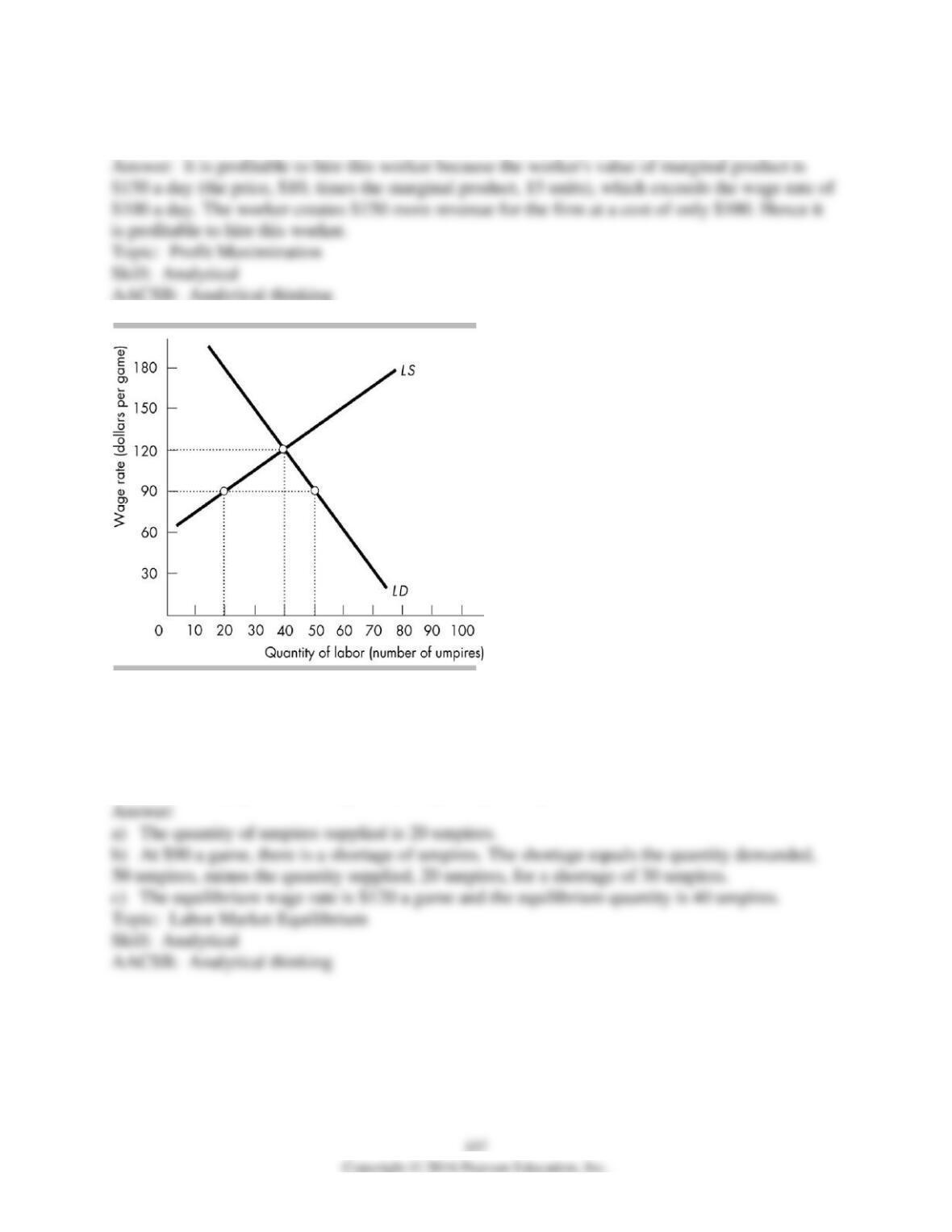
6) The above figure represents the market for professional minor-league baseball umpires.
a) If umpires are offered $90 a game, what is the quantity of umpires supplied?
b) If umpires are offered $90 a game, is there a surplus or shortage of games umpired? What
does the shortage or surplus equal?
c) What is the equilibrium wage rate and quantity of umpires?
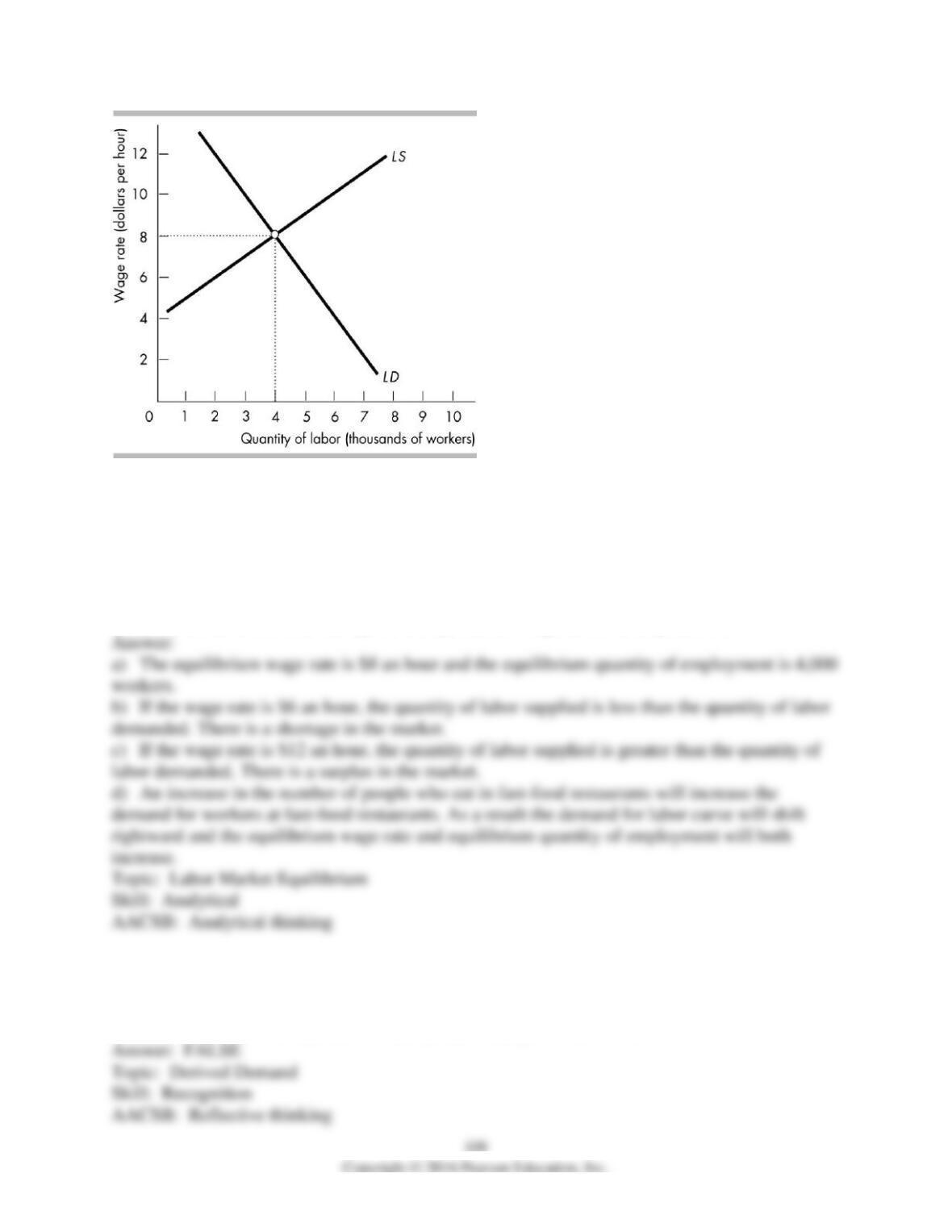
7) The above figure represents the market for teenage workers at fast-food restaurants in Kansas
City.
a) What is the equilibrium wage rate and employment?
b) Describe the market at a wage rate of $6 per hour.
c) Describe the market at a wage rate of $12 an hour.
d) How would an increase in the number of young, married college graduates, who tend to eat at
fast-food restaurants, affect the figure, the equilibrium wage rate, and employment?
9 True or False
1) The demand for a good or service is called a derived demand because it is derived from the
demand for the factors of production that produce this good or service.
2) The marginal product of labor equals the value of marginal product of labor multiplied by the
price of the output produced.
3) As the quantity of labor employed decreases, the value of marginal product diminishes.
4) The demand curve for labor is negatively sloped only because the firm must lower its price if
it wishes to sell more output.
5) An increase in the price of a firm’s good or service shifts its demand curve for labor leftward.
6) As a person’s wage rate increases, the substitution effect motivates an increase in work and the
income effect motivates a decrease in work.
7) The labor supply curve is backward bending because at higher wages the income effect
eventually dominates the substitution effect.
8) If the income effect is larger than the substitution effect, then a wage hike will be
accompanied by an increase in the quantity of labor supplied.
9) With respect to labor supply, the income effect leads a person to want to work more in order
to raise his or her income.
10) If a union cannot increase the demand for union labor, then an increase in union wages will
result in a decrease in union employment.
11) One reason unions might support an increase in the minimum wage is because such a policy
would cause a leftward shift in the demand curve for union labor.
12) For a monopsony, the marginal cost of labor exceeds the wage rate because the firm must
increase the wage it pays to all of its workers if it wishes to increase its employment.
13) If a monopsony paid its workers a wage equal to their value of marginal product, it would be
maximizing its profit.
14) Land is an example of a renewable resource.
15) Land is an example of an nonrenewable resource.
16) The supply of a renewable resource is perfectly elastic.
17) Discounting is converting a future amount of money to a present value.
18) If the interest rate is 7.5 percent, the present value of $500 to be received three years from
today is $477.50.
10 Extended Problems
Quantity of labor
(workers)
Total product
(car washes per day)
0
0
2
48
4
88
6
120
8
144
10
160
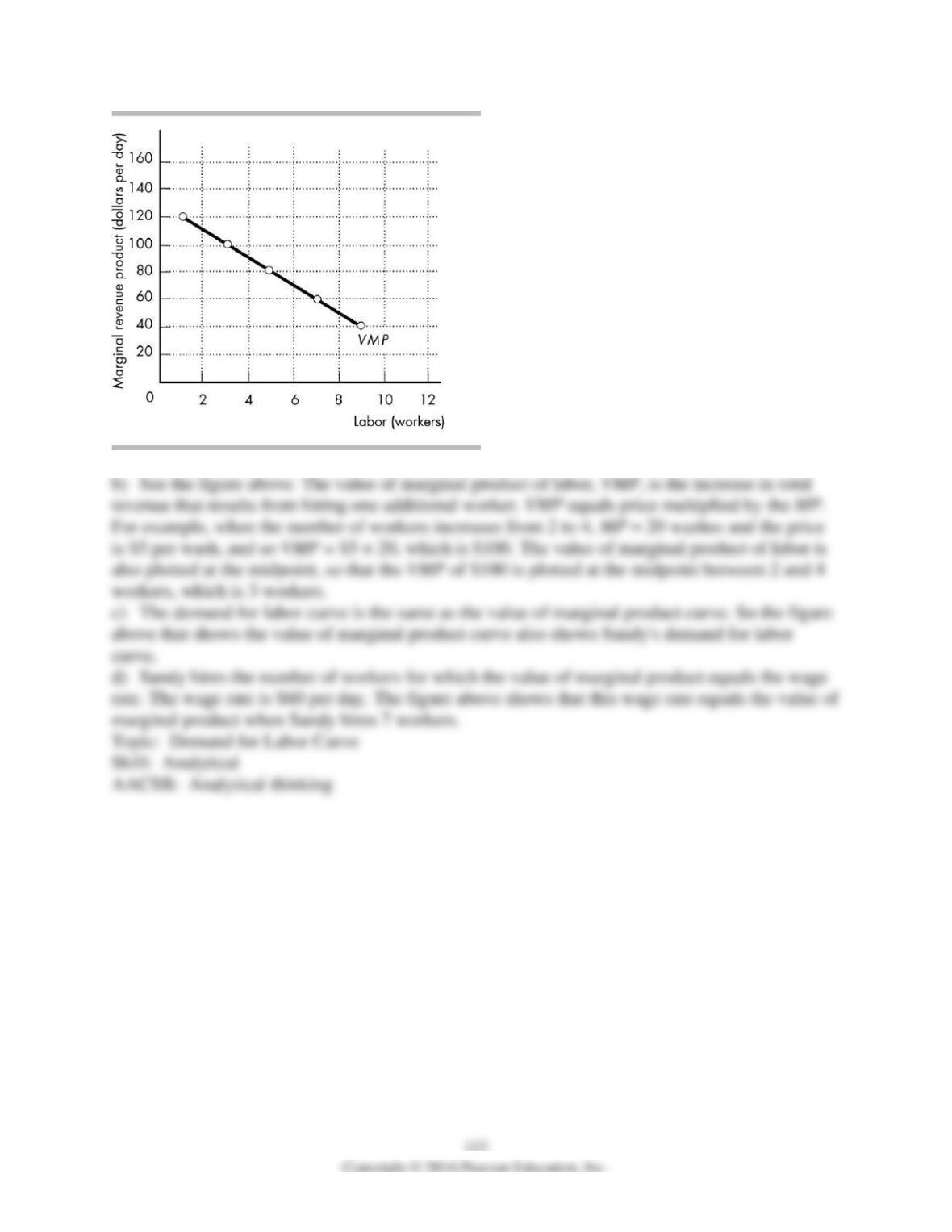
Sandy’s Shiny Car is a perfectly competitive car wash service. The table above shows Sandy’s
total product schedule. Sandy can sell as many washes as she chooses at $5, and the wage rate of
her workers is $60 a day.
1)
a) Draw Sandy’s workers’ marginal product of labor curve.
b) Draw Sandy’s workers’ value of marginal product curve.
c) Find Sandy’s demand for labor curve.
d) How many workers does Sandy employ?
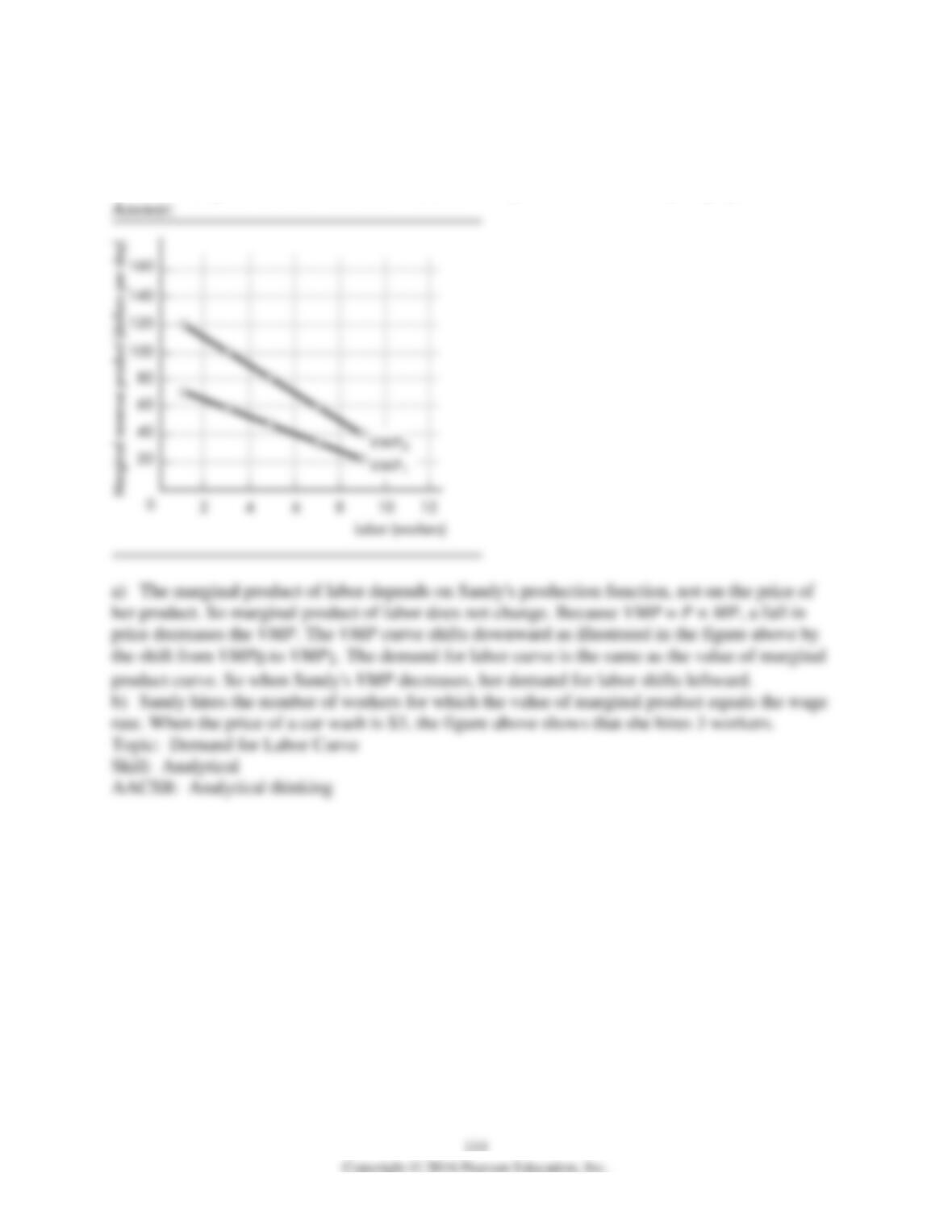
2) Suppose the price of a car wash falls to $3. The wage rate remains $60 per day.
a) What happens to the marginal product of labor? To the value of marginal product? To
Sandy’s demand for labor curve?
b) When the price of a car wash falls to $3, how many workers does Sandy employ?
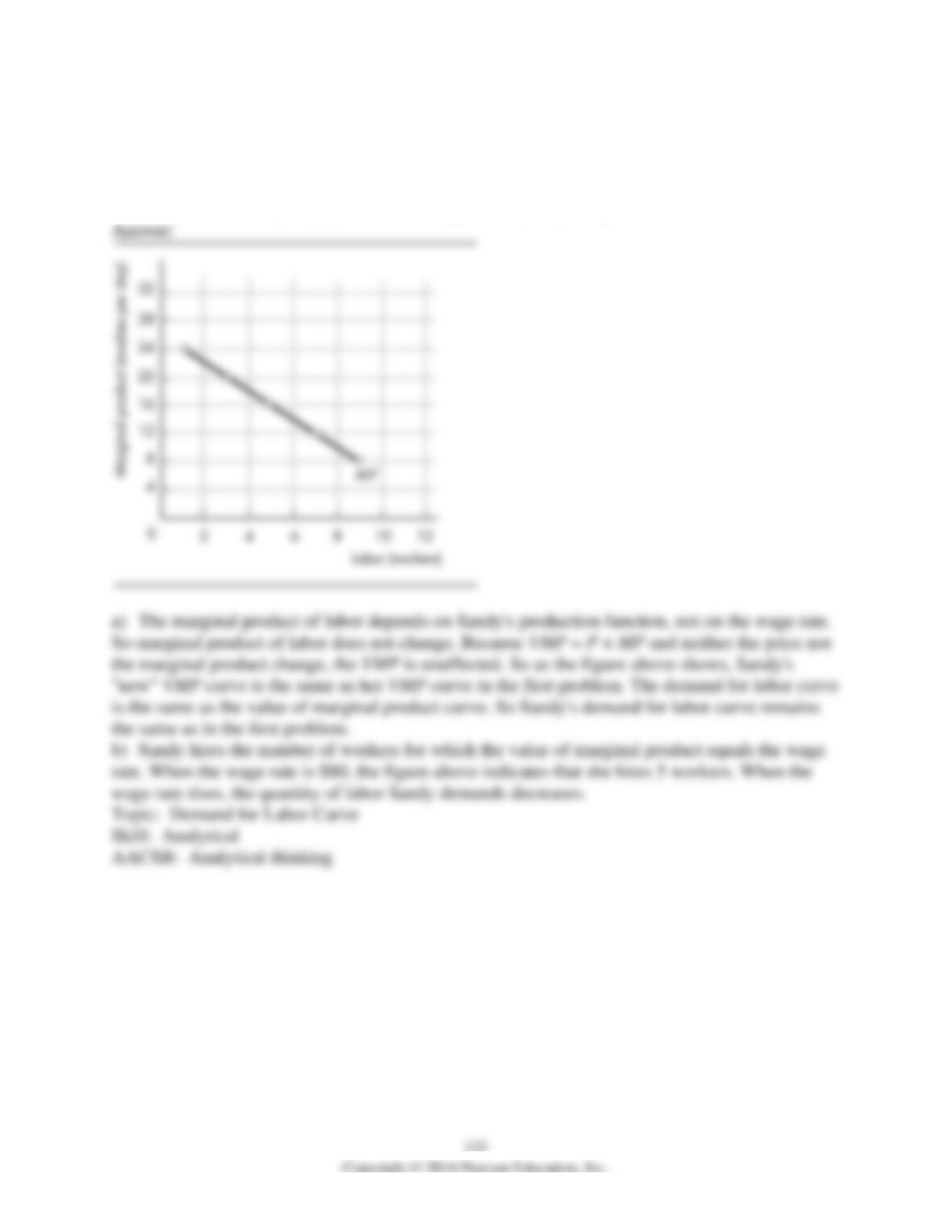
3) Suppose the price of car wash returns to $5 but the wage rate increases to $80 per day.
a) What happens to the marginal product of labor? What happens to the value of marginal
product? What happens to Sandy’s demand for labor curve?
b) What happens to the number of workers Sandy employs? How does this number compare
with the number Sandy employs when the wage rate is $60 per day?