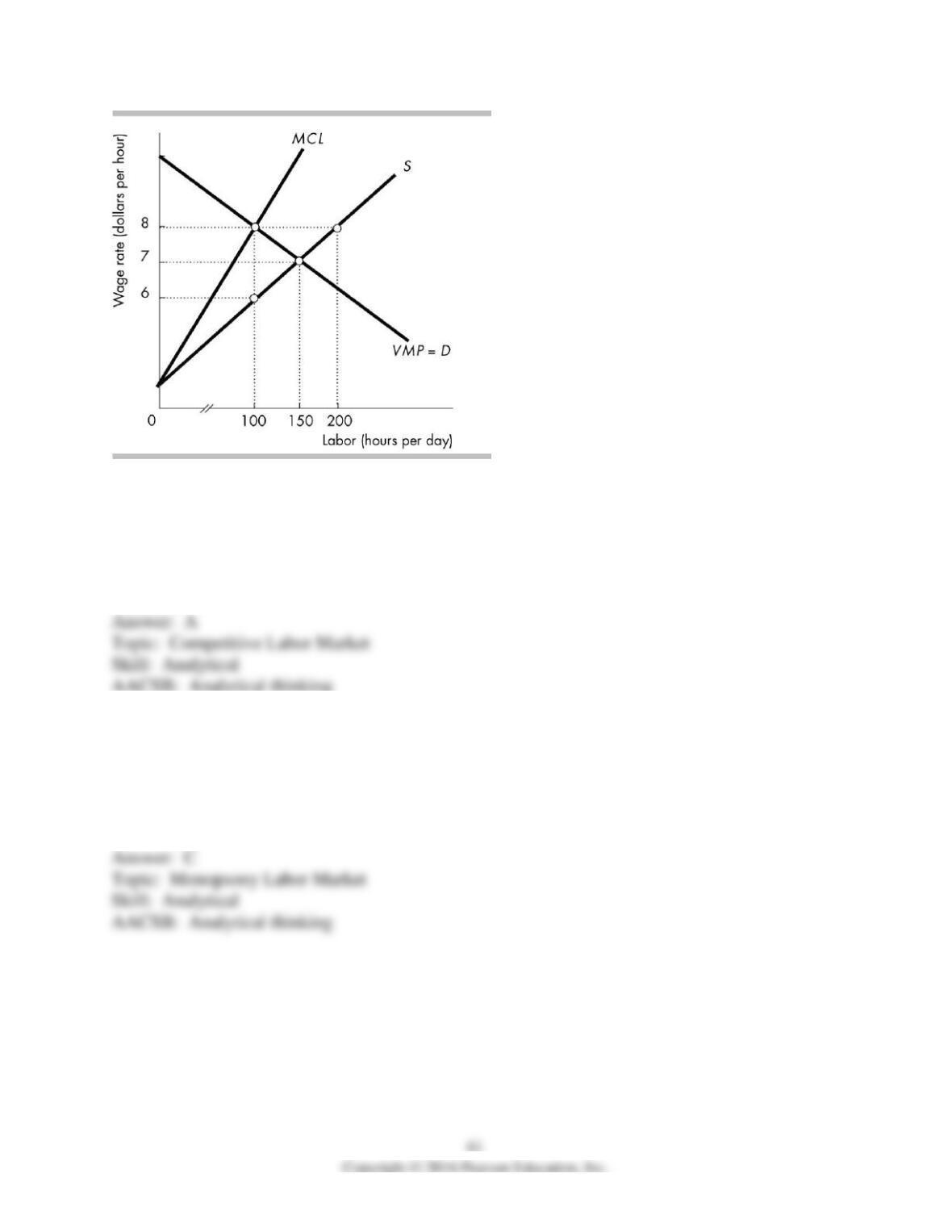
100) In the above figure, the competitive wage rate is ________ and the quantity of labor is
________.
A) $7.00; 150 hours
B) $8.00; 200 hours
C) $6.00; 100 hours
D) $8.00; 100 hours
101) In the above figure, the monopsony wage rate is ________ and the quantity of labor is
________.
A) $7.00; 150 hours
B) $8.00; 200 hours
C) $6.00; 100 hours
D) $8.00; 100 hours
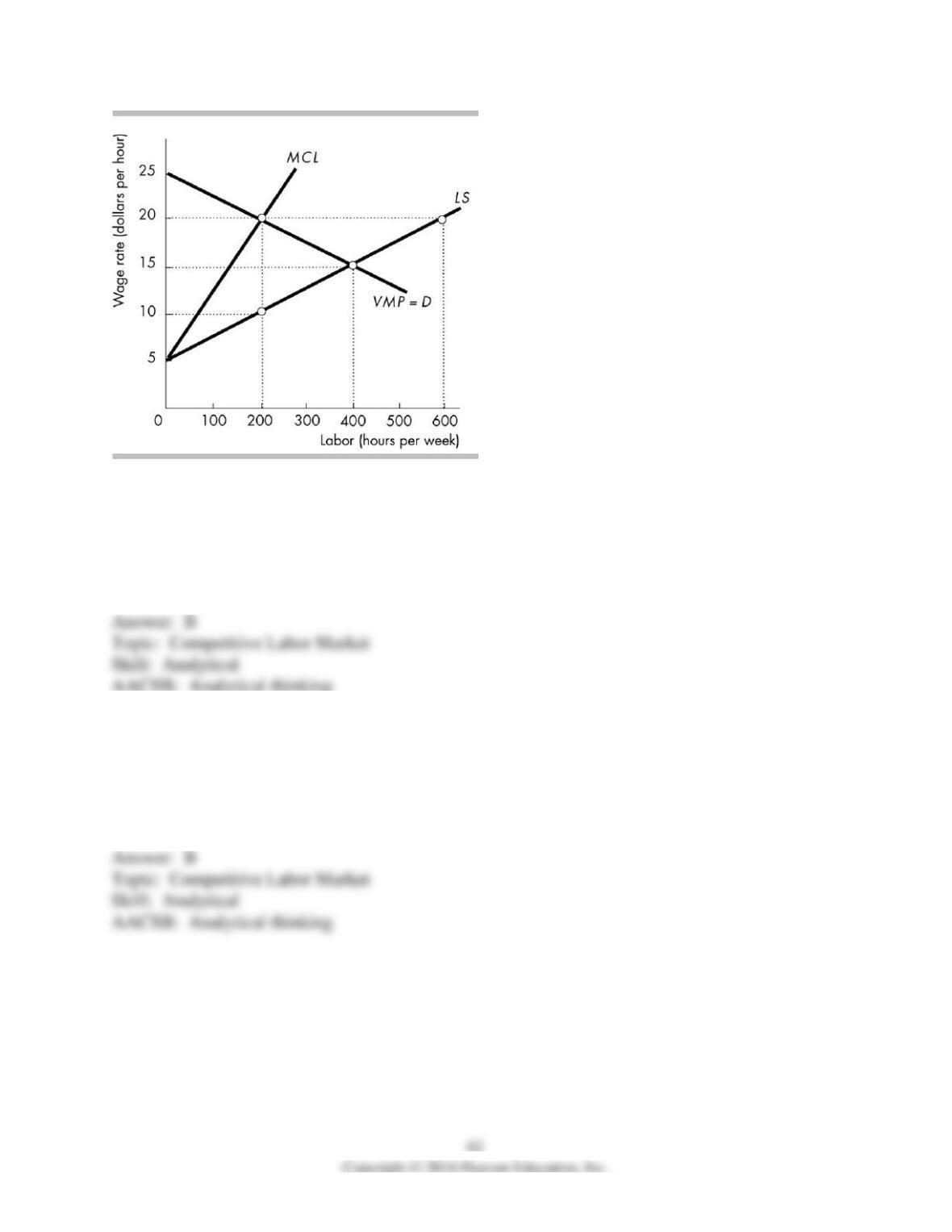
102) Consider the labor market depicted in the above figure. The competitive equilibrium would
be for ________ hours of employment.
A) 200
B) 400
C) 600
D) None of the above answers is correct.
103) Consider the labor market depicted in the above figure. The competitive equilibrium would
be for workers to be paid an hourly wage equal to
A) $10.
B) $15.
C) $20.
D) None of the above answers is correct.
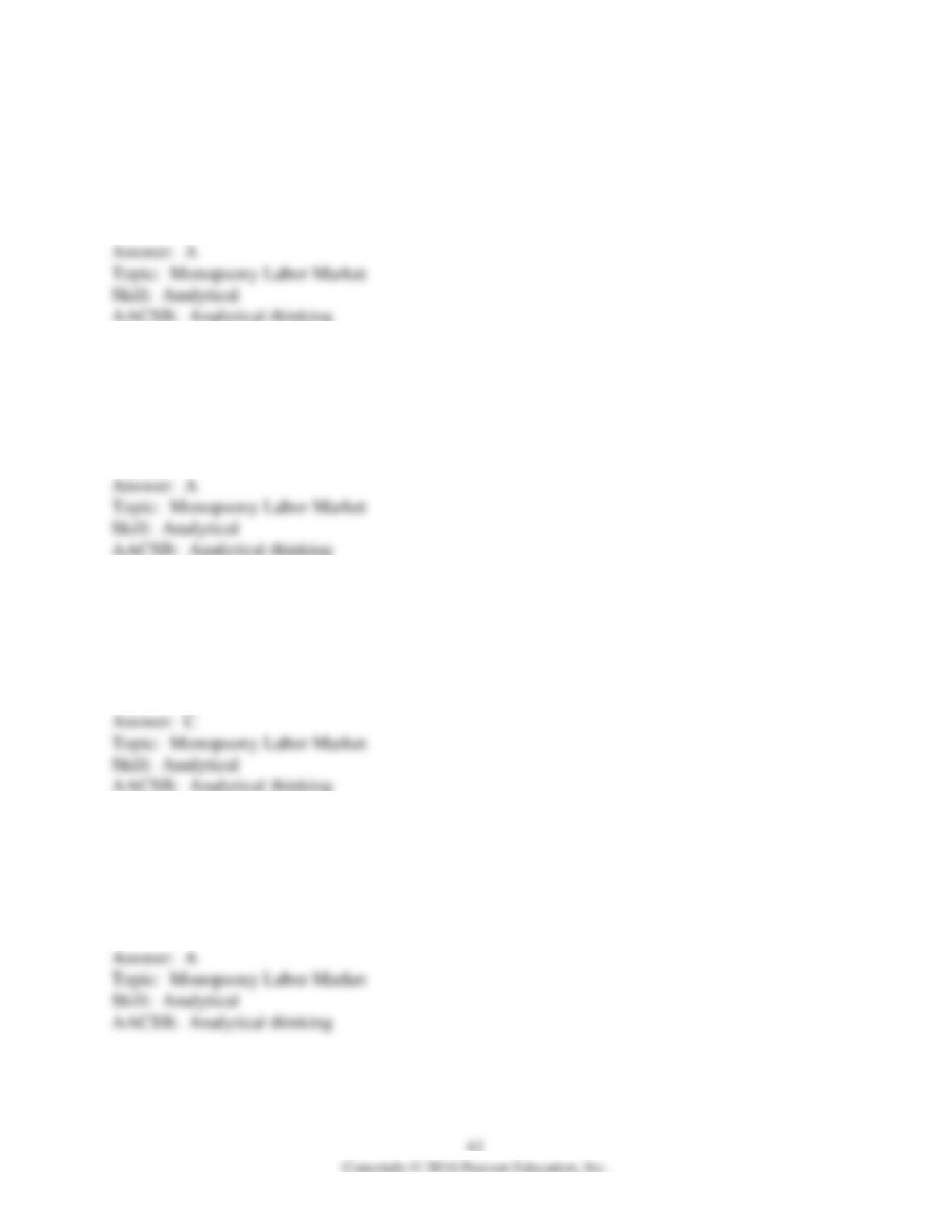
104) Consider the monopsony in the above figure. The monopsony will hire ________ hours per
week.
A) 200
B) 400
C) 600
D) None of the above answers is correct.
105) Consider the monopsony in the above figure. The monopsony will pay a hourly wage rate
equal to
A) $10.
B) $15.
C) $20.
D) None of the above answers is correct.
106) Consider the monopsony in the above figure. The 200th hour of labor creates how much
added revenue per hour for the monopsony?
A) $10
B) $15
C) $20
D) None of the above answers is correct.
107) Consider the labor market depicted in the above figure. What wage rate must be paid to
have the 200th hour of labor supplied?
A) $10
B) $15
C) $20
D) None of the above answers is correct.
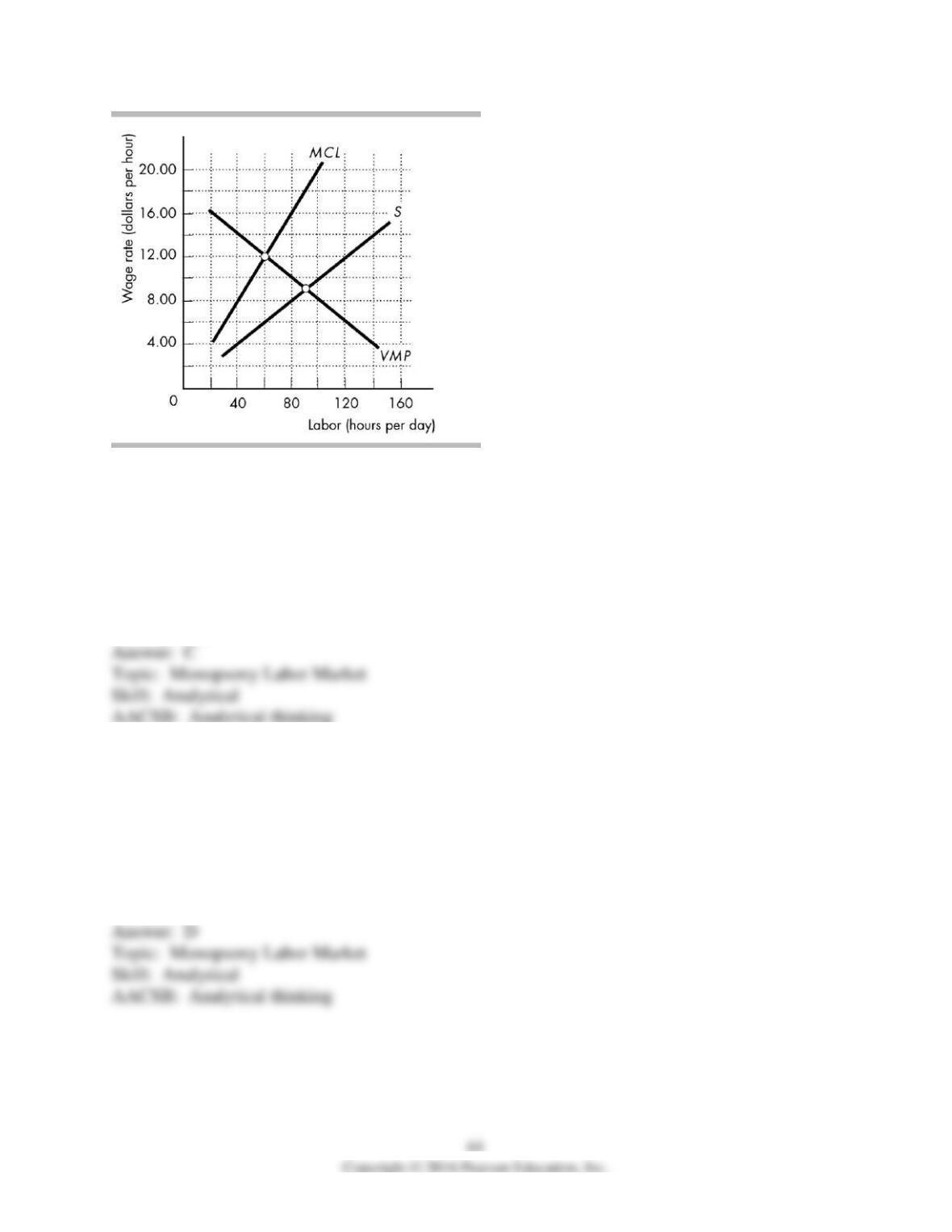
108) City-Mart is the only employer of sales clerks in Panburg. In the figure above S is the labor
supply curve faced by City-Mart, VMP is City-Mart’s value of marginal product curve, and MCL
is its marginal cost of labor curve. The lowest wage rate at which City-Mart can hire 40 hours of
labor per day is
A) $8 per hour.
B) $12 per hour.
C) $4 per hour.
D) $9 per hour.
109) City-Mart is the only employer of sales clerks in Panburg. In the figure above S is the labor
supply curve faced by City-Mart, VMP is City-Mart’s value of marginal product curve, and MCL
is its marginal cost of labor curve. City-Mart maximizes its profit if it hires ________ hours of
labor and pays ________ per hour.
A) 90; $9
B) 60; $12
C) 90; $6
D) 60; $6
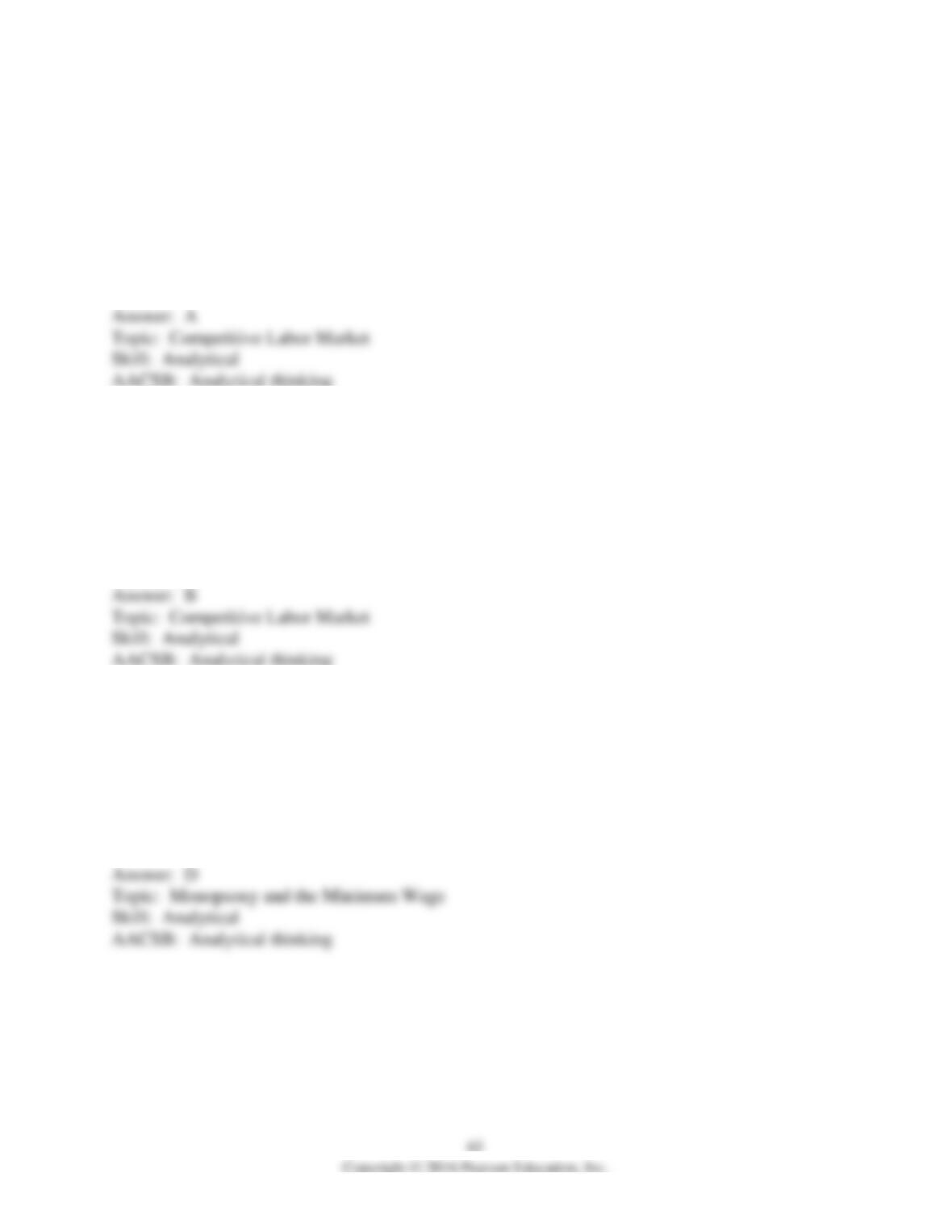
110) City-Mart is the only employer of sales clerks in Panburg. In the figure above S is the labor
supply curve faced by City-Mart, VMP is City-Mart’s value of marginal product curve, and MCL
is its marginal cost of labor curve. If the market for sales clerks’ labor in Panburg were
competitive, the wage rate would be ________ per hour, and ________ hours of labor would be
hired.
A) $9; 90
B) $12; 60
C) $6; 90
D) $6; 60
111) City-Mart is the only employer of sales clerks in Panburg. In the figure above S is the labor
supply curve faced by City-Mart, VMP is City-Mart’s value of marginal product curve, and MCL
is its marginal cost of labor curve. City-Mart sales clerks’ wage is ________ it would be if the
labor market were competitive.
A) $3 per hour higher than
B) $3 per hour lower than
C) $6 per hour lower than
D) the same as
112) City-Mart is the only employer of sales clerks in Panburg. In the figure above S is the labor
supply curve faced by City-Mart, VMP is City-Mart’s value of marginal product curve, and MCL
is its marginal cost of labor curve. If a minimum wage law is passed that requires employers to
pay at least $7 per hour, City-Mart will employ ________ hours of sales clerk labor per day.
A) 35
B) 110
C) 90
D) 70
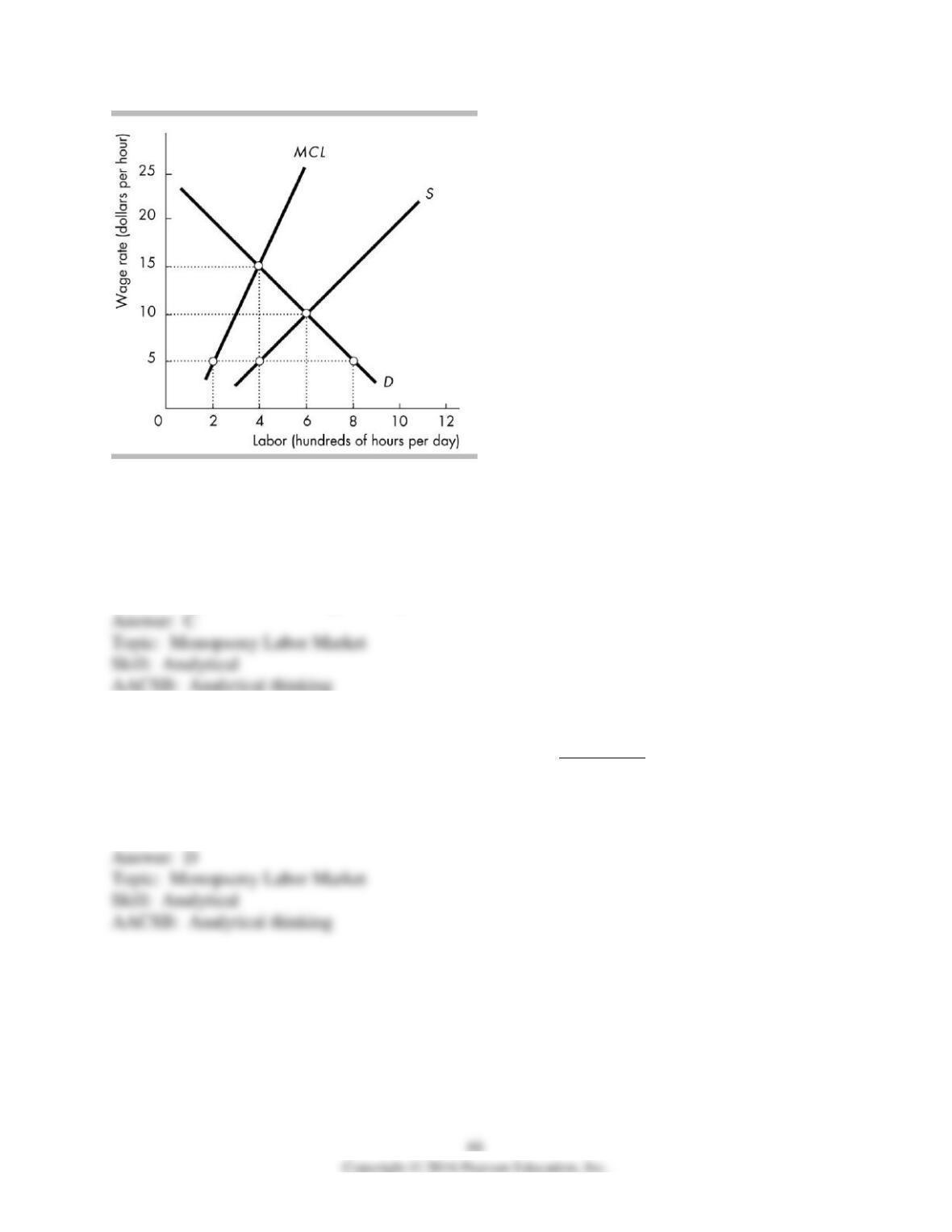
113) The above figure shows the market for labor. The employer is a monopsony. The firm
maximizes its profit by hiring
A) 800 hours of labor at a wage of $5 per hour.
B) 600 hours of labor at a wage of $10 per hour.
C) 400 hours of labor at a wage of $5 per hour.
D) 200 hours of labor at a wage of $5 per hour.
114) The above figure shows the market for labor. The employer is a monopsony. At the
equilibrium level of employment, which of the following is CORRECT?
A) MCL = VMP
B) VMP > W
C) W < MCL
D) All of the above are correct.
115) The above figure shows the market for labor. The employer is a monopsony. The firm will
maximize its profit by hiring 400 hours of labor because at that point
A) MCL > W.
B) VMP > W.
C) MCL > VMP.
D) MCL = VMP.
116) The above figure shows the market for labor. The employer is a monopsony. The firm will
not hire 800 hours of labor because at that point
A) VMP > MCL.
B) VMP = MCL.
C) VMP < MCL.
D) VMP = W.
117) The above figure shows the market for labor. The employer is a monopsony. If the workers
are unionized, the wage will be
A) $5 per hour.
B) between $5 per hour and $15 per hour.
C) above $15 per hour.
D) less than if the workers were not unionized.
118) The above figure shows the market for labor. The employer is a monopsony. If a minimum
wage is set at $10 per hour, which of the following will occur?
A) The firm will pay $5 per hour.
B) The firm will pay $10 per hour.
C) The firm will pay $15 per hour.
D) The firm will hire less than 400 hours of labor.
119) The above figure shows the market for labor. The employer is a monopsony. If a minimum
wage of $10 is imposed, the equilibrium level of employment is
A) 200 hours per day.
B) 400 hours per day.
C) 600 hours per day.
D) 800 hours per day.
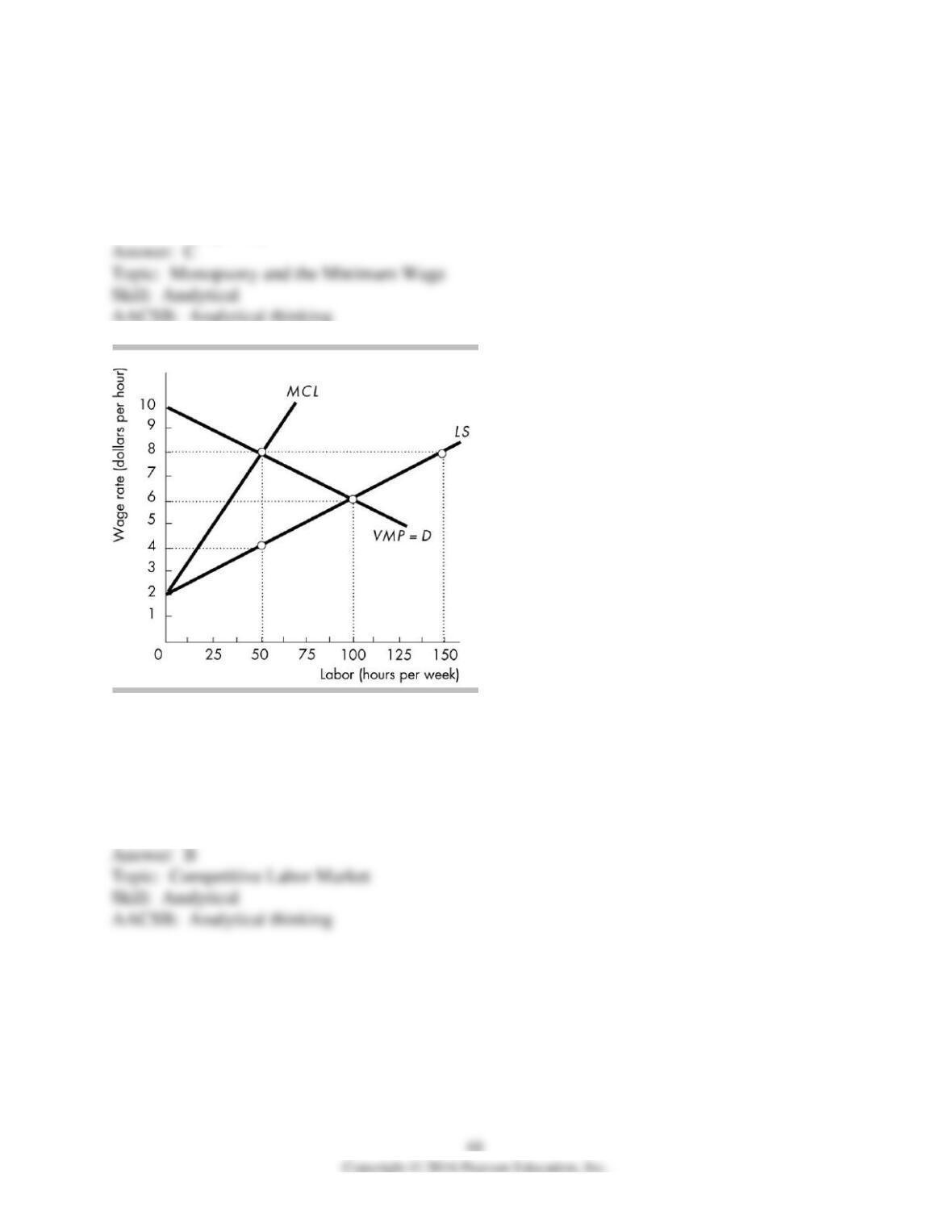
120) The figure above shows a labor market. If this labor market is perfectly competitive, the
wage rate is
A) $4 per hour.
B) $6 per hour.
C) $8 per hour.
D) $10 per hour.
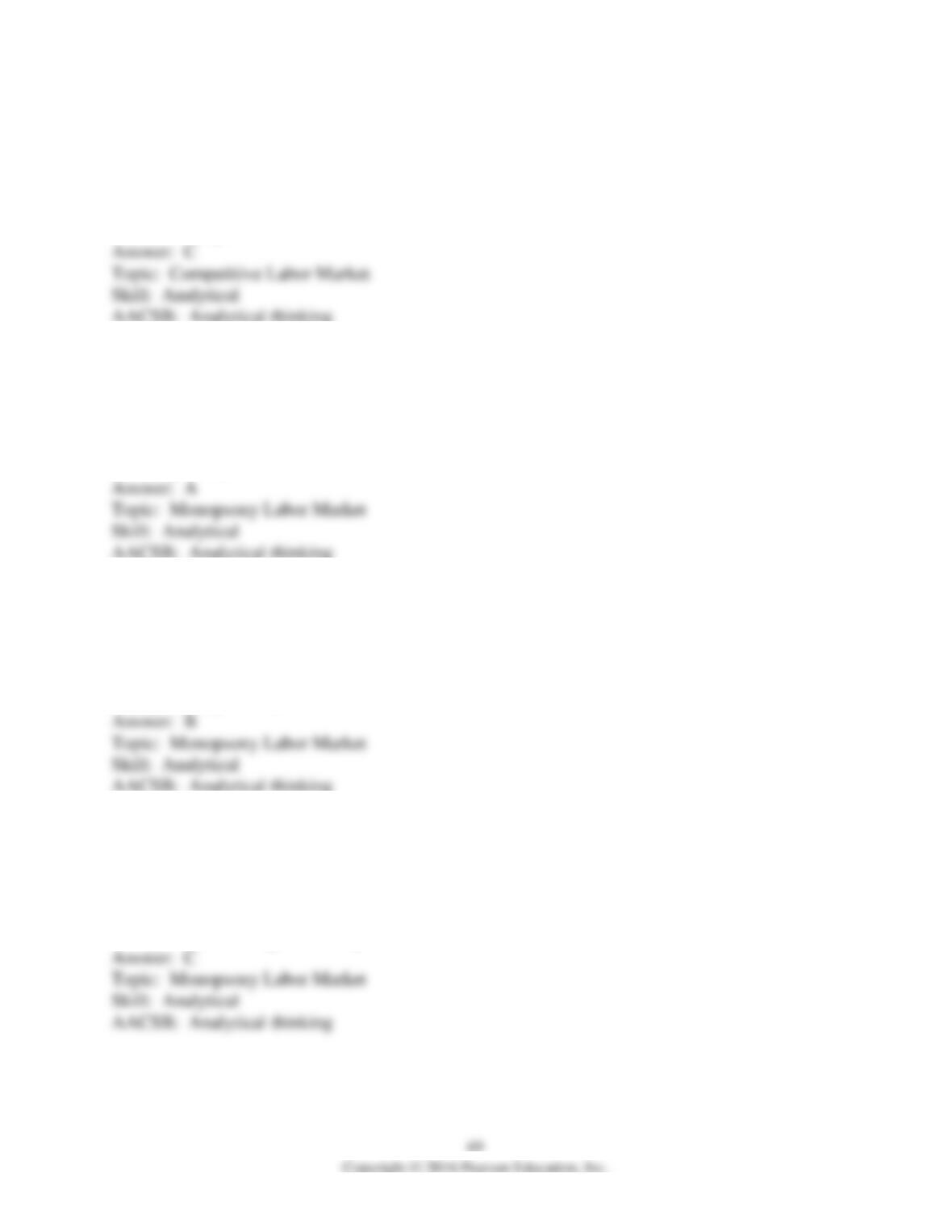
121) The figure above shows a labor market. If this labor market is perfectly competitive,
employment is
A) 0 hours per week.
B) 50 hours per week.
C) 100 hours per week.
D) 150 hours per week.
122) The figure above shows a labor market. If there is a monopsony in this labor market, the
wage rate is
A) $4 per hour.
B) $6 per hour.
C) $8 per hour.
D) $10 per hour.
123) The figure above shows a labor market. If there is a monopsony in this labor market,
employment is
A) 0 hours per week.
B) 50 hours per week.
C) 100 hours per week.
D) 150 hours per week.
124) The figure above shows a labor market. If there is a monopsony in this labor market, the
monopsony pays a wage rate
A) greater than the value of marginal product of labor.
B) equal to the value of marginal product of labor.
C) less than the value of marginal product of labor.
D) equal to the average revenue product of labor.
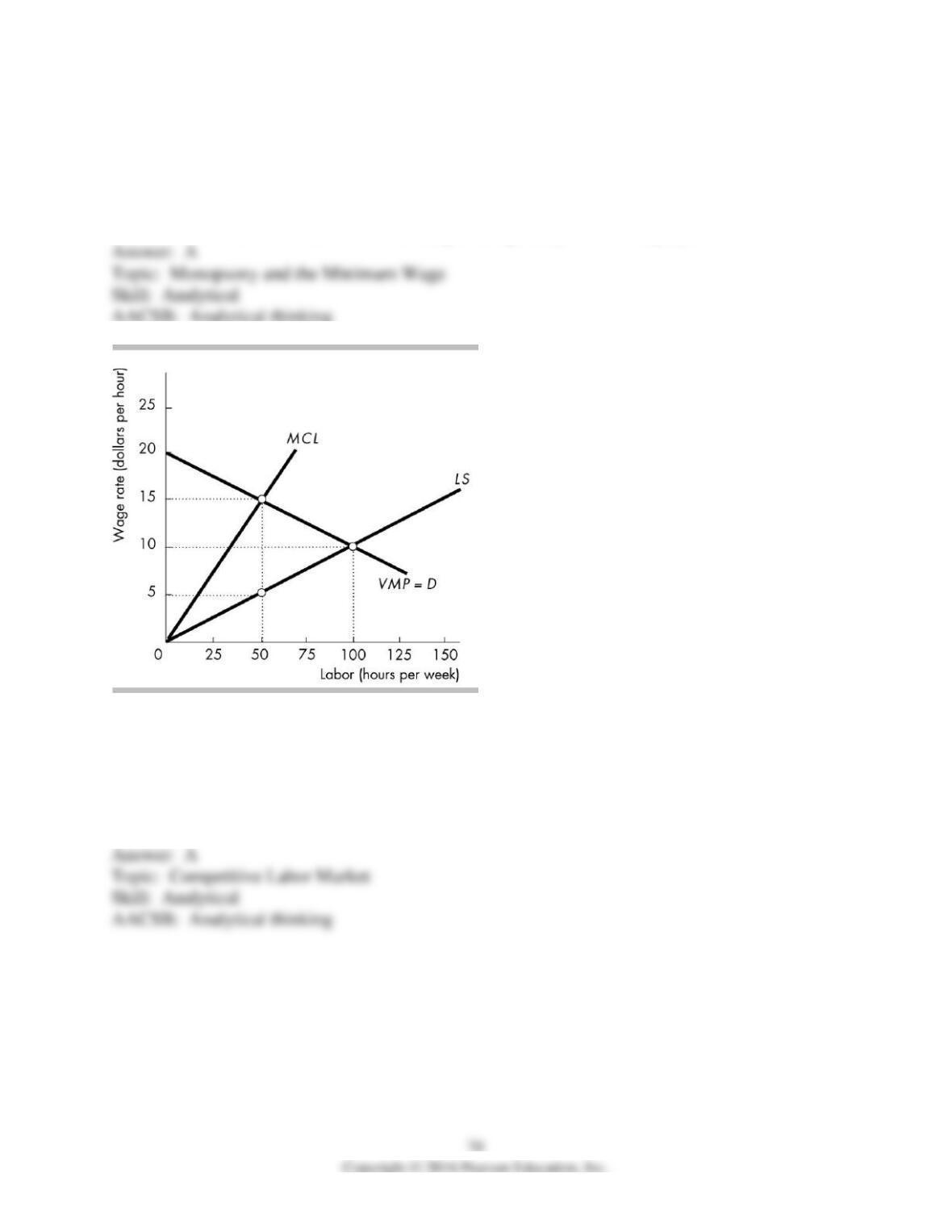
125) The figure above shows a labor market. If there is a monopsony in this labor market, then
increasing the minimum wage from $3 per hour to $5 per hour
A) will increase the quantity of labor employed.
B) will leave unchanged the quantity of labor employed.
C) will decrease the quantity of labor employed.
D) could increase, decrease, or leave unchanged the quantity of labor employed.
126) If the labor market in the above figure is competitive, what is the equilibrium wage and
quantity of labor hired?
A) $10 and 100 hours
B) $10 and 50 hours
C) $5 and 100 hours
D) $15 and 50 hours
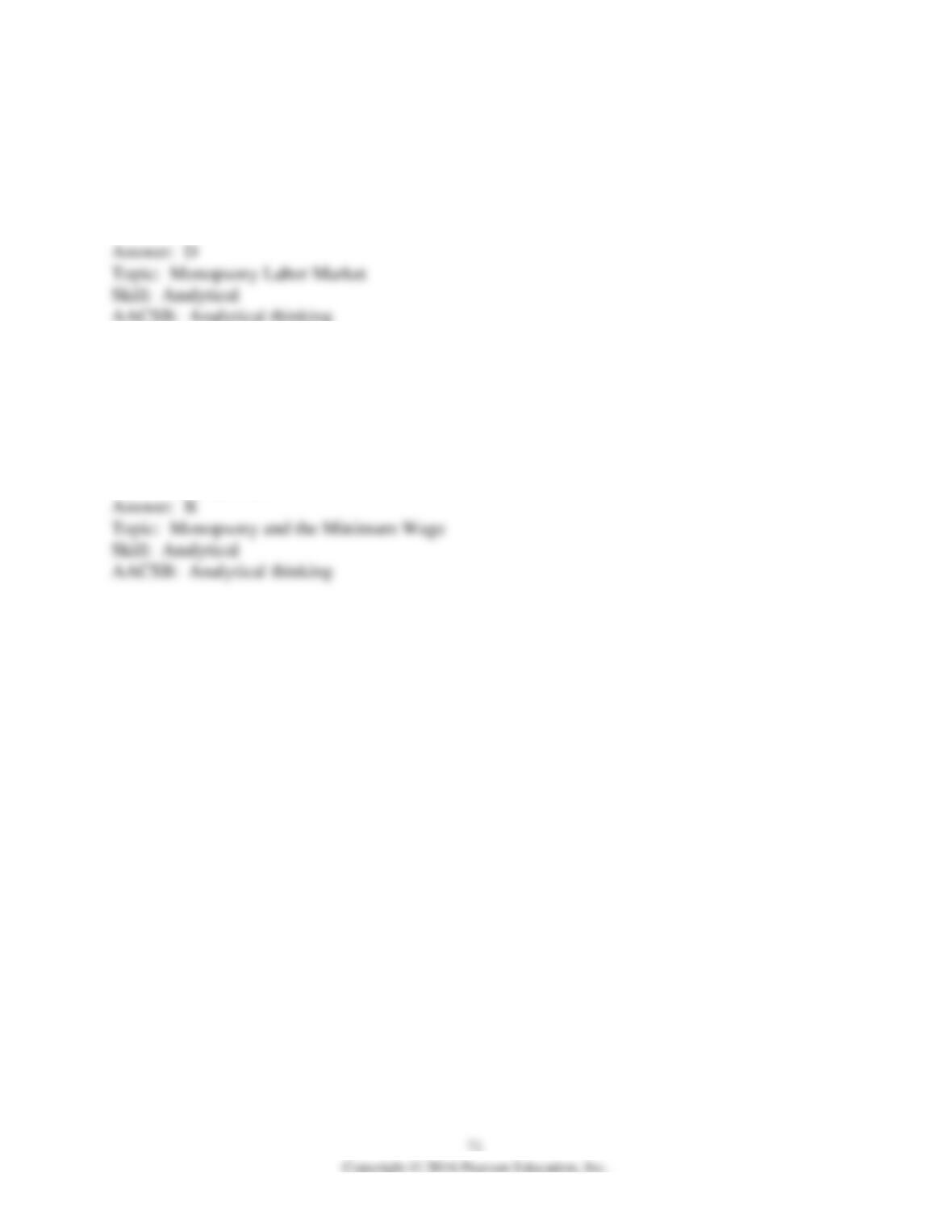
127) If there is a monopsony operating in the labor market illustrated in the figure above, the
equilibrium wage and quantity of labor hired is
A) $15 and 50 hours.
B) $10 and 100 hours.
C) $10 and 50 hours.
D) $5 and 50 hours.
128) If there is a monopsony operating in the labor market illustrated in the figure above and the
federal government decides to institute a minimum wage of $8 an hour then the wage paid will
________ and the quantity of labor hired will ________.
A) increase; decrease
B) increase; increase
C) decrease; increase
D) decrease; decrease
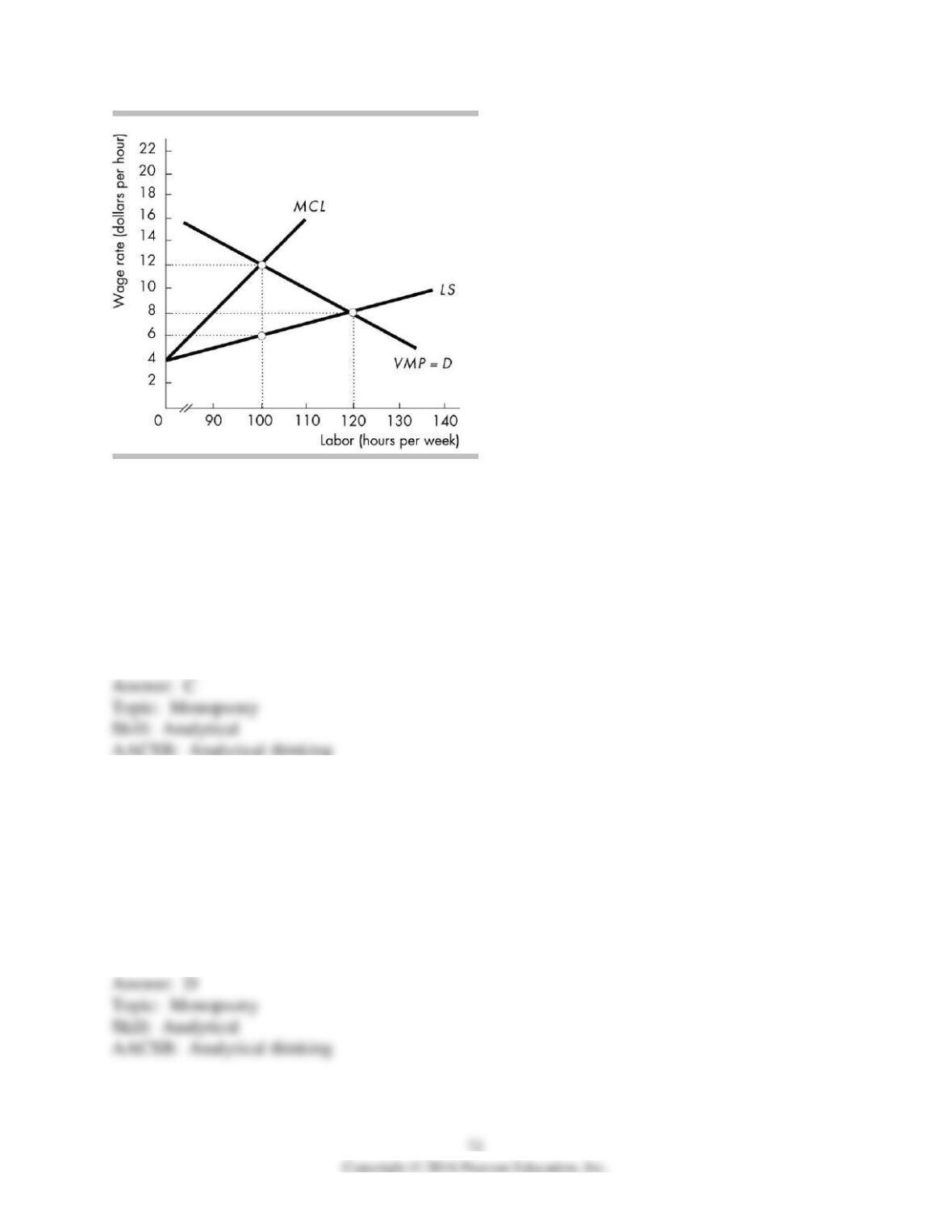
129) Hank’s Propane Storage Company is a profit-maximizing monopsony in the local labor
market for propane handling, delivery, and other associated services. The supply and marginal
cost of labor curves are shown in the figure above. Hank’s demand for labor curve is the curve
labeled VMP = D. Hank will employ ________ hours of labor per week and pay a wage rate of
________ per hour.
A) 100; $12
B) 100; $8
C) 100; $6
D) 120; $8
130) Hank’s Propane Storage Company is a profit-maximizing monopsony in the local labor
market for propane handling, delivery, and other associated services. The supply and marginal
cost of labor curves are shown in the figure above. Hank’s demand for labor curve is the curve
labeled VMP = D. What is Hank’s total cost of labor at the profit-maximizing quantity of labor
employed?
A) $1,200
B) $960
C) $800
D) $600
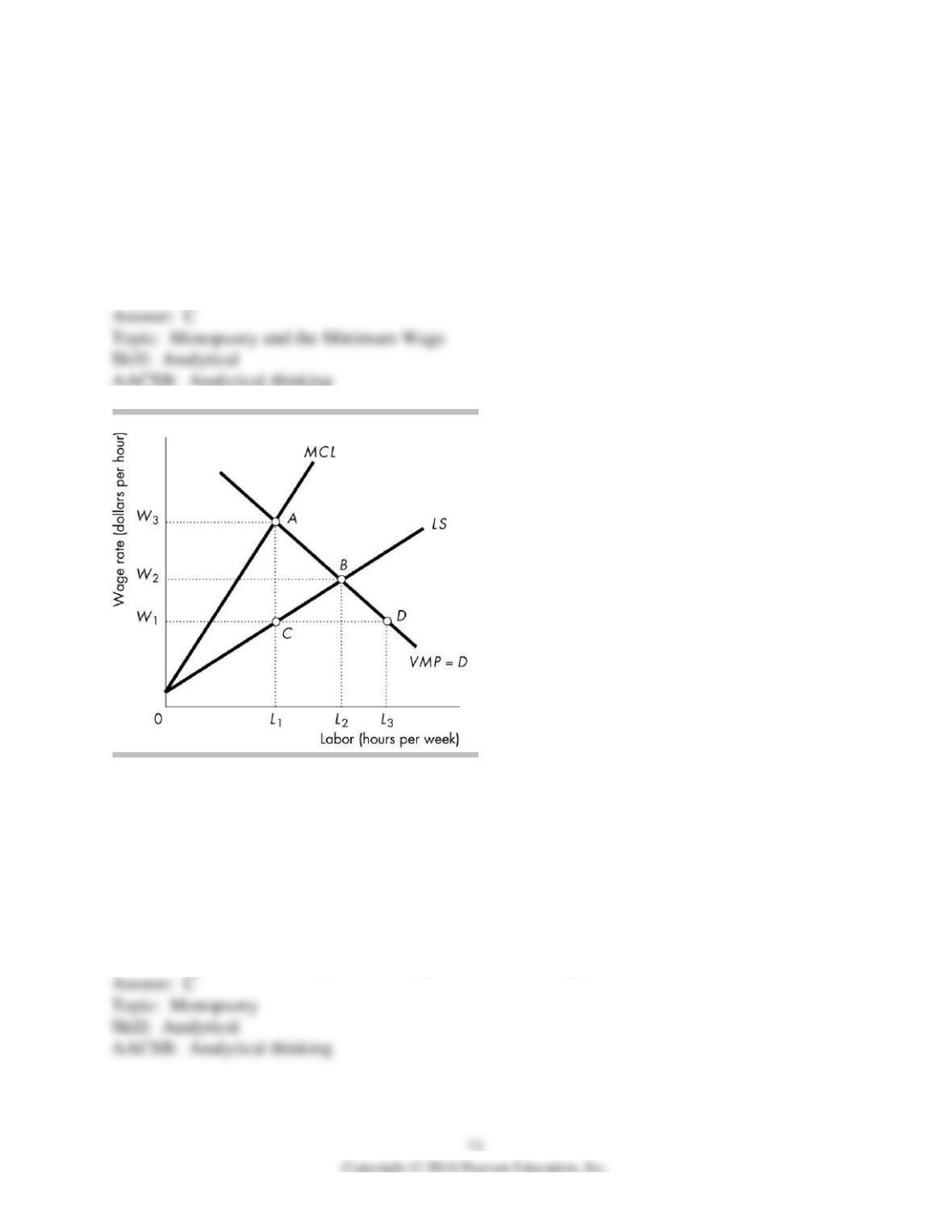
131) Hank’s Propane Storage Company is a profit-maximizing monopsony in the local labor
market for propane handling, delivery, and other associated services. The supply and marginal
cost of labor curves are shown in the figure above. Hank’s demand for labor curve is the curve
labeled VMP = D. At what level should a minimum wage be set in order to achieve the wage rate
and quantity of employment that would be attained in a competitive labor market?
A) $4 per hour
B) $6 per hour
C) $8 per hour
D) $12 per hour
132) In the above figure, the curve labeled MCL is the marginal cost of labor curve and is used in
a
A) competitive situation in which individual firms cannot influence the wage rate they must pay.
B) competitive situation in which skill differentials create a difference between what a firm must
pay labor versus the wage at which households are willing to supply labor.
C) monopsony situation in which the firm can influence wages by how much labor it hires, so
that the wage rate received by workers is less than the marginal cost of labor.
D) monopsony situation in which the firm can influence wages by how much labor it hires, so
that the wage rate received by workers is greater than the marginal cost of labor.
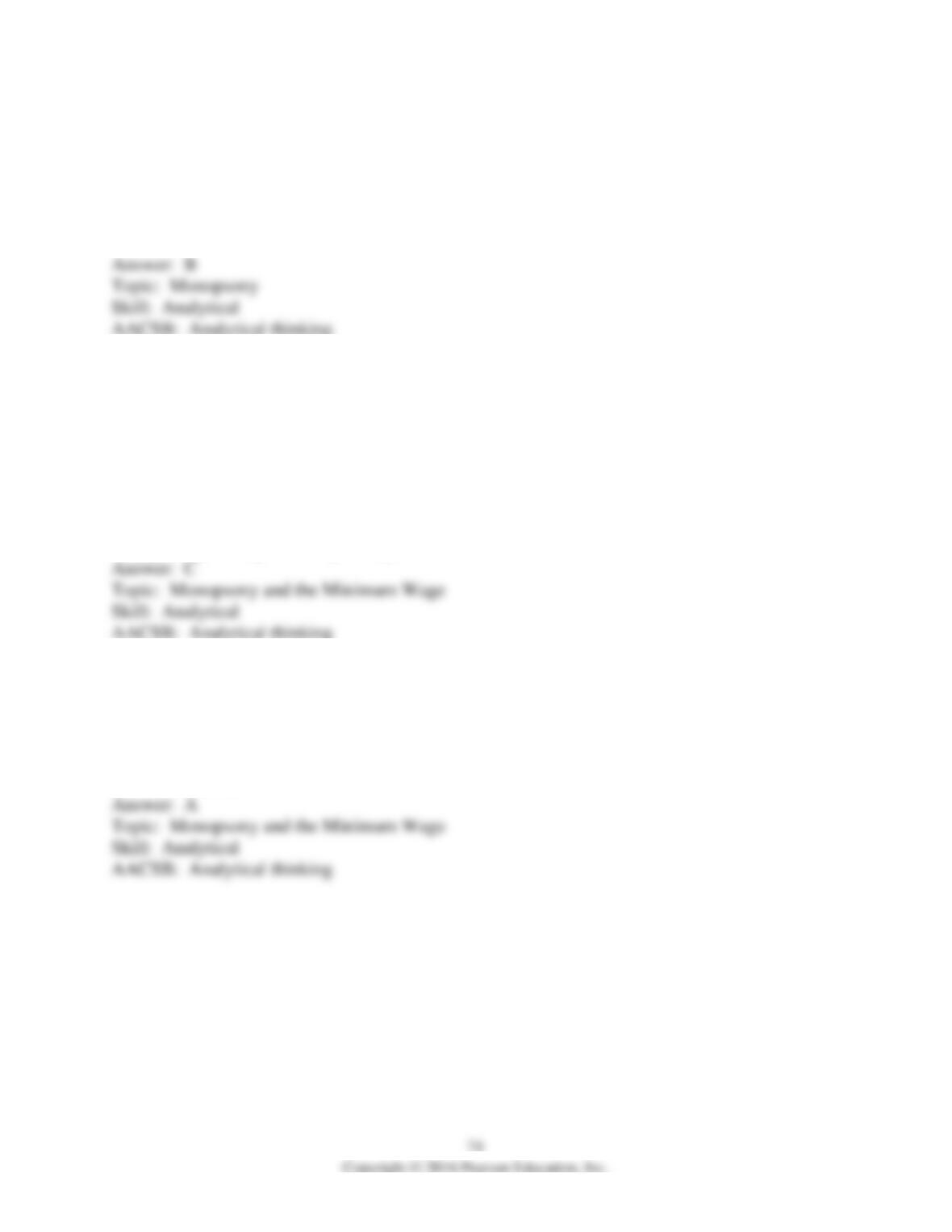
133) In the above figure, what would be the wage paid and quantity of labor employed under
competitive market conditions compared to monopsony conditions?
A) W1 and L1 with competition versus W2 and L2 with monopsony
B) W2 and L2 with competition versus W1 and L1 with monopsony
C) W2 and L2 with competition versus W3 and L1 with monopsony
D) W3 and L3 with competition versus W3 and L1 with monopsony
134) The above figure illustrates the case of a monopsony in the labor market. If the current
wage paid is W1 and new wage legislation is passed that increases the minimum wage in this
market to W2, the firm will
A) hire less labor at the higher wage and, according to the law of demand, moving from point D
to B.
B) hire the same amount of labor as before the law was passed because it cannot adjust to wage
changes.
C) hire more labor, moving from point C to B.
D) pay a higher wage, moving from point C to A.
135) In a monopsony labor market, a minimum wage set equal to the competitive market
equilibrium wage rate can ________ the wage rate and ________ employment.
A) raise; increase
B) raise; decrease
C) lower; increase
D) lower; decrease
136) The union representing the bread makers at the Hostess Bread Company went on strike and
demanded higher wages than what the firm wanted to pay.
I. If the firm is in a competitive labor market the union can only raise wages by decreasing
employment.
II. If the firm is a monopsony in the labor market the union can only raise wages by decreasing
employment.
III. If the firm is a monopsony in the labor market the union can both raise wages and increase
employment.
A) I only
B) II only
C) I and II
D) I and III
137) When a union faces a monopsony buyer, a ________ exists.
A) dual-monopoly
B) monopoly
C) bilateral monopoly
D) monopolistic monopsony
138) An example of a bilateral monopoly would be when a union
A) bargains with many different employers.
B) deals directly with the final consumers.
C) bargains with a monopoly.
D) bargains with a monopsony.
139) A situation where a union bargains with a monopsony employer is termed a
A) bilateral monopsony.
B) bilateral monopoly.
C) bilateral agreement.
D) unilateral agreement.
140) A bilateral monopoly is a
A) firm that is a monopsony in a resource market and a monopoly in a product market.
B) firm that is a monopoly in two product markets.
C) market in which a monopoly discriminates, setting a higher price for affluent customers.
D) market in which a monopsony bargains with a monopoly.
141) If a monopsony must negotiate with a union, then the wage will probably be
A) more than the value of marginal product.
B) more than the marginal cost of labor.
C) the same as if there had been no union.
D) more than what it would have been without a union but not more than the value of marginal
product.
142) In a bilateral monopoly, the wage rate is likely to be ________ than the value of marginal
product of labor and ________ than in a pure monopsony.
A) lower; lower
B) lower; higher
C) higher; lower
D) higher; higher
143) A minimum wage might increase employment by a monopsony if it makes the supply of
labor curve to that firm
A) steeper, that is, makes supply more elastic.
B) steeper, that is, makes supply less elastic.
C) flatter, that is, makes supply more elastic.
D) flatter, that is, makes supply less elastic.
144) Which of the following is a recent trend in the labor market?
A) Low-skilled workers have lost jobs.
B) The demand for high-skilled labor has increased as technology has increased.
C) The wages of high-skilled labor have decreased.
D) The marginal productivity of low-skilled workers has increased.
145) If the substitution effect from a higher wage rate exceeds the income effect, then a higher
wage rate
A) increases the quantity of labor supplied.
B) decreases the quantity of labor supplied.
C) shifts the supply of labor curve leftward.
D) shifts the supply of labor curve rightward.
146) The demand for a product produced by a union becomes more elastic. After this change,
how does an increase in the wage rate paid its members affect their employment?
A) It does not decrease employment at all.
B) It decreases employment by less than it would have before.
C) It decreases employment by more than it would have before.
D) It increases employment.
147) Which of the following would unions be most likely to support?
A) decreasing the legal minimum wage
B) restricting immigration
C) encouraging imports
D) increasing the elasticity of demand for the goods their workers produce
148) For a monopsony, the labor supply curve
A) lies above the MCL curve.
B) is the same as the MCL curve.
C) lies below the MCL curve.
D) is the same as the labor demand curve.
149) In order to hire an additional worker, a monopsony must pay
A) a higher wage rate than it paid before.
B) the same wage rate it paid before.
C) a lower wage rate than it paid before.
D) a wage rate that is sometimes higher, sometimes lower, and sometimes the same as before,
depending on the elasticity of the supply of labor.
4 Capital and Natural Resource Markets
1) Changes in which of the following change the demand for capital and shifts the demand curve
for capital?
A) current income
B) expected future income
C) the rental rate
D) the marginal product of capital
2) A technological change that raises the value of marginal product of capital ________ the
rental rate of capital because the ________.
A) raises; supply curve of capital shifts leftward
B) lowers; supply curve of capital shifts rightward
C) raises; demand curve for capital shifts rightward
D) lowers; demand curve for capital shifts leftward
3) Other things being equal, a technological change that raises the value of marginal product of
capital raises the rental rate of capital because the
A) supply curve of capital shifts leftward.
B) supply curve of capital shifts rightward.
C) demand curve for capital shifts rightward.
D) demand curve for capital shifts leftward.
4) The supply of land is
A) perfectly elastic.
B) elastic, but not perfectly elastic.
C) perfectly inelastic.
D) inelastic, but not perfectly inelastic.
5) If the supply of a factor is perfectly inelastic, then
A) no more than the existing quantity can be supplied.
B) the supply curve is horizontal.
C) sellers will provide whatever quantity is demanded at the going price.
D) a fall in price results in no quantity being supplied.
6) The loan market is in equilibrium. If the demand for land decreases, the rental rate of land
________.
A) might rise or fall
B) rises
C) falls
D) remains unchanged
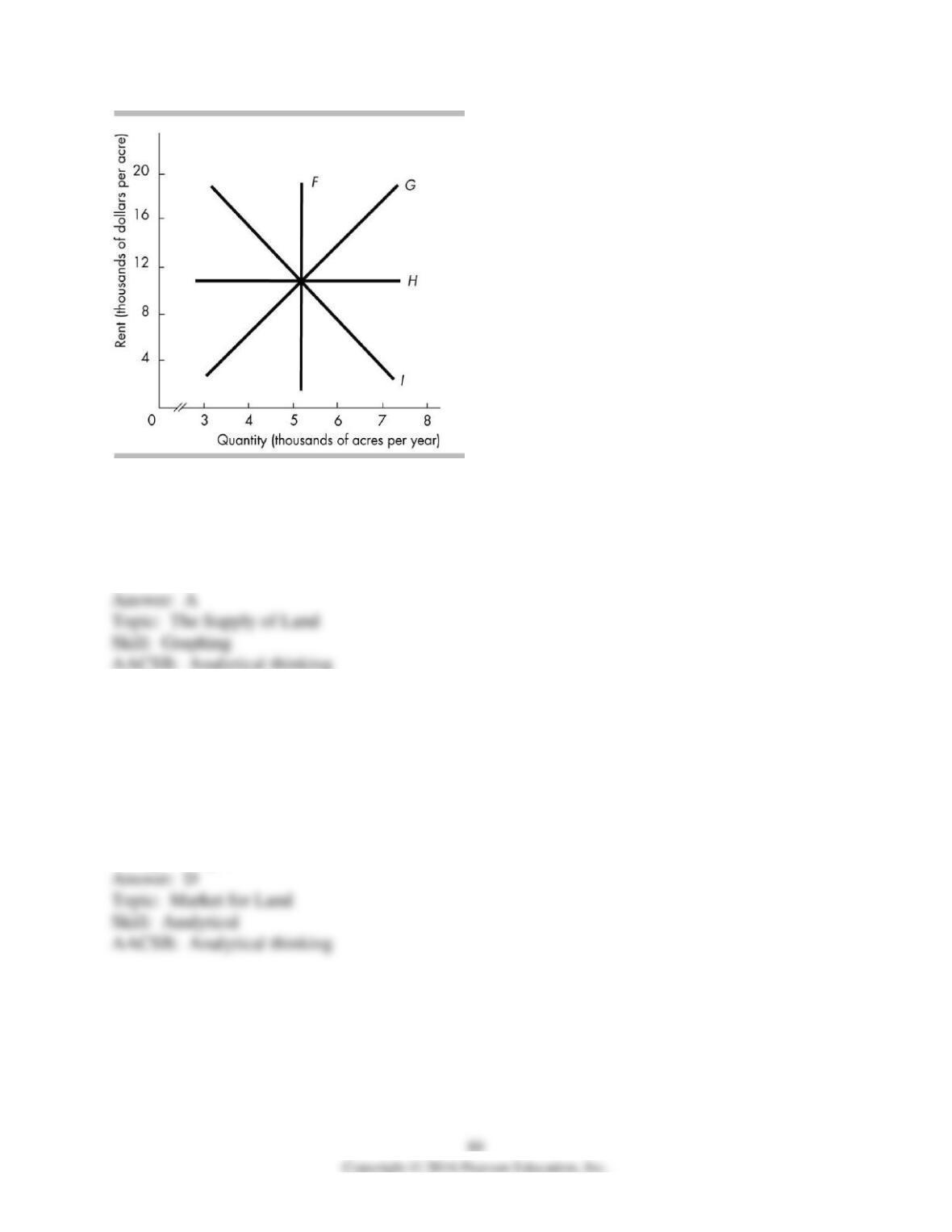
7) In the above figure, which curve depicts the supply of land for Chicago’s “Magnificent Mile”?
A) curve F
B) curve G
C) curve H
D) curve I
8) Starbucks sells coffee in both New York City and in rural upstate New York. The price of
coffee is higher in New York City. This fact means that the value of marginal product of land is
________ in New York City and so Starbucks is willing to pay a ________ rent in New York
City.
A) lower; lower
B) higher; lower
C) lower; higher
D) higher; higher