32) The labor supply curve has a positive slope if the
A) substitution effect outweighs the income effect.
B) income effect outweighs the substitution effect.
C) demand for labor is elastic.
D) demand for labor is inelastic.
33) For many jobs, as wages increase, the quantity supplied of labor increases. This set of facts is
evidence that the
A) substitution effect is larger than the income effect and the supply of labor curve is upward
sloping.
B) income effect is larger than the substitution effect and the supply of labor curve is upward
sloping.
C) substitution effect is larger than the income effect and the supply of labor curve is backward
bending.
D) income effect is larger than the substitution effect and the supply of labor curve is backward
bending.
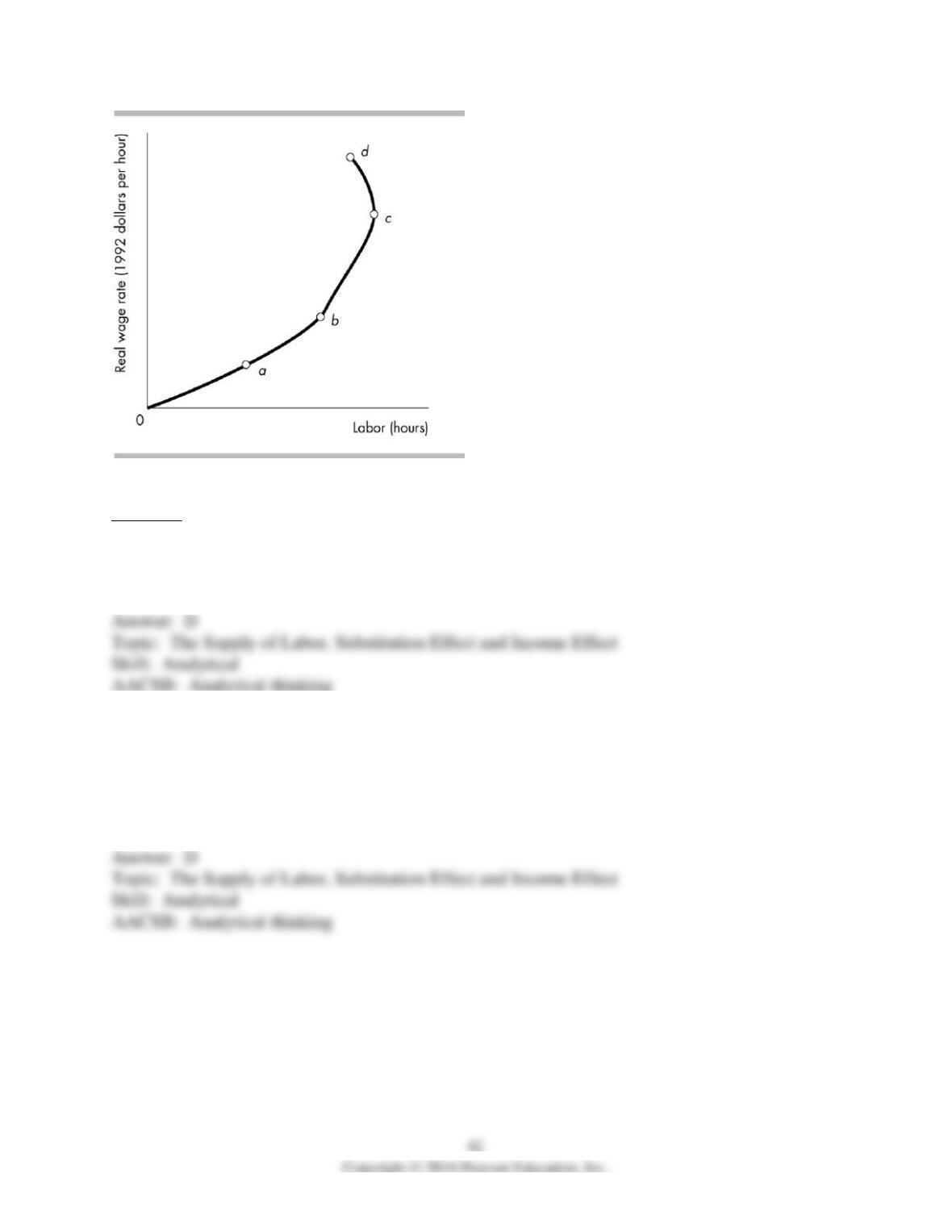
34) In the figure above, the substitution effect outweighs the income effect in all segments
EXCEPT
A) 0a.
B) 0c.
C) bc.
D) cd.
35) In the figure above, the segment of the curve showing where the income effect outweighs the
substitution effect is
A) 0a.
B) bd.
C) 0c.
D) cd.
36) The market supply of labor curve has a positive slope if higher wages induce households to
choose
A) leisure rather than supplying labor in the labor market.
B) supplying labor in the labor market rather than leisure.
C) demanding labor rather than supplying it.
D) None of the above answers is correct.
37) Which of the following will increase the wage rate?
A) an increase in the adult population
B) an increase in the retirement age
C) an improvement in technology that increases the marginal product of labor
D) Both answers A and B are correct.
38) Which of the following will increase the wage rate?
A) The price of the output produced by the workers increases.
B) New technology increases the marginal product of labor.
C) an increase in labor supply
D) Both answers A and B are correct.
39) You observe that more labor is employed and the wage rate increases. This set of events
could have been the result of a
A) rightward shift of the labor demand curve.
B) leftward shift of the labor supply curve.
C) rightward shift of the labor supply curve.
D) leftward shift of the labor demand curve.
Wage rate
(dollars per
hour)
Quantity of
labor supplied
(hours per day)
Quantity of labor
demanded
(hours per day)
5
200
600
10
300
500
15
400
400
20
500
300
25
600
200
40) The table above gives information about the labor market in Lantis, a community in which
the labor market is perfectly competitive. The equilibrium wage rate is ________ an hour and the
quantity of labor employed is ________ hours per day.
A) $5; 600
B) $25; 200
C) $15; 400
D) None of the above answers is correct.
41) The table above gives information about the labor market in Lantis, a community in which
the labor market is perfectly competitive. If the demand for labor decreases by 200 hours per
day, the equilibrium wage rate falls to ________ an hour and the quantity of labor employed
________ hours per day.
A) $10; remains at 400
B) $10; decreases to 300
C) $20; increases to 400
D) $5; remains at 200
42) The table above gives information about the labor market in Lantis, a community in which
the labor market is perfectly competitive. If the price of the good increases and increases the
value of marginal product of labor by $10 an hour, the equilibrium wage rate ________ an hour
and the quantity of labor employed ________.
A) rises to $10; increases to 600
B) stays at $15; decreases to 300 hours
C) rises to $20; increases to 500 hours
D) None of the above answers is correct.
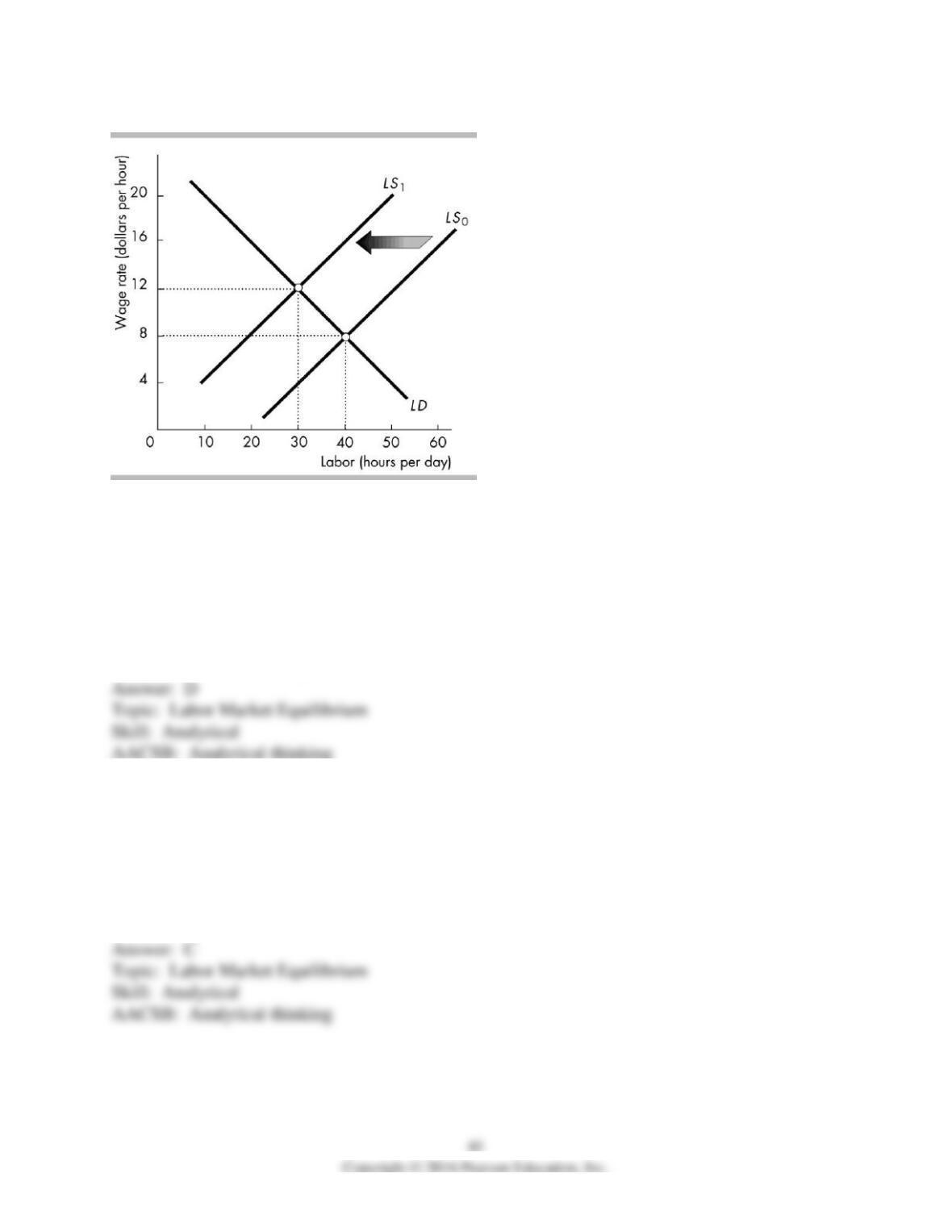
43) The figure above shows the labor demand and labor supply curves for workers in local fast-
food restaurants. The fast-food restaurant industry is competitive. A decrease in the supply of
labor shifts the labor supply curve from LS0 to LS1. Fast-food restaurants hire ________ and
total labor income earned by the fast-food workers ________.
A) 40 hours of labor a day; increases
B) 30 hours of labor a day; decreases
C) 40 hours of labor a day; decreases
D) 30 hours of labor a day; increases
44) The figure above shows the labor demand and labor supply curves for workers in local fast-
food restaurants. The fast-food restaurant industry is competitive. A decrease in the supply of
labor shifts the labor supply curve from LS0 to LS1. The wages of fast-food workers ________.
A) decrease by $4 per hour
B) decrease by $10 per hour
C) increase by $4 per hour
D) remain the same
45) The existence of a union
A) has no effect on labor supply and demand.
B) affects labor supply only.
C) affects labor demand only.
D) can affect both labor supply and labor demand.
46) If a union is able to decrease the supply of workers in a competitive labor market but the
union cannot affect the demand for its members’ labor, then
A) wages and the quantity of labor hired will both increase.
B) wages will increase but the quantity of labor hired will decrease.
C) wages will decrease but the quantity of labor hired will increase.
D) wages and the quantity of labor hired will both decrease.
47) If a union restricts the supply of labor but cannot change the demand for labor, the union
________ the wage rate and ________ the level of employment.
A) raises; decreases
B) raises; increases
C) lowers; decreases
D) lowers; increases
48) If a union successfully restricts the supply of labor to the firm but the union has no effect on
the demand for labor, then the
A) wage increases and there is no change in employment.
B) wage increases and employment increases.
C) wage increases and employment decreases.
D) wage increases and there is an unambiguous effect on employment.
49) On the supply side of the labor market, the union’s success is limited by how much
A) nonunion labor is available in the same market.
B) employment union members will accept.
C) capital the firm utilizes.
D) all of the above
50) If a union is unable to increase the demand for its workers, then success at raising the wage
rate paid its members means that
A) all union members receive a higher wage.
B) some union members will lose their jobs.
C) more union members will be hired.
D) the union will push for a decrease in the minimum wage.
51) If a union can successfully shift the demand curve for union labor rightward, the union can
achieve
A) an increase in wages and employment.
B) an increase in wages but a decrease in employment.
C) an increase in employment but a decrease in wages.
D) a decrease in both employment and wages.
52) Unions tend to ________ import restrictions and ________ a higher minimum wage.
A) favor; favor
B) favor; oppose
C) oppose; favor
D) oppose; oppose
53) Which of the following methods is used by unions to increase the demand for the labor of its
members?
A) Decrease the marginal product of union members.
B) Support minimum wage laws.
C) Oppose import restrictions.
D) Decrease demand for the good produced.
54) Which of the following increases the demand for U.S. union labor?
A) an increase in the minimum wage
B) an increase in the demand for imported goods
C) new laws that ease immigration restrictions
D) All of the above cause an increase in the demand for union labor.
55) Unions support minimum wage laws because an increase in the minimum wage
A) increases the supply of union labor.
B) decreases the supply of union labor.
C) increases the demand for union labor.
D) decreases the demand for union labor.
56) A rise in the minimum wage increases the demand for union labor because this policy change
A) lowers the wage rate paid to union labor.
B) raises the productivity of union labor.
C) lowers the cost of a substitute for union labor.
D) raises the cost of a substitute for union labor.
57) Unions support minimum wage laws, because
A) union workers are typically paid the minimum wage.
B) an increase in the minimum wage paid to low-skilled labor increases the opportunity cost of
employing high-skilled union labor and, hence, increases the demand for union labor.
C) an increase in the minimum wage paid to low-skilled labor increases the opportunity cost of
employing low-skilled labor and, hence, increases the demand for union labor.
D) an increase in the minimum wage paid to low-skilled labor causes the supply curve of low-
skilled labor to shift leftward and, hence, increases the demand for union labor.
58) Which of the following is a method used by unions to increase the demand for their
members’ labor?
A) Support import restrictions.
B) Decrease the marginal product of union members.
C) Oppose immigration restrictions.
D) Oppose minimum wage laws.
59) Which of the following activities increases the demand for union labor?
A) a decrease in the minimum wage
B) a decrease in immigration
C) an increase in the union wage
D) an increased desire by consumers to buy imports
60) Which of the following decreases the supply of labor that competes with union labor?
A) an increase in the minimum wage
B) an increase in the demand for imported goods
C) new laws that restrict immigration
D) All of the above would cause a decrease in the supply of labor that competes with union
labor.
61) An advertisement campaign that successfully convinces consumers to buy union-made
products has the direct effect of shifting the
A) demand curve for union labor rightward.
B) demand curve for union labor leftward.
C) supply curve of union labor rightward.
D) supply curve of union labor leftward.
62) Which of the following activities increases the demand for union labor?
A) a decrease in the minimum wage
B) an increase in immigration
C) additional job training for union members
D) an increased desire by consumers to buy imports
63) Many autoworkers are unionized. Which of the following methods can help them achieve
higher wages?
I. Training that increases union members’ marginal product
II. A publicity campaign promoting purchase of union-made automobile
A) I only
B) II only
C) I and II
D) Neither I nor II
64) Which of the following is NOT a method by which unions try to increase the demand for the
labor of their members?
A) increasing the marginal product of union members
B) increasing the supply of the goods produced by union labor
C) supporting minimum wage laws
D) supporting immigration restrictions
65) In order to change the demand for union labor, unions favor all of the following EXCEPT
increasing
A) the minimum wage.
B) import restrictions.
C) immigration.
D) job training for members.
66) A monopsony is
A) a market in which there is only a single seller.
B) a market in which there is only a single buyer.
C) a monopoly sanctioned by law.
D) an illegal monopoly.
67) A monopsony is a market structure in which there is a
A) single seller.
B) single buyer.
C) price floor set by a regulatory agency.
D) price ceiling set by a regulatory agency.
68) A market structure in which there is only one buyer is
A) a monopoly.
B) a monopsony.
C) an oligopoly.
D) a competitive market.
69) A monopsony is
A) a market in which there is only one producer of a good or service.
B) a market in which there is only one producer and one consumer of a good or service.
C) a market in which there is only one buyer of a good or service.
D) a temporary situation in labor markets when prices are adjusted through the use of collective
bargaining.
70) In which of the following situations is there most likely to be a monopsony?
A) the market for farm workers in a large rural area
B) the market for advertising executives in New York City
C) the market for accountants in New York City
D) the market for NBA players drafted out of college by one NBA team
71) The marginal cost of labor, MCL, is defined as the
A) total cost of producing a certain amount of output.
B) total cost of hiring an additional worker.
C) additional cost of hiring an additional worker.
D) additional fixed cost of producing an additional unit of output.
72) Because a monopsony is the only buyer in a particular market, the
A) supply of labor to the monopsony is perfectly elastic.
B) supply of labor to the monopsony is perfectly inelastic.
C) supply of labor curve faced by the monopsony is upward sloping.
D) supply of labor curve faced by the monopsony is downward sloping.
73) For a monopsony, the labor supply curve is
A) above the MCL curve.
B) always below the VMP curve.
C) downward sloping.
D) upward sloping.
74) For a monopsony the labor supply curve
A) does not exist.
B) is the marginal product of labor curve.
C) is the marginal cost of labor curve.
D) lies below the marginal cost of labor curve.
75) Because a monopsony must raise the wage on all labor hired in order to hire more labor,
A) the MCL curve is horizontal at the market wage.
B) the MCL curve is negatively sloped.
C) MCL = W.
D) MCL > W.
76) For a monopsony, the marginal cost of labor is ________ the wage rate.
A) greater than
B) less than
C) equal to
D) first greater than and later less than
77) A labor market monopsony
A) has a marginal cost of labor curve that lies above the labor supply curve.
B) has a marginal cost of labor curve that lies below the labor supply curve.
C) is a labor market in which the firm has an elastic demand for labor.
D) is a labor market in which the firm has an inelastic demand for labor.
78) For a monopsony, the marginal cost of labor curve lies above the labor supply curve because
A) to hire one more unit of labor requires that the wage be raised for all units of labor.
B) to hire one more unit of labor requires that the wage be raised for just the last unit of labor
hired.
C) to hire one more unit of labor, the firm uses its monopsony power to not raise the wage it
pays.
D) to hire one more unit of labor requires that the firm offer a lower wage.
79) If a firm faces a labor supply curve that is positively sloped, then the marginal cost of labor
curve
A) equals the wage rate.
B) equals the minimum wage.
C) lies above the value of marginal product curve.
D) lies above the labor supply curve.
80) When a firm faces a labor supply curve that is upward sloping, the firm must
A) offer a higher wage if it wishes to hire more workers.
B) pay a wage that exceeds the value of marginal product.
C) pay a wage that does not exceed the minimum wage.
D) maximize the amount of labor that it hires.
81) A monopsony will hire another worker if the
A) marginal cost of labor exceeds the value of marginal product.
B) marginal cost of labor is less than the value of marginal product.
C) marginal cost of labor is less than the wage rate.
D) wage rate exceeds the value of marginal product.
82) A monopsony maximizes its profit by hiring the level of employment that sets
A) labor supply equal to labor demand.
B) the value of marginal product equal to the wage.
C) the value of marginal product equal to the marginal cost of labor.
D) the value of marginal product equal to the demand for labor.
83) The monopsony will hire the amount of labor so that the
A) demand for labor equals supply for labor.
B) value of marginal product of labor equals the wage rate.
C) value of marginal product of labor equals the marginal cost of labor.
D) supply for labor equals the wage rate.
84) A monopsony pays a wage rate ________ the marginal cost of labor and ________ the value
of marginal product of labor.
A) equal to; equal to
B) lower than; lower than
C) equal to; lower than
D) lower than; equal to
85) Because the marginal cost of labor curve lies above the labor supply curve, a monopsony
will pay a wage that is
A) equal to the wage paid in a competitive market.
B) equal to value of marginal product.
C) greater than value of marginal product.
D) less than the wage paid in a competitive market.
86) A monopsony pays a wage rate that is
A) greater than value of marginal product.
B) equal to the marginal cost of labor.
C) less than value of marginal product.
D) unacceptable to the workers hired.
87) A monopsony will never pay a wage that is
A) equal to the minimum wage.
B) less than the value of marginal product.
C) more than the value of marginal product.
D) negotiated with the union.
88) In comparison to an employer in a competitive labor market, a monopsony employer hires
________ workers and produces ________ output.
A) fewer; less
B) fewer; more
C) more; less
D) more; more
89) In comparison to an employer in a competitive labor market, a monopsony employer pays a
________ wage rate and hires ________ workers.
A) lower; fewer
B) lower; more
C) higher; more
D) higher; fewer
90) In a monopsony labor market, the employer hires the quantity of labor where the ________
equals the ________.
A) marginal revenue of labor; marginal cost of labor
B) marginal cost of labor; marginal product of labor
C) marginal product of labor; value of marginal product of labor
D) marginal cost of labor; value of marginal product of labor
91) In a labor market, employment
A) and the wage rate are higher when the market is a monopsony than when the market is
competitive.
B) is higher and the wage rate is lower when the market is a monopsony than when the market is
competitive.
C) is lower and the wage rate is higher when the market is a monopsony than when the market is
competitive.
D) and the wage rate are lower when the market is a monopsony than when the market is
competitive.
92) Compared to a monopsony, a perfectly competitive labor market results in a
A) higher wage rate and more workers hired.
B) higher wage rate and fewer workers hired.
C) lower wage rate and more workers hired.
D) lower wage rate and fewer workers hired.
93) If a labor market that was previously competitive becomes controlled by a monopsony, the
wage rate ________ and employment ________.
A) rises; increases
B) falls; decreases
C) rises; decreases
D) falls; increase
Wage
(dollars per
hour)
Quantity of
labor demanded
(workers)
Quantity of
labor supplied
(workers)
5
9
3
10
8
4
15
7
5
20
6
6
25
5
7
30
4
8
35
3
9
94) Anthony’s Accountants is the only employer of accountants in the island of Fairisle. The
table gives the demand and supply of accountants on Fairisle. The marginal cost of hiring a sixth
accountant is ________ an hour.
A) $20
B) $15
C) $25
D) $45
Wage
(dollars per
week)
Quantity of
labor supplied
(naturalists)
Value of marginal
product
(dollars)
200
0
250
1
850
300
2
750
350
3
650
400
4
550
450
5
450
500
6
350
95) Pointy Stone State Park is the sole employer of naturalists in the area. The table above
provides information about the supply of naturalists and the value of marginal product of labor
for naturalists. The marginal cost of labor for the third naturalist is
A) $650.
B) $450.
C) $350.
D) $525.
96) Pointy Stone State Park is the sole employer of naturalists in the area. The table above
provides information about the supply of naturalists and the value of marginal product of labor
for naturalists. How many naturalists will Pointy Stone State Park hire?
A) 2
B) 3
C) 4
D) 5
97) Pointy Stone State Park is the sole employer of naturalists in the area. The table above
provides information about the supply of naturalists and the value of marginal product of labor
for naturalists. What weekly wage will Pointy Stone State Park pay naturalists?
A) $550 per week
B) $500 per week
C) $450 per week
D) $400 per week
98) Pointy Stone State Park is the sole employer of naturalists in the area. The table above
provides information about the supply of naturalists and the value of marginal product of labor
for naturalists. On the last naturalist hired, Pointy Stone State Park will earn a profit of
A) zero.
B) $100 per week.
C) $150 per week.
D) $200 per week.
99) Pointy Stone State Park is the sole employer of naturalists in the area. The table above
provides information about the supply of naturalists and the value of marginal product of labor
for naturalists. If as a result of a minimum wage law Pointy Stone State Park were required to
pay its naturalists $450 per week then the employment of naturalists by Pointy Stone State Park
will
A) increase.
B) decrease.
C) not change.
D) Any of the above are possible results.