18) The market for used cars is shown in the above figure. Buyers cannot tell whether any given car is a
lemon. For all cars offered for sale to be sold, the percent of all cars that are lemons is θ. What happens to
θ if car buyers incur a $100 transaction cost when buying a used car?
19) Explain how product liability laws can reduce adverse selection.
18.4 Market Power from Price Ignorance
1) Competitive firms are able to set price above marginal cost when
A) the markup is less than the cost of going to another store.
B) the markup is greater than the cost of going to another store.
C) all consumers have full information.
D) consumers know what other stores are charging.
2) When consumers have asymmetric information and when search costs and the number of firms are
large, a single-price equilibrium in a competitive market
A) is impossible.
B) occurs when price equals average cost.
C) occurs when price equals marginal cost plus the search cost.
D) occurs when the price is the price a monopoly would set.
3) If there is zero search cost, then in the presence of asymmetric information, competitive firms will
A) charge the monopoly price.
B) charge the competitive price.
C) charge zero price.
D) shut down.

4) The Internet has made it possible to compare lots of prices without incurring a lot of cost. This
A) has given firms added market power to price discriminate.
B) has significantly reduced search cost and made markets more competitive.
C) has enabled firms to charge higher prices to consumers with computers.
D) has only affected technology markets.
5) the Internet has made it possible to compare lots of prices without incurring a lot of cost. If internet
access is unequally distributed throughout the population one would expect
A) consumers with internet access to pay a higher price.
B) consumers without internet access to pay a lower price.
C) price discrimination against consumers without internet access.
D) firms to charge the same price to all consumers.
6) As long as there is asymmetric information among consumers and positive search cost, if price is below
the monopoly price and the same across all firms, then a competitive firm
A) can always profit from raising its price.
B) can always profit from lowering its price.
C) can profit from raising its price but by no more than the search cost.
D) can profit from lowering its price but by no more than the search cost.
7) New smart phone applications are developed to help consumers find the cheapest prices in the
neighborhood. As a result,
A) firms get greater market power.
B) consumers’ search costs are greatly lowered.
C) firms are able to charge higher prices.
D) only smart markets become more competitive.
8) New smart phone applications are developed to help consumers find the cheapest prices in the
neighborhood. Therefore,
A) the local competitive will become more intensive.
B) the prices of goods listed in the application will be lowered.
C) price discrimination will occur against consumers without a smart phone or this application.
D) All of the above.

9) With asymmetric information among consumers and positive search costs, a firm may
A) raise its price above the monopoly price.
B) price at the monopoly level.
C) price at the competitive level.
D) None of the above.
10) Empirical studies conclude that advertising
A) raises prices in all markets.
B) can reduce the prices of many goods.
C) reduces the prices on all goods.
D) has no impact on prices.
11) If consumers have limited information about price and search costs exist, then
A) the result must be that all firms will charge the same price.
B) the monopoly price must result.
C) the full-information, competitive price is not an equilibrium.
D) the difference in prices between firms will be greater than the search cost.
12) With asymmetric information among consumers and positive search costs c, all the other firms in the
market are charging a monopoly price Pm. A firm may lower its price
A) by less than c to attract more buyers when there are many firms in the market.
B) by more than c to attract more buyers when there are many firms in the market.
C) by less than c to attract more buyers when there are few firms in the market.
D) by more than c to attract more buyers when there are few firms in the market.
For the following, please answer “True” or “False” and explain why.
13) In the tourist-trap model, a consumer might pay more than marginal cost for a good sold in a
competitive market if the cost of possibly finding the good cheaper is more than the markup over
marginal cost.
14) In a competitive market with large search costs, many firms, and asymmetric information, why is the
monopoly price the only possible single-price equilibrium?
15) Explain why high priced lawyers may support an industry ban on price advertising for lawyers.
18.5 Problems Arising from Ignorance When Hiring
1) Firms under-invest in safety because
A) firms are not concerned with safety.
B) firms do not want their plants to be safe.
C) firms are risk averse.
D) firms do not enjoy all of the benefits from investments in safety.
2) Government mandated safety standard within firms
A) will always decrease efficiency.
B) can increase efficiency by avoiding a prisoner’s dilemma outcome.
C) are unnecessary because of asymmetric information.
D) will create unfair competition among firms.
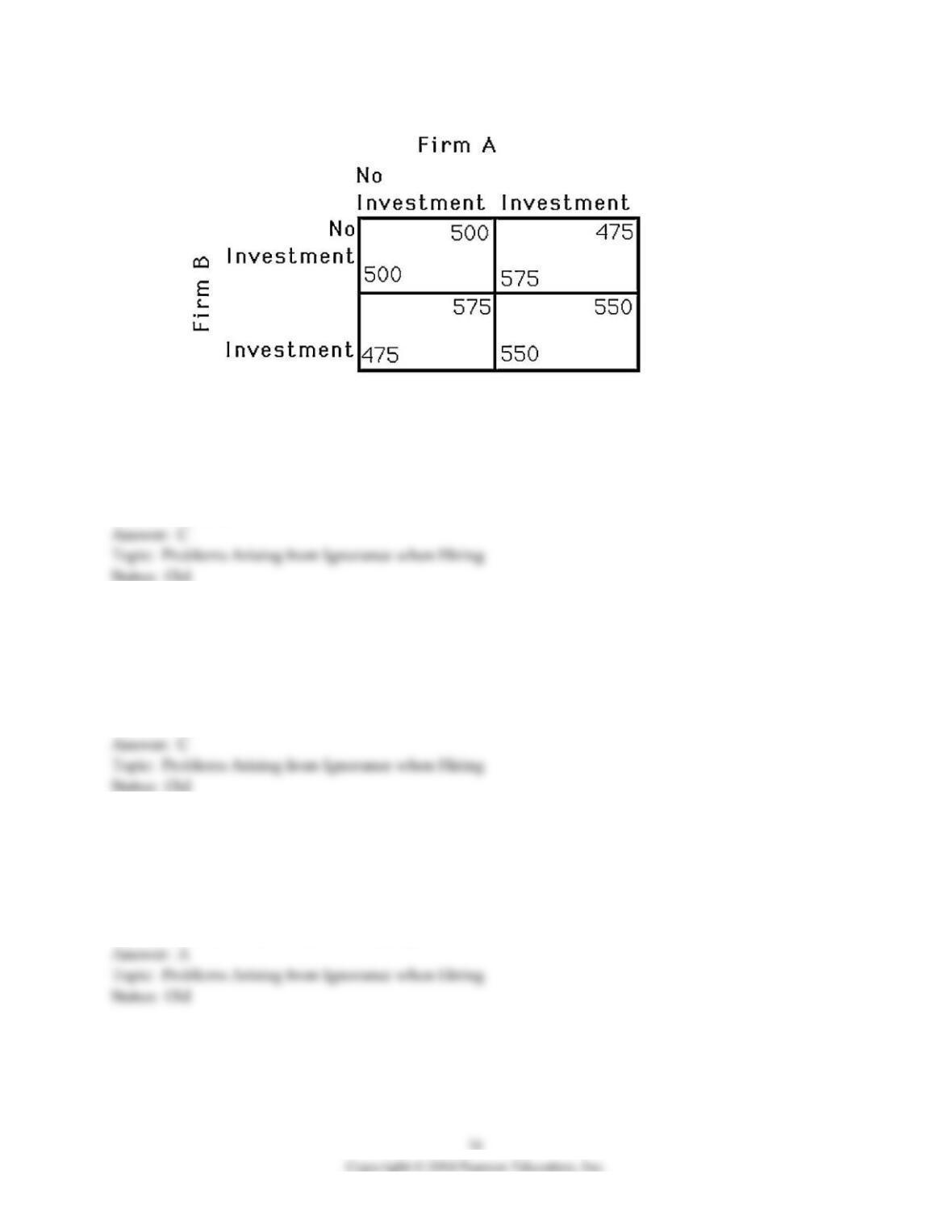
3) The above figure shows the payoff to two firms in an industry deciding to make an investment in
worker safety. The dominant strategy for each firm
A) is to do the opposite of the other firm.
B) is to make the investment.
C) is to not make the investment.
D) does not exist.
4) The above figure shows the payoff to two firms in an industry deciding to make an investment in
worker safety. The Nash equilibrium
A) is for just one of the firms to make the investment.
B) is for both firms to make the investment.
C) is for neither firm to make the investment.
D) does not exist.
5) The above figure shows the payoff to two firms in an industry deciding to make an investment in
worker safety. Neither firm will make the investment because
A) each can benefit from the other firm incurring the costs.
B) there is no benefit to making the investment.
C) each firm pays for the other firm’s investment.
D) society does not care about worker safety.

6) Workers do not know the safety records at individual firms; they only know industry averages. As a
result,
A) each firm tries to outdo each other in making safety improvements.
B) each firm has the incentive to be the safest in its industry.
C) the equilibrium level of safety is less than optimal.
D) the optimal level of safety is achieved.
7) Investment in safety at the firm level poses a prisoners’ dilemma because
A) if each firm plays its dominant strategy, joint profits are maximized.
B) if each firm plays its dominant strategy, joint profits are not maximized.
C) neither firm has a dominant strategy.
D) the Nash equilibrium is not achieved.
8) Some software firms require that applicants have passed certain standardized certification tests before
being hired. This policy is necessary when
A) cheap talk does not provide a credible signal.
B) cheap talk does provide a credible signal.
C) the interests of the firm and the applicant converge.
D) the applicant is honest about her abilities.
9) A pooling equilibrium occurs when
A) dissimilar workers are paid alike.
B) firms can distinguish between workers of different qualities.
C) workers of the same quality are paid different wages.
D) all workers are overpaid equally.
10) If diplomas work efficiently in signaling productive capabilities to employers, the resulting
equilibrium
A) will be a separating equilibrium.
B) will be a pooling equilibrium.
C) will always be inefficient.
D) will never be efficient.

11) Employers verify the facts of potential employees’ resumes to avoid
A) signaling.
B) screening.
C) cheap talk.
D) moral hazard.
12) If getting accepted into college is very difficult because of high standards of intelligence and ability,
but students learn absolutely nothing while in college, it is most likely that
A) they will not be hired upon graduation.
B) attendance sends a signal to employers regarding ability.
C) nobody will want to go to college.
D) a college degree is not a credible signal.
13) If low-quality workers are unable to obtain a college degree, then a separating equilibrium can occur
if
A) the cost of obtaining a degree is less than the wage premium paid to those who have obtained the
degree.
B) the cost of obtaining a degree is greater than the wage premium paid to those who have obtained the
degree.
C) the cost of obtaining a degree is zero.
D) the wage premium paid to those who have obtained the degree is positive.
14) When relatively few workers have high ability,
A) they will settle for the average wage.
B) they will want to signal their ability.
C) the premium for high ability is less than when most workers have high ability.
D) they do not need to signal their ability.
15) If a college degree is used to signal high ability, but the cost of a college degree is relatively high,
A) a separating equilibrium is achieved.
B) a pooling equilibrium is achieved.
C) even low-ability workers will attend college.
D) the share of high-ability workers must be 1.

16) Screening and signaling in the labor market are inefficient
A) unless college costs are relatively low.
B) unless they result in a better job match.
C) because the benefits are spread out over many firms.
D) because they raise the wage paid to all workers.
17) Cheap talk works at placing workers in the right job as long as
A) the interests of the worker and the firm coincide.
B) all workers want the most demanding jobs regardless of their abilities.
C) workers have different ability levels that are unknown to firms.
D) firms are not profit maximizers.
18) Auto insurance rates are lower for young women relative to young men. An unusually reckless young
woman driver benefits from this
A) statistical discrimination.
B) signal.
C) screening.
D) majority voting.
19) In a company, if high-ability workers get paid $80,000, while low-ability workers get paid $50,000, the
education (MBA) that can qualify the workers as high-ability ones cost $20,000. What’s the highest share
of high-ability workers to get a separating equilibrium?
A) 1/4
B) 1/3
C) 1/2
D) 1
For the following, please answer “True” or “False” and explain why.
20) If an employer cannot distinguish the ability of workers a separating equilibrium will result.
21) Two firms, A and B, are faced with a decision on making investments in safety. They each currently
earn profit of $500 each. A safety investment would cost $100 paid by the firm that makes the investment
and would lower both firms’ labor costs by $75 per firm. Draw the payoff matrix for this game and
determine the Nash equilibrium. Does it make sense for the firms in the industry to ask the government
to force them to make the investment? Explain.
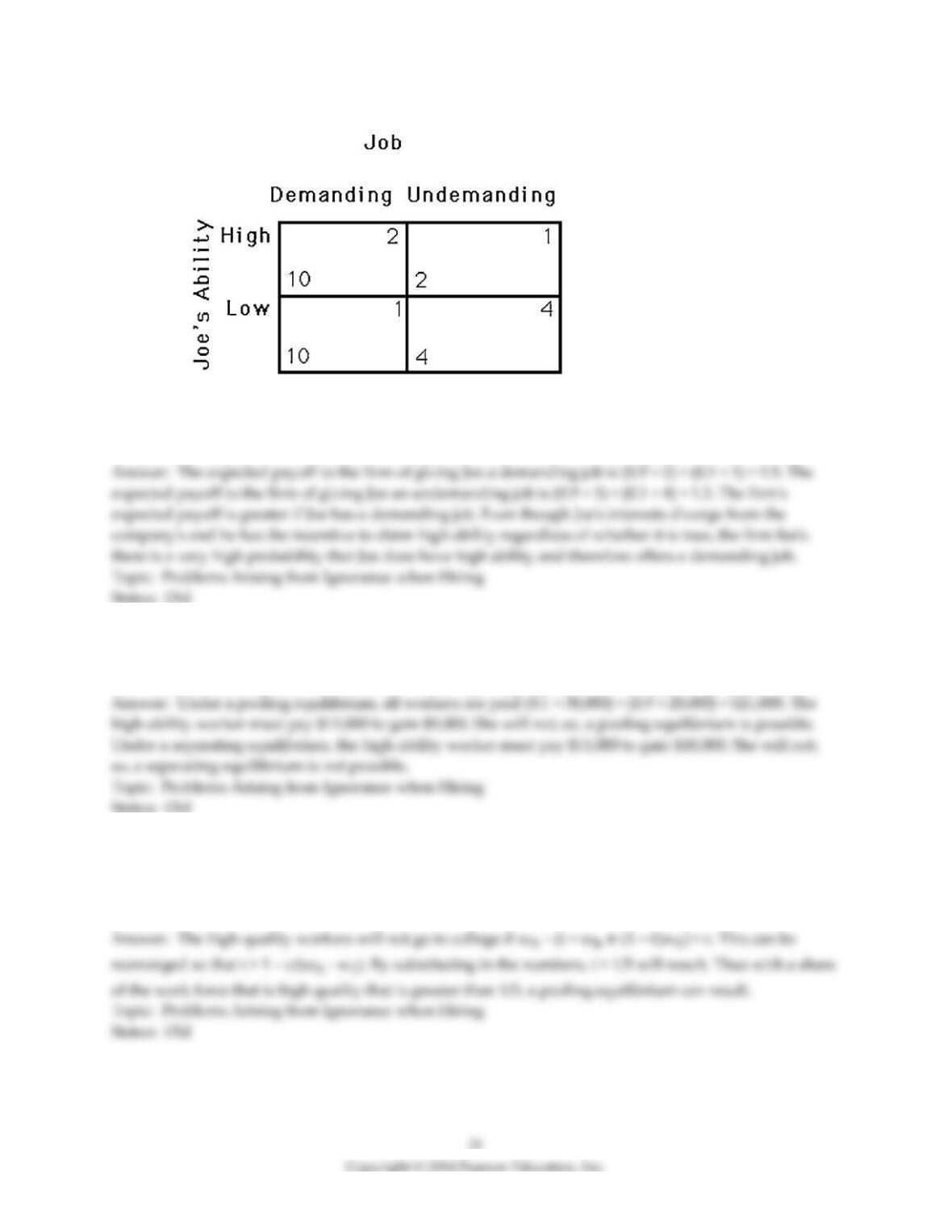
22) Joe wants to achieve the highest position possible with the XYZ Co. During the interview, he tells
them he is capable of performing many difficult tasks. The company feels there is an 10% chance he is
lying. Given the payoff matrix in the above figure, what job level will the company offer to Joe? Why?
23) Suppose 10% of all workers are of high ability. If a firm knows a worker’s ability, workers of low
ability are paid $20,000 and workers of high ability are paid $30,000. A college degree can signal ability,
and the cost of the degree is $11,000. Will there be a pooling equilibrium or a separating equilibrium?
24) The cost, c, of a college education that serves only as a signal of a high-quality worker is $20,000. The
wage of a known high-quality worker, wh, is $75,000. The wage for a known low-quality worker, w1, is
$50,000. For what value of the share of the work force that is of high quality, t, is a pooling equilibrium
possible?