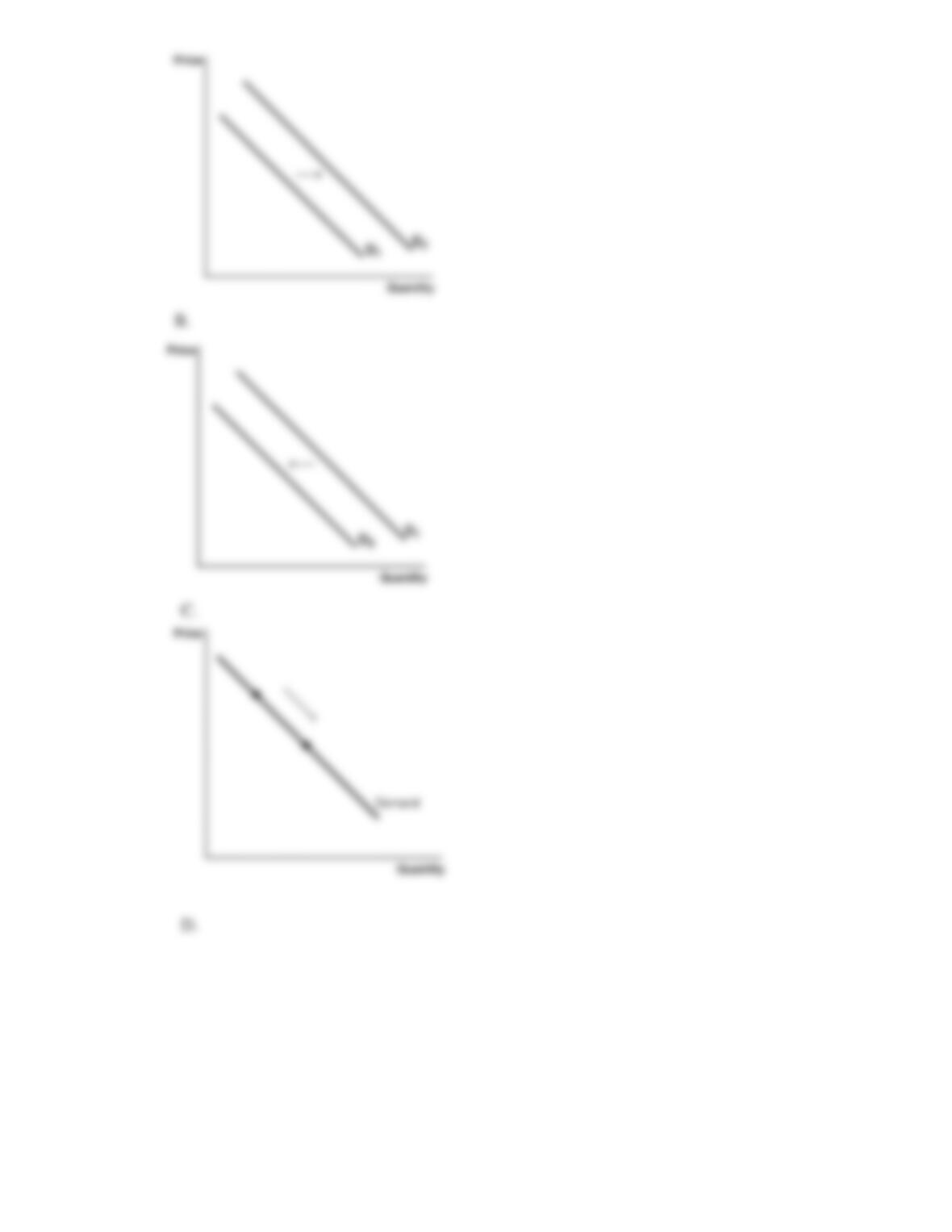
83. Health insurance companies routinely hold patients partially responsible for medical costs. One
decides to increase the amount that patients have to pay. Which graph best represents this change?
a. Graph A d. Graph D
b. Graph B e. Graph E
c. Graph C
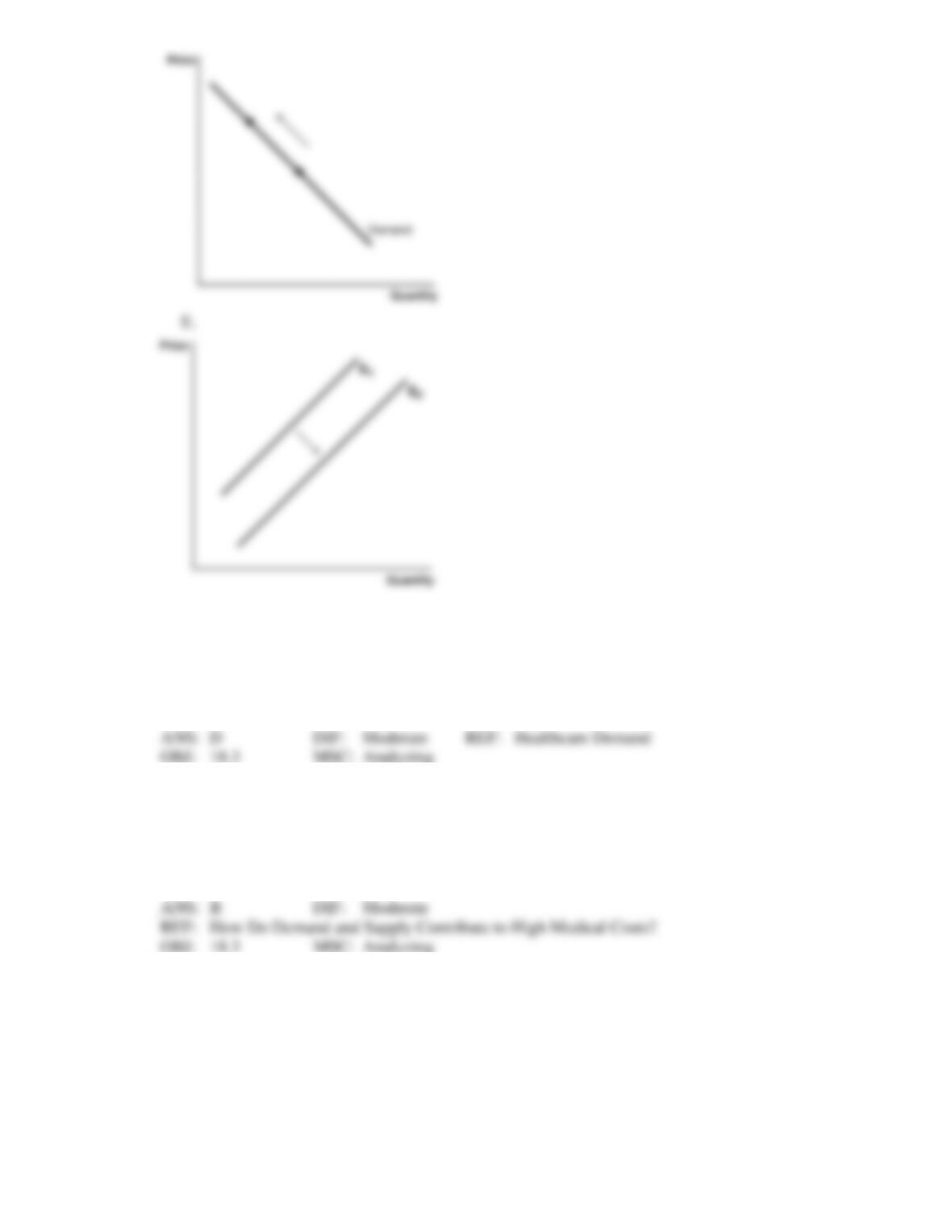
84. Which graph represents what would happen if a medical procedure such as eye surgery previously
paid for by insurance was no longer covered?
a. Graph A d. Graph D
b. Graph B e. Graph E
c. Graph C
85. What has happened to the elasticity of demand for health care over time?
a. It has become more elastic.
b. It has become more inelastic as people live longer and advances in medical technology are
made.
c. It has become more elastic as people face a shortened life span and advances in medical
technology are made.
d. It has become more inelastic as people face a shortened life span and advances in medical
technology are made.
e. The magnitude of elasticity has been constant over time.
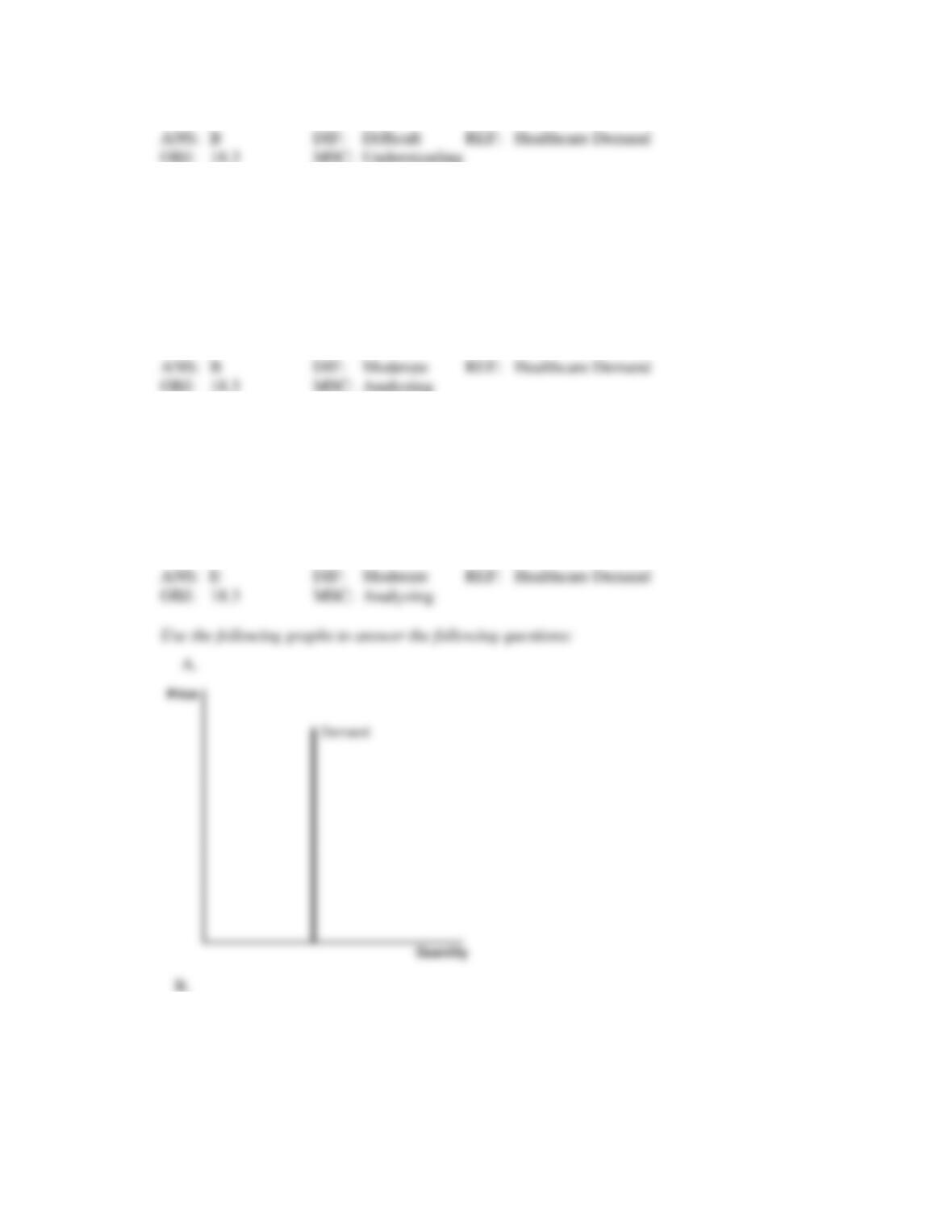
86. There is an increase in the number of individuals in the country who have insurance. Which of the
following will occur now?
a. The demand for health care will decrease, but not as much if deductibles and co-pays are used.
b. The demand for health care will increase, but not as much if deductibles and co-pays are used.
c. The demand for health care will be unaffected.
d. Individuals will likely be discouraged from receiving preventive care.
e. Whether individuals seek preventive care will be unaffected by whether an individual has
insurance.
87. One effect that insurance companies have on the overall cost for consumers or patients of health
care is that they
a. have no impact on costs.
b. increase costs as hospitals are forced to go out of business.
c. decrease costs as doctors quit and seek other occupations.
d. decrease costs as patients seek less care.
e. tend to increase costs as patients seek more care than they otherwise would.
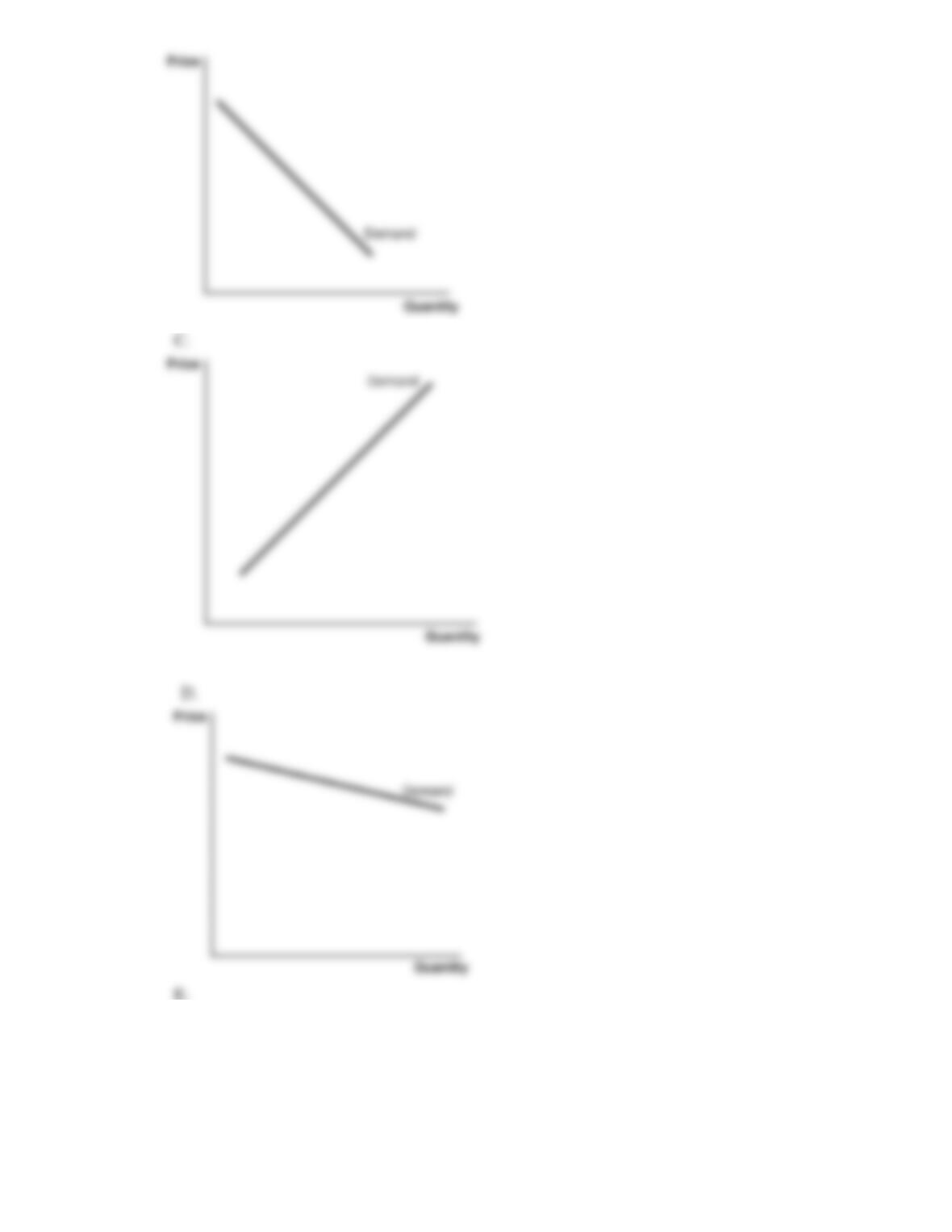
88. Which graph best describes the demand for a heart transplant?
a. Graph A d. Graph D
b. Graph B e. Graph E
c. Graph C
89. Which graph best describes the demand for an elective surgery that is so price sensitive that
doctors have to issue coupons to get more patients?
a. Graph A d. Graph D
b. Graph B e. Graph E
c. Graph C
90. A key reason why Americans might travel abroad for health care is because
a. medical procedures are too costly in the United States.
b. the quality of health care for certain procedures is too low in the United States.
c. there are too few doctors in the United States.
d. the government is only willing to pay the full cost of medical care that is delivered in a country
where treatment is less expensive.
e. the federal government is willing to cover healthcare costs regardless of where they are
delivered.
91. A distortion in the health care market can occur when the
a. existence of health insurance encourages consumers not to seek preventive care.
b. involvement of the government raises healthcare expenditures because doctors are guaranteed
a payment that exceeds the market equilibrium price.
c. involvement of health maintenance organizations discourages efficiency in healthcare
expenditures.
d. government’s licensing of medical care providers reduces supply, which, in turn, increases the
equilibrium price.
e. demand for health care is inelastic.
92. As the price of medical care rises, the
a. quantity supplied increases. d. quantity demanded increases.
b. supply increases. e. supply curve decreases.
c. demand increases.
93. When healthcare costs are paid for by
a. private insurance companies, the expenses are lower because the insurance company acts like a
monopolist.
b. the government, the expenses are lower because the government acts like a monopolist.
c. the government through payroll taxes, the employer faces a disincentive to hire more workers.
d. the government, the expenses are higher because the government acts like a monopsonist.
e. private individuals, the expenses are higher because consumers are more responsive to the
prices being charged.
94. The U.S. government’s Medicare program is the primary financier (or payer) of health insurance
for the aged. In this situation, the government is
a. a monopsonist that allows providers to charge whatever they want but imposes quality
controls.
b. a monopolist that imposes price controls to reduce overall cost.
c. a monopsonist that imposes price controls to reduce overall cost.
d. a monopolist that imposes price controls to increase overall quality.
e. both a monopolist and monopsonist that makes active use of price controls.
95. Through the Medicaid program, the U.S. government is the primary provider of health insurance
for the poor (although not all of the poor in need of health care insurance are able to participate in
this program). In this situation, the government is
a. a monopsonist that imposes price controls to reduce overall cost.
b. a monopsonist that allows providers to charge whatever they want but imposes quality
controls.
c. a monopolist that imposes price controls to reduce overall cost.
d. a monopolist that imposes price controls to increase overall quality.
e. both a monopolist and monopsonist that makes active use of price controls.
96. Cyril is a 70-year-old, retired grocery store owner from Brooklyn who fell out of a tree while
bird-watching in upstate New York. The bill from the hospital for putting a cast on his broken arm
is estimated to be $5,000. This price for medical care was determined by the
a. intersection of supply and demand in an unfettered market.
b. intersection of supply and demand, but the government played a significant role in increasing
supply and imposing a payment limit through the Medicaid program.
c. intersection of supply and demand, but the government played a significant role in reducing
supply and imposing a payment limit through the Medicare program.
d. involvement of the government through the Medicare program, and the cost was increased
because hospitals are not required to deliver emergency room care to the uninsured.
e. intersection of supply and demand, but the government played a rather insignificant role
despite providing Medicare health insurance.
97. In which of the following countries is an individual’s ability to pay the primary method of
rationing health care?
a. Norway d. United States
b. United Kingdom e. France
c. Canada
98. Health care has to be rationed because
a. there are too many deliverers of health care.
b. advances in medical research have slowed down.
c. consumers are avoiding trips to the doctor.
d. the supplier is acting like a monopoly and intentionally reducing the delivery of health care.
e. the demand for health care exceeds the supply of health care at the prices imposed by the
government.
99. Which of the following is true for a single-payer system?
a. Medical care tends to be rationed through pricing.
b. Medical care tends to be rationed with a waiting period.
c. Physicians’ wages are generally higher than in a multipayer system.
d. The single payer is able to act as a monopolist.
e. Medical care is available promptly to all who want it.
100. In a single-payer system, which of the following is true?
a. The single payer is able to act as a monopsonist.
b. Medical care tends to be rationed through pricing.
c. Physicians’ wages are generally higher than in a multipayer system.
d. The single payer is able to act as a monopolist.
e. Medical care is available promptly to all who want it.
101. A key reason why Canadians might travel abroad for health care is because
a. surgeries are too costly in Canada.
b. the quality of health care at home is too low.
c. there are too many doctors in Canada.
d. the government is only willing to pay the full cost of medical care that is delivered in a country
where treatment is less expensive.
e. at home there are lengthy delays with some medically necessary operations.
102. Health care in Canada is rationed primarily by
a. making the cost to the consumer as inexpensive as possible.
b. making the cost to the insurance company as inexpensive as possible.
c. the government deciding not to play an active role in the healthcare market.
d. delays in receiving care.
e. encouraging doctors to set up private practices that compete against hospitals.
103. Priscilla is a retired nurse from Toronto who fell out of a tree while bird-watching in Halifax, Nova
Scotia (a Canadian province). The bill from the hospital for putting a cast on her broken arm is
estimated to be $3,000 (Canadian). This price for medical care was determined
a. by the intersection of supply and demand, unfettered by government influence.
b. by the intersection of supply and demand, but the government played a significant role in
imposing a payment limit through its monopsonist power.
c. by the intersection of supply and demand, but the government played a significant role in
imposing a payment limit through its monopolist power.
d. by the involvement of the government and private health insurance companies.
e. as higher than it should have been because of a shortage of care.
104. After many years of medical training, Quinn has become a medical doctor in Canada. Quinn would
expect
a. to earn a high salary when he opened his own private practice.
b. to work in Canadian hospitals with very few doctors who were trained in the United States.
c. to spend the majority of his time talking to health insurance companies to ensure that his
patients receive the care that they need.
d. to earn a salary similar to that earned by a doctor in the United States.
e. a difficult time finding employment as a doctor given the abundance of trained individuals
willing to be a doctor in Canada.
105. As the government pays for an increasing portion of medical care expenses for citizens in the
United States
a. the government’s monopsony power will grow and citizens will pay higher prices for medical
care.
b. the government’s monopsony power will grow and citizens will pay lower prices for medical
care.
c. the government’s monopoly power will grow and citizens will pay higher prices for medical
care.
d. the government’s monopoly power will grow and citizens will pay lower prices for medical
care.
e. there will be no effect on the government’s power to determine the prices paid for medical
care.
106. When comparing the healthcare system in France with that in the United States, one of the key
differences is that
a. the French are able to obtain lower overall healthcare costs because the government is the only
payer of healthcare expenses, and there is no private insurance.
b. the French are able to obtain lower overall healthcare costs because the government pays for
most medical care, and private health insurance is held by nearly all to cover the remainder of
needed medical care.
c. Americans are able to obtain lower overall healthcare costs because of the lack of government
involvement.
d. Americans are able to obtain lower overall healthcare costs because most people have
insurance.
e. the French are able to obtain lower overall healthcare costs because the French are discouraged
from making use of costly procedures for serious healthcare conditions.
107. After many years of medical training, Belinda has become a medical doctor in France. Which of
the following statements is true?
a. Belinda would expect to earn a lower salary than if she was a doctor in the United States
because of government pressure to control costs.
b. Belinda would expect to have an easy time getting patients because the government forces
patients to see specific doctors.
c. Belinda would expect to earn a higher salary than if she was a doctor in the United States.
d. Belinda would expect patients to avoid coming to the doctor if they had a serious condition
because of their inability to pay their medical bills.
e. Patients will be generally dissatisfied with medical care because of the significant
out-of-pocket costs they incur.
108. Marion fell out of a tree while bird-watching outside her home in Dijon, France. The bill from the
hospital for putting a cast on her broken arm is estimated to be €2,000. This price for medical care
was determined
a. by the intersection of supply and demand, unfettered by government regulations.
b. by the intersection of supply and demand, but the government played a significant role in
increasing supply.
c. by the intersection of supply and demand, but the government played a significant monopolist
role to control costs.
d. by the intersection of supply and demand, but the government played a significant
monopsonist role to control costs.
e. not at all by the role of the government as the primary payer of health care costs.
109. In the United States, it is against the law to buy or sell body organs. The consequence of this
regulation is that the supply
a. of organs becomes completely inelastic.
b. of organs becomes completely elastic.
c. of organs increases.
d. curve decreases but then increases.
e. curve becomes backward-bending.
110. In terms of the supply curve, the consequence of allowing people to sell their body organs is that
the supply
a. of organs becomes more inelastic.
b. of organs becomes more elastic.
c. of organs decreases.
d. curve decreases but then increases.
e. curve becomes backward bending.
111. The U.S. healthcare debate is a polarized one, often limited to the merits of a privatized versus a
universal system. In reality, however, solutions involve many complex
a. trade-offs. d. agents.
b. markets. e. expenditures.
c. demands.
112. At the start of the twentieth century, life expectancy in the United States was
a. slightly less than 50 years. d. similar to what it is today.
b. slightly less than 60 years. e. slightly greater than 70 years.
c. slightly greater than 60 years.
113. Major advances in technology and medicine since 1950 have created a trade-off between
________ and ________.
a. cost; life expectancy d. treatment; care
b. innovation; malpractice e. health; well-being
c. ethics; efficacy
114. The societal trade-off in health care usually means that
a. the more you pay for health care, the less your insurer pays.
b. being unhealthy is more fun, but you pay the price in more healthcare cost.
c. a longer life, especially as a senior citizen, costs more for everyone.
d. stronger cancer treatments hurt you in the short run, but enable you to live longer.
e. guarding against as many infections as possible will be rewarded with longer life.
115. How does health insurance distort what is otherwise a normal consumer transaction?
a. Health insurance turns human lives into what is little more than risk assessment.
b. Individuals purchase insurance in case they get sick, not because they seek a healthy lifestyle.
c. It doesn’t create distortions. In fact, health insurance produces better market fundamentals than
direct transactions.
d. The individual consuming the service is not primarily responsible for payment.
e. Insurance companies magnify the problem of adverse selection.
116. More important than total expenditure is the ________ delivery of health care.
a. unregulated d. diminishing
b. unrationed e. asymmetric
c. efficient
117. Since many medical procedures involve lifesaving treatment, demand can best be described as
a. sticky. d. perfectly inelastic.
b. perfectly elastic. e. very inelastic.
c. unit elastic.
118. Treatments with a high cost-to-benefit ratio, like heroic efforts to extend life, would ________ if
consumers had greater out-of-pocket expenses.
a. remain unchanged d. increase marginally
b. disappear completely e. decrease
c. increase dramatically
119. Computerized medical records have promoted ________ in recent years, while industry costs are
________.
a. greater efficiency; declining d. decreased privacy; declining
b. greater efficiency; rising e. technology; rising
c. increased privacy; declining
120. Which of the following statements is true?
a. Factors other than healthcare expenditures contribute significantly to diminishing returns.
b. As a result of efficiency and technology, healthcare spending is subject to permanent
increasing returns.
c. According to the production function, high initial healthcare spending is required to produce
any measurable returns.
d. End-of-life treatments are often the most cost-effective because hospitals have a fixed time
frame for which to administer care.
e. As a result of efficiency and technology, healthcare costs are wholly on the decline, despite
large increases in many aspects.
121. Diminishing returns to healthcare spending indicates that greater efficiency can be achieved by
a. decreasing overall spending.
b. decreasing spending in top categories such as hospital care.
c. increasing spending in areas that now only account for a small fraction of overall spending.
d. reallocating funds in areas with declining returns to areas with substantial production potential.
e. exhausting all possibilities to extend human life, which will lead to greater output per person.
122. The ________ structure within the healthcare industry contributes to escalating costs.
a. diminishing d. incentive
b. inefficient e. expenditure
c. efficient
123. The two biggest consumers of medical care are ________ and ________.
a. veterans; the elderly d. veterans; the poor
b. the elderly; children e. patients; government
c. the poor; children
124. ________ is the federal program that provides medical assistance to the elderly.
a. Medicaid d. Affordable Care Act
b. Medicall e. Medicare
c. Obamacare
125. ________ is the federal program that provides medical assistance to the poor.
a. Obamacare d. Medicare
b. Medicaid e. Affordable Care Act
c. Welfare
126. Medicare and Medicaid account for approximately ________ of all government spending.
a. one-half d. one-fifth
b. one-third e. two-thirds
c. three-quarters