
Quantity of
labor
(workers)
Output
(groomings)
Marginal
product
(groomings)
0
0
1
12
12
2
20
8
3
25
5
4
28
3
5
30
2
69) Doug’s Dog Grooming is a perfectly competitive firm charging $5 per dog grooming. Doug’s
Dog Grooming has the total and marginal product of labor schedules in the above table and can
hire workers from a perfectly competitive labor market for $15 per hour. What is the value of
marginal product of the third worker?
A) $5
B) $25
C) $15
D) $375
70) Doug’s Dog Grooming is a perfectly competitive firm charging $5 per dog grooming. Doug’s
Dog Grooming has the total and marginal product of labor schedules in the above table and can
hire workers from a perfectly competitive labor market for $15 per hour. The profit-maximizing
level of employment for Doug’s Dog Grooming is
A) 1 worker.
B) 2 workers.
C) 4 workers.
D) 6 workers.

Labor
(workers)
Output
(pounds of bricks
per hour)
0
0
1
10
2
16
3
19
4
21
5
22
71) The table above shows the number of pounds of bricks that can be produced by the Red
Brick Company as the number of workers hired increases. The brick market is perfectly
competitive and each pound of bricks sells for $20. The labor market is competitive and the
wage rate is $30 an hour. When the Red Brick Company maximizes its profit, it produces
________ bricks an hour.
A) 19
B) 21
C) 22
D) 10
72) The firm’s demand for labor is derived directly from ________.
A) the wage rate
B) the supply of labor
C) labor’s cost
D) labor’s value of marginal product
73) A firm’s demand for labor curve is the same as the firm’s
A) marginal product curve.
B) marginal cost curve.
C) marginal revenue curve.
D) value of marginal product curve.
74) Which answer below CORRECTLY describes the relationship between the demand for labor
curve and the value of marginal product curve?
A) The curves intersect to determine the equilibrium quantity of labor.
B) The value of marginal product curve lies to the right and above the demand for labor curve.
C) The curves are the same.
D) The value of marginal product curve lies to the left of the demand for labor curve.
75) A firm’s demand for labor curve
A) is the same as its value of marginal product curve.
B) is steeper than its value of marginal product curve.
C) is flatter than its value of marginal product curve.
D) intersects its value of marginal product curve at the profit-maximizing quantity of
employment.
76) A firm’s value of marginal product of labor curve
A) is flatter than its demand for labor curve.
B) is steeper than its demand for labor curve.
C) is its demand for labor curve.
D) bends backward.
77) A firm’s demand for labor curve
A) is the same as its value of marginal product of labor curve.
B) shows how many jobs the firm demands at different wage rates.
C) shifts rightward when the price of the firm’s output falls.
D) None of the above answers are correct.

78) Because the value of marginal product diminishes as the quantity of labor employed
increases, the ________ the wage rate, the ________ workers the firm hires.
A) lower; more
B) higher; more
C) lower; fewer
D) None of the above answers is correct because there is no relationship between the wage rate
and the number of workers hired.
79) In the short run, ________ increases the quantity of labor demanded by the firm.
A) a decrease in the price of the firm’s output
B) an increase in the prices of other factors of production used by the firm
C) a technological advance that decreases the marginal product of labor
D) a decrease in the wage rate
80) A decrease in the wage rate
A) shifts the firm’s demand for labor curve rightward.
B) shifts the firm’s demand for labor curve leftward.
C) leads to a movement along the demand for labor curve but does not shift the curve.
D) None of the above answers is correct.
81) The demand for labor depends on
I. technology.
II. the prices of other factors of production.
III. the price of the product.
A) I and II
B) II and III
C) I and III
D) I, II and III

82) A firm’s demand for labor
A) increases when the price of the firm’s output falls.
B) decreases when the price of the firm’s output falls.
C) decreases when the wage rate decreases.
D) always increases when the prices of other factors fall.
83) A fall in the price of a firm’s output
A) decreases the firm’s demand for labor.
B) increases the firm’s demand for labor.
C) decreases the firm’s supply of labor.
D) increases the firm’s supply of labor.
84) The demand for labor increases (that is, the demand for labor curve shifts rightward) if the
A) wage rate increases.
B) wage rate decreases.
C) price of the firm’s output rises.
D) price of the firm’s output falls.
85) If the price of hair styling increases, then
A) hair styling salons hire fewer workers but makes more profit.
B) hair stylists demand an increase in wages and the salons hire fewer workers.
C) the value of marginal product of each hair stylist increases and the demand curve for hair
stylists shifts leftward.
D) the value of marginal product of each hair stylist increases and the demand curve for hair
stylists shifts rightward.

86) An increase in the price of a firm’s output
A) raises the value of marginal product of each unit of labor.
B) shifts the firm’s demand for labor curve rightward.
C) results in the firm increasing the amount of output it produces.
D) All of the above answers are correct.
87) A decrease in the price of a firm’s output
A) raises the value of marginal product of each unit of labor.
B) shifts the firm’s demand for labor curve rightward.
C) results in the firm increasing the amount of output it produces.
D) None of the above is correct.
88) If the price of a firm’s output rises, its
A) marginal product of labor increases.
B) value of marginal product decreases.
C) demand for labor increases.
D) demand for labor decreases.
89) An increase in the price of a firm’s product
A) decreases its value of marginal product of labor.
B) increases its demand for labor.
C) increases its supply of labor.
D) None of the above answers is correct.

90) When the price of the good or service it produces rises, the firm’s
A) demand for labor curve shifts rightward.
B) demand for labor curve shifts leftward.
C) demand for labor curve remains unchanged.
D) output decreases.
91) If the demand for dog grooming increases so that the price of dog grooming rises, then
number of workers hired by Doug’s Dog Grooming would
A) decrease.
B) increase.
C) remain unchanged.
D) Any of the above answers are possible.
92) Which of the following would explain why Josh’s Limo Service might increase its demand
for limo drivers?
A) an increase in demand for limo rides, resulting in a rise in the price of a limo ride
B) a decrease in the demand for limo rides
C) a fall in the price of a taxi ride
D) a rise in the wage paid to limo drivers
93) An increase in the price of a firm’s output increases the firm’s demand for labor because the
A) marginal product of each worker increases.
B) value of marginal product of each worker increases.
C) value of marginal product curve becomes steeper.
D) value of marginal product curve becomes flatter.

94) Due to a recession, Hostess Bakeries found that the demand for its products decreased. The
demand for products ________ the demand for bakers and ________ the equilibrium wage rate
paid to bakers.
A) increased; raised
B) decreased; raised
C) increased; lowered
D) decreased; lowered
Quantity of
labor
(workers)
Output
(pounds)
0
0
1
1000
2
1800
3
2400
4
2800
95) The preceding table gives monthly production information for Peter‘s Peanuts, a firm in a
perfectly competitive industry. The market price of peanuts is $2.00 per pound. What is the
marginal product from employing the fourth worker?
A) 7 pounds of peanuts
B) 100 pounds of peanuts
C) 400 pounds of peanuts
D) 2,800 pounds of peanuts
96) The preceding table gives monthly production information for Peter‘s Peanuts, a firm in a
perfectly competitive industry. The market price of peanuts is $2.00 per pound. What is the value
of marginal product from employing the third worker?
A) $800
B) $1,200
C) $2,000
D) $4,800

97) The preceding table gives monthly production information for Peter‘s Peanuts, a firm in a
perfectly competitive industry. The market price of peanuts is $2.00 per pound. If a worker costs
$800 per month, how many workers will Peter employ to maximize profit?
A) zero
B) one
C) two
D) four
98) The preceding table gives monthly production information for Peter‘s Peanuts, a firm in a
perfectly competitive industry. Initially the market price of peanuts is $2.00 per pound. If the
market price of peanuts fall to $1 per pound and a worker costs $800 per month, how many
workers will Peter employ to maximize his profit?
A) zero
B) two
C) three
D) four
99) The preceding table gives monthly production information for Peter‘s Peanuts, a firm in a
perfectly competitive industry. The market price of peanuts is $2.00 per pound. A worker costs
$1,200 per month. How many workers does Peter hire to maximize his profit?
A) zero
B) one
C) three
D) four
100) The preceding table gives monthly production information for Peter’s Peanuts, a firm in a
perfectly competitive industry. An increase in the wage rate for labor leads to
A) an increase in the quantity of labor demanded.
B) a decrease in the quantity of labor demanded.
C) an increase in the demand for labor.
D) a decrease in the demand for labor.
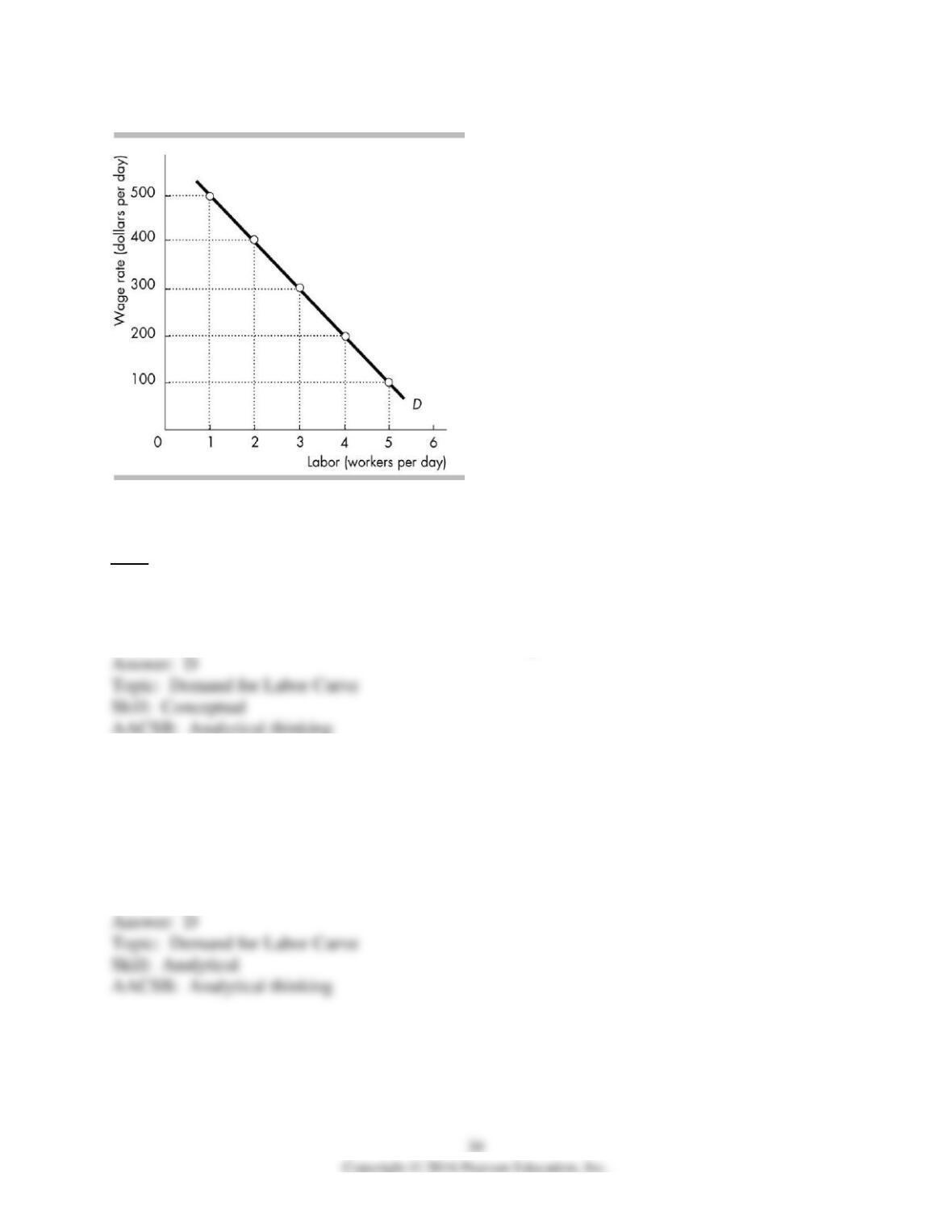
101) The figure above shows a local lawn cutting service‘s demand for labor curve when the
price of cutting an acre of lawn is $50 per acre. If the market wage is $300 per day, the firm will
NOT hire a fourth worker because the fourth worker would create
A) an economic loss and the firm would shut down.
B) additional revenue that exceeds the worker’s wage.
C) additional revenue that exceeds the worker’s value of marginal product.
D) additional revenue that falls short of the worker’s wage.
102) The figure above shows a local lawn cutting service‘s demand for labor curve when the
price of cutting an acre of lawn is $50 per acre. How much labor will the firm hire if the market
wage is $300 per day?
A) 0 workers
B) 1 worker
C) 2 workers
D) 3 workers

103) The figure above shows a local lawn cutting service‘s demand for labor curve when the
price of cutting an acre of lawn is $50 per acre. If the wage rate rises from $100 per day to $200
per day, the firm’s demand for labor curve
A) shifts leftward.
B) shifts rightward.
C) does not shift at all, but the firm moves upward along the curve.
D) None of the above because this change shifts the supply of labor curve.
104) The figure above shows a local lawn cutting service‘s demand for labor curve when the
price of cutting an acre of lawn is $50 per acre. If the price of lawn cutting rises to $60 per acre
of lawn cut, the firm’s demand for labor curve
A) shifts rightward.
B) shifts leftward.
C) does not shift at all, but the firm moves upward along the curve.
D) None of the above because this change shifts the supply of labor curve.
105) Usually the demand for labor decreases (that is, the demand for labor curve shifts leftward)
if the
A) wage rate increases.
B) wage rate decreases.
C) price of the firm’s output rises.
D) prices of other factors fall.
106) A firm’s demand for labor increases and its demand curve for labor shifts rightward if
A) the wage rate falls.
B) the price of its product falls.
C) its value of marginal product decreases.
D) an advance in technology increases the marginal product of labor.
107) New technology
A) definitely increases a firm’s demand for labor.
B) definitely decreases a firm’s demand for labor.
C) definitely does not change a firm’s demand for labor.
D) could increase or decrease a firm’s demand for labor.
108) A company finds that for the next worker hired, the worker’s VMP is less than the cost of
the worker. In this case, to maximize its profit the company should
A) definitely hire the worker.
B) perhaps hire the worker, depending on the relationship between the company’s MC and MR.
C) definitely not hire the worker.
D) None of the above answers is correct.
109) A firm’s price rises. As a result, the
A) supply of labor to the firm decreases, that is, the labor supply curve shifts leftward.
B) supply of labor to the firm increases, that is, the labor supply curve shifts rightward.
C) demand for labor by the firm increases, that is, the labor demand curve shifts rightward.
D) demand for labor by the firm decreases, that is, the labor demand curve shifts leftward.
110) Suppose the price of oranges rises. As a result, the
A) supply of orange pickers increases.
B) supply of orange pickers decreases.
C) demand for orange pickers increases.
D) demand for orange pickers decreases.
3 Labor Markets
1) A household’s reservation wage is the ________.
A) lowest wage rate at which the household will supply labor
B) wage at which the household’s labor supply curve bends backward
C) wage rate at which the household’s income is largest
D) highest wage rate at which the household will supply labor
2) The reservation wage is the
A) highest wage for which a person is willing to supply labor.
B) lowest wage for which a person is willing to supply labor.
C) wage for which a person is willing to work full time.
D) wage for which a person is willing to work overtime.
3) The lowest wage for which a person is willing to supply labor is known as the
A) substitution wage.
B) income effect.
C) derived wage.
D) reservation wage.
4) A worker supplies labor to the market if the
A) wage is less than the reservation wage.
B) wage is greater than the reservation wage.
C) minimum wage is less than the reservation wage.
D) demand for labor exceeds the supply of labor.
5) If Sam decides to work, his
A) reservation wage is greater than his wage rate.
B) reservation wage is less than his wage rate.
C) value of marginal product is greater than his wage rate.
D) value of marginal product equals his wage rate.
6) John’s reservation wage is $10 per hour. This means that
A) John will not supply labor in the market until he receives a wage of at least $10 per hour.
B) John will supply labor in the market at a wage of $10 and lower.
C) John will work 10 hours per day.
D) John will decrease the hours he works when his wage rate exceeds $10 per hour.
7) If the wage rate paid in the fast-food outlets in a small town is greater than the reservation
wage of all the teenagers in the town and less than the reservation wage of all the adults, then the
fast-food outlets will hire ________.
A) mostly adults and a few teenagers
B) some adults and some teenagers
C) only adults
D) only teenagers
8) The ________ effect means that, other things remaining the same, the higher the wage rate,
the less time people will spend working and the more time people will spend at leisure.
A) price
B) labor
C) income
D) substitution
9) With respect to the labor supply curve, the income effect
A) reinforces the substitution effect.
B) lowers the opportunity cost of labor.
C) raises the opportunity cost of labor.
D) influences a person to work less as the wage rate increases.
10) Because of the income effect, a higher wage rate
A) shifts the supply of labor curve leftward.
B) shifts the supply of labor curve rightward.
C) leads to a decrease in quantity of labor supplied.
D) leads to an increase in quantity of labor supplied.
11) Because of the income effect, the labor supply curve is
A) eventually backward bending as wage rate increases.
B) positively sloped.
C) horizontal.
D) vertical.
12) The income effect means that at a high enough wage rate labor supply curve has a
A) positive slope because an increase in the wage rate increases income.
B) positive slope because an increase in income increases the demand for leisure.
C) negative slope because an increase in income increases the demand for leisure.
D) negative slope because an increase in the wage rate increases hours worked to earn more
income.

13) The income effect of a higher wage rate results in a
I. higher income as people work more.
II. person choosing to decrease work hours as income increases.
III. backward-bending labor supply curve.
A) I and II
B) II and III
C) I and III
D) II only
14) A professional tennis player enters fewer tournaments each year as the prize money she won
increased. This observation indicates that the tennis player
A) is irrational.
B) has shifted her labor demand curve leftward.
C) has shifted her labor supply curve rightward.
D) has a backward bending labor supply curve.
15) As wages rise, the substitution effect induces households to
A) choose leisure rather than supplying labor in the labor market.
B) choose supplying labor in the labor market rather than engage in leisure.
C) reduce the opportunity cost of leisure.
D) reduce the economic rent from leisure.
16) The opportunity cost of leisure is
A) the substitution effect.
B) the income effect.
C) a person’s income.
D) a person’s wage rate.

17) The hourly wage rate is the opportunity cost of one hour of leisure because
A) the person’s substitution effect exceeds his or her income effect.
B) that is what a person gives up to enjoy the hour of leisure time.
C) the person must work for a living.
D) the person prefers leisure to work regardless of the wage.
18) With respect to labor supply, the substitution effect means a
A) person increases his or her hours of labor in response to a higher wage rate.
B) person decreases his or her hours of labor in response to a higher wage rate.
C) person substitutes high paying work for low paying work.
D) firm substitutes capital for labor.
19) With respect to labor supply, the substitution effect takes account of the point that at higher
wage rates
A) a person can afford to take more leisure.
B) leisure has become less expensive and so a person consumes less leisure.
C) there are no factors inducing a person to work less.
D) leisure has become more expensive and so a person consumes less leisure.
20) Meredith receives a wage hike. If Meredith decides to work an extra hour
A) her reservation wage rate exceeds her value of marginal product.
B) her opportunity cost of leisure is high.
C) her substitution effect is greater than her income effect.
D) she operates on the backward-bending portion of her labor supply curve.

21) For the past year, Teddy has had a part-time job at which he is willing to work 10 hours each
week. During Teddy’s annual review, his boss grants him an 8 percent increase in his wage. As a
result of the wage increase, Teddy is now willing to work 15 hours each week. Teddy’s
opportunity cost of ________ has risen and because for Teddy the substitution effect of the wage
hike is ________ than the income effect.
A) work; greater
B) work; less
C) leisure; greater
D) leisure; less
22) For the past year, Teddy has had a part-time job at which he is willing to work 30 hours each
week. During Teddy’s annual review, his boss grants him an 8 percent increase in his wage. As a
result of the wage increase, Teddy is now willing to work 25 hours each week. Teddy’s
opportunity cost of ________ has risen and because for Teddy the substitution effect of the wage
hike is ________ than the income effect.
A) work; greater
B) work; less
C) leisure; greater
D) leisure; less
23) At high wage rates, the labor supply curve bends backward because the ________ effect
dominates the ________ effect.
A) income; price
B) substitution; income
C) substitution; price
D) income; substitution

24) As the wage rate rises, the income effect influences workers to choose ________ leisure, and
the substitution effect influences workers to choose ________ leisure.
A) more; less
B) more; more
C) less; less
D) less; more
25) The labor supply curve is backward bending because
A) as the wage rate rises, the substitution effect becomes larger than the income effect.
B) as the wage rate rises, the income effect becomes larger than the substitution effect.
C) an increase in the wage rate shifts the supply of labor curve leftward at higher wages.
D) an increase in the wage rate shifts the supply of labor curve rightward at higher wages.
26) If your labor supply increases when you get a raise, which of the following is TRUE?
A) Your substitution effect is greater than your income effect.
B) Your substitution effect is less than your income effect.
C) Your substitution effect equals your income effect.
D) None of the above answers is correct.
27) If Joe receives an increase in his wage rate and decides to decrease his hours worked, the
A) substitution effect and the income effect must be equal.
B) substitution effect must exceed the income effect.
C) income effect must exceed the substitution effect.
D) substitution effect must be zero.

28) In order for there to be a backward-bending supply of labor curve, it must be the case that
A) at low wage rates, the income effect of a wage increase exceeds the substitution effect, but at
high wage rates the substitution effect of a wage increase exceeds the income effect.
B) at low wage rates, the substitution effect of a wage increase exceeds the income effect, but at
high wage rates the income effect of a wage increase exceeds the substitution effect.
C) the income effect of a wage increase exceeds the substitution effect at all wage rates.
D) the substitution effect of a wage increase exceeds the income effect at all wage rates.
29) An individual’s labor supply curve will have a
A) positive slope if the income effect exceeds the substitution effect.
B) negative slope if the substitution effect exceeds the income effect.
C) positive slope if the substitution effect exceeds the income effect.
D) negative slope regardless of whether the substitution effect or income effect is larger.
30) The labor supply curve has a
A) positive slope always.
B) negative slope if the income effect is greater than the substitution effect.
C) positive slope if the income effect is greater than the substitution effect.
D) negative slope always.
31) When the ________ effect dominates the ________ effect, the labor supply curve is
________.
A) income; substitution; vertical
B) substitution; income; positively sloped
C) income; substitution; negatively sloped
D) substitution; income; horizontal