CHAPTER 18: Health Insurance and Health Care
MULTIPLE CHOICE
1. What is a central healthcare question that society must find an answer for?
a. Should health care insurance companies be involved in the health care market?
b. Is the marginal benefit of spending more on prevention greater or less than the marginal
benefit of spending on the extension of life?
c. Should the government be involved in the health care market?
d. Should people be required to seek preventive care?
e. Should medical care in the emergency room be delivered only to those who can pay for it?
2. A central issue that society must deal with regarding health care
a. concerns the optimal mix of expenditures for the various categories of health care (prescription
drugs, nursing home care, home health care, and medical products).
b. is whether health care insurance companies should be involved in the healthcare market.
c. is whether the government should be involved in the healthcare market.
d. is whether people should be required to seek preventive care.
e. is whether medical care in the emergency room should be delivered only to those who can pay
for it.
3. Total expenditures on health care are
a. greater in the United States than in Mexico, but less than in Canada.
b. greater in the United States than in Canada, but less than in Mexico.
c. less in the United States than in Canada and Mexico.
d. approximately equal in the United States, Canada, and Mexico.
e. greater in the United States than in Canada and Mexico.
4. On a global perspective, per capita expenditures on health care are greater in the United States than
a. both Canada and Mexico.
b. in Canada, but less than in Mexico.
c. in Mexico, but less than in Canada.
d. neither Canada nor Mexico.
e. in Mexico, but approximately equal to expenditures in Canada.
5. Healthcare represents approximately ________ percent of the gross domestic product (GDP) of the
United States.
a. 10 d. 33
b. 17 e. 50
c. 25
6. On an annual basis, healthcare expenditures in the United States are approximately
a. $100 billion. d. $1 trillion.
b. $500 billion. e. $3 trillion.
c. $750 billion.
7. What is one cited reason why healthcare expenditures are so high in the United States?
a. Medicare and Medicaid reduce the supply of medical care.
b. Patients covered by insurance consume too much medical care.
c. Doctors know patients are likely covered by insurance, which reduces the demand for medical
care.
d. Insurance companies attempt to control medical care costs by capping expenditures.
e. Patients covered by insurance consume too little health care.
8. What is one cited reason why healthcare expenditures are so high in the United States?
a. Medicare and Medicaid reduce the supply of medical care.
b. Doctors know patients are likely covered by insurance, which reduces the demand for medical
care.
c. Insurance companies attempt to control medical care costs by capping expenditures.
d. Patients covered by insurance consume too little health care.
e. Doctors know patients are likely covered by insurance and provide unnecessary services and
treatments.
9. What is one cited reason why healthcare expenditures are so high in the United States?
a. Medicare and Medicaid reduce the supply of medical care.
b. Doctors know patients are likely covered by insurance, which reduces the demand for medical
care.
c. Government-sponsored forms of health insurance increase the demand for medical care by the
elderly and the poor.
d. Insurance companies attempt to control medical care costs by capping expenditures.
e. Patients covered by insurance consume too little health care.
10. What is one cited reason why healthcare expenditures are so high in the United States?
a. Medicare and Medicaid reduce the supply of medical care.
b. Doctors know patients are likely covered by insurance, which reduces the demand for medical
care.
c. Insurance companies attempt to control medical care costs by capping expenditures.
d. The uninsured often seek care from emergency rooms, where medical care is more expensive.
e. Patients covered by insurance consume too little health care.
11. What is one cited reason why healthcare expenditures are so high in the United States?
a. The uninsured often delay care, but preventive treatment would have been less expensive.
b. Medicare and Medicaid reduce the supply of medical care.
c. Doctors know patients are likely covered by insurance, which reduces the demand for medical
care.
d. Insurance companies attempt to control medical care costs by capping expenditures.
e. Patients covered by insurance consume too little health care.
12. What is one cited reason why healthcare expenditures are so high in the United States?
a. Medicare and Medicaid reduce the supply of medical care.
b. Doctors know patients are likely covered by insurance, which reduces the demand for medical
care.
c. People engage in unhealthy habits.
d. Insurance companies attempt to control medical care costs by capping expenditures.
e. Patients covered by insurance consume too little health care.
13. The largest component of personal healthcare expenditures in the United States is
a. nursing home care. d. home health care.
b. hospital care. e. physician and clinical services.
c. prescription drugs.
14. What is the result of consistently increasing spending by patients, insurance companies, and the
government on medical care in the United States?
a. The benefits to medical care increase at a decreasing rate.
b. The marginal benefits to medical care initially increase at an increasing rate but then increase
at a decreasing rate.
c. The marginal benefits to medical care increase at an increasing rate.
d. The marginal benefit to medical care decreases at an increasing rate.
e. The marginal benefit to medical care is constant.
15. Current life expectancy in the United States is
a. almost 85 years. d. almost 80 years.
b. over 80 years. e. almost 90 years.
c. about 70 years.
16. Which of the following is one of the central questions that society must answer regarding medical
care?
a. Should funding be increased?
b. Should funding be tied to medical results?
c. Should funding be reallocated away from end-of-life care and applied toward prevention and
medical research?
d. To what extent should funding be decreased?
e. Should health insurance companies be abolished?
17. Which of the following is one of the central questions that society must answer regarding medical
care is?
a. What is the optimal mix of medical care expenses?
b. Should funding be increased?
c. Should funding be tied to medical results?
d. To what extent should funding be decreased?
e. Should health insurance companies be abolished?
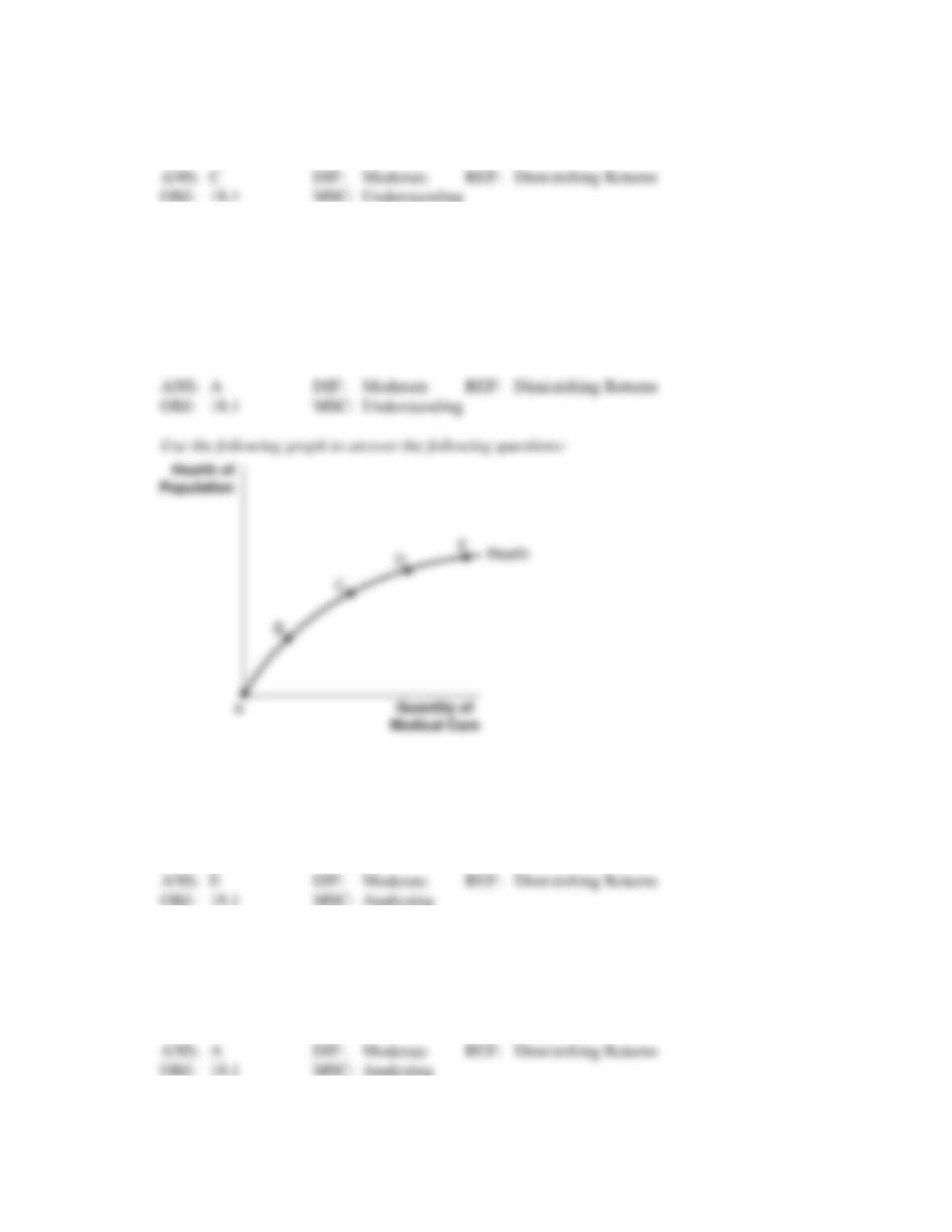
18. Which point on the graph best represents the United States, where a great deal of health care is
delivered but there are few additional health gains?
a. Point A d. Point D
b. Point B e. Point E
c. Point C
19. Which point on the graph best represents a country that has no health-care infrastructure and where
a small investment in health care would initially deliver significant health gains?
a. Point A d. Point D
b. Point B e. Point E
c. Point C
20. What makes the healthcare market different from other markets?
a. The consumers and producers in the healthcare market interact with one another more
frequently in terms of prices and the amount to pay compared to other markets.
b. The consumers and producers in the healthcare market rarely interact with one another in
terms of prices and the amount to pay compared to other markets.
c. Producers in the healthcare market are encouraged to underproduce.
d. Consumers in the healthcare market are encouraged to underconsume.
e. Consumers in the healthcare market are encouraged to underproduce.
21. The ________ is the often the intermediary between consumers and producers in the healthcare
market.
a. employer d. pharmacy
b. insurance company e. doctor
c. hospital
22. The Medicare and Medicaid programs represent ________ percent of medical spending in the
United States.
a. 5 d. 33
b. 12 e. 51
c. 24
23. A distortion in the healthcare market can occur when
a. health insurance companies require individuals to have a primary care doctor.
b. doctors are rewarded for reducing a patient’s recovery time after surgery.
c. the involvement of health maintenance organizations discourages efficiency in health care
expenditures.
d. the existence of healthcare insurance encourages customers to seek more health care than they
otherwise would.
e. when there is a lack of restrictions for entry into the market for delivering health care.
24. Which of the following is a negative consequence to having insurance companies exist in a
society?
a. The asymmetric problem is reduced by insuring large groups of people.
b. They are able to pool risks and give the sick the same access to medical care as the healthy.
c. When they have insurance, individuals will consume more medical care than if they have to
pay the full cost for care.
d. When they have insurance, individuals will consume less medical care than if they have to pay
the full cost for care.
e. By insuring large groups of people, the asymmetric problem is increased.
25. What would happen if, as a business owner, Toderick forced his employees to join an HMO?
a. Medical care costs would likely be higher than if Toderick’s employees could see any doctor
and receive any test they wanted because unnecessary care would be fully covered.
b. Medical care costs would likely be lower than if Toderick’s employees could see any doctor
and receive any test they wanted because the amount of unnecessary care would be reduced.
c. Medical care costs would likely be unaffected by whether employees join an HMO or not.
d. Medical care costs would likely be lower because the less healthy would be encouraged to
receive care.
e. Medical care costs would likely be lower because the healthy would be discouraged from
receiving care.
26. The adverse selection problem and the principal-agent problem are examples of
a. diminishing returns. d. third-party participation.
b. asymmetric information. e. market failures.
c. moral hazard.
27. ________ exist(s) whenever one party has more information than the other party.
a. Moral hazard d. Symmetric information
b. Immoral hazard e. Diminishing returns
c. Asymmetric information
28. ________ exist(s) whenever one party has access to some aspect of product quality that the other
party does not have.
a. Adverse selection d. Diminishing returns
b. Immoral hazard e. Symmetric information
c. Moral hazard
29. How can an insurance company reduce the adverse selection problem?
a. The adverse selection problem can’t be reduced.
b. An easy insurance application process could be used, unhealthy individuals could be refused
coverage, and large groups of individuals could be insured.
c. An extensive insurance application process could be used, unhealthy individuals could be
refused coverage, and only individuals would be insured.
d. An extensive insurance application process could be used, hardly anyone would be refused
coverage, and large groups of individuals could be insured.
e. An extensive insurance application process could be used, unhealthy individuals would be
refused coverage, and large groups of individuals could be insured.
30. A key component in the Affordable Care Act passed in the United States is the requirement that
individuals must either obtain basic medical insurance coverage or pay a tax. Which of the
following problems was this mandate designed to reduce?
a. moral hazard d. market failure
b. adverse selection e. principal agent problem
c. diminishing returns
31. What form does the adverse selection problem take in the healthcare market?
a. Buyers can buy as much health care as they want.
b. Sellers can sell as much health care as they want.
c. Buyers and sellers face delays when interacting.
d. Sellers are less likely to provide care because they know it is expensive.
e. Buyers that are less healthy are more likely to seek insurance because they anticipate needing
medical care.
32. Insurance companies that sell insurance to individuals are able to minimize the severity of the
adverse selection problem by
a. guaranteeing that all applicants receive coverage.
b. requiring a medical exam.
c. limiting the amounts that doctors are paid.
d. requiring patients to use a health maintenance organization (HMO).
e. expediting payment of benefits.
33. After many horrendous first dates arranged through a dating website where Cecily provided
minimal information, Cecily has decided to ask her good friends, who know all about her, to help
her find a companion. By relying on her friends, Cecily is trying to reduce a(n)
a. moral hazard problem that became a principal agent problem.
b. principal agent problem that became an adverse selection problem.
c. principal agent problem.
d. adverse selection problem.
e. moral hazard problem.
34. What would happen if insurance companies offered to pay for patients to receive a second opinion
before a medical procedure?
a. The principal agent problem would become less severe.
b. The adverse selection problem would become more severe.
c. The moral hazard problem would become more severe.
d. The adverse selection problem would become less severe.
e. The moral hazard problem would become less severe.
35. The problem that arises when an agent does not complete a task in the way intended by the
principal is called
a. the principal-agent problem. d. adverse selection.
b. immoral hazard. e. market failure.
c. diminishing returns.
36. In order to reduce the principal-agent problem, an insurance company can
a. give patients access to medical records, require doctors to justify tests, and pass reforms to
medical malpractice laws.
b. give patients only limited access to medical records, force doctors to justify tests, and pass
reforms to medical malpractice laws.
c. give patients access to medical records, allow doctors to determine which medical tests are
appropriate, and pass reforms to medical malpractice laws.
d. give patients access to medical records, require doctors to justify tests, and repeal medical
malpractice laws.
e. do nothing; there is no way to reduce the principal agent problem.
37. What would be the consequence for patients of a law that limited the amount of annual profit a
health insurance company could earn?
a. The principal-agent problem would become less severe.
b. The adverse selection problem would become more severe.
c. The moral hazard problem would become more severe.
d. The adverse selection problem would become less severe.
e. The moral hazard problem would become less severe.
38. A doctor may order more tests than necessary for a patient. This reflects which of the following
problems?
a. symmetric information d. principal-agent problem
b. diminishing returns e. market failure
c. adverse selection
39. After winning the lottery, Fez has decided to move from his apartment to a mansion. He has hired
a professional company to move his belongings. What type of problem should Fez be most
concerned about?
a. diminishing returns
b. adverse selection
c. principal-agent problem
d. symmetric information
e. an adverse selection problem that became a principal-agent problem
40. Instead of changing the oil in his car by himself, Ashton takes his car to a 10-minute oil change
store. Although it’s fast and inexpensive, what type of problem might Ashton encounter?
a. diminishing returns
b. adverse selection
c. principal-agent problem
d. symmetric information
e. an adverse selection problem that became a principal-agent problem
41. After attending medical school, Georgiana has decided to encourage all of her family members to
see her for their healthcare needs because she knows their health problems and has an incentive to
keep them alive and as healthy as possible. What type of asymmetric information problem is
Georgiana trying to correct by having her family members see her for care?
a. principal-agent problem
b. diminishing returns
c. adverse selection
d. moral hazard
e. an adverse selection problem that became a principal-agent problem
42. Instead of referring to a sample of comments a doctor has provided on his own website, Catrina
has decided instead to rely on reviews from friends who have been his patients. What type of
asymmetric information problem is Catrina trying to correct by soliciting comments from friends?
a. diminishing returns
b. adverse selection
c. moral hazard
d. principal-agent problem
e. an adverse selection problem that became a principal-agent problem
43. Noelle’s mother has always said, “If you want something done right, you have to do it yourself.”
What type of asymmetric information problem does her statement reflect?
a. diminishing returns
b. adverse selection
c. moral hazard
d. principal-agent problem
e. an adverse selection problem that became a principal-agent problem
44. The problem that arises when a party that is protected from risk behaves differently than if it were
not protected from risk is
a. moral hazard. d. adverse selection.
b. diminishing returns. e. market failure.
c. the principal-agent problem.
45. One method of reducing the moral hazard problem in health care insurance would be
a. for all insurance companies to increase the cost for coverage.
b. to allow insurance companies to agree to cover preventive care completely.
c. to allow insurance companies to impose payment limits on preventable conditions.
d. to allow insurance companies to limit the number of new customers.
e. to allow insurance companies to require a medical exam before offering coverage.
46. ________ would be minimized if hospital policy based a physician’s salary on how healthy
patients were following treatment by that doctor rather than the number of patients treated per year.
a. Moral hazard d. Market failure
b. Adverse selection e. The principal-agent problem
c. Diminishing returns
47. How can an insurance company reduce the moral hazard problem?
a. Impose a coinsurance where patients pay for a percentage of their medical care expenses, pay
none of the medical expenses associated with preventive care, and raise deductibles.
b. Impose a coinsurance where patients pay for a percentage of their medical care expenses, pay
all of the medical expenses associated with preventive care, and raise deductibles.
c. Eliminate patients’ responsibility to pay for a percentage of their medical care expenses, pay
all of the medical expenses associated with preventive care, and raise deductibles.
d. Impose a coinsurance where patients pay for a percentage of their medical care expenses, pay
all of the medical expenses associated with preventive care, and lower deductibles.
e. There is no way to reduce the moral hazard problem.
48. Requiring patients to pay a portion of the cost of the medical care they receive is designed to
reduce the severity of
a. moral hazard. d. the principal-agent problem.
b. diminishing returns. e. market failure.
c. adverse selection.
49. One method of reducing the moral hazard problem in healthcare insurance would be to allow
insurance companies to
a. increase the cost for coverage.
b. agree to cover preventive care completely.
c. increase the number of doctors eligible for payment.
d. limit the number of new customers.
e. require a medical exam before offering coverage.
50. After Luis received health insurance from his job as an accountant, he decided to become a
skydiver on the weekends because he knew that his health insurance from his employer would
cover most of his medical costs if he were injured. Which of the following statements is true?
a. The moral hazard problem increased in intensity.
b. The moral hazard problem decreased in intensity.
c. The principal-agent problem became more severe.
d. The principal-agent problem became less severe.
e. The adverse selection problem became more severe.
51. As the owner of a business that sells alarm clocks, Jaslene wants to hire workers who will sell as
many of these clocks as possible. If Jaslene perceives the moral hazard to be strong among her
sales employees, what could she do to minimize it?
a. offer a significant signing bonus
b. offer a constant hourly wage
c. offer a constant yearly salary
d. pay employees a percentage of their sales
e. conduct a lengthy interview process
52. Reese has a tendency to get very bored while he is driving his car and falls asleep behind the
wheel. He has decided to seek the maximum amount of car insurance that he can obtain. What
does this situation reflect?
a. the problem of diminishing returns
b. the problem of adverse selection
c. the principal-agent problem
d. the problem of moral hazard
e. an adverse selection problem that became a principal agent problem
53. As the owner of a large manufacturing plant, Josephina has the following choice of health plans to
offer her employees:
1. Low-deductible, high-premium health insurance plan
2. High-deductible, low-premium health insurance plan
Which employer-provided and employer-subsidized health insurance plan would Josephina choose
if she wants to keep her health care insurance subsidy as low as possible?
a. healthcare plan 1, because most costs are covered by the employee and the employee is
encouraged to visit the doctor only when it is necessary
b. healthcare plan 2, because most costs are covered by the employee and the employee is
encouraged to visit the doctor only when it is necessary
c. healthcare plan 1, because this plan encourages healthy employees to get coverage and lowers
the overall premium paid by all employees
d. healthcare plan 2, because employees are encouraged to visit the doctor for all possible
problems
e. either one, because there should be no noticeable difference in overall health care costs
associated with either health insurance plan
54. As the largest employer in a small town, Carlyle may be more likely to take business risks because,
if the company struggles, he might expect the local government to provide financial assistance.
This situation reflects a(n)
a. moral hazard problem that becomes an adverse selection problem.
b. principal-agent problem that becomes a moral hazard problem.
c. principal-agent problem.
d. moral hazard problem.
e. adverse selection problem.
55. As the manager in an insurance company, Emanuel is responsible for reviewing the following two
plans that he will offer to the public:
1. Low-deductible, high-premium health insurance plan
2. High-deductible, low-premium health insurance plan
Which plan would someone choose if he or she were concerned that doctors may order too many
tests?
a. healthcare plan 1, because patients will first make sure that all tests are necessary when they
must pay a substantial portion of the costs
b. healthcare plan 2, because patients will first make sure that all tests are necessary when they
must pay a substantial portion of the costs
c. healthcare plan 2, because the insurance company will discourage doctors from ordering too
many tests
d. healthcare plan 2, because the threat of malpractice lawsuits will discourage doctors from
ordering too many tests
e. neither one, because they would not deal effectively with the problem
56. What would be the consequence for insurance companies allowing patients as many treatments as
they want?
a. The principal-agent problem would become less severe.
b. The adverse selection problem would become more severe.
c. The moral hazard problem would become more severe.
d. The adverse selection problem would become less severe.
e. The moral hazard problem would become less severe.
57. What would be the consequence of a law that forced individuals to receive an annual preventive
health checkup?
a. The adverse selection problem would become more intense.
b. The moral hazard problem would become more intense.
c. The adverse selection problem would become less intense.
d. The moral hazard problem would become less intense.
e. Both the moral hazard and adverse selection problems would become less intense.
58. What would be the consequence of a law that forced patients to pay all of the costs for preventive
care?
a. The adverse selection problem would become more intense.
b. The moral hazard problem would become more intense.
c. The adverse selection problem would become less intense.
d. The moral hazard problem would become less intense.
e. Both the moral hazard and adverse selection problems would become more intense.
59. After a natural disaster destroyed one of the 10 hospitals in a city and injured nearly 75 percent of
the population, what would you expect to happen to the price and quantity of medical services,
ceteris paribus?
a. There would be no expected changes to equilibrium price or quantity.
b. Equilibrium price would rise because supply would slightly decrease and demand would
dramatically increase. The effect on equilibrium quantity is ambiguous.
c. Equilibrium price would fall because supply would slightly decrease and demand would
dramatically increase. The effect on equilibrium quantity is ambiguous.
d. Equilibrium price would rise and quantity would unambiguously fall because supply would
slightly decrease and demand would dramatically increase.
e. Equilibrium price would fall and quantity would unambiguously rise because demand would
decrease and supply would remain constant.
60. After a natural disaster destroyed nine of the 10 hospitals in a city but injured only 1 percent of the
population, what would you expect to happen to the price and quantity of medical services?
a. There would be no expected changes to equilibrium price or quantity.
b. Equilibrium price and quantity would rise because supply would slightly decrease and demand
would dramatically increase.
c. Equilibrium price and quantity would fall because supply would slightly decrease and demand
would dramatically increase.
d. Equilibrium price would rise because supply would significantly decrease and demand would
increase only slightly. The effect on equilibrium quantity is ambiguous.
e. Equilibrium price would fall and quantity would rise because demand would decrease and
supply would remain constant.
61. In a town with only one hospital, the largest employer (a local manufacturing plant) now offers
health insurance to its employees. What would be the expected change to the price and quantity of
medical services?
a. Equilibrium price and quantity would not be affected.
b. Equilibrium price and quantity would rise because supply and demand have decreased.
c. Equilibrium price and quantity would fall because supply has decreased but demand has
increased.
d. Equilibrium price and quantity would rise because demand has increased but supply has
remained constant.
e. Equilibrium price would fall and quantity would rise because demand has decreased and
supply has remained constant.
62. After years of paying all healthcare expenses for employees, a city’s largest employer has decided
not to offer healthcare coverage anymore. The equilibrium price and quantity for medical services
in the city would
a. not be affected.
b. rise because supply and demand would decrease.
c. fall because demand would decrease and supply would remain constant.
d. rise as demand would increase, but supply would remain constant.
e. rise because demand would decrease and supply would remain constant.
63. Favorable tax policies have encouraged the construction of new hospitals in the United States.
How does this affect the equilibrium price and quantity for medical services?
a. They are not affected.
b. They have risen because supply and demand have decreased.
c. They have fallen because demand has decreased and supply has remained constant.
d. Equilibrium price has fallen and quantity has risen as supply has increased, but demand has
remained constant.
e. Equilibrium price has fallen and quantity has risen because demand has decreased and supply
has remained constant.
64. As governor, Marcy has decided that anyone who works but earns less than $20,000 a year will
have their health insurance premiums paid for by the government. How does this affect the
equilibrium price and quantity of medical services?
a. They are not affected.
b. They have risen because demand has increased, but supply has remained constant.
c. They have risen because supply and demand have decreased.
d. They have fallen because demand has decreased and supply has remained constant.
e. Equilibrium price has fallen and quantity has risen because demand decreased and supply has
remained constant.
65. As governor, Lynda has decided to balance the budget by reducing the number of people for whom
the government provides health care. How does this affect the equilibrium price and quantity of
medical services?
a. They are not affected.
b. They have risen as demand has increased, but supply has remained constant.
c. They have risen because supply and demand have decreased.
d. They have fallen because demand has decreased and supply has remained constant.
e. Equilibrium price has fallen and quantity has risen because demand has decreased and supply
has remained constant.
66. The federal government has recently decided to expand the amount of prescription drug insurance
offered to the elderly. How does this affect the price and quantity of medical services?
a. Equilibrium price and quantity are not affected.
b. Equilibrium price and quantity have risen because supply and demand have decreased.
c. Equilibrium price and quantity have risen as demand has increased, but supply has remained
constant.
d. Equilibrium price and quantity have fallen because demand has decreased and supply has
remained constant.
e. Equilibrium price has fallen and quantity has risen because demand has decreased and supply
has remained constant.
67. In an effort to reduce the federal budget deficit, Congress has decided to reduce the amount of
money spent on Medicare and Medicaid. How does this affect the equilibrium price and quantity of
medical services?
a. They are not affected.
b. They have risen as demand has increased, but supply has remained constant.
c. They have fallen because demand has decreased and supply has remained constant.
d. They have risen because supply and demand have decreased.
e. Equilibrium price has fallen and quantity has risen because demand has decreased and supply
has remained constant.
68. What would happen to the price and quantity of medical services if a new doctor’s office opened in
a small town?
a. Equilibrium price and quantity would rise because both supply and demand would increase.
b. Equilibrium price and quantity would fall because both supply and demand would decrease.
c. Equilibrium price and quantity would rise because demand would decrease and supply would
remain constant.
d. Equilibrium price would fall and quantity would rise because supply would increase and
demand would remain constant.
e. Equilibrium price and quantity would fall because demand would decrease and supply would
remain constant.
69. What would happen to the price and quantity of medical services if an existing doctor’s office
closed in a small town, ceteris paribus?
a. Equilibrium price and quantity would rise because both supply and demand increased.
b. Equilibrium price and quantity would fall because both supply and demand decreased.
c. Equilibrium price would rise and quantity would fall because supply decreased and demand
was constant.
d. Equilibrium price and quantity would rise because demand decreased while supply was
constant.
e. Equilibrium price and quantity would fall because demand decreased and supply was constant.
70. Many colleges and universities in the United States now require students to purchase health
insurance. Such a requirement would
a. decrease the demand for health care.
b. increase the supply of health care.
c. decrease the supply of health care.
d. have no effect on the supply or demand for health care.
e. lower the overall price for healthcare insurance as healthy college students are added to the
pool of insured.
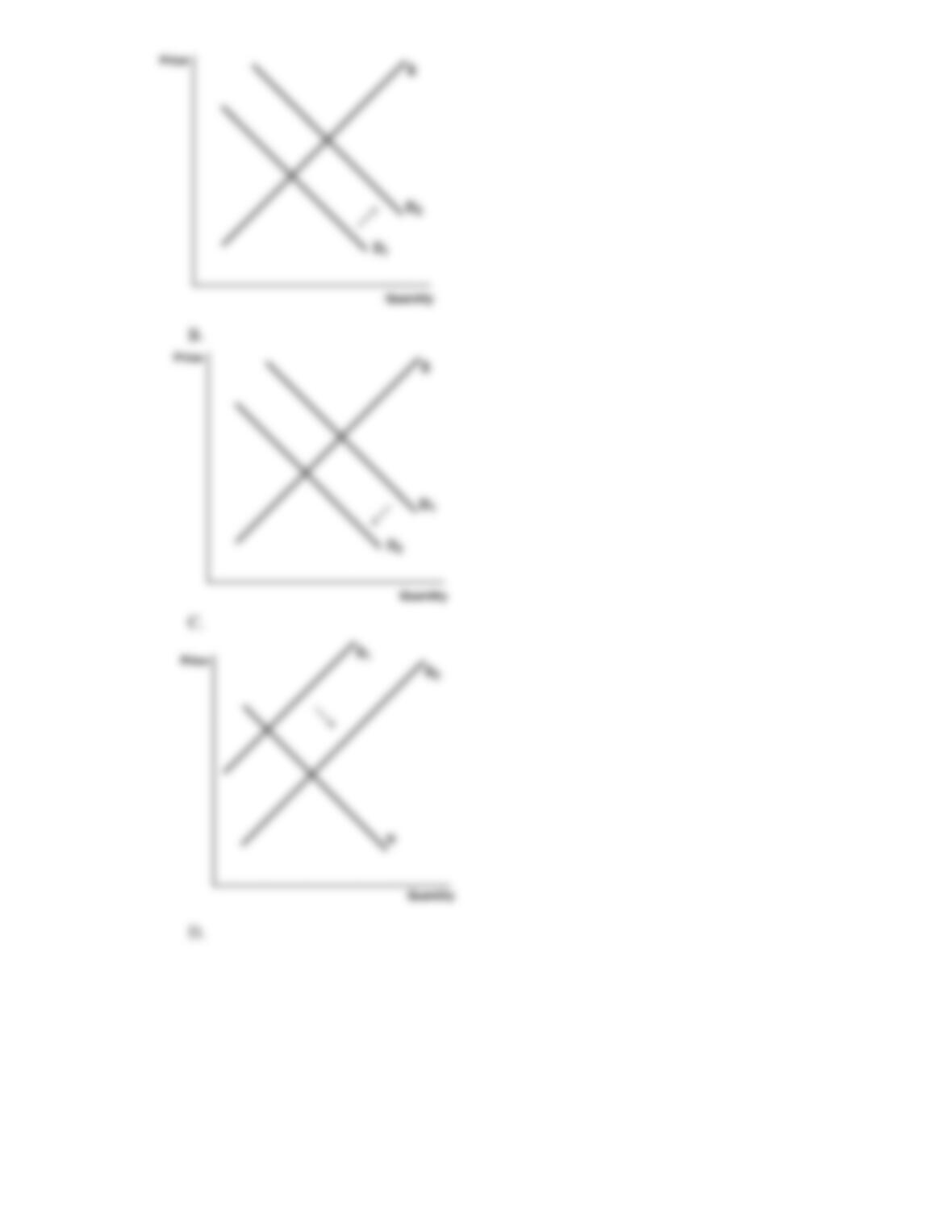
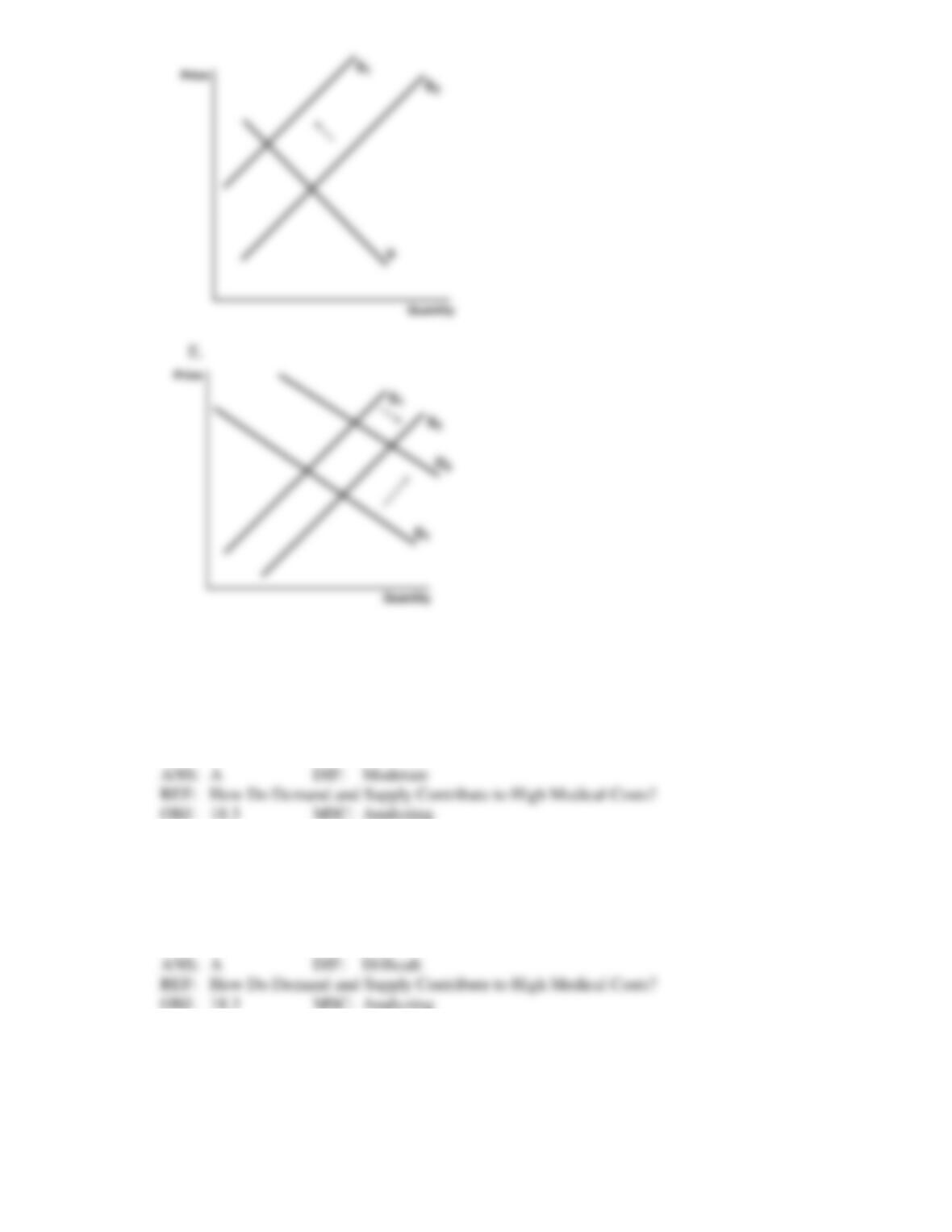
71. In terms of supply and demand for hip surgery conducted in a foreign country, which graph
represents the expansion of medical tourism as consumers become aware of the high quality of
health care that can be found abroad?
a. Graph A d. Graph D
b. Graph B e. Graph E
c. Graph C
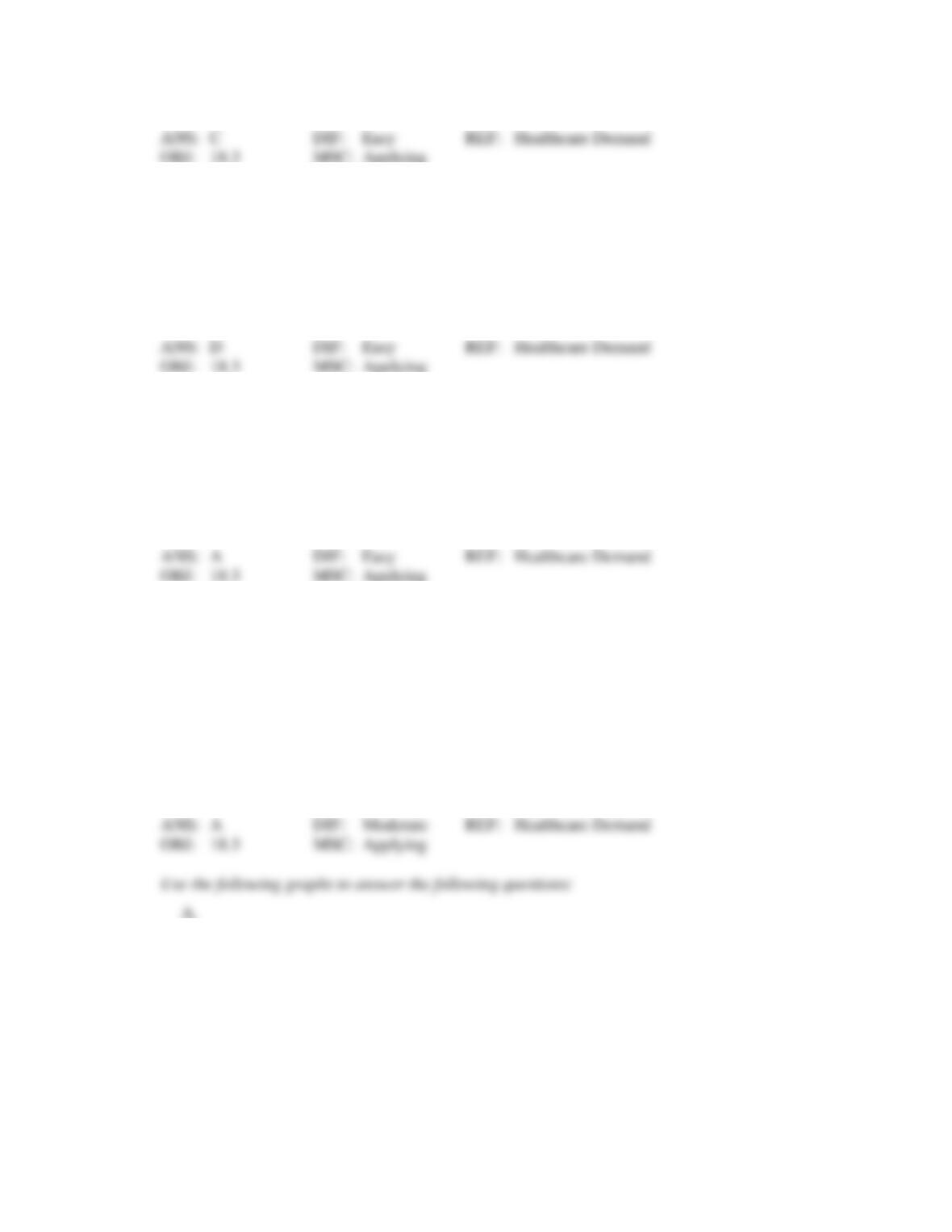
72. Which graph represents the development of very expensive technology that makes it possible to
cure diseases that previously were incurable?
a. Graph A d. Graph D
b. Graph B e. Graph E
c. Graph C
73. Which graph represents the passage of a law that makes it more difficult to be licensed as a
medical doctor who can perform brain surgery?
a. Graph A d. Graph D
b. Graph B e. Graph E
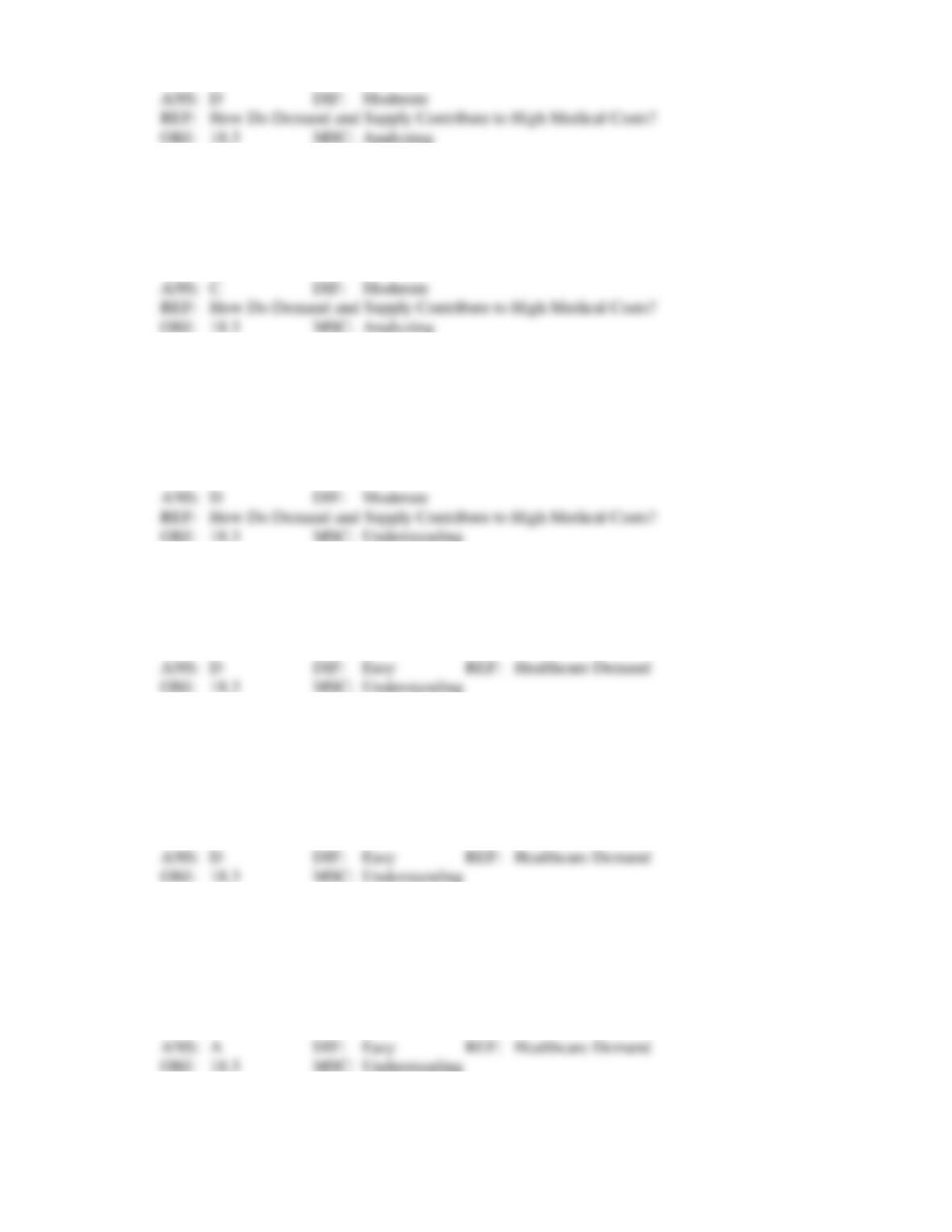
c. Graph C
74. Which graph represents what would happen if hospitals were to receive a significant tax deduction
for constructing new facilities?
a. Graph A d. Graph D
b. Graph B e. Graph E
c. Graph C
75. How do demand and supply influence the increasing cost of health care?
a. Demand and supply have no influence over the price of health care.
b. Demand is limited and supply is strong and inelastic.
c. Demand and supply are both limited.
d. The demand for health care is strong and inelastic, whereas supply is limited.
e. The demand and supply for health care are both strong and inelastic.
76. As the price of medical care rises, the
a. quantity supplied decreases. d. quantity demanded decreases.
b. supply increases. e. supply curve decreases.
c. demand increases.
77. Which of the following statements is true?
a. The demand for health care among unhealthy young adults is elastic.
b. The demand for health care among healthy young adults is inelastic.
c. The demand for health care among healthy older adults is elastic.
d. The demand for health care among unhealthy older adults is inelastic.
e. The degree of healthiness has no effect on the elasticity of demand for health care.
78. Which of the following statements is true?
a. The demand for health care among healthy young adults is elastic.
b. The demand for health care among healthy young adults is inelastic.
c. The demand for health care among unhealthy older adults is elastic.
d. The demand for health care among healthy older adults is inelastic.
e. The degree of healthiness has no effect on the elasticity of demand for health care.
79. Which of the following medical procedures would have the most inelastic demand?
a. the removal of a healthy appendix d. a consultation about hair loss
b. plastic surgery e. immunization for the flu
c. a heart transplant
80. While throwing a Frisbee to his dog, Fareem sprained his ankle. In regard to seeking medical care,
Fareem’s demand for care is
a. completely inelastic.
b. completely elastic.
c. more inelastic than it would be for a broken leg.
d. more elastic than it would be for a broken leg.
e. highly, but not completely, inelastic.
81. While tossing a toy to her cat, Danika sprained her ankle. In regard to seeking medical care,
Danika’s demand for care is
a. more elastic than if she had a sprained ankle as well as a severe wound requiring stitches.
b. more inelastic than if she had a sprained ankle as well as a severe wound requiring stitches.
c. completely inelastic.
d. completely elastic.
e. highly, but not completely, inelastic.
82. Patients in need of an organ transplant often require years of weekly treatments to keep them
healthy until a compatible organ is found. Because such maintenance care may last for years, the
demand for treatment is
a. more elastic than would be the case for an ailment that required stitches in a single office visit
because of the long time horizon.
b. more inelastic than would be the case for an ailment that required stitches in a single office
visit because of the long time horizon.
c. neither elastic nor inelastic.
d. more elastic because of its necessity.
e. more inelastic due to the fact that the supply of treatment is limited.