Chapter 18 – Antitrust Policy and Regulation
18-1
CHAPTER 18
Antitrust Policy and Regulation
A. Short-Answer, Essays, and Problems
1. What are the basic purposes of antitrust policy?
2. Briefly describe the historical background that gave rise to antitrust and regulation in the United States.
3. What were the two basic means of control by government as substitute for, or to supplements to, market
forces in monopolized industries?
4. Describe the economic case against monopoly.
5. Explain: “Antitrust is basically pro–business, because it is antimonopoly. To believe that it is antibusiness
is to believe that monopoly is pro–business.”
6. Describe the importance and major features of the Sherman Act of 1890.
7. How did the Clayton Act of 1914 strengthen and clarify the intent of the Sherman Act of 1890?
8. What was the importance of the Federal Trade Commission Act of 1914?
9. Describe a recent violation of the Wheeler-Lea Act of 1938.
10. What was the purpose of the Celler-Kefauver Act of 1950?
11. Describe two historic legal cases to contrast the two different views of antitrust laws. One case would
support the behavioralist view of antitrust laws. The other case would support the structuralist views of the
antitrust laws.
12. What has been the recent view of antitrust laws?
13. In what cases would the market share held by the dominant firm be or not be an especially relevant or
important factor in determining whether a firm has too much market power?
14. Why has one Presidential administration enforced the antitrust laws more or less strictly than another?
15. How effective have antitrust laws been in breaking up existing monopolies?
16. Describe the three types of mergers and give examples.
Chapter 18 – Antitrust Policy and Regulation
18-2
17. In the table below are data on five different industries and the market shares for each of the firms in the
industry. Assume that there is no foreign competition, entry into the industry is difficult, and that no firm
in each industry is on the verge of bankruptcy. In the column to the right of the table, calculate the
Herfindahl index.
Industry Market share of firms in industry
Herfindahl index
1 2 3 4 5 6
Alpha 33 22 14 12 10 9 _____
Beta 25 25 25 15 10 — _____
Cappa 20 20 20 20 20 — _____
Delta 60 10 10 10 10 — _____
Epsilon 25 20 15 15 15 10 _____
(a) Which industry has the most monopoly power and which industry has the least monopoly power?
(b) If the sixth firm in Industry Alpha sought to merge with the fifth firm in that industry, would the
government be likely to challenge the merger?
(c) Would a conglomerate merger between the fourth firm in Industry Beta and the sixth firm in Industry
Epsilon likely be challenged by the government?
18. In the table below are data on five different industries and the market shares for each of the firms in the
industry. Assume that there is no foreign competition, entry into the industry is difficult, and that no firm
in each industry is on the verge of bankruptcy. In the column to the right of the table, calculate the
Herfindahl index.
Industry Market share of firms in industry
Herfindahl index
1 2 3 4 5 6
Aviation 25 20 15 15 15 10 _____
Textiles 25 25 25 15 10 — _____
Computers 60 10 10 10 10 — _____
Chemicals 20 20 20 20 20 — _____
Automotive 33 22 14 12 10 9 _____
(a) Which industry has the most monopoly power and which industry has the least monopoly power?
(b) If the sixth firm in the automotive industry sought to merge with the fifth firm in that industry, would
the government be likely to challenge the merger?
(c) Would a conglomerate merger between the first firm in the computer industry and the second firm in
the textiles industry likely be challenged by the government?
19. On occasion the government has approved the merging of certain smaller firms in oligopolistic industries
(such as steel and automobiles) on the grounds that the net result would strengthen competition. Do you
20. How have antitrust laws been applied to monopoly since the 1980s?
21. How has the European Union differed from the United States in the treatment of a monopoly? Consider the
treatment of Microsoft.
22. “In practice the antitrust laws deal more with oligopolies than with pure monopolies.” Is this true?
23. What has been the general approach to the enforcement of antitrust laws based on the type of mergers and
price fixing among firms?
24. Why are horizontal mergers more likely to be opposed than vertical and conglomerate mergers?
25. Why are price fixing among firms and price discrimination treated differently under antitrust legislation?
Chapter 18 – Antitrust Policy and Regulation
18-3
26. How is price fixing among firms treated under antitrust policy? Give two examples of legal actions against
price fixing.
27. (Consider This) Give two examples of price fixing in the news.
28. How is price discrimination treated under antitrust laws?
29. What are tying contracts? How are tying contracts treated by antitrust enforcers?
30. Consider the following situations related to a sports stadium in a city. Assume this is the primary venue for
sports games. Decide whether the city government is likely to intervene to enforce antitrust law or not.
(a) In response to slow sales of memorabilia in its sport shop, the stadium management decides to require
patrons to buy one item of memorabilia over $5 along with their ticket.
(b) The stadium management decides to charge different prices for students, regular patrons and senior
citizens.
(c) The stadium is purchased by a soft drink company, who will only provide their products at games.
(d) A company is coming into the town wanting to build a new sports complex. The stadium management
decides to fund a smear campaign against the new development, as well as threaten to pull funding
from key city council members’ campaign funds.
31. (Consider This) Give two examples of legal actions against price fixing among firms.
32. Explain: “An effectively regulated natural monopoly will have trouble attracting capital to sustain and
modernize its facilities.”
33. “Monopoly has developed in both product and resource markets because of the shortcomings and
inefficiencies of competitive markets.” Do you agree? Explain.
34. “Monopolistic firms will always be against regulation.” Evaluate.
35. Contrast the public interest theory of regulation with the legal cartel theory of regulation.
36. What have been the major outcomes from deregulation of industry? Give three examples of changes in
particular industries.
37. What are the major differences between “industrial” regulation and “social” regulation? Cite examples of
Federal commissions that address the two types of regulation.
38. What are social regulation and agency examples?
39. What arguments are made in support of social regulation?
40. Do the costs of social regulation outweigh the benefits?
41. What are four criticisms of social regulation?
42. Explain what critics see as the problems with social regulation.
43. What are the likely economic effects of social regulation on prices, innovation, and competition?
44. Why do supporters of social regulation need to remember that “there is no free lunch”?
45. What do critics of social regulation need to remember about government?
Chapter 18 – Antitrust Policy and Regulation
18-4
46. Explain: “Ironically, by “taking the rough edges off of capitalism,” social regulation may be a strong pro–
capitalist force.”
47. What two reminders are needed in the debate over social regulation?
48. (Last Word) What were the charges, findings, and proposed court remedy in the Microsoft antitrust case?
49. (Last Word) What was the appeals court ruling and the final settlement in the Microsoft antitrust case?
Chapter 18 – Antitrust Policy and Regulation
18-5
B. Answers to Short-Answer, Essays, and Problems
1. What are the basic purposes of antitrust policy?
2. Briefly describe the historical background that gave rise to antitrust and regulation in the United States.
3. What were the two basic means of control by government as substitute for, or to supplements to, market
forces in monopolized industries?
4. Describe the economic case against monopoly.
5. Explain: “Antitrust is basically pro–business, because it is antimonopoly. To believe that it is antibusiness
is to believe that monopoly is pro–business.”
6. Describe the importance and major features of the Sherman Act of 1890.
Chapter 18 – Antitrust Policy and Regulation
7. How did the Clayton Act of 1914 strengthen and clarify the intent of the Sherman Act of 1890?
8. What was the importance of the Federal Trade Commission Act of 1914?
9. Describe a recent violation of the Wheeler-Lea Act of 1938.
In 2007, the FTC fined four makers of over-the-counter diet pills a collective $25 million for claiming their
products produces fast and permanent weight loss. [text: E p. 376; MI p. 376]
10. What was the purpose of the Celler-Kefauver Act of 1950?
11. Describe two historic legal cases to contrast the two different views of antitrust laws. One case would
support the behavioralist view of antitrust laws. The other case would support the structuralist views of the
antitrust laws.
12. What has been the recent view of antitrust laws?
13. In what cases would the market share held by the dominant firm be or not be an especially relevant or
important factor in determining whether a firm has too much market power?
The application of antitrust law depends on how the market is defined. If the market is defined broadly to
include a wide range of products which could substitute for each other, then there is less concentration than
if the market is defined narrowly. The key legal question is, “What is the relevant market for a product?”
Chapter 18 – Antitrust Policy and Regulation
18-7
14. Why has one Presidential administration enforced the antitrust laws more or less strictly than another?
15. How effective have antitrust laws been in breaking up existing monopolies?
16. Describe the three types of mergers and give examples.
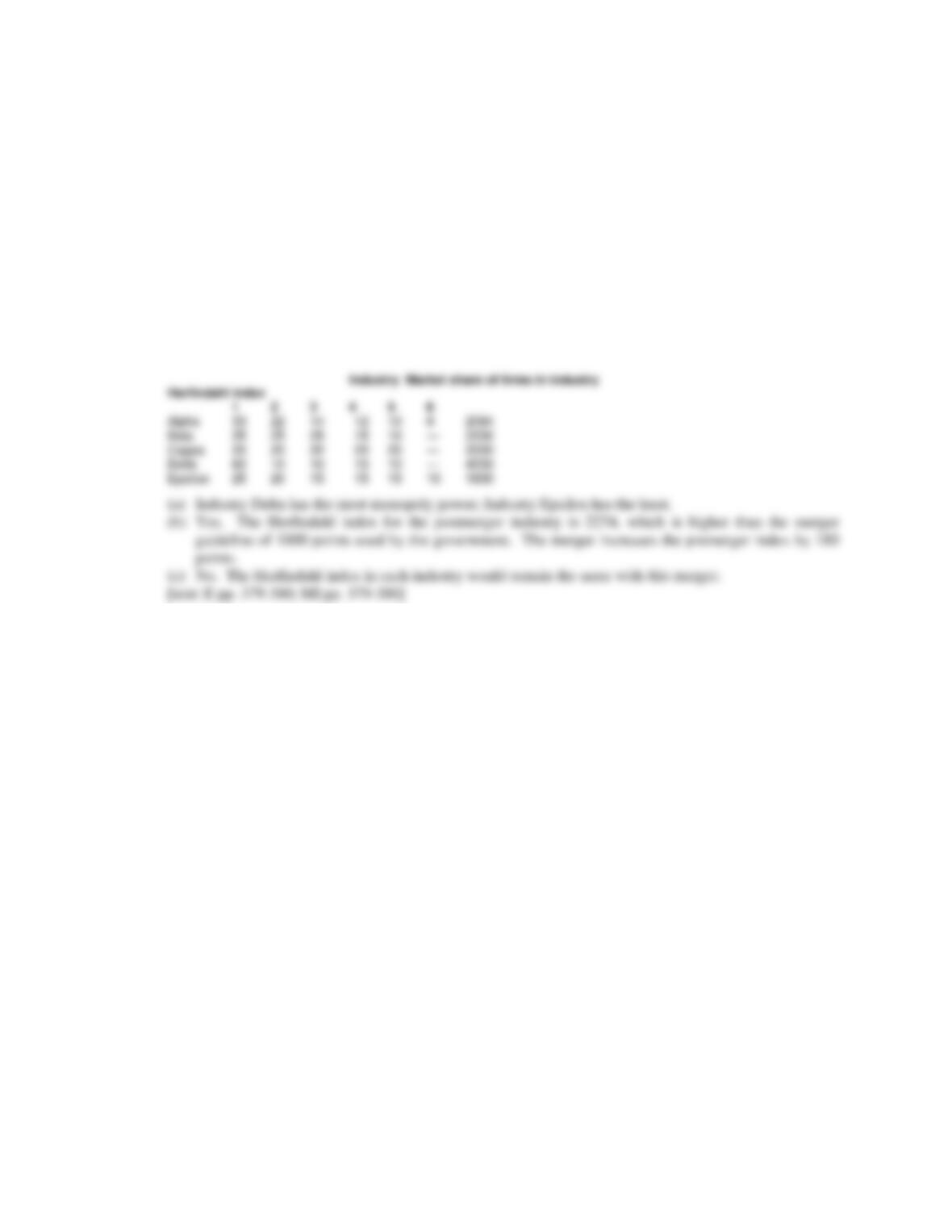
17. In the table below are data on five different industries and the market shares for each of the firms in the
industry. Assume that there is no foreign competition, entry into the industry is difficult, and that no firm
in each industry is on the verge of bankruptcy. In the column to the right of the table, calculate the
Herfindahl index.
Chapter 18 – Antitrust Policy and Regulation
18-8
Industry Market share of firms in industry
Herfindahl index
1 2 3 4 5 6
Alpha 33 22 14 12 10 9 _____
Beta 25 25 25 15 10 — _____
Cappa 20 20 20 20 20 — _____
Delta 60 10 10 10 10 — _____
Epsilon 25 20 15 15 15 10 _____
(a) Which industry has the most monopoly power and which industry has the least monopoly power?
(b) If the sixth firm in Industry Alpha sought to merge with the fifth firm in that industry, would the
government be likely to challenge the merger?
(c) Would a conglomerate merger between the fourth firm in Industry Beta and the sixth firm in Industry
Epsilon likely be challenged by the government?
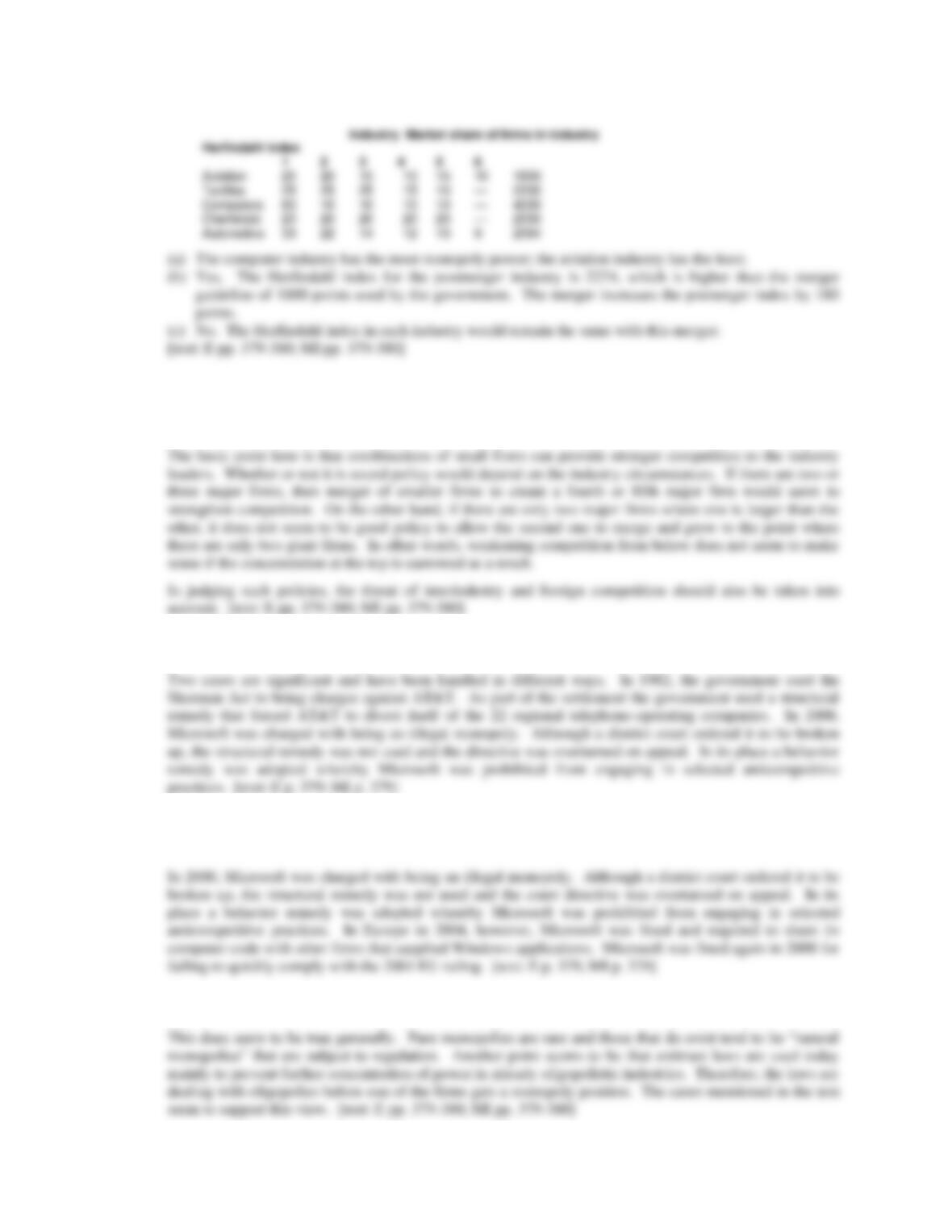
18. In the table below are data on five different industries and the market shares for each of the firms in the
industry. Assume that there is no foreign competition, entry into the industry is difficult, and that no firm
in each industry is on the verge of bankruptcy. In the column to the right of the table, calculate the
Herfindahl index.
Industry Market share of firms in industry
Herfindahl index
1 2 3 4 5 6
Aviation 25 20 15 15 15 10 _____
Textiles 25 25 25 15 10 — _____
Computers 60 10 10 10 10 — _____
Chemicals 20 20 20 20 20 — _____
Automotive 33 22 14 12 10 9 _____
(a) Which industry has the most monopoly power and which industry has the least monopoly power?
(b) If the sixth firm in the automotive industry sought to merge with the fifth firm in that industry, would
the government be likely to challenge the merger?
(c) Would a conglomerate merger between the first firm in the computer industry and the second firm in
the textiles industry likely be challenged by the government?
Chapter 18 – Antitrust Policy and Regulation
18-9
19. On occasion the government has approved the merging of certain smaller firms in oligopolistic industries
(such as steel and automobiles) on the grounds that the net result would strengthen competition. Do you
think that this is sound policy? Justify your answer.
20. How have antitrust laws been applied to monopoly since the 1980s?
21. How has the European Union differed from the United States in the treatment of a monopoly? Consider the
treatment of Microsoft.
22. “In practice the antitrust laws deal more with oligopolies than with pure monopolies.” Is this true?
Chapter 18 – Antitrust Policy and Regulation
18–10
23. What has been the general approach to the enforcement of antitrust laws based on the type of mergers and
price fixing among firms?
24. Why are horizontal mergers more likely to be opposed than vertical and conglomerate mergers?
25. Why are price fixing among firms and price discrimination treated differently under antitrust legislation?
26. How is price fixing among firms treated under antitrust policy? Give two examples of legal actions against
price fixing.
27. (Consider This) Give two examples of price fixing in the news.
Chapter 18 – Antitrust Policy and Regulation
18–11
28. How is price discrimination treated under antitrust laws?
29. What are tying contracts? How are tying contracts treated by antitrust enforcers?
30. Consider the following situations related to a sports stadium in a city. Assume this is the primary venue for
sports games. Decide whether the city government is likely to intervene to enforce antitrust law or not.
(a) In response to slow sales of memorabilia in its sport shop, the stadium management decides to require
patrons to buy one item of memorabilia over $5 along with their ticket.
(b) The stadium management decides to charge different prices for students, regular patrons and senior
citizens.
(c) The stadium is purchased by a soft drink company, who will only provide their products at games.
(d) A company is coming into the town wanting to build a new sports complex. The stadium management
decides to fund a smear campaign against the new development, as well as threaten to pull funding
from key city council members’ campaign funds.
31. (Consider This) Give two examples of legal actions against price fixing among firms.
32. Explain: “An effectively regulated natural monopoly will have trouble attracting capital to sustain and
modernize its facilities.”
Chapter 18 – Antitrust Policy and Regulation
18–12
33. “Monopoly has developed in both product and resource markets because of the shortcomings and
inefficiencies of competitive markets.” Do you agree? Explain.
34. “Monopolistic firms will always be against regulation.” Evaluate.
35. Contrast the public interest theory of regulation with the legal cartel theory of regulation.
36. What have been the major outcomes from deregulation of industry? Give three examples of changes in
particular industries.
37. What are the major differences between “industrial” regulation and “social” regulation? Cite examples of
Federal commissions that address the two types of regulation.
Chapter 18 – Antitrust Policy and Regulation
38. What are social regulation and agency examples?
39. What arguments are made in support of social regulation?
40. Do the costs of social regulation outweigh the benefits?
41. What are four criticisms of social regulation?
Chapter 18 – Antitrust Policy and Regulation
42. Explain what critics see as the problems with social regulation.
43. What are the likely economic effects of social regulation on prices, innovation, and competition?
44. Why do supporters of social regulation need to remember that “there is no free lunch”?
45. What do critics of social regulation need to remember about government?
46. Explain: “Ironically, by “taking the rough edges off of capitalism,” social regulation may be a strong pro–
capitalist force.”
47. What two reminders are needed in the debate over social regulation?
Chapter 18 – Antitrust Policy and Regulation
48. (Last Word) What were the charges, findings, and proposed district court remedy in the Microsoft antitrust
case?
49. (Last Word) What was the appeals court ruling and the final settlement in the Microsoft antitrust case?