Microeconomics: Theory and Applications with Calculus, 3e (Perloff)
Chapter 18 Asymmetric Information
18.1 Problems Due to Asymmetric Information
1) Adverse selection can occur when
A) all persons involved in a transaction have full information.
B) one person has information not available to others.
C) post-agreement incentives result in workers shirking.
D) nobody has any information about a particular product.
2) If you sell your DVD player on eBay you will be better informed about the quality of the product than
any potential buyer. This is called
A) adverse selection.
B) asymmetric information.
C) moral hazard.
D) opportunistic behavior.
3) A person who practices poisonous snake charming and does not reveal this to her health insurance
company before purchasing insurance is an example of
A) moral hazard.
B) adverse selection.
C) signaling.
D) screening.
4) A person who starts practicing poisonous snake charming after signing a contract with a health
insurance company is an example of
A) moral hazard.
B) adverse selection.
C) signaling.
D) screening.
5) A person who generally drives without a seat belt on does not reveal this to his automobile insurance
company before he purchases insurance. This is an example of
A) adverse selection.
B) moral hazard.
C) signaling.
D) screening.
6) A person starting to drive more recklessly after signing a contract with an automobile insurance
company is an example of
A) adverse selection.
B) moral hazard.
C) signaling.
D) screening.
7) In the automobile insurance market, adverse selection occurs when
A) drivers with greater risks buy a policy with large deductibles.
B) drivers with greater risks buy a policy with no deductibles.
C) uninsured drivers drive recklessly.
D) insured drivers drive recklessly.
8) Opportunism may occur when
A) both parties have limited information.
B) both parties have full information.
C) one party has information the other does not.
D) All of the above.
9) Adverse selection occurs when
A) a person takes more risks that are not known to the life insurance company because he has life
insurance.
B) a person buys life insurance because he has a risky lifestyle that is not known to the life insurance
company.
C) a person is a risk lover.
D) pregnant women with health insurance make more doctor visits than uninsured pregnant women.
10) Adverse selection occurs when there is
A) full information.
B) unobserved behavior.
C) an unobserved characteristic.
D) a worker who shirks because his boss does not watch him.
11) If reckless drivers are more likely to buy automobile insurance than safe drivers are,
A) a moral hazard has occurred.
B) adverse selection has occurred.
C) the market for insurance is efficient.
D) then automobile insurance will be fairly priced.
For the following, please answer “True” or “False” and explain why.
12) Adverse selection occurs when an agreement encourages undesirable behavior.
13) Explain what may occur when a buyer and a seller have unequal amounts of limited information.
Describe two different types of problems that may arise when asymmetric information exists.
14) The XYZ Co. is hiring salespersons. They will be paid a very attractive hourly rate that is independent
of how much they sell. Describe an adverse selection that would take place. Describe a moral hazard that
would take place.
18.2 Responses to Adverse Selection
1) Used car buyers will believe that a car is of good quality when the seller signals the car’s high quality
by offering a warranty when
A) a warranty on a lemon is costly to the seller.
B) warranties are offered on all cars.
C) warranties are only offered on lemons.
D) a warranty on a good car is a false signal.
2) If the market interest rate is 5% and a bank advertises loans at 12%, the bank will receive
A) no applications.
B) applications from mostly low-risk borrowers.
C) applications from mostly high-risk borrowers.
D) a moral hazard.
3) If a life insurance company does not require a medical exam of its policyholders, it is most likely that
the company
A) charges above-average premiums.
B) charges below-average premiums.
C) charges no premiums.
D) has only very healthy policyholders.
4) Assume Health Insurance is provided universally by the government. This would
A) eliminate the problems of adverse selection.
B) result in adverse selection.
C) eliminate the problems of moral hazard.
D) All of the above.
5) If a student achieves a high SAT score, this
A) sends a signal to a college that the applicant will be a good college student.
B) does not act as a screening device.
C) is a moral hazard.
D) provides a college with no information.
6) Life insurance companies often give applicants a physical examination to prevent
A) the person from dying before obtaining the policy.
B) signaling.
C) adverse selection.
D) profit maximization.
7) Some companies subject their applicants to extensive tests. Why?
A) to reduce the informational asymmetry between the firm and the applicant
B) to screen the applicant to avoid the problem of adverse selection
C) to gather more information about the applicant
D) All of the above.
8) The requirement that all drivers must carry auto insurance reduces
A) moral hazard.
B) the effectiveness of signaling.
C) adverse selection.
D) the chance of auto accidents.
9) If bad drivers can usually avoid being ticketed by the police, then insurance companies will
A) use one’s driving record as a signal.
B) use one’s driving record as a screening device.
C) not be able to use one’s driving record as a screening device.
D) request driving records directly from the police and not from the individual applicant.
10) A physical examination is NOT a good screening device for life insurance companies if
A) life-threatening diseases are usually undetected.
B) doctors cannot be easily bribed to write a good report.
C) medical history is a good predictor of life expectancy.
D) one’s current state of health is a good predictor of life expectancy.
For the following, please answer “True” or “False” and explain why.
11) Signals can help prevent adverse selection as long as a false signal is costly to the person sending it.
12) How can a warranty at the seller’s expense signal that a product is of high quality?
13) Explain why some people who are applying for a job at a bank dress up, arrive early, and have their
paperwork neatly completed for the job interview.
18.3 How Ignorance About Quality Drives Out High-Quality Goods
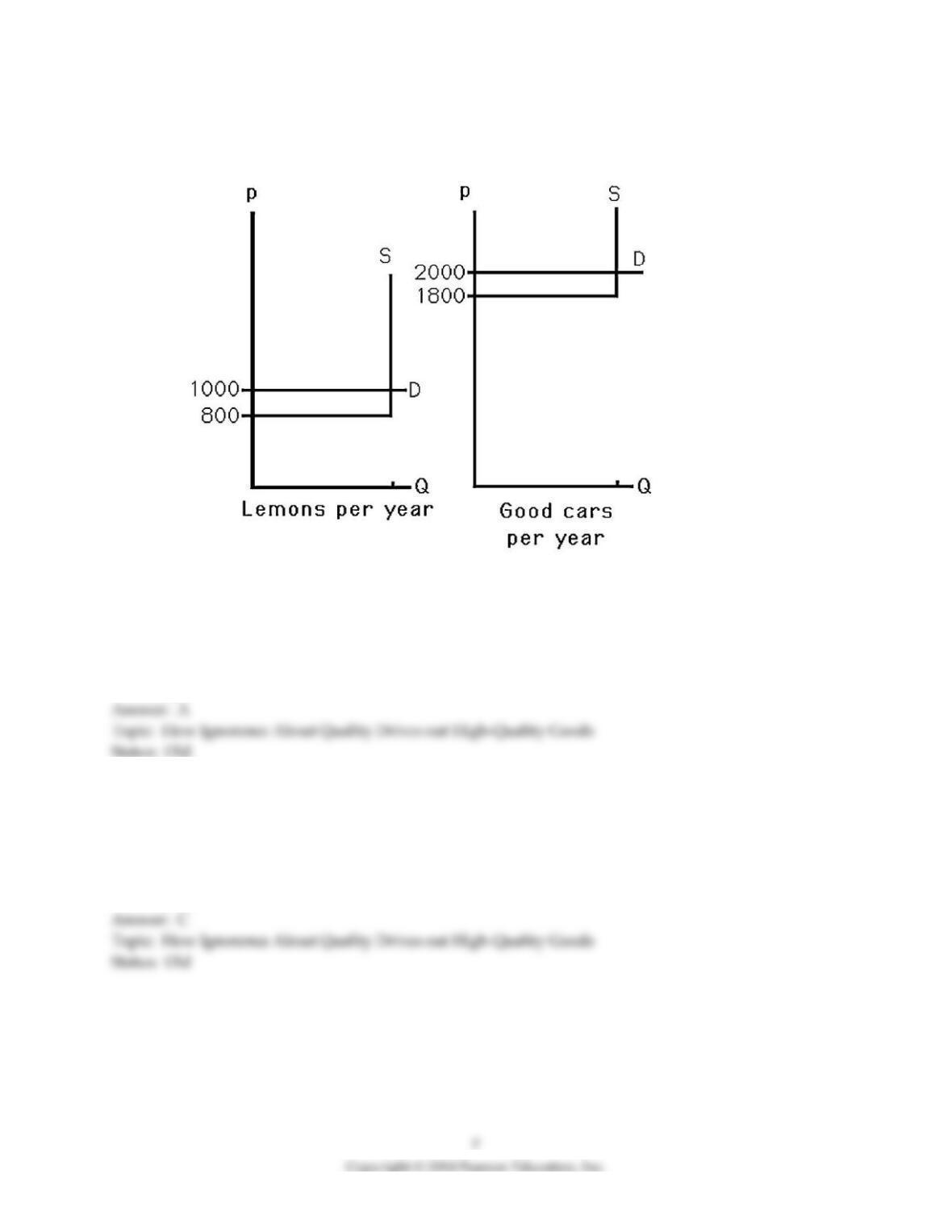
1) The market for used cars is shown in the above figure. Buyers cannot tell whether any given car is a
lemon. Ten percent (10%) of all cars are lemons. Which of the following statements is true?
A) All of the cars will be sold.
B) No cars will be sold.
C) Only lemons will be sold.
D) Only good cars will be sold.
2) The market for used cars is shown in the above figure. Buyers cannot tell whether any given car is a
lemon. Forty percent (40%) of all cars are lemons. Which of the following statements is true?
A) All of the cars will be sold.
B) No cars will be sold.
C) Only lemons will be sold.
D) Ten percent of the used cars sold will be lemons.
3) The market for used cars is shown in the above figure. Neither buyers nor sellers can tell whether any
given car is a lemon. Ten percent (10%) of all cars are lemons. Which of the following statements is true?
A) All of the cars will be sold at $1,900.
B) No cars will be sold.
C) Only lemons will be sold at $1,600.
D) Only lemons will be sold at $1,000.
4) The market for used cars is shown in the above figure. Neither buyers nor sellers can tell whether any
given car is a lemon. Forty percent (40%) of all cars are lemons. Which of the following statements is true?
A) All of the cars will be sold at $1,600.
B) No cars will be sold.
C) Only lemons are sold for $1,000.
D) Only good cars will be sold for $2,000.
5) The market for used cars is shown in the above figure. Neither buyers nor sellers can tell whether any
given car is a lemon. Forty percent (40%) of all cars are lemons. Which of the following statements is true?
A) All of the cars will be sold at $1,600.
B) Sellers of good-quality cars are implicitly subsidizing the sellers of lemons.
C) The information is symmetric and the market is efficient.
D) All of the above.
6) The market for used cars is shown in the above figure. Buyers cannot tell whether any given car is a
lemon. Forty percent (40%) of all cars are lemons. Which of the following statements is true?
A) All of the cars will be sold at $1,600.
B) No cars will be sold.
C) Only lemons will be sold at $1,600.
D) Only lemons will be sold at $1,000.
7) The market for used cars is shown in the above figure. Buyers cannot tell whether any given car is a
lemon. Ten percent (10%) of all cars are lemons. Which of the following statements is true?
A) All of the cars sell for $1,900.
B) Only lemons are sold for $1,900.
C) Only lemons are sold for $1,000.
D) Only good cars will be sold for $2,000.
8) The market for used cars is shown in the above figure. Buyers cannot tell whether any given car is a
lemon. Ten percent (10%) of all cars are lemons. Which of the following statements is true?
A) Only lemons are sold for $1,900.
B) Only lemons are sold for $1,000.
C) Buyers of lemons will pay too much for their cars.
D) Buyers of good cars will pay too much for their cars.
9) The market for used cars is shown in the above figure. Buyers cannot tell whether any given car is a
lemon. Forty percent (40%) of all cars are lemons. However, sellers can switch to selling lemons at lower
costs. Which of the following statements is true?
A) Only lemons are sold for $1,600.
B) Only lemons are sold for $800.
C) All the sellers of good cars will switch to selling lemons.
D) 40% buyers will get lemons.
10) A consumer is likely to avoid adverse selection and get a high-quality lunch at
A) a snack bar at a traveling carnival.
B) a vendor who parks her cart at a different location every noon.
C) a restaurant in the center of a business district.
D) a restaurant located next door to Disneyland.
11) Which of the following reduces the effects of asymmetric information?
A) repeat purchases
B) warranties
C) building a reputation
D) All of the above.
12) With asymmetric information, firms might be reluctant to improve the quality of their products
because
A) it costs them more to produce the better quality product.
B) they are not able to completely capture the benefits of the improvement.
C) consumers do not value the better product.
D) consumers are better informed about the product and value the new product less.
13) Asymmetric information will always cause
A) efficiency problems.
B) equity problems.
C) Both A and B.
D) None of the above.
For the following, please answer “True” or “False” and explain why.
14) If sellers of good cars and sellers of lemons both offer a warranty on their cars, consumers will then be
able to tell which cars are the lemons.
15) A downtown diner daily serving the same business people will be more likely to serve a tasty lunch
than a snack bar at a tourist attraction.
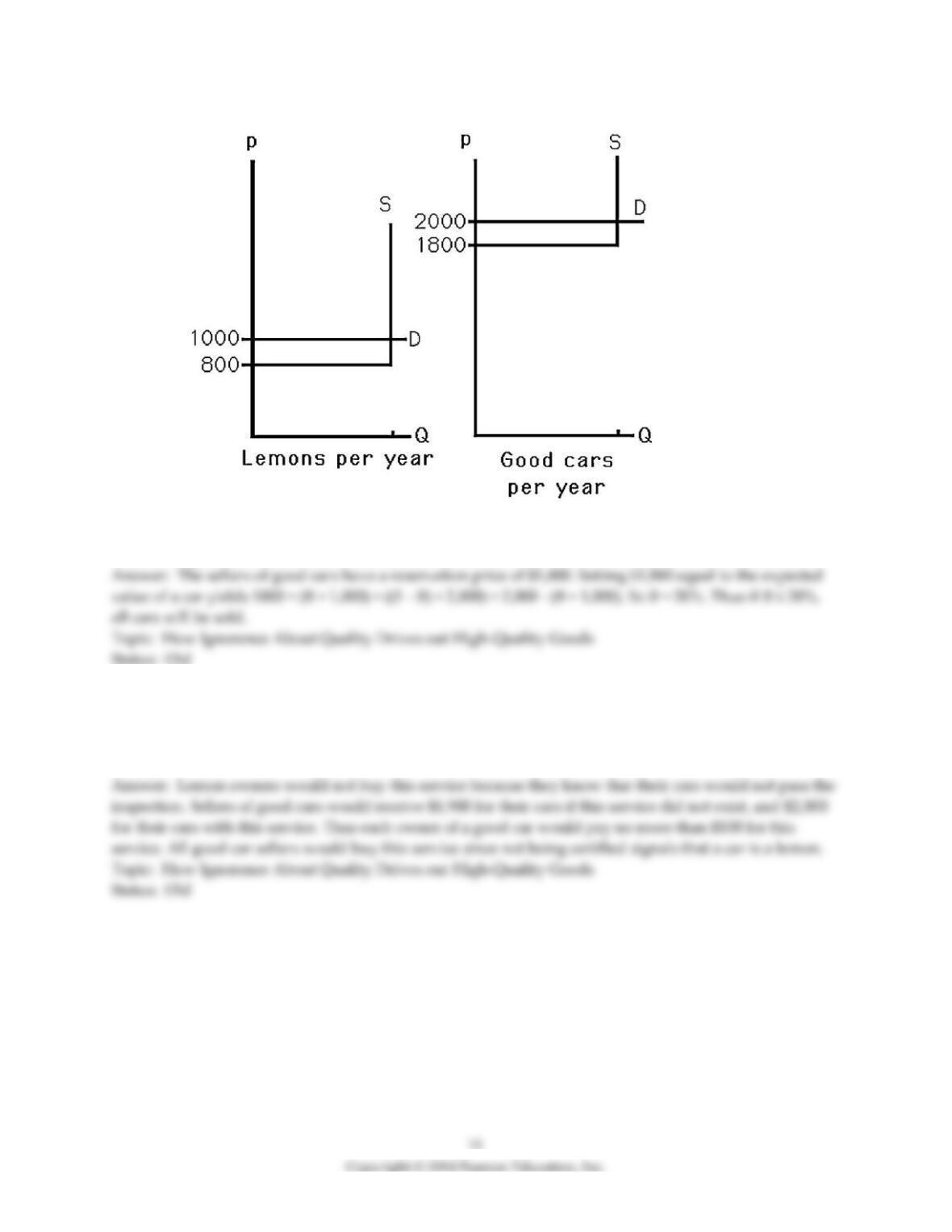
16) The market for used cars is shown in the above figure. Buyers cannot tell whether any given car is a
lemon. The percent of all cars that are lemons is θ. What value of θ is necessary for all cars to be sold?
17) The market for used cars is shown in the above figure. Ten percent (10%) of all cars are lemons. A
mechanic is offering to inspect a car for sale and certify that a car is not a lemon. If car sellers are risk
neutral, what is the highest price that a car seller would pay for such a service? Who would buy this
service?