Moderate
DISC: Monetary and fiscal policy
United States – BPROG: Analytic
Monetary and fiscal policy
Shifting the Tax Burden: Tax Incidence
182. Suppose that the government imposes an excise tax on widgets. The portion of the tax borne by the buyer of widgets
depends upon
a.
elasticity of demand.
b.
income of buyers.
c.
size of the tax that is imposed.
d.
cross elasticity of demand between widgets and floogles.
a
Moderate
DISC: Elasticity
United States – BPROG: Reflective Thinking – BPROG: Analysis
Elasticity
Shifting the Tax Burden: Tax Incidence
183. If demand is more elastic, the portion of an excise tax borne by a buyer will
a.
increase.
b.
decrease.
c.
be unchanged.
d.
increase for normal goods, decrease for inferior goods.
Moderate
DISC: Elasticity
United States – BPROG: Analytic
Elasticity
Shifting the Tax Burden: Tax Incidence
184. When demand for a product is very inelastic, the burden of a tax falls mainly on
a.
producers.
b.
consumers.
c.
tax collectors.
d.
people who drop out of the market.
Moderate
DISC: Elasticity
United States – BPROG: Analytic
Shifting the Tax Burden: Tax Incidence
185. If the demand curve for a product is vertical, then
a.
consumers will refuse to bear any share of tax burden.
b.
producers will bear the larger share of the tax burden.
c.
consumers will bear the entire tax burden.
d.
producers and consumers will equally share the tax burden.
1
DISC: Elasticity
United States – BPRPOG: Analysis
Shifting the Tax Burden: Tax Incidence
186. The excess burden of an excise tax is
a.
greater the more inelastic the supply curve.
b.
greater the more elastic the demand curve.
c.
smaller the more elastic the supply curve.
d.
greater the more inelastic the demand curve.
b
1
DISC: Elasticity
United States – BPROG: Analytic
Shifting the Tax Burden: Tax Incidence
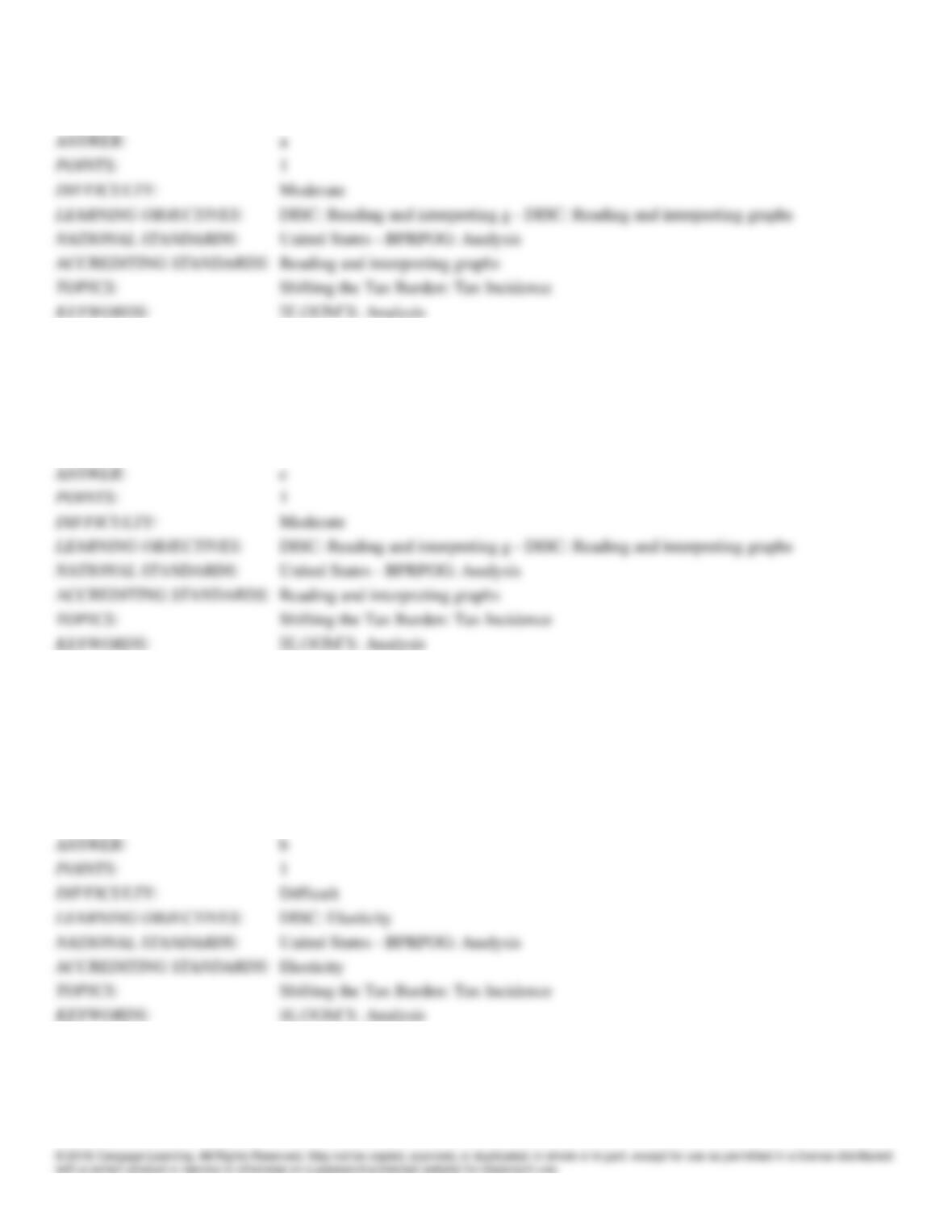
Figure 18-3
187. In which panel of Figure 18-3 would an excise tax be borne entirely by the consumer?
a.
1
b.
2
c.
3
d.
4
1
DISC: Reading and interpreting g – DISC: Reading and interpreting graphs
United States – BPRPOG: Analysis
Reading and interpreting graphs
Shifting the Tax Burden: Tax Incidence
188. In which panel of Figure 18-3 would an excise tax be borne entirely by the supplier?
a.
1
b.
2
c.
3
d.
4
1
DISC: Reading and interpreting g – DISC: Reading and interpreting graphs
United States – BPRPOG: Analysis
Reading and interpreting graphs
Shifting the Tax Burden: Tax Incidence
189. In 1984, the South Carolina State Supreme Court ruled that a 20 percent admission tax on X-rated movies was
unconstitutional. When the affected cinemas sought a refund of collected taxes, they were denied on the grounds that the
tax, although collected by the theater, was indeed paid by the theatergoers. The Supreme Court apparently believed
a.
the supply of X-rated movies was perfectly elastic.
b.
the demand for X-rated movies was perfectly inelastic.
c.
the legislation intended that the theatergoers pay the tax.
d.
the burden fell on the theatergoers-there are no excess burdens on the theater.
b
1
DISC: Elasticity
United States – BPRPOG: Analysis
Shifting the Tax Burden: Tax Incidence
190. When taxes alter individual behavior as people attempt to avoid the tax, efficiency
a.
losses are probable.
b.
gains are possible.
c.
gains are impossible.
d.
losses are impossible.
DISC: Efficiency and equity
United States – BPROG: Analytic
Efficiency and equity
Shifting the Tax Burden: Tax Incidence
191. Faced with a shortage of funds to pay claims, the workman’s compensation systems in many states have been forced
to raise the workman’s compensation tax rate substantially. The tax is paid by employers. Employers have complained that
they cannot afford the tax and threaten to go out of business. Assuming the supply of labor is very inelastic, one can argue
that ultimately the burden of this tax actually will rest
a.
mostly on workers.
b.
mostly on employers.
c.
about 50/50 on workers and employers, like the Social Security tax.
d.
all on employers by statute.
DISC: Elasticity
United States – BPRPOG: Analysis
Shifting the Tax Burden: Tax Incidence
192. Rhode Island has enacted a substantial increase in the tax on employers that finances the workman’s compensation
system. For some employers, the tax is about $25 per $100 paid in wages. Employers claim they cannot afford to pay the
tax. Under which of the following conditions will the actual burden of the tax fall on employers?
a.
The employers’ demand for labor is perfectly elastic.
b.
The supply of labor is perfectly inelastic.
c.
The employers’ demand for labor is perfectly inelastic.
d.
The demand for the good they produce must be perfectly inelastic.
DISC: Elasticity
United States – BPRPOG: Analysis
Shifting the Tax Burden: Tax Incidence
193. The burden of the payroll tax falls entirely on the employee regardless of how it is formally divided between
employer and employee if the
a.
demand for labor is inelastic.
b.
supply of labor curve is horizontal.
c.
supply of labor curve is virtually vertical.
d.
demand for labor curve is elastic.
DISC: Elasticity
United States – BPROG: Reflective Thinking – BPROG: Analysis
Shifting the Tax Burden: Tax Incidence
194. The incidence of a payroll tax
a.
depends upon whether it is levied on the employer or employee.
b.
is the same whether it is levied on the employer or the employee.
c.
is more heavily on the employee as demand for labor becomes more elastic.
d.
is more heavily on the employer as demand for labor becomes less elastic.
DISC: Elasticity
United States – BPROG: Analytic
Monetary and fiscal policy
Shifting the Tax Burden: Tax Incidence
195. A tax that creates an excess burden may nevertheless improve efficiency if
a.
consumption of the good has been generating beneficial externalities.
b.
consumption of the good has been generating no externalities.
c.
consumption of the good has been generating detrimental externalities.
d.
the good has been supplied by a monopolist.
DISC: Efficiency and equity
United States – BPRPOG: Analysis
Efficiency and equity
When Taxation Can Improve Efficiency
196. Taxation may improve the social welfare when the taxed good
a.
is socially undesirable (like, in some views, liquor and pornography).
b.
imposes negative externalities.
c.
is overproduced under a free-market system.
d.
All of the above are correct.
Moderate
DISC: Monetary and fiscal policy
United States – BPROG: Reflective Thinking – BPROG: Analysis
Monetary and fiscal policy
When Taxation Can Improve Efficiency
197. Economists generally think that the ____ tax is among the best ways to raise revenue.
a.
property
b.
personal income
c.
sales
d.
value-added
Moderate
DISC: Efficiency and equity
United States – BPROG: Analytic
Efficiency and equity
Equity, Efficiency, and the Optimal Tax
198. A comprehensive income tax with few loopholes is efficient because labor
a.
supply is very little affected by taxation.
b.
demand is very little affected by taxation.
c.
supply is highly responsive to taxation.
d.
demand is highly responsive to taxation.
a
Moderate
DISC: Efficiency and equity
United States – BPROG: Reflective Thinking – BPROG: Analysis
Efficiency and equity
Equity, Efficiency, and the Optimal Tax
199. In the area of taxation, the trade-off between equity and efficiency
a.
never occurs since efficient taxes are often the most progressive.
b.
is relevant as efficient taxes are often regressive.
c.
is irrelevant.
d.
is relevant because efficient taxes are often progressive.
Moderate
DISC: Efficiency and equity
United States – BPROG: Analytic
Efficiency and equity
Equity, Efficiency, and the Optimal Tax
200. Regarding taxation and efficiency, which of the following statements is not true?
a.
Many inefficiencies arise from taxation.
b.
Many burdens arise from taxation.
c.
Some taxes lead to greater efficiency.
d.
All of the above statements are true.
Difficult
DISC: Efficiency and equity
United States – BPROG: Analytic
Efficiency and equity
When Taxation Can Improve Efficiency
201. Sometimes, the taxes with the smallest excess burden are:
a.
progressive
b.
regressive
c.
proportional
d.
digressive
Difficult
DISC: Efficiency and equity
United States – BPROG: Reflective Thinking – BPROG: Analysis
Efficiency and equity
Equity, Efficiency, and the Optimal Tax
Essay
202. Define the following terms and explain their importance to the study of economics:
a.
regressive tax
b.
proportional tax
c.
progressive tax
d.
direct tax
e.
indirect tax
loopholes or exemptions.
income rises. Progressive taxation is an important element of vertical equity in taxes.
personal income tax, corporate profits taxes, and inheritance taxes. The incidence of
a direct tax generally cannot be shifted.
United States – BPROG: Analytic
The study of economics, and defi – The study of economics, and definitions of economics
The Level and Types of Taxation
203. Briefly and concisely define the following terms:
a.
fiscal federalism
b.
horizontal equity
c.
vertical equity
d.
benefits principle of taxation
United States – Analytic – BB-Legal
The study of economics, and defi – The study of economics, and definitions of economics
The Level and Types of Taxation
204. Many Americans believe that taxes have been gobbling up an ever-increasing share of the U.S. economy. Is this
observation correct? Explain.
205. Explain the purpose of payroll taxes. Is it a proportional form of tax?
206. What are tax loopholes and what are their effects?
207. Describe the U.S. Social Security system and explain how it is funded.
208. What is personal income tax? On which principle does the federal government levy this tax?
209. How is state and local government funded and how does such funding differ from federal government funding?
210. Are property taxes progressive or regressive?
211. What is the controversy surrounding property taxes as a source for school funding?
212. Discuss the three principles of equity applied to taxation in the text.
213. Explain the concept of efficiency as it relates to taxation.
214. What is the flypaper theory of tax incidence? This theory is typically wrong. Why?
215. Explain the excess burden of a tax on luxury yachts.
216. The authors of the text suggest that a comprehensive personal income tax with few loopholes would be efficient and
equitable. What is their reasoning for this statement?
217. Explain why some argue that income tax loopholes primarily benefit the rich.
218. Explain whether or not the ability-to–pay principle of tax equity is consistent with the benefits received principle of
taxation.
219. Who bears the burden of an excise tax if demand is perfectly inelastic; if supply is perfectly inelastic? Use graphs in
your explanation.
220. Why do many economists rate the income tax high in efficiency and equity terms?
221. What are the arguments for and against federal government grants to states?