
CHAPTER 17—FINANCIAL PLANNING AND FORECASTING
1. The first, and most critical, step in constructing a set of forecasted financial statements is the sales forecast.
a.
True
b.
False
True
1
EASY
17-2 The Sales Forecast
2. A typical sales forecast, though concerned with future events, will usually be based on recent historical trends and
events as well as on forecasts of economic prospects.
a.
True
b.
False
True
1
EASY
17-2 The Sales Forecast
3. Errors in the sales forecast can be offset by similar errors in costs and income forecasts. Thus, as long as the errors are
not large, sales forecast accuracy is not critical to the firm.
a.
True
b.
False
False
1
EASY
17-2 The Sales Forecast
4. As a firm’s sales grow, its current assets also tend to increase. For instance, as sales increase, the firm’s inventories
generally increase, and purchases of inventories result in more accounts payable. Thus, spontaneously generated funds
arise from transactions brought on by sales increases.
a.
True
CHAPTER 17—FINANCIAL PLANNING AND FORECASTING
b.
False
True
1
EASY
17-3 The AFN Equation
5. The term “spontaneously generated funds” generally refers to increases in the cash account that result from growth in
sales, assuming the firm is operating with a positive profit margin.
a.
True
b.
False
False
1
EASY
17-3 The AFN Equation
6. A rapid build-up of inventories normally requires additional financing, unless the increase is matched by an equally
large decrease in some other asset.
a.
True
b.
False
True
1
EASY
17-3 The AFN Equation
7. If a firm wants to maintain its ratios at their existing levels, then if it has a positive sales growth rate of any amount, it
will require some amount of external funding.
a.
True
b.
False
False
8. To determine the amount of additional funds needed (AFN), you may subtract the expected increase in liabilities, which
represents a source of funds, from the sum of the expected increases in retained earnings and assets, both of which are
uses of funds.
a.
True
b.
False
False
1
EASY
17-3 The AFN Equation
9. When developing forecasted financial statements there are some inputs that management controls such as the growth
rate and operating costs/sales ratio, while other inputs such as the tax rate and interest rate are not under its control.
a.
True
b.
False
True
1
EASY
17-4 Forecasted Financial Statements
10. If a firm with a positive net worth is operating its fixed assets at full capacity, if its dividend payout ratio is 100%, and
if it wants to hold all financial ratios constant, then for any positive growth rate in sales, it will require external financing.
a.
True
b.
False
True
1
MODERATE
1
EASY
17-3 The AFN Equation
11. A firm’s profit margin is 5%, its debt ratio is 56%, and its dividend payout ratio is 40%. If the firm is operating at less
than full capacity, then sales could increase to some extent without the need for external funds, but if it is operating at full
capacity with respect to all assets, including fixed assets, then any positive growth in sales will require some external
financing.
a.
True
b.
False
False
1
MODERATE
17-3 The AFN Equation
12. Two firms with identical capital intensity ratios are generating the same amount of sales. However, Firm A is
operating at full capacity, while Firm B is operating below capacity. If the two firms expect the same growth in sales
during the next period, then Firm A is likely to need more additional funds than Firm B, other things held constant.
a.
True
b.
False
True
1
MODERATE
17-3 The AFN Equation
13. If a firm’s capital intensity ratio (A0*/S0) decreases as sales increase, use of the AFN formula is likely to understate
the amount of additional funds required, other things held constant.
a.
True
b.
False
False
1
MODERATE
17-3 The AFN Equation
14. The fact that long-term debt and common stock are raised infrequently and in large amounts lessens the need for the
firm to forecast those accounts on a continual basis.
a.
True
b.
False
False
1
MODERATE
17-4 Forecasted Financial Statements
FOFM.BRIG.16.17.04 – Forecasted Financial Statements
United States – BUSPROG.FOFM.BRIG.16.06 – Reflective thinking
United States – OH – DISC.FOFM.BRIG.16.05 – Financial analysis and cash flows
Financial forecasting
Bloom’s: Comprehension
15. When we use the AFN equation to forecast the additional funds needed (AFN), we are implicitly assuming that all
financial ratios are constant. If financial ratios are not constant, regression techniques can be used to improve the financial
forecast.
a.
True
b.
False
True
1
MODERATE
17-5 Using Regression to Improve Forecasts
FOFM.BRIG.16.17.05 – Using Regression to Improve Forecasts
United States – BUSPROG.FOFM.BRIG.16.06 – Reflective thinking
United States – OH – DISC.FOFM.BRIG.16.05 – Financial analysis and cash flows
AFN and linear regression
16. Which of the following is NOT a key element in strategic planning as it is described in the text?
a.
The mission statement.
b.
The statement of the corporation’s scope.
c.
The statement of cash flows.
d.
The statement of corporate objectives.
e.
The operating plan.
c
1
17-3 The AFN Equation
FOFM.BRIG.16.17.03 – The AFN Equation
United States – BUSPROG.FOFM.BRIG.16.06 – Reflective thinking
United States – OH – DISC.FOFM.BRIG.16.05 – Financial analysis and cash flows
Capital intensity ratio
Bloom’s: Comprehension
17. Which of the following assumptions is embodied in the AFN equation?
a.
All balance sheet accounts are tied directly to sales.
b.
Accounts payable and accruals are tied directly to sales.
c.
Common stock and long-term debt are tied directly to sales.
d.
Fixed assets, but not current assets, are tied directly to sales.
e.
Last year’s total assets were not optimal for last year’s sales.
b
1
17-3 The AFN Equation
FOFM.BRIG.16.17.03 – The AFN Equation
United States – BUSPROG.FOFM.BRIG.16.03 – Analytic skills
United States – OH – DISC.FOFM.BRIG.16.05 – Financial analysis and cash flows
AFN equation
Bloom’s: Analysis
Multiple Choice: Conceptual
18. Jefferson City Computers has developed a forecasting model to estimate its AFN for the upcoming year. All else being
equal, which of the following factors is most likely to lead to an increase of the additional funds needed (AFN)?
a.
A sharp increase in its forecasted sales.
b.
A sharp reduction in its forecasted sales.
c.
The company reduces its dividend payout ratio.
d.
The company switches its materials purchases to a supplier that sells on terms of 1/5, net 90, from a supplier
whose terms are 3/15, net 35.
e.
The company discovers that it has excess capacity in its fixed assets.
1
17-3 The AFN Equation
FOFM.BRIG.16.17.03 – The AFN Equation
17-1 Strategic Planning
FOFM.BRIG.16.17.01 – Strategic Planning
United States – BUSPROG.FOFM.BRIG.16.03 – Analytic skills
United States – OH – DISC.FOFM.BRIG.16.05 – Financial analysis and cash flows
Strategic planning
Bloom’s: Comprehension
Multiple Choice: Conceptual
CHAPTER 17—FINANCIAL PLANNING AND FORECASTING
United States – BUSPROG.FOFM.BRIG.16.03 – Analytic skills
United States – OH – DISC.FOFM.BRIG.16.05 – Financial analysis and cash flows
Additional funds needed
Bloom’s: Evaluation
Multiple Choice: Conceptual
19. The term “additional funds needed (AFN)” is generally defined as follows:
a.
Funds that are obtained automatically from routine business transactions.
b.
Funds that a firm must raise externally from non-spontaneous sources, i.e., by borrowing or by selling new
stock, to support operations.
c.
The amount of assets required per dollar of sales.
d.
The amount of internally generated cash in a given year minus the amount of cash needed to acquire the new
assets needed to support growth.
e.
A forecasting approach in which the forecasted percentage of sales for each balance sheet account is held
constant.
b
1
EASY/MODERATE
17-3 The AFN Equation
FOFM.BRIG.16.17.03 – The AFN Equation
United States – BUSPROG.FOFM.BRIG.16.03 – Analytic skills
United States – OH – DISC.FOFM.BRIG.16.05 – Financial analysis and cash flows
Additional funds needed
Multiple Choice: Conceptual
20. The capital intensity ratio is generally defined as follows:
a.
Sales divided by total assets, i.e., the total assets turnover ratio.
b.
The percentage of liabilities that increase spontaneously as a percentage of sales.
c.
The ratio of sales to current assets.
d.
The ratio of current assets to sales.
e.
The amount of assets required per dollar of sales, or A0*/S0.
e
1
EASY/MODERATE
17-3 The AFN Equation
FOFM.BRIG.16.17.03 – The AFN Equation
United States – BUSPROG.FOFM.BRIG.16.03 – Analytic skills
United States – OH – DISC.FOFM.BRIG.16.05 – Financial analysis and cash flows
Capital intensity ratio
Bloom’s: Comprehension
21. Which of the following is NOT one of the steps taken in the financial planning process?
CHAPTER 17—FINANCIAL PLANNING AND FORECASTING
a.
Assumptions are made about future levels of sales, costs, and interest rates for use in the forecast.
b.
The entire financial plan is reexamined, assumptions are reviewed, and the management team considers how
additional changes in operations might improve results.
c.
Projected ratios are calculated and analyzed.
d.
Develop a set of projected financial statements.
e.
Consult with key competitors about the optimal set of prices to charge, i.e., the prices that will maximize
profits for our firm and its competitors.
1
17-1 Strategic Planning
FOFM.BRIG.16.17.01 – Strategic Planning
United States – BUSPROG.FOFM.BRIG.16.03 – Analytic skills
United States – OH – DISC.FOFM.BRIG.16.05 – Financial analysis and cash flows
Financial planning
Bloom’s: Analysis
Multiple Choice: Conceptual
22. Spontaneously generated funds are generally defined as follows:
a.
Assets required per dollar of sales.
b.
A forecasting approach in which the forecasted percentage of sales for each item is held constant.
c.
Funds that a firm must raise externally through borrowing or by selling new common or preferred stock.
d.
Funds that arise out of normal business operations from its suppliers, employees, and the government, and
they include spontaneous increases in accounts payable and accruals.
e.
The amount of cash raised in a given year minus the amount of cash needed to finance the additional capital
expenditures and working capital needed to support the firm’s growth.
d
1
17-3 The AFN Equation
FOFM.BRIG.16.17.03 – The AFN Equation
United States – BUSPROG.FOFM.BRIG.16.03 – Analytic skills
United States – OH – DISC.FOFM.BRIG.16.05 – Financial analysis and cash flows
Spontaneously gen. funds
Bloom’s: Comprehension
Multiple Choice: Conceptual
23. A company expects sales to increase during the coming year, and it is using the AFN equation to forecast the
additional capital that it must raise. Which of the following conditions would cause the AFN to increase?
a.
The company previously thought its fixed assets were being operated at full capacity, but now it learns that it
actually has excess capacity.
b.
The company increases its dividend payout ratio.
c.
The company begins to pay employees monthly rather than weekly.
d.
The company’s profit margin increases.
e.
The company decides to stop taking discounts on purchased materials.
CHAPTER 17—FINANCIAL PLANNING AND FORECASTING
b
1
17-3 The AFN Equation
FOFM.BRIG.16.17.03 – The AFN Equation
United States – BUSPROG.FOFM.BRIG.16.03 – Analytic skills
United States – OH – DISC.FOFM.BRIG.16.05 – Financial analysis and cash flows
Additional funds needed
Bloom’s: Analysis
Multiple Choice: Conceptual
24. Which of the following statements is CORRECT?
a.
Perhaps the most important step when developing forecasted financial statements is to determine the
breakdown of common equity between common stock and retained earnings.
b.
The first, and perhaps the most critical, step in forecasting financial requirements is to forecast future sales.
c.
Forecasted financial statements, as discussed in the text, are used primarily as a part of the managerial
compensation program, where management’s historical performance is evaluated.
d.
The capital intensity ratio gives us an idea of the physical condition of the firm’s fixed assets.
e.
The AFN equation produces more accurate forecasts than the forecasted financial statement method, especially
if fixed assets are lumpy and economies of scale exist.
b
1
FOFM.BRIG.16.17.00 – Comprehensive
United States – BUSPROG.FOFM.BRIG.16.03 – Analytic skills
United States – OH – DISC.FOFM.BRIG.16.05 – Financial analysis and cash flows
Forecasting concepts
Bloom’s: Comprehension
Multiple Choice: Conceptual
25. Which of the following statements is CORRECT?
a.
Once a firm has defined its purpose, scope, and objectives, it must develop a strategy or strategies for
achieving its goals. The statement of corporate strategies sets forth detailed plans rather than broad approaches
for achieving a firm’s goals.
b.
A firm’s corporate purpose states the general philosophy of the business and provides managers with specific
operational objectives.
c.
Operating plans provide management with detailed implementation guidance, consistent with the corporate
strategy, to help meet the corporate objectives. These operating plans can be developed for any time horizon,
but many companies use a 5-year horizon.
d.
A firm’s mission statement defines its lines of business and geographic area of operations.
e.
The corporate scope is a condensed version of the entire set of strategic plans.
1
26. Which of the following statements is CORRECT?
a.
Since accounts payable and accrued liabilities must eventually be paid off, as these accounts increase, AFN as
calculated by the AFN equation must also increase.
b.
Suppose a firm is operating its fixed assets at below 100% of capacity, but it has no excess current assets.
Based on the AFN equation, its AFN will be larger than if it had been operating with excess capacity in both
fixed and current assets.
c.
If a firm retains all of its earnings, then it cannot require any additional funds to support sales growth.
d.
Additional funds needed (AFN) are typically raised using a combination of notes payable, long-term debt, and
common stock. Such funds are non-spontaneous in the sense that they require explicit financing decisions to
obtain them.
e.
If a firm has a positive free cash flow, then it must have either a zero or a negative AFN.
FOFM.BRIG.16.17.03 – The AFN Equation
United States – BUSPROG.FOFM.BRIG.16.03 – Analytic skills
United States – OH – DISC.FOFM.BRIG.16.05 – Financial analysis and cash flows
Additional funds needed
Bloom’s: Comprehension
Multiple Choice: Conceptual
27. Which of the following statements is CORRECT?
a.
Any forecast of financial requirements involves determining how much money the firm will need, and this
need is determined by adding together increases in assets and spontaneous liabilities and then subtracting
operating income.
b.
The AFN equation for forecasting funds requirements requires only a forecast of the firm’s balance sheet.
Although a forecasted income statement may help clarify the results, income statement data are not essential
because funds needed relate only to the balance sheet.
c.
Dividends are paid with cash taken from the accumulated retained earnings account, hence dividend policy
does not affect the AFN forecast.
d.
A negative AFN indicates that retained earnings and spontaneous capital are far more than sufficient to finance
the additional assets needed.
e.
If assets and spontaneously generated liabilities are not projected to grow at the same rate as sales, then the
AFN method will provide more accurate forecasts than the projected financial statement method.
FOFM.BRIG.16.17.01 – Strategic Planning
United States – BUSPROG.FOFM.BRIG.16.03 – Analytic skills
United States – OH – DISC.FOFM.BRIG.16.05 – Financial analysis and cash flows
Strategic planning
Bloom’s: Comprehension
Multiple Choice: Conceptual
28. Which of the following statements is CORRECT?
a.
The sustainable growth rate is the maximum achievable growth rate without the firm having to raise external
funds. In other words, it is the growth rate at which the firm’s AFN equals zero.
b.
If a firm’s assets are growing at a positive rate, but its retained earnings are not increasing, then it would be
impossible for the firm’s AFN to be negative.
c.
If a firm increases its dividend payout ratio in anticipation of higher earnings, but sales and earnings actually
decrease, then the firm’s actual AFN must, mathematically, exceed the previously calculated AFN.
d.
Higher sales usually require higher asset levels, and this leads to what we call AFN. However, the AFN will be
zero if the firm chooses to retain all of its profits, i.e., to have a zero dividend payout ratio.
e.
Dividend policy does not affect the requirement for external funds based on the AFN equation.
a
MODERATE/CHALLENGING
FOFM.BRIG.16.17.03 – The AFN Equation
United States – BUSPROG.FOFM.BRIG.16.03 – Analytic skills
United States – OH – DISC.FOFM.BRIG.16.05 – Financial analysis and cash flows
AFN equation
Bloom’s: Comprehension
Multiple Choice: Conceptual
29. Which of the following statements is CORRECT?
a.
When we use the AFN equation, we assume that the ratios of assets and liabilities to sales (A0*/S0 and L0*/S0)
vary from year to year in a stable, predictable manner.
b.
When fixed assets are added in large, discrete units as a company grows, the assumption of constant ratios is
more appropriate than if assets are relatively small and can be added in small increments as sales grow.
c.
Firms whose fixed assets are “lumpy” frequently have excess capacity, and this should be accounted for in the
financial forecasting process.
d.
For a firm that uses lumpy assets, it is impossible to have small increases in sales without expanding fixed
assets.
e.
Regression techniques cannot be used in situations where excess capacity or economies of scale exist.
c
MODERATE/CHALLENGING
FOFM.BRIG.16.17.05 – Using Regression to Improve Forecasts
United States – BUSPROG.FOFM.BRIG.16.03 – Analytic skills
FOFM.BRIG.16.17.03 – The AFN Equation
United States – BUSPROG.FOFM.BRIG.16.03 – Analytic skills
United States – OH – DISC.FOFM.BRIG.16.05 – Financial analysis and cash flows
Additional funds needed
Bloom’s: Comprehension
Multiple Choice: Conceptual
30. Last year Godinho Corp. had $250 million of sales, and it had $75 million of fixed assets that were being operated at
80% of capacity. In millions, how large could sales have been if the company had operated at full capacity?
a.
$312.5
b.
$328.1
c.
$344.5
d.
$361.8
e.
$379.8
a
1
EASY
17-3 The AFN Equation
31. Kamath-Meier Corporation’s CFO uses this equation, which was developed by regressing inventories on sales over the
past 5 years, to forecast inventory requirements: Inventories = $22.0 + 0.125(Sales). The company expects sales of $400
million during the current year, and it expects sales to grow by 30% next year. What is the inventory forecast for next
year? All dollars are in millions.
a.
$74.6
b.
$78.5
c.
$82.7
d.
$87.0
e.
$91.4
d
1
32. Last year Wei Guan Inc. had $350 million of sales, and it had $270 million of fixed assets that were used at 65% of
capacity. In millions, by how much could Wei Guan’s sales increase before it is required to increase its fixed assets?
a.
$170.09
b.
$179.04
c.
$188.46
d.
$197.88
e.
$207.78
c
1
17-3 The AFN Equation
33. Last year Handorf-Zhu Inc. had $850 million of sales, and it had $425 million of fixed assets that were used at only
60% of capacity. What is the maximum sales growth rate the company could achieve before it had to increase its fixed
assets?
a.
54.30%
b.
57.16%
c.
60.17%
d.
63.33%
e.
66.67%
e
EASY
17-5 Using Regression to Improve Forecasts
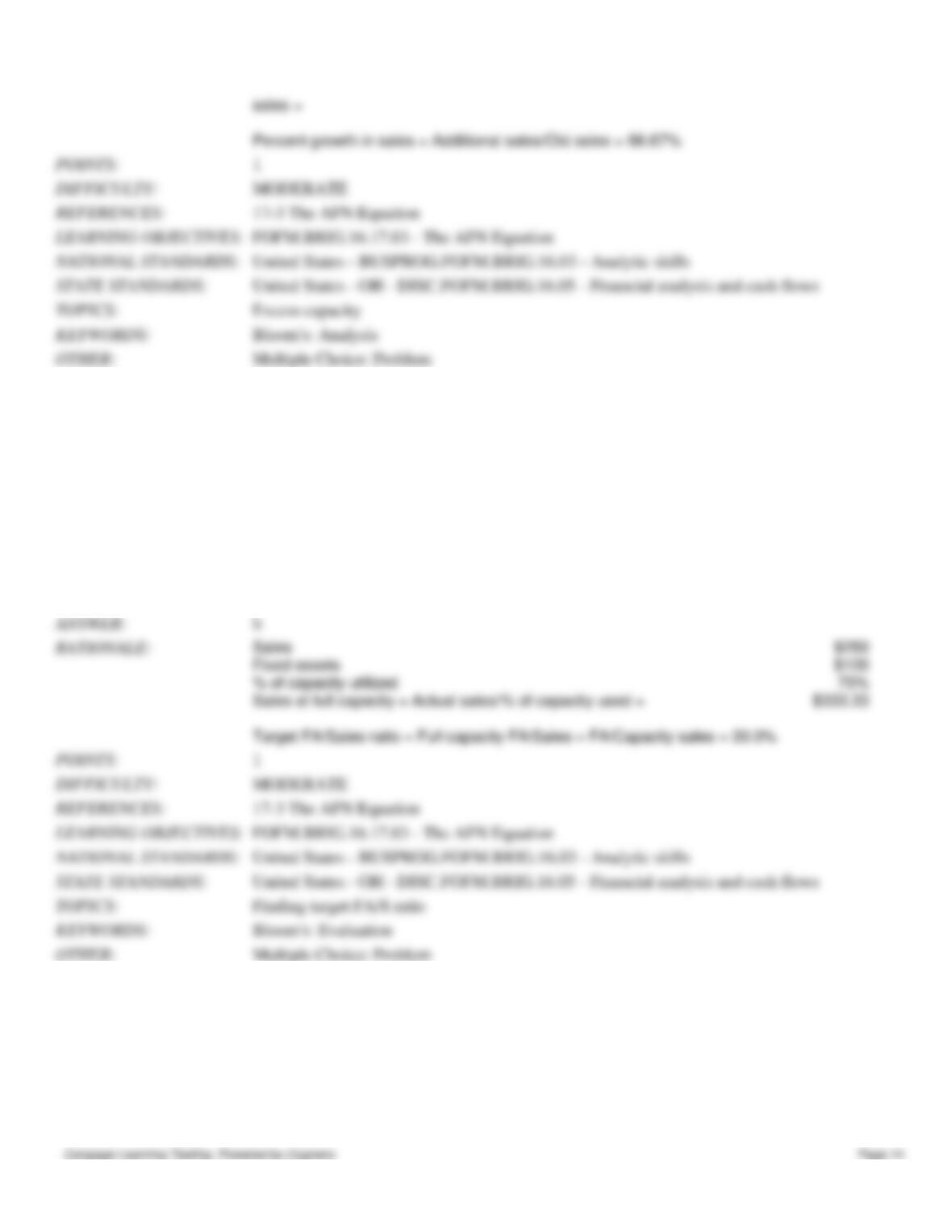
34. Last year Jain Technologies had $250 million of sales and $100 million of fixed assets, so its Fixed Assets/Sales ratio
was 40%. However, its fixed assets were used at only 75% of capacity. Now the company is developing its financial
forecast for the coming year. As part of that process, the company wants to set its target Fixed Assets/Sales ratio at the
level it would have had had it been operating at full capacity. What target Fixed Assets/Sales ratio should the company
set?
a.
28.5%
b.
30.0%
c.
31.5%
d.
33.1%
e.
34.7%
b
1
MODERATE
17-3 The AFN Equation
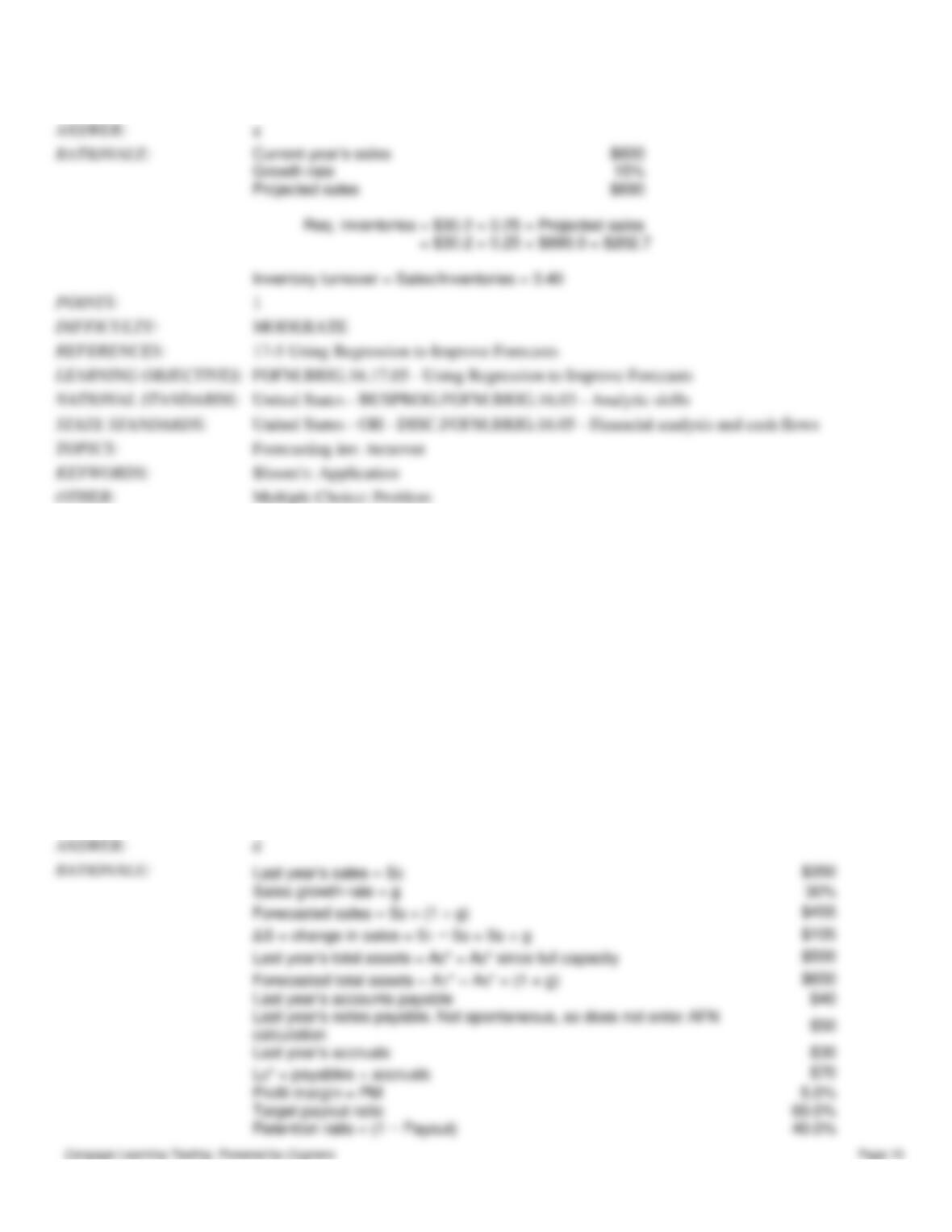
35. Fairchild Garden Supply expects $600 million of sales this year, and it forecasts a 15% increase for next year. The
CFO uses this equation to forecast inventory requirements at different levels of sales: Inventories = $30.2 + 0.25(Sales).
All dollars are in millions. What is the projected inventory turnover ratio for the coming year?
a.
3.40
b.
3.57
c.
3.75
d.
3.94
1
MODERATE
17-3 The AFN Equation
CHAPTER 17—FINANCIAL PLANNING AND FORECASTING
e.
4.14
a
1
MODERATE
17-5 Using Regression to Improve Forecasts
FOFM.BRIG.16.17.05 – Using Regression to Improve Forecasts
United States – BUSPROG.FOFM.BRIG.16.03 – Analytic skills
United States – OH – DISC.FOFM.BRIG.16.05 – Financial analysis and cash flows
Forecasting inv. turnover
Bloom’s: Application
Multiple Choice: Problem
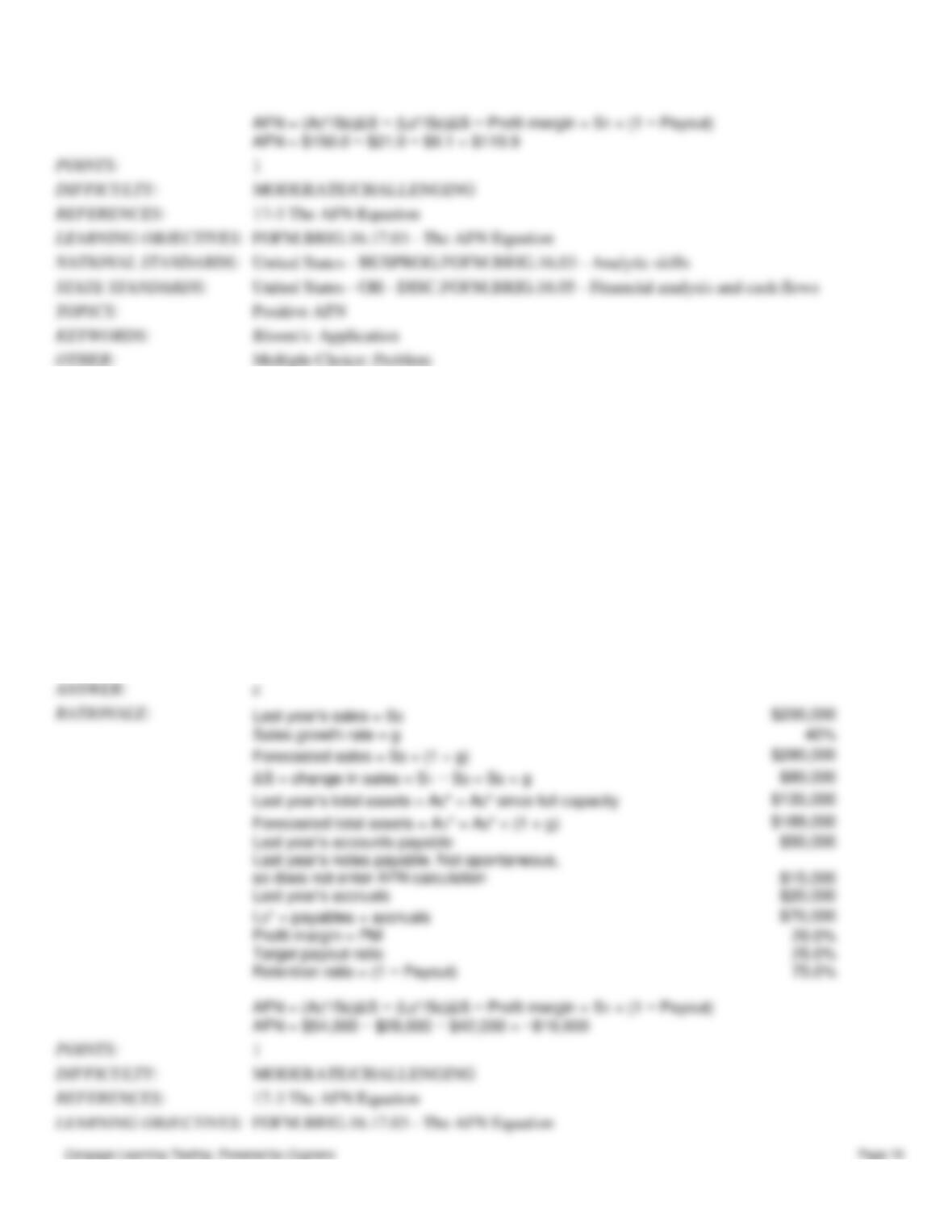
36. Clayton Industries is planning its operations for next year. Ronnie Clayton, the CEO, wants you to forecast the firm’s
additional funds needed (AFN). Data for use in your forecast are shown below. Based on the AFN equation, what is the
AFN for the coming year? Dollars are in millions.
Last year’s sales = S0
$350
Last year’s accounts payable
$40
Sales growth rate = g
30%
Last year’s notes payable
$50
Last year’s total assets = A0*
$500
Last year’s accruals
$30
Last year’s profit margin = PM
5%
Target payout ratio
60%
a.
$102.8
b.
$108.2
c.
$113.9
d.
$119.9
e.
$125.9
d
CHAPTER 17—FINANCIAL PLANNING AND FORECASTING
1
MODERATE/CHALLENGING
17-3 The AFN Equation
FOFM.BRIG.16.17.03 – The AFN Equation
United States – BUSPROG.FOFM.BRIG.16.03 – Analytic skills
United States – OH – DISC.FOFM.BRIG.16.05 – Financial analysis and cash flows
Positive AFN
Bloom’s: Application
Multiple Choice: Problem
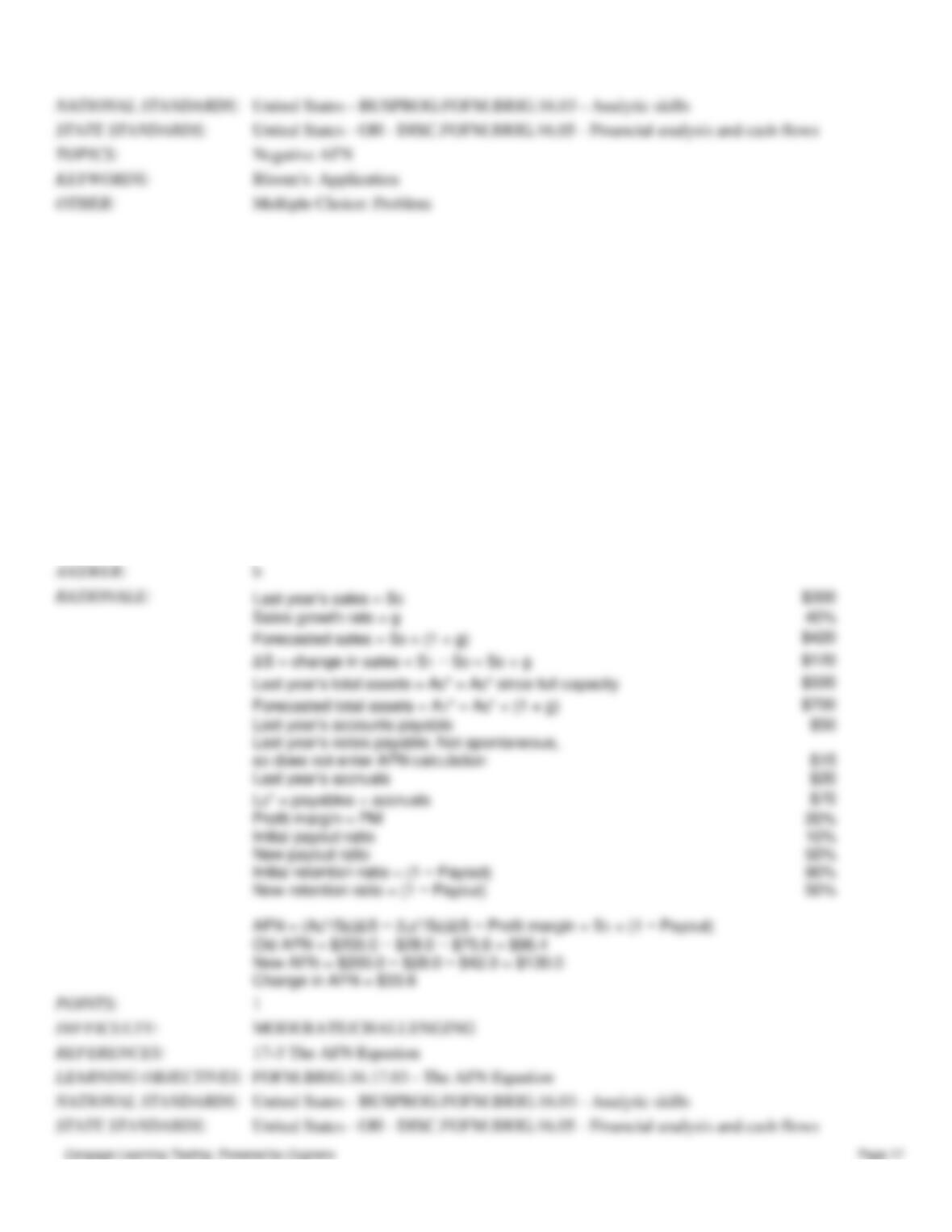
37. Chua Chang & Wu Inc. is planning its operations for next year, and the CEO wants you to forecast the firm’s
additional funds needed (AFN). Data for use in your forecast are shown below. Based on the AFN equation, what is the
AFN for the coming year?
Last year’s sales = S0
$200,000
Last year’s accounts payable
$50,000
Sales growth rate = g
40%
Last year’s notes payable
$15,000
Last year’s total assets = A0*
$135,000
Last year’s accruals
$20,000
Last year’s profit margin = PM
20.0%
Target payout ratio
25.0%
a.
−$14,440
b.
−$15,200
c.
−$16,000
d.
−$16,800
e.
−$17,640
c
1
MODERATE/CHALLENGING
17-3 The AFN Equation
FOFM.BRIG.16.17.03 – The AFN Equation
38. Howton & Howton Worldwide (HHW) is planning its operations for the coming year, and the CEO wants you to
forecast the firm’s additional funds needed (AFN). Data for use in the forecast are shown below. However, the CEO is
concerned about the impact of a change in the payout ratio from the 10% that was used in the past to 50%, which the
firm’s investment bankers have recommended. Based on the AFN equation, by how much would the AFN for the coming
year change if HHW increased the payout from 10% to the new and higher level? All dollars are in millions.
Last year’s sales = S0
$300.0
Last year’s accounts payable
$50.0
Sales growth rate = g
40%
Last year’s notes payable
$15.0
Last year’s total assets = A0*
$500.0
Last year’s accruals
$20.0
Last year’s profit margin = PM
20.0%
Initial payout ratio
10.0%
a.
$31.9
b.
$33.6
c.
$35.3
d.
$37.0
e.
$38.9
b
1
MODERATE/CHALLENGING
17-3 The AFN Equation
United States – BUSPROG.FOFM.BRIG.16.03 – Analytic skills
United States – OH – DISC.FOFM.BRIG.16.05 – Financial analysis and cash flows
United States – BUSPROG.FOFM.BRIG.16.03 – Analytic skills
United States – OH – DISC.FOFM.BRIG.16.05 – Financial analysis and cash flows
Negative AFN
Bloom’s: Application
Multiple Choice: Problem
CHAPTER 17—FINANCIAL PLANNING AND FORECASTING
AFN–changing div. payout
39. Last year Emery Industries had $450 million of sales and $225 million of fixed assets, so its Fixed Assets/Sales ratio
was 50%. However, its fixed assets were used at only 65% of capacity. If the company had been able to sell off enough of
its fixed assets at book value so that it was operating at full capacity, with sales held constant at $450 million, how much
cash (in millions) would it have generated?
a.
$74.81
b.
$78.75
c.
$82.69
d.
$86.82
e.
$91.16
b
1
CHALLENGING
17-3 The AFN Equation