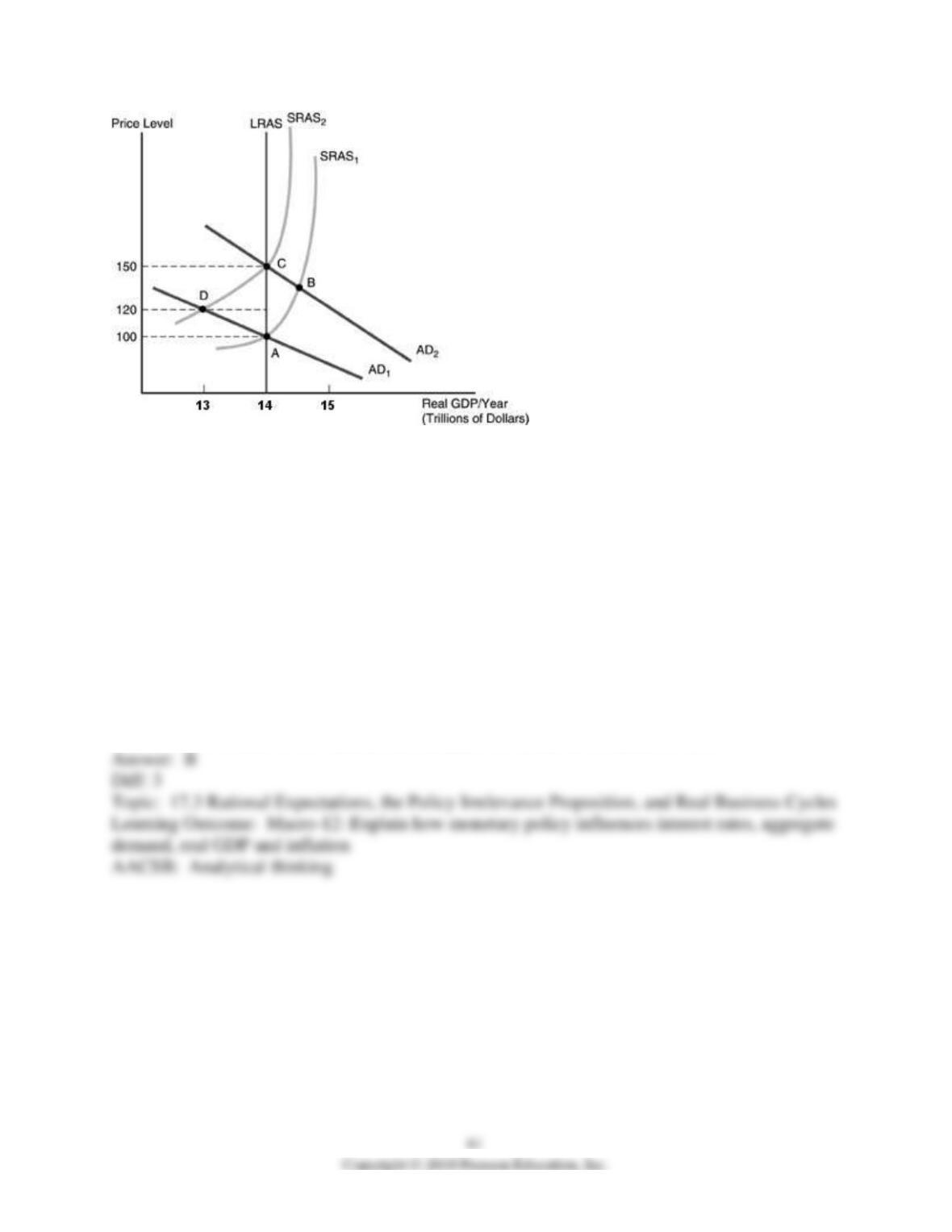
41) Refer to the above figure. Suppose the economy is in equilibrium at point A. If the Fed tries
to stimulate the economy by undertaking an expansionary monetary policy action and this is
NOT expected by the people in the economy, we would expect to see
A) aggregate demand increases, real GDP increases, and the price level increases. In the long
run, aggregate supply would increase and the new long-run equilibrium would be point B.
B) aggregate demand increases, real GDP increases, and the price level increases in the short run.
In the long run, people realize the real situation, causing the short-run aggregate supply curve to
shift up. Real GDP returns to $14 trillion, and the price level increases to 150.
C) aggregate demand increases but people would anticipate this, causing the short-run aggregate
supply curve to shift up at the same time, with the new equilibrium of $14 trillion of real GDP
and a price level of 100.
D) aggregate supply shifts up as people anticipate the effects of the expansionary monetary
system. In the short run, real GDP falls to $13 trillion and the price level rises to 120. In the long
run, real GDP returns to $14 trillion, and the price level increases further, to 150.
42) Refer to the above figure. Suppose the economy is in equilibrium at point A. If rational
expectations exist, an increase in aggregate demand caused by an anticipated increase in the
money supply will cause the economy to
A) stay at point A.
B) move to point B.
C) move to point C.
D) move to point D.
43) Refer to the above figure. Suppose the economy is in long-run equilibrium at point A, and
the government initiates an expansionary monetary policy to increase aggregate demand. Which
of the following is a TRUE statement concerning the differences between what happens when
the central bank action is unanticipated and when it is anticipated?
A) The new long-run equilibrium when the increase in aggregate demand is unanticipated is
point B while the new long-run equilibrium when the increase in aggregate demand is anticipated
is point C.
B) The new long-run equilibrium when the increase in aggregate demand is unanticipated is
point B while the new long-run equilibrium when the increase in aggregate demand is anticipated
is point A.
C) The new long-run equilibrium will be point C in either case. When the increase in aggregate
demand is unanticipated, the economy moves to B in the short run, but when the increase in
aggregate demand is anticipated, short-run aggregate supply shifts when the aggregate demand
curve shifts, and the economy moves immediately to point C.
D) The new long-run equilibrium is point C in either case. When the increase in aggregate
demand is unanticipated, the new short-run equilibrium is point B, but when the increase in
aggregate demand is anticipated the new short-run equilibrium is point D.
44) Suppose that the economy is in long-run equilibrium and the central bank decided to engage
in unexpected expansionary policy by increasing the money supply. If we assume rational
expectations, which of the following statements is correct about the effect of expansionary policy
in the long run?
A) The unemployment rate will increase, real GDP will increase and the price level will increase.
B) The unemployment rate will decrease, real GDP will decrease and the price level will
decrease.
C) The unemployment rate will remain unchanged, real GDP will remain unchanged and the
price level will increase.
D) The unemployment rate will remain unchanged, real GDP will remain unchanged and the
price level will decrease.
45) Suppose that the economy is in long-run equilibrium and the government decided to engage
in unexpected contractionary policy by decreasing the money supply. If we assume rational
expectations, which of the following statements is correct about the effect of contractionary
policy in the long run?
A) The unemployment rate will increase, real GDP will increase and the price level will increase.
B) The unemployment rate will decrease, real GDP will decrease and the price level will
decrease.
C) The unemployment rate will remain unchanged, real GDP will remain unchanged and the
price level will increase.
D) The unemployment rate will remain unchanged, real GDP will remain unchanged and the
price level will decrease.
46) Suppose that the economy is in long-run equilibrium and the government decided to engage
in expected expansionary policy by increasing the money supply. If we assume rational
expectations, which of the following statements is correct about the effect of expansionary policy
in the long run?
A) The unemployment rate will increase, real GDP will increase and the price level will increase.
B) The unemployment rate will decrease, real GDP will decrease and the price level will
decrease.
C) The unemployment rate will remain unchanged, real GDP will remain unchanged and the
price level will increase.
D) The unemployment rate will remain unchanged, real GDP will remain unchanged and the
price level will decrease.
47) Under the assumption of rational expectations, fiscal and monetary policy changes are
effective in the short run
A) all of the time.
B) only when the short-run aggregate supply curve is the same as the long-run aggregate supply
curve.
C) only when the policy changes leave the position of the aggregate demand curve unaffected.
D) only when the policy changes are unanticipated.
48) A central bank initiates a contractionary monetary policy that is correctly anticipated by
economic agents in the economy. The result is
A) decreased prices, but no change in real GDP.
B) decreased prices and decreased real GDP in the short run, but only decreased prices in the
long run.
C) decreased real GDP in the short run and decreased prices in the long run.
D) decreased real GDP and prices in both the short run and the long run.
49) Which statement is TRUE when rational expectations exist and there is a change in monetary
policy which is expected?
A) The change in monetary policy leads to a change in aggregate demand that leads to a
temporary short-run equilibrium that is different from the long-run equilibrium.
B) The change in monetary policy leads to a simultaneous shift of the short-run aggregate supply
curve.
C) The change in monetary policy lead to a simultaneous shift in the long-run aggregate supply
curve.
D) The change in monetary policy does not change equilibrium in either the short-run or long-
run.
50) Which statement is TRUE when rational expectations exist and there is a change in monetary
policy which is unexpected?
A) The change in monetary policy leads to a change in aggregate demand that leads to a
temporary short-run equilibrium that is different from the long-run equilibrium.
B) The change in monetary policy leads to a simultaneous shift of the short-run aggregate supply
curve.
C) The change in monetary policy lead to a simultaneous shift in the long-run aggregate supply
curve.
D) The change in monetary policy does not change equilibrium in either the short-run or long-
run.
51) Under the assumption of rational expectations, people’s expectations about the economy are
an important determinant of
A) the short-run aggregate supply curve.
B) the long-run aggregate supply curve.
C) the short-run aggregate demand curve.
D) the long-run aggregate demand curve.
52) The idea that anticipated monetary policy changes cannot affect real GDP or employment is
known as
A) the systematic policy hypothesis.
B) the policy irrelevance theorem.
C) the bounded rationality hypothesis.
D) the Keynesian hypothesis.
53) Fully anticipated monetary policy actions cannot alter either the rate of unemployment or the
level of real GDP. This statement is
A) the policy irrelevance proposition.
B) the nonaccelerating inflation rate of unemployment theory.
C) the Phillips curve.
D) not supported by any economic theory.
54) Which of the following is NOT an inference of the rational expectations hypothesis?
A) Government policy actions have no real effects in the short run unless the actions are
unanticipated.
B) Government policy actions have no real effects in the long run.
C) Government policy actions that are anticipated have no real effects in the short run.
D) Government policy actions that are unanticipated have no monetary effects in the short run.
55) If people do NOT always make the same mistakes when forecasting the future, then
A) rational expectations are irrational.
B) the Fed can control monetary policy and determine real variables such as real GDP.
C) the policy irrelevance theorem holds.
D) fiscal policy is more effective than monetary policy at fine-tuning the economy.
56) Under the assumption of rational expectations, real GDP is determined by
A) the economy’s aggregate demand curve.
B) monetary policy but not by fiscal policy.
C) a combination of monetary and fiscal policy.
D) the long-run aggregate supply curve.
57) Real business cycle theory explains changes in employment and output by focusing on
A) real supply-side factors.
B) changes in monetary policy.
C) changes in fiscal policy.
D) the interaction of fiscal and monetary policies.
58) According to the real business cycle theory, which of the following would be a real
disturbance to the economy?
A) change in the required reserve ratio
B) reduction in the money supply
C) increase in the labor force
D) increase in the price level
59) Suppose the economy is in equilibrium when there is a change in environmental policy that
bans all pesticides and herbicides on farmland. We would expect to observe
A) a decrease in aggregate supply and an increase in aggregate demand.
B) a decrease in both real output and the natural rate of unemployment.
C) a decrease in real output and an increase in the natural rate of unemployment.
D) a decrease in real output and an increase in the price level.
60) According to the real business cycle theory, which of the following is a TRUE statement
about the effects of an oil shock in the 1970s?
A) The shock affected real variables only and did not affect nominal variables.
B) The shock shifted the short-run aggregate supply curve but not the long-run aggregate supply
curve.
C) The natural rate of unemployment remained unchanged, but employment levels did decline.
D) Relative prices changed but there was no impact on the price level in general.
61) According to the real-business-cycle perspective
A) the economy cannot be stabilized by active policy actions.
B) the Phillips curve is very important.
C) active policy making is important.
D) passive policy making is important.
62) The rational expectations hypothesis suggests that
A) unanticipated fiscal policy actions are more powerful than monetary policy actions.
B) anticipated monetary policy actions are more powerful than fiscal policy actions.
C) fiscal policy actions only work when accompanied by changes in the money supply.
D) anticipated fiscal and monetary policy actions are not effective in stabilizing the economy.
63) The rational expectations hypothesis states that
A) individuals always behave irrationally.
B) prices do not adjust in a downward direction.
C) people incorporate past and present economic information into decision making.
D) consumers do not understand the effects of monetary and fiscal policy.
64) The policy irrelevance proposition implies that
A) unanticipated monetary policy actions are equally effective in stimulating both aggregate
demand and aggregate supply.
B) anticipated monetary policy actions are effective in stimulating aggregate supply, but they are
not effective in stimulating aggregate demand.
C) anticipated monetary policy actions are effective in increasing real GDP, but they do not
reduce unemployment.
D) anticipated monetary policy actions are ineffective in generating changes in real GDP.
65) A hypothesis that assumes that people combine the effects of past policy changes on
economic events and their own judgment about future effects of current and future policy
changes is known as
A) adaptive expectations.
B) irrelevant expectations.
C) rational expectations.
D) active expectations.
66) Which of the following holds that economic decision making on all levels is unbiased and is
based on all available information?
A) Keynesian cycle theory
B) rational expectations based theory
C) adaptive expectations based theory
D) bounded rationality theory
67) Adding the assumption of pure competition and complete flexibility of all prices and wages
to the rational expectations hypothesis yields a theory that provides support for
A) passive policy making.
B) active policy making.
C) discretionary policy making.
D) irrelevant policy making.
68) The proposition that policy actions have no real effects in the short run if the policy actions
are anticipated is known as
A) the unemployment stabilization proposition.
B) the policy irrelevance proposition.
C) the policy illusion proposition.
D) the Keynesian proposition.
69) Those who accept both the rational expectations hypothesis and the assumption of flexibility
of wages and price would likely argue that
A) saving and investment do not contribute to economic growth.
B) active policy making does not contribute to economic stability.
C) if policy makers are willing to accept a high inflation rate, they can reduce unemployment to a
point below the natural rate.
D) policy makers can eliminate fluctuations in the level of business activity with careful planning
of a widely publicized monetary policy.
70) According to a theory that relies on the rational expectations hypothesis and the assumption
that wages and prices are flexible, why do anticipated expansionary monetary actions NOT boost
real GDP?
A) Anticipated expansionary monetary policy actions do not increase aggregate demand.
B) The short-run aggregate supply curve shifts upward simultaneously with the rightward shift of
aggregate demand.
C) The short-run aggregate supply curve shifts downward simultaneously with the upward shift
of aggregate demand.
D) The higher interest rates associated with anticipated expansionary monetary policy actions
will dampen investment spending.
71) One implication of coupling the rational expectations hypothesis with the assumption of
flexible wages and prices is that
A) expansionary monetary policy will be effective in combating recessions.
B) contractionary monetary policy will be effective in combating inflation.
C) only predictable policy actions by the Fed will have an effect on the real economy.
D) only unpredictable policy actions by the Fed will have an effect on the real economy.
72) The rational expectations hypothesis suggests that if wages and prices are flexible
A) unanticipated monetary policy actions can shift the long-run aggregate supply curve but
cannot shift the aggregate demand curve.
B) anticipated monetary policy actions can affect nominal variables, but not real variables.
C) unanticipated monetary policy actions can affect real variables, but not nominal variables.
D) growth in the money supply can alter real variables only if the growth is anticipated.
73) The hypothesis suggesting that people combine the effects of past policy changes on
economic variables with their own judgment about the future effects of current and future
economic policy is referred to as the
A) active expectations hypothesis.
B) passive expectations hypothesis.
C) rational expectations hypothesis.
D) adaptive expectations hypothesis.
74) The idea that policy actions have no real effects in the short run if they are anticipated and no
real effects in the long run is called the
A) Keynesian proposition.
B) policy irrelevance proposition.
C) adaptive proposition.
D) money illusion proposition.
75) The rational expectations hypothesis is based on the assumption that
A) individuals combine effects of past policy actions with their own judgment about future
policy effects and changes when forming their expectations.
B) individuals adapt in response to past policy actions and changes without looking ahead when
forming their expectations.
C) firms pay above equilibrium wages to their employees.
D) most firms operate in a less than competitive environment.
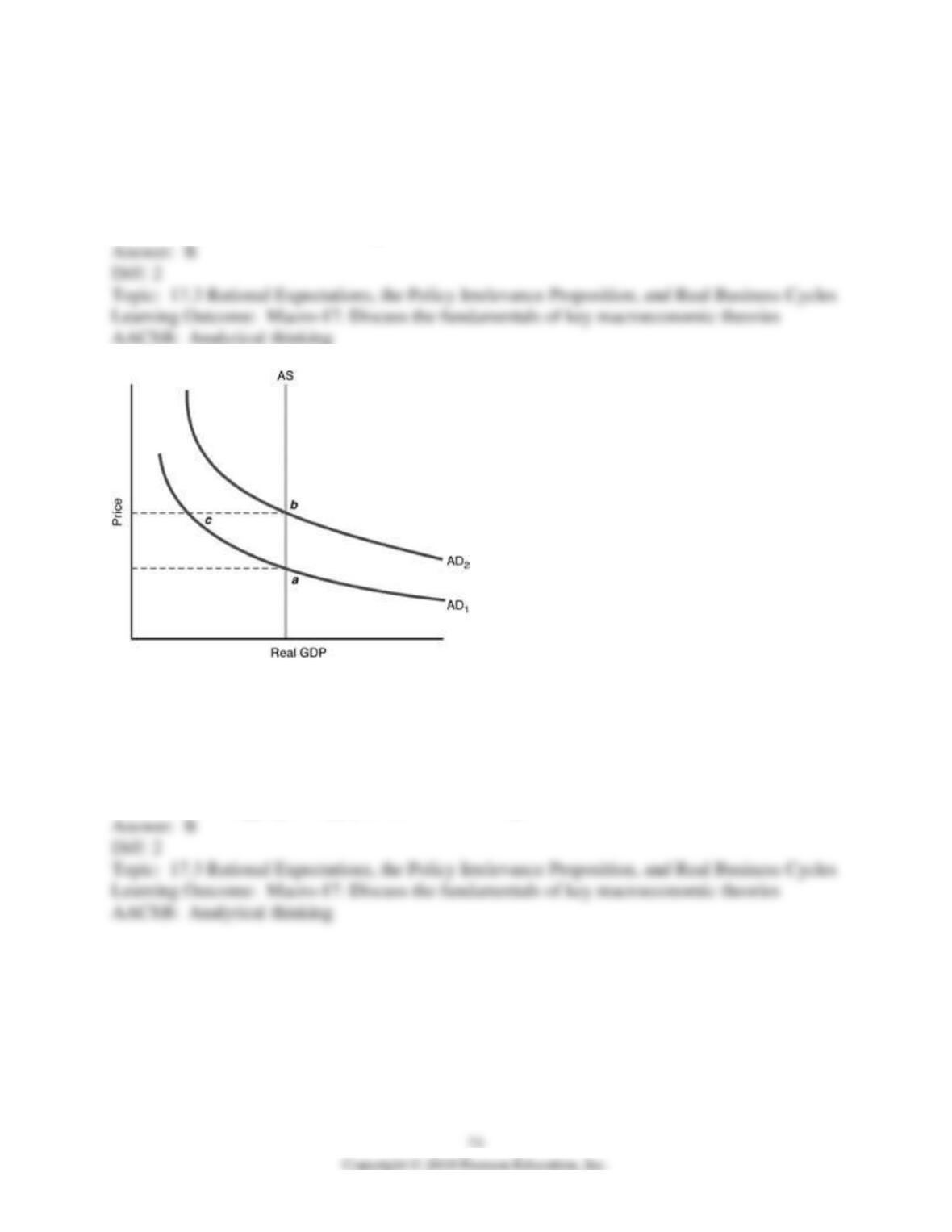
76) The policy irrelevance proposition suggests that the policy effects on the economy primarily
occur as a result of
A) fiscal policy measures.
B) policy mistakes or misjudgment of policies.
C) nondiscretionary fiscal policy.
D) illusion about the value of money.
77) Refer to the above figure. The rational expectations hypothesis implies that an anticipated
increase in aggregate demand from AD1 to AD2 will
A) move the economy from c to b.
B) move the economy from a to b.
C) move the economy from a to c.
D) will shift the aggregate supply (AS) curve to the right.
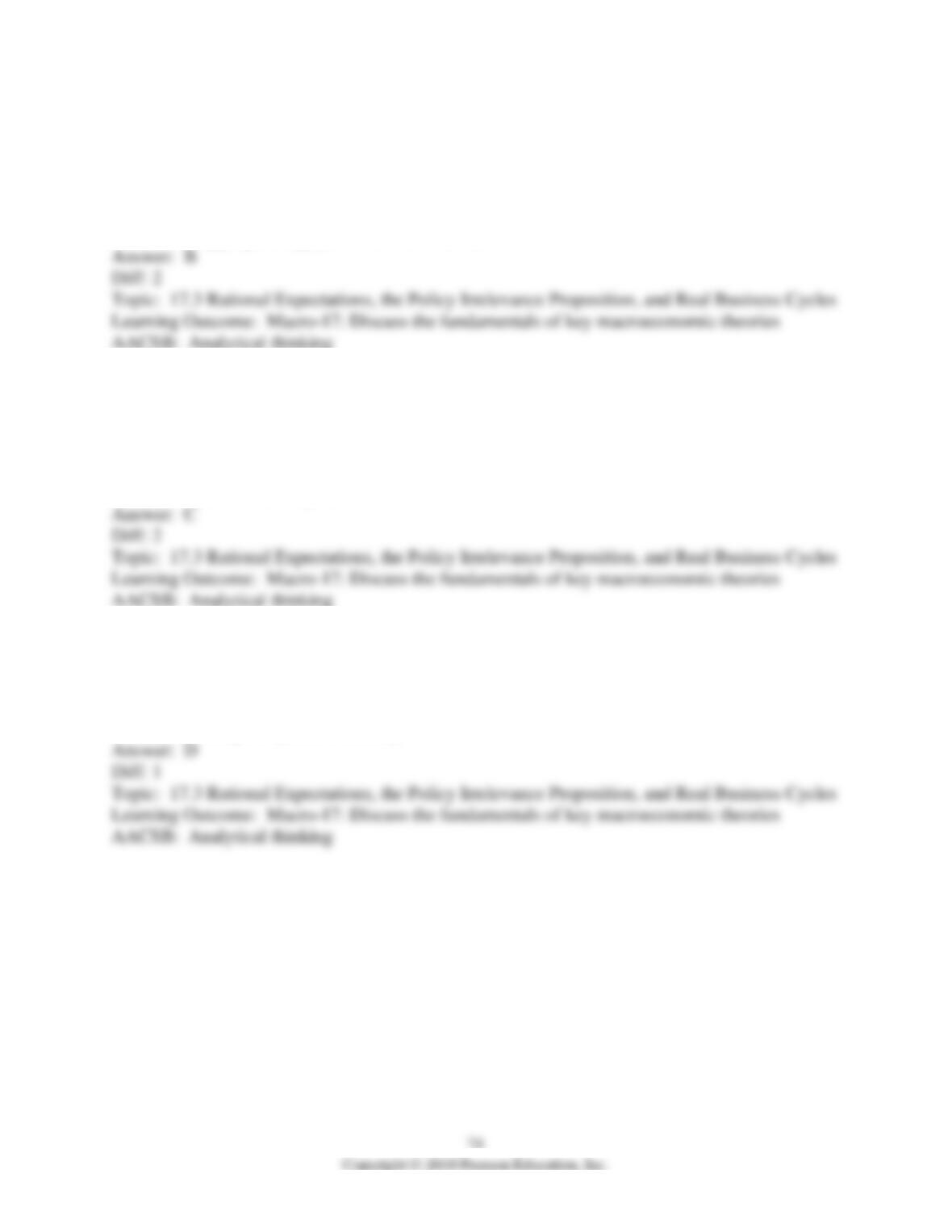
78) Refer to the above figure. The rational expectations hypothesis implies that an anticipated
decrease in aggregate demand from AD2 to AD1 will
A) move the economy from b to c.
B) move the economy from b to a.
C) move the economy from c to a.
D) shift the aggregate supply (AS) curve to the left.
79) According to the theory based on rational expectations and flexible wages and prices,
A) fiscal policy has less effect on real GDP than monetary policy in the long run.
B) monetary policy has less effect on real GDP than fiscal policy in the long run.
C) neither fiscal nor monetary policy influence real GDP in the long run.
D) only the combination of discretionary fiscal policy and conservative monetary policy can
affect real GDP in the long run.
80) The rational expectations hypothesis is based on all the following assumptions EXCEPT
A) use of judgment about effects of future policy actions.
B) use of knowledge of effects of past policy actions.
C) understanding of how the economy operates.
D) understanding that prices are sticky.
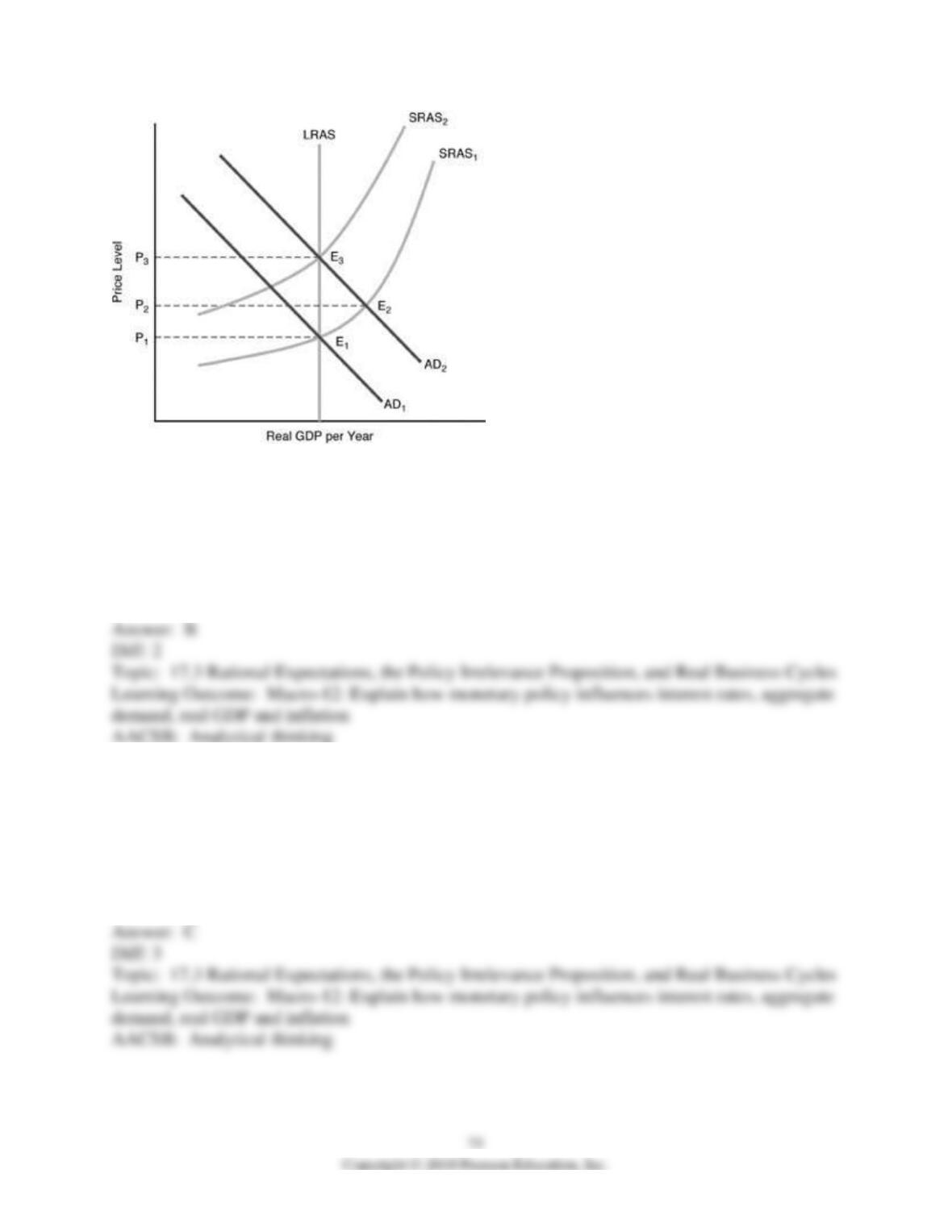
81) In the above figure, if we start at AD1 and SRAS1, and the money supply increases
unexpectedly, what would be the short-run equilibrium even with rational expectations?
A) E1
B) E2
C) E3
D) P1
82) In the above figure, if we start at AD1 and SRAS1, and the money supply increases
unexpectedly, what would be the long-run equilibrium?
A) E1
B) E2
C) E3
D) P1
83) In the above figure, if we start at AD1 and SRAS1, and the money supply increases
unexpectedly, what causes the economy to get to the long-run equilibrium?
A) People’s expectations will revise after a short-run gain in output, wages will fall, and SRAS
will shift leftward.
B) People’s expectations will revise after a short-run gain in output, wages will rise, and SRAS
will shift rightward.
C) People’s expectations will revise after a short-run loss in output, wages will fall, and SRAS
will shift leftward.
D) People’s expectations will revise after a short-run gain in output, wages will rise, and SRAS
will shift leftward.
84) The policy irrelevance proposition states that
A) only relatively large expected changes in monetary policy impact the economy.
B) anticipated changes in monetary policy are ineffective in changing real GDP.
C) only statements from the White House have impact on the economy.
D) in the short run unanticipated changes in monetary policy are ineffective in changing real
GDP.
85) Real business cycle theory emphasizes the effect of ________ on real GDP.
A) government spending
B) the money supply
C) aggregate supply shocks
D) aggregate demand shocks
86) When “stagflation” occurs
A) the economy experiences higher inflation rates and lower unemployment rates at the same
time.
B) the economy experiences lower inflation rates and higher unemployment rates at the same
time.
C) the economy experiences lower inflation rates and lower unemployment rates at the same
time.
D) the economy experiences higher inflation rates and higher unemployment rates at the same
time.
87) The real business cycle theory
A) indicates that supply side shocks cause most business cycles.
B) indicates that demand side shocks cause most business cycles.
C) indicates that unanticipated changes in the money supply cause most business cycles.
D) indicates that frequent fiscal policy actions cause most business cycles.
88) The real business cycle theory is based on all of the assumptions below EXCEPT
A) the absence of rationality among people.
B) flexible wages.
C) pure competition.
D) flexible prices.
89) Which of the following holds that business cycles are primarily due to changes in technology
and does NOT invoke any monetary or demand-side forces?
A) the real business cycle theory
B) the efficiency wage theory
C) rational expectations hypothesis
D) adaptive expectations hypothesis
90) Real business cycles are mostly a result of
A) discretionary fiscal policy.
B) abrupt changes in monetary policy.
C) increases in the budget deficit and national debt.
D) shocks to the aggregate supply side of the economy.
91) Which of the following would NOT cause a real business cycle?
A) a change in technology
B) a change in the composition of the labor force
C) a change in the money supply
D) a sustained change in the price of oil
92) During the 1970s, the shocks to the United States’ economy resulted in
A) an increase in the unemployment rate, but a decrease in the inflation rate.
B) a decrease in the unemployment rate, but an increase in the inflation rate.
C) an increase in both the unemployment rate and the inflation rate.
D) a decrease in both the unemployment rate and the inflation rate.
93) The real business cycle theory
A) is an extension of the Keynesian view of business cycles.
B) is an extension of the adaptive expectations theory of business cycles.
C) suggests that instability is caused by shifts in the long-run aggregate supply curve.
D) suggests that instability is caused by shifts in the aggregate demand curve caused by changing
consumer confidence in the economy.
94) Stagflation means a
A) high rate of inflation coupled with a high rate of unemployment.
B) high rate of inflation coupled with a very low rate of unemployment.
C) low rate of inflation coupled with a very high rate of unemployment.
D) low rate of inflation coupled with a rate of unemployment below the natural rate.
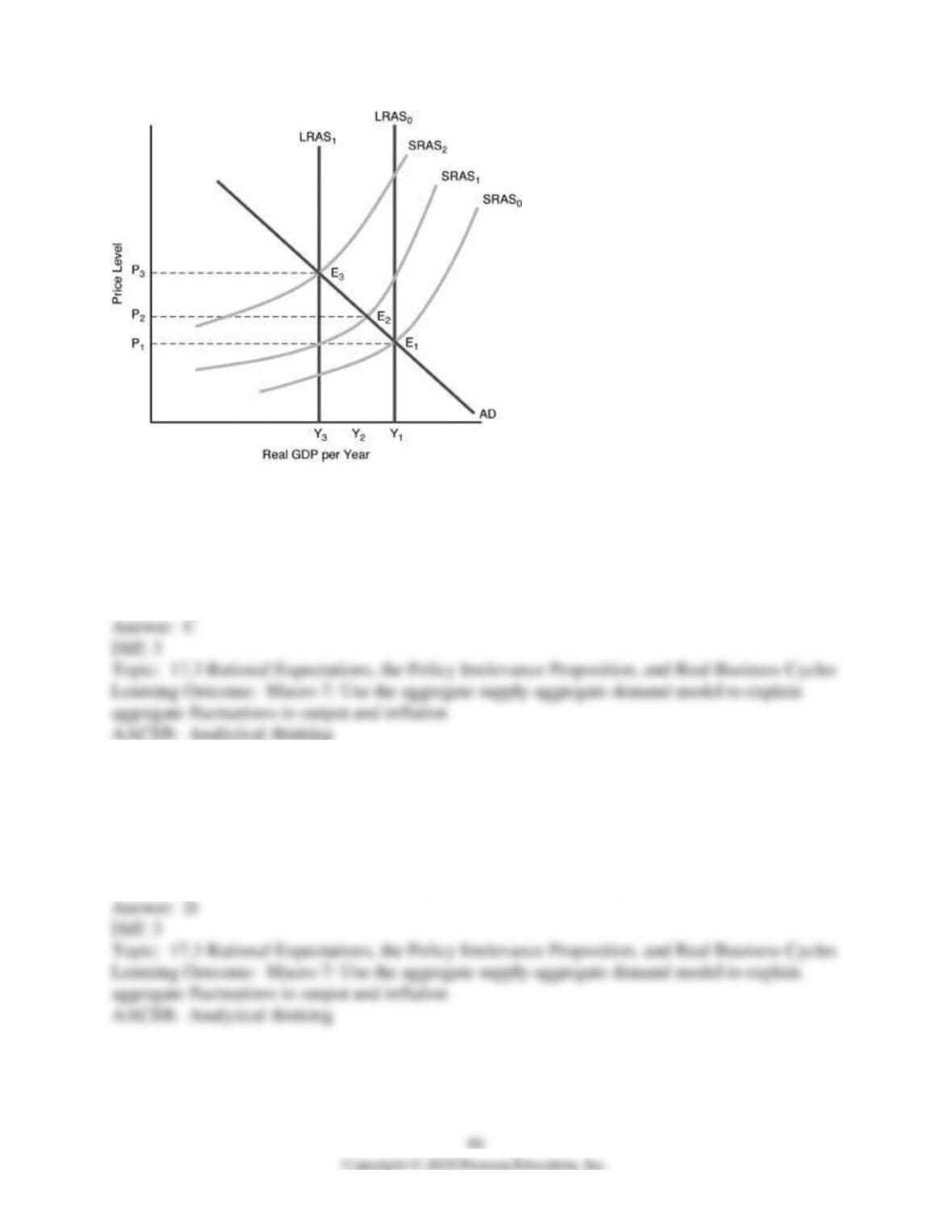
95) In the above figure, starting at E1, if there is a supply shock that is permanent, the
A) aggregate supply would shift to SRAS1 and LRAS1 would shift to LRAS0.
B) aggregate supply would shift to SRAS1 and LRAS0 would shift to LRAS1.
C) aggregate supply would shift to SRAS2 and LRAS0 would shift to LRAS1.
D) aggregate supply would shift to SRAS1 and then return to SRAS0.
96) In the above figure, starting at E1, if there is a supply shock that is temporary, the
A) aggregate supply would shift to SRAS0 and LRAS1 would shift to LRAS0.
B) aggregate supply would shift to SRAS1 and LRAS0 would shift to LRAS1.
C) aggregate supply would shift to SRAS2 and LRAS0 would shift to LRAS1.
D) aggregate supply would shift to SRAS1 and then return to SRAS0.