41
28) An unexpected increase in aggregate demand
A) causes the price level to fall.
B) both the unemployment rate and the price level to rise.
C) the unemployment rate to rise.
D) causes the price level to rise.
29) An unexpected increase in aggregate demand
A) will reduce the price level.
B) will increase the average duration of unemployment.
C) will reduce the unemployment rate.
D) will increase real GDP, but will not affect the rate and duration of unemployment.
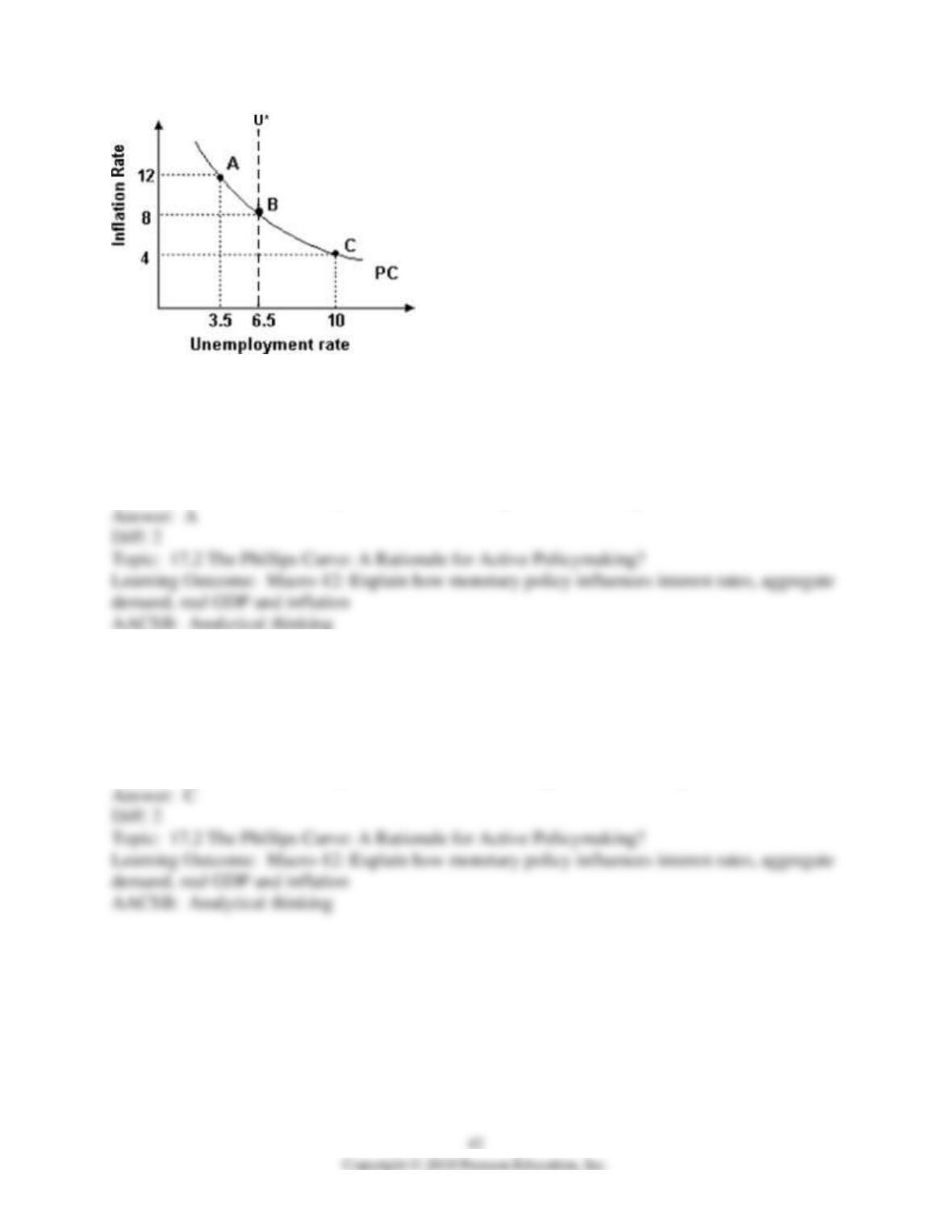
30) Refer to the above figure. Suppose the economy is at point B and the central bank adopts
expansionary monetary policy. In the short run, this will result in
A) the economy moving towards point A.
B) the economy staying at point B.
C) the economy moving towards point C.
D) an outcome that cannot be predicted, as not enough information is given.
31) Refer to the above figure. Suppose the economy is at point B and the central bank adopts
contractionary monetary policy. In the short run, this will result in
A) the economy moving towards point A.
B) the economy staying at point B.
C) the economy moving towards point C.
D) an outcome that cannot be predicted, because not enough information is given.
32) The short-run Phillips curve and the long-run Phillips curve are different because
A) the expected rate of inflation is always zero in the long run, while it is a positive number in
the short run.
B) the expected rate of inflation is always zero in the short run, while it is a positive number in
the long run.
C) the actual and expected rate of inflation are equal in the short run.
D) the actual and expected rate of inflation are equal in the long run.
33) The Phillips Curve will shift downward if
A) the expected inflation rate falls.
B) the price level falls.
C) the overall employment rate remains unchanged.
D) the unexpected inflation rate rises.
34) The Phillips Curve will shift when
A) the expected inflation rate changes.
B) the price level falls.
C) the overall employment rate remains unchanged.
D) none of the above.
35) According to economist A.W. Phillips
A) there is no trade-off between inflation and unemployment.
B) high inflation rates are associated with low unemployment rates.
C) unemployment can be effectively combated by raising wages.
D) higher rates of inflation are associated with higher rates of unemployment.
36) The Phillips curve is
A) a positive relationship in the long run between the rate of inflation and the rate of
unemployment.
B) a negative relationship between the inflation rate and the unemployment rate, at least in the
short run.
C) a positive relationship between the unemployment rate and the real Gross Domestic Product
(GDP) level.
D) a positive relationship between price stability and constant, small-increment changes in the
fiscal policy on the part of the Fed.
37) What happens to the Phillips curve when future inflation is expected to rise?
A) The curve shifts to the right.
B) The curve shifts to the left.
C) The curve becomes horizontal.
D) The Phillips curve is unaffected.
38) The short-run Phillips curve suggests what policy making implications?
A) Active policy making does not yield any predictable results.
B) Passive policy making is more effective than active policy making.
C) Using discretionary policies, it may be possible to achieve just the right unemployment and
inflation mix.
D) Maintaining both the inflation and unemployment rates at low levels is possible if policy
makers will rely solely on nondiscretionary policy making.
39) Critics of the Phillips curve argue that in the long run
A) there is a trade-off between unemployment and inflation.
B) for any given unemployment level there is a corresponding inflation rate to which the
economy will automatically revert.
C) employees are not able to anticipate future rates of inflation, and therefore unemployment can
always be reduced by inflating the economy.
D) there is no trade-off between inflation and unemployment because workers’ expectations
adjust to any systematic attempts to reduce unemployment below the natural rate.
40) The Phillips curve shows
A) the relationship between the rate of interest and planned investment.
B) the relationship between the money supply and the price level.
C) that an increase in government spending will decrease real national income.
D) that when inflation is higher, the unemployment rate reduces.
41) The Phillips curve trade-off relationship implies that
A) the government can fine-tune the economy and generate both the natural rate of
unemployment and zero inflation.
B) the government can fine-tune the economy and pick the most preferred combination of
unemployment and inflation.
C) low unemployment can be obtained only by generating rapidly increasing inflation.
D) there is no relationship between inflation and unemployment, at least in the long run.
42) A trade-off between unemployment and inflation is reflected in the
A) natural rate of unemployment.
B) Phillips Curve.
C) economic stability.
D) nonaccelerating inflation rate of unemployment (NAIRU).
43) What is the Phillips curve? What does the Phillips curve suggest about optimal policy?
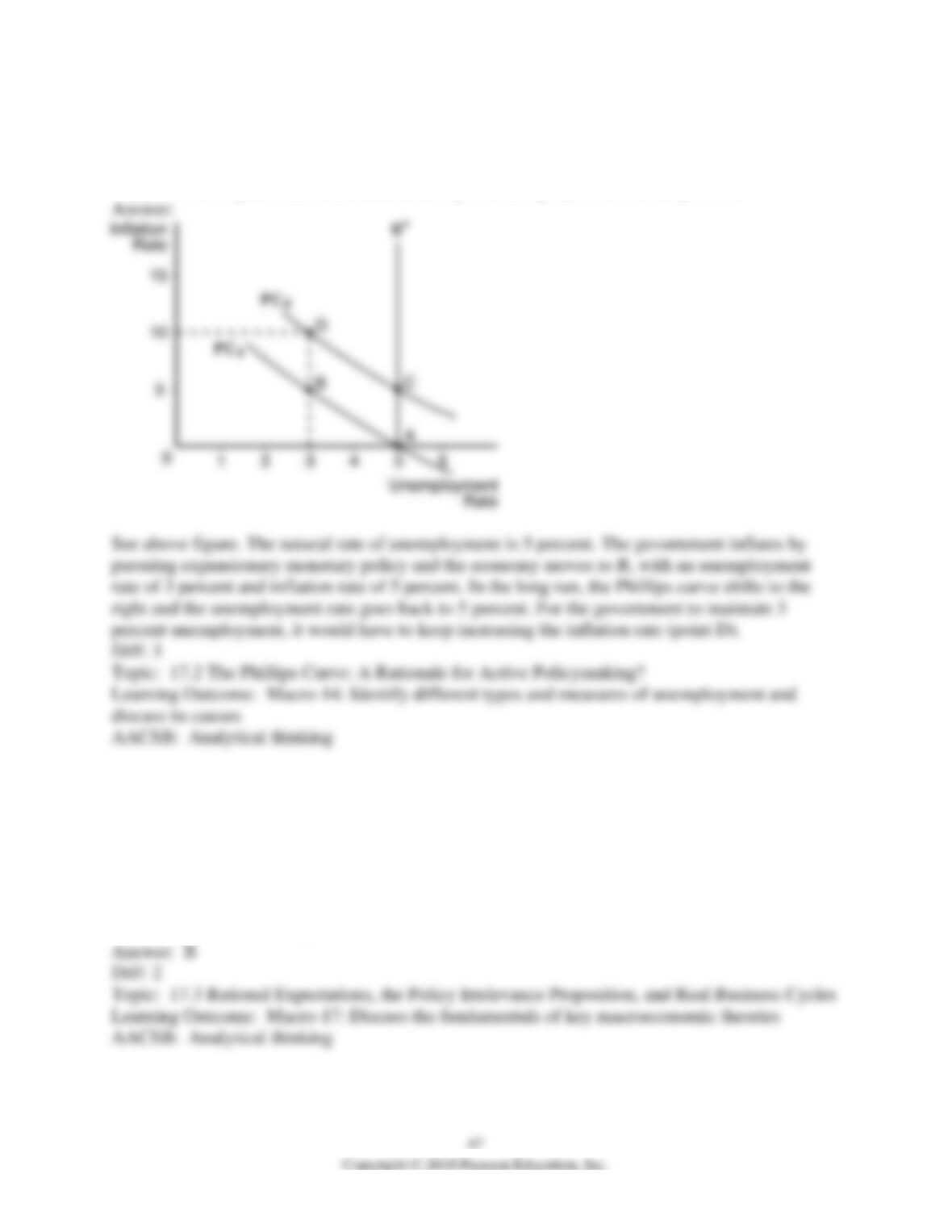
44) Suppose the economy has been experiencing zero inflation and 5 percent unemployment for
several years. The government decides to lower the unemployment by generating some inflation.
Using a graph, show what the short-run effects would be and what would happen in the long run.
What would the government have to do to keep the unemployment rate at 3 percent?
17.3 Rational Expectations, the Policy Irrelevance Proposition, and Real Business Cycles
1) When Bono forms his future expectations for the economy using all available current data and
his own judgment about future policy effects, this is known as
A) the policy irrelevance proposition.
B) rational expectations.
C) irrational expectations.
D) the new classical theory.
2) Which of the following hypotheses states that people combine the effects of past policy
changes on important economic variables with their own judgment about the future effects of
future and current policy changes?
A) policy irrelevance hypothesis
B) rational expectations hypothesis
C) life cycle hypothesis
D) real business cycle hypothesis
3) According to the rational expectations hypothesis, monetary policy can have effects on such
variables as real Gross Domestic Product (GDP) in the short run
A) only when the policy is anticipated.
B) only when the policy is unsystematic and unanticipated.
C) regardless of whether the policy is anticipated or unanticipated.
D) when the central bank implements policy actions as anticipated.
4) The rational expectations hypothesis is a theory that states that
A) individuals can predict the future perfectly, at least with respect to macroeconomic variables
like the interest rate and inflation.
B) people make their economic plans by using all available past and present information and
their understanding about how the economy operates.
C) people make their economic plans in an irrational, intuitive manner.
D) people make their economic plans by relying on the policy statements made by the President
and by leaders in Congress.
5) According to the rational expectations hypothesis, an individual’s assessment of future
economic performance
A) does not consider past performance.
B) does not consider the impact of inflation.
C) only considers past performance.
D) considers both past performance and current economic policy actions.
6) One economic hypothesis states that people form expectations by combining the effects of
past policy changes on important economic variables with their own judgment about the future
effects of current and future policy changes, and then react accordingly. This is known as the
A) relevance hypothesis.
B) contrary opinion hypothesis.
C) rational expectations hypothesis.
D) structural hypothesis.
7) The hypothesis that people combine the effects of past policy changes on important economic
variables with their own judgment about the future effects of current and future policy changes is
the basis of the
A) adaptive hypothesis.
B) short-run Phillips curve hypothesis.
C) rational expectations hypothesis.
D) demand-pull inflation hypothesis.
8) Rational expectations theory suggests that short-run stabilization policy
A) is best achieved with monetary policy.
B) is best achieved with fiscal policy.
C) is equally easy to achieve with monetary or fiscal policy.
D) is not effective in stabilizing the economy.
9) If you accept the rational expectations hypothesis as accurate, what would you tell monetary
policy makers who ask you how to more effectively manage the economy?
A) Consumers do not understand the workings of monetary policy, so discretionary and
nondiscretionary policies are equally effective.
B) Individuals do understand how monetary policy works, so consistency and predictability are
the keys to effective policy making.
C) Individuals base their economic expectations solely on current information, so repeating
policy decisions that have worked in the past is the most effective path to take.
D) Only unanticipated policies will be effective once individuals understand how monetary
policy works.
10) Assume the Fed initiates an expansionary monetary policy that is correctly anticipated by
economic agents in the economy. According to the rational expectation hypothesis, the result is
A) an increased price level in the short run, but no effect on price level in the long run.
B) decreased real Gross Domestic Product (GDP) in the short run, but increased real Gross
Domestic Product (GDP) in the long run.
C) increased real Gross Domestic Product (GDP) and increased employment in the long run.
D) an increased price level, but no change in real Gross Domestic Product (GDP) in the long run.
51
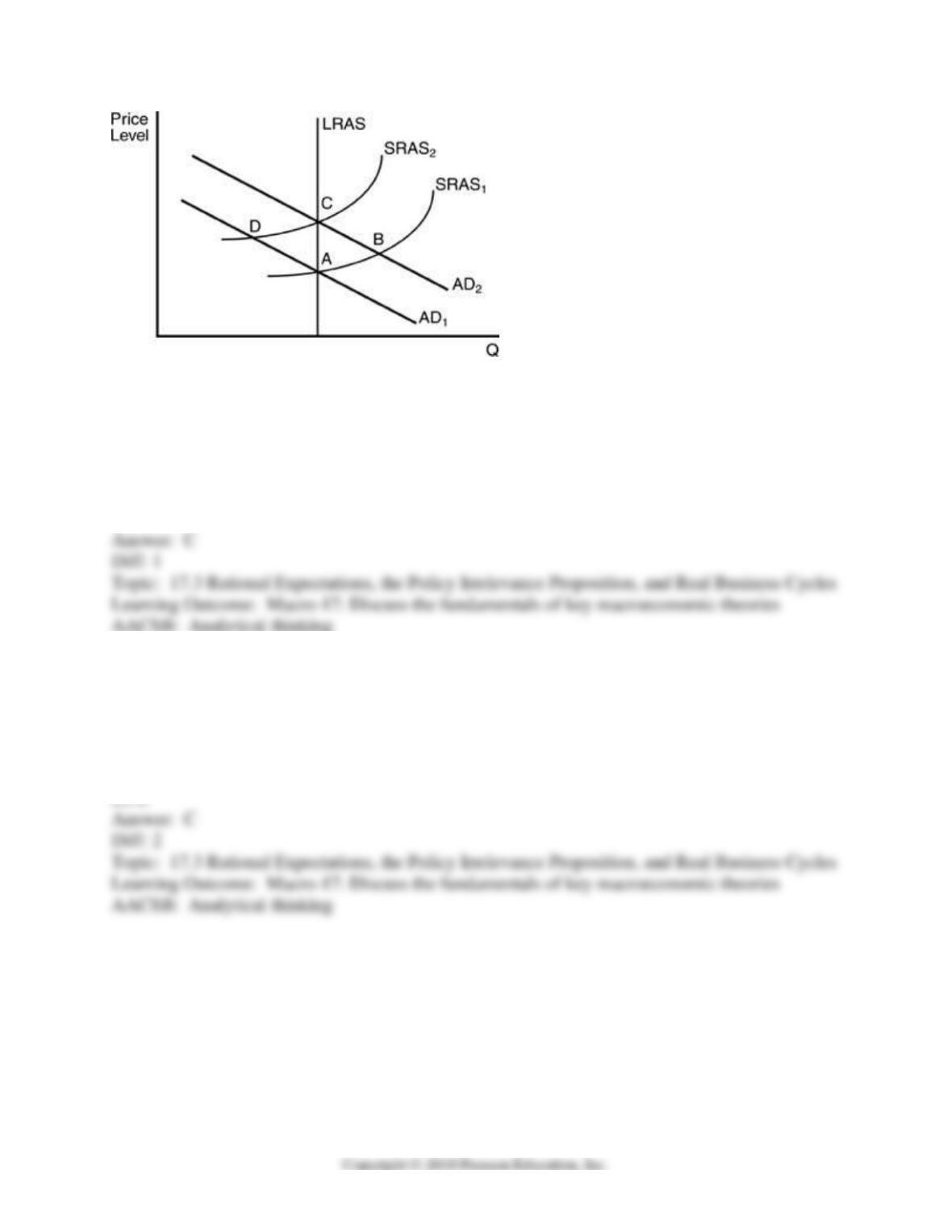
11) In the above figure, suppose the economy is initially at a short-run equilibrium at point D and
there is an unanticipated increase in the money supply. Which point represents the new short-run
equilibrium?
A) A
B) B
C) C
D) D
12) In the above figure, suppose the economy is in equilibrium at point A. The Fed engages in an
expansionary monetary policy that is fully anticipated by the public. Other things being equal,
what point represents the new equilibrium according to the rational expectations theory?
A) A
B) B
C) C
D) D
13) In the above figure, suppose the economy is currently in equilibrium at point C. Applying
rational expectations theory, what happens if the Fed announces that it is decreasing the money
supply and follows through on its statement?
A) The price level will increase.
B) Real Gross Domestic Product (GDP) per year will increase.
C) Real Gross Domestic Product (GDP) per year will decrease.
D) The price level will decrease.
14) Proponents of the policy irrelevance proposition believe that, under the assumption of
rational expectations, the unemployment rate will
A) go up whenever the Fed announces an anticipated monetary policy change.
B) go down whenever the Fed announces an anticipated fiscal policy change.
C) equal the natural rate of unemployment in the long run, regardless of any monetary policy
actions.
D) always be higher in the long run than the natural rate of employment.
15) The idea that anticipated monetary policy cannot affect real variables such as real Gross
Domestic Product (GDP) or employment is known as
A) the Keynesian hypothesis.
B) the policy irrelevance proposition.
C) the job search model.
D) the monetary velocity theory.
16) According to the policy irrelevance proposition, monetary policy can affect real variables
A) in both the short run and the long run.
B) in the long run only.
C) only in the short run when the policy is unanticipated.
D) as long as the policy is fully anticipated.
17) One key implication of rational expectations is that
A) anticipated monetary policy has no effect on the price level.
B) anticipated monetary policy cannot affect the level of real GDP.
C) unanticipated monetary policy has no effect on the economy but anticipated monetary policy
does have an effect on the economy.
D) both unanticipated monetary policy and anticipated monetary policy have an effect on the
economy.
18) When workers and employers correctly anticipate the rate of inflation
A) there will be no unemployment.
B) there will be only underemployment.
C) unemployment will be at the natural rate.
D) workers will underestimate the real wage.
19) In the aggregate supply-aggregate demand model, if every person in the economy correctly
anticipates the inflation rate, the unemployment rate will
A) be negative.
B) be more than the natural rate of unemployment.
C) equal the natural rate of unemployment.
D) equal zero.
20) In the absence of rational expectations, an expansionary monetary policy should in the short
run
A) shift the aggregate supply function.
B) increase real Gross Domestic Product (GDP) and the price level.
C) increase the rate of unemployment.
D) generate stagflation.
21) In the short run, an unanticipated increase in the inflation rate would
A) increase the unemployment rate.
B) decrease the unemployment rate.
C) unambiguously improve the misery index.
D) lower the natural rate of unemployment.
22) If all the assumptions underpinning the policy irrelevance proposition are in place, fully
anticipated monetary policy will
A) affect the unemployment rate but have no impact on the level of real Gross Domestic Product
(GDP).
B) have an impact on real Gross Domestic Product (GDP) but cannot alter the level of
unemployment.
C) effectively alter both the rate of unemployment and the level of real Gross Domestic Product
(GDP).
D) not change either the level of real Gross Domestic Product (GDP) or the unemployment rate.
23) According to the policy irrelevance proposition
A) monetary policy can effectively reduce the rate of unemployment in the short run.
B) workers are not rational in the long run.
C) the Phillips curve slopes upward, not downward as traditionally assumed.
D) expansionary monetary policy will only lead to a higher rate of inflation in the long run.
24) According to the policy irrelevance proposition, the impact of an anticipated expansionary
monetary policy will be to
A) increase the price level in the long run.
B) increase the real Gross Domestic Product (GDP) in the long run.
C) decrease the natural rate of unemployment.
D) decrease the price level and the unemployment rate.
25) According to the policy irrelevance proposition, real Gross Domestic Product (GDP) is
determined by
A) the economy’s aggregate demand curve.
B) the economy’s long-run aggregate supply curve.
C) the rate of inflation only.
D) a combination of fiscal policy and monetary policy.
26) One key assumption behind the policy irrelevance proposition is that
A) wages are “sticky” downward.
B) prices are “sticky” upward.
C) the rational expectations hypothesis holds.
D) markets are not purely competitive.
27) The rational expectations hypothesis indicates that a monetary policy designed to alter real
Gross Domestic Product (GDP) will fail unless
A) there are unanticipated changes in the money supply.
B) wages and prices are flexible.
C) labor unions have long-term contracts.
D) changes in the money supply are completely anticipated.
28) A key implication of the policy irrelevance proposition is that
A) only fully anticipated policy actions can influence real Gross Domestic Product (GDP).
B) only unanticipated policy actions can influence real Gross Domestic Product (GDP).
C) the rational expectations hypothesis is incorrect.
D) none of the above.
29) Under the rational expectations hypothesis, if wages adjust rapidly to new information about
intended policy actions, monetary policy can have an effect
A) in both the short and the long run.
B) in the long run, but not the short run.
C) only in the short run and only if the policy is unanticipated.
D) only in the long run and only if the policy is fully anticipated.
30) Under the rational expectations hypothesis, if wages adjust rapidly to new information about
intended policy actions, the only time that changes in government policies have real effects is
when
A) the changes are unanticipated.
B) the changes involve fiscal policy.
C) the changes involve monetary policy.
D) the changes affect aggregate demand.
31) Suppose there is an oil supply shock to the U.S. economy due to an embargo by major oil
producing nations. According to the real business cycle theory, the supply shock will, other
things being equal
A) push real Gross Domestic Product (GDP) upward in the short run but downward in the long
run.
B) push the economy into an expansionary phase of the business cycle.
C) cause real Gross Domestic Product (GDP) to decline both in the short run and in the long run.
D) cause economy-wide deflation.
32) The short run aggregate supply (SRAS) curve shifts left when oil supply shocks occur
because
A) fewer goods are produced at any given price level due to higher oil prices.
B) oil consumption will increase at any given price level.
C) average total cost will fall at any given output level.
D) the price level will fall at any given output level.
33) A reduction in world oil supplies is likely to cause
A) an increase in aggregate demand and a decrease in the equilibrium price level.
B) a decrease in equilibrium price level and an increase in real Gross Domestic Product (GDP).
C) an increase in equilibrium price level and an increase in real Gross Domestic Product (GDP).
D) a reduction in aggregate supply, a rise in the equilibrium price level, and a fall in real Gross
Domestic Product (GDP).
34) According to the real business cycle theory, an increase in energy prices will
A) increase both real Gross Domestic Product (GDP) and the price level.
B) increase real Gross Domestic Product (GDP) but not change the price level.
C) decrease real Gross Domestic Product (GDP) but increase the price level.
D) decrease both real Gross Domestic Product (GDP) and the price level.
35) Real business cycle theory explains variations in prices, employment, and real Gross
Domestic Product (GDP) by focusing on
A) changes in real variables such as supply shocks, technological changes, and shifts in the
composition of the labor force.
B) anticipated monetary policies enacted by the Fed.
C) the effects of the Phillips curve.
D) anticipated changes in fiscal policy enacted by the government.
36) The rational expectations hypothesis states that
A) the government combines the effects of past policy changes on important economic variables
with accepted views about the effects of current and future policy changes.
B) people combine the effect of past policy changes on important economic variables with
unpredictable views on what policy makers will do to determine what the economy will do in the
future.
C) people combine the effects of past policy changes on important economic variables with their
own judgments about the future effects of current and future policy changes.
D) people understand how the economy operates and use their knowledge in making
expectations about the future, but are uninformed about how fiscal and monetary policies are
made and carried out.
37) Which of the following statements is consistent with the rational expectations hypothesis?
A) When it comes to making personal economic decisions, people rarely behave in a rational
manner.
B) People combine the effects of past policy changes on important economic variables with their
own judgment about the future effects of current and future policy changes.
C) When it comes to making personal economic decisions, people always behave in a rational
manner.
D) Every person in the economy is always correct in her predictions about current and future
policy changes.
38) According to the rational expectations hypothesis, individuals form their expectations about
future values of economic variables by all of the following EXCEPT
A) past information.
B) current information.
C) their understanding of how the economy operates.
D) formal macroeconomic theories.
39) People combining the effects of past policy changes on important economic variables with
their own judgment about the future effects of current and future policy changes is consistent
with
A) frictional unemployment.
B) the rational expectations hypothesis.
C) active policy making.
D) passive policy making.
60
40) According to the rational expectations hypothesis, the attempt by the government to reduce
unemployment below its natural rate through expansionary policies will
A) succeed in the short run and can succeed in the long run as long as the government makes it
clear what its goals are.
B) succeed because the government knows how people will react to their policies and will adjust
their policies accordingly.
C) fail because people will figure out what the government is doing and alter their expectations
and their behavior in ways that counteract the government policy.
D) fail because the economy can never achieve an unemployment rate below the natural level.