97) In the above figure, starting at E3, if there is an increase in technology that causes a
permanent increase in production capabilities
A) aggregate supply would shift to SRAS0 and LRAS1 would shift to LRAS0.
B) aggregate supply would shift to SRAS1 and LRAS0 would shift to LRAS1.
C) aggregate supply would shift to SRAS2 and LRAS0 would shift to LRAS1.
D) aggregate supply would shift to SRAS1 and then return to SRAS0.
98) In the above figure, starting at E3, if there is an increase in technology that causes a
temporary increase in production capabilities
A) aggregate supply would shift to SRAS0 and LRAS1 would shift to LRAS0.
B) aggregate supply would shift to SRAS1 and LRAS1 would shift to LRAS1.
C) aggregate supply would shift to SRAS2 and LRAS1 would shift to LRAS1.
D) aggregate supply would shift to SRAS1 and then return to SRAS2.
99) In the case of a permanent negative supply shock
A) only the long-run aggregate supply curve shifts leftward.
B) only the short-run aggregate supply curve shifts leftward.
C) both the long-run and short-run aggregate supply curves shift leftward.
D) there are no shifts in either the long-run or short-run aggregate supply curve.
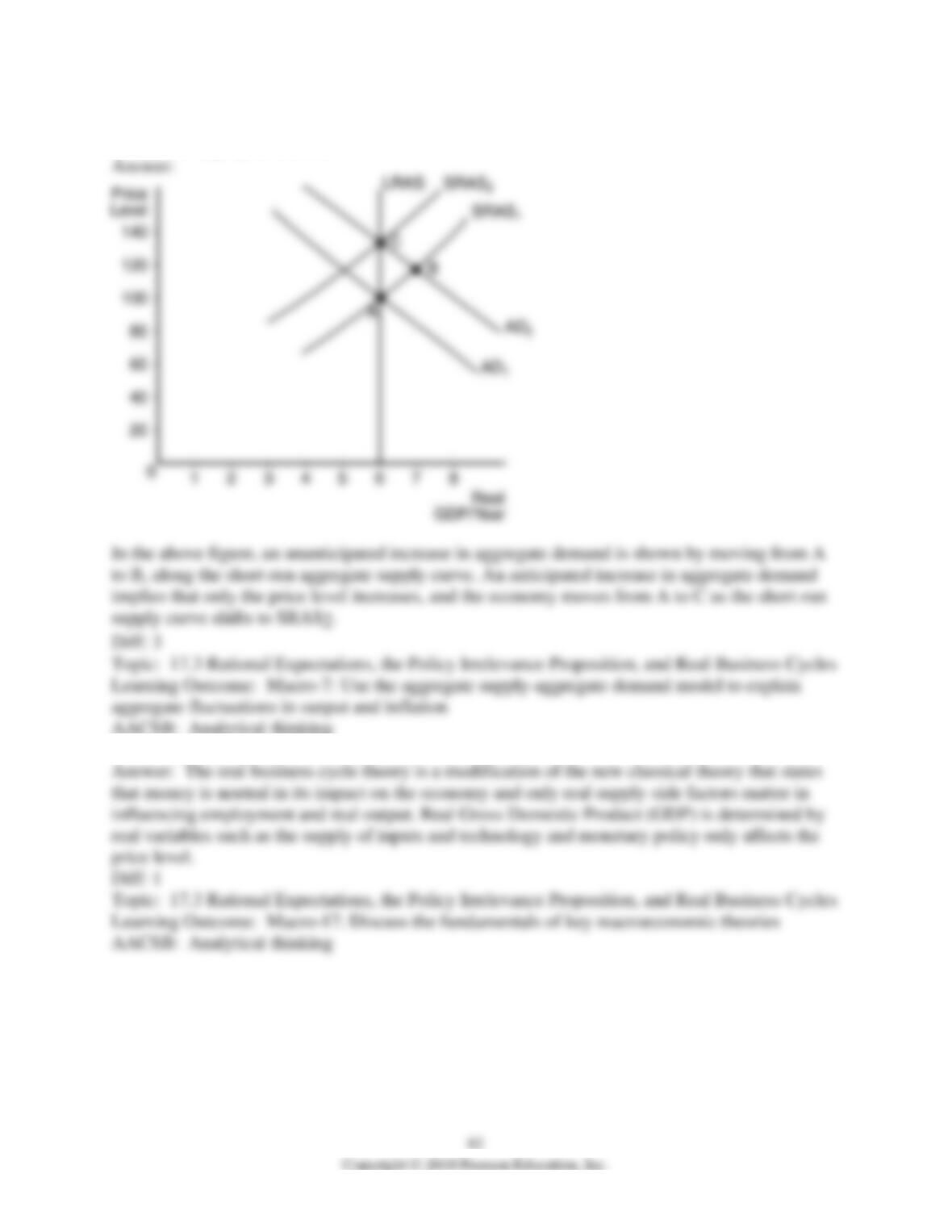
100) Using a graph, show and explain the difference between an anticipated and an unanticipated
increase in aggregate demand.
101) Describe and explain the real business cycle theory.
102) Explain the rational expectations hypothesis.
103) Describe and explain the policy irrelevance proposition.
17.4 Modern Approaches to Justifying Active Policymaking
1) According to sticky-price theories,
A) only fiscal policy is an effective stabilization policy.
B) only monetary policy is an effective stabilization policy.
C) both fiscal and monetary policy can be effective stabilization policies.
D) neither fiscal nor monetary policy is an effective stabilization policy.
2) Costs that deter firms from changing prices in response to demand changes are known as
A) sticky costs.
B) menu costs.
C) transaction costs.
D) implicit costs.
3) During the 1960s, many Keynesian economists felt that by studying the Phillips curve
A) policy makers could dispense with the Federal Reserve’s open-market operations.
B) policy makers could fine-tune the economy by selecting policies that would produce the exact
mix of unemployment and inflation that suited current government objectives.
C) the President and Congress did not need to attempt to balance the budget.
D) policy makers could eliminate even frictional unemployment in the economy.
4) Which of the following can help explain why prices might be “sticky”?
A) the rational expectations hypothesis
B) the policy irrelevance proposition
C) people are not rational
D) menu costs
5) The menu cost theory states that
A) prices are not fully flexible because it is costly for firms to change prices every time there is a
demand change.
B) economic agents quickly learn the likely responses of the Fed to changes in unemployment.
C) prices depend only on the input costs.
D) the economy is characterized by perfect competition.
6) Some economists suggest that because of the costs of negotiating contracts, printing price
lists, etc., it is costly for firms to change prices in response to demand changes. This hypothesis
is known as the
A) sticky wage theory.
B) menu cost theory.
C) Phillips theory.
D) rational expectations theory.
7) The menu cost theory suggests that
A) there will be no unemployment.
B) wages and prices move freely and quickly.
C) frequent price changes are costly for firms.
D) perfect competition does not exist.
8) In new Keynesian theory, the pattern of inflation exhibited by an economy with growing
aggregate demand known as inflation dynamics is
A) initially sluggish upward adjustment of the price level and inflation in response to higher
aggregate demand followed by higher inflation in the future.
B) initially speedy upward adjustment of the price level and inflation in response to higher
aggregate demand followed by lower inflation in the future.
C) initially sluggish downward adjustment of the price level and inflation in response to higher
aggregate demand followed by lower inflation in the future.
D) initially speedy upward adjustment of the price level and inflation in response to higher
aggregate demand followed by higher inflation in the future.
9) The term for a pattern of initially sluggish adjustment of the equilibrium price level to a
change in aggregate demand followed by a greater adjustment in the future is
A) real-business-cycle inflation dynamics.
B) New Keynesian inflation dynamics.
C) passive price dynamics.
D) active price dynamics.
10) According to the new Keynesian sticky-price theory, a rise in aggregate demand results in
________ price level in the near term and in ________ price level in the longer term.
A) a higher; an unchanged
B) an unchanged; a higher
C) a lower; an unchanged
D) a lower; a higher
11) The most important new Keynesian assumption that distinguishes this theory from the real-
business-cycle theory is the new Keynesian assumption
A) of a horizontal aggregate demand curve.
B) of price flexibility.
C) about the importance of interest rates in determining investment spending.
D) of a horizontal short-run aggregate curve.
12) Which of the following is NOT associated with the new Keynesian economics?
A) inflation dynamics
B) small-menu cost theory
C) policy irrelevance proposition
D) sticky-price theories of real GDP determination
13) The costs associated with changing prices are called
A) price costs.
B) implicit costs.
C) menu costs.
D) market-clearing costs.
14) Which of the following statements concerning price rigidity is TRUE?
A) Since the economy experiences continued inflation prices are not rigid.
B) Prices will be rigid when there is unanticipated monetary policy but not when there is
anticipated monetary policy.
C) Data has clearly demonstrated that the long run aggregate supply curve is horizontal.
D) When there are demand changes, firms will not change their price because of the costs
associated with renegotiating contracts and informing customers of price changes.
15) A theory suggesting that price stickiness leads to sluggish short-run adjustment of the price
level to variations in aggregate demand is known as
A) new Keynesian flexible-price business cycles.
B) new Keynesian inflation dynamics.
C) real-business-cycle fixed-price business cycles.
D) real-business-cycle inflation dynamics.
16) The theory of new Keynesian inflation dynamics suggests that a fall in aggregate demand
would
A) immediately reduce the price level, followed by a more sluggish decline in real GDP.
B) immediately raise the price level, followed by a more sluggish decline in real GDP.
C) immediately reduce real GDP, followed by a more sluggish decline in the price level.
D) immediately raise real GDP, followed by a more sluggish increase in the price level.
17) According to the new Keynesian theory, the widespread importance of small menu costs
results in variations in aggregate demand causing both
A) greater short-run adjustments in real GDP and delayed adjustment in the price level.
B) greater short-run adjustments in the real GDP and immediate adjustment in the price level.
C) smaller short-run adjustments in real GDP and delayed adjustment in the price level.
D) smaller short-run adjustments in real GDP and immediate adjustment in the price level.
18) New Keynesian inflation dynamics can account for sluggish responses of
A) real GDP to changes in aggregate supply.
B) real GDP to changes in aggregate demand.
C) inflation to changes in aggregate supply.
D) inflation to changes in aggregate demand.
19) If the price of sugar changed in the market from 20 cents to 25 cents per pound, and
Sunharvest Grocery Market didn’t change the price it charges for the sugar, this behavior is likely
due to
A) discretionary policy.
B) irrational expectations.
C) large menu costs.
D) small menu costs.
20) Costs that tend to deter firms from changing their prices in response to changes in the market
equilibrium price are referred to as
A) large menu costs.
B) small menu costs.
C) real menu costs.
D) burden costs.
21) Which of the following factors strengthens the case for policy activism?
A) sticky prices
B) flexible wages
C) flexible prices
D) lack of real-business-cycles
22) Menu costs are a possible reason for
A) aggregate supply shocks.
B) low levels of consumer confidence in response to aggregate supply shocks.
C) sticky product prices.
D) swings in the labor force participation rate.
23) Costs of renewing contracts or printing new price lists are known as
A) implicit economic costs.
B) menu costs.
C) operating costs.
D) opportunity costs.
24) Small menu costs are a common reason offered for the existence of
A) sticky wages.
B) sticky resource prices.
C) sticky prices.
D) sticky output adjustments.
25) Economists who favor policy activism argue that the United States economy is NOT always
in equilibrium because
A) the national debt is too large.
B) the Federal Reserve’s monetary policy is too restrictive.
C) the markets are over regulated.
D) wage and price rigidities exist.
26) Menu costs are
A) the constantly changing resource prices that make planning for firms difficult.
B) the advertised prices for final products that firms guarantee for a certain period of time.
C) the cost of compliance with government regulations.
D) the costs that deter firms from changing prices in reaction to demand changes.
27) If a significant portion of firms in the economy does NOT immediately adjust product prices,
then the short-run aggregate supply curve
A) slopes upward.
B) slopes downward.
C) is horizontal.
D) is vertical.
28) The new Keynesian sticky-price theory indicates that an increase in aggregate demand
generates
A) a speedy rise in real GDP but a sluggish increase in the price level.
B) a speedy rise in the price level but a sluggish increase in real GDP.
C) sluggish increases in both real GDP and the price level.
D) rapid increases in both real GDP and the price level.
29) If a significant portion of firms in the economy does NOT adjust product prices, a predicted
result according to new Keynesian theory is
A) real business cycles.
B) real inflation cycles.
C) inflation dynamics.
D) output dynamics.
30) New Keynesian inflation dynamics predicts that an increase in aggregate demand will
generate, in chronological order
A) a leftward movement along a horizontal short-run aggregate supply curve, a short-run decline
in real GDP, a downward shift in the short-run aggregate supply curve, and a decrease in the
price level.
B) a rightward movement along a horizontal short-run aggregate supply curve, a short-run
increase in real GDP, an upward shift in the short-run aggregate supply curve, and an increase in
the price level.
C) an leftward shift in a vertical short-run aggregate supply curve, a short-run decline in real
GDP, an upward movement along the short-run aggregate supply curve, and an increase in the
price level.
D) a rightward shift in a vertical short-run aggregate supply curve, a short-run increase in real
GDP, an upward movement along the short-run aggregate supply curve, and an increase in the
price level.
31) According to the hypothesis of New Keynesian inflation dynamics, an increase in aggregate
demand brings about
A) initial sluggish adjustment of the price level followed by higher inflation later on.
B) initial rapid adjustment of the price level followed by lower inflation later on.
C) initial sluggish adjustment of real GDP followed by more rapid real GDP growth later on.
D) sluggish growth in real GDP both initially and later on.
32) According to some New Keynesian theories, one possible rationale for active policy making
is
A) flexible prices.
B) sluggish adjustment of the price level in response to changes in aggregate demand
C) people are not rational and so do not react to incentives.
D) growing competition in U.S. product markets.
33) New Keynesian theory implies that which of the following reduces firms’ incentive to adjust
their prices?
A) a downward sloping aggregate demand curve
B) the required reserve ratio
C) menu costs
D) none of the above
34) New Keynesians hypothesize that
A) the relationship between inflation and unemployment is exploitable in the long run.
B) the relationship between inflation and unemployment is exploitable in the short run.
C) there is no relationship between inflation and unemployment.
D) fluctuations in output are largely caused by supply shocks.
35) What did Milton Friedman and E.S. Phelps argue with respect to the Phillips Curve?
A) The Phillips Curve could accurately guide activist policy makers over the long run.
B) The inverse relationship between unemployment and inflation only holds in the long run. In
the short run, unemployment and inflation are positively related.
C) Economic participants would soon understand activist policymakers’ strategy and revise their
expectations, making discretionary efforts to fine-tune the economy ineffective.
D) The inflation rate will consistently be 2 percentage points below the unemployment rate.
36) The stagflation experienced in the U.S. during the late 1960s and the 1970s showed us that
A) the Phillips curve accurately represents the trade-off between unemployment and inflation.
B) both inflation and economic expansion could exist simultaneously.
C) the relationship between unemployment and inflation was not as clear-cut as presented on the
Phillips curve.
D) it is possible to alleviate economic stagflation through the government discretionary fiscal
policy.
37) Economists Milton Friedman and E.S. Phelps suggested that the apparent trade-off suggested
by the Phillips curve could not be exploited by policy makers, because
A) economic participants routinely incorporate changes in the inflation rate into their
expectations.
B) economic participants are not rational, and therefore act unpredictably to any policy change.
C) unemployment levels and the inflation rate have a clear, positive relationship.
D) unemployment levels and the inflation rate have a negative (inverse) relationship.
38) According to New Keynesians, which of the following is a key factor that determines the
inflation rate?
A) anticipated future inflation
B) fiscal policy
C) supply shock
D) the menu cost
39) According to New Keynesians, which of the following is one of the two key factors that
determines the inflation rate?
A) fiscal policy
B) firms’ average inflation adjusted per-unit costs of production
C) energy cost
D) monetary policy
40) The longer is the interval between firms’ price adjustments
A) the longer the interval that the horizontal new Keynesian aggregate supply curve will remain
in position.
B) the shorter the interval the horizontal new Keynesian aggregate supply curve will remain in
position.
C) the new Keynesian aggregate supply curve will become steeper.
D) the smaller the output effect of a given change in the money supply.
41) New Keynesians argue that
A) appropriate activist policies can reduce cyclical fluctuations.
B) appropriate activist policies will increase the length of cyclical fluctuations.
C) appropriate activist policies will have an known effect on the length of cyclical fluctuations.
D) none of the above.