Economics Today, 19e (Miller)
Chapter 17 Stabilization in an Integrated World Economy
17.1 Active versus Passive Policymaking and the Natural Rate of Unemployment
1) Active policymaking refers to
A) actions taken by policy makers in response to a change in the overall economy.
B) policy making that is carried out in response to a rule.
C) relying on policies that act as automatic stabilizers.
D) nondiscretionary policymaking.
2) Active policymaking would include all of the following EXCEPT
A) interest rate changes by the Fed.
B) tax increases.
C) unemployment insurance benefits.
D) increased government spending by the Congress.
3) Which of the following would be an example of passive policymaking?
A) establishing a system of automatic tax stabilizers
B) marginal rate tax cuts intended to increase real Gross Domestic Product (GDP)
C) government spending decreases intended to decrease real Gross Domestic Product (GDP)
D) raising the money supply when the unemployment rate increases.
4) Monetary and fiscal policymaking that is carried out in response to a pre-set rule and does
NOT respond to changes in economic activity is known as
A) active policymaking.
B) discretionary policymaking.
C) nondiscretionary policymaking.
D) Keynesian policymaking.
5) When policymakers make decisions in response to a pre-specified rule, they are undertaking
A) active policy.
B) discretionary policy.
C) passive policy.
D) irrational policy.
6) With discretionary policy making, fiscal and monetary policies are usually
A) undertaken in response to or anticipation of some change in the overall economy.
B) set according to pre-established standards that do not take into account any changes in the
economy.
C) immune to any political overtones.
D) immune to any lag times that might counter their effectiveness.
7) If a policymaker is convinced that time lags frequently negate the impact of short-run
stabilization efforts, it is likely she would favor ________ policymaking.
A) nondiscretionary
B) discretionary
C) active
D) aggressive
8) When policy makers take actions in response to or in anticipation of some change in the
overall economy, there is
A) active policymaking.
B) passive policymaking.
C) rationalization policymaking.
D) rational expectations policymaking.
9) Proponents of passive policymaking believe that
A) the existence of time lags makes active policy ineffective or even procyclical.
B) time lags do not exist so the economy will adjust too rapidly with active policy.
C) government should not follow any particular policy.
D) fiscal policy is always better than monetary policy in stabilizing the economy.
10) Which of the following scenarios can be classified as passive policymaking?
A) The Federal Reserve cuts the federal funds rate in order to increase economic activity.
B) The federal government increases spending in order to create jobs.
C) The Federal Reserve adjusts the money supply as appropriate to attain a target rate of
inflation.
D) Congress increases expenditures in an effort to stimulate economic activity.
11) Actions on the part of monetary and fiscal policymakers that are undertaken in response to
some change in the overall economy are known as
A) nondiscretionary policymaking.
B) passive policymaking.
C) creative policymaking.
D) active policymaking.
12) When policymakers base their actions on a rule there is
A) active policymaking.
B) passive policymaking.
C) rationalization policymaking.
D) rational expectations policymaking.
13) An example of nondiscretionary policymaking is
A) a rule under which the Fed targets the inflation rate.
B) expansionary fiscal policy.
C) changes in the interest rate initiated by the Fed.
D) a Congressional tax-rate cut aimed at boosting real GDP.
14) If a policy is carried out by a rule, then we have an example of
A) active policymaking.
B) discretionary policymaking.
C) nondiscretionary policymaking.
D) natural policymaking.
15) Suppose a constitutional amendment is passed that mandates a balanced federal budget every
year and the President and Congress consistently carry this mandate out. This would be an
example of
A) active policymaking.
B) decisive policymaking.
C) nondiscretionary policymaking.
D) cooperative policymaking.
16) The Federal Reserve is anticipating a contractionary period in the economy. The Fed decides
to engage in open market operations to stimulate the economy. This action is
A) active policymaking.
B) passive policymaking.
C) the monetary rule.
D) nondiscretionary rule.
17) Which of the following statements has been proposed as a benefit of passive policymaking?
A) Passive policymaking allows for making immediate changes in response to an anticipated
change in economic performance.
B) Passive policymaking utilizes the rational expectations hypothesis.
C) When using passive policymaking there is no tradeoff between price stability and
unemployment.
D) Passive policymaking does not wait for the time lag between recognition of a problem and
policy action before engaging in economic policies to stabilize the economy.
18) Which one of the following is an example of passive policymaking?
A) introducing expansionary monetary policy to combat a recession
B) introducing expansionary monetary policy to combat inflation
C) introducing expansionary fiscal policy to combat a recession
D) following a predetermined monetary policy rule
19) What best defines active policymaking?
A) taking action to offset a change in economic performance
B) taking action to increase long-term economic growth
C) taking action to make markets more competitive so as to improve efficiency
D) taking action to make markets less competitive so as to improve equity
20) Policymaking that is carried out in response to a rule is
A) active policymaking.
B) passive policymaking.
C) restrictive policymaking.
D) determined policymaking.
21) The idea of policymaking taking place in response to a predetermined set of rules is referred
to as
A) active policymaking.
B) discretionary policymaking.
C) passive policymaking.
D) Keynesianism.
22) The idea of policymaking being undertaken as a response to a change in the economy is
referred to as
A) active policymaking.
B) non-discretionary policymaking.
C) passive policymaking.
D) Keynesianism.
23) If the rate of growth in the money supply is predetermined on the basis of a monetary rule,
this is known as
A) direct policymaking.
B) active policymaking.
C) passive policymaking.
D) fiscal policymaking.
24) If the Fed engages in open market sales in direct response to an increase in the rate of
inflation, this is known as
A) direct policymaking.
B) active policymaking.
C) passive policymaking.
D) fiscal policymaking.
25) Structural unemployment is likely to be affected by
A) an economic recession or boom.
B) the reservation wage curves of people.
C) minimum wage laws in the economy.
D) the amount of the money supply.
26) Which of the following types of unemployment that occurs after all adjustments in the labor
market have occurred?
A) passive unemployment
B) natural unemployment
C) cyclical unemployment
D) seasonal unemployment
27) What types of unemployment will still exist when the economy is at the natural rate of
unemployment?
A) none as there will be no unemployment
B) frictional and structural unemployment only
C) structural and cyclical unemployment only
D) frictional, structural, and cyclical unemployment
28) The Phillips curve shows the relationship between
A) the price level and real Gross Domestic Product (GDP).
B) the real Gross Domestic Production (GDP) and the unemployment rate.
C) the unemployment rate and inflation rate.
D) the interest rate and exchange rate.
29) Structural unemployment may result from all of the following factors EXCEPT
A) union wage contracts.
B) a higher minimum wage.
C) improved college education.
D) welfare and unemployment benefits.
30) You recently graduated from college and you are actively looking for employment. The
economy has completely recovered from the last recession and you are taking your time looking
for the “perfect” job. In the meantime, the unemployment you are experiencing is categorized as
A) cyclical.
B) structural.
C) seasonal.
D) frictional.
31) The natural rate of unemployment is
A) zero.
B) the unemployment rate when there is no structural unemployment.
C) the unemployment rate becomes negative.
D) the unemployment rate that exists in long-run equilibrium, after adjustments to all changes
have occurred.
32) The natural rate of unemployment
A) prevails in long-run macroeconomic equilibrium, when all workers and employers have fully
adjusted to any changes in the economy.
B) prevails in the short-run macroeconomic equilibrium, before workers and employers have had
a chance to adjust to an economic shock.
C) exists due to welfare and unemployment benefits that reduce potential workers’ incentives to
find work.
D) exists only during periods of recession or depression in the economy.
33) The natural rate of unemployment includes
A) frictional and cyclical unemployment.
B) only cyclical unemployment.
C) workers who are underemployed.
D) frictional unemployment and structural unemployment.
34) The difference between the actual unemployment rate and the natural unemployment rate is
A) cyclical unemployment.
B) frictional unemployment.
C) the percentage of discouraged workers in the labor force.
D) structural unemployment.
35) According to the text, minimum-wage laws cause increases in
A) employment possibilities.
B) structural unemployment.
C) poverty.
D) productivity.
36) Frictional and structural unemployment both exist
A) when inflation becomes very high.
B) when the economy is in long-run equilibrium.
C) only when the economy is at the peak of the business cycle.
D) only when the economy is in recession.
37) An increase in unemployment insurance and other transfer payments may
A) increase the natural rate of unemployment.
B) increase the number of discouraged workers.
C) reduce the rate of inflation at every level of unemployment.
D) lead to less unanticipated inflation.
38) From 1950 until the late 1980s, the natural rate of unemployment in the United States
A) fell sharply as government retraining programs helped put the unemployed back to work.
B) cycled up and down in tandem with the actual rate of unemployment.
C) rose sharply, always exceeding the actual rate of unemployment.
D) trended upward.
39) From the late 1980s to 2000, the natural rate of unemployment
A) climbed sharply.
B) held constant.
C) fluctuated up and down, following the path of the actual rate of unemployment.
D) gradually declined.
40) During a recession, the overall unemployment rate
A) falls rapidly.
B) exceeds the natural rate of unemployment.
C) falls below the natural rate of unemployment.
D) equals the inflation rate.
41) Cyclical unemployment is
A) the difference between the unemployment rate when the economy is in a recession and the
unemployment rate when the economy is at the peak of an expansion.
B) the difference between the actual unemployment rate and the natural rate of unemployment.
C) the unemployment due to union activities and government-imposed restrictions to entry into
specific occupations.
D) the unemployment due to the unemployment benefits and welfare programs of the
government.
42) If cyclical unemployment is negative, then
A) the actual unemployment rate is below the natural rate of unemployment.
B) the natural rate of unemployment is getting smaller.
C) there have been some errors in classifying the type of unemployment experienced by some
people.
D) structural unemployment must be increasing.
43) Which of the following unemployment rates can be negative?
A) the cyclical unemployment rate
B) the natural unemployment rate
C) the seasonal unemployment rate
D) the unemployment rate that includes underemployment
44) Which type of unemployment is associated with the slump in aggregate demand that
accompanies a recession?
A) expansionary unemployment
B) cyclical unemployment
C) frictional unemployment
D) structural unemployment
45) An unexpected increase in aggregate demand typically causes
A) frictional unemployment to increase but structural unemployment to decrease.
B) the price level to increase but has no effect on the unemployment rate.
C) the price level to increase and the unemployment rate to fall.
D) the price level to increase and the unemployment rate to increase.
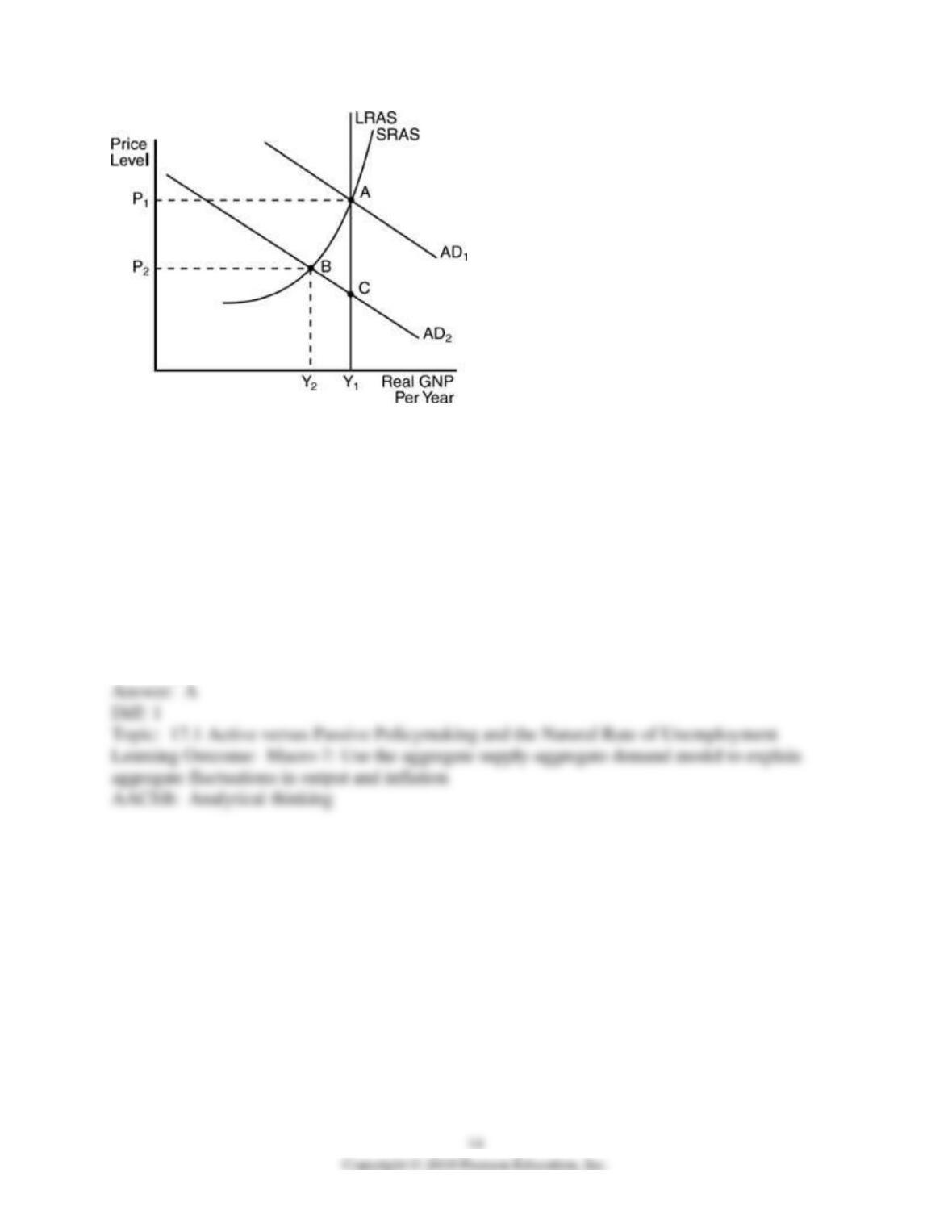
46) In the above figure, start with the economy in equilibrium at point A. Then an unanticipated
reduction in aggregate demand triggers a shift from AD1 to AD2. In the short run, this would
cause
A) the price level to fall from P1 to P2, real Gross Domestic Product (GDP) to fall from Y1 to
Y2, and the rate of unemployment to increase.
B) the price level to move from P1 to P2, but real Gross Domestic Product (GDP) would stay at
Y1.
C) the price level to fall by some amount less than P1 but greater than P2, and the rate of
unemployment would decrease.
D) no change in either the price level or real Gross Domestic Product (GDP), but a decrease in
unemployment.
47) Suppose the economy is initially operating at point A in the above figure. Which of the
following statements is TRUE?
A) An unexpected reduction in aggregate demand will cause the economy to move from point A
to point B in the long run.
B) An unexpected reduction in aggregate demand will cause the economy to move from point A
to point B in the short run.
C) An unexpected reduction in aggregate demand will cause the economy to move from point A
to point C in the short run.
D) none of the above
48) One result of an unanticipated reduction in aggregate demand would be that
A) fewer firms would be hiring.
B) more firms would be hiring.
C) there would be no change in hiring.
D) the price level would rise.
49) On average, the greater the unexpected decline in aggregate demand
A) the weaker is the resulting deflation.
B) the greater is the resulting deflation.
C) the greater is the resulting inflation.
D) the greater is the rise in the price level.
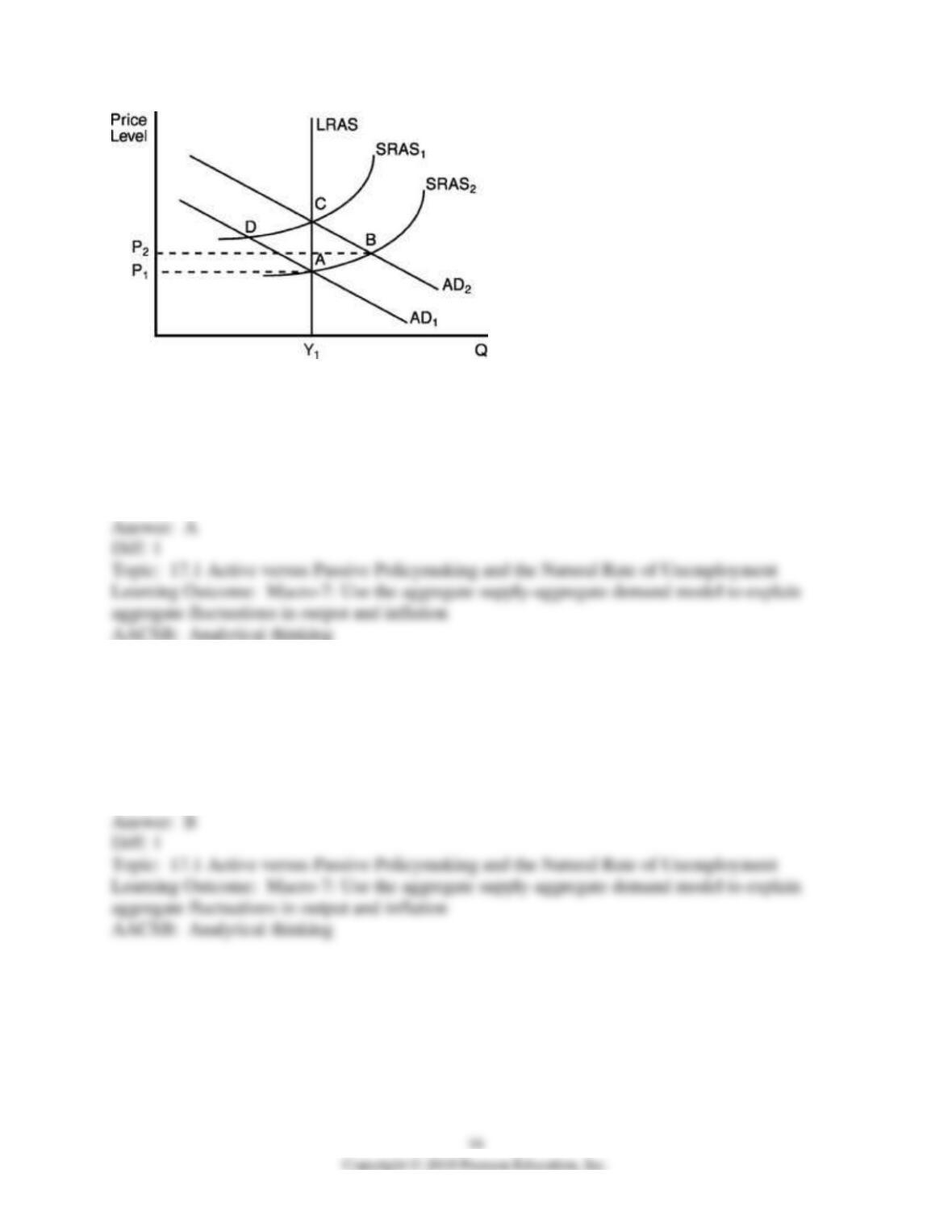
50) In the above figure, if A is the initial equilibrium point and there is an unanticipated rise in
aggregate demand from AD1 to AD2, then
A) the new short-run equilibrium will be at point B.
B) the new long-run equilibrium will be at point B.
C) the new short-run equilibrium will be at point D.
D) real Gross Domestic Product (GDP) per year will fall below Y1.
51) In the above figure, if initial equilibrium is at point A and if there is an unanticipated
increase in aggregate demand from AD1 to AD2, then
A) in the short run real output will remain at Y1.
B) in the short run real output will increase above Y1, but in the long run it will return to Y1.
C) in the long run real output will increase above Y1.
D) real output will increase above Y1 in both the short run and in the long run.
52) In the above figure, if initial equilibrium is at point A and there is a fully anticipated increase
in aggregate demand from AD1 to AD2 due to an anticipated increase in the money supply, then
A) the economy will move directly from point A to point C without passing through point B.
B) the economy will move directly from point A to point B, and will remain at point B in the
long run.
C) the price level will shift to P2 in the short run.
D) the price level will shift to P2 in the long run.
53) Suppose that the inflation rate has been 2 percent per year for several years, and the
unemployment rate has been stable at 5 percent. Unanticipated changes in government policy
cause the inflation rate to increase to 5 percent. In the short run, we would expect the
unemployment rate to
A) remain constant.
B) increase to 7 percent.
C) increase, but the exact amount cannot be known for sure.
D) decrease.
54) In the short run, unanticipated inflation typically leads to
A) higher rates of unemployment.
B) decreases in aggregate demand.
C) lower rates of unemployment.
D) workers’ thinking the real wage has been reduced.
55) When the actual unemployment rate is greater than the NAIRU, the inflation rate
A) tends to increase.
B) tends to decrease.
C) remains unchanged.
D) falls to zero.
56) Assume that the government decides to use fiscal or monetary policy to stimulate the
economy and that this action comes as a surprise to most individuals and businesses. In the short
run, the result will be
A) a decrease in the average duration of unemployment and a decrease in the unemployment
rate.
B) an increase in the average duration of unemployment and an increase in the unemployment
rate.
C) a decrease in aggregated demand and a rise in the price level.
D) an increase in aggregate demand and a fall in the price level.
57) An important source of structural unemployment is
A) seasonal variations in aggregate demand.
B) unemployment insurance benefits.
C) people looking for the right job decide to change jobs.
D) recessions.
58) Which of the following is NOT a possible cause of structural unemployment?
A) individuals take the time to search for the best job opportunities
B) a mismatch of worker training and skills with requirements of employers
C) government-imposed minimum wage laws
D) union activity that sets wages above the equilibrium level
59) The natural rate of unemployment is
A) the unemployment rate when cyclical unemployment is the only type of unemployment.
B) the unemployment rate when there is no frictional unemployment.
C) the rate of unemployment associated with long-run equilibrium.
D) zero.
60) The natural rate of unemployment consists of
A) unemployment associated with high inflation.
B) only seasonal unemployment.
C) only structural unemployment.
D) structural and frictional unemployment.
61) When the economy is in long-run equilibrium, there will be
A) no unemployment.
B) frictional and structural unemployment.
C) cyclical unemployment only.
D) cyclical and seasonal unemployment.
62) Suppose the natural rate of unemployment is 4 percent. If the actual unemployment is 5
percent, then the cyclical unemployment rate is
A) -9 percent.
B) -1 percent.
C) 1 percent.
D) 9 percent.
63) Deviations of the actual unemployment rate from the natural rate of unemployment are called
A) frictional unemployment.
B) cyclical unemployment.
C) seasonal unemployment.
D) underemployment.
64) When the economy is operating at a level of real GDP that is greater than its potential level,
we know that
A) the actual unemployment rate is greater than the natural rate of unemployment.
B) the structural rate of unemployment is negative.
C) the frictional unemployment is zero.
D) the cyclical rate of unemployment is negative.