
CHAPTER 17—CAPITAL BUDGETING Key
1. Holding all else equal, the profitability index will fall following an increase in the:
2. The discount rate that equates present value of cash inflows and outflows is called the:
3. Acceptance of investment projects where IRR > MCC:
4. Acceptance of new investment projects will increase the value of the firm provided that:
5. The change in net cash flows due to an investment project is called:
6. Generally, a firm’s estimated component cost of debt:
7. An estimate of the firm’s cost of equity capital is:
8. The pattern of returns for all potential investment projects is the:
9. Examples of mandatory nonrevenue-producing investments are provided by:
10. Net present value is the:
11. Capital budgeting is the process of planning investment expenditures when returns are expected to:

12. When net present value is positive:
13. The most difficult step in capital expenditure analysis is estimating:
14. Cash flows include depreciation:
15. Net present value equals:
16. The internal rate of return can be calculated by solving for ki after setting net present value equal to:
17. Firms should finance a project if its:
18. A firm must choose between two projects, X and Y. Project X has the highest net present value, but project
Y has the highest profitability index. The firm should choose project Y if:
19. The first step in most capital budgeting decisions is:
20. If the tax rate is 25% and the prevailing interest rate is 12%, the after tax cost of debt is:
21. The crossover discount rate only equates the:

22. When NPV is positive, the IRR:
23. The risk-free rate of return is the investor reward for:
24. The cost of capital is the:
25. The beta coefficient is:
26. Cost of Capital. Indicate whether each of the following statements is true or false. Explain why.
A.
In practice, the component costs of debt and equity are independently, determined.
B.
The marginal cost of capital will be more elastic for larger as opposed to smaller firms.
C.
Information costs both increase the marginal cost of capital and reduce the internal rate of return on investment projects.
D.
Investments necessary to replace worn-out or damaged equipment tend to have high levels of risk.
E.
Depreciation expenses that involve no direct cash outlay must be incorporated in investment project evaluation.
to scarce managerial talent.
Similarly, the task of information gathering in the investment project evaluation process reduces the IRR from those projects.

27. NPV Analysis. The net present value (NPV), profitability index (PI), and internal rate of return (IRR)
methods are often employed in project valuation. Indicate whether each of the following statements is true or
false and explain why.
A.
A PI < 1 describes a project with IRR < k.
B.
Selection solely according to the PI criterion will tend to favor smaller as opposed to larger investment projects.
C.
Use of the NPV criterion is especially appropriate for larger firms with easy access to capital markets.
D.
The IRR method can tend to overstate the relative attractiveness of investment projects when the opportunity cost of cash flows is
below the IRR.
E.
When NPV > 0, the IRR exceeds the cost of capital.
28. Cost of Capital. Determine whether each of the following would increase or decrease the firm’s cost of
capital for investment project evaluation. Explain.
A.
The company’s stock price suffers a sharp decline, but no decline in the company’s earnings potential is perceived.
B.
A merger with a leading competitor increases the company’s stock price substantially.
C.
The company’s home state increases the corporate state income tax.
D.
In an effort to spur business activity, Congress cuts corporate income taxes.
True. Selection according to the PI criterion will tend to favor smaller as opposed to larger investment projects so as to maximize the
29. Rate-of-Return Analysis. New York City licenses taxicabs in two classes: (1) for operation by companies
with fleets, and (2) for operation by independent driver-owners who have only one cab. It also fixes the rates
that taxis charge. For many years, no new licenses have been issued in either class. In the unofficial market for
licenses (medallions), their market value is currently roughly $250,000.
A.
Does the $250,000 medallion price indicate that operators of New York taxicabs are earning only normal profits?
B.
What factors would determine whether a change in the fare fixed by the city would raise or lower the value of a license?
C.
Cab drivers, whether hired by companies or as owners of their own cabs, seem unanimous in opposing any increase in the number of
cabs licensed. They argue that an increase in the number of cabs would increase competition for customers, and drive down what they
regard as an already unduly low return to drivers. Is their economic analysis correct? Who would benefit and who would lose from an
expansion in the number of licenses issued at a nominal fee?
expected economic profit of $25,000 (= 0.1 ´ $250,000) per year.
cost reductions associated with fare increases) in order to answer this question.
service at lower fares. New entrants would benefit through lower capital costs and generally easier entry.
weighted average cost of capital.

30. NPV Analysis. The Santa Catalina Passenger Ferry Company is contemplating leasing an additional
ferryboat to expand service to Santa Monica or Newport Beach. Financial analysis resulted in the following
projections for a 5-year planning horizon:
Santa Monica
Newport Beach
Cost
$300,000
$200,000
PV of expected cash flow @k = 15%
$375,000
$270,000
A.
Calculate the net present value for each service. Which is more desirable according to the NPV criterion?
B.
Calculate the profitability index for each service. Which is more desirable according to the PI criterion?
C.
Under what conditions would either or both of the services be undertaken?
A.
Santa Monica
= PV Cash Flow – Cost
= $375,000 – $300,000
= $75,000
Newport Beach
= PV Cash Flow – Cost
= $270,000 – $200,000
= $70,000
B.
Santa Monica
= $375,000/$300,000
= 1.25

31. NPV Analysis. Nocando Retailing, Ltd. is contemplating leasing additional retail space to expand its
distribution network in northeastern markets. Financial analysis resulted in the following projections for a
five-year planning horizon:
Stand-Alone Stores
Shopping Mall Outlets
Cost
$2 million
$5 million
PV of expected cash flow @k = 12%
$2.5 million
$6 million
A.
Calculate the net present value for each type of retail space. Which is more desirable according to the NPV criterion?
B.
Calculate the profitability index for each. Which is more desirable according to the PI criterion?
C.
Under what conditions would either or both of the leasing options be undertaken?
Stand-Alone
Newport Beach
= $270,000/$200,000
= 1.35


32. NPV Analysis. Travel Services, Inc., is contemplating purchase of a number of seats on regularly scheduled
airlines for resale to leisure and business customers. The company projects the following costs and revenues for
each type of service:
Leisure
Business
Cost
$200,000
$ 75,000
PV of expected cash flow
$250,000
$100,000
A.
Calculate the net present value for each service. Which is more desirable according to the NPV criterion?
B.
Calculate the profitability index for each service. Which is more desirable according to the PI criterion?
C.
Under what conditions would either or both of the services be undertaken?
A.
Leisure
= PV Cash Flow – Cost
= $250,000 – $200,000
= $50,000
Business
= PV Cash Flow – Cost
= $100,000 – $75,000
= $25,000
B.
Leisure
= $250,000/$200,000
= 1.25

33. NPV Analysis. Paralegal Services, Inc., is contemplating purchase of additional computer hardware
equipment and software programming. Financial analysis resulted in the following projections for a three-year
planning horizon:
Hardware
Software
Cost
$500,000
$200,000
PV of expected cash flow @k = 20%
$750,000
$500,000
A.
Calculate the net present value for each. Which is more desirable according to the NPV criterion?
B.
Calculate the profitability index for each. Which is more desirable according to the PI criterion?
C.
Under what conditions would either or both investments be undertaken?
Hardware
Business
= $100,000/$75,000
= 1.33

34. NPV Analysis. The Health Maintenance Organization, Ltd., is considering offering extended service hours
during weekday and weekend periods. The company has the following projections for a two-year planning
horizon:
Weekday
Weekend
Cost
$150,000
$100,000
PV of expected cash flow @k = 8%
$125,000
$125,000
A.
Calculate the net present value for each service. Which is more desirable according to the NPV criterion?
B.
Calculate the profitability index for each service. Which is more desirable according to the PI criterion?
C.
Under what conditions would either or both of the services be undertaken?
A.
Weekday
= PV Cash Flow – Cost
= $125,000 – $150,000
Weekend
= PV Cash Flow – Cost
= $125,000 – $100,000
= $25,000
B.
Weekday
= $125,000/$150,000
= 0.83

35. NPV Analysis. QED Exploration, Ltd., is contemplating on-shore and off-shore oil and gas exploration
projects. Financial analysis resulted in the following projections for a ten-year planning horizon:
On-shore
Off-shore
Cost
$5 million
$3 million
PV of expected cash flow @k = 30%
$7 million
$4 million
A.
Calculate the net present value for each investment. Which is more desirable according to the NPV criterion?
B.
Calculate the profitability index for each investment. Which is more desirable according to the PI criterion?
C.
Under what conditions would either or both investments be undertaken?
Weekend
= $125,000/$100,000
= 1.25


36. Expected Return. Pediatric Medicine, Ltd., is considering two alternative capital budgeting projects.
Project A is an investment of $300,000 to renovate office facilities. Project B is an investment of $600,000 to
expand diagnostic capabilities. Relevant cash flow data for the two projects over their expected two-year lives
are as follows:
Year 1
Year 2
Pr.
Cash Flow
Pr.
Cash Flow
Project A
0.18
$ 0
0.08
$ 0
0.64
100,000
0.84
100,000
0.18
200,000
0.08
200,000
Project B
0.50
$ 0
0.125
$ 0
0.50
400,000
0.75
200,000
0.125
400,000
A.
Calculate the expected value, standard deviation, and coefficient of variation of cash flows for each project.
B.
Calculate the risk-adjusted NPV for each project, using a 12% cost of capital for the more risky project and 10% for the less risky one.
Which project is preferred using the NPV criterion?
C.
Calculate the PI for each project, and rank them according to their PIs.
D.
Calculate the IRR for each project, and rank them according to their IRRs.
E.
Compare your answers to parts B, C, and D, and discuss any differences.
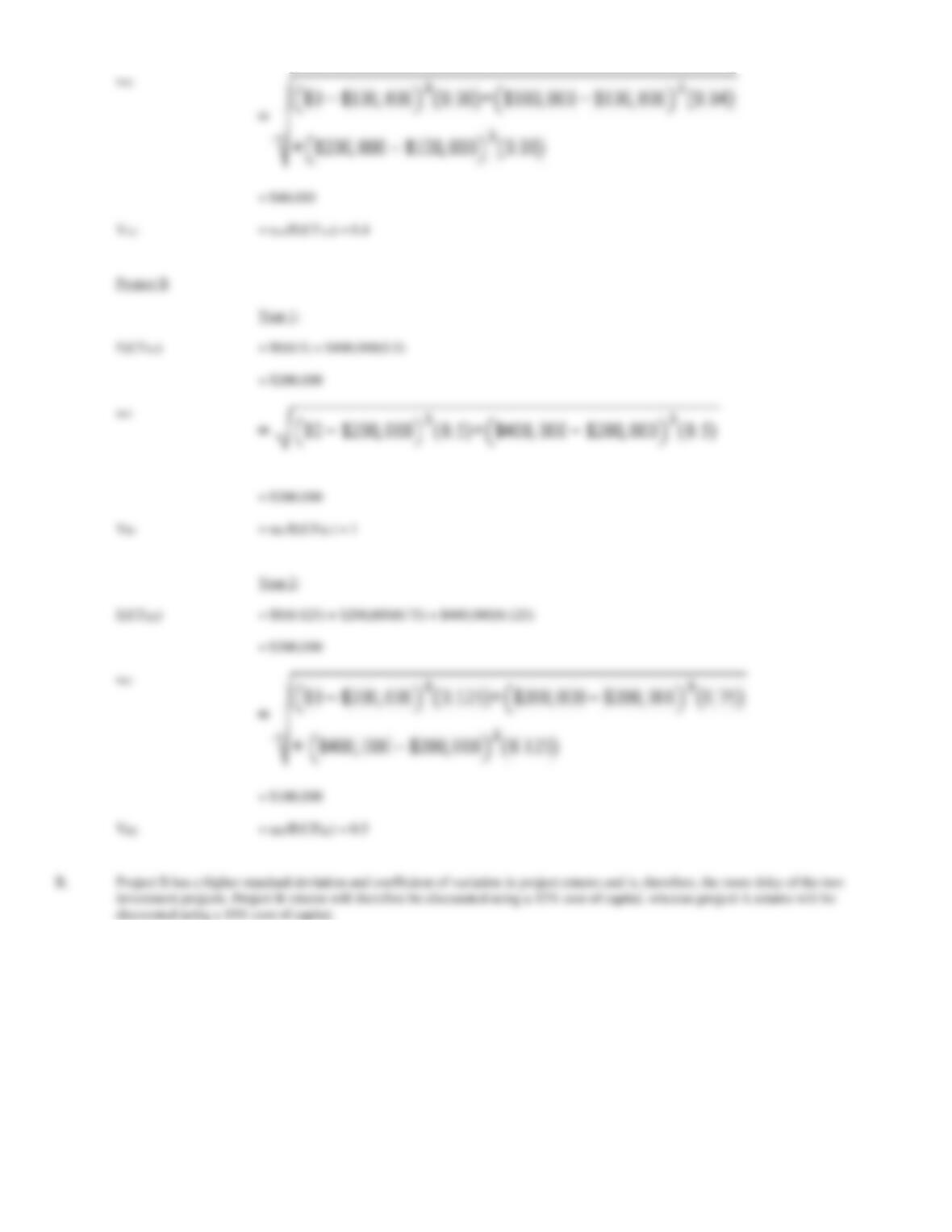
A.
Project A
Year 1:
= $0(0.18) + $100,000(0.64) + $200,000(0.18)
= $100,000
= $60,000
= sA1/E(CFA1) = 0.6
Year 2:
= $0(0.08) + $100,000(0.84) + $200,000(0.08)
= $100,000

37. Expected Return. Manhattan Transfer, Inc., is considering two alternative capital budgeting projects.
Project A is an investment of $225,000 to renovate warehouse facilities. Project B is an investment of $450,000
to expand distribution facilities. Relevant annual cash flow data for the two projects over their expected
five-year lives are as follows:
Project A
Project B
Pr.
Cash Flow
Pr.
Cash Flow
0.18
$ 50,000
0.245
$100,000
0.64
75,000
0.510
150,000
0.18
100,000
0.245
200,000
A.
Calculate the expected value, standard deviation, and coefficient of variation of cash flows for each project.
B.
Calculate the risk-adjusted NPV for each project, using a 15% cost of capital for the more risky project and 12% for the less risky one.
Which project is preferred using the NPV criterion?
C.
Calculate the PI for each project, and rank them according to their PIs.
D.
Calculate the IRR for each project, and rank them according to their IRRs.
E.
Compare your answers to parts B, C, and D, and discuss any differences.
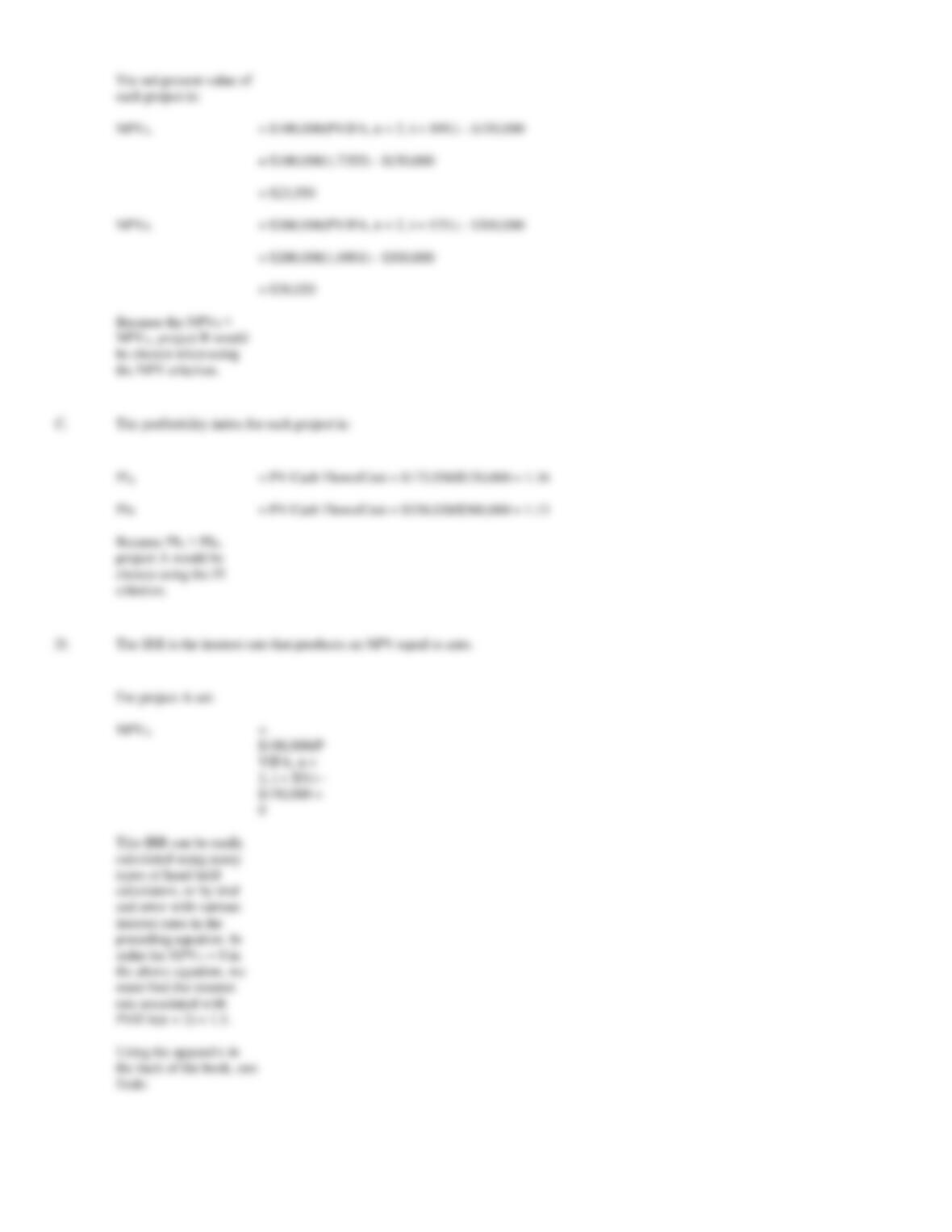
A.
Project A
Interest Rate
PVIFA (n = 2)
20%
1.5278
$2,780
24%
1.4568
-4,320
= $200,000(PVIFA, n = 2, i = X%) – $300,000 = 0