27) Forward guidance refers to central banks
A) setting long-term interest rates.
B) telling the public what future monetary policy will be.
C) simultaneously reducing unemployment and inflation.
D) engaging in monetary policy to offset the negative side-effects of the government’s fiscal policies.
28) Which of the following could decrease unemployment and inflation simultaneously?
A) a decrease in oil prices
B) expansionary monetary policy
C) contractionary monetary policy
D) an increase in the real wage
29) In August 1979, President Jimmy Carter appointed ________ as chairman of the Board of Governors
of the Federal Reserve System.
A) Ben Bernanke
B) Alan Greenspan
C) G. William Miller
D) Paul Volcker
30) If the current unemployment rate is 5%, under which of the following circumstances would you
expect the Fed to use contractionary monetary policy?
A) if the natural rate of unemployment is below 5%
B) if the natural rate of unemployment is above 5%
C) if the inflation rate is above 5%
D) if the inflation rate is below 5%
31) Which of the following is an appropriate policy for a central bank to follow if the economy is
plagued with deflation?
A) increasing the target interest rate on overnight loans
B) using contractionary monetary policy to drive up interest rates
C) consistently pursuing policy to promote the credibility of the central bank
D) gradually raising the required reserve rate
32) Deflation refers to
A) a decrease in the rate of inflation.
B) a falling price level.
C) Both A and B are correct.
D) None of the above is correct.
33) Disinflation refers to
A) a decrease in the price level.
B) a rapid increase in the price level.
C) a reduction in the rate of inflation.
D) an increase in the rate of inflation.
34) Expansionary monetary policy will result in
A) lower interest rates.
B) decreased rates of inflation.
C) a decrease in aggregate demand.
D) All of the above are correct.
35) If the Federal Reserve chooses to fight high unemployment with expansionary monetary policy and
firms and consumers expect this policy to increase inflation, which of the following would you expect to
see?
A) an upward shift of the short-run Phillips curve
B) a downward shift of the short-run Phillips curve
C) a decrease in the long-run aggregate supply curve
D) Both B and C are correct answers.
36) The experience of Paul Volcker’s fight against inflation during the late 1970s and early 1980s
indicates that firms and workers
A) had adaptive expectations.
B) had rational expectations and that they trusted Fed announcements.
C) preferred high unemployment to high inflation.
D) Both A and B are correct answers.
37) If the Federal Reserve announces that its target for the federal funds rate is falling from 3 percent to
2.25 percent, how do you expect workers and firms to react?
A) As long as the Fed’s announcement is credible, workers and firms will decrease their consumption
and investment spending, which will decrease aggregate demand and inflation.
B) As long as the Fed’s announcement is credible, workers and firms will increase their consumption
and investment spending, which will increase aggregate demand and inflation.
C) If the Fed’s announcement is not credible, workers and firms will not expect inflation to rise so they
will increase their consumption and investment spending, which will decrease aggregate demand and
increase inflation.
D) Workers and firms will incorporate the decrease in interest rates into their expectations of inflation,
and they will expect inflation to fall as a result of Fed’s policy announcement.
38) If the economy experiences a(n) ________, inflation will rise and real GDP will fall.
A) negative supply shock
B) positive supply shock
C) increase in short-run aggregate supply
D) decrease in aggregate demand
39) All of the following have enhanced the Fed’s credibility in conducting monetary policy except
A) following through with changes it has announced.
B) revealing the Fed’s target for the federal funds rate.
C) making the minutes of the open market committee meetings public.
D) discontinuing the policy of announcing whether it considered the economy to be at greater risk of
inflation or recession following each FOMC meeting.
40) Under Alan Greenspan, the Fed strived to hit its goals of price stability and high employment
through
A) setting targets for the federal funds rate of interest.
B) setting targets for rates of growth in the M1 and M2 money supplies.
C) practicing discretionary monetary policy, reacting to counter-changes in the level of unemployment
during recessions and booms.
D) strict adherence to rules based strategies.
41) Two actions by the Fed during Alan Greenspan’s term as chairman have been identified as possibly
contributing to the financial crisis in 2008. Which of the following was one of those actions?
A) decreasing the money supply to fight the possibility of disinflation
B) the decision during 1998 to help save the hedge fund Long Term Capital Management
C) working in concert with the European Central Bank to stabilize the dollar / euro exchange rate
D) financing the war in Afghanistan by printing money and generating rapid inflation
42) A study conducted by Alberto Alesina and Lawrence Summers concluded that countries with
________ had lower inflation rates than countries with ________.
A) low rates of unemployment; high rates of unemployment
B) a large government debt; little to no government debt
C) no private banking system; an independent banking system
D) highly independent central banks; central banks that have little independence
Article Summary
In a July 2015 interview on CNBC, Republican Senator Pat Toomey expressed concern that interest
rates remained low and that it was time for the Fed to announce a date for interest rates to rise and to
stick with that date. In the interview, Toomey stated “The Fed no longer has credibility, and you can
see that. The divergence between the futures markets and the Fed’s own projections about what
they’re going to do about interest rates—this is a huge problem.” A member of the Senate banking
committee, Toomey has called on the Fed to adopt a rule which would require it to explain how
monetary policy would be set, as well as explain to Congress any reasons for deviations from the
rule. In a 1977 amendment to the Federal Reserve Act, Congress has mandated that the Fed act to
maintain stable prices, maximize employment, and stabilize long-term interest rates.
Source: Tom DiChristopher, “Fed has lost credibility: Senator Toomey,” cnbc.com, July 16, 2015.
43) Refer to the Article Summary. Senator Pat Toomey brought the Fed’s credibility into question when
it once again delayed raising interest rates despite several prior announcements alluding to timing for a
potential interest rate hike. Prior to this, over the past two decades whenever a change in Fed policy had
been announced, the change has ________ taken place, leading to ________ credibility.
A) rarely; greater
B) actually; greater
C) rarely; less
D) actually; less
44) Refer to the Article Summary. If the Federal Reserve’s announcements about upcoming monetary
policy decisions are not seen as credible, as Senator Pat Toomey alludes to regarding the Fed’s changing
projections as to when they would increase interest rates, which of the following would you expect to
see?
A) Inflation expectations will accurately reflect actual inflation.
B) Expansionary monetary policy will result in lower rates of inflation.
C) Firms and workers will be unable to accurately forecast changes in the rate of inflation.
D) The Federal Reserve will have more control over the inflation rate.
45) When a central bank makes joint decisions with the government’s Treasury department,
A) the central bank risks losing credibility.
B) the central bank is asserting its independence.
C) the government enhances its credibility.
D) the government loses its ability to conduct fiscal policy.
46) One problem with deflation is that it can raise the real value of debt.
47) If inflation falls from 11% to 5%, there is deflation.
48) The FOMC no longer sets targets for M1 and M2 to meet its goals of price stability and high
employment.
49) In face of a negative supply shock, the Fed may avoid a rise in unemployment only if it is willing to
increase the rate of inflation.
50) Fed Chairman Alan Greenspan managed to keep the rate of inflation low as the economy was
growing at a brisk pace by setting and hitting low money supply growth rate targets.
51) How would you expect the Fed to respond to a negative supply shock in the economy?
52) Can the Federal Reserve achieve both low inflation and low levels of unemployment? Explain.
53) Why is the credibility of the Fed’s policy announcements particularly important?
80
54) Why do most economists believe that it is important for a country’s central bank to be independent
of the rest of the country’s central government?
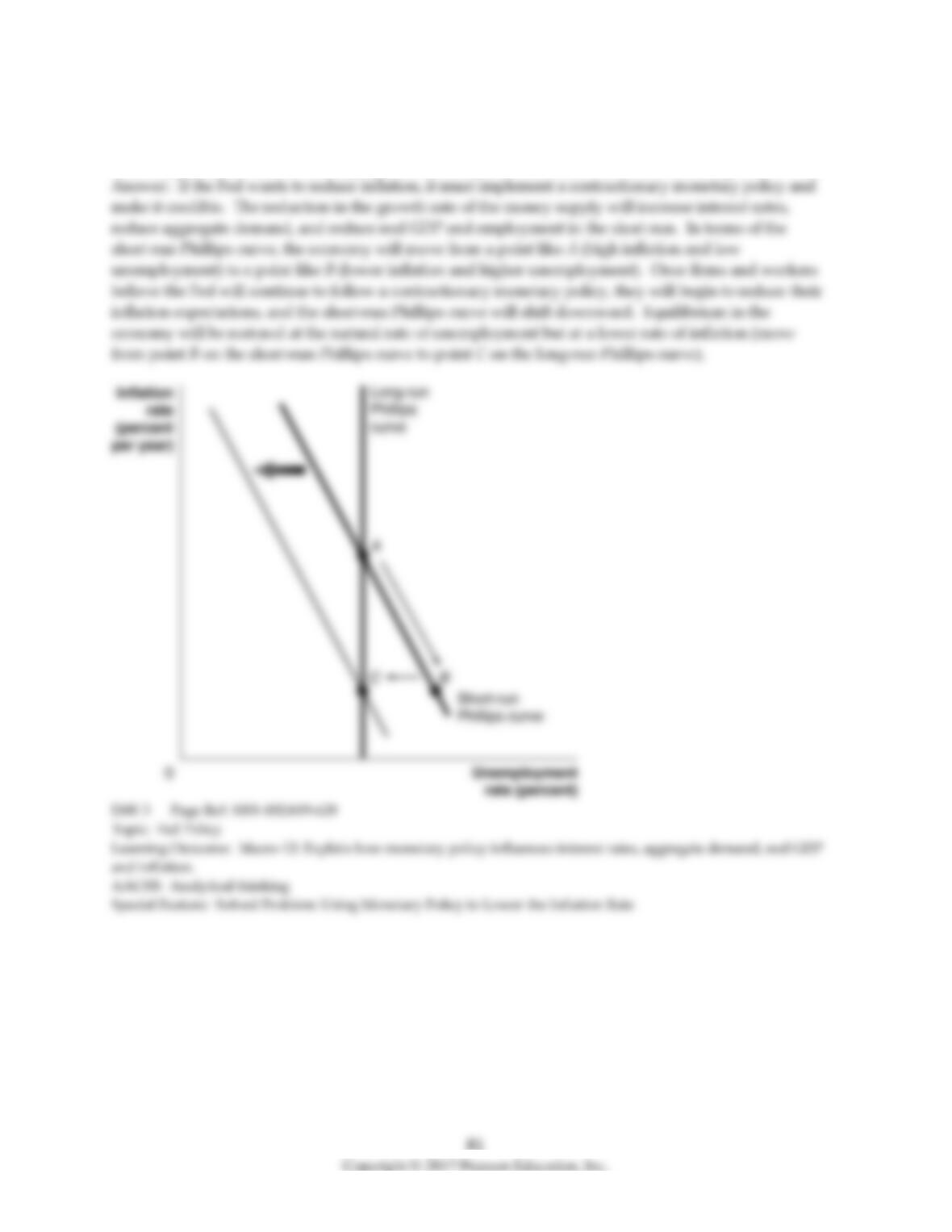
55) If the Federal Reserve wants to reduce inflation from 4 percent to 3 percent permanently, how can
that goal be achieved, and what impact will that have on employment in the short run and the long
run? Support your answer with a graph of the Phillips curve in the short run and the long run.
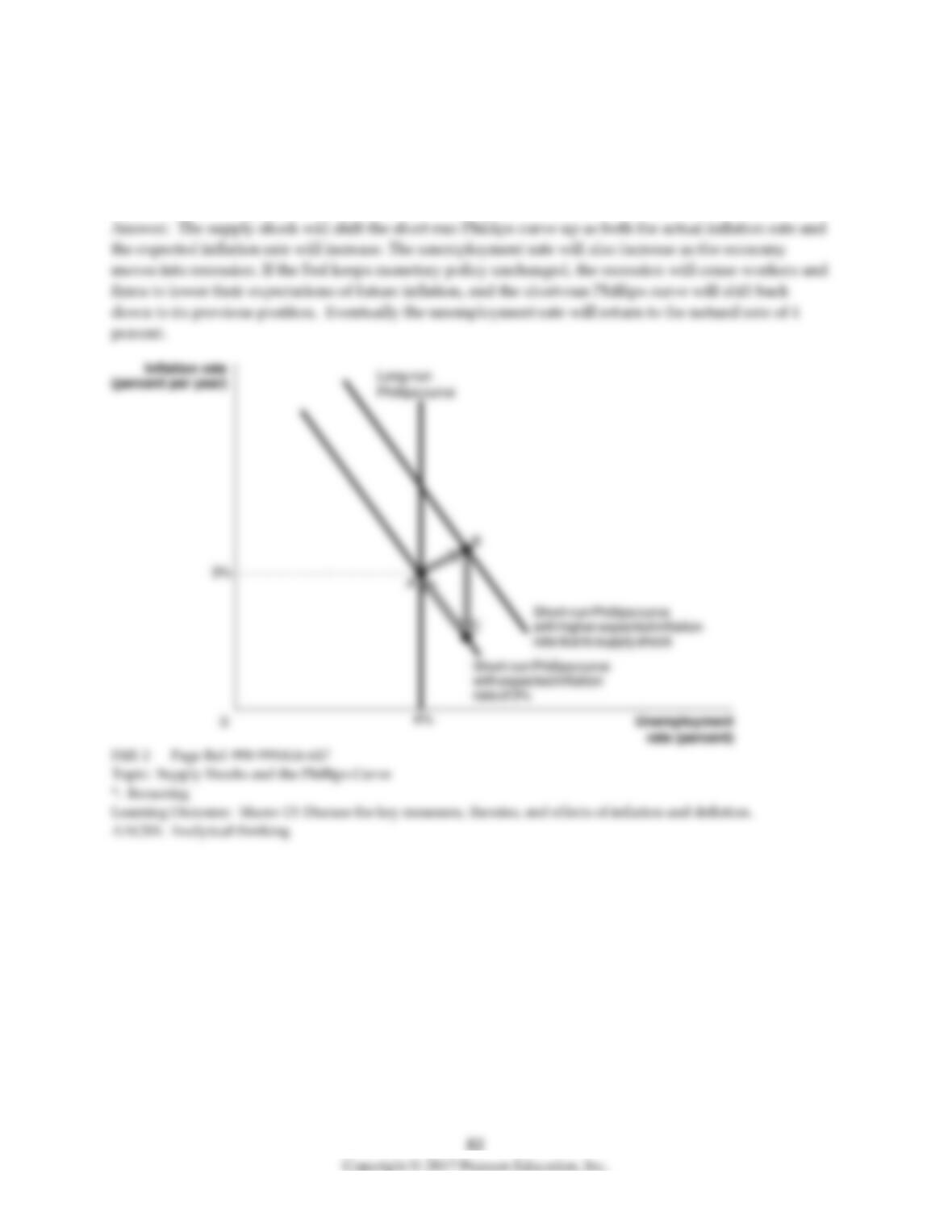
56) Suppose the current inflation rate and the expected inflation rate are both 3 percent. The current
unemployment rate and the natural rate of unemployment are both 4 percent. Use a Phillips curve
graph to show the effect on the economy of a severe supply shock. If the Federal Reserve keeps
monetary policy unchanged, what will eventually happen to the unemployment rate? Show this on
your Phillips curve graph.