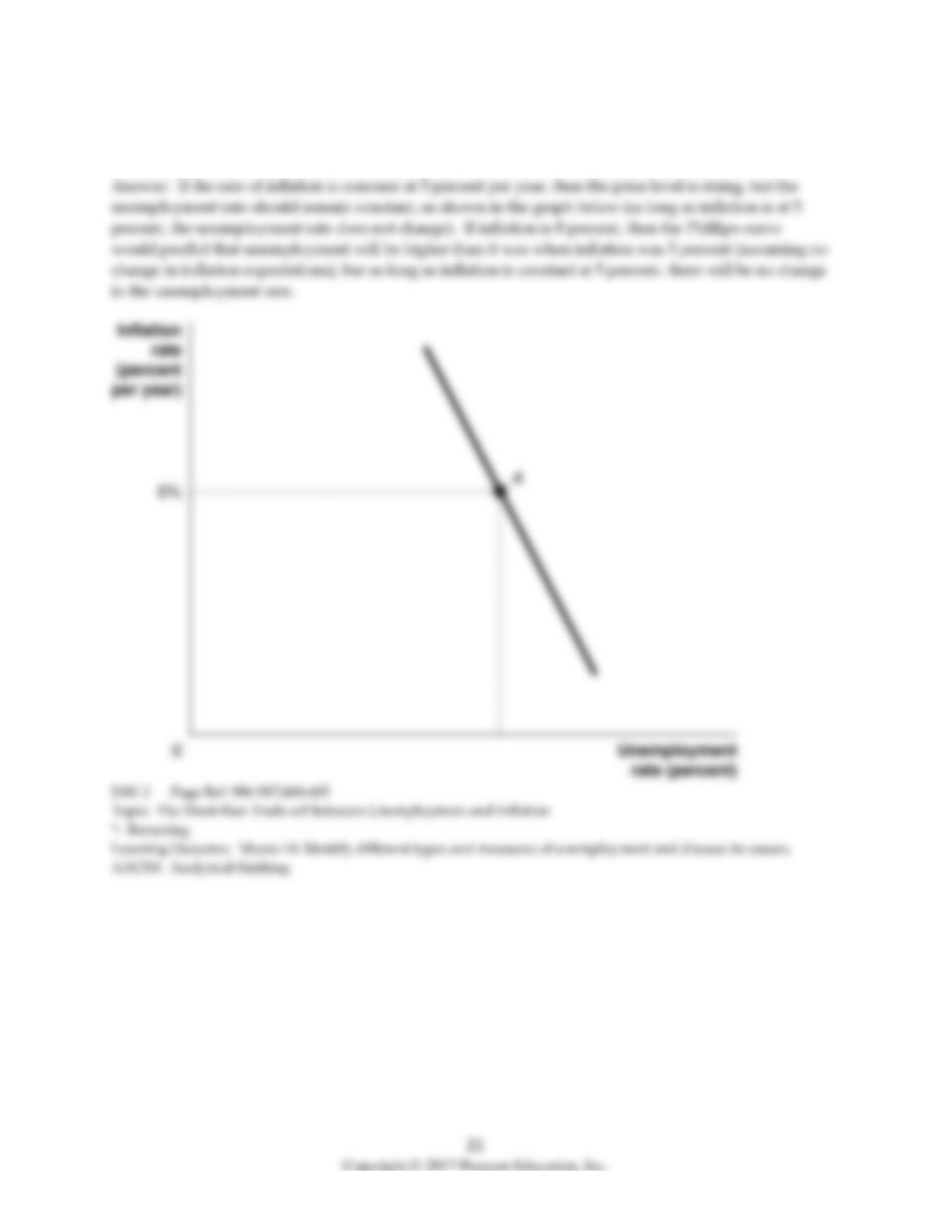
68) If the rate of inflation in the economy is steady at 5 percent per year, how does the short-run Phillips
curve predict that the unemployment rate will be changing, if at all? Does your answer change if
inflation in the economy is 0 percent? Illustrate your answer with a Phillips curve.
17.2 The Short-Run and Long-Run Phillips Curves
1) The expansionary monetary and fiscal policies of the 1960s resulted in
A) high inflation rates and high rates of unemployment.
B) low inflation rates and low rates of unemployment.
C) low inflation rates and high rates of unemployment.
D) high inflation rates and low rates of unemployment.
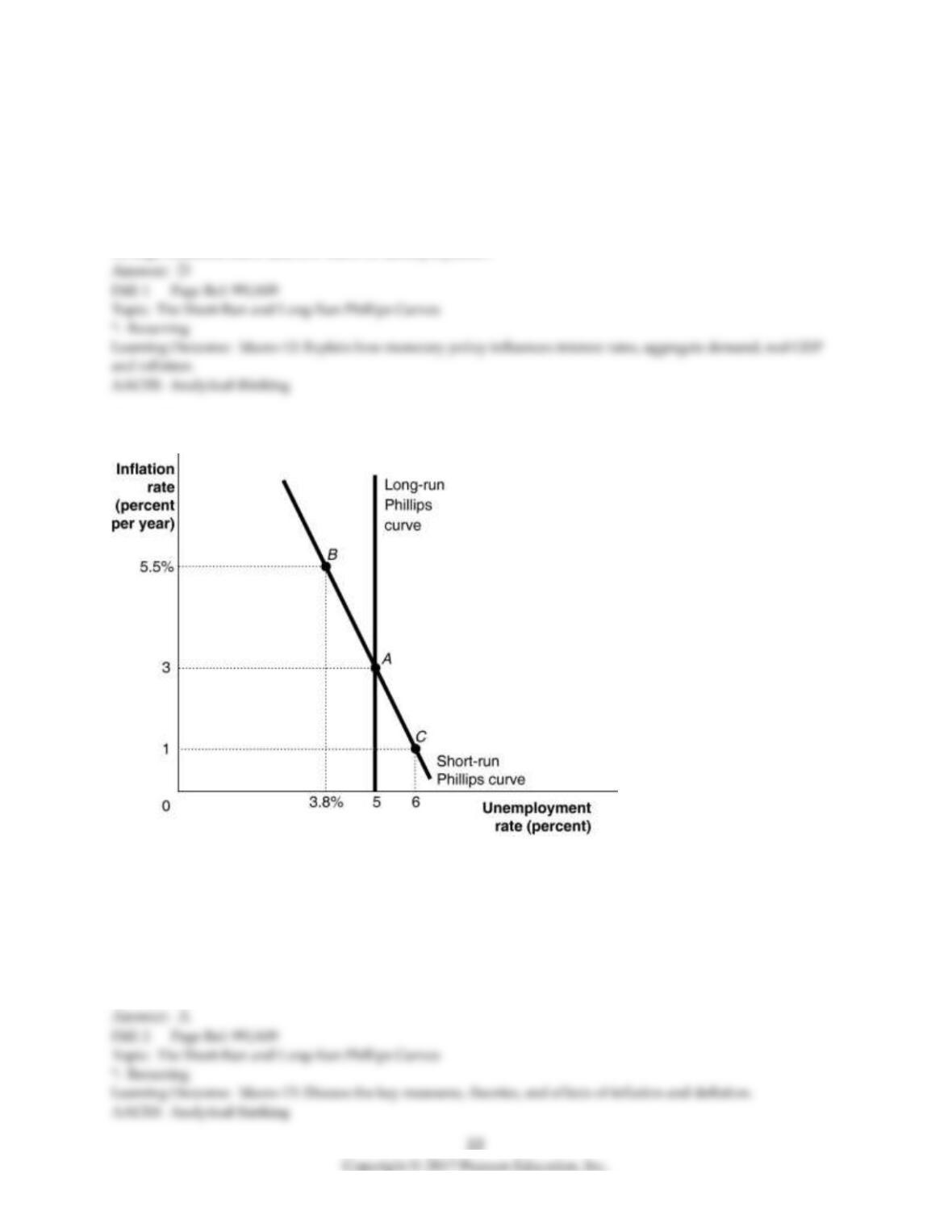
Figure 17-2
2) Refer to Figure 17-2. Suppose the economy is at point B in the figure above. Which of the following is
true?
A) The expected rate of inflation is 3%.
B) The natural rate of unemployment is 3.8%.
C) The current unemployment rate is 5%.
D) The economy is producing at potential GDP.
E) Expected inflation and actual inflation are the same.
3) Refer to Figure 17-2. Suppose the economy is at point A in the figure above. Which of the following
is true?
A) The expected rate of inflation is 5.5%.
B) The current unemployment rate is equal to the natural rate of unemployment.
C) The current unemployment rate is 3.8%.
D) Actual inflation is 1%.
E) The economy will move from A to B.
4) Refer to Figure 17-2. Suppose the economy is at point C in the figure above. If workers adjust their
expectations of inflation, which of the following will be true?
A) The short-run Phillips curve will shift to the right.
B) The short-run Phillips curve will shift to the left.
C) The economy will move from C to A.
D) Workers and firms expect inflation to be 1%.
E) The natural rate of unemployment is 6%.
5) Refer to Figure 17-2. Suppose the economy is at point A in the figure above. Which of the following
is true?
A) The short-run Phillips curve will shift to the right.
B) The short-run Phillips curve will shift to the left.
C) The long-run Phillips curve will shift to the left.
D) Actual inflation and expected inflation are the same.
E) The long-run Phillips curve will shift to the right.
6) Refer to Figure 17-2. Suppose the Fed used expansionary policy to push short-run equilibrium to
point B. If the short-run equilibrium remained at point B long enough,
A) the short-run Phillips curve would shift up.
B) the short-run Phillips curve would shift down.
C) the economy would move back to point A.
D) the economy would stay at point B in the long run.
7) Refer to Figure 17-2. Suppose the Fed used contractionary policy to push short-run equilibrium to
point C. If the short-run equilibrium remained at point C long enough,
A) the short-run Phillips curve would shift up.
B) the short-run Phillips curve would shift down.
C) the economy would move back to point A.
D) the economy would stay at point C in the long run.
8) Refer to Figure 17-2. Suppose the economy is at point A. The Fed uses expansionary monetary policy
to lower the unemployment rate permanently below the level associated with A. Which of the
following will occur?
A) Inflation will accelerate in the long run.
B) Inflationary expectations will decline.
C) Unemployment will rise above the natural rate.
D) Unemployment will accelerate in the long run.
9) Refer to Figure 17-2. At which point is the unemployment rate equal to the natural rate of
unemployment?
A) A
B) B
C) C
D) There is insufficient information on the graph to answer this question.
10) Refer to Figure 17-2. At which point are inflation expectations equal to the actual inflation rate?
A) A
B) B
C) C
D) all of the above
11) Refer to Figure 17-2. The nonaccelerating inflation rate of unemployment, or NAIRU, is associated
with which point rate in the figure above?
A) A
B) B
C) C
D) all of the above
12) A decrease in the expected inflation rate will
A) shift the short-run Phillips curve to the right.
B) shift the short-run Phillips curve to the left.
C) increase the inflation rate.
D) increase the unemployment rate.
13) If workers and firms raise their inflation expectations,
A) unemployment will fall.
B) actual inflation will fall to match expected inflation.
C) the short-run Phillips curve will be vertical.
D) the short-run Phillips curve will shift upward.
14) At the point where actual inflation is equal to expected inflation,
A) the short-run Phillips curve is the same as the long-run Phillips curve.
B) the unemployment rate is zero.
C) the short-run Phillips curve intersects the long-run Phillips curve.
D) there is no short-run Phillips curve, as this situation only occurs in the long run.
15) If expected inflation rises, the long-run Phillips curve will
A) shift to the right.
B) not be affected.
C) shift to the left.
D) become negatively sloped.
16) A decrease in expected inflation will
A) reduce real wages.
B) increase the natural rate of unemployment.
C) shift the long-run Phillips curve to the left.
D) shift the short-run Phillips curve to the left.
17) Which of the following would increase the natural rate of unemployment?
A) an increase in the number of younger, less skilled workers in the economy
B) a reduction in the generosity of unemployment insurance programs
C) restrictions on the ability of unions to negotiate wage changes with companies
D) an increase in government-sponsored programs that train unemployed workers so they can find new
jobs quickly
18) What can the Federal Reserve do to reduce the natural rate of unemployment?
A) nothing
B) follow expansionary monetary policy that will increase inflation
C) follow expansionary monetary policy that will reduce inflation
D) follow contractionary monetary policy that will increase inflation
19) What is the NAIRU?
A) the natural accelerating inflation rate of unemployment
B) the nonaccelerating inflation rate of unemployment
C) the nongovernmental agency of inflationary rate unions
D) the new accrual index of real unemployment
20) The long-run aggregate supply curve is ________, while the long-run Phillips curve is ________.
A) positively sloped; negatively sloped
B) vertical; negatively sloped
C) vertical; also vertical
D) positively sloped; positively sloped
21) If the economy is producing at potential GDP,
A) unemployment is at its natural rate.
B) the Phillips curve must be positively sloped.
C) the short-run aggregate supply curve must be vertical.
D) inflation in the economy is at its natural rate.
22) The long-run Phillips curve is ________ than the short-run Phillips curve.
A) flatter
B) steeper
C) less stable
D) more volatile
23) What impact does monetary policy have on the long-run Phillips curve?
A) Monetary policy can only shift the long-run Phillips curve to the left.
B) Monetary policy shifts the long-run Phillips curve to the right or left, depending on whether
monetary policy is expansionary or contractionary.
C) Monetary policy can only shift the long-run Phillips curve to the right.
D) Monetary policy has no impact on the long-run Phillips curve.
24) When unemployment is below its natural rate, the inflation rate will eventually
A) increase.
B) decrease.
C) move to its natural rate.
D) become equal to the natural rate of unemployment.
25) If the Federal Reserve attempts to continue reducing unemployment by manipulating monetary
policy, which of the following would you expect to see?
A) The Fed will follow deflationary monetary policies.
B) The Fed will follow inflationary monetary policies.
C) The rate of inflation will fall as Fed tries to reduce the unemployment rate.
D) The Fed will reduce the natural rate of unemployment.
26) Growth in aggregate demand will
A) cause deflation.
B) increase unemployment.
C) move the economy to a higher point on the short-run Phillips curve.
D) cause the short-run Phillips curve to shift to the left.
27) If weak aggregate demand is pushing the economy into recession, which of the following must be
true?
A) The economy is at an equilibrium that is on the long-run aggregate supply curve.
B) The economy is at an equilibrium that is on the long-run Phillips curve.
C) The economy is at an equilibrium that is not on the long-run Phillips curve.
D) Contractionary monetary policies will push the economy back to the long-run Phillips curve.
28) In the long run, the Federal Reserve can control which of the following?
A) the inflation rate
B) the unemployment rate
C) the growth rate of real GDP in the economy
D) the natural rate of unemployment
29) The short-run Phillips curve will shift if there is
A) an increase in the unemployment rate.
B) an increase in inflation that is unanticipated.
C) a decrease in inflation that is unanticipated.
D) a change in inflation expectations.
30) A “long-run exploitable Phillips curve” refers to a Phillips curve that in the long run is ________
rather than ________.
A) vertical; horizontal
B) upward sloping; vertical
C) horizontal; upward sloping
D) downward sloping; vertical
31) The expansionary monetary and fiscal policies of the 1960s resulted in ________ inflation rates and
________ rates of unemployment.
A) high; high
B) low; low
C) low; high
D) high; low
32) The natural rate of unemployment equals
A) the rate of structural unemployment.
B) structural plus frictional unemployment.
C) structural plus frictional plus cyclical unemployment.
D) the rate of unemployment we observe in any given period of measurement.
33) The natural rate of unemployment will not change following an increase in ________
unemployment.
A) cyclical
B) frictional
C) structural
D) all of the above
34) What can the Federal Reserve do to increase the natural rate of unemployment?
A) nothing
B) follow expansionary monetary policy that will increase inflation
C) follow contractionary monetary policy that will reduce inflation
D) follow contractionary monetary policy that will increase inflation
35) An increase in frictional unemployment will
A) shift the long-run Phillips curve to the right.
B) increase the natural rate of unemployment.
C) shift the short-run Phillips curve to the right.
D) All of the above are correct.
E) None of the above is correct.
36) A decrease in cyclical unemployment will
A) shift the long-run Phillips curve to the left.
B) decrease the natural rate of unemployment.
C) shift the short-run Phillips curve to the left.
D) All of the above are correct.
E) None of the above is correct.
37) Ceteris paribus, an increase in the current or actual rate of inflation will cause
A) the short-run Phillips curve to shift upward.
B) the unemployment rate to decrease (a movement along the short-run Phillips curve).
C) the long-run Phillips curve to shift leftward.
D) expectations of future inflation rates to be revised downward.
38) What actions could the Federal Reserve take to achieve consistent growth in real GDP at 4 percent
per year?
A) The Fed could increase the growth rate of the money supply by 1% each year until the inflation rate
was exactly equal to 4 percent.
B) The Fed could maintain a growth rate of the money supply of 4 percent, regardless of whether
inflation was rising or falling in the economy.
C) The Fed could follow contractionary monetary policy that would reduce the federal funds rate to
zero so investment will rise consistently.
D) The Fed has no direct control over real GDP in the long run, so there are no actions it could take to
achieve that goal.
39) In the 1960s, many economists and policy makers considered the trade-off between inflation and
unemployment revealed in the Phillips curve to be permanent. This belief was challenged by ________,
who argued that there is no trade-off between inflation and unemployment and the long run.
A) Robert Lucas and Thomas Sargent
B) Finn Kydland and Edward Prescott
C) Paul Samuelson and James Tobin
D) Milton Friedman and Edmund Phelps
40) In the long run, the Phillips curve is a ________ at ________.
A) horizontal line; 0% inflation
B) negatively sloped line; the intersection of aggregate demand and short-run aggregate supply
C) vertical line; the natural rate of unemployment
D) None of the above is correct.
41) An increase in the expected inflation rate will
A) shift the short-run Phillips curve to the right.
B) shift the short-run Phillips curve to the left.
C) reduce the inflation rate.
D) reduce the unemployment rate.
42) If workers and firms lower their inflation expectations,
A) unemployment will rise.
B) actual inflation will fall to match expected inflation.
C) the short-run Phillips curve will be vertical.
D) the short-run Phillips curve will shift downward.
34
43) If the long-run aggregate supply curve is vertical,
A) the economy stays at the natural rate of inflation in the long run.
B) the short-run Phillips curve must be vertical.
C) unemployment and inflation are positively related in the long run.
D) the trade-off between unemployment and inflation cannot be permanent.
44) Where does the short-run Phillips curve intersect the long-run Phillips curve?
A) at the point where the rate of inflation and the unemployment rate are equal
B) at the natural rate of inflation
C) at the point where actual inflation is equal to expected inflation
D) There is no intersection between the short-run and long-run Phillips curves.
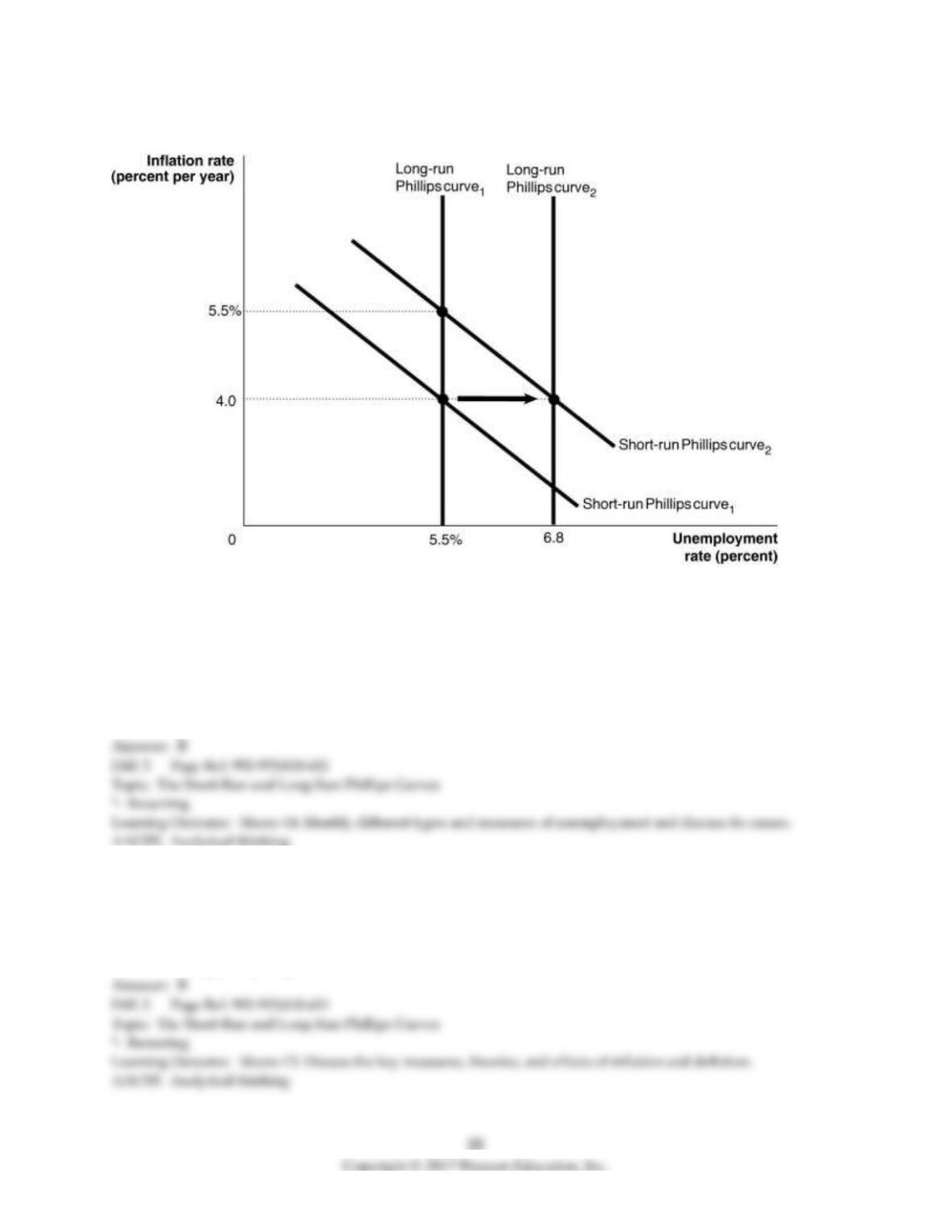
Figure 17-3
45) Refer to Figure 17-3. The shifts shown in the short-run and long-run Phillips curves between period
1 and period 2 could be explained by
A) an increase in the expected inflation rate from 4.0 to 5.5 percent.
B) an increase in the natural rate of unemployment from 5.5 to 6.8 percent.
C) either an increase in expected inflation from 4.0 to 5.5 percent or an increase in the natural rate of
unemployment from 5.5 to 6.8 percent.
D) None of the above is correct.
46) If expected inflation falls, the long-run Phillips curve will
A) shift to the right.
B) not be affected.
C) shift to the left.
D) become negatively sloped.
47) An increase in expected inflation will
A) increase real wages.
B) decrease the natural rate of unemployment.
C) shift the long-run Phillips curve to the right.
D) None of the above is correct.
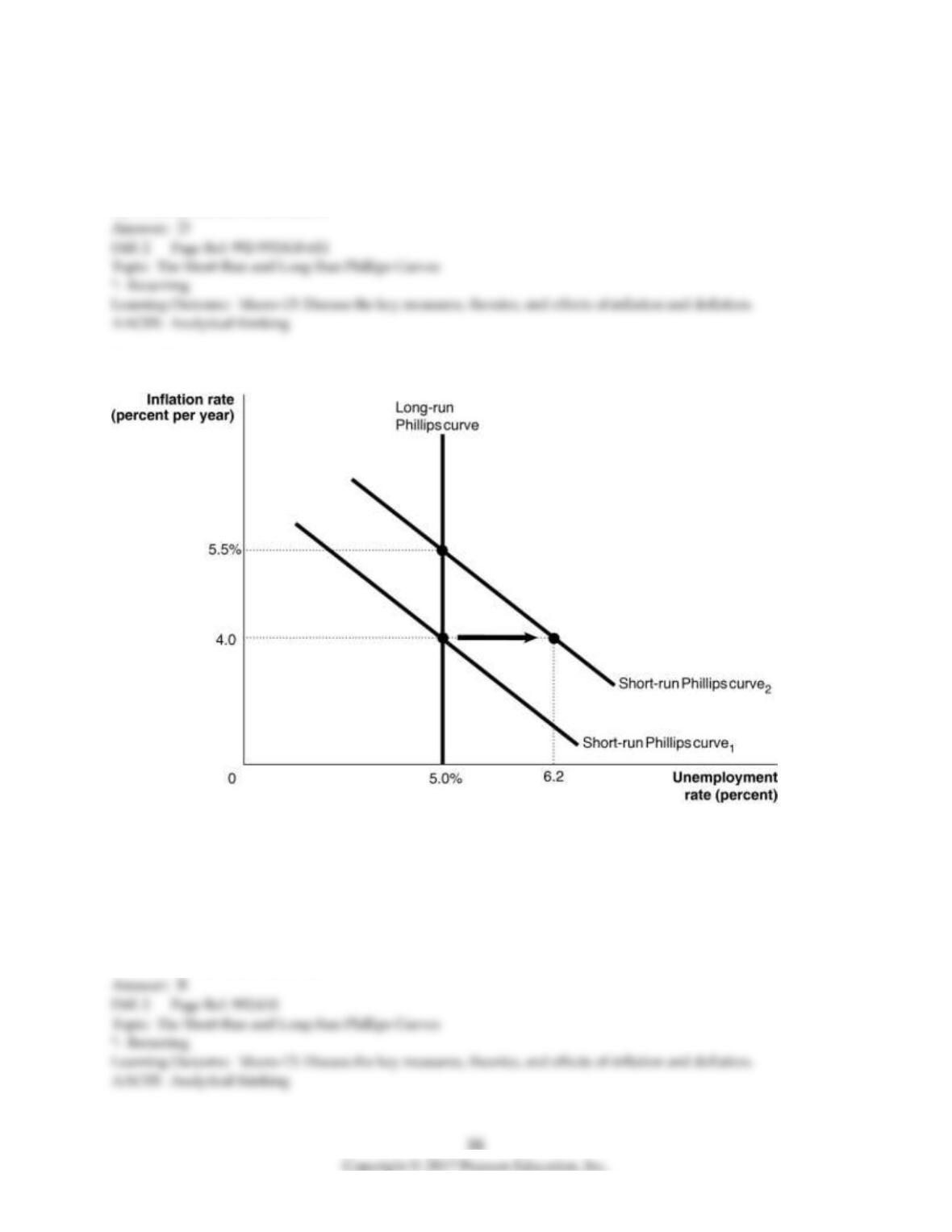
Figure 17-4
48) Refer to Figure 17-4. Consider the shift in the short-run Phillips curves shown in the above graph.
This shift may be explained by
A) an increase in the natural rate of unemployment from 5.0 to 6.2 percent.
B) an increase in the expected rate of inflation from 4.0 to 5.5 percent.
C) either an increase in the natural rate of unemployment from 5.0 to 6.2 percent or an increase in the
expected rate of inflation from 4.0 to 5.5 percent.
D) None of the above is correct.
49) Which of the following would decrease the natural rate of unemployment?
A) a decrease in the number of younger, less skilled workers in the economy
B) an increase in the generosity of unemployment insurance programs
C) fewer restrictions on unions to negotiate wage changes with companies
D) a decrease in government-sponsored programs that train unemployed workers so they can find new
jobs quickly
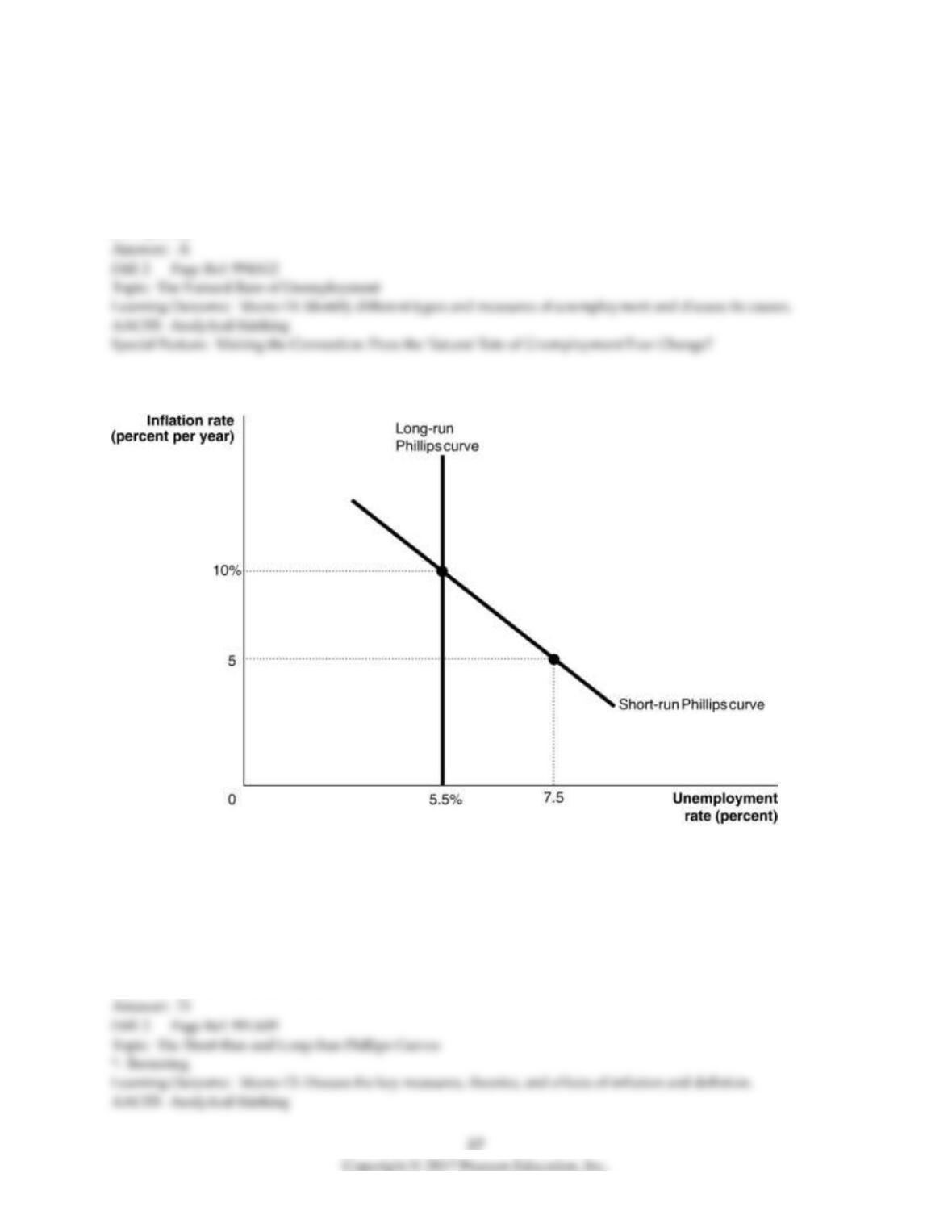
Figure 17-5
50) Refer to Figure 17-5. Consider the Phillips curves shown in the above graph. We can conclude from
this graph that
A) the natural rate of unemployment in this economy is 5.5 percent.
B) the expected rate of inflation in this economy is 10 percent.
C) ceteris paribus, a fall in the rate of inflation to 5 percent will increase unemployment to 7.5 percent in
the short run.
D) All of the above are correct.
51) A decrease in aggregate demand will
A) cause inflation.
B) decrease unemployment.
C) move the economy to a lower point on the short-run Phillips curve.
D) cause the short-run Phillips curve to shift to the right.
52) Monetary policy has ________ impact on the long-run Phillips curve.
A) a positive
B) a negative
C) an unpredictable
D) no
53) In the short run, the Federal Reserve can affect which of the following?
A) the inflation rate
B) the unemployment rate
C) the growth rate of real GDP in the economy
D) all of the above
54) The ________ curves are both vertical.
A) aggregate demand and short-run Phillips
B) long-run aggregate supply and short-run Phillips
C) long-run aggregate supply and long-run Phillips
D) short-run aggregate supply and short-run Phillips
55) If the economy is producing ________, unemployment is at its natural rate.
A) at potential GDP
B) above potential GDP
C) at an inflation rate of zero
D) at an unemployment rate of zero
56) The short-run Phillips curve is ________ than the long-run Phillips curve.
A) flatter
B) steeper
C) less stable
D) Both B and C are correct.
57) When unemployment is above its natural rate, the inflation rate will eventually
A) increase.
B) decrease.
C) move to its natural rate.
D) become equal to the natural rate of unemployment.
58) If strong aggregate demand is pushing the economy beyond potential real GDP, which of the
following must be true?
A) The economy is at an equilibrium that is on the long-run aggregate supply curve.
B) The economy is at an equilibrium that is on the long-run Phillips curve.
C) The economy is at an equilibrium that is not on the long-run Phillips curve.
D) Expansionary monetary policies will push the economy back to the long-run Phillips curve.
59) The short-run Phillips curve will not shift unless there is
A) an increase in the unemployment rate.
B) an increase in inflation that is unanticipated.
C) a decrease in inflation that is unanticipated.
D) a change in inflation expectations.
60) The natural rate of unemployment is fixed and unchanging.
61) A decrease in the level of cyclical unemployment will shift the long-run Phillips curve.
62) If unemployment persists for a long period of time, the natural rate of unemployment rises.
63) If inflationary expectations on the part of the public increase, the trade-off between inflation and
unemployment becomes worse.
64) An increase in expected inflation will shift the short-run Phillips Curve.