65) An increase in the level of structural unemployment will shift the long-run Phillips curve.
66) If the Fed attempts to reach and maintain very low rates of unemployment, we would expect the
rate of inflation to rise.
67) In the long run, the Fed may decrease the unemployment rate only if it is willing to increase the rate
of inflation.
68) What is the relationship between the short-run Phillips curve and the long-run Phillips curve?
69) If workers accurately predict the rate of inflation, is there a short-run trade-off between inflation and
unemployment, as predicted by the Phillips curve? Why or why not?
70) Suppose a presidential candidate makes a statement in a debate whereby he promises that he would
encourage the Fed to permanently lower the unemployment rate to 3%. His opponent claims that this
type of policy idea is mired in the 1960s and would only cause inflation. Explain what the opponent
means.
71) Use the following information to draw a graph showing the short-run and long-run Phillips curves,
and be sure your graph shows the point where the short-run and long-run Phillips curves intersect.
Natural rate of unemployment = 4 percent
Current rate of unemployment = 5 percent
Expected inflation rate = 3 percent
Current inflation rate = 2 percent
17.3 Expectations of the Inflation Rate and Monetary Policy
1) During which of the following time periods did inflation remain above 5 percent every year?
A) 1990 through 1999
B) 1973 through 1982
C) 1968 through 1971
D) 1958 through 1962
2) When individuals use all available information about an economic variable to make a decision,
expectations are
A) underestimates of reality.
B) accurate.
C) rational.
D) overestimates of reality.
3) When inflation is very low, how do workers and firms adjust their expectations of inflation?
A) They rapidly adjust their expectations of inflation upward.
B) They rapidly adjust their expectations of inflation downward.
C) They tend to ignore inflation.
D) They are more aggressive in asking for wage and price increases.
4) If people assume that future rates of inflation will follow the pattern of inflation rates in the past, they
are said to have
A) rational expectations.
B) adaptive expectations.
C) unstable expectations.
D) accommodative expectations.
5) According to economists Robert Lucas and Thomas Sargent, when are the gains to accurately
forecasting inflation highest?
A) when inflation is high and unstable
B) when inflation is low
C) when inflation is moderate but stable
D) when inflation is high and stable
6) If workers and firms know that the Federal Reserve is following an expansionary monetary policy,
workers and firms will expect inflation to ________ and will adjust wages so that the real wage
________.
A) increase; increases
B) increase; remains unchanged
C) decrease; decreases
D) increase; decreases
7) If actual inflation is greater than expected inflation, what is the relationship between the actual real
wage and the expected real wage?
A) The actual real wage will be lower than the expected real wage.
B) The actual real wage will be higher than the expected real wage.
C) The actual real wage will be equal to the expected real wage.
D) The relationship between the actual real wage and the expected real wage cannot be predicted.
45
8) If firms and workers have rational expectations, including knowledge of the policy being used by the
Federal Reserve, the short-run Phillips curve will be
A) negatively sloped.
B) positively sloped.
C) vertical.
D) flatter in the long run than it is in the short run.
9) If firms and workers have rational expectations, including knowledge of the policy being used by the
Federal Reserve
A) expansionary monetary policy is especially effective.
B) expansionary monetary policy is ineffective.
C) expansionary monetary policy is effective in the short run, but not the long run.
D) expansionary monetary policy is effective in the short run and the long run.
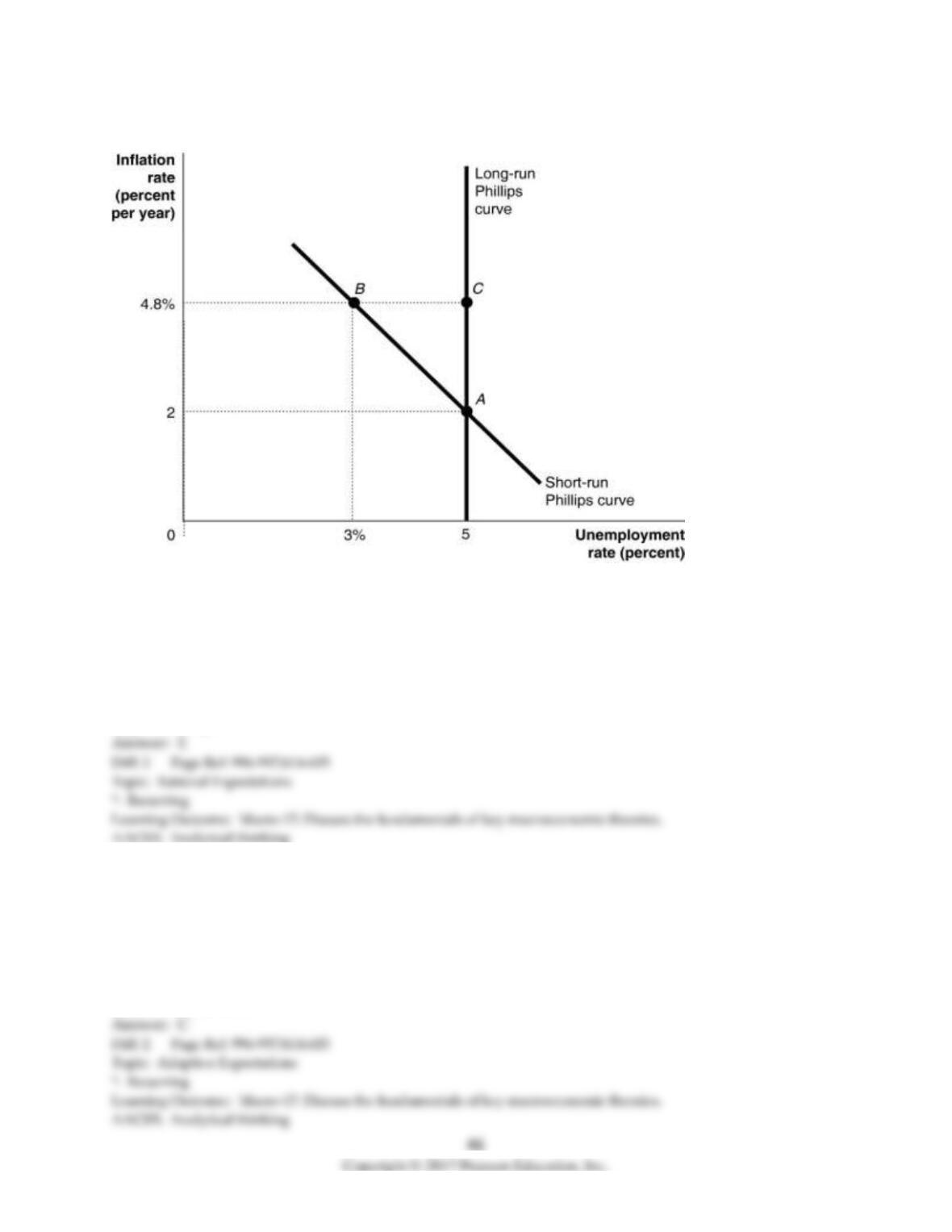
Figure 17-6
10) Refer to Figure 17-6. If firms and workers have rational expectations, an expansionary monetary
policy will cause the short-run equilibrium to move from
A) point B to point C.
B) point C to point A.
C) point A to point B.
D) point B to point A.
E) point A to point C.
11) Refer to Figure 17-6. If firms and workers have adaptive expectations, an expansionary monetary
policy will cause the short-run equilibrium to move from
A) point B to point C.
B) point A to point C.
C) point A to point B.
D) point B to point A.
E) point C to point B.
12) In which of the following situations might you expect expansionary monetary policy to reduce the
unemployment rate?
A) if expectations are rational
B) if changes in monetary policy are unanticipated
C) if actual inflation is higher than expected
D) if actual inflation is lower than expected
13) Some economists argue that the short-run Phillips curve is not vertical, and that monetary policy can
be effective in the short run. Which one of the following is not one of the reasons for this skepticism?
A) Empirical evidence shows workers and firms have rational expectations.
B) Contracts with workers and suppliers may hinder firms’ abilities to adjust to price changes.
C) Wages and prices may not adjust rapidly enough to keep the short-run Phillips curve vertical.
D) Individuals may not be able to use information of Fed Policy to make a reliable forecast of inflation.
14) Lucas and Sargent argue that the short-run trade-off between unemployment and inflation is caused by
A) workers and firms using Fed policy to predict inflation.
B) workers and firms using all the information available to predict inflation.
C) workers and firms rapidly adjusting wages and prices in response to changes in expectations.
D) workers and firms being fooled by unexpected changes in monetary policy.
15) If wages and prices adjust slowly, we would expect expansionary monetary policy to be
A) less likely to reduce the natural unemployment rate.
B) more likely to reduce inflation.
C) more likely to affect the unemployment rate.
D) more likely to result in a vertical short-run Phillips curve.
16) Models that focus on factors such as technology shocks rather than “monetary” explanations of
fluctuations in real GDP are called
A) nonmonetary business cycle models.
B) real business cycle models.
C) rational expectations models.
D) short-run macroeconomic models.
17) Which of the following would be the source of a “real” business cycle?
A) changes in technology
B) anticipated expansionary monetary policy
C) unanticipated expansionary monetary policy
D) unanticipated contractionary monetary policy
18) According to real business cycle models,
A) the long-run Phillips curve is negatively sloped.
B) the economy is normally operating below the natural rate of unemployment.
C) unexpected changes in monetary policy are the major source of fluctuations in real GDP.
D) the economy is normally at potential GDP.
19) The major criticism of real business cycle models is
A) negative technology shocks are uncommon and can’t explain all business cycle fluctuations.
B) positive technology shocks actually push real GDP above the economy’s potential GDP.
C) negative technology shocks actually push real GDP below the economy’s potential GDP
D) this model relies too heavily on monetary explanations for fluctuations in real GDP.
20) If workers and firms have rational expectations, they understand that ________ monetary policy will
raise the inflation rate, so actual inflation ________ expected inflation.
A) expansionary; will be equal to
B) expansionary; will be greater than
C) contractionary; will be equal to
D) contractionary; will be less than
E) expansionary; will be less than
21) Proponents of the new classical macroeconomics do not believe which of the following?
A) Expansionary monetary policy can be an effective policy tool.
B) Workers and firms use information contained in Fed policy to form inflation expectations.
C) Wages and prices will adjust rapidly in the economy.
D) The economy will normally be at its potential level.
22) If changes in inflation are higher than expected,
A) the short-run Phillips curve will be positively sloped, but not vertical.
B) the short-run Phillips curve will be negatively sloped.
C) the short-run Phillips curve will be vertical.
D) the long-run Phillips curve will be negatively sloped.
23) With which of the following statements would a “real business cycle” theorist most closely agree?
A) “Monetary policies have the greatest impact on real GDP when they are anticipated.”
B) “Expansionary monetary policy allows the central bank to control inflation and unemployment
simultaneously.”
C) “Wages adjust rapidly to changes in inflation as long as expectations are formed rationally.”
D) “Technological shocks to the economy affect only aggregate demand in the short run.”
24) Monetary policy can
A) shift the short-run trade-off between inflation and unemployment if it affects expected inflation.
B) shift the long-run trade-off between inflation and unemployment through changes in cyclical
unemployment.
C) shift neither the short-run nor long-run Phillips curve trade-offs between inflation and
unemployment.
D) shift both the short-run and long-run trade-offs between inflation and unemployment if changes in
policy are credible.
25) If the Federal Reserve attempts to continue reducing unemployment by manipulating monetary
policy, which of the following would you expect to see?
A) The Fed’s policies will be deflationary.
B) The Fed’s policies will be inflationary.
C) The rate of inflation will fall as the Fed tries to reduce the unemployment rate.
D) The Fed will reduce the natural rate of unemployment.
26) If actual inflation is less than expected inflation, what is the relationship between the actual real
wage and the expected real wage?
A) The actual real wage is lower than the expected real wage.
B) The actual real wage is higher than the expected real wage.
C) The actual real wage is equal to the expected real wage.
D) The relationship between the actual real wage and the expected real wage cannot be predicted.
27) The actual real wage is lower than the expected real wage if
A) actual inflation is less than expected inflation.
B) expected inflation is less than actual inflation.
C) actual unemployment is less than expected unemployment.
D) actual unemployment is less than actual inflation.
28) According to economists Robert Lucas and Thomas Sargent, the apparent short-run trade-off
between unemployment and inflation in the 1950s and 1960s was the result of
A) unexpected changes in monetary policy.
B) expected changes in monetary policy.
C) unexpected changes in fiscal policy.
D) expected changes in fiscal policy.
29) If rational workers and firms know that the Federal Reserve is following a contractionary monetary
policy, they will expect inflation to ________ and will adjust wages so that the real wage ________.
A) increase; remains unchanged
B) decrease; remains unchanged
C) decrease; increases
D) increase; decreases
30) According to the “rational expectations” school of thought in macroeconomics, the short-run Phillips
curve is ________ in face of anticipated changes in monetary policy.
A) negatively sloped
B) positively sloped
C) vertical
D) horizontal
31) According to the “rational expectations” school of thought in macroeconomics, the short-run Phillips
curve is ________ in face of unanticipated changes in monetary policy.
A) negatively sloped
B) positively sloped
C) vertical
D) horizontal
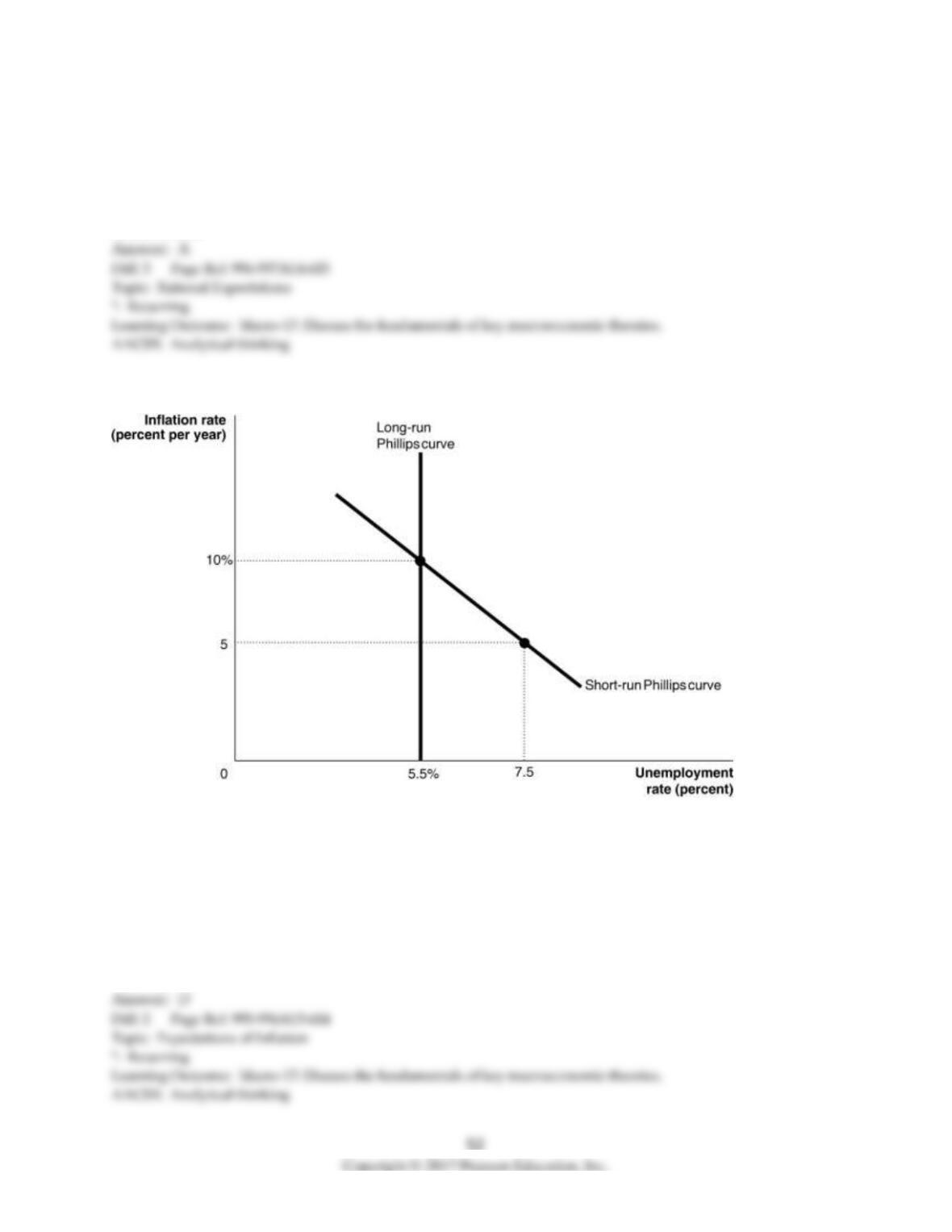
Figure 17-7
32) Refer to Figure 17-7. Consider the Phillips curves depicted in the graph above. The Fed announces
its intention to decrease inflation from 10 percent to 5 percent per year, and it succeeds. If expectations
of inflation are not altered by the Fed’s announcement, the rate of unemployment will be ________ in
the short run.
A) less than 5.5 percent
B) 5.5 percent
C) between 5.5 and 7.5 percent
D) 7.5 percent
53
33) Refer to Figure 17-7. Consider the Phillips curves depicted in the graph above. The Fed announces
its intention to decrease inflation from 10 percent to 5 percent per year, and it succeeds. If expectations
of inflation are reduced to 8 percent by the Fed’s announcement, the rate of unemployment will be
________ in the short run.
A) less than 5.5 percent
B) 5.5 percent
C) between 5.5 and 7.5 percent
D) 7.5 percent
34) Refer to Figure 17-7. Consider the Phillips curves depicted in the graph above. The Fed announces
its intention to decrease inflation from 10 percent to 5 percent per year, and it succeeds. If the
assumptions of the rational expectations school hold true, and the Fed’s announcement is credible, the
rate of unemployment will be ________ in the short run.
A) less than 5.5 percent
B) 5.5 percent
C) between 5.5 and 7.5 percent
D) 7.5 percent
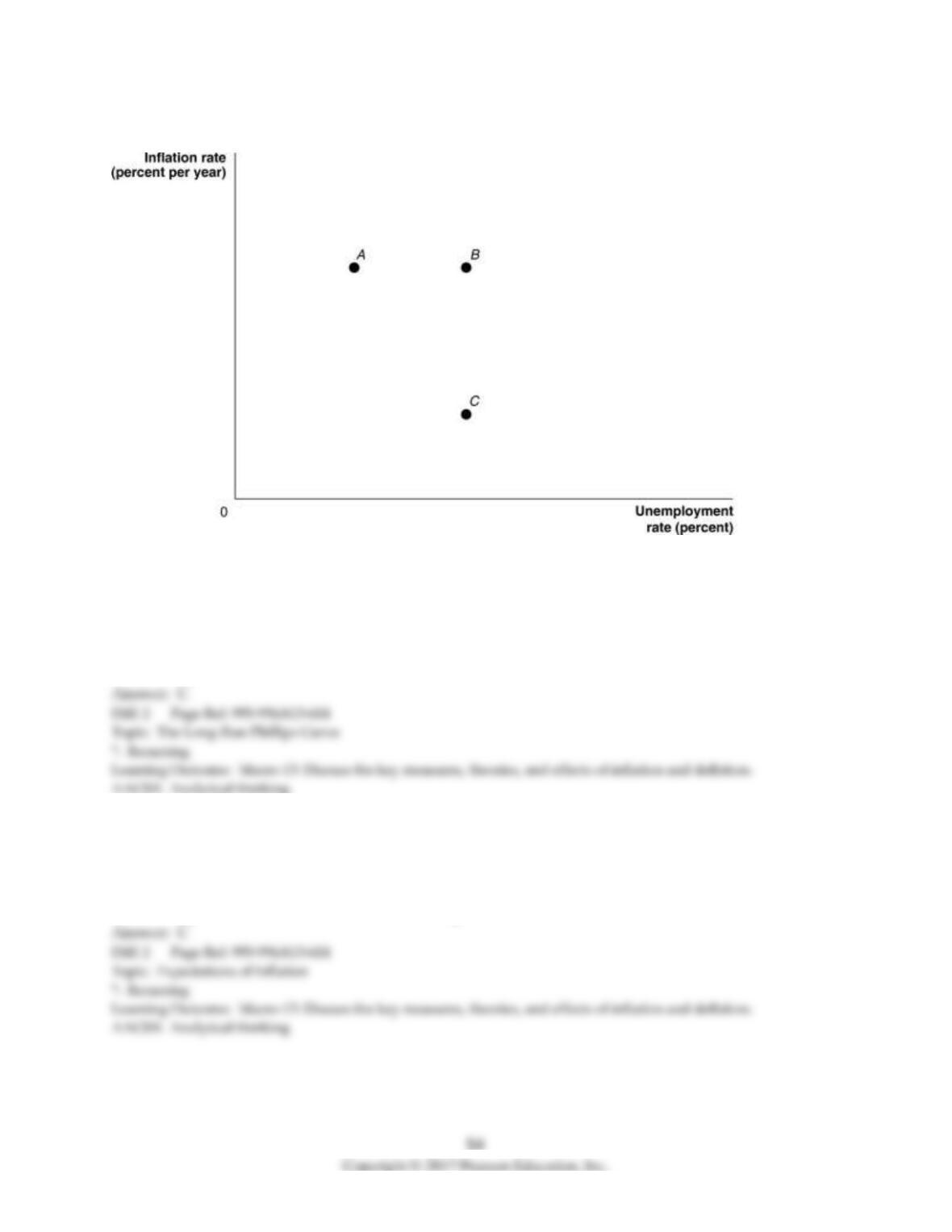
Figure 17-8
35) Refer to Figure 17-8. A typical long-run Phillips curve would have the appearance of a curve
running through points
A) A and B.
B) A and C.
C) B and C.
D) A, B, and C.
36) If wages and prices adjust rapidly, we would expect expansionary monetary policy to be
A) more likely to reduce the natural rate of unemployment.
B) more likely to affect the unemployment rate.
C) less likely to affect the unemployment rate.
D) less likely to result in a vertical short-run Phillips curve.
37) When individuals use ________ about an economic variable to make a decision, expectations are
rational.
A) only historical information
B) only information announced by the Fed
C) all available information
D) only information garnered in the private sector
38) If people assume that future rates of inflation will ________, they are said to have adaptive
expectations.
A) be higher than inflation rates of the past
B) follow the pattern of inflation rates in the past
C) be lower than inflation rates of the past
D) not be related to inflation rates of the past
39) Models that focus on factors other than changes in the money supply to explain fluctuations in real
GDP are called
A) nonmonetary business cycle models.
B) real business cycle models.
C) rational expectations models.
D) short-run macroeconomic models.
40) ________ would be the source of a “real” business cycle.
A) Technology shocks
B) Anticipated changes in monetary policy
C) Unanticipated changes in monetary policy
D) all of the above
41) According to ________, the economy is normally at potential GDP.
A) the short-run Phillips curve
B) the adaptive expectations theory
C) new Keynesian economists
D) real business cycle models
42) With which of the following statements would a “real business cycle” theorist most closely agree?
A) “Monetary policies have greatest impact on real GDP when they are anticipated.”
B) “Expansionary monetary policy allows the central bank to control inflation and unemployment
simultaneously.”
C) “Wages adjust slowly to changes in inflation as long as expectations are formed rationally.”
D) “Technological shocks to the economy explain deviations of real GDP from its potential level.”
43) What impact does expansionary monetary policy have on the short-run Phillips curve if consumers
and firms expect the expansionary monetary policy to increase inflation?
A) The short-run Phillips curve shifts down.
B) The short-run Phillips curve shifts up.
C) The short-run Phillips curve becomes the long-run Phillips curve.
D) The short-run Phillips curve is not affected by expansionary monetary policy.
44) Empirical evidence shows that the short-run Phillips curve was vertical during the 1950s and 1960s.
45) Even if expectations of inflation are rational, sluggish adjustment of wages and prices will still create
a short-run trade-off between inflation and unemployment.
46) If workers and firms ignore inflation or form their inflation expectations adaptively, expansionary
monetary policy will lower unemployment permanently.
47) During the 1960s, when confronted with moderate and stable inflation, people tended to form
adaptive expectations of future inflation rates.
48) When confronted with rational expectations regarding changes in monetary policy, the short-run
Phillips curve may be vertical.
49) Real business cycle models argue that fluctuations in real GDP are caused by unanticipated changes
in the money supply.
50) The “rational expectations” school of economists, including Robert Lucas and Thomas Sargent, argue
that changes in monetary policy cannot affect unemployment rates in the short run or long run.
51) If firms and workers have adaptive expectations, what impact will expansionary monetary policy
have on inflation, unemployment, and the Phillips curve?
52) Workers and firms are currently expecting the price level to increase from 110 to 114. The Federal
Reserve then announces that it will be reducing the growth rate of the money supply. If the Fed’s
announcement is credible, and firms and workers have rational expectations, describe how the
expectations of firms and workers will be affected and how the change in expectations will affect the
unemployment rate.
53) Explain why expansionary monetary policy would not result in reduced unemployment rates if
workers and firms have rational expectations.
54) Suppose that last year the unemployment rate was 5 percent and the inflation rate was 2.5 percent.
If the natural rate of unemployment is 5 percent, how do you expect inflation to change?
55) Last year, the unemployment rate was 4 percent and the inflation rate was 3 percent. If the natural
rate of unemployment is 3 percent, how do you expect inflation to change?
56) During a time when the inflation rate is increasing each year for a number of years, are adaptive
expectations or rational expectations likely to give the more accurate forecasts? Briefly explain.
57) If firms and workers have adaptive expectations, what impact will contractionary monetary policy
have on inflation, unemployment, and the Phillips curve?
58) What does it mean to say that workers and firms have rational expectations?
59) Use the information below to explain adjustments that move the economy to a long-run equilibrium.
Assume that firms and workers have adaptive expectations.
The current unemployment rate = 7%.
The natural rate of unemployment = 5.5%.
Last year’s inflation rate = 5%.
This year’s inflation rate = 4%.