61
60) Use the information below to explain adjustments that move the economy to a long-run equilibrium.
Assume that firms and workers have adaptive expectations.
The current unemployment rate = 4%.
The natural rate of unemployment = 6%.
Last year’s inflation rate = 3%.
This year’s inflation rate = 4%.
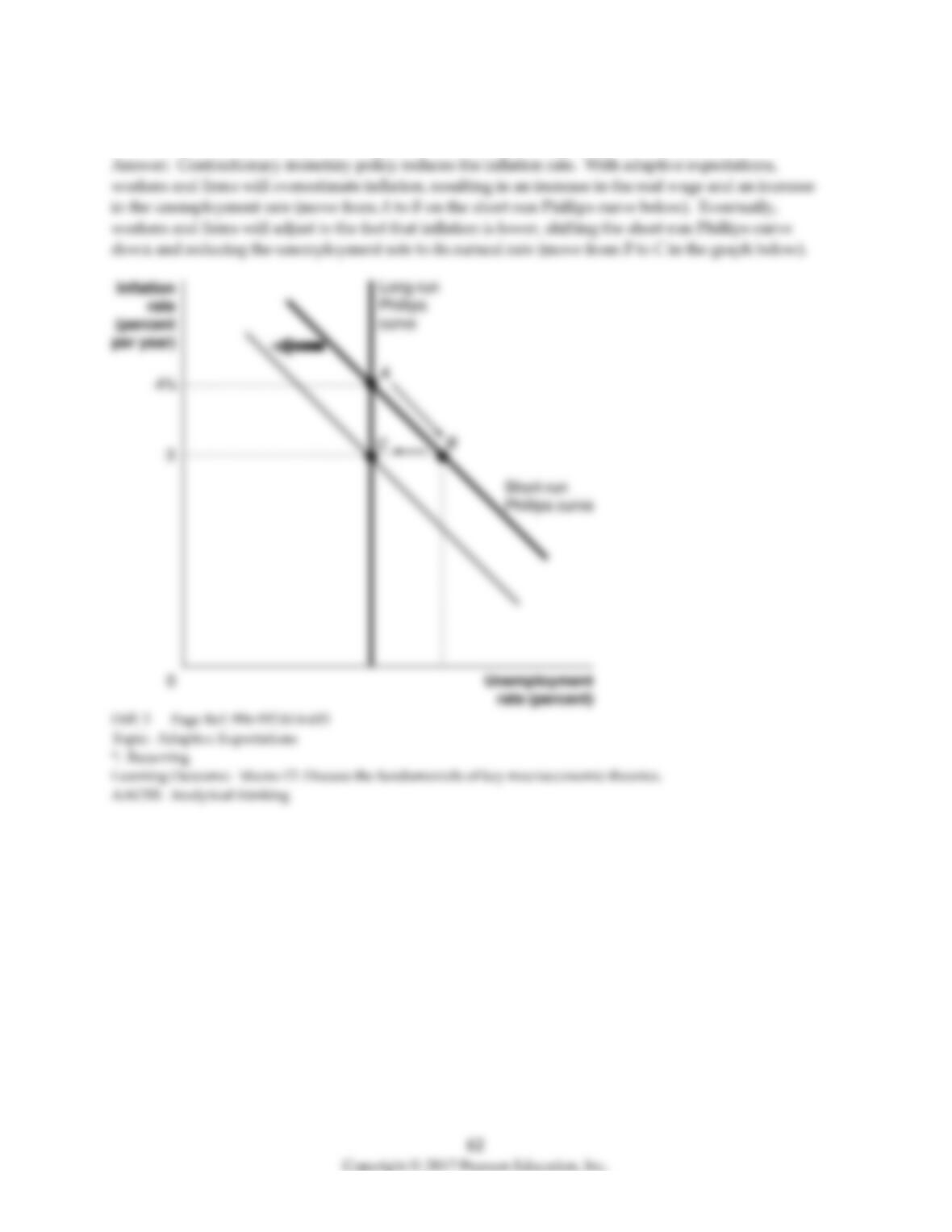
61) If expectations are adaptive, how will the economy adjust to a new long-run equilibrium in response
to expansionary monetary policy? Support your answer with a graph of the Phillips curve.
62) If expectations are adaptive, how will the economy adjust to a new long-run equilibrium in response
to contractionary monetary policy? Support your answer with a graph of the Phillips curve.
17.4 Federal Reserve Policy from the 1970s to the Present
1) Which of the following could increase unemployment and inflation simultaneously?
A) an increase in oil prices
B) expansionary monetary policy
C) contractionary monetary policy
D) a decrease in the real wage
2) A reduction in the rate of inflation is referred to as
A) unemployment.
B) recession.
C) disinflation.
D) deflation.
3) A falling price level is called ________ and a fall in the rate of inflation is called ________.
A) disinflation; a contraction
B) a contraction; disinflation
C) disinflation; deflation
D) deflation; disinflation
4) Contractionary monetary policy will result in
A) higher interest rates.
B) increased rates of inflation.
C) an upward shift in the short-run Phillips curve.
D) a leftward shift in the long-run Phillips curve.
5) What impact does expansionary monetary policy have on the short-run Phillips curve if consumers
and firms expect the expansionary monetary policy to increase inflation?
A) The short-run Phillips curve shifts down.
B) The short-run Phillips curve shifts up.
C) The short-run Phillips curve becomes the long-run Phillips curve.
D) The short-run Phillips curve is not affected by expansionary monetary policy.
6) If the Federal Reserve chooses to fight high inflation with contractionary monetary policy and firms
and consumers expect this policy to reduce inflation, which of the following would you expect to see?
A) a downward shift of the short-run Phillips curve
B) a reduction in the unemployment rate
C) a decrease in the long-run aggregate supply curve
D) an increase in inflationary expectations
7) The experience of Paul Volcker’s fight against inflation during the late 1970s and early 1980s indicates
that firms and workers may have
A) had adaptive expectations.
B) had rational expectations but didn’t trust Fed announcements.
C) preferred high unemployment to high inflation.
D) Both A and B are correct answers.
8) In order to change inflationary expectations in 1979, the Fed‘s monetary policy under Paul Volcker’s
leadership resulted in ________ and ________.
A) disinflation; high unemployment
B) steep inflation; low unemployment
C) disinflation; low unemployment
D) steep inflation; high unemployment
E) deflation; high unemployment
9) If the current unemployment rate is 5%, under which of the following circumstances would you
expect the Fed to use expansionary monetary policy?
A) if the natural rate of unemployment is below 5%
B) if the natural rate of unemployment is above 5%
C) if the inflation rate is above 5%
D) if the inflation rate is below 5%
10) If the Federal Reserve announces that its target for the federal funds rate is rising from 4 percent to
4.25 percent, how do you expect workers and firms to react?
A) As long as the Fed’s announcement is credible, workers and firms will increase their consumption
and investment spending, which will increase aggregate demand and inflation.
B) As long as the Fed’s announcement is credible, workers and firms will reduce their consumption and
investment spending, which will reduce aggregate demand and reduce inflation.
C) If the Fed’s announcement is not credible, workers and firms will not expect inflation to fall so they
will reduce their consumption and investment spending, which will increase aggregate demand and
reduce inflation.
D) Workers and firms will incorporate the increase in interest rates into their expectations of inflation,
and they will expect inflation to rise as a result of Fed’s policy announcement.
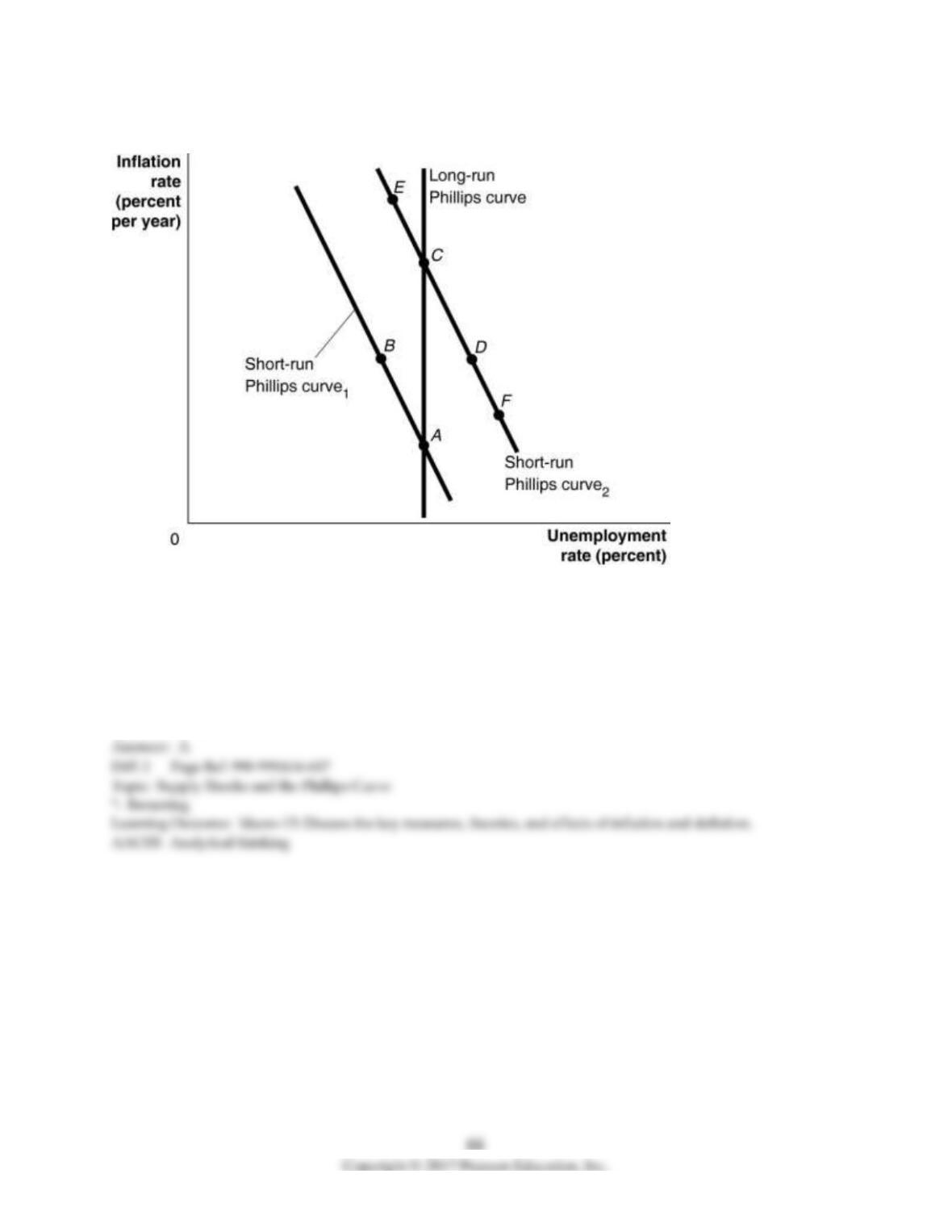
Figure 17-9
11) Refer to Figure 17-9. A supply shock, such as rising oil prices, would be depicted as a movement
from
A) A to D to C.
B) C to B to A.
C) C to D to A.
D) C to E to B.
E) A to B to C.
12) Refer to Figure 17-9. Fed Chairman Paul Volcker’s response to high inflation of the late 1970s is
depicted in the figure above as a movement from
A) A to D to C.
B) C to B to A.
C) C to D to A.
D) C to E to B.
E) A to B to C.
13) Refer to Figure 17-9. A follower of the new classical macroeconomics would argue that a
contractionary monetary policy to lower inflation after a supply shock, like that pursued by Volcker in
1979, would result in a movement from
A) A to D to C.
B) A to B.
C) C to D to A.
D) C to A.
E) A to C.
14) Refer to Figure 17-9. A(n) ________ would be depicted as a movement from A to D to C.
A) supply shock, such as rising oil prices,
B) increase in aggregate demand
C) implementation of contractionary monetary policy
D) increase in short-run aggregate supply
15) Refer to Figure 17-9. Fed Chairman Paul Volcker’s response to the ________ of the late 1970s is
depicted in the figure above as a movement from C to D to A.
A) deflation
B) high unemployment
C) high inflation
D) appreciation of the dollar
16) Refer to Figure 17-9. A follower of the new classical macroeconomics would argue that ________
like that pursued by Paul Volcker in 1979, would result in a movement from C to A.
A) expansionary monetary policy
B) contractionary monetary policy
C) expansionary fiscal policy
D) contractionary fiscal policy
17) If the economy experiences a negative supply shock, which of the following will be true?
A) Inflation will rise, and real GDP will fall.
B) Inflation will rise, and real GDP will rise.
C) Inflation will fall, and real GDP will fall.
D) Inflation will fall, and real GDP will rise.
18) Which of the following is not an appropriate policy for a central bank to follow if the economy is
plagued with deflation?
A) increasing the target interest rate on overnight loans
B) using expansionary monetary policy to drive down interest rates
C) consistently pursuing policy to promote the credibility of the central bank
D) explicitly and credibly targeting inflation
19) In conducting monetary policy, how has the Federal Reserve enhanced its credibility?
A) by not following through with changes it has announced
B) by revealing the Fed’s target for the federal funds rate
C) by keeping the minutes of the open market committee meetings confidential
D) by marketing and increased expenditure on advertising
20) Two actions by the Fed during Alan Greenspan’s term as chairman have been identified as possibly
contributing to the financial crisis in 2008. Which of the following was one of those actions?
A) decreasing the money supply to fight the possibility of disinflation
B) the decision to keep the federal funds rate at 1 percent from June 2003 to June 2004
C) working in concert with the European Central Bank to stabilize the dollar / euro exchange rate
D) financing the first Gulf War by printing money and generating rapid inflation
21) A provision of the Dodd-Frank Act of 2010 revised the Federal Reserve Act to
A) allow the Fed to make loans to investment banks.
B) allow the Fed to make loans to any individual, partnership, or corporation in unusual and exigent
circumstances.
C) restrict the Fed’s ability to make loans except to commercial banks.
D) allow the Fed to buy commercial paper issued by nonfinancial firms.
22) The policy which holds that the federal government should not allow large financial firms to fail, for
fear of damaging the financial system, is known as the ________ policy.
A) Dodd-Frank
B) mandatory bailout
C) too-big-to-fail
D) rational expectations
23) A study conducted by Alberto Alesina and Lawrence Summers concluded that countries with
highly independent central banks had ________ than countries whose central banks had little
independence.
A) higher unemployment rates
B) lower unemployment rates
C) higher inflation rates
D) lower inflation rates
24) If the Fed decided to reverse its policy actions implemented during the heart of the recession, the
Fed would be acting to try to prevent
A) a decrease in unemployment.
B) an increase in unemployment.
C) an increase in deflation.
D) an increase in inflation.
25) If the Fed chose to change its policy actions implemented during the heart of the recession faster
than the timing suggested by the White House, this would be an indication of the Fed‘s
A) lack of credibility.
B) independence.
C) changing its monetary policy target.
D) frictional relationship with the White House.
26) One criticism of the Fed’s policy of forward guidance during the recession of 2007-2009 is that it
contributed to a prolonged period of abnormally low interest rates, leading to speculative bubbles in
stocks or other financial assets as investors
A) chose to sell off these assets due to the low returns on investment.
B) borrowed at these low interest rates to buy these assets.
C) delayed purchasing these assets until interest rates rose.
D) switched from investing in these assets to assets with higher risks.