65) During a recession, the
A) natural rate of unemployment has fallen.
B) cyclical rate of unemployment is positive.
C) cyclical rate of unemployment is zero.
D) cyclical rate of unemployment is negative.
66) Deviations of the actual unemployment rate away from the natural rate are
A) cyclical unemployment.
B) frictional unemployment.
C) structural unemployment.
D) the monetary rule.
67) Suppose the natural rate of unemployment is 6 percent. If the actual unemployment rate is 6
percent, then the cyclical unemployment rate
A) is 0 percent.
B) is 6 percent.
C) is 11 percent.
D) cannot be determined given the information.
68) Suppose the natural rate of unemployment is 6 percent. If the actual unemployment rate is 5
percent, then the cyclical unemployment rate is
A) 9 percent.
B) 1 percent.
C) -1 percent.
D) 0 percent as cyclical unemployment cannot be less than zero.
69) We observe the duration of unemployment rising and wage rates falling. It is likely that
A) the government has initiated expansionary fiscal policy but the policies haven’t taken effect
yet.
B) summer has arrived.
C) aggregate demand has decreased.
D) aggregate supply has increased.
70) Suppose the government abolished the minimum wage law and the law that requires union
wage rates to be paid on all government contract jobs. We would expect to see
A) a decline in the natural rate of unemployment.
B) an increase in claims for unemployment benefits.
C) the duration of unemployment to increase.
D) a recession.
71) Suppose there was an unexpected increase in aggregate demand. We would expect to
observe
A) frictional unemployment to increase.
B) the duration of unemployment and the amount of unemployment to decrease.
C) higher wages, with the duration of unemployment and the amount of unemployment
unchanged.
D) a decrease in aggregate demand.
72) An unexpected increase in aggregate demand causes
A) the unemployment rate to fall, with no change in the price level.
B) the price level to rise, but the duration of unemployment will remain constant, so the
unemployment rate remains constant.
C) simultaneously the price level to rise and the unemployment rate to fall.
D) simultaneously the price level to fall and the unemployment rate to fall.
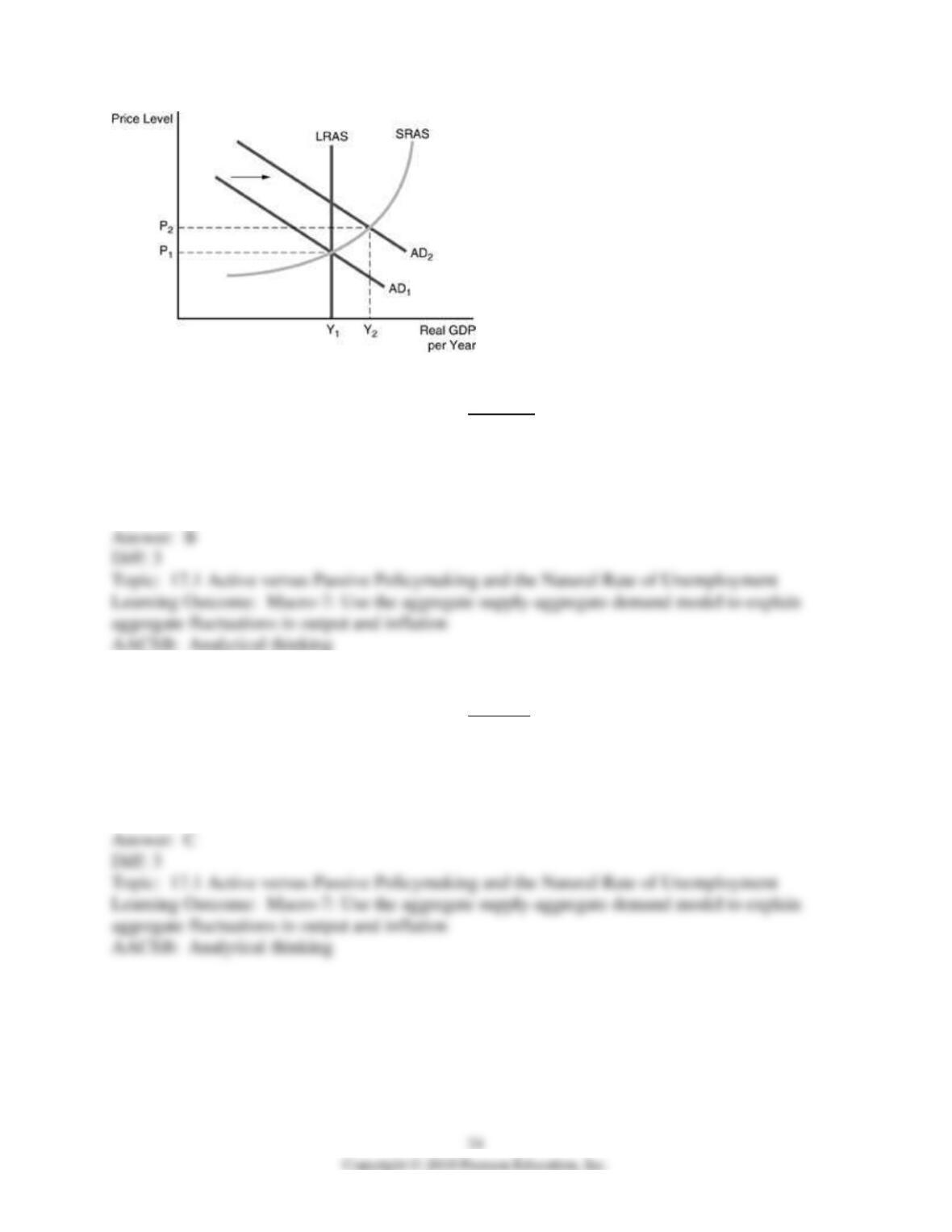
73) Refer to the above figure. Unexpected expansionary monetary policy has caused the
aggregate demand curve to shift to AD2. In the short run
A) real GDP will be Y1, and the price level will be P1.
B) real GDP will be Y2, and the price level will be P2.
C) real GDP will be Y1, and the price level will be above P2.
D) real GDP will be between Y1 and Y2, and the price level will be between P1 and P2.
74) Refer to the above figure. Unexpected expansionary monetary policy has caused the
aggregate demand curve to shift to AD2. In the long run
A) real GDP will be Y1, and the price level will be P1.
B) real GDP will be Y2, and the price level will be P2.
C) real GDP will be Y1, and the price level will be above P2.
D) real GDP will be between Y1 and Y2, and the price level will be between P1 and P2.
75) Refer to the above figure. Unexpected expansionary monetary policy has caused the
aggregate demand curve to shift to AD2. In the short run
A) the unemployment rate will be the same rate as before the expansionary monetary policy.
B) the unemployment rate will be larger than the rate before the expansionary monetary policy.
C) the unemployment rate will be smaller than the rate before the expansionary monetary policy.
D) the unemployment rate can increase or decrease depending upon how much the LRAS will
shift.
76) Refer to the above figure. Unexpected expansionary monetary policy has caused the
aggregate demand curve to shift to AD2. In the long run
A) the unemployment rate will be the same rate as before the expansionary monetary policy.
B) the unemployment rate will be larger than the rate before the expansionary monetary policy.
C) the unemployment rate will be smaller than the rate before the expansionary monetary policy.
D) the unemployment rate can increase or decrease depending upon how much the LRAS will
shift.
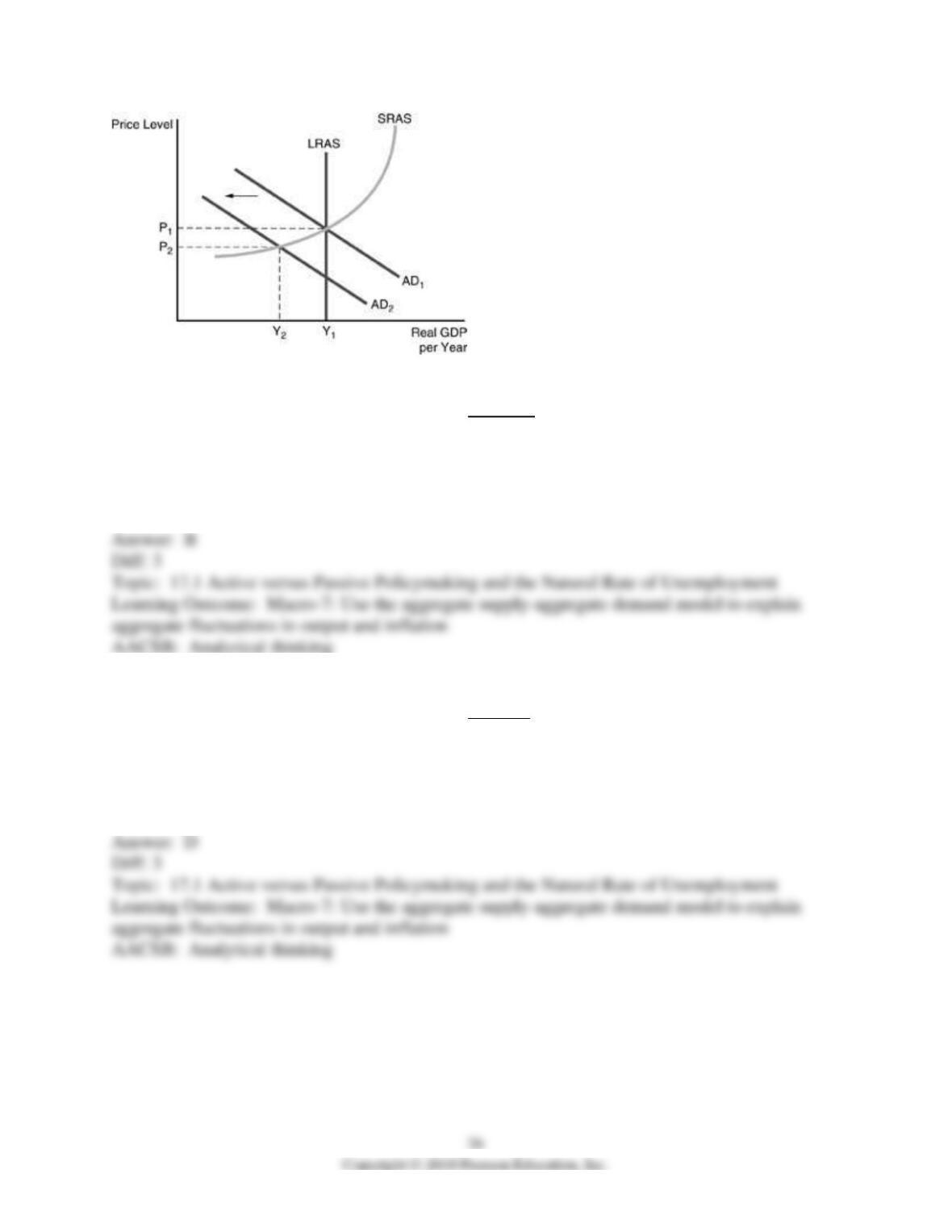
77) Refer to the above figure. Unexpected contractionary monetary policy has caused the
aggregate demand curve to shift to AD2. In the short run
A) real GDP will be Y1, and the price level will be P1.
B) real GDP will be Y2, and the price level will be P2.
C) real GDP will be between Y1 and Y2, and the price level will be above P1.
D) real GDP will be between Y1 and Y2, and the price level will be below P2.
78) Refer to the above figure. Unexpected contractionary monetary policy has caused the
aggregate demand curve to shift to AD2. In the long run
A) real GDP will be Y1, and the price level will be P1.
B) real GDP will be Y2, and the price level will be P2.
C) real GDP will be between Y1 and Y2, and the price level will be above P1.
D) real GDP will be between Y1 and Y2, and the price level will be below P2.
79) Refer to the above figure. Unexpected contractionary monetary policy has caused the
aggregate demand curve to shift to AD2. In the short run
A) the unemployment rate will be the same rate as before the expansionary monetary policy.
B) the unemployment rate will be larger than the rate before the contractionary monetary policy.
C) the unemployment rate will be smaller than the rate before the expansionary monetary policy.
D) the unemployment rate can increase or decrease depending upon how much the LRAS will
shift.
80) Refer to the above figure. Unexpected contractionary monetary policy has caused the
aggregate demand curve to shift to AD2. In the long run
A) the unemployment rate will be the same rate as before the contractionary monetary policy.
B) the unemployment rate will be larger than the rate before the expansionary monetary policy.
C) the unemployment rate will be smaller than the rate before the expansionary monetary policy.
D) the unemployment rate can increase or decrease depending upon how much the LRAS will
shift.
81) The inflation rate has been constant for several years at 4 percent, and the unemployment
rate has been stable at 6 percent over the same time period. Changes in government policy that
cause the inflation rate to rise to 6 percent will
A) have no effect on the unemployment rate.
B) cause the unemployment rate to fall in the short run.
C) cause the unemployment rate to rise to 9 percent in the short run.
D) cause the unemployment rate to rise in the short run, but we cannot tell by how much.
82) When the economy is at its natural rate of unemployment,
A) it is still experiencing frictional and cyclical unemployment.
B) it is still experiencing structural and cyclical unemployment.
C) it is still experiencing frictional, seasonal, and structural unemployment.
D) it is still experiencing frictional, structural, and cyclical unemployment.
83) All of the following would increase the natural rate of unemployment EXCEPT
A) union activity restricts the mobility of labor.
B) government licensing of teachers restricts employment.
C) a mismatch of skills and jobs.
D) an economic recession.
84) Which one of the following would likely reduce the level of structural unemployment?
A) increasing the minimum wage to encourage more people to work
B) increasing the level of union bargaining power
C) reducing unemployment insurance benefits
D) strengthening restrictions on who can be licensed to enter certain professions
85) Cyclical unemployment is negative when
A) the inflation rate is positive.
B) the economy is at the peak of a business expansion.
C) the inflation rate is negative.
D) the actual unemployment rate exceeds the natural rate.
86) Expansionary fiscal policy can be used to reduce cyclical unemployment by
A) increasing long-run aggregate supply so as to raise real GDP.
B) increasing aggregate demand so as to raise real GDP.
C) raising nominal wages so as to encourage workers to work more hours.
D) eliminating inefficiencies from labor markets.
87) Explain the difference between active and passive policymaking.
88) What is meant by the natural rate of unemployment?
89) What kinds of unemployment are associated with the natural rate of unemployment?
90) The natural rate of unemployment has increased in the United States and Europe over the last
twenty years. What are things that could account for this?
17.2 The Phillips Curve: A Rationale for Active Policymaking?
1) The trade-off between unemployment and inflation is known as
A) the Keynesian mechanism.
B) the Phillips curve.
C) an expansionary gap.
D) passive policy making.
2) The short-run Phillips curve relationship implies that the inflation rate
A) is higher when the actual unemployment rate is also higher.
B) is higher when the actual unemployment rate is lower.
C) is higher when the natural unemployment rate is also higher.
D) is constant regardless of the actual unemployment rate.
3) The short-run Phillips curve relationship indicates that
A) only an anticipated change in aggregate demand affects the inflation rate or the
unemployment rate.
B) an unanticipated increase in aggregate demand raises the inflation rate but lowers the
unemployment rate.
C) an unanticipated increase in aggregate demand lowers the inflation rate but raises the
unemployment rate.
D) an unanticipated increase in aggregate demand raises both the inflation rate and the
unemployment rate.
4) The Phillips curve reflects the relationship between
A) unemployment and real GDP.
B) unemployment and inflation.
C) inflation and real GDP.
D) the price level and inflation.
5) At one time, many economists believed that
A) the government could determine what the Phillips curve should be.
B) the government could determine the slope of the Phillips curve.
C) the government could make the Phillips curve horizontal.
D) the government could decide at which point on the Phillips curve the economy should be.
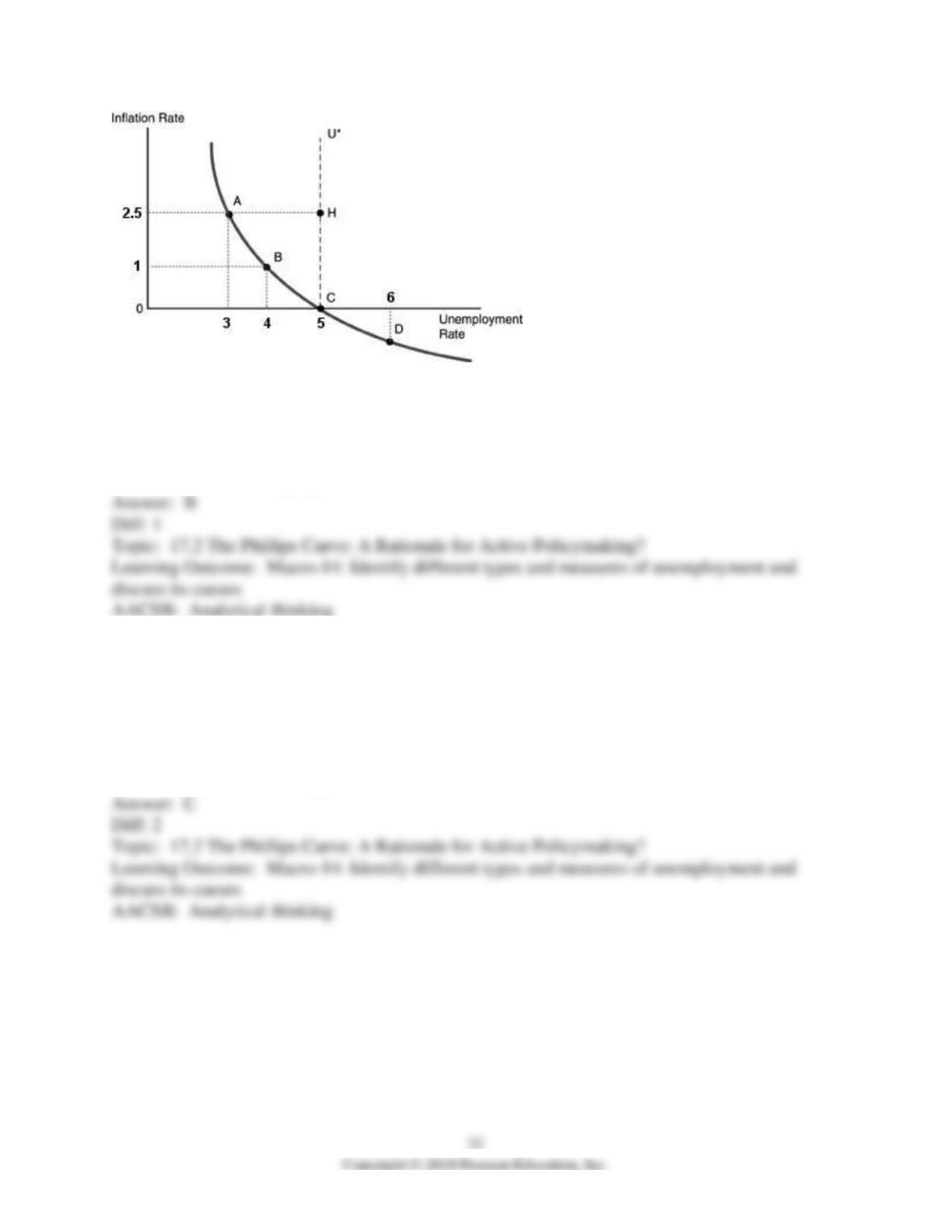
6) Refer to the above figure. Line ABCD is a(n)
A) aggregate demand curve.
B) Phillips curve.
C) discretionary-policy curve.
D) natural rate of unemployment curve.
7) Refer to the above figure. Government policy that moved the economy from A to B would be
accomplished by
A) an expansionary fiscal policy combined with a contractionary monetary policy.
B) a contractionary fiscal policy combined with an expansionary monetary policy.
C) a contractionary policy that would reduce the rate of inflation and would cause workers to
remain unemployed longer than they were before.
D) raising the minimum wage.
8) Refer to the above figure. Suppose the economy is at C. If the government tried to reduce the
unemployment rate to 3 percent, the new long-run outcome will be at point
A) A.
B) C.
C) D.
D) H.
9) Refer to the above figure. Suppose the natural rate of unemployment is 5 percent. If the
government tried to reduce unemployment to 4 percent and keep it there, it must
A) raise unemployment benefits.
B) accept a permanent inflation rate of 1 percent.
C) generate higher and higher inflation rates or else people will adjust their behavior and the
unemployment rate will return to 5 percent.
D) use contractionary fiscal and expansionary monetary policy.
10) Policymakers’ attempts to use the Phillips curve to reduce the unemployment rate below the
natural rate
A) will be successful since the Phillips curve shows the relationship between the inflation rate
and the unemployment rate.
B) will be successful if monetary policy is used.
C) will be unsuccessful if monetary policy is used since monetary policy leads to higher prices.
D) will be unsuccessful since workers’ expectations adjust to attempts to reduce unemployment
below the natural rate.
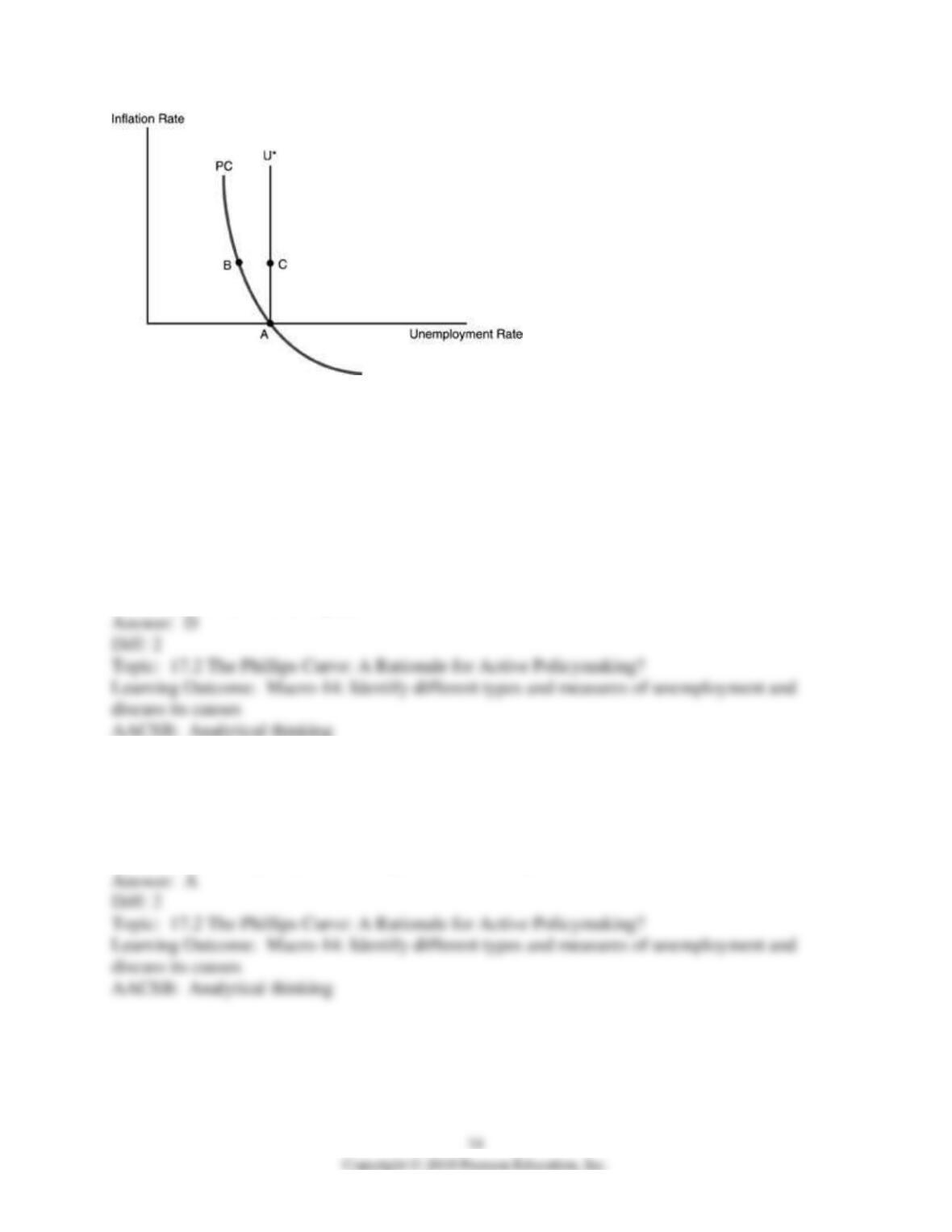
11) Refer to the above figure. The economy initially is at point A. The Fed unexpectedly
increases the money supply. Which of the following statements are TRUE?
A) In the short run, the economy will move from point A to point C. In the long run, the
economy will move to point B.
B) In the short run, the economy will move from point A to point C. In the long run, the
economy will move back to point A.
C) In the short run, the economy will move from point A to point B. In the long run, the
economy will stay at point B.
D) In the short run, the economy will move from point A to point B. In the long run, the
economy will move back to point A.
12) If households and businesses correctly anticipate the inflation rate, the unemployment rate
A) will be the natural rate of unemployment.
B) will be the cyclical rate of unemployment.
C) will be inversely related to the expected inflation rate.
D) will be positively related to the expected inflation rate.
35
13) Unemployment that deviates from the natural rate of unemployment is referred to as
A) frictional unemployment.
B) cyclical unemployment.
C) seasonal unemployment.
D) structural unemployment.
14) Suppose the Fed permanently increases the money supply by a given amount. Which of the
following is most likely to occur in the long run as a result of this monetary policy action?
A) an increase in employment
B) a reduction in the real interest rate
C) a decrease in unemployment
D) none of the above
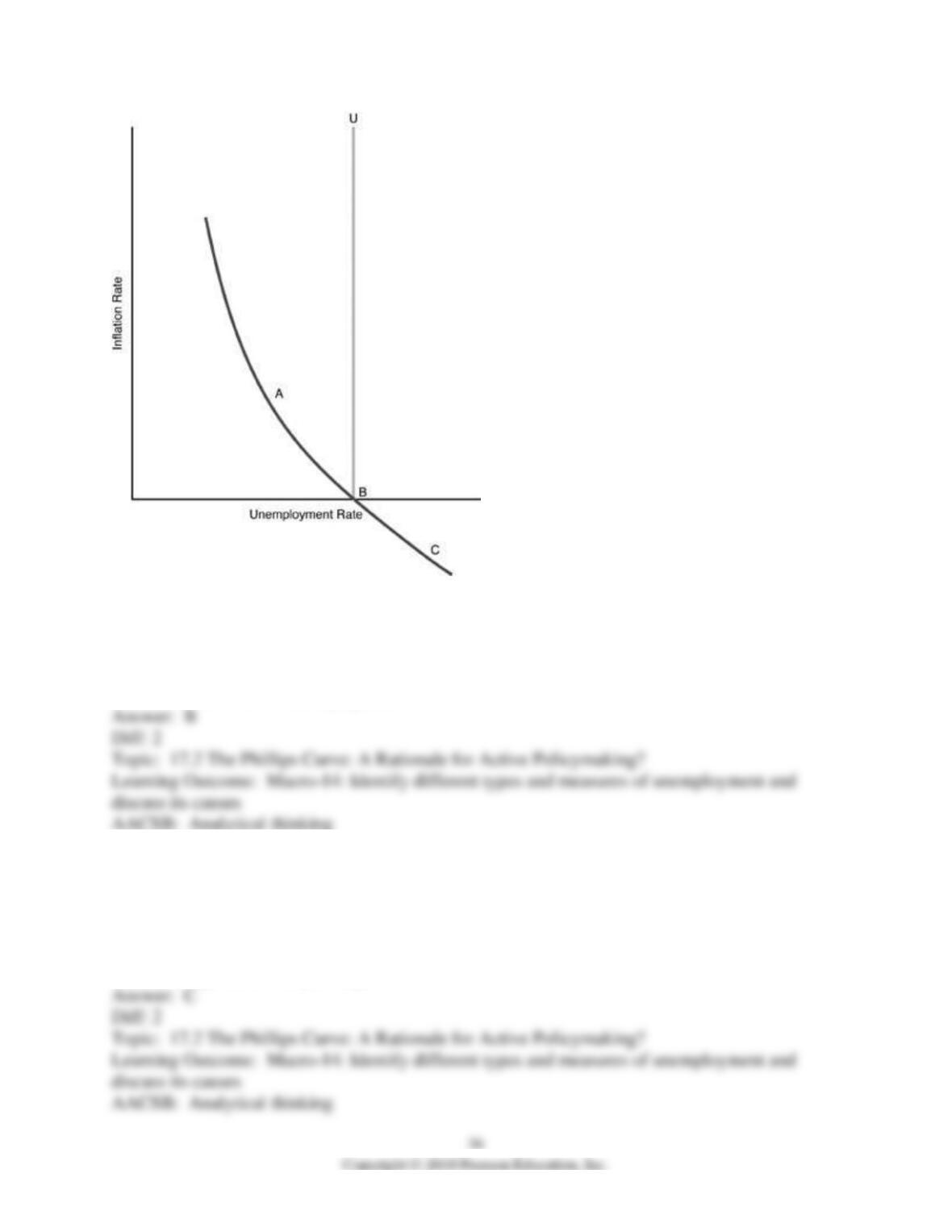
15) In the above figure, what does the line U represent?
A) the Phillips curve
B) the natural rate of unemployment
C) potential unemployment
D) full inflation rate of unemployment
16) Use the above figure. Assuming that policy actions are unanticipated, if the economy is at
point A and the policy makers want to get to point B, they could
A) increase the money supply.
B) decrease taxation.
C) decrease the money supply.
D) increase government spending.
17) According to A.W. Phillips, an inverse relationship has existed between
A) unemployment and interest rates.
B) the rate of growth of the money supply and the unemployment rate.
C) the inflation rate and unemployment rate.
D) the inflation rate and the money supply.
18) Which of the following curves shows the relationship between the unemployment rate and
the rate of change in the price level?
A) the new Keynesian aggregate supply curve
B) the real business cycle curve
C) the aggregate demand curve
D) none of the above
19) According to the Phillips curve
A) there is a direct relationship between price-level changes and the level of unemployment rate.
B) the unemployment rate is not affected by changes in the price level.
C) price-level changes are not affected by changes in the unemployment rate.
D) there is an inverse relationship between price-level changes and the unemployment rate.
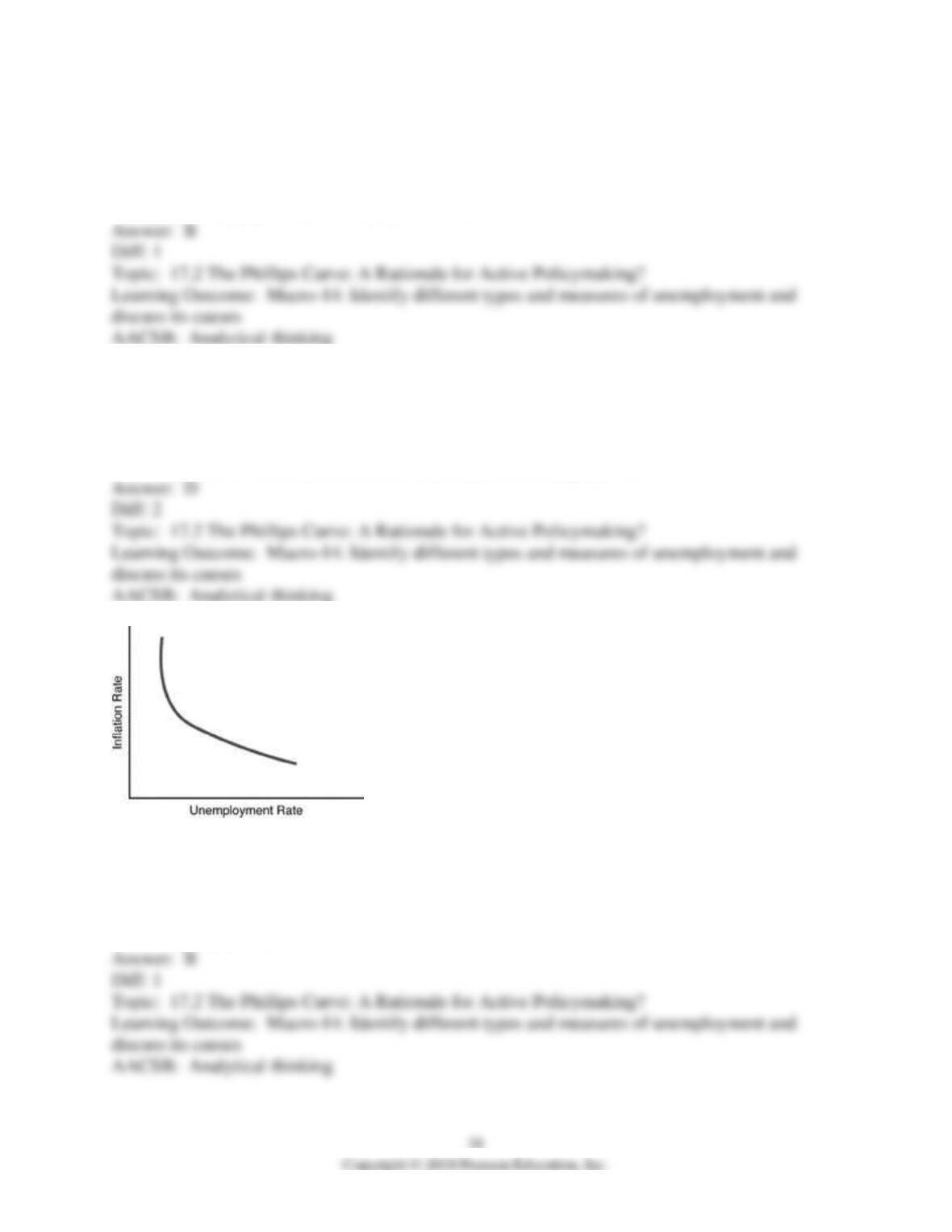
20) The Phillips curve shows the relationship between
A) the rate of growth in real GDP and the unemployment rate.
B) the inflation rate and the unemployment rate.
C) aggregate demand and the unemployment rate.
D) aggregate supply and the unemployment rate.
21) The downward slope of the Phillips curve suggests that
A) an increase in the price level will depress nominal wages.
B) an increase in the price level will increase the money supply.
C) a decrease in the money supply will stimulate aggregate demand.
D) policy makers face a trade-off between inflation and unemployment.
22) Use the above figure. This graph is known as
A) the Laffer curve.
B) the short-run Phillips curve.
C) the NAIRU relationship.
D) the Keynesian curve.
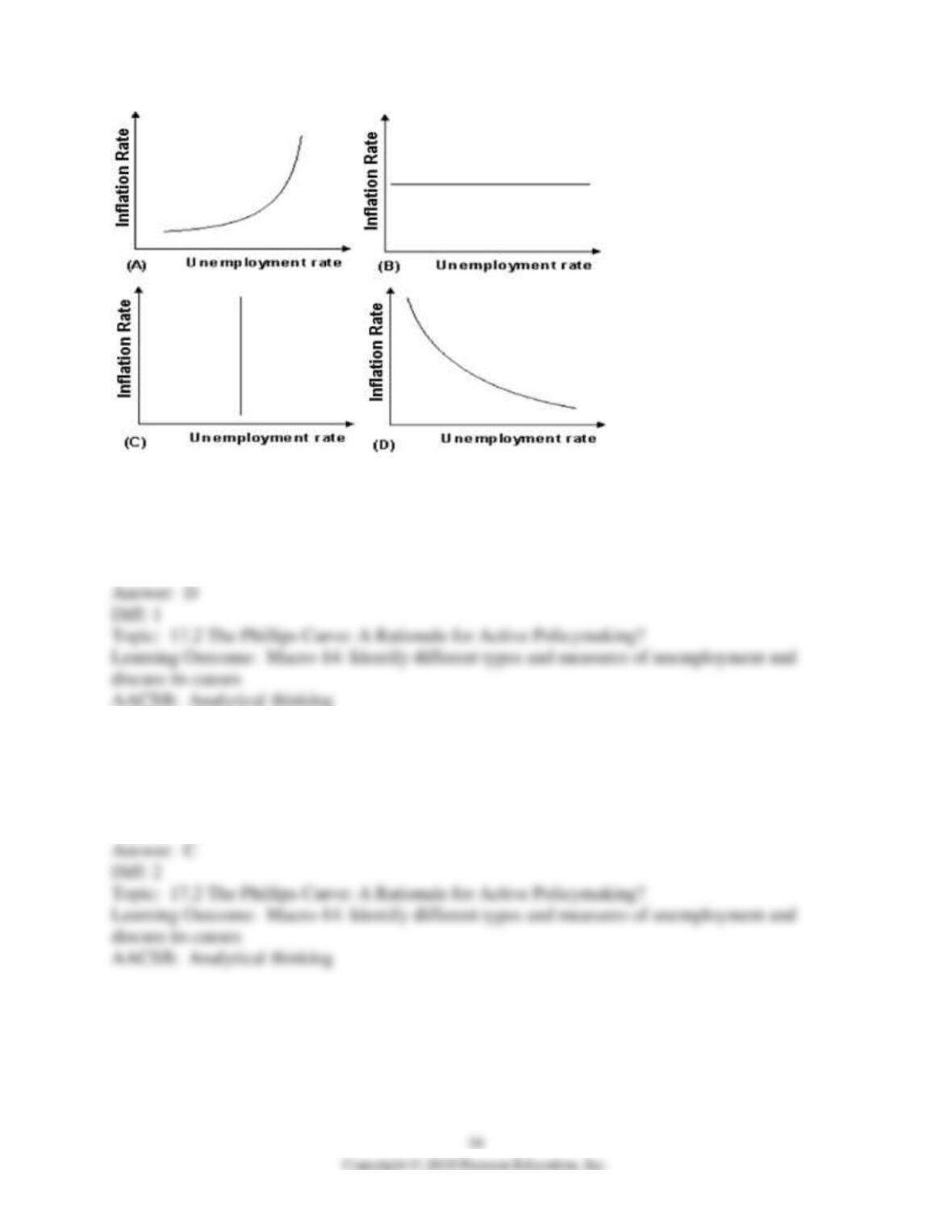
23) Use the above figure. Graph ________ correctly depicts the short-run Phillips Curve.
A) A
B) B
C) C
D) D
24) Use the above figure. The long-run Phillips curve is best depicted by graph
A) A.
B) B.
C) C.
D) D.
25) According to economists who support passive policymaking
A) there is no difference between the effect of an anticipated change in aggregate demand and
the effect of an unanticipated change in aggregate demand of an identical amount.
B) workers always consider a change in nominal wages to be a change in real wages.
C) expansionary policies can reduce unemployment without increasing the price level.
D) policies that attempt to exploit the Phillips curve trade-off will eventually become ineffective
for reducing unemployment.
26) Historical evidence suggests that
A) the Phillips curve is horizontal.
B) once policy makers attempted to exploit a short-run Phillips curve trade-off, it disappeared.
C) shifts in long-run aggregate supply do not affect real output.
D) inflation rates are lowest when unemployment rates are also low.
27) An unexpected decrease in aggregate demand
A) causes the price level to fall and the unemployment rate to rise.
B) causes the price level to fall and the unemployment rate to fall.
C) causes the price level to rise and the unemployment rate to rise.
D) causes the price level to rise and the unemployment rate to fall.