Macroeconomics 2017 (Hubbard)
Chapter 17 Inflation, Unemployment, and Federal Reserve Policy
17.1 The Discovery of the Short-Run Trade-off between Unemployment and Inflation
1) Goodyear benefitted when the Federal Reserve slashed the federal funds rate to near-zero levels in
2008. Lower interest rates increased demand for its tires, which would allow Goodyear to ________
employment and ________ prices.
A) increase; increase
B) increase; decrease
C) decrease; increase
D) decrease; decrease
2) Evidence shows that many people who delay searching for a job for a year or longer after they are
laid off
A) find it more difficult to find new employment than if they had searched for a new job soon after they
were laid off.
B) find it easier to find new employment than if they had searched for a new job soon after they were
laid off.
C) find that they have little to no chance to find new employment after being unemployed for so long.
D) find that the extra unemployment benefits they receive during their extended period of
unemployment more than make up for the difficulty in finding a job once they decide to re-enter the
workforce.
3) The curve showing the short-run relationship between the unemployment rate and the inflation rate
is called
A) the monetary policy curve.
B) the Phillips curve.
C) the Sargent curve.
D) the unemployment curve.
4) According to the short-run Phillips curve, the unemployment rate and the inflation rate are
A) unrelated.
B) positively related.
C) negatively related.
D) unaffected by monetary policy.
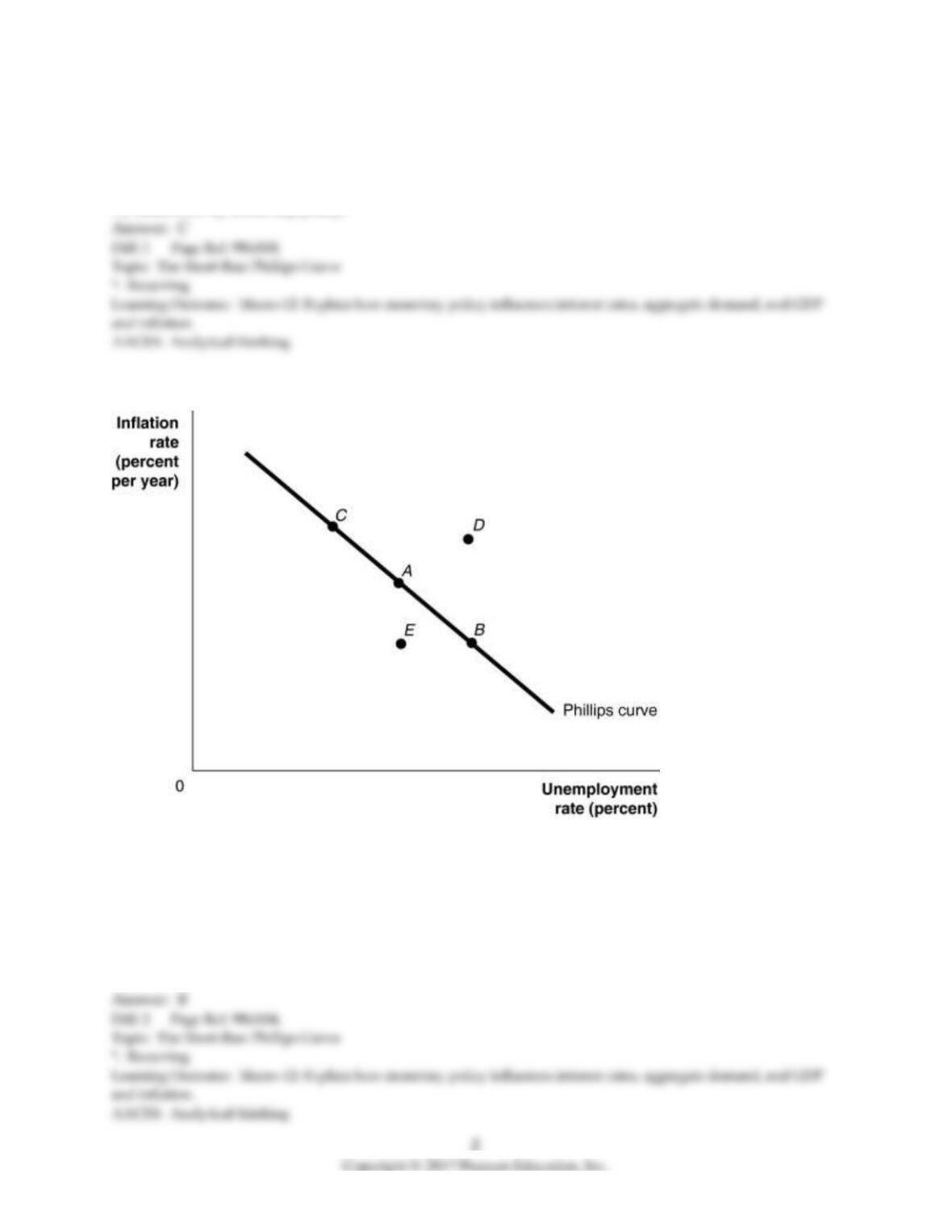
Figure 17-1
5) Refer to Figure 17-1. What should the Federal Reserve do if it wants to move from point A to point B
in the short-run Phillips curve depicted in the figure above?
A) buy treasury bills
B) sell treasury bills
C) lower the discount rate
D) increase the money supply
E) lower taxes
6) Refer to Figure 17-1. Suppose that the economy is currently at point A. If the Federal Reserve
engaged in contractionary monetary policy, where would the economy end up in the short run?
A) It would remain at point A.
B) point B
C) point C
D) point D
E) point E
7) Refer to Figure 17-1. Suppose that the economy is currently at point A, and the unemployment rate at
A is the natural rate. What policy would the Federal Reserve pursue if it wanted the economy to move
to point B in the long run?
A) Buy treasury bills.
B) Sell treasury bills.
C) Raise the discount rate.
D) Decrease the money supply.
E) No policy will move the economy to point B in the long run.
8) Refer to Figure 17-1. Suppose that the economy is currently at point A on the short-run Phillips curve
in the figure above, and the unemployment rate at A is the natural rate. If the economy was to move to
point C, which of the following must be true?
A) The economy is producing a level of GDP equal to potential GDP.
B) Aggregate demand must have decreased.
C) Equilibrium GDP at point C must be above potential GDP.
D) The Fed conducted contractionary policy to cause the move.
E) The Fed sold treasury bills to cause the move.
9) Refer to Figure 17-1. What should the Federal Reserve do if it wants to move from point A to point C
in the short-run Phillips curve depicted in the figure above?
A) buy treasury bills
B) sell treasury bills
C) raise the discount rate
D) decrease the money supply
E) raise taxes
10) Refer to Figure 17-1. Suppose that the economy is currently at point A. If the Federal Reserve
engaged in expansionary monetary policy, where would the economy end up in the short run?
A) It would remain at point A.
B) point B
C) point C
D) point D
E) point E
11) Refer to Figure 17-1. Suppose that the economy is currently at point A, and the unemployment rate
at A is the natural rate. What policy would the Federal Reserve pursue if it wanted the economy to
move to point C in the long run?
A) Buy treasury bills.
B) Sell treasury bills.
C) Lower the discount rate.
D) Increase the money supply.
E) No policy will move the economy to point C in the long run.
12) Refer to Figure 17-1. Suppose that the economy is currently at point A on the short-run Phillips
curve in the figure above, and the unemployment rate at A is the natural rate. If the economy was to
move to point B, which of the following must be true?
A) The economy is producing a level of GDP equal to potential GDP.
B) Aggregate demand must have increased.
C) Equilibrium GDP at point B must be below potential GDP.
D) The Fed conducted expansionary policy to cause the move.
E) The Fed purchased treasury bills to cause the move.
13) According to the short-run Phillips curve, if unemployment is 3.2% and inflation is 1.3%, an increase
in the inflation rate might result in which of the following?
A) an increase in the unemployment rate to 3.4%
B) a decrease in the unemployment rate to 3.0%
C) a decrease in the demand for labor in the economy
D) a return to the original inflation rate of 1.3%
14) Which of the following best explains the negative slope of the short-run Phillips curve?
A) Weak growth in aggregate demand keeps the economy below potential GDP, so unemployment rises
but inflation falls.
B) Aggregate demand grows so quickly that the inflation rate rises as unemployment rises.
C) Long-run aggregate supply increases quickly enough that inflation falls as unemployment also falls.
D) Short-run aggregate supply increases at the same pace as aggregate demand increases so that
inflation and unemployment do not change.
15) If the Phillips curve represents a “structural relationship,” then
A) the trade-off between unemployment and inflation is permanent.
B) the trade-off between unemployment and inflation holds only for the short run.
C) the trade-off between unemployment and inflation holds in the long run, but not in the short run.
D) the Phillips curve will be vertical in the long run.
16) According to the short-run Phillips curve, which of the following would result in low rates of
unemployment?
A) weak increases in aggregate supply
B) a lower inflation rate
C) weak increases in aggregate demand
D) a higher inflation rate
17) What is a “structural” relationship?
A) a relationship that depends on the size of firm investments in capital such as buildings and other
structures
B) a relationship that depends on the basic behavior of consumers and firms and remains unchanged
over long periods
C) a relationship between any two variables that is temporary
D) any relationship that cannot be anticipated
18) What is the natural rate of unemployment?
A) the unemployment rate that exists when the economy is at potential GDP
B) the unemployment rate that exists when the economy is at a trough in a business cycle
C) an unemployment rate of 0%
D) any unemployment rate that is above the inflation rate
19) In the long run, the Phillips curve is a ________ at ________.
A) horizontal line; 0% inflation
B) negatively sloped line; the intersection of aggregate demand and short-run aggregate supply
C) vertical line; the natural rate of unemployment
D) vertical line; the expected rate of inflation
20) Employees at the university have negotiated a 5 percent increase in wages for the next year, based
on their inflation expectations. If inflation is actually 4 percent over the next year, which of the
following will occur?
A) Unemployment of university employees will fall.
B) Real wages for university employees will rise.
C) Inflation will be 5 percent the following year.
D) The decrease in inflation is expected.
21) Employees at the university have negotiated a 5 percent increase in wages for the next year, based
on their inflation expectations. If inflation is actually 6 percent over the next year, which of the
following will occur?
A) Unemployment of university employees will rise.
B) Real wages for university employees will fall.
C) Inflation will be 5 percent the following year.
D) The increase in inflation is expected.
22) If actual inflation is less than expected inflation, which of the following will be true?
A) Real wages will rise.
B) Real wages will fall.
C) The Phillips curve will be a vertical line.
D) The unemployment rate will fall.
23) Gretchen expects the price level to rise from 104 this year to 108 next year, and she is able to
incorporate these expectations into her wage contract. If the price level rises to 106 next year instead of
108, which of the following will occur?
A) Gretchen’s real wage will be unchanged.
B) Gretchen’s real wage will fall.
C) Gretchen’s real wage will rise.
D) Gretchen’s real wage may rise or fall, depending on the unemployment rate.
24) Matt’s real wage in 2014 is $26.80. If the price level is 104, what is Matt’s nominal wage?
A) $30.80
B) $27.87
C) $26.80
D) $25.77
25) If workers and firms expect that inflation will be 3 percent next year, and real wages are not
changing over time, by how much will nominal wages increase?
A) 3 percent
B) more than 3 percent
C) less than 3 percent
D) depends on actual inflation for next year
26) If actual inflation is less than expected inflation, actual real wages will be ________ expected real
wages and unemployment will ________.
A) greater than; rise
B) greater than; fall
C) less than; rise
D) less than; fall
27) The key to understanding the short-run trade-off behind the Phillips curve is that an increase in
inflation will decrease unemployment if the inflation is ________ by both workers and firms.
A) unexpected
B) expected
C) perfectly predicted
D) ignored
28) If the long-run aggregate supply curve is vertical,
A) the economy stays at the natural rate of inflation in the long run.
B) the short-run Phillips curve must be vertical.
C) unemployment and inflation are positively related in the long run.
D) the trade-off between unemployment and inflation cannot be permanent.
29) The price level in the economy between 2014 and 2015 rose from 100 to 105. Between 2015 and 2016,
the price level rose from 105 to 110.25. How does the short-run Phillips curve predict the
unemployment rate will change as a result?
A) The unemployment rate will decrease since inflation decreased.
B) The unemployment rate will decrease since inflation increased.
C) The unemployment rate will increase since inflation increased.
D) The unemployment rate would not change since there is no change in the rate of inflation.
30) A higher inflation rate can lead to lower unemployment if ________ mistakenly expect the inflation
rate to be lower than it turns out to be.
A) workers, but not employers
B) employers, but not workers
C) both workers and employers
D) neither workers nor employers
31) Goodyear benefitted when the Federal Reserve ________ in 2008. This Fed action would help
increase demand for its tires, which allowed Goodyear to increase employment and increase prices.
A) drove down interest rates
B) increased the discount rate
C) lowered the required reserve rate
D) implemented a series of open market sales of Treasury bonds
32) Evidence shows that for many people, delaying searching for a job for a year or longer after they are
laid off will contribute to a deterioration of their job skills, making it harder for them to find
employment. This deterioration in job skills and the subsequent retraining that is necessary to obtain
employment relates to which type of unemployment?
A) cyclical
B) frictional
C) seasonal
D) structural
33) In the decade of the ________, A.W. Phillips plotted data for Great Britain which revealed a
relationship between rates of changes in wages versus unemployment rates. Economists later
discovered other “Phillips Curve” relationships between rates of inflation versus unemployment rates.
A) 1930s
B) 1940s
C) 1950s
D) 1960s
34) The curve showing the short-run relationship between the ________ and the ________ is called the
Phillips curve.
A) nominal interest rate; real interest rate
B) unemployment rate; inflation rate
C) price level; real GDP
D) exchange rate; real interest rate
35) According to the ________ Phillips curve, the unemployment rate and the inflation rate are
negatively related.
A) long-run
B) short-run
C) long-run and short-run
D) rational expectations
36) In a graph of unemployment rates (on the horizontal axis) versus inflation rates (on the vertical
axis), the short-run Phillips Curve is
A) downward sloping.
B) horizontal.
C) vertical.
D) upward sloping.
37) According to the short-run Phillips curve, if unemployment is 2.4% and inflation is 3.7%, a decrease
in the inflation rate might result in which of the following?
A) an increase in the unemployment rate to 3.4%
B) a decrease in the unemployment rate to 3.0%
C) a decrease in the demand for labor in the economy
D) Both A and C are correct answers.
38) Assume weak growth in aggregate demand keeps the economy below potential GDP, so
unemployment rises but inflation falls. This explains the ________ slope of the short-run Phillips curve.
A) positive
B) negative
C) zero
D) infinite
39) According to the short-run Phillips curve, which of the following would result in high rates of
unemployment?
A) strong increases in aggregate supply
B) a lower inflation rate
C) strong increases in aggregate demand
D) a higher inflation rate
40) Employees at the hospital have negotiated a 3 percent increase in wages for the next year, based on
their inflation expectations. If inflation is actually 5 percent over the next year, which of the following
will occur?
A) Unemployment of hospital employees will rise.
B) Real wages for hospital employees will fall.
C) Inflation will be 3 percent the following year.
D) The increase in inflation is expected.
41) If actual inflation is greater than expected inflation,
A) real wages rise.
B) real wages fall.
C) the Phillips curve is a vertical line.
D) the unemployment rate rises.
42) Alejandro expects the price level to rise from 105 this year to 108 next year. If the price level rises to
110 next year instead of 108, which of the following will occur?
A) Alejandro’s real wage remains unchanged.
B) Alejandro’s real wage falls.
C) Alejandro’s real wage rises.
D) Alejandro’s real wage may rise or fall, depending on the unemployment rate.
43) Shondra’s real wage in 2016 is $18.50. If the price level is 106, what is Shondra’s nominal wage?
A) $19.61
B) $18.61
C) $18.50
D) $17.44
44) If workers and firms expect that inflation will be 5 percent next year, and real wages are not
changing over time, by how much will nominal wages increase?
A) 5 percent
B) more than 5 percent
C) less than 5 percent
D) depends on actual inflation for next year
45) The price level in the economy between 2014 and 2015 rose from 100 to 110. Between 2015 and 2016,
the price level rose from 110 to 121. How does the short-run Phillips curve predict the unemployment
rate will change as a result?
A) The unemployment rate will decrease since inflation decreased.
B) The unemployment rate will decrease since inflation increased.
C) The unemployment rate will increase since inflation increased.
D) The unemployment rate will not change since there is no change in the rate of inflation.
46) If the Phillips curve represents a “________ relationship,” then the trade-off between unemployment
and inflation is permanent.
A) structural
B) frictional
C) cyclical
D) dynamic
47) A relationship that depends on the basic behavior of consumers and firms and remains unchanged
over long periods is called a ________ relationship.
A) frictional
B) structural
C) cyclical
D) dynamic
48) The unemployment rate that exists when the economy is at potential GDP is called
A) the natural rate of unemployment.
B) cyclical unemployment.
C) deflation-based unemployment.
D) zero-rate unemployment.
49) All other factors held constant, increased growth in aggregate demand will
A) increase inflation.
B) reduce unemployment.
C) move the economy to a higher point on the short-run Phillips curve.
D) All of the above are correct.
50) If actual inflation is greater than expected inflation, what is the relationship between the actual real
wage and the expected real wage?
A) The actual real wage will be lower than the expected real wage.
B) The actual real wage will be higher than the expected real wage.
C) The actual real wage will be equal to the expected real wage.
D) The relationship between the actual real wage and the expected real wage cannot be predicted.
51) If changes in inflation are higher than expected,
A) the short-run Phillips curve will be positively sloped, but not vertical.
B) the short-run Phillips curve will be negatively sloped.
C) the short-run Phillips curve will be vertical.
D) the long-run Phillips curve will be negatively sloped.
52) In an effort to discover whether or not workers understand inflation, economist Robert Shiller
conducted a survey. When asked about the effect of general inflation on their wages or salary, the most
popular response coming from workers was,
A) “My wages usually catch up to rising prices within a year.”
B) “The price increase will create extra profit for my employer…. There will be no affect on my pay.”
C) “My wages have always increased by more than the rate of inflation.”
D) None of the above is correct.
53) Robert Shiller posed the following question to workers: “Imagine that next year the inflation rate
unexpectedly doubles. How long would it probably take, in these times, before your income is
increased enough so that you can afford the same things as you do today?” Shiller found that ________
percent of the workers he interviewed reported that it would take several years to restore the
purchasing power of their wages or that this power would never be restored.
A) 25
B) 42
C) 64
D) 81
54) The natural rate of unemployment is the rate that exists when the economy is producing at potential
GDP.
55) Ceteris paribus, in the short run following a decrease in the rate of growth in aggregate demand, we
would expect to see an increase in the rate of unemployment and a decrease in the rate of inflation.
56) A study conducted by Robert Shiller, a Yale Economist, found that a large majority of the public
thinks that increases in inflation will not quickly lead to an increase in wages.
57) An increase in the inflation rate increases employment only if the increase in inflation is unexpected.
58) If the actual rate of inflation exceeds the expected rate of inflation, the actual real wage is greater
than the expected real wage and unemployment falls.
59) In the 1960s, many economists and policymakers believed the trade-off between inflation and
unemployment was permanent.
60) Workers at a local mining company are paid $25.60 per hour, and they have incorporated a 3 percent
annual raise in their contracts to account for expected inflation. Explain how unexpected inflation of 5
percent will affect the real wage and the unemployment rate.
61) If workers accurately predict the rate of inflation, is there a short-run trade-off between inflation and
unemployment, as predicted by the Phillips curve? Why or why not?
62) Does the short-run Phillips curve have a positive or negative slope? Explain how this slope is
derived.
63) When will an increase in aggregate demand not result in lower unemployment rates in the short
run?
64) Workers at a local construction company are paid $32.50 per hour, and they have incorporated a 4
percent annual raise in their contracts to account for expected inflation. Explain how unexpected
inflation of 2 percent will affect the real wages earned by these workers and the unemployment rate of
these workers.
65) What action should the Fed take if it wants to move from a point on the short-run Phillips curve
representing low unemployment and high inflation to a point representing higher unemployment and
lower inflation?
66) When will a decrease in aggregate demand not result in a lower inflation rate in the short run?
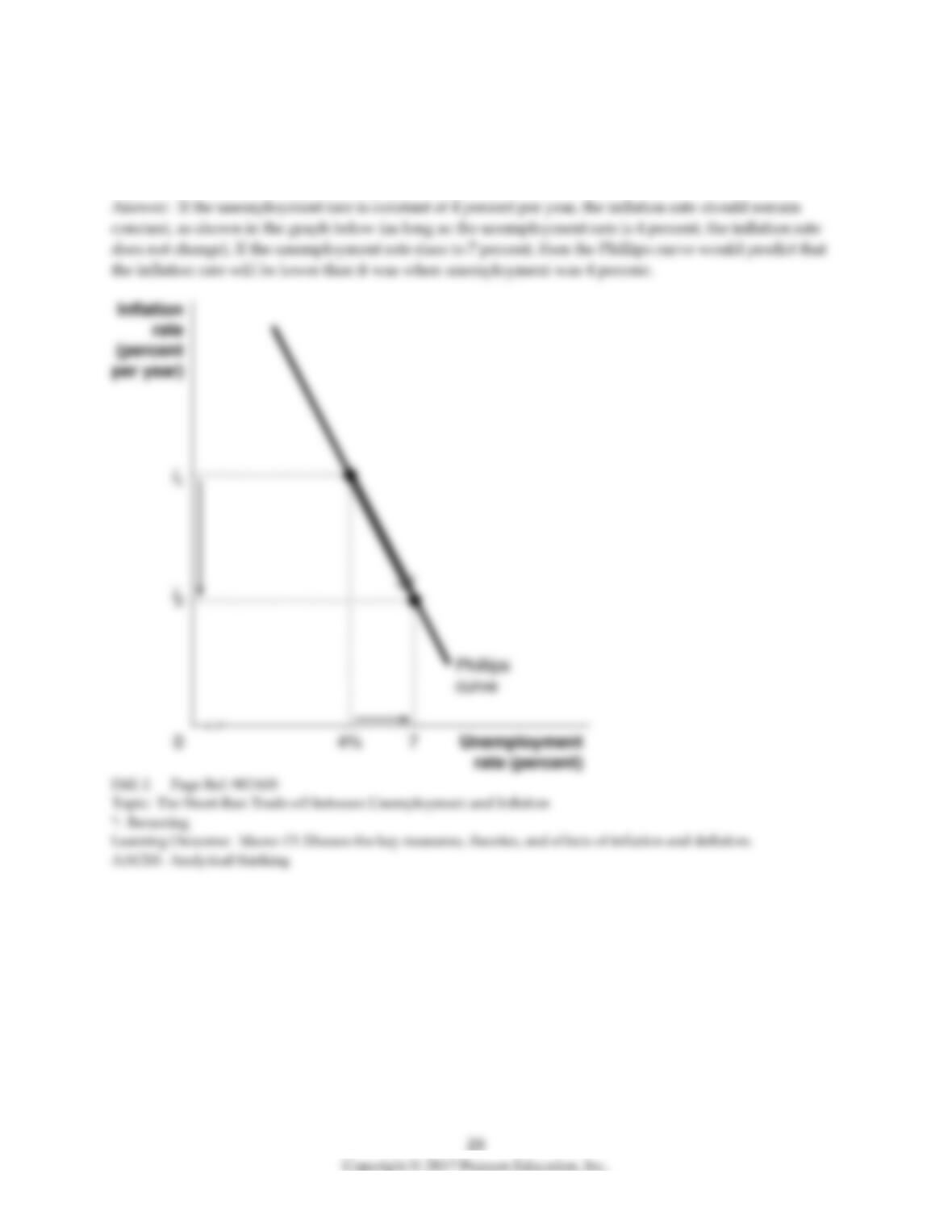
67) If the unemployment rate in the economy is steady at 4 percent per year, how does the short-run
Phillips curve predict that the inflation rate will be changing, if at all? What will happen if the
unemployment rate now rises to 7 percent per year? Assume there are no changes to inflation
expectations. Provide an appropriate graph to support your discussion.