132
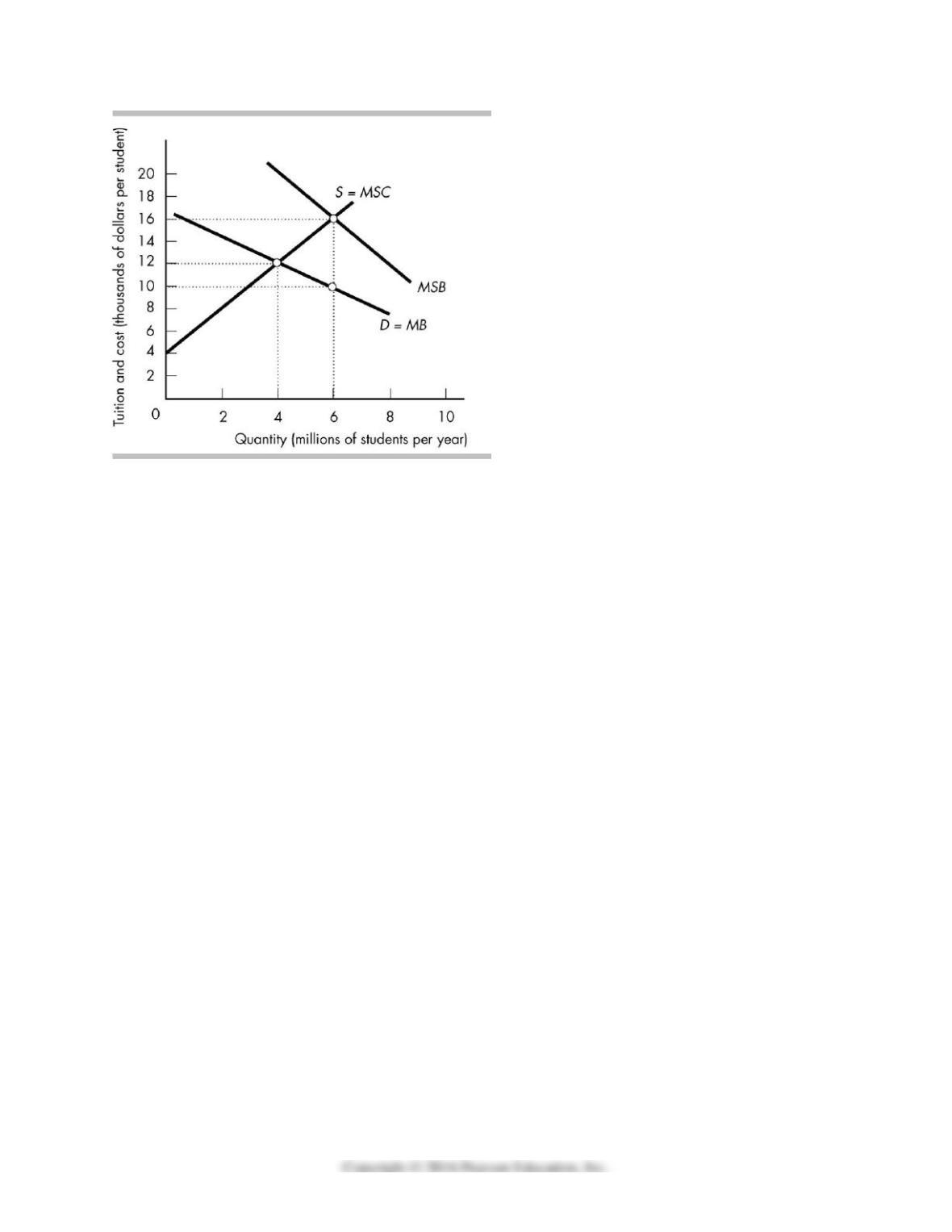
11) The figure above shows the market for education. Education has an external benefit.
a) If the market is competitive and left unregulated, how many students will be enrolled per
year?
b) What is the efficient number of students?
c) In the figure, show the effect of a government private subsidy that moves the market to the
efficient number of students. What is the amount of the subsidy and what tuition must the
students pay?
8 True or False
1) A marginal external cost is the cost of producing an additional unit of a good that falls on the
producer.
2) The marginal social cost is the cost of producing an additional unit of a good or service that
falls on people other than the producer of the good or service.
3) If a product has zero external costs, then marginal social cost equal marginal private cost.
4) In an unregulated competitive market, the presence of marginal external cost of a good or
service results in overproduction.
5) If property rights for air and water exist, then polluters bear the costs of pollution.
6) The Coase Theorem points out that for an efficient outcome to result, it is irrelevant which
party receives the property rights.
7) The Coase Theorem states that externalities can always be eliminated by the market as long as
property rights exist, the number of parties involved is small, and transactions costs are low.
8) Mandating clean technology, cap-and-trade, and taxes are tools that government can use to
limit pollution.
9) When external costs are present and government imposes a tax equal to the external marginal
cost, then efficiency can be achieved.
10) The government can aid in reducing pollution by using a policy of cap-and-trade, which
means that polluters are taxed on the amount of pollution they discharge.
11) The problem of the commons is the absence of incentives to prevent overuse and depletion of
the common resource.
12) For a common resource, the marginal private benefit of the resource is greater than the
marginal social benefit.
13) For a common resource, the marginal private cost of the resource is equal to the marginal
social cost.
14) A common resource is used efficiently if marginal social benefit equals marginal social cost.
15) One way of overcoming the problem of the commons is to make it private property.
16) If there are externalities present in a market, resources are allocated efficiently when
marginal social cost equals marginal social benefit.
17) The marginal social benefit is the sum of the benefit enjoyed by the consumer of an
additional unit of a good or service plus the marginal benefit enjoyed by others.
18) When people make decisions about the quantity of education to undertake, they balance the
marginal social benefit against the marginal private cost.
19) In an unregulated competitive market, the presence of marginal external benefit from a good
or service results in less than the efficient quantity being produced.
20) In an unregulated competitive market, the presence of marginal external benefit from a good
or service results in overproduction.
21) One way that government can encourage the production of goods or services that have
external benefits is to subsidize the good or service.
22) If an activity has an external benefit, such as education, a tax on that activity can lead to the
efficient level of output being produced.
23) In the case of an external benefit generated by an activity, such as education, a private
subsidy for that activity can achieve an efficient outcome.
24) Subsidizing education can lead an efficient level of production because education has
external benefits.
9 Extended Problems
Quantity of paper
produced
(tons per week)
Paper mill’s
marginal cost
(dollars per ton)
Catfish farmers’
marginal cost
from pollution
(dollars per ton)
Marginal social
benefit of paper
(dollars per ton)
10
10
5
55
20
15
10
45
30
20
15
35
40
25
20
25
50
30
25
15
60
35
30
5
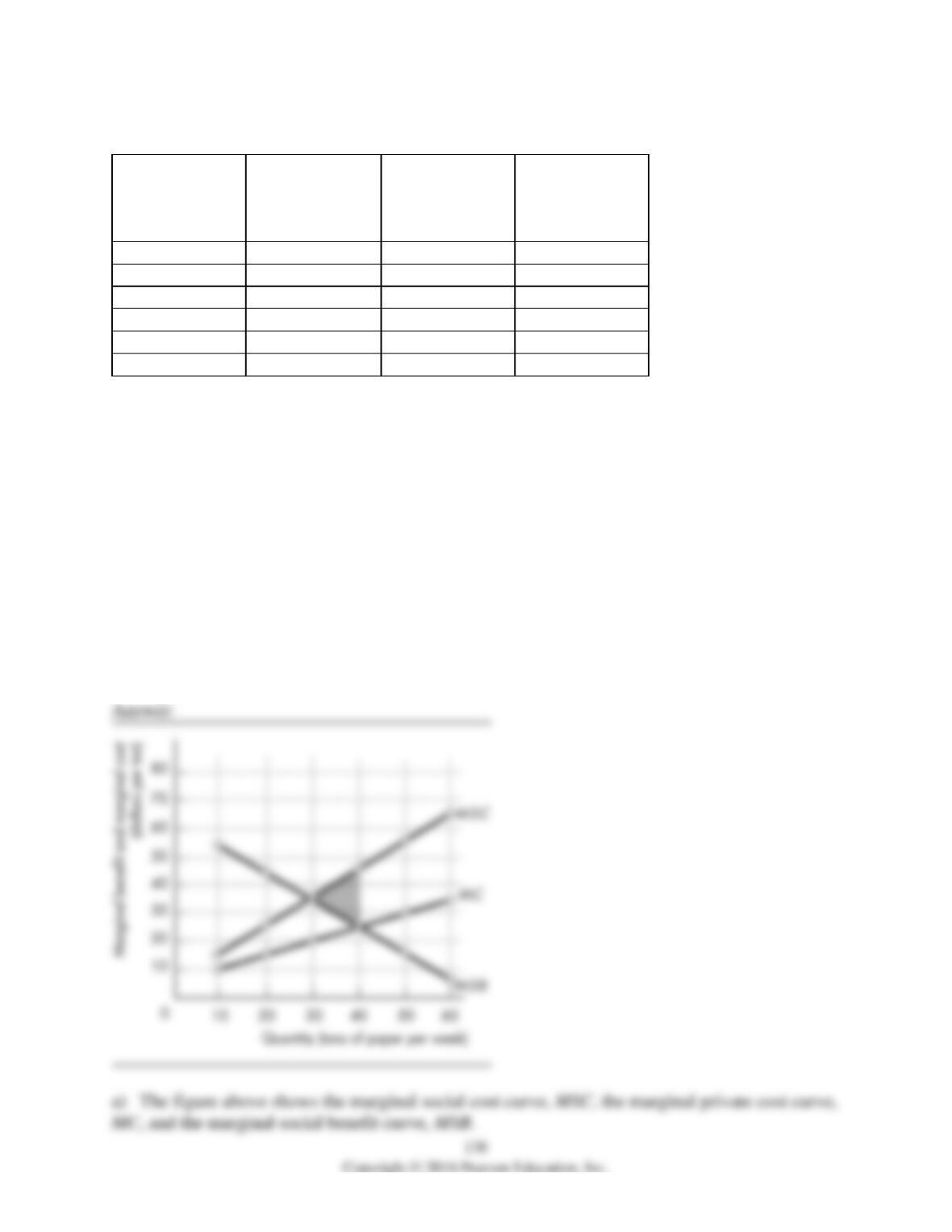
1) A paper mill dumps waste into a lake used by a catfish farmer. The table above shows costs
and benefits arising from the production of paper.
a) Draw the paper mill’s marginal private cost curve, the marginal social cost curve, and the
marginal social benefit of paper curve.
b) What is the efficient level of paper production? If no one owns the lake and there is no
regulation of pollution, what is the quantity of paper produced per week? Illustrate the
deadweight loss in your figure.
c) If the government introduces a Pigovian tax, what is the tax per ton of paper produced that
achieves an efficient outcome? What is the amount of the tax?
d) If the catfish farmer owns the lake, how much paper is produced per week and what does the
paper mill pay the farmer per ton? Explain you answer.
e) If the paper mill owns the lake, how much paper is produced per week? Explain.
f) Compare the quantities of paper produced in (c) and (d) and explain the relationship between
these quantities.
140
Enrollment
(millions of
students per year)
Marginal social
cost
(thousands of
dollars per
student per year)
Marginal private
benefit
(thousands of
dollars per
student per year)
Marginal
external benefit
(thousands of
dollars per
student per year)
4
4
16
8
8
6
14
7
12
8
12
6
16
10
10
5
20
12
8
4
24
14
6
3
2) The table above shows costs and benefits arising from college education. There is no
government involvement and the schools are competitive.
a) Draw the marginal social cost, marginal private benefit, and marginal social benefit curves.
b) How many students are enrolled and what is the tuition?
c) What is the efficient level of enrollment?
d) What is the deadweight loss? Why does it arise?
e) If the government provides the efficient amount of education, how many school places does
it offer and what is the tuition? Explain your answer.
f) If the government provides the efficient amount of education, of the tuition paid by a student
what does the government pay and what does what a student pay?