28) What are ITQs? Where are they used?
29) What is an individual transferable quota (ITQ)?
30) If the number of ITQs issued equals the efficient production level, what is the price of an
ITQ?
31) Explain the difference between marginal social benefit and marginal external benefit.
32) “Education in elementary and high schools has external benefits because families who have a
lot of children do not pay any more than families without children.” Is this statement correct or
incorrect? Explain your answer.
33) Describe some of the external benefits associated with education. What can government do
to encourage production of the efficient amount of education?
34) Does the existence of the University of Oklahoma affect citizens who do not attend the
University?
35) “External benefits lead to overproduction so that more than the efficient quantity is
produced.” Is the previous statement true or false?
36) Why does the existence of an external benefit lead to the production of less than the efficient
quantity?
37) Why would the amount of education provided be inefficient if subsidies to education were
not provided?
38) Why should people without children pay some tax to support local schools?
39) Why does government provide educational opportunities in the form of vouchers, subsidies,
and public provision?
40) A private subsidy has what effect on the amount of a good or service produced? Is a private
subsidy an appropriate policy to offset the inefficiency from an external cost or an external
benefit?
7 Numeric and Graphing Questions
1) If the marginal social cost of a good is $70 and the marginal external cost is $20, what does
the marginal private cost equal?
2) The marginal private cost of a chemical is $100 per ton and its marginal external cost is $20
per ton. What is the marginal social cost of the chemical?
3) The marginal social cost of a chemical is $100 per ton and its marginal private cost is $85 per
ton. What is the marginal external cost of the chemical?
Quantity
(tons of paper)
Marginal
private cost
(dollars)
Marginal
external cost
(dollars)
Marginal
social cost
(dollars)
100
10
5
____
200
20
10
____
300
30
15
____
400
40
20
____
500
50
25
____
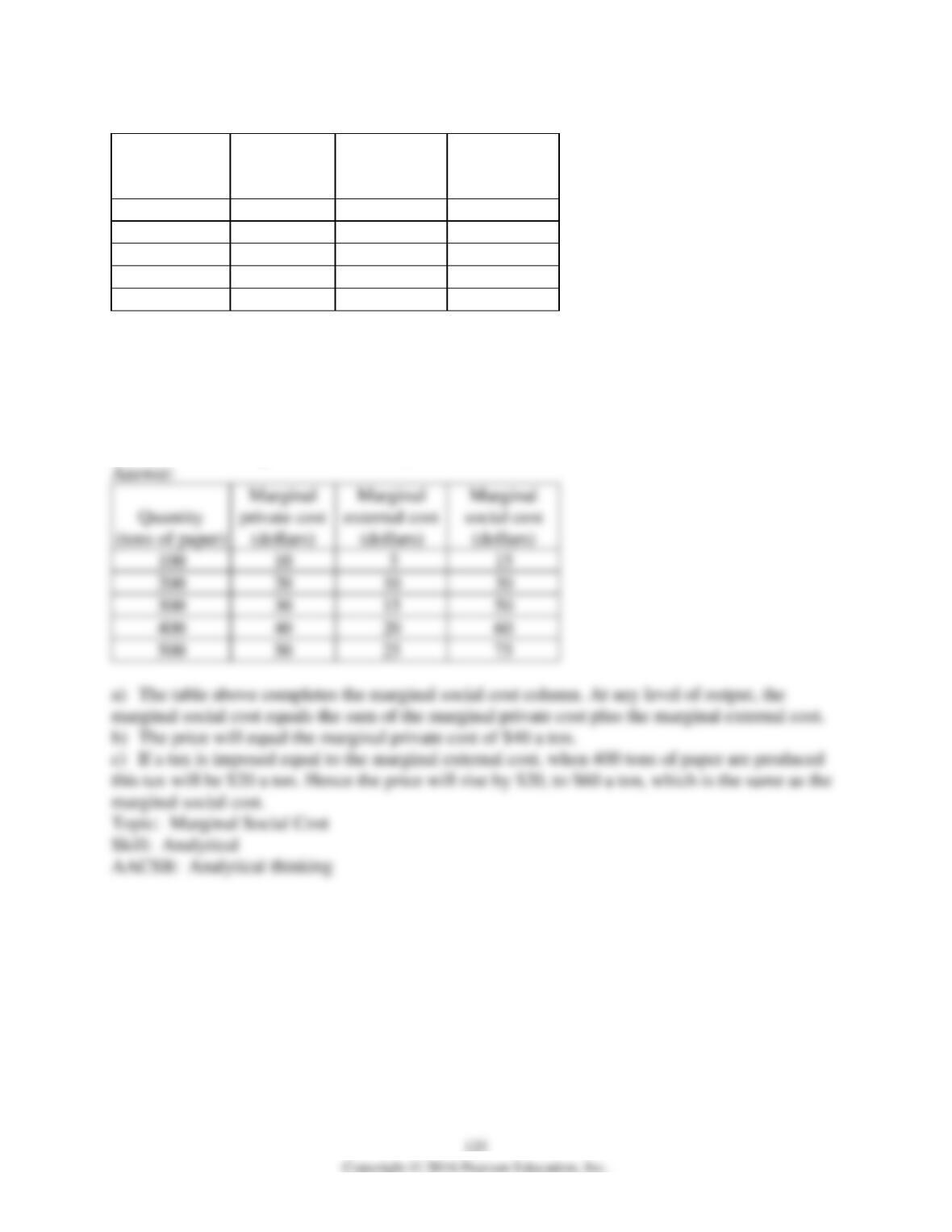
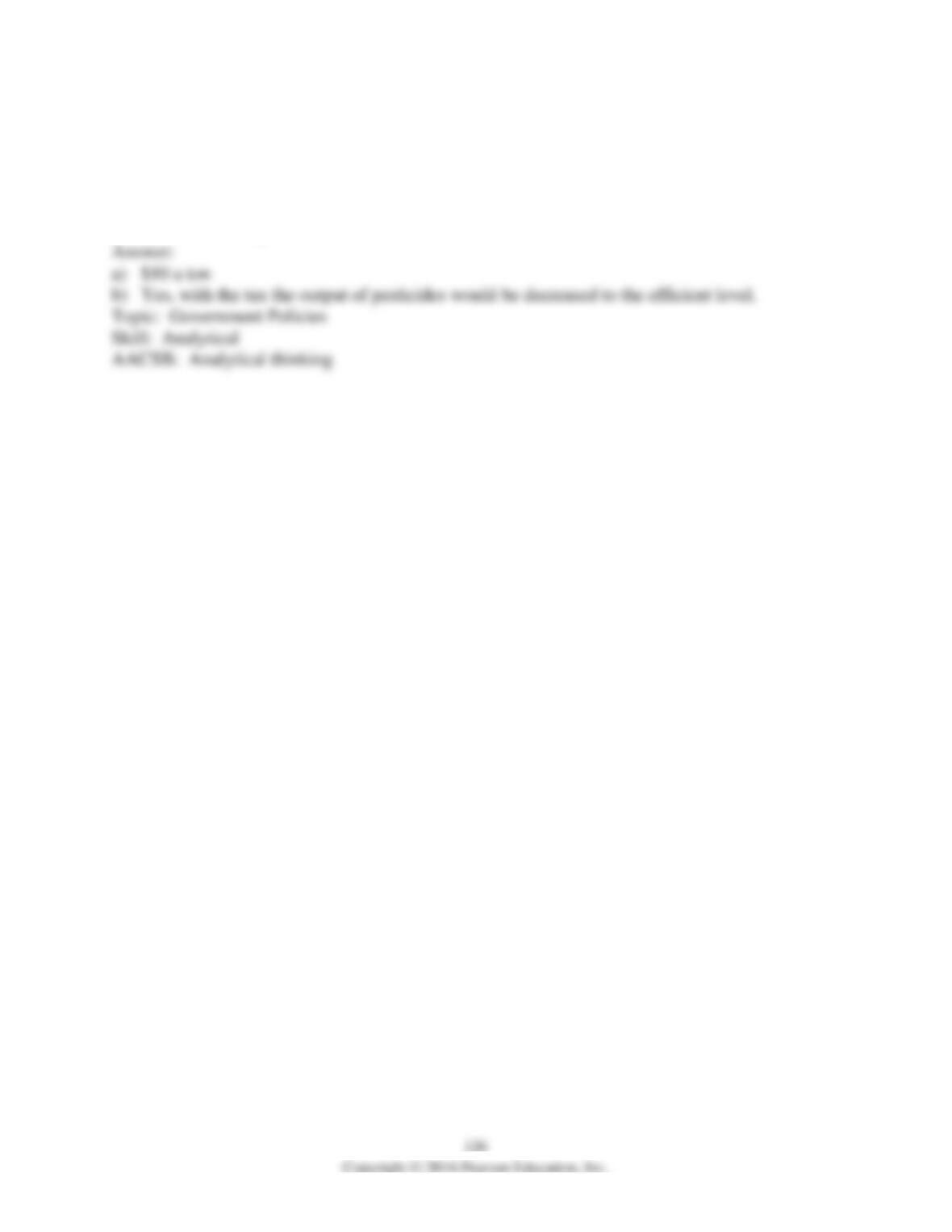
4) The table above gives the private costs and external costs of producing paper.
a) Complete the table by finding the marginal social cost at each level of production.
b) If the market is competitive and is left unregulated and 400 tons of paper are produced, what
is the price of a ton of paper?
c) If the government imposes a tax equal to the external cost at each level of production, what
price would be charged if 400 tons are produced?
Marginal
private cost
(dollars)
Marginal
external cost
(dollars)
Marginal
social cost
(dollars)
100
10
15
200
20
10
30
300
30
15
50
400
40
20
60
500
50
25
75
5) Suppose unregulated production of pesticides results in an equilibrium price and quantity of
$400 and 1,000 tons per day, respectively, and a marginal external cost of $10 a ton.
a) If the government were to eliminate the external cost by using taxes, what should the tax
equal?
b) Would the government action described above affect the quantity of pesticides produced? If
yes, how? If no, why not?
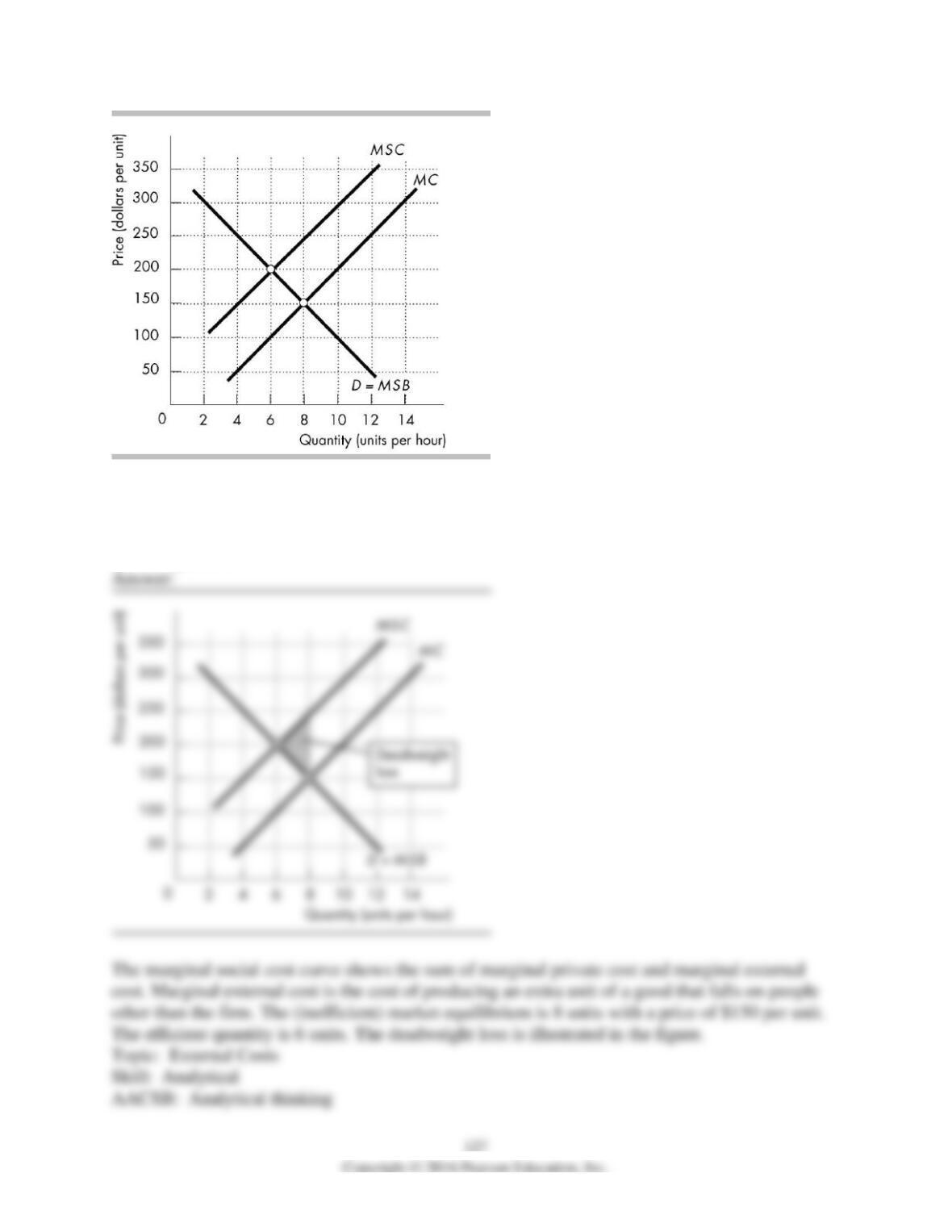
6) Use the figure above to answer this question. Explain what the marginal social cost curve and
the marginal external cost mean. In the figure, if the market is competitive and unregulated, what
is the equilibrium price and quantity? What is the efficient amount of output? Illustrate the
deadweight loss.
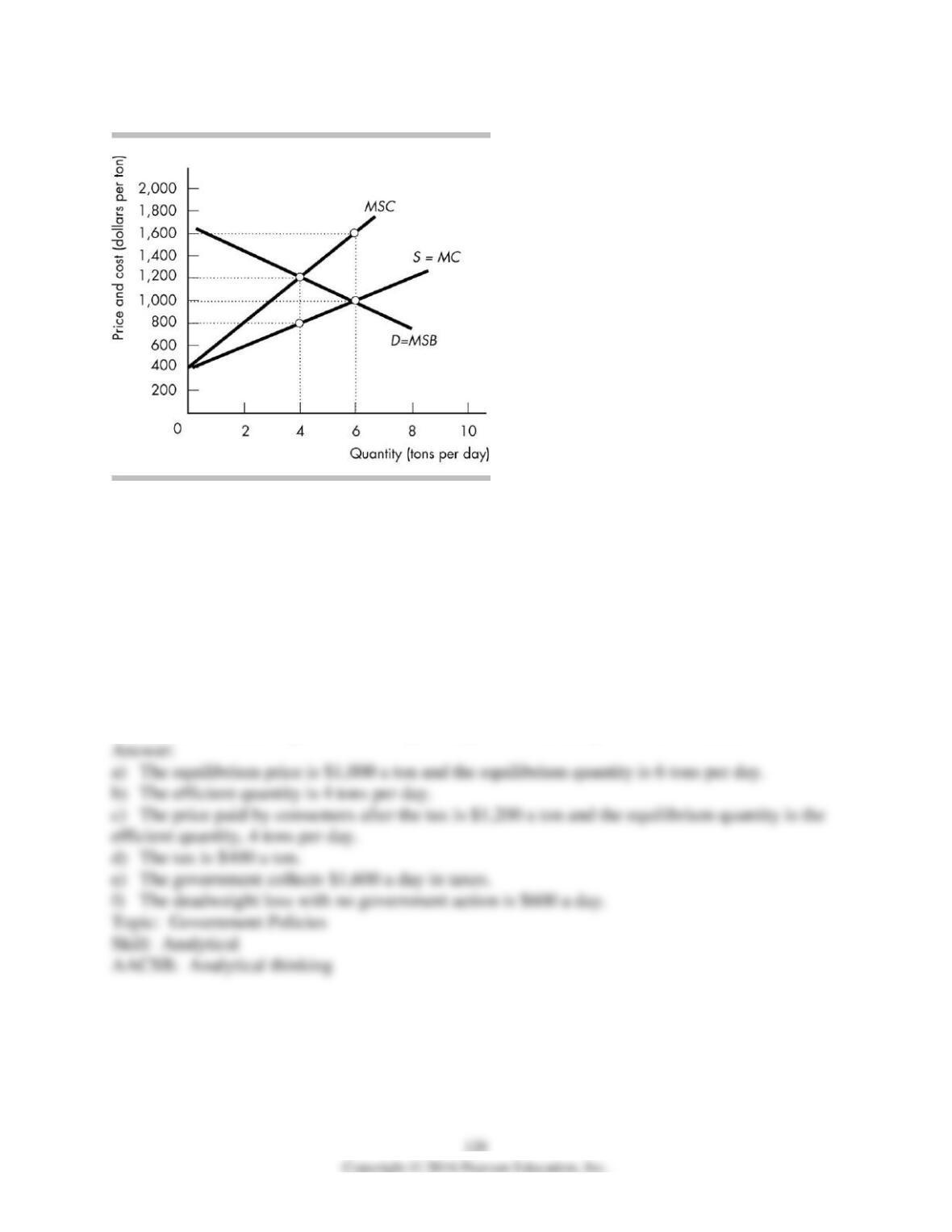
7) The above figure shows the market for fertilizer. When fertilizer is applied to lawns, it runs
off into neighboring streams and ponds, killing fish and creating an external cost.
a) What is the equilibrium price and quantity of fertilizer in an unregulated, competitive
market?
b) What is the efficient quantity of fertilizer?
c) Suppose government imposes a tax equal to the marginal external cost. What is the
equilibrium price paid by consumers and the equilibrium quantity after implementation of the
tax?
d) At the output level in part (c), how much is the tax?
e) How much tax revenue does government collect?
f) What is the deadweight loss borne by society if the externality is left uncorrected?
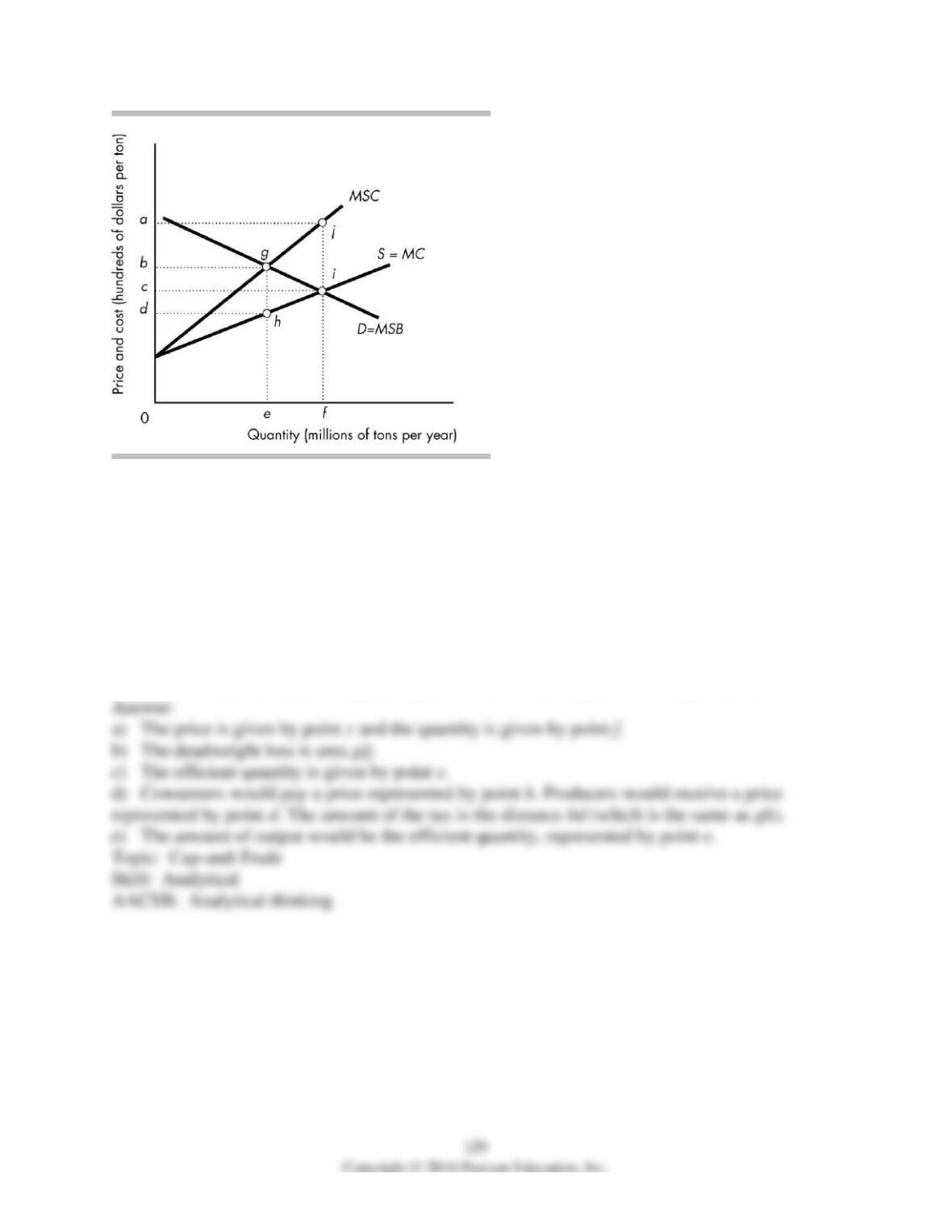
8) The figure above shows the market for steel, the production of which creates pollution.
a) What point represents the equilibrium price and what point represents the equilibrium
quantity in an unregulated, competitive market?
b) What area represents the deadweight loss of the unregulated, competitive market outcome?
c) What point represents the efficient quantity?
d) If the output level in part (c) was achieved through the use of a government imposed tax,
what price would consumers pay? What price would the producers receive? What distance
represents the amount of the tax?
e) If government successfully uses marketable permits issued under a cap-and-trade policy to
eliminate the external cost, what point represents how much output would be produced?
Marginal
social cost
(dollars per
course)
Quantity of
students
Marginal
private benefit
(dollars per
course)
Marginal
social benefit
(dollars per
course)
100
4,500
20
60
80
4,000
40
80
60
3,500
60
100
40
3,000
80
120
20
2,500
100
140
9) The table above gives the marginal social cost (which equals the price), marginal private
benefit, and marginal social benefit of students attending Diablo Valley College (DVC) in
Concord, California.
a) When 4,500 students attend DVC, what does the marginal external benefit equal?
b) If the market is competitive and left without government intervention, what is the quantity of
students that will attend DVC and what will be the price of a course?
c) What is the efficient quantity of students attending DVC?
d) If the government can set the price per course, in order to have the efficient quantity of
students attending DVC, what should the government set as the price?
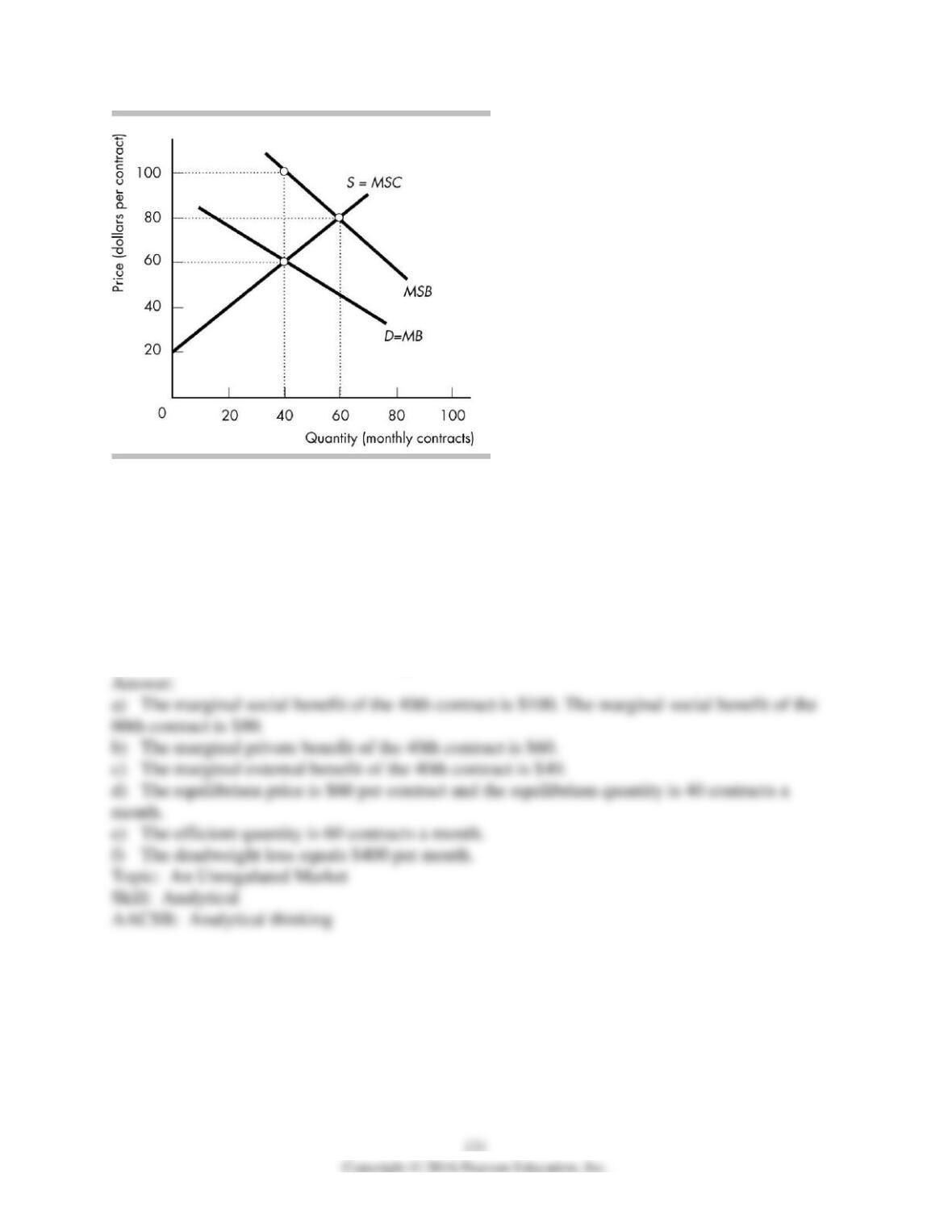
10) Attractive landscaping increases the property values of surrounding homes, creating a
marginal benefit. The figure above represents the market for monthly landscaping contracts.
a) What is the marginal social benefit of the 40th contract? Of the 60th contract?
b) What is the marginal private benefit of the 40th contract?
c) What is the marginal external benefit of the 40th contract?
d) What is the unregulated competitive equilibrium price and quantity?
e) What is the efficient quantity?
f) What is the amount of the deadweight loss?