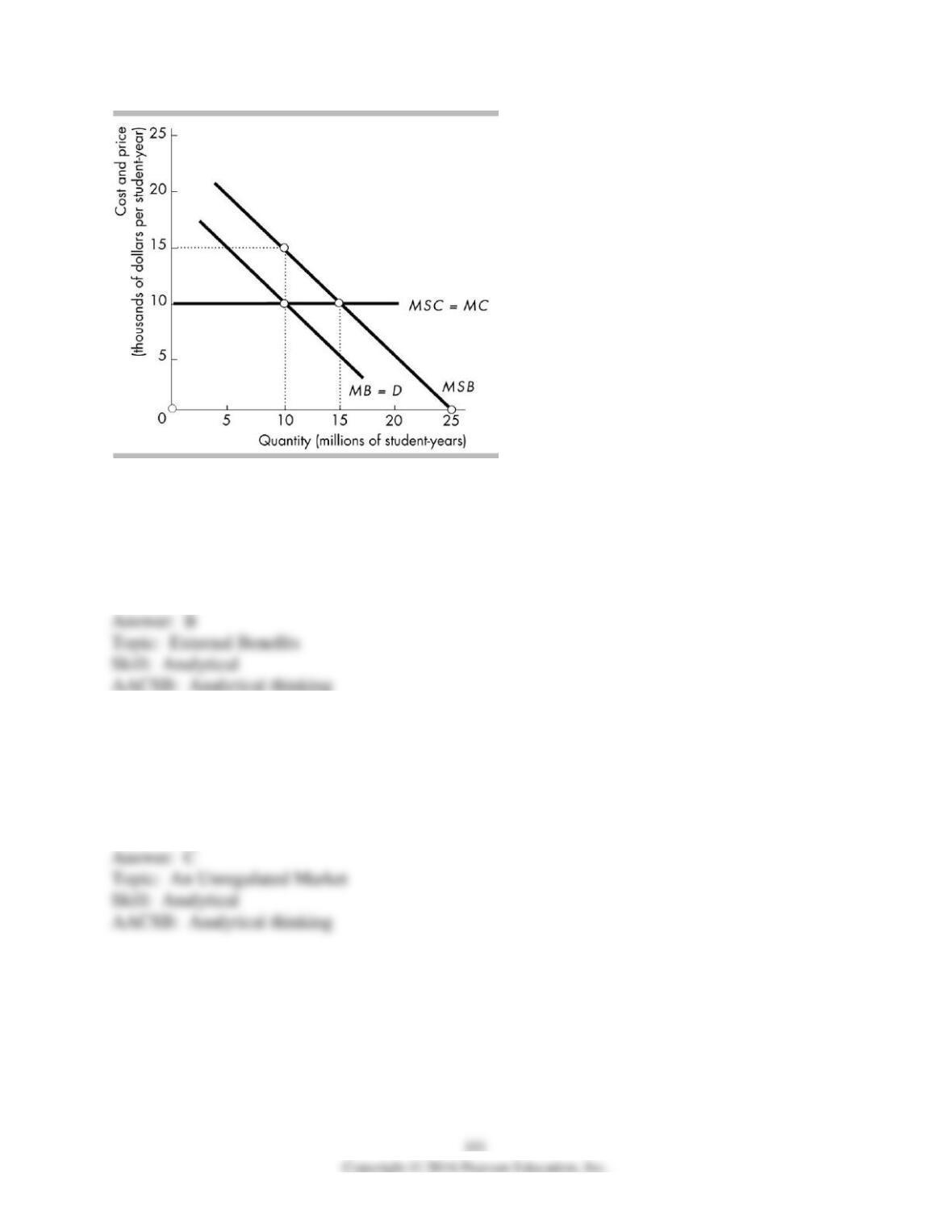
95) The above figure shows the marginal benefits and marginal costs of a college education.
What is the amount of the external benefit in the figure?
A) $0
B) $5,000
C) $10,000
D) $15,000
96) The above figure shows the marginal benefits and marginal costs of a college education. If
no subsidies are paid, colleges charge tuition of
A) $0.
B) $5,000.
C) $10,000.
D) $15,000.
97) The above figure shows the marginal benefits and marginal costs of a college education. If
no subsidies are paid, enrollment equals
A) 0.
B) 10 million.
C) 15 million.
D) 25 million.
98) The above figure shows the marginal benefits and marginal costs of a college education. The
efficient number of students is
A) 0.
B) 10 million.
C) 15 million.
D) 25 million.
99) The above figure shows the marginal benefits and marginal costs of a college education. If a
subsidy of $5,000 is paid to the colleges, then colleges charge tuition of
A) $0.
B) $5,000.
C) $10,000.
D) $15,000.
100) The above figure shows the marginal benefits and marginal costs of a college education. If
colleges receive a $5,000 subsidy, then enrollment equals
A) 0.
B) 10 million.
C) 15 million.
D) 25 million.
101) The above figure shows the marginal benefits and marginal costs of a college education. If
a voucher for $5,000 is given to the students, then colleges charge tuition of
A) $0.
B) $5,000.
C) $10,000.
D) $15,000.
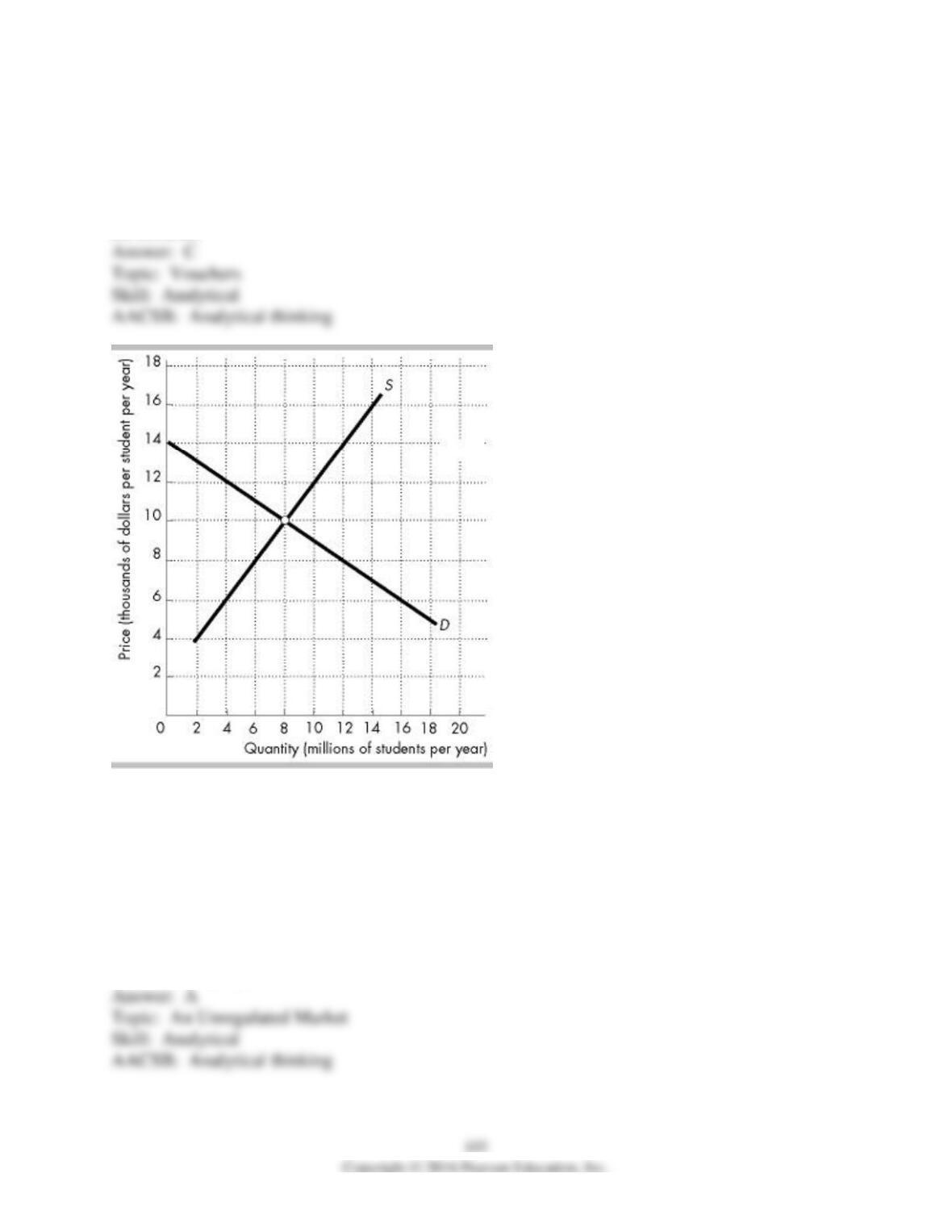
The figure shows the supply curve (S) and the demand curve (D) for college education. The
external benefit from college education is $6,000 per student per year and is constant.
102) In the figure above, with no government involvement and if the colleges are competitive,
how many students are enrolled?
A) 8 million per year
B) 12 million per year
C) 10 million per year
D) 4 million per year
103) In the figure above, with no government involvement and if the colleges are competitive,
what is the tuition?
A) $10,000 per year
B) $14,000 per year
C) $8,000 per year
D) $16,000 per year
104) In the figure above, with no government involvement and if the colleges are competitive,
what is the deadweight loss?
A) $12 billion per year
B) $6 billion per year
C) $4 billion per year
D) zero
105) In the figure above, if the government provides the efficient amount of education, how
many students will be accepted?
A) 8 million per year
B) 12 million per year
C) 10 million per year
D) 16 million per year
106) In the figure above, if the government provides the efficient amount of education, what is
the tuition?
A) $10,000 per year
B) $14,000 per year
C) $8,000 per year
D) $6,000 per year
107) In the figure above, if the government provides a subsidy to colleges of $6,000 per student
per year, how many students will be accepted?
A) 8 million per year
B) 12 million per year
C) 10 million per year
D) 16 million per year
108) In the figure above, if the government provides a subsidy to colleges of $6,000 per student
per year, what is the tuition?
A) $10,000 per year
B) $12,000 per year
C) $8,000 per year
D) $6,000 per year
109) In the figure above, if the government gives a voucher equal to $3,000 per year to each
college student, how many students will be accepted?
A) 8 million per year
B) 12 million per year
C) 10 million per year
D) 14 million per year
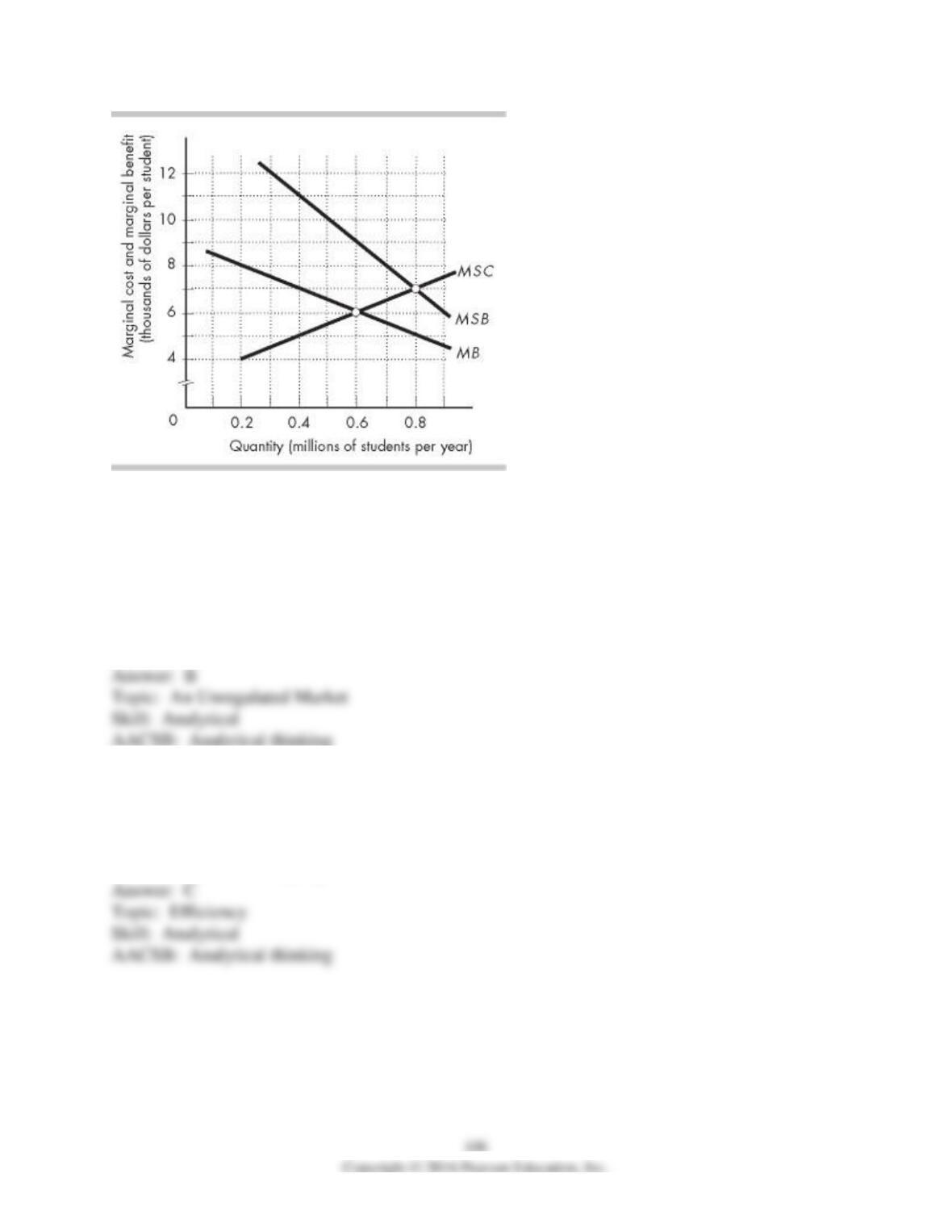
110) The figure above shows the marginal social costs (MSC), marginal private benefits (MB),
and marginal social benefits (MSB) of college education in Inland. If Inland’s government does
not intervene, and the colleges are competitive, ________ million students are enrolled, and the
tuition is ________ per year.
A) 0.8; $7,000
B) 0.6; $6,000
C) 0.6; $9,000
D) 0.8; $5,000
111) The efficient level of college enrollment in Inland is
A) 0.6 million students per year.
B) 0.7 million students per year.
C) 0.8 million students per year.
D) 0.5 million students per year.
112) The figure above shows the marginal social costs (MSC), marginal private benefits (MB),
and marginal social benefits (MSB) of college education in Inland. If Inland’s government does
not intervene, and the colleges are competitive, the deadweight loss is
A) zero.
B) $100 million per year.
C) $200 million per year.
D) $300 million per year.
113) The figure above shows the marginal social costs (MSC), marginal private benefits (MB),
and marginal social benefits (MSB) of college education in Inland. If Inland’s government wants
to provide the efficient level of education, it must set tuition at ________ per year to ensure that
________ million students are enrolled.
A) $5,000; 0.8
B) $6,000; 0.6
C) $7,000; 0.8
D) $5,000; 0.6
114) The figure above shows the marginal social costs (MSC), marginal private benefits (MB),
and marginal social benefits (MSB) of college education in Inland. Suppose Inland’s government
is considering subsidizing private colleges to ensure the efficient level of enrollment. What
should be the amount of the subsidy (if any)?
A) The government should not subsidize private colleges.
B) $2,000 per student per year
C) $1,000 per student per year
D) $4,000 per student per year
115) The figure above shows the marginal social costs (MSC), marginal private benefits (MB),
and marginal social benefits (MSB) of college education in Inland. If Inland’s government
provides a voucher per student equal to the marginal external benefit of college education, then
________ million students will attend college, and colleges will collect ________ per student
from the voucher.
A) 0.6; $3,000
B) 0.8; $5,000
C) 0.8; $2,000
D) 0.6; $1,000
116) Suppose that recycling rubber for sneakers creates an external benefit of $2.00 per ton of
rubber. There are no external costs. The efficient amount of rubber will be recycled when the
government creates a
A) subsidy of more than $2.00 per ton of rubber.
B) subsidy of $2.00 per ton of rubber.
C) tax of more than $2.00 per ton of rubber.
D) tax of $2.00 per ton of rubber.
117) Which of the following is a possible government solution to the problem posed by a good
with an external benefit?
A) Give a voucher to buyers of the good.
B) Tax the consumption of the good.
C) Tax the production of the good.
D) All of the above are possible solutions.
5 News Based Questions
1) The Loma Linda City Council made it official in June 2008, passing the most restrictive
smoking ordinance yet in the Inland area. Dr. Linda Ferry, who counsels veterans on quitting
smoking at Jerry L. Pettis Memorial VA Medical Center, said that the smoking ordinance would
protect children from exposure to secondhand smoke and discourage teenagers and adults from
taking up smoking. What is TRUE about this situation?
A) Marginal external costs are negative.
B) Marginal external benefits are positive.
C) Marginal external costs are positive.
D) Marginal external benefits are negative.
2) When CSU sophomore Cody Clow and his housemates chose not to heed the city’s ordinance
against unreasonable noise and host a loud party at their off-campus residence last fall, they were
confronted and ticketed by police. Fort Collins city code describes unreasonable noise as any
sound that will “unreasonably interfere with the enjoyment of life or property.” What is TRUE
about this situation?
A) Marginal external costs are positive.
B) Marginal external costs are negative.
C) Marginal external benefits are positive.
D) Marginal external benefits are negative.
3) When CSU sophomore Cody Clow and his housemates chose not to heed the city’s ordinance
against unreasonable noise and host a loud party at their off-campus residence last fall, they were
confronted and ticketed by police. Fort Collins city code describes unreasonable noise as any
sound that will “unreasonably interfere with the enjoyment of life or property.” The method the
local government used cope with the externality most closely resembles a ________.
A) tax
B) voucher
C) subsidy
D) cap-and-trade policy
4) In 2008, a man was charged with one count of illegally stocking wild animals, a civil offense.
State investigators had accused him of bringing 31 wild hogs from Texas to Wisconsin to hunt
on his private land in 2002, spawning a feral hog population that has caused thousands of dollars
in crop damage to hundreds of farms in the region. Can the Coase theorem apply in this
example? Why or why not?
A) No; because a large number of parties are involved
B) Yes
C) No; because transaction costs are low
D) No; because all property rights are clearly defined
5) In 2008, a man was charged with one count of illegally stocking wild animals, a civil offense.
State investigators had accused him of bringing 31 wild hogs from Texas to Wisconsin to hunt
on his private land in 2002, spawning a feral hog population that has caused thousands of dollars
in crop damage to hundreds of farms in the region. What is the externality in this example?
A) Bringing 31 wild hogs from Texas to Wisconsin to hunt on his private land
B) Spawning a feral hog population
C) Illegally stocking wild animals
D) Crop damage
6) In 2008, a man was charged with one count of illegally stocking wild animals, a civil offense.
State investigators had accused him of bringing 31 wild hogs from Texas to Wisconsin to hunt
on his private land in 2002, spawning a feral hog population that has caused thousands of dollars
in crop damage to hundreds of farms in the region. The marginal external ________ of the man’s
movement of feral pigs is ________.
A) costs; negative.
B) benefits; positive
C) costs; positive.
D) benefits; negative
7) Scientists have said for years cod was so seriously overfished in European Union waters that
there was a risk of extinction due to stock collapse. “To ensure this recovery… Ministers agreed
a 10 percent cut in days at sea (for North Sea cod),” EU Fisheries Commissioner Joe Borg stated
in 2008. What is the goal of this policy?
A) To reduce the number of fishing days to the point where marginal cost per day equals
marginal benefit
B) To reduce the number of fishing days to the point where marginal social cost per day equals
marginal benefit
C) To reduce the number of fishing days to the point where marginal social benefit per day
equals marginal benefit
D) To reduce the number of fishing days to the point where marginal social cost per day equals
marginal social benefit
8) Scientists have said for years cod was so seriously overfished in European Union waters that
there was a risk of extinction due to stock collapse. Why would cod be on the risk of extinction?
A) Fishing in the sea for cod is an example of a public good.
B) Fishing in the sea for cod is an example of a common resource.
C) Fishing in the sea for cod is an example of a private good.
D) Fishing in the sea for cod is an example of a natural monopoly.
9) Scientists have said for years cod was so seriously overfished in European Union waters that
there was a risk of extinction due to stock collapse. Why would overfishing occur in this
common market?
A) Fishing occurs until marginal cost per boat equals marginal social benefit which is inefficient.
B) Fishing occurs until marginal social cost per boat equals marginal social benefit which is
inefficient.
C) Fishing occurs until marginal cost per boat equals marginal benefit which is inefficient.
D) Fishing occurs until marginal social cost per boat equals marginal cost which is inefficient.
10) Scientists have said for years cod was so seriously overfished in European Union waters that
there was a risk of extinction due to stock collapse. In October 2008, they called for the EU to set
the 2008 number of days fishermen are allowed to fish at less than half of 2006 levels. This
policy is most like
A) a production quota.
B) property right.
C) an individual transferable quota.
D) marginal social benefit right.
11) With the debris of more than 50 years of climbing on the beautiful high slopes — oxygen
canisters, tents, backpacks and even some bodies — Mount Everest has been called the world’s
highest garbage dump. If Everest is a common resource, currently there is an ________ of the
mountain.
A) inefficient underuse
B) efficient overuse
C) efficient underuse
D) inefficient overuse
12) With the debris of more than 50 years of climbing on the beautiful high slopes – oxygen
canisters, tents, backpacks and even some bodies – Mount Everest has been called the world’s
highest garbage dump. It has been suggested that there should be a limited number of climbers
allowed on the mountain each year to limit the environmental degradation that occurs. This
method of achieving efficient use of a common resource is most like
A) a property right.
B) an individual transferable quota.
C) a production quota.
D) a marginal social benefit right.
13) With the debris of more than 50 years of climbing on the beautiful high slopes – oxygen
canisters, tents, backpacks and even some bodies – Mount Everest has been called the world’s
highest garbage dump. Currently climbers must pay only a $3,000 trash-collection fee, which is
woefully less than the actual cost of collecting trash. If climbers had to pay a higher trash-
collection fee, the use of this common resource would
A) become less efficient.
B) become more efficient.
C) not deviate from the current level of efficiency.
D) More information about who would collect the trash is needed.
14) The granite boulders in Rocky Mountain National Park are a favored place among talented
climbers who specialize in the art of bouldering, or climbing harder (but shorter) routes without
tying into a rope. Climbers have taken to (illegally) stashing foam crash pads underneath the
boulders but marmots and other rodents chew up the pads and the litter is spread by the wind. To
limit overuse of this park, suppose a limited number of permits are sold each year to climbers
who can sell them at any time to other climbers. This method of achieving efficient use of a
common resource is most like what government policy?
A) Production quota
B) Property right
C) Individual transferable quota
D) Marginal social benefit right
15) The granite boulders in Rocky Mountain National Park are a favored place among talented
climbers who specialize in the art of bouldering, or climbing harder (but shorter) routes without
tying into a rope. Climbers have taken to (illegally) stashing foam crash pads underneath the
boulders but marmots and other rodents chew up the pads and the litter is spread by the wind.
The pristine National Park is most like a
A) public good.
B) private good.
C) common resource.
D) natural monopoly.
16) The granite boulders in Rocky Mountain National Park are a favored place among talented
climbers who specialize in the art of bouldering, or climbing harder (but shorter) routes without
tying into a rope. Climbers have taken to (illegally) stashing foam crash pads underneath the
boulders but marmots and other rodents chew up the pads and the litter is spread by the wind.
Why would the park be overused in this manner?
A) because the marginal private benefit of using the park is greater than the marginal social
benefit of using the park
B) because the marginal social benefit of using the park is greater than the marginal private
benefit of using the park
C) because there are no external costs to using the park
D) because the marginal private cost of using the park is less than the marginal social cost of
using the park
6 Essay Questions
1) What is marginal external cost? Give an example.
2) Discuss the difference between a private cost and a social cost.
3) What is marginal external cost of production?
4) When a forest is logged, it is possible for the logging to create “soil runoff,” a situation in
which the soil, no longer protected by trees, erodes and silts a river miles downstream from the
logging area. Is soil runoff created by logging in Montana that ruins a river an example of a
private cost to the lumbering company or an external cost?
5) Why do firms ignore external costs when they pollute?
6) Explain why a producer who is causing external costs does not have the incentive to reduce
these costs.
7) The marginal social cost of burning garbage in Houston is the sum of the marginal private cost
and the marginal external cost.” Is this assertion correct or incorrect?
8) If the production of a good creates an external cost, is the supply curve the same as the
marginal social cost or the same as the marginal private cost curve or both?
9) Why does an external cost lead to inefficient overproduction?
10) If the production of a good causes pollution (an external cost) is the unregulated competitive
market equilibrium of that product efficient?
11) Burning coal to generate electricity can create pollution. If the market for generating
electricity is competitive and is allowed to operate without any government intervention, is the
equilibrium quantity of coal burned equal to, more than, or less than the efficient quantity?
12) “Suppose the market for aluminum is perfectly competitive and unregulated. If aluminum
factories emit pollution, the marginal social cost of aluminum is less than the market price.” True
or false? Explain.
13) “If production of a good creates an external cost, then, when production is such that the
marginal private costs are equal to the marginal private benefits, the market outcome will be
inefficient.” Explain whether this assertion is correct or incorrect.
14) Why is it not efficient to eliminate all pollution?
15) What do we mean by “property rights” and why are they important?
16) What is the Coase theorem? What conditions need to be present for this theorem to work?
17) “According to the Coase theorem, if Gabriel wants the local television station to cease
having helicopters fly over his house at night, he will be more likely to be able to reach an
agreement with the station if the property right to the airspace is clearly defined and the
transaction costs of negotiating are high.” Is this statement true or false? Explain your answer.
18) Using the Coase theorem, why might a firm that currently pollutes a river no one owns
pollute the river less if it owned the river?
19) Use the idea of external costs to explain why some cities have laws against late-night rock
concerts.
20) List and briefly define the three methods government can use to cope with an external cost,
such as pollution.
21) The production of paper creates pollution, an external cost. What happens to the production
of paper if the government imposes a tax on paper producers equal to the marginal external cost
of the pollution?
22) Explain how a Pigovian tax works.
23) What is a cap-and-trade policy? (Be certain to mention marketable permits.) Suppose there
are two firms in an area, each emitting tons of sulfur. The government decides on a target level
of 200 tons of sulfur, and gives each firm a permit to emit 100 tons of sulfur. Suppose Firm A is
very efficient and can reduce pollution by 100 tons with an abatement cost of $500. Firm B has
an older plant, so it will cost Firm B $1,000 to reduce emissions by 100 tons. What will occur
with marketable permits?
24) What is the tragedy of the commons?
25) “The problem with a common resource is that no one gets to use the resource.” Comment on
the preceding assertion.
26) Why are fish in the ocean an example of a resource that suffers from the tragedy of the
commons but cattle grazing in a farmer’s pasture do not suffer from the tragedy of the commons?
27) How does the government determine the quota amount that will produce an efficient use of a
common resource?