36) Food stamps provided by the U.S. Department of Agriculture are an example of
A) a positive externality.
B) a private subsidy.
C) vouchers.
D) an external benefit.
37) A voucher can eliminate the deadweight loss and lead to an efficient outcome if the value of
the voucher equals the ________ of the good.
A) marginal external benefit
B) marginal social benefit
C) marginal private benefit
D) marginal social cost
38) The HPV vaccine protects against human papillomavirus (HPV) that causes cancer. It
protects both the person getting the vaccine and the sexual partners of that person. To encourage
the efficient number of people to be vaccinated the government could
A) give producers a subsidy equal to the private marginal benefit.
B) give consumers a voucher equal to the marginal external benefit.
C) impose a tax equal to the marginal social benefit.
D) impose a tax equal to the marginal external benefit.
Marginal private
benefit (dollars)
Quantity
(thousands of
student-years)
24,000
0
20,000
20
16,000
40
12,000
60
8,000
80
4,000
100
0
120
39) The table above provides information about the marginal private benefit of education. The
marginal private cost, which also equals the marginal social cost, of educating a student is
$16,000 per year and does not change as more students are educated. There is an external benefit
from education that is equal to $12,000 per student year and does not change as more students
are educated. If the market for education is competitive and unregulated, the equilibrium quantity
of education will be ________ and the tuition will be ________.
A) 20,000 student-years; $20,000
B) 40,000 student-years; $16,000
C) 60,000 student-years; $12,000
D) 80,000 student-years; $8,000
40) The table above provides information about the marginal private benefit for education. The
marginal private cost, which also equals the marginal social cost, of educating a student is
$16,000 per year and does not change as more students are educated. There is an external benefit
from education that is equal to $12,000 per student year and does not change as more students
are educated. What is the efficient amount of education?
A) 40,000 student-years
B) 60,000 student-years
C) 80,000 student-years
D) 100,000 student-years
41) The table above provides information about the marginal private benefit for education. The
marginal private cost, which also equals the marginal social cost, of educating a student is
$16,000 per year and does not change as more students are educated. There is an external benefit
from education that is equal to $12,000 per student year and does not change as more students
are educated. If the government subsidizes education, how much should the subsidy be in order
to attain the efficient level of enrollment?
A) $4,000
B) $8,000
C) $12,000
D) $16,000
42) The table above provides information about the marginal private benefit for education. The
marginal private cost, which also equals the marginal social cost, of educating a student is
$16,000 per year and does not change as more students are educated. There is an external benefit
from education that is equal to $12,000 per student year and does not change as more students
are educated. If the government undertakes public provision of the efficient amount of education,
how much will the government charge for tuition?
A) $4,000
B) $8,000
C) $12,000
D) $16,000
Quantity (millions
of students per
year)
Marginal private
benefit (thousands
of dollars per
student per year)
Marginal social
benefit (thousands
of dollars per
student per year)
Marginal private cost and
marginal social cost
(thousands of dollars per
student per year)
4
20
28
8
8
18
25
10
12
16
22
12
16
14
19
14
20
12
16
16
24
10
13
18
43) The table above shows the marginal costs and marginal benefits of college education. If the
market for college education is perfectly competitive and unregulated, how many students are
enrolled in college?
A) 12 million
B) 20 million
C) 16 million
D) 24 million
44) The table above shows the marginal costs and marginal benefits of college education. If the
market for college education is perfectly competitive and unregulated, what is the price of
college education?
A) $8,000 per year
B) $12,000 per year
C) $14,000 per year
D) $16,000 per year
45) The table above shows the marginal costs and marginal benefits of college education. If 8
million students are enrolled, the marginal external benefit is
A) zero.
B) $4,000.
C) $5,000.
D) $7,000.
46) The table above shows the marginal costs and marginal benefits of college education. If 20
million students are enrolled, the marginal external benefit is
A) zero.
B) $4,000.
C) $5,000.
D) $7,000.
47) The table above shows the marginal costs and marginal benefits of college education. If the
market for college education is perfectly competitive and unregulated, at the equilibrium
quantity, the marginal external benefit is
A) zero.
B) $5,000.
C) $4,000.
D) $8,000.
48) The table above shows the marginal costs and marginal benefits of college education. If the
market for college education is perfectly competitive and unregulated, at the equilibrium
quantity, the marginal social benefit is
A) zero.
B) $14,000.
C) $19,000.
D) $16,000.
49) The table above shows the marginal costs and marginal benefits of college education. If the
market for college education is perfectly competitive and unregulated, at the equilibrium
quantity, the marginal private benefit is
A) zero.
B) $14,000.
C) $19,000.
D) $16,000.
50) The table above shows the marginal costs and marginal benefits of college education. If the
market for college education is perfectly competitive and unregulated, at the equilibrium
quantity, the marginal private cost is
A) zero.
B) $14,000.
C) $19,000.
D) $16,000.
51) The table above shows the marginal costs and marginal benefits of college education. The
efficient amount of enrollment is
A) 12 million.
B) 20 million.
C) 16 million.
D) 24 million.
52) The table above shows the marginal costs and marginal benefits of college education. If the
market for college education is perfectly competitive and unregulated, the amount of enrollment
is
A) efficient.
B) inefficient because marginal social cost exceeds marginal social benefit.
C) inefficient because marginal social benefit exceeds marginal social cost.
D) inefficient because the quantity of education demanded exceeds the quantity of education
supplied.
53) The table above shows the marginal costs and marginal benefits of college education. The
marginal private cost of college education at the efficient quantity of enrollment is
A) $8,000 per year.
B) $12,000 per year.
C) $14,000 per year.
D) $16,000 per year.
54) The table above shows the marginal costs and marginal benefits of college education. The
marginal private benefit of college education at the efficient amount of enrollment is
A) $20,000 per year.
B) $16,000 per year.
C) $12,000 per year.
D) $14,000 per year.
55) The table above shows the marginal costs and marginal benefits of college education. The
marginal social benefit of college education at the efficient amount of enrollment is
A) $20,000 per year.
B) $16,000 per year.
C) $12,000 per year.
D) $14,000 per year.
56) The table above shows the marginal costs and marginal benefits of college education. With
public provision of the efficient level of college education, tuition is
A) $10,000 per year.
B) $12,000 per year.
C) $14,000 per year.
D) $16,000 per year.
57) The table above shows the marginal costs and marginal benefits of college education. With
public provision of the efficient amount of college education, the cost paid by the taxpayers is
A) zero.
B) $8,000 per student.
C) $4,000 per student.
D) $12,000 per student.
Quantity
(units)
Marginal
private benefit
(dollars per
unit)
Marginal
social benefit
(dollars per
unit)
Marginal private cost =
marginal social cost
(dollars per unit)
1,000
70
90
30
2,000
60
80
40
3,000
50
70
50
4,000
40
60
60
5,000
30
50
70
6,000
20
40
80
58) In the above table, if the market is perfectly competitive and unregulated, the equilibrium
output will be
A) 1,000 units.
B) 2,000 units.
C) 3,000 units.
D) 4,000 units.
59) In the above table, if the market is perfectly competitive and unregulated, the equilibrium
price will be
A) $50 per unit.
B) $60 per unit.
C) $70 per unit.
D) $110 per unit.
60) In the above table, if the market is perfectly competitive and unregulated, at the equilibrium
output level
A) marginal private cost equals the marginal private benefit.
B) marginal private cost is less than the marginal private benefit.
C) marginal social cost equals the marginal private benefit.
D) marginal social cost is greater than the marginal private benefit.
61) In the above table, if the market is perfectly competitive and unregulated, at the equilibrium
output level
A) resource allocation is efficient.
B) resource allocation is inefficient.
C) too many units of output are produced.
D) consumers pay too low a price.
62) In the above table, if the market is perfectly competitive and unregulated, at the equilibrium
level of output, the marginal external benefit per unit is
A) zero.
B) $20 per unit.
C) $50 per unit.
D) $70 per unit.
63) In the above table, if the market is perfectly competitive and unregulated, at the equilibrium
level of output, the marginal social benefit per unit is
A) zero.
B) $20 per unit.
C) $50 per unit.
D) $70 per unit.
64) Based on the data in the above table, the product exhibits
A) external benefits.
B) external costs.
C) no externalities.
D) increasing returns.
65) In the above table, the efficient level of output can be achieved through a per unit subsidy of
A) zero.
B) $20.
C) $60.
D) $120.
66) In the above table, the efficient level of output can be achieved through a per unit
A) subsidy of $20.
B) tax of $20.
C) subsidy of $60.
D) tax of $60.
67) In the above table, the efficient level of output is
A) 2,000 units.
B) 3,000 units.
C) 4,000 units.
D) 5,000 units.
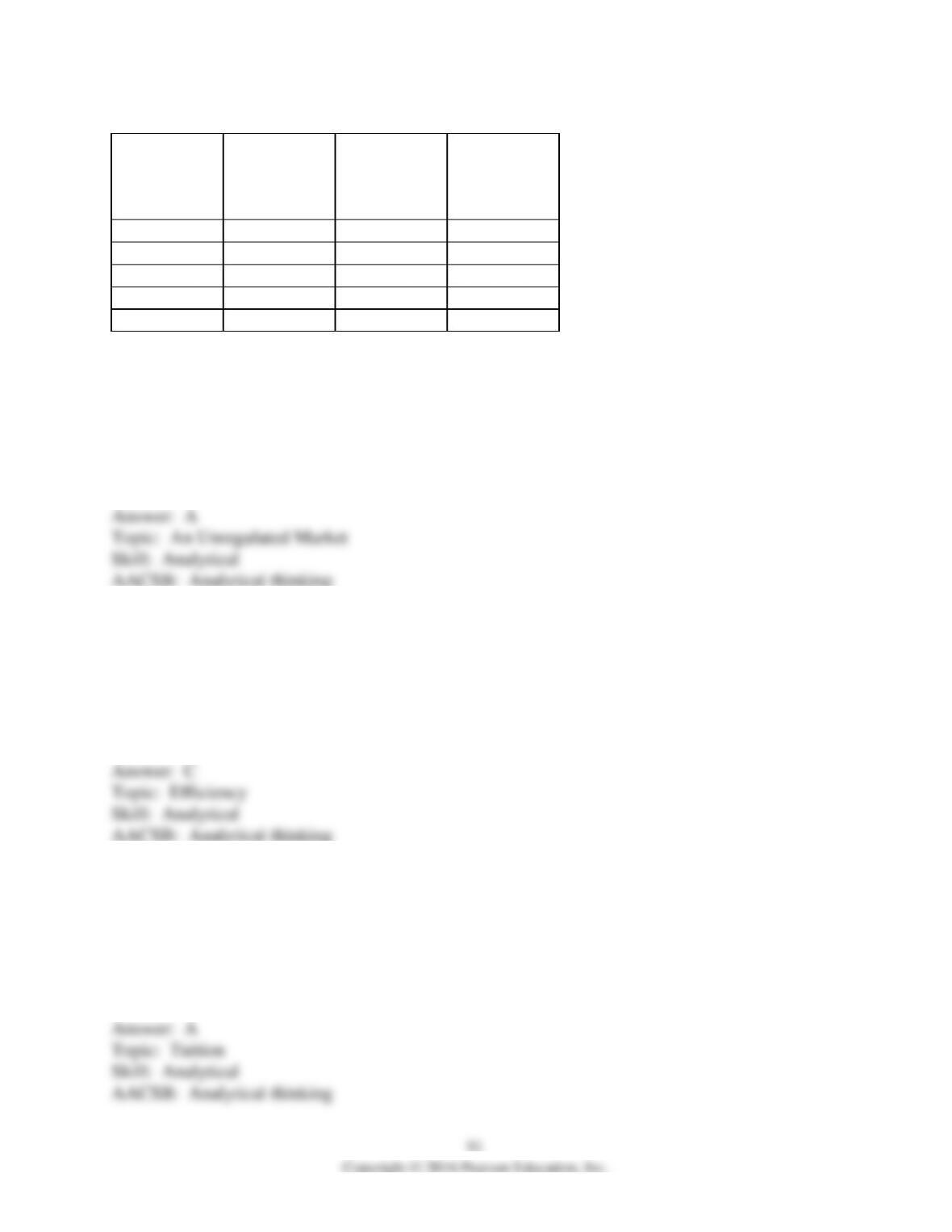
Quantity
(number of
students)
Marginal
private benefit
(dollars per
student)
Marginal
social benefit
(dollars per
student)
Marginal
private cost
(dollars per
student)
1,000
1,000
3,400
1,000
2,000
800
3,200
1,600
3,000
600
3,000
2,200
4,000
400
2,800
2,800
5,000
200
2,600
3,400
68) The table above shows the marginal private benefit, marginal social benefit, and marginal
cost of education at the College of Epsilon. What is the equilibrium number of students at the
college if the market is unregulated?
A) 1,000
B) 3,000
C) 4,000
D) 5,000
69) The table above shows the marginal private benefit, marginal social benefit, and marginal
cost of education at the College of Epsilon. What is the efficient number of students at the
college?
A) 1,000
B) 3,000
C) 4,000
D) 5,000
70) The table above shows the marginal private benefit, marginal social benefit, and marginal
cost of education at the College of Epsilon. What is the tuition that will make the number of
students equal to the efficient number?
A) $400
B) $800
C) $2,800
D) $3,200
71) The table above shows the marginal private benefit, marginal social benefit, and marginal
cost of education at the College of Epsilon. What subsidy per student will the college require to
take in the efficient number of students?
A) $2,400
B) $400
C) $2,800
D) $3,400
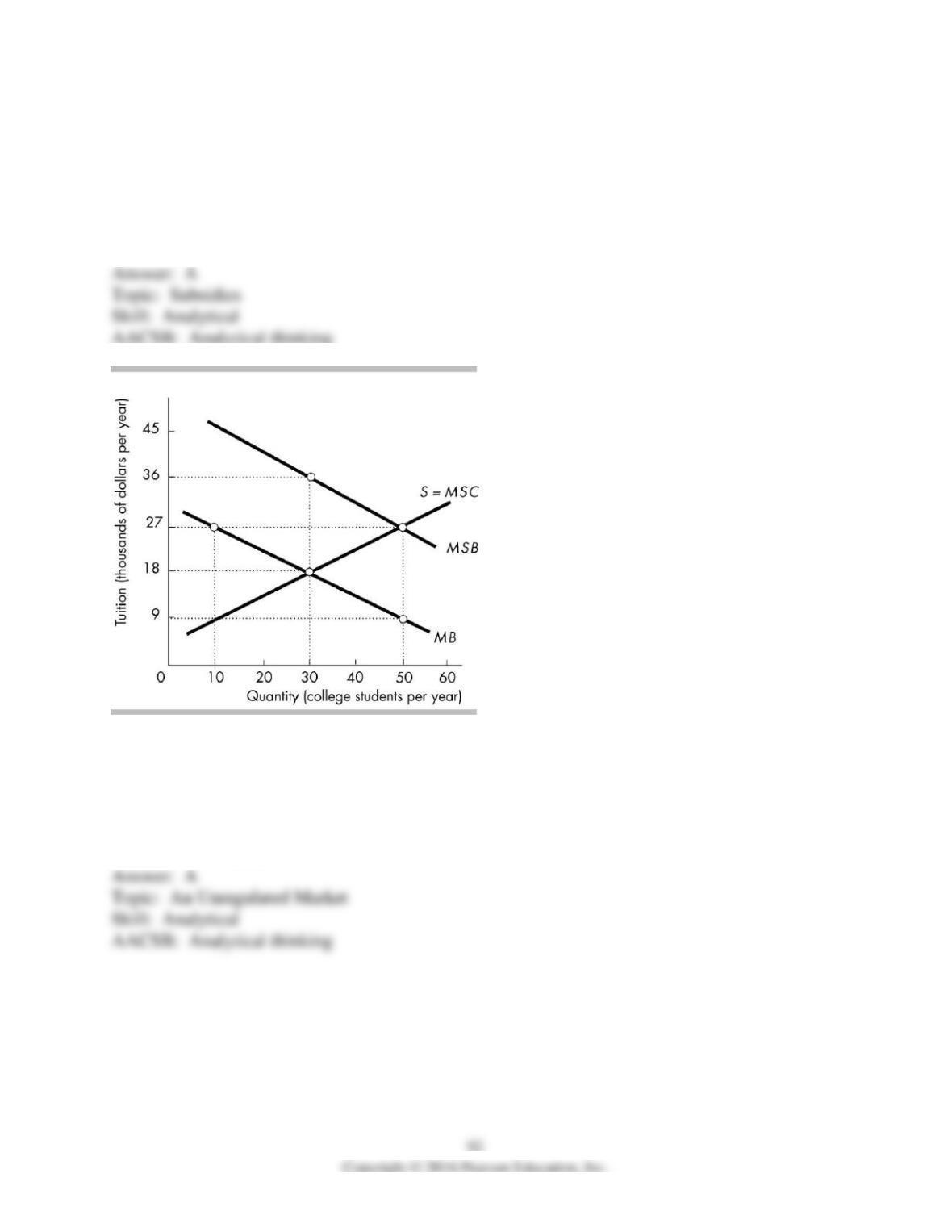
72) In the above figure, the unregulated, competitive market equilibrium is tuition of ________
and the equilibrium quantity is ________ students in college.
A) $18,000; 30 million
B) $12,000; 40 million
C) $6,000; 50 million
D) $18,000; 50 million
73) In the above figure, what amount of subsidy per student would government have to provide
to colleges if its desired objective was to achieve an efficient level of education, 50 million
students per year?
A) $6,000 per year
B) $12,000 per year
C) $18,000 per year
D) $27,000 per year
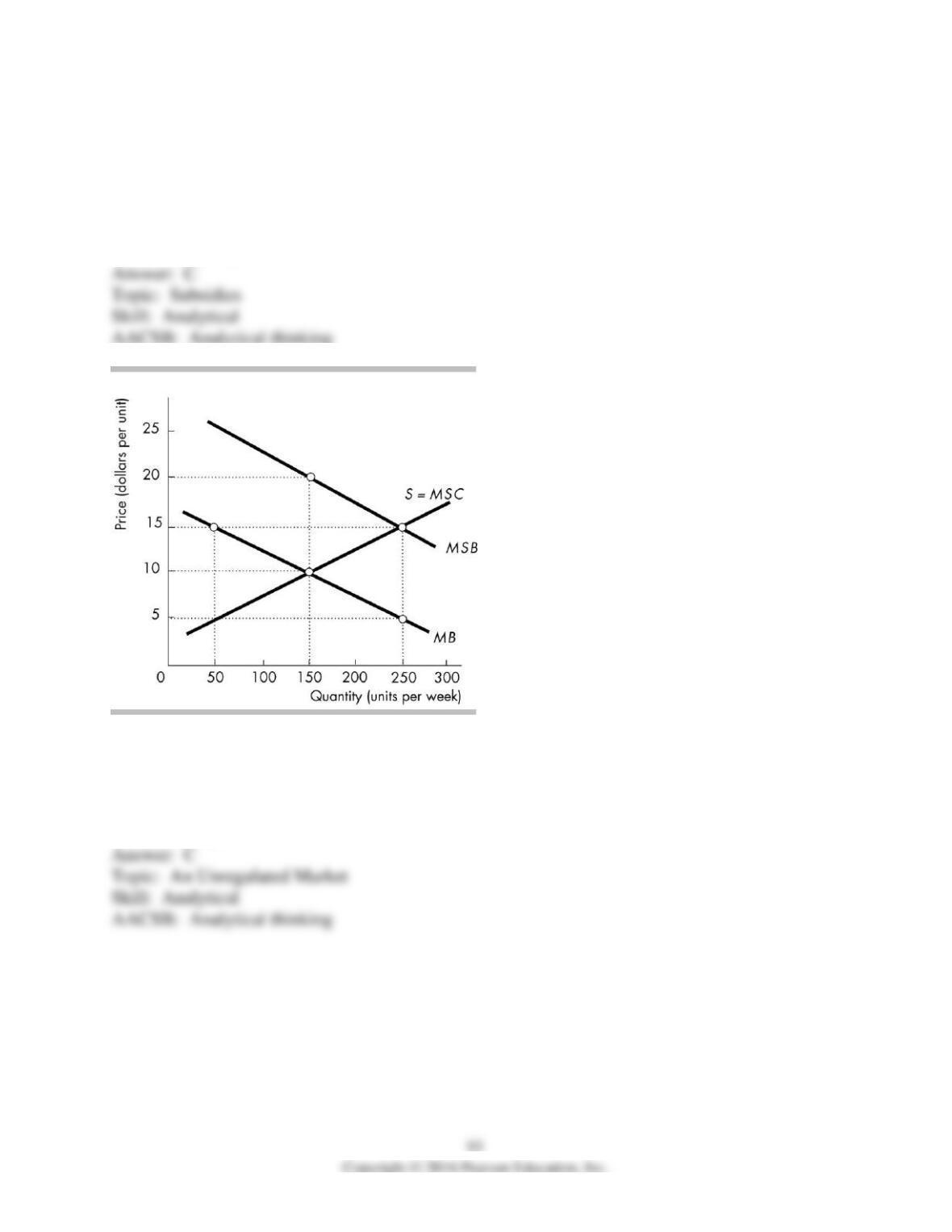
74) In the above figure, if the market is competitive and unregulated, output will be
A) zero.
B) 50 units per week.
C) 150 units per week.
D) 250 units per week.
75) In the above figure, if the market is competitive and unregulated, the price will be
A) $20 per unit.
B) $15 per unit.
C) $10 per unit.
D) $5 per unit.
76) In the above figure, if the market is competitive and unregulated, then at the equilibrium
amount of output the marginal social benefit is
A) less than the marginal cost to producers.
B) greater than the marginal social cost.
C) equal to the marginal cost to producers.
D) equal to the marginal private benefit from consumption.
77) In the above figure, if the market is competitive and unregulated
A) more than the efficient amount of output will be produced.
B) less than the efficient amount of output will be produced.
C) the efficient amount of output will be produced.
D) the distribution of income will be fair.
78) In the above figure, in order to promote an efficient allocation of resources, the government
could grant a subsidy equal to
A) zero.
B) $5 per unit.
C) $10 per unit.
D) $15 per unit.
79) In the above figure, if a subsidy is granted that generates an efficient allocation of resources,
then the output level will be
A) zero.
B) 50 units per week.
C) 150 units per week.
D) 250 units per week.
80) In the above figure, if a subsidy is granted to producers that generates an efficient level of
production, then the deadweight loss will be
A) zero.
B) $500
C) $1,000.
D) $2,000.
81) In the above figure, if a subsidy is granted to producers that generates an efficient allocation
of resources, then consumers will pay a price of
A) $20 per unit.
B) $15 per unit.
C) $10 per unit.
D) $5 per unit.
82) In the above figure, if a subsidy is granted to producers that generates an efficient allocation
of resources, then producers will receive a total amount (price plus subsidy) equal to
A) $20 per unit.
B) $15 per unit.
C) $10 per unit.
D) $5 per unit.
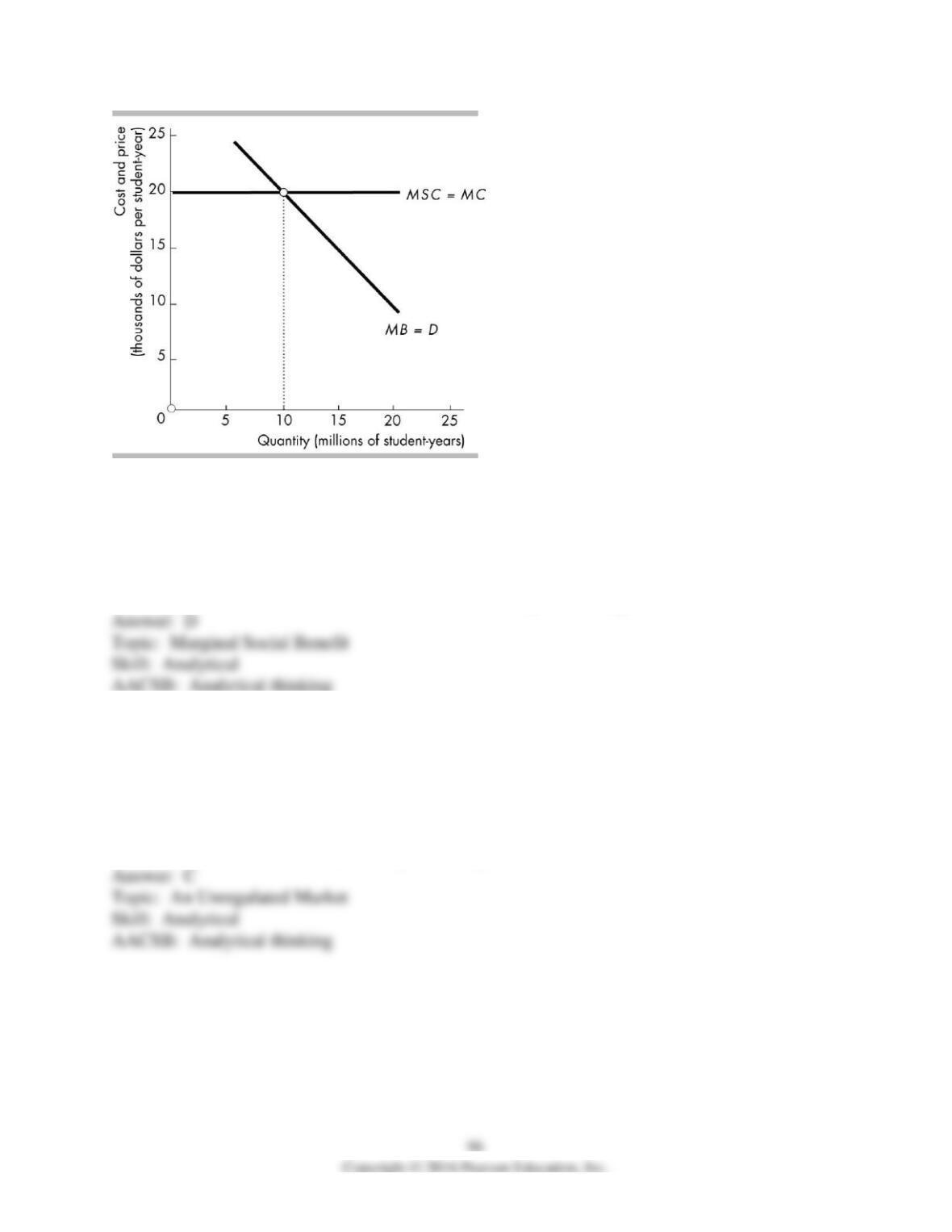
83) The above figure shows the marginal private benefit and marginal social cost of a college
education. If society’s external benefits from college graduates is $10,000 each, then the
A) marginal social cost curve lies $10,000 to the left of the private marginal benefit curve.
B) marginal social cost curve lies $10,000 to the right of the private marginal benefit curve.
C) marginal social benefit curve lies $10,000 below the private marginal benefit curve.
D) marginal social benefit curve lies $10,000 above the private marginal benefit curve.
84) The above figure shows the marginal private benefit and marginal social cost of a college
education. If society’s external benefits from college graduates is $10,000 each, then without
government intervention
A) no students will go to college.
B) less than 10 million students will go to college.
C) 10 million students will go to college.
D) more than 10 million students will go to college.
85) The above figure shows the marginal private benefit and marginal social cost of a college
education. If society’s external benefits from college graduates is $10,000 each, then the private
market outcome is inefficient because
A) no students will go to college.
B) society places less value on educating the next student than it will cost society to educate that
student.
C) society places greater value on educating the next student than it will cost society to educate
that student.
D) the marginal cost will shift upward.
86) The above figure shows the marginal private benefit and marginal social cost of a college
education. If society’s external benefits from college graduates is $10,000 each, then
A) a subsidy of $10,000 per student paid to colleges will achieve efficiency.
B) a tax of $10,000 per student imposed on the colleges will achieve efficiency.
C) 10 million students per year is the efficient number students.
D) None of the above answers are correct.
87) The above figure shows the marginal private benefit and marginal social cost of a college
education. A $10,000 subsidy to colleges results in a college charging tuition of
A) $0.
B) $10,000.
C) $20,000.
D) $30,000.
88) The above figure shows the marginal private benefit and marginal social cost of a college
education. If students receive a $10,000 voucher
A) no students will go to college.
B) less than 10 million students will go to college.
C) 10 million students will go to college.
D) more than 10 million students will go to college.
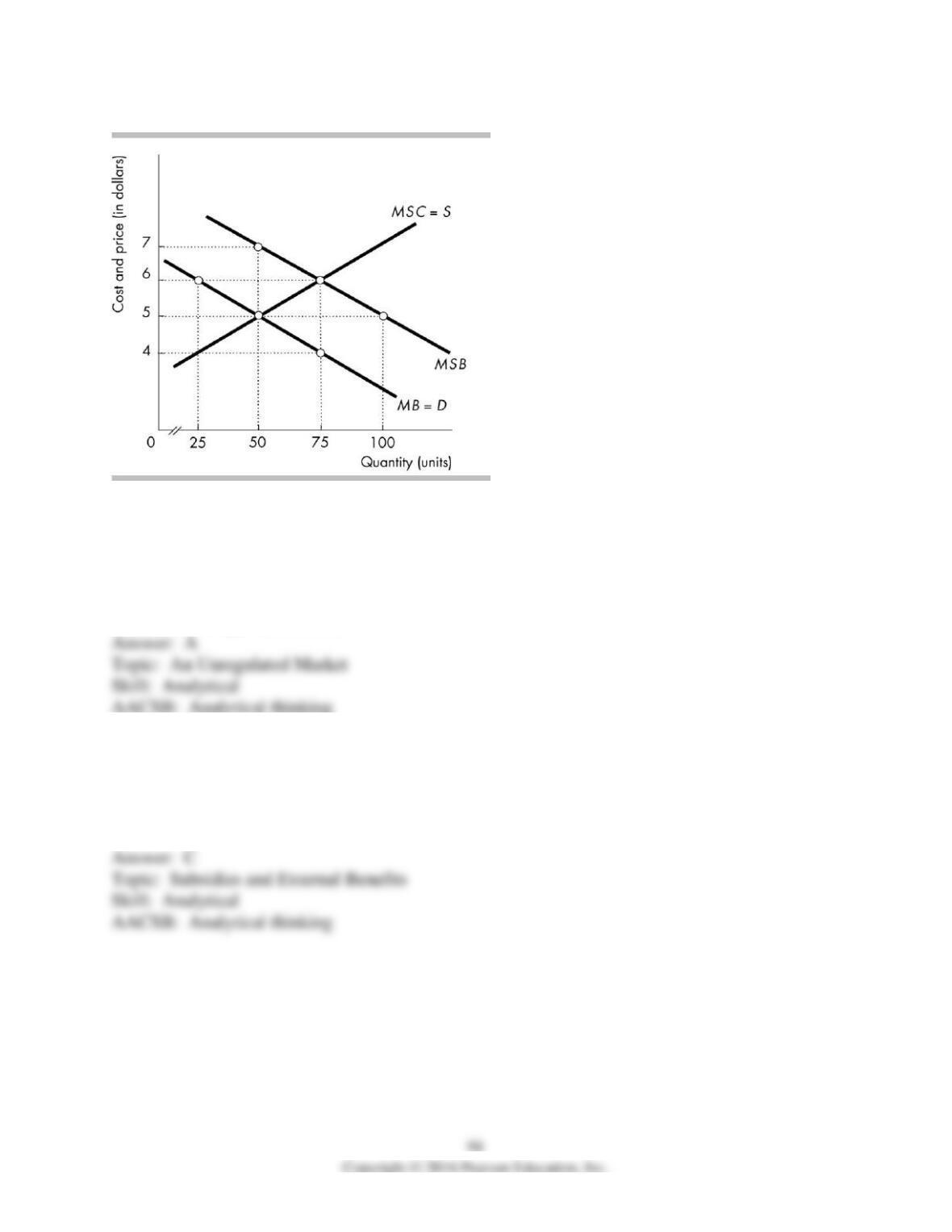
89) In the above figure, if no government intervention occurs, at the unregulated competitive
market equilibrium, there is an
A) external marginal benefit of $2.
B) external marginal cost of $2.
C) external marginal benefit of $1.
D) external marginal cost of $3.
90) In the above figure, the efficient amount of output is ________ units.
A) 25
B) 50
C) 75
D) 100
91) In the above figure, to achieve efficiency, the government should
A) impose a tax of $2 per unit.
B) impose a tax of $3 per unit.
C) offer a subsidy of $2 per unit.
D) offer a subsidy of $3 per unit.
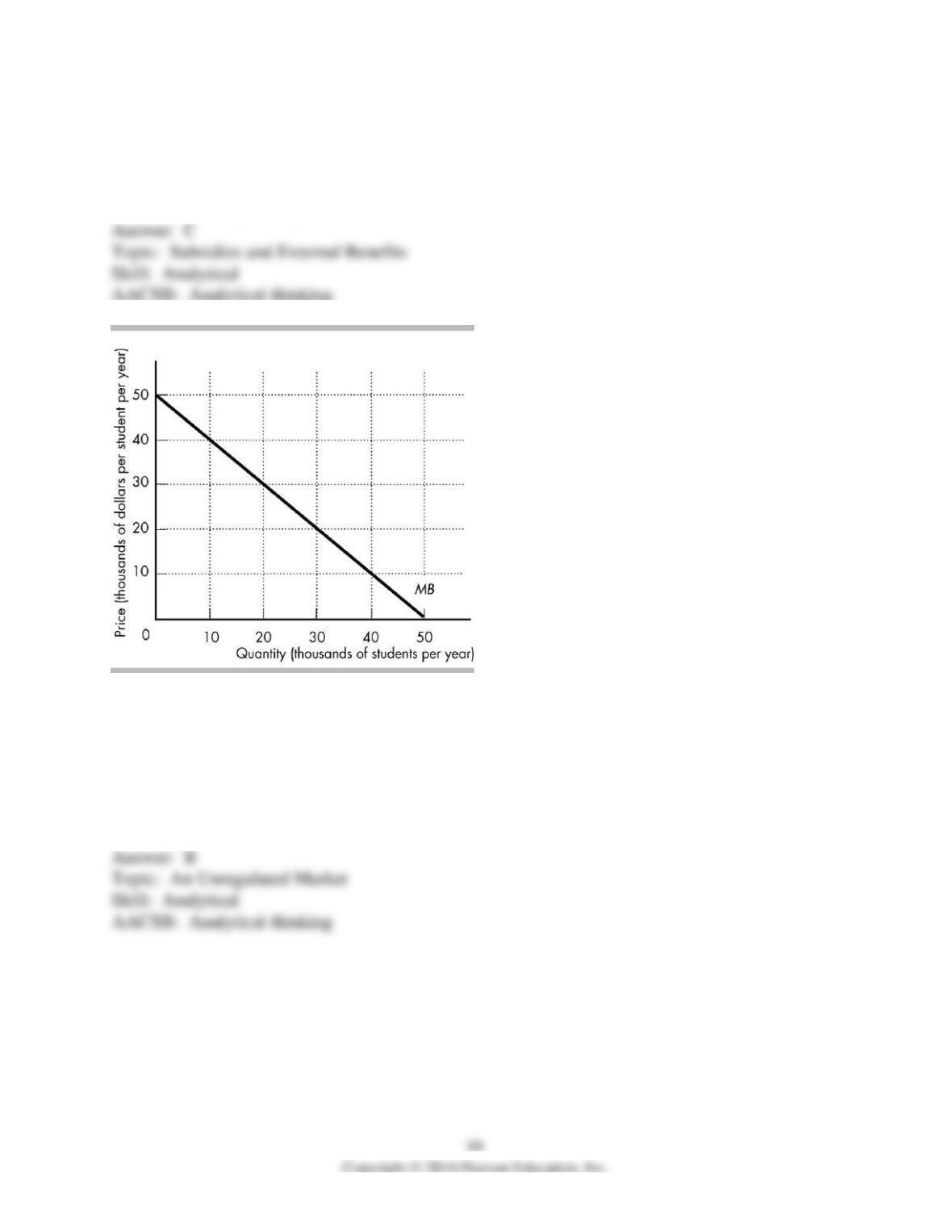
92) The marginal cost of educating a student is $30,000, and this cost is independent of the
number of students. The figure above shows the marginal private benefit that a student receives
from education. If schools are competitive, how many students are enrolled?
A) zero
B) 20,000
C) 50,000
D) It depends on the demand.
93) The marginal cost of educating a student is $30,000, and this cost is independent of the
number of students. The figure above shows the marginal private benefit that a student receives
from education. An independent government agency determines that the efficient number of
students is 40,000. What is the marginal social benefit from education?
A) It depends on the demand.
B) $20,000
C) $10,000
D) $40,000
94) The marginal cost of educating a student is $30,000, and this cost is independent of the
number of students. The figure above shows the marginal private benefit that a student receives
from education. An independent government agency determines that the efficient number of
students is 40,000. What subsidy per student must be given to colleges to make the efficient
number of students undertake education?
A) It depends on the demand.
B) $20,000
C) $30,000
D) $10,000