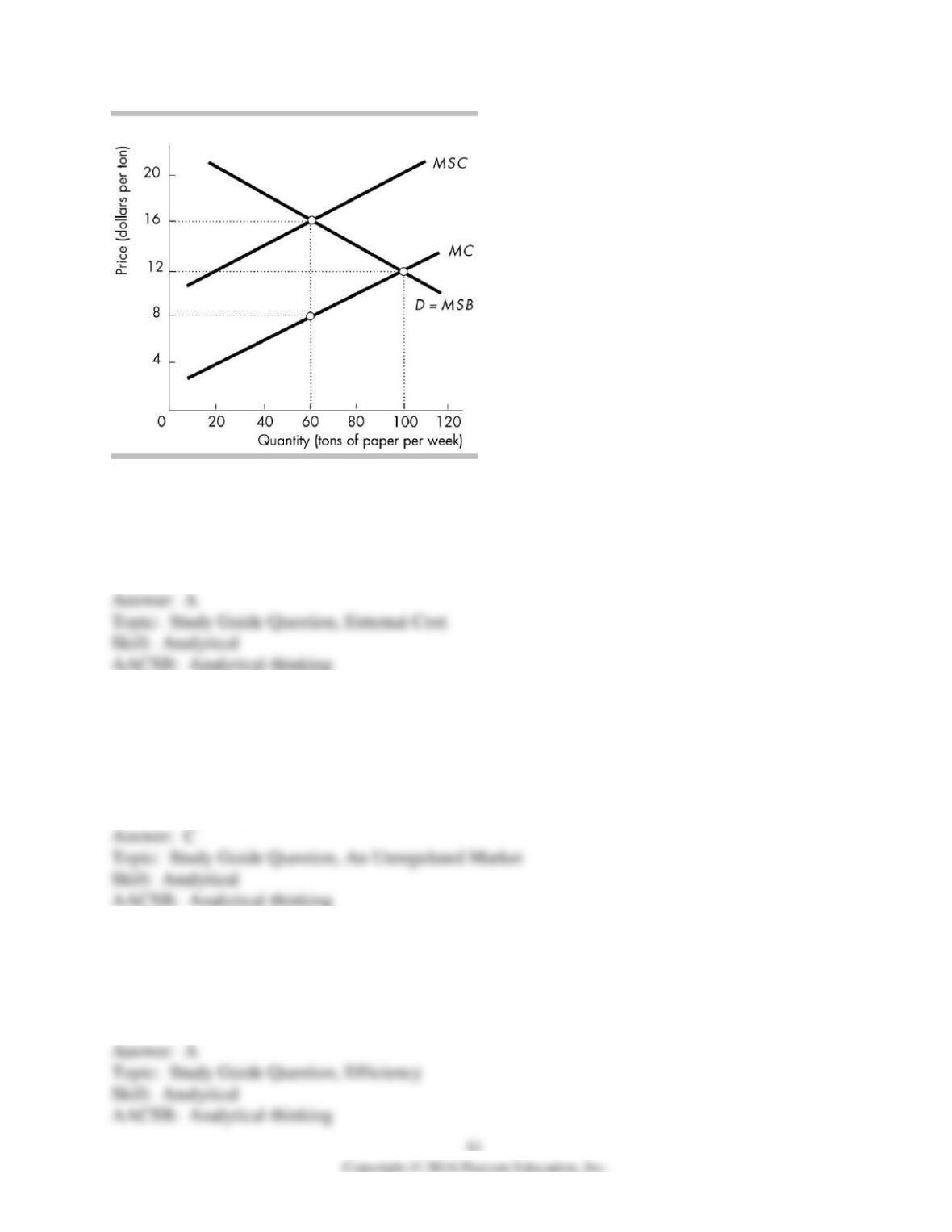
178) The amount of the external marginal cost per ton illustrated in the above figure is
A) $8.00 per ton.
B) $12.00 per ton.
C) $16.00 per ton.
D) zero because no external cost is illustrated.
179) Using the above figure, in the absence of any government intervention, the number of tons
of paper produced will be
A) 60 million tons.
B) 80 million tons.
C) 100 million tons.
D) 120 million tons.
180) Using the above figure, the efficient amount of paper produced is
A) 60 million tons.
B) 80 million tons.
C) 100 million tons.
D) 120 million tons.
181) In the above figure, to achieve the efficient amount of paper production, the government
could impose a tax of
A) $2 per ton.
B) $8 per ton.
C) $26 per ton.
D) zero, because the efficient amount is produced with no government intervention.
3 Negative Externality: The Tragedy of the Commons
1) The tragedy of commons is the
A) underuse of a common resource.
B) absence of incentives for people to pay for what they consume.
C) fact that common resources are nonrival.
D) overuse of a common resource.
2) Which of the following applies to the tragedy of the commons?
I. In the absence of government action, there is an absence of incentives to prevent the overuse
of the common resource.
II. When consumers take account of the marginal social benefit and marginal social cost,
overuse of the resource occurs.
III. Even with government action, it is impossible for an efficient level of output to be achieved.
A) I only
B) I and II
C) II and III
D) I, II and III
3) The tragedy of the commons is the absence of incentives to
A) correctly measure the marginal social benefit from a common resource.
B) prevent under use of the common resource.
C) prevent overuse and depletion of a common resource.
D) discover the common resource.
4) The tragedy of the commons is the absence of incentives to
A) use commonly owned resources.
B) prevent the overuse of commonly owned resources.
C) use privately owned resources.
D) have commonly owned resources.
5) In which of the following cases does the tragedy of the commons occur?
I. Cattle grazing on private ranches.
II. Catching lobsters off the coast of Florida.
III. Raising salmon on salmon farms.
IV. Using legal services provided by the courts.
A) I only
B) II only
C) II and III only
D) I and IV only
6) The Atlantic City Expressway is a highway that runs from outside Philadelphia to Atlantic
City, New Jersey. It is notoriously congested during the summer weekends when many people
are driving to the beach about the same time. The marginal private cost for a driver of driving on
the Expressway includes
I. the cost of gasoline.
II. the cost of increasing congestion for everyone else.
A) I only
B) II only
C) Both I and II
D) Neither I nor II
7) For a common resource, the marginal private cost curve slopes ________ and the marginal
social cost curve slopes ________.
A) upward; upward
B) upward; downward
C) downward; upward
D) downward; downward
8) For a common resource, the marginal social cost of the resource is ________ the marginal
private cost.
A) greater than
B) equal to
C) less than
D) not comparable to
9) For a common resource, the equilibrium with no government intervention is such that
________ is less than ________.
A) marginal private cost; marginal social benefit
B) marginal social benefit; marginal social cost
C) marginal private benefit; marginal social benefit
D) total social benefit; total social cost
10) For a common resource, efficiency requires that the ________ equals the ________.
A) marginal private benefit; marginal social cost
B) marginal social benefit; marginal social cost
C) marginal private benefit; marginal social benefit
D) marginal social cost; marginal private cost
11) A common resource is used efficiently if
A) the output is maximized.
B) marginal social benefit equals marginal social cost.
C) marginal private benefit equals marginal private cost.
D) marginal social benefit is maximized.
12) To achieve the efficient amount of use of a common resource, the use should be such that
________ equals ________.
A) marginal social cost; marginal private cost
B) marginal social cost; marginal social benefit
C) marginal social benefit; marginal private cost
D) marginal private cost; marginal private benefit
13) The problem of the commons arises because ________ exceeds ________ when the resource
is used.
A) marginal social cost; marginal private cost
B) marginal private benefit; marginal social benefit
C) marginal private benefit; marginal private cost
D) marginal private cost; marginal social cost
14) The Atlantic City Expressway is a highway that runs from outside Philadelphia to Atlantic
City, New Jersey. It is notoriously congested during the summer weekends when many people
are driving to the beach about the same time. Because drivers who decide to take this road ignore
the impact of their driving on overall traffic congestion the result is ________ cars on the road
than the efficient number of cars and a deadweight loss is ________.
A) fewer; not created
B) fewer; created
C) more; not created
D) more; created
15) One way to overcome the problem of the commons is to
A) assign property rights so that someone owns the resource.
B) take away property rights so that no one owns the resource.
C) leave the market alone because the market will reach an equilibrium in which the efficient
amount of the resource is used.
D) None of the above answers is correct.
16) The catch of American lobster off the shores of New England is regulated using quotas. If
the quota is set correctly, then at this quantity, the marginal social cost ________ the marginal
social benefit.
A) is less than
B) is greater than
C) is not comparable to
D) equals
17) When a production quota is used to remedy the problem of the commons, then
A) the production quota is set so that use of the resource is where marginal private benefit equals
marginal private cost.
B) the production quota is set so that use of the resource is where marginal social benefit equals
marginal private cost.
C) the market equilibrium, but not the efficient outcome, is achieved.
D) all users of the resource have an incentive to cheat on the quota quantity.
18) If the government assigns private property rights to a common resource, then the
A) resource is under-utilized.
B) marginal private cost becomes equal to the marginal social cost.
C) government needs to set a quota to achieve efficiency.
D) None of the above answers is correct.
19) The market price of an individual transferable quota is equal to the
A) marginal private benefit.
B) marginal social benefit.
C) marginal social benefit minus the marginal cost.
D) marginal private benefit minus the marginal cost.
20) An individual transferable quota can be used to achieve the
A) equilibrium for a public good.
B) efficient use of a common resource.
C) equilibrium for a private good.
D) equilibrium for a common resource.
21) When producers are hard to monitor and marginal costs differ across producers, ________
are an effective method to achieve efficient use of a ________.
A) individual transferable quotas; public good
B) marginal private benefits; public good
C) individual transferable quotas; common resource
D) individual transferable quotas; excludable good
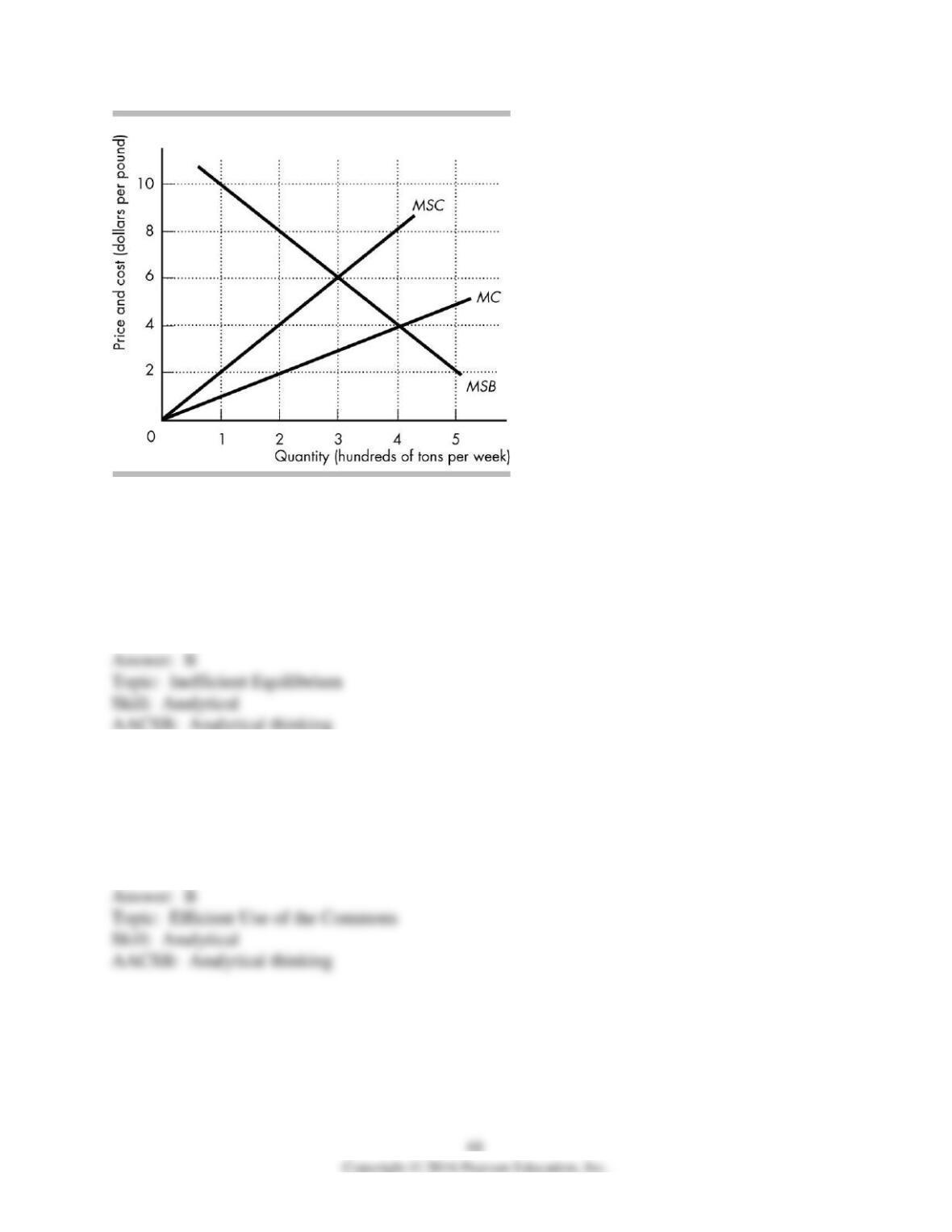
22) The above figure shows the marginal private cost curve, marginal social cost curve, and
marginal social benefit curve for cod, a common resource. The market equilibrium with no
government intervention is ________.
A) 0 tons per week
B) 400 tons per week
C) 300 tons per week
D) None of the above answers is correct.
23) The above figure shows the marginal private cost curve, marginal social cost curve, and
marginal social benefit curve for cod, a common resource. The efficient outcome is ________.
A) 0 tons per week
B) 300 tons per week
C) 400 tons per week
D) None of the above answers is correct.
24) The above figure shows the marginal private cost curve, marginal social cost curve, and
marginal social benefit curve for cod, a common resource. A quota to prevent the overuse of the
cod sets the catch equal to ________.
A) 0 tons per week
B) 300 tons per week
C) 400 tons per week
D) None of the above answers is correct.
25) The above figure shows the marginal private cost curve, marginal social cost curve, and
marginal social benefit curve for cod, a common resource. The market equilibrium with no
government intervention is ________.
A) 0 tons per week
B) 400 tons per week
C) 300 tons per week
D) None of the above answers is correct.
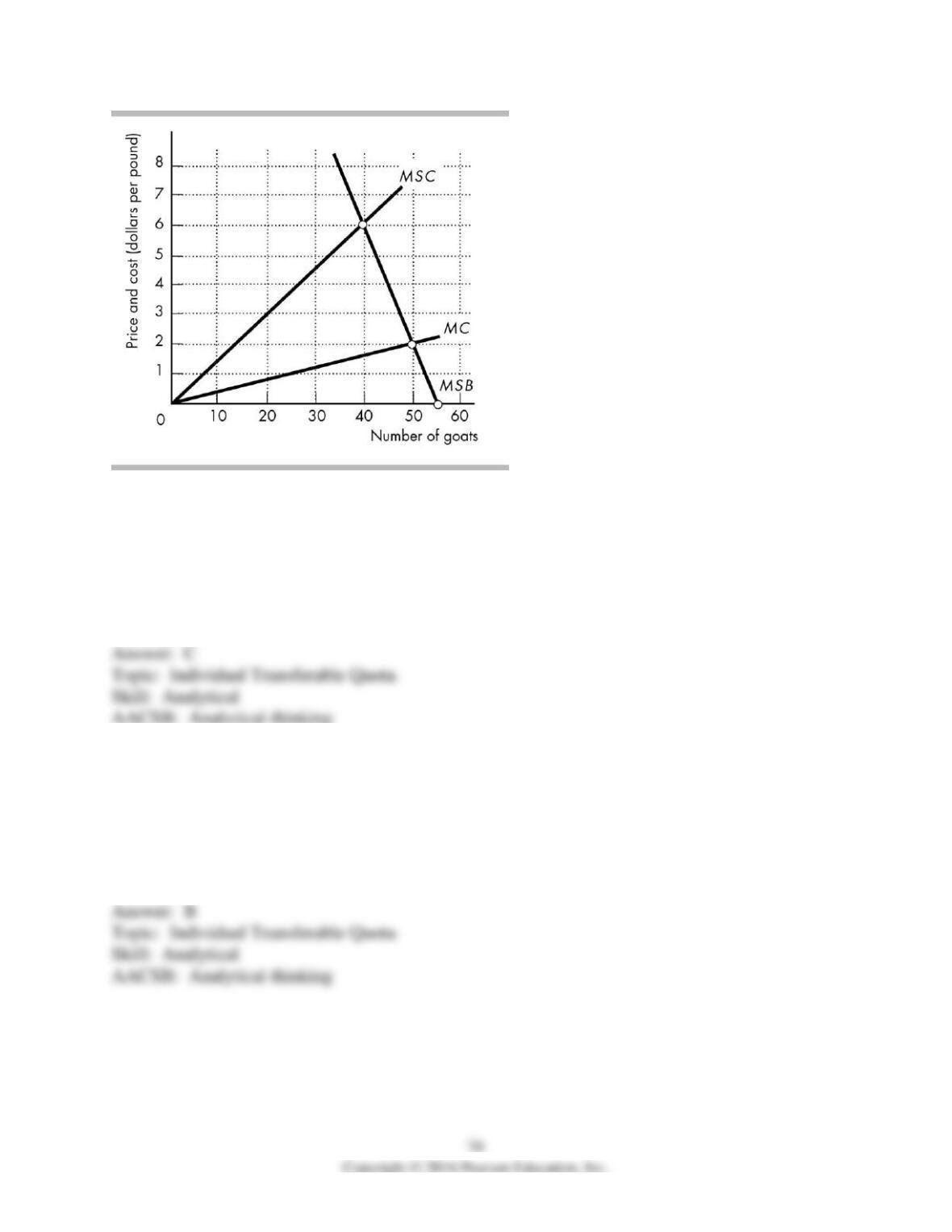
26) The above figure shows the marginal private cost curve, marginal social cost curve, and
marginal social benefit curve for raising goats on a common pasture. The market equilibrium
with no government intervention is raising ________.
A) 0 goats
B) 40 goats
C) 50 goats
D) 55 goats
27) The above figure shows the marginal private cost curve, marginal social cost curve, and
marginal social benefit curve for raising goats on a common pasture. The efficient outcome is
raising ________.
A) 0 goats
B) 40 goats
C) 50 goats
D) 55 goats
28) The above figure shows the marginal private cost curve, marginal social cost curve, and
marginal social benefit curve for raising goats on a common pasture. A quota to prevent the
overuse of the common pasture sets the number of goats to be raised equal to ________.
A) 0 goats
B) 40 goats
C) 50 goats
D) 55 goats
29) The above figure shows the marginal private cost curve, marginal social cost curve, and
marginal social benefit curve for raising goats on a common pasture. If property rights to the
pasture are granted to a farmer so that the farmer owns the pasture, the farmer raises ________.
A) 0 goats
B) 40 goats
C) 50 goats
D) 55 goats
30) The above figure shows the marginal private cost curve, marginal social cost curve, and
marginal social benefit curve for raising goats on a common pasture. Suppose the government
assigns individual transferable quotas (ITQ) set to achieve the efficient outcome. The market
price of an ITQ is ________ per pound.
A) $4.20
B) $2.00
C) $6.00
D) $4.00
31) For a common resource, efficiency requires that the ________ equals the ________.
A) marginal private benefit; marginal private cost
B) marginal social benefit; marginal social cost
C) marginal private benefit; marginal social benefit
D) marginal social cost; marginal private cost
32) If the government assigns private property rights to a common resource, then the
A) resource is under-utilized.
B) marginal private cost becomes equal to the marginal social cost.
C) government needs to set a quota to achieve efficiency.
D) None of the above answers is correct.
4 Positive Externality: Knowledge
1) ________ is the benefit that a consumer of a good or service receives.
A) Marginal private benefit
B) Marginal external benefit
C) Marginal social benefit
D) Both answers A and B are correct.
2) The benefit from an additional unit of a good or service that the consumer of that good or
service receives is the
A) marginal private benefit.
B) marginal external benefit.
C) marginal social benefit.
D) opportunity cost.
3) The benefit from an additional unit of a good or service that people other than the consumer of
that good or service receives is the
A) marginal private benefit.
B) marginal external benefit.
C) marginal social benefit.
D) opportunity cost.
4) Suppose your neighbor has a beautiful garden. The benefit that she enjoys from her garden is
called ________ and the benefit the rest of the neighborhood enjoys is called ________.
A) marginal private benefit; marginal external benefit
B) private cost; external cost
C) marginal social benefit; marginal external benefit
D) marginal external benefit; marginal social benefit
5) The benefit from an additional unit of a good or service that society receives from the
consumption of that good or service is the
A) marginal private benefit.
B) marginal external benefit.
C) marginal social benefit.
D) opportunity cost.
6) The HPV vaccine protects against human papillomavirus (HPV) that causes cancer. It protects
both the person getting the vaccine and the sexual partners of that person. When calculating the
marginal social benefit of the vaccine, it is necessary to include
A) only the marginal private benefit.
B) only the marginal external benefit.
C) both the marginal private benefit and the marginal external benefit.
D) either the marginal private benefit or the marginal external benefit, whichever is larger.
7) Most economist would consider the marginal private benefit of education is
A) less than the marginal social benefit.
B) equal to the marginal social benefit.
C) greater than the marginal social benefit.
D) equal to the marginal social cost.
8) If the marginal social benefit of a good equals the marginal private benefit of the good, then
the marginal external benefit of the good
A) is zero.
B) equals the marginal social benefit.
C) equals the marginal social cost.
D) equals the marginal private cost.
9) When individuals make decisions about how much schooling to obtain, they
A) do not take account of the personal benefits that it creates.
B) do not take account of the external benefits that it creates.
C) overvalue the personal benefits that it creates.
D) overvalue the external benefits that it creates.
10) Individuals making decisions about how much to purchase of a product with an external
benefit base their decisions on which of the following?
A) the price and marginal private benefit
B) the economically efficient output
C) the price and the marginal social benefit
D) the size of the deadweight loss
11) When people determine the quantity of education they will undertake, they ________ the
external benefits. As a result, if education were left to an unregulated market, people would
undertake too ________ education.
A) overvalue; much
B) ignore; much
C) ignore; little
D) overvalue; little
12) When external benefits are present,
A) competitive markets are efficient.
B) competitive markets are inefficient.
C) a tax is required to eliminate the inefficiency.
D) property rights have already been established.
13) In an unregulated, competitive market, less than the efficient quantity of education is
produced and consumed because
A) the decisions to produce and consume education are based on marginal private costs and
marginal private benefits.
B) the decisions to produce and consume education are based on marginal social costs and
marginal social benefits.
C) the decisions to produce and consume education are based on marginal private benefits and
marginal social costs.
D) marginal private costs are consistently greater than marginal private benefits.
14) Most governments subsidize basic education because
A) there are external costs associated with well educated citizens.
B) the marginal social benefit of education is greater than the marginal private benefit.
C) of the existence of private schools.
D) None of the above answers are correct.
15) Education in the United States is heavily subsidized by the government. This fact suggest
that
I. less than the efficient amount of education would be provided by an unregulated market.
II. the marginal social benefit of education is greater than marginal social cost of education.
A) I only
B) II only
C) both I and II
D) neither I nor II
16) One reason that education has external benefits is that
A) knowledge has diminishing marginal productivity.
B) education creates job opportunities for teachers.
C) education creates better citizens.
D) property owners pay taxes to support the school system.
17) The concept of externalities means that subsidizing education can be justified on the grounds
that as a student becomes better educated, the student will
A) earn a higher income.
B) enhance the lives of people around the student.
C) make contributions to the student’s alma mater.
D) none of the above
18) When the marginal social benefit of Good A is greater than the marginal private benefit of
Good A, then
A) competitive, unregulated markets will produce a quantity of Good A that is less than the
efficient quantity.
B) competitive, unregulated markets will produce the quantity of Good A that is equal to the
efficient quantity.
C) competitive, unregulated markets will produce a quantity of Good A that is greater than the
efficient quantity.
D) the government should levy a tax on the production of Good A that is equal to the horizontal
distance between the two marginal cost curves.
19) When the consumption of a good creates an external benefit,
A) the marginal social cost curve lies below the marginal private cost curve.
B) the marginal social benefit curve lies above the marginal private benefit curve.
C) the quantity produced in an unregulated, competitive market is greater than the efficient
quantity.
D) None of the above answers is correct.
20) Consider a market in which there is an external benefit. The inefficient market equilibrium is
such that
A) too little output is produced.
B) too much output is produced.
C) price is too high.
D) marginal social cost is greater than marginal social benefit.
21) Suppose a good has an external benefit and no external cost. When a competitive,
unregulated market is at its equilibrium, then the
A) marginal private benefit is less than the marginal social benefit.
B) marginal private benefit is greater than the marginal social benefit.
C) marginal private cost is less than the marginal social cost.
D) marginal private cost is greater than the marginal social cost.
22) The HPV vaccine protects against human papillomavirus (HPV) that causes cancer. It
protects both the person getting the vaccine and the sexual partners of that person. In a private
market with no government intervention, the equilibrium will be
A) overprovision of the HPV vaccine and a deadweight loss.
B) overprovision of the HPV vaccine but no deadweight loss.
C) underprovision of the HPV vaccine but no deadweight loss.
D) underprovision of the HPV vaccine and a deadweight loss.
23) If production of a good produces an external benefit, in order for the marginal social cost to
equal the marginal social benefit
A) the good should be taxed.
B) permits should be required to purchase the good.
C) the good could be subsidized.
D) the government needs to take no action.
24) All of the following are devices that governments can use to achieve a more efficient
allocation of resources in the presence of external benefits EXCEPT
A) vouchers.
B) private subsidies.
C) marketable permits.
D) public provision.
25) One way that government can increase the production of goods that have external benefits is
to
A) tax the activity.
B) subsidize the activity.
C) use marketable permits.
D) Both answers B and C are correct.
26) Governments can use subsidies ________.
A) as a means of increasing government spending
B) when they want to increase taxes
C) to achieve an efficient outcome if there are external costs
D) to achieve an efficient outcome if there are external benefits
27) A government subsidy for a good
A) is similar to a tax insofar as it decreases the production of the good being subsidized.
B) increases production of the subsidized goods.
C) punishes those who consume or produce the subsidized good.
D) has no effect on the quantity of the good produced.
28) Consider a market in which there is an external benefit. A private subsidy paid to producers
can be used to arrive at the efficient market equilibrium because the subsidy will
A) increase the quantity produced.
B) decrease the supply of the good.
C) increase the price demanders pay.
D) decrease demand.
29) If a good has an external benefit, efficiency can be achieved by
A) leaving the market unregulated.
B) monopolizing the market.
C) offering a private subsidy on the good equal to the external benefit.
D) imposing a tax on the good equal to the external benefit.
30) If a local fishing club spends time each year cleaning up local streams by removing trash
thrown by motorists, efficiency would be improved if
A) motorists were fined and fishing club activities were taxed.
B) the fishing club’s activities were subsidized.
C) the fishing club was taxed.
D) motorists were subsidized.
31) Public universities, by charging tuition ________ the marginal cost of education, ________
the number of students.
A) below; decrease
B) below; increase
C) above; decrease
D) above; increase
32) When external benefits exist, which of the following can produce the efficient amount of
output?
I. vouchers
II. private subsidies
III. taxes
IV. marketable permits.
A) I and II only
B) I and III only
C) II and IV only
D) III and IV only
33) School vouchers can be used to arrive at the efficient market equilibrium because vouchers
A) increase demand for schooling.
B) increase supply of schooling.
C) decrease the cost of schooling.
D) decrease supply of schooling.
34) The outcome from a voucher scheme is efficient when the government makes the value of
the voucher equal to ________.
A) marginal external cost
B) marginal external benefit
C) external cost
D) external benefit
35) Vouchers create the efficient outcome only if production is such that the marginal social cost
A) exceeds the marginal private benefit.
B) equals the marginal external benefit.
C) equals the marginal social benefit.
D) is decreased so it equals the marginal private cost.