
17.5 Allocating Property Rights to Reduce Externalities
1) The existence of externalities is due mainly to the fact that
A) monopolies tend to produce too little of a good anyway.
B) the optimal level of pollution is zero.
C) pollution is not a serious problem.
D) property rights are poorly defined.
2) The exclusive privilege to use an asset is called a(n)
A) property right.
B) exclusive use agreement.
C) property privilege.
D) right to work privilege.
3) The result that, under certain circumstances, no government action is needed to control an externality
because it can be eliminated by bargaining between the affected parties is called
A) a Nash equilibrium.
B) Coase Theorem.
C) Bargaining Theorem.
D) English Bargaining.
4) Suppose two neighbors share a park. One neighbor, Al, leaves trash in the park. This bothers the other
neighbor, Bert. According to Coase’s theorem, the optimal level of trash in the park can be achieved if
A) Al is fined by the government.
B) Al has the right to leave trash and Bert cannot do anything about it.
C) Al has the right to leave trash and Bert can pay him to limit his dumping.
D) Bert moves.
5) Suppose two neighbors share a park. One neighbor, Al, leaves trash in the park. This bothers the other
neighbor, Bert. According to Coase’s theorem, one necessary condition to alleviate the externality is that
A) Al is fined by the government.
B) Al has the right to leave trash and Bert cannot do anything about it.
C) Bert has the right to a clean park and Al cannot leave trash.
D) Either Al or Bert owns the park.
6) Suppose two neighbors share a park. One neighbor, Al, leaves trash in the park. This bothers the other
neighbor, Bert. According to Coase’s theorem, the optimal level of trash in the park can be achieved if
A) someone is assigned property rights to the park.
B) government limits the use of the park.
C) nobody catches Al leaving the trash.
D) Bert moves.
7) Suppose twenty neighbors share a park. One of the neighbors, Al, leaves trash in the park. This bothers
the other neighbors. According to Coase’s theorem, assigning the property rights to the park to Al
A) will achieve the socially optimal quantity of trash.
B) will result in zero trash being dumped in the park.
C) might still not achieve the social optimum since coordinating the other nineteen neighbors can be
costly.
D) is unfair.
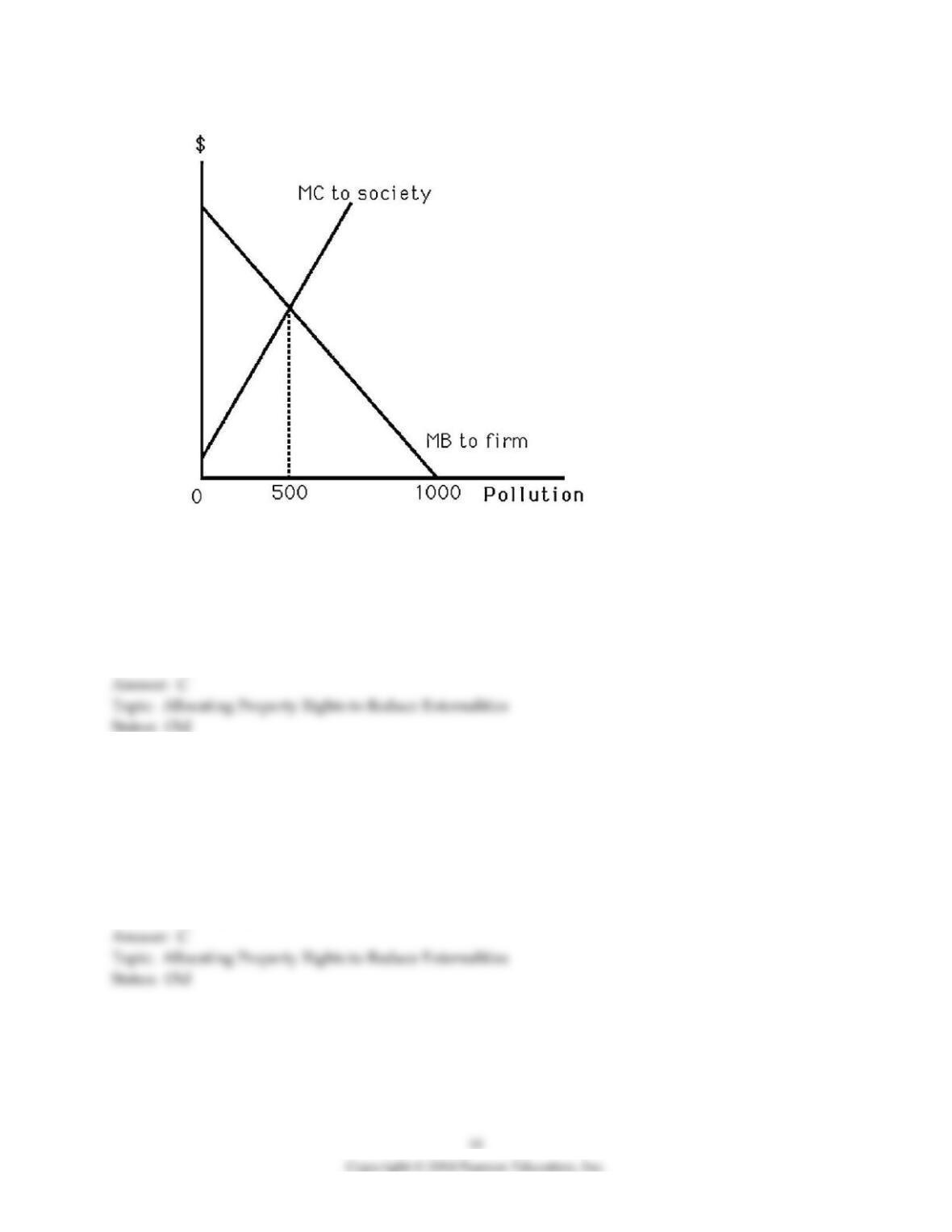
8) The above figure shows the marginal benefit to a firm of polluting in the local river while producing its
output, and the marginal cost to the surrounding neighbors. The marginal cost of production is zero for
the firm. If property rights are not defined, how much pollution will occur?
A) 0 units
B) 500 units
C) 1000 units
D) more than 1000 units
9) The above figure shows the marginal benefit to a firm of polluting in the local river while producing its
output, and the marginal cost to the surrounding neighbors. The marginal cost of production is zero for
the firm. If the firm owns the river and there are thousands of surrounding neighbors, how much
pollution is likely to occur?
A) 0 units
B) 500 units
C) 1000 units
D) more than 1000 units
10) The above figure shows the marginal benefit to a firm of polluting in the local river while producing
its output, and the marginal cost to the firm‘s neighbor. The marginal cost of production is zero for the
firm. If there is just one neighbor who owns the river, how much pollution is likely to occur?
A) 0 units
B) 500 units
C) 1000 units
D) more than 1000 units.
11) The above figure shows the marginal benefit to a firm of polluting in the local river while producing
its output, and the marginal cost to the surrounding neighbors. The marginal cost of production is zero
for the firm. If the firm owns the river and there is just one neighbor affected by the pollution, how much
pollution is likely to occur?
A) 0 units
B) 500 units
C) 1000 units
D) more than 1000 units
12) The above figure shows the marginal benefit to a firm of polluting in the local river while producing
its output, and the marginal cost to the surrounding neighbors. The marginal cost of production is zero
for the firm. According to Coase’s Theorem, which of the following scenarios is most likely to lead to the
socially optimal level of pollution?
A) The firm owns the river and there are a thousand surrounding neighbors.
B) The firm owns the river and there is just one nearby neighbor.
C) The river is jointly owned by one thousand surrounding neighbors.
D) The firm owns the river, and therefore produces the social optimum no matter what.
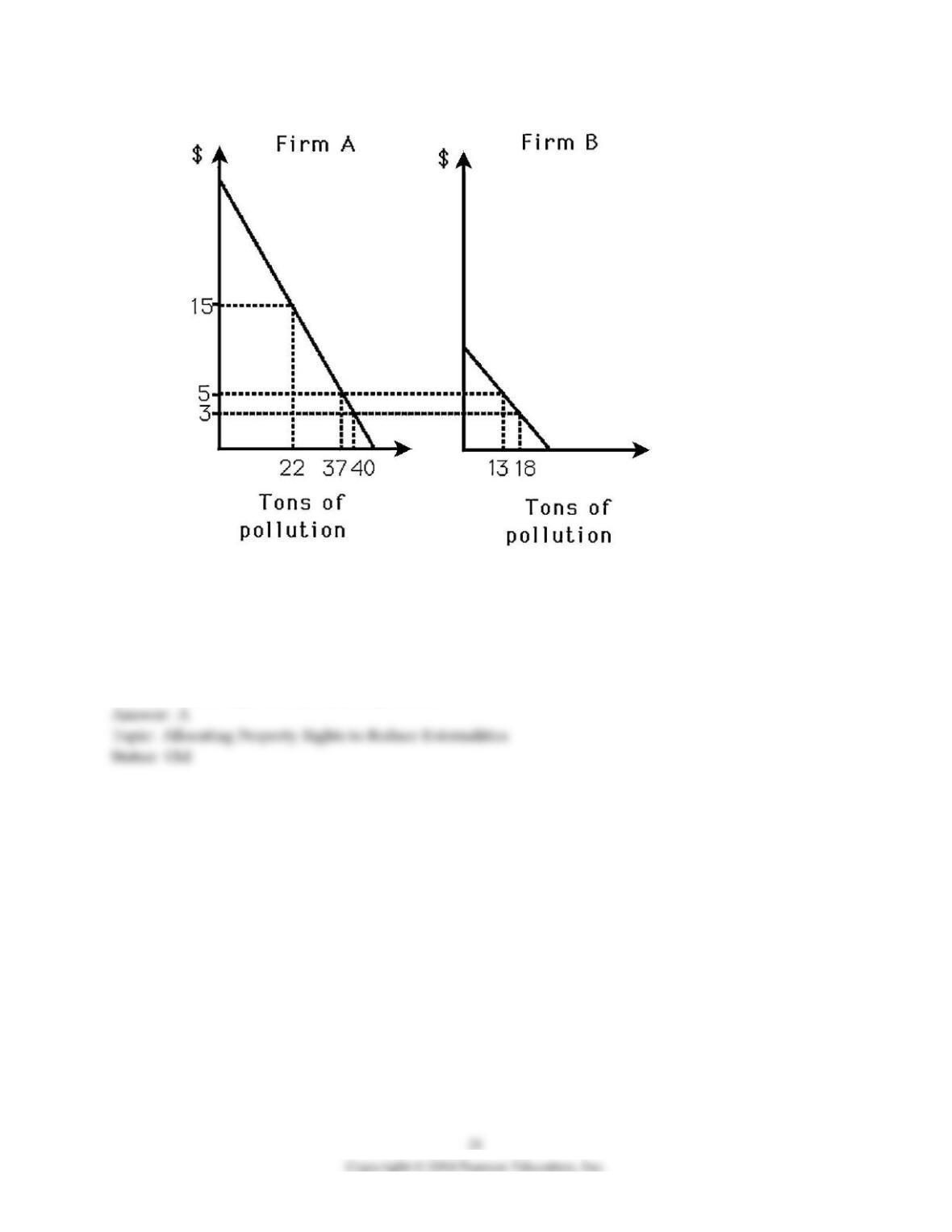
13) The above figure shows the marginal benefit from pollution for two firms. If each firm receives a
marketable permit to produce 25 units of pollution, which one of the following is most likely to happen?
A) Firm B will sell some pollution rights to firm A.
B) Firm A will sell some pollution rights to firm B.
C) Firm A will produce all 50 units of pollution.
D) Both firms will produce 25 units of pollution.
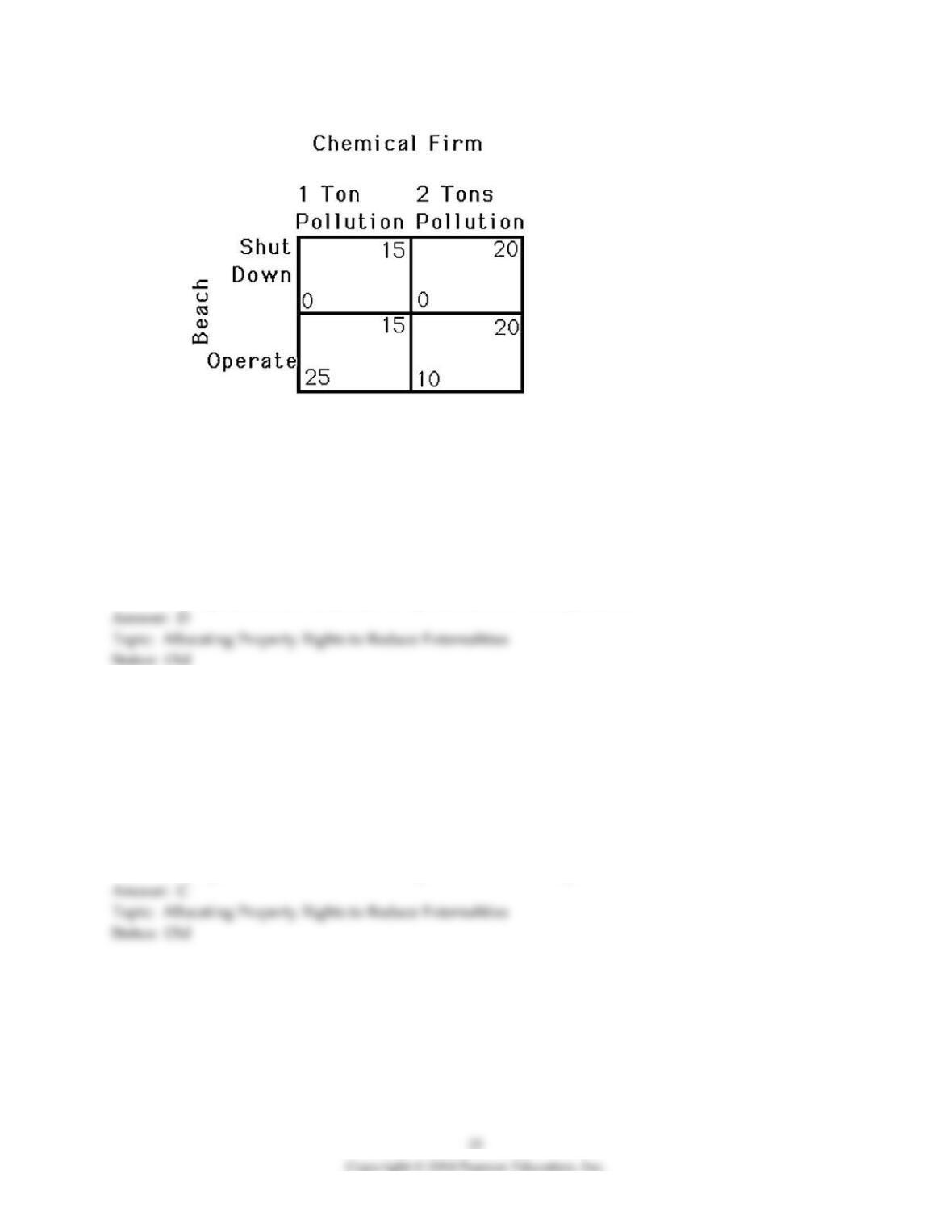
14) The above figure shows the payoff matrix for two firms. A chemical firm must choose between a low
level of production which yields one ton of pollution into a nearby lake and a high level of production
which yields two tons of pollution into the nearby lake. A private beach on the lake must decide whether
to operate or not. Increased pollution reduces the number of people who wish to visit the beach. If
nobody owns the lake, then
A) the beach shuts down and the chemical firm produces 1 ton of pollution.
B) the beach shuts down and the chemical firm produces two tons of pollution.
C) the beach operates and the chemical firm produces 1 ton of pollution.
D) the beach operates and the chemical firm produces two tons of pollution.
15) The above figure shows the payoff matrix for two firms. A chemical firm must choose between a low
level of production which yields one ton of pollution into a nearby lake and a high level of production
which yields two tons of pollution into the nearby lake. A private beach on the lake must decide whether
to operate or not. Increased pollution reduces the number of people who wish to visit the beach. If the
beach owner also owns the lake, and the chemical firm must pay $10 per ton to pollute, then
A) the beach shuts down and the chemical firm produces 1 ton of pollution.
B) the beach shuts down and the chemical firm produces two tons of pollution.
C) the beach operates and the chemical firm produces 1 ton of pollution.
D) the beach operates and the chemical firm produces two tons of pollution.

16) The above figure shows the payoff matrix for two firms. A chemical firm must choose between a low
level of production which yields one ton of pollution into a nearby lake and a high level of production
which yields two tons of pollution into the nearby lake. A private beach on the lake must decide whether
to operate or not. Increased pollution reduces the number of people who wish to visit the beach. If the
chemical firm owns the lake, and the beach owner must pay $10 to keep the chemical firm at just one ton
of pollution, then
A) the beach shuts down and the chemical firm produces 1 ton of pollution.
B) the beach shuts down and the chemical firm produces two tons of pollution.
C) the beach operates and the chemical firm produces 1 ton of pollution.
D) the beach operates and the chemical firm produces two tons of pollution.
17) The above figure shows the payoff matrix for two firms. A chemical firm must choose between a low
level of production which yields one ton of pollution into a nearby lake and a high level of production
which yields two tons of pollution into the nearby lake. A private beach on the lake must decide whether
to operate or not. Increased pollution reduces the number of people who wish to visit the beach. As long
as someone owns the lake and the two parties can negotiate, then
A) the beach shuts down and the chemical firm produces 1 ton of pollution.
B) the beach shuts down and the chemical firm produces two tons of pollution.
C) the beach operates and the chemical firm produces 1 ton of pollution.
D) the beach operates and the chemical firm produces two tons of pollution.
18) The above figure shows the payoff matrix for two firms. A chemical firm must choose between a low
level of production which yields one ton of pollution into a nearby lake and a high level of production
which yields two tons of pollution into the nearby lake. A private beach on the lake must decide whether
to operate or not. Increased pollution reduces the number of people who wish to visit the beach. Joint
profits are maximized when
A) the beach shuts down and the chemical firm produces 1 ton of pollution.
B) the beach shuts down and the chemical firm produces two tons of pollution.
C) the beach operates and the chemical firm produces 1 ton of pollution.
D) the beach operates and the chemical firm produces two tons of pollution.
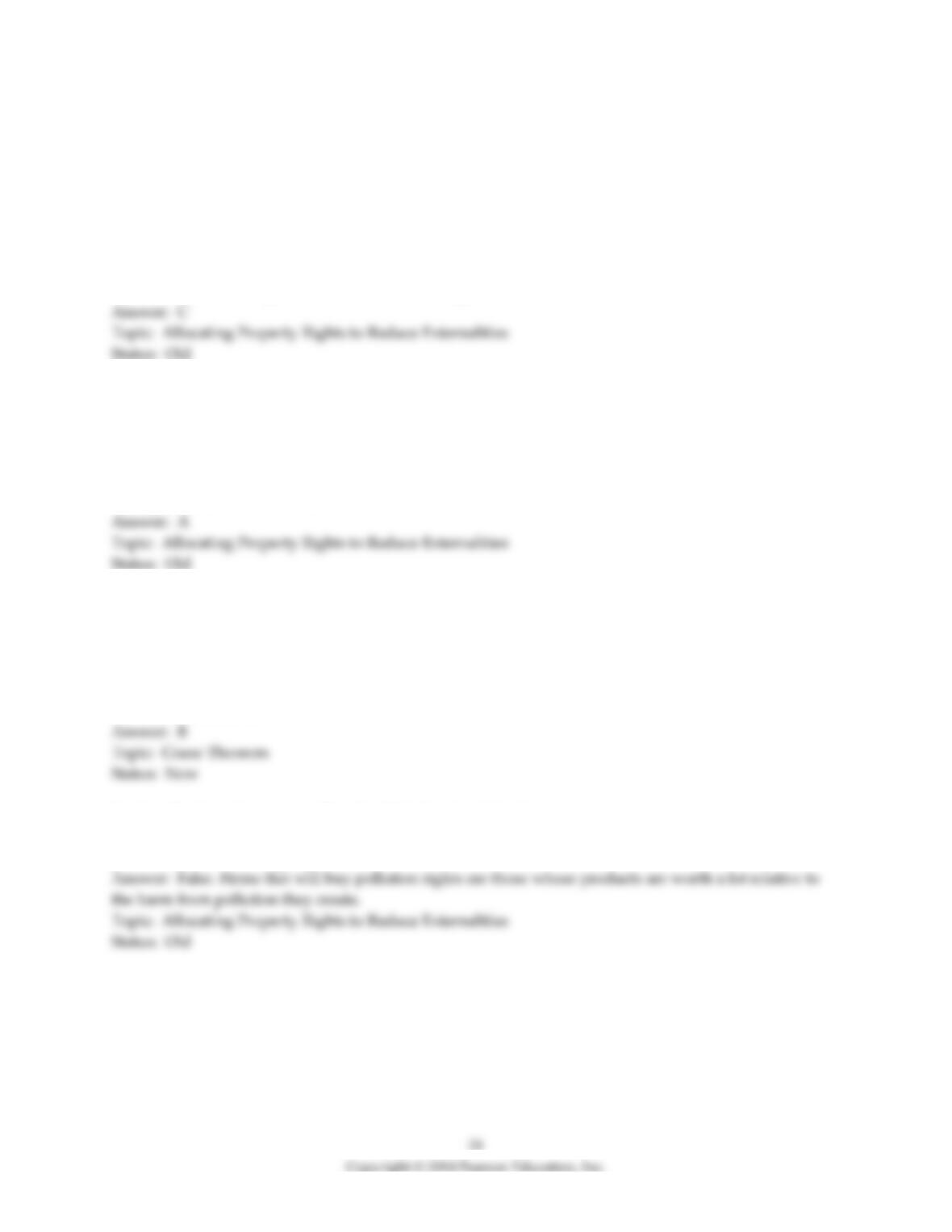
19) The above figure shows the payoff matrix for two firms. A chemical firm must choose between a low
level of production which yields one ton of pollution into a nearby lake and a high level of production
which yields two tons of pollution into the nearby lake. A private beach on the lake must decide whether
to operate or not. Increased pollution reduces the number of people who wish to visit the beach. If
nobody owns the lake, then
A) joint profits are zero.
B) joint profits are maximized.
C) joint profits are not maximized.
D) the beach will not operate because of too much pollution.
20) If the government wanted to efficiently limit the emission of Carbon Monoxide by all firms to exactly
4 Million tons it could
A) issue rights to pollute worth 4 Million tons and let the firms trade those rights in a market.
B) appeal to firms’ environmental conscience to pollute less.
C) subsidize production.
D) rely on the Coase Theorem.
21) According to the Coase approach, to achieve socially optimal outcome, two sides must bargain. The
bargaining might not be successful because
A) transaction costs are ignorable.
B) firms engage in strategic bargaining.
C) both sides have perfect information.
D) None of the above.
For the following, please answer “True” or “False” and explain why.
22) Firms that are most likely to buy marketable pollution rights are those that produce the most
pollution per unit of output produced.
23) A firm operates and produces pollution that only harms an individual, Bob. The firm and Bob both
know the costs and benefits of reducing pollution. Neither the firm nor Bob acts strategically while
bargaining, and there are no transaction costs associated with bargaining. Explain how the efficient level
of pollution occurs no matter whether the firm or Bob owns the property right to pollution.
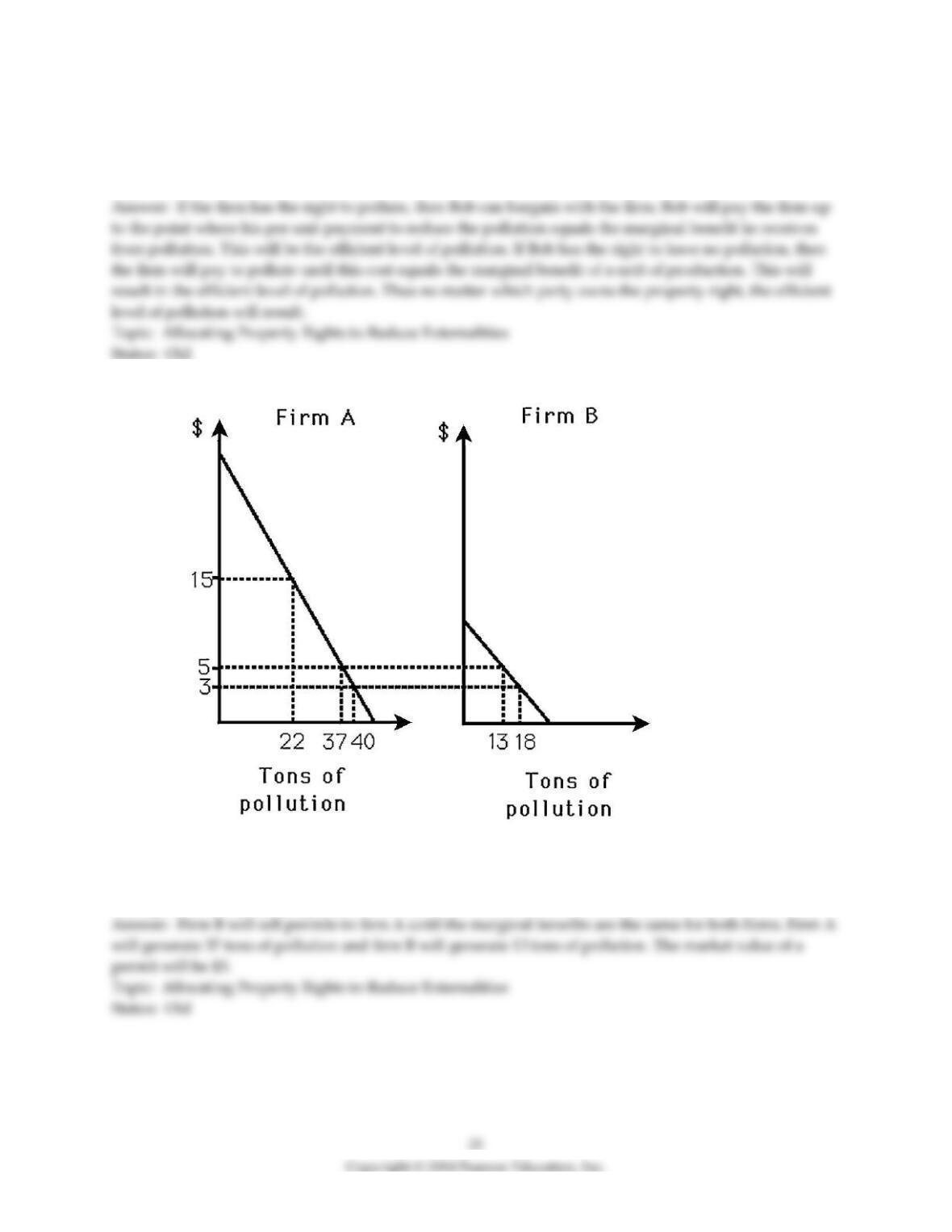
24) The above figure shows the marginal benefit from pollution for two firms. If both firms receive a
marketable permit to pollute 25 units of pollution each, how much will each firm pollute and how much
will a permit for one unit of pollution be worth?
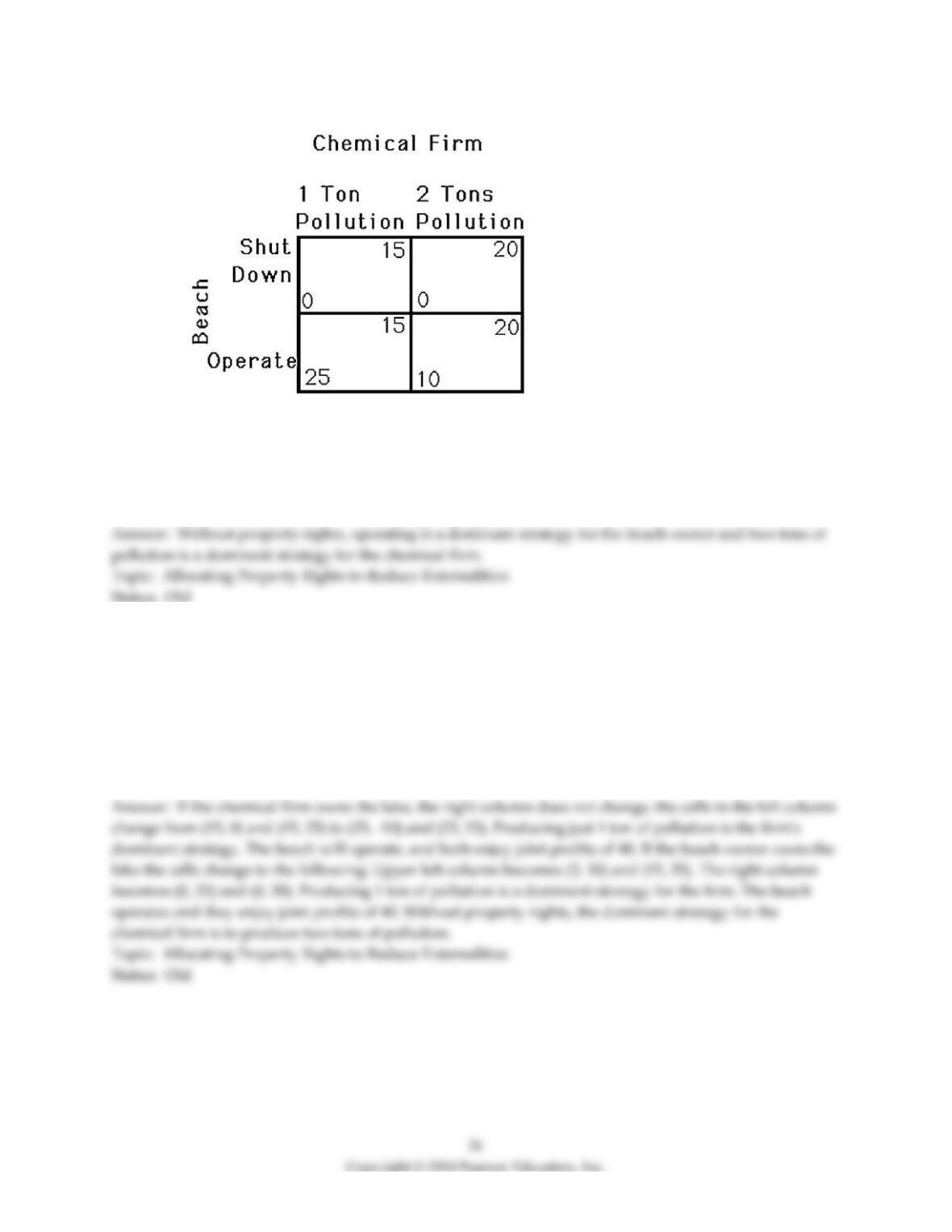
25) The above figure shows the payoff matrix for two firms. A chemical firm must choose between a low
level of production which yields one ton of pollution into a nearby lake and a high level of production
which yields two tons of pollution into the nearby lake. A private beach on the lake must decide whether
to operate or not. Increased pollution reduces the number of people who wish to visit the beach.
Determine the Nash equilibrium without property rights.
26) The above figure shows the payoff matrix for two firms. A chemical firm must choose between a low
level of production which yields one ton of pollution into a nearby lake and a high level of production
which yields two tons of pollution into the nearby lake. A private beach on the lake must decide whether
to operate or not. Increased pollution reduces the number of people who wish to visit the beach. If the
chemical firm owns the lake and the beach owner must pay the chemical firm $10 to produce only one
ton of pollution, what is the outcome? If the beach owner owns the lake and the chemical firm must pay
$10 per ton of pollution, what is the outcome? Compare this result to the case where nobody owns the
lake.

17.6 Rivalry and Exclusion
1) A common resource is best described as a resource where
A) there is a positive externality in consumption.
B) there is a negative externality in consumption.
C) there is a positive externality in production.
D) there is a negative externality in production.
2) Which of the following is NOT a common property?
A) a city park
B) a main street
C) a public beach
D) a movie screening
3) To alleviate the commons problem, the government can
A) apply a tax.
B) set a quota.
C) assign property rights.
D) All of the above.
4) Fishermen on the East Coast are using lobster traps out of which most of the lobsters that enter can
escape. Why?
A) It will make over-fishing less likely.
B) They can’t come up with better traps.
C) They are not educated enough to maximize profit.
D) They catch more lobsters this way.
5) The Commons Problem arises because
A) firms don’t maximize profits.
B) social and private incentives are not aligned and property rights are missing.
C) social cost equals private cost and property rights are missing.
D) social benefit equals private benefit and property rights are missing.
6) In the case of a good that has no exclusion and no rivalry, private markets fail because
A) of free-ridership.
B) this is a natural monopoly.
C) profit is driven down to zero.
D) the quantity produced will exceed the social optimum.
7) A commodity or service whose consumption by one person does not preclude others from also
consuming it is called a
A) private good.
B) public good.
C) Giffen Good.
D) Coase Good.
8) Which of the following goods has the property of rivalry?
A) national defense
B) a highway
C) a public beach
D) a movie screening
9) A public good in which exclusion is possible is called
A) an exclusive good.
B) a common good.
C) an impure good.
D) a club good.
10) Which of the following is NOT a club good?
A) cable television
B) a rock concert
C) a country club
D) a baseball bat

11) Markets tend to produce too little of an excludable public good because
A) transaction costs are high.
B) of the lack of rivalry.
C) these goods are depletable.
D) All of the above.
12) The total demand for a public good is found by
A) horizontally summing all individual demands.
B) vertically summing all individual demands.
C) finding the demand from the median voter.
D) dividing the marginal cost of the good by the number of voters.
13) The efficient quantity of a pure public good occurs when the marginal cost of producing that good
equals the
A) marginal benefit to the median voter.
B) marginal benefit to each individual.
C) sum of all individual marginal benefits.
D) sum of all individual marginal benefits divided by the number of voters.
14) When majority rule voting is used to determine whether to purchase a public good,
A) the efficient outcome is not assured.
B) the median voter gets her way.
C) the sum of the marginal benefits is ignored.
D) All of the above.
15) When majority rule voting is used to determine whether to purchase a public good,
A) the efficient outcome is assured.
B) the median voter gets her way.
C) the sum of the marginal benefits must equal marginal cost.
D) the marginal benefit of the good to the median voter equals the good’s marginal cost.
For the following, please answer “True” or “False” and explain why.
16) The efficient quantity of a public good occurs when the marginal cost of providing that good equals
the sum of the marginal benefits to all individuals.
17) Over-fishing of common fishing grounds happens because fishing grounds are a common property
and social and private incentive are the same.
18) Explain the externality generated when a shepherd grazes sheep in a field that is common property
that several other shepherds use.
19) Explain why state governments may charge a fee for beach access to address the commons problem.
20) Explain why the social demand curve for a public good is the vertical sum of the demand curves of
each individual.
21) Suppose three neighbors must vote on the installation of a traffic light that costs $210. The cost of the
light will be shared by all three. Voter A values the light at $50; voter B values the light at $50; and voter
C (who drives the most) values the light at $200. If the voting rule is that the majority wins, does the light
get purchased? Is it efficient to purchase the light?
22) Suppose 100 citizens each derive marginal benefit from submarines according to the function
MB = 10 – Q. If subs cost $100 each to produce, what is the efficient quantity of submarines?
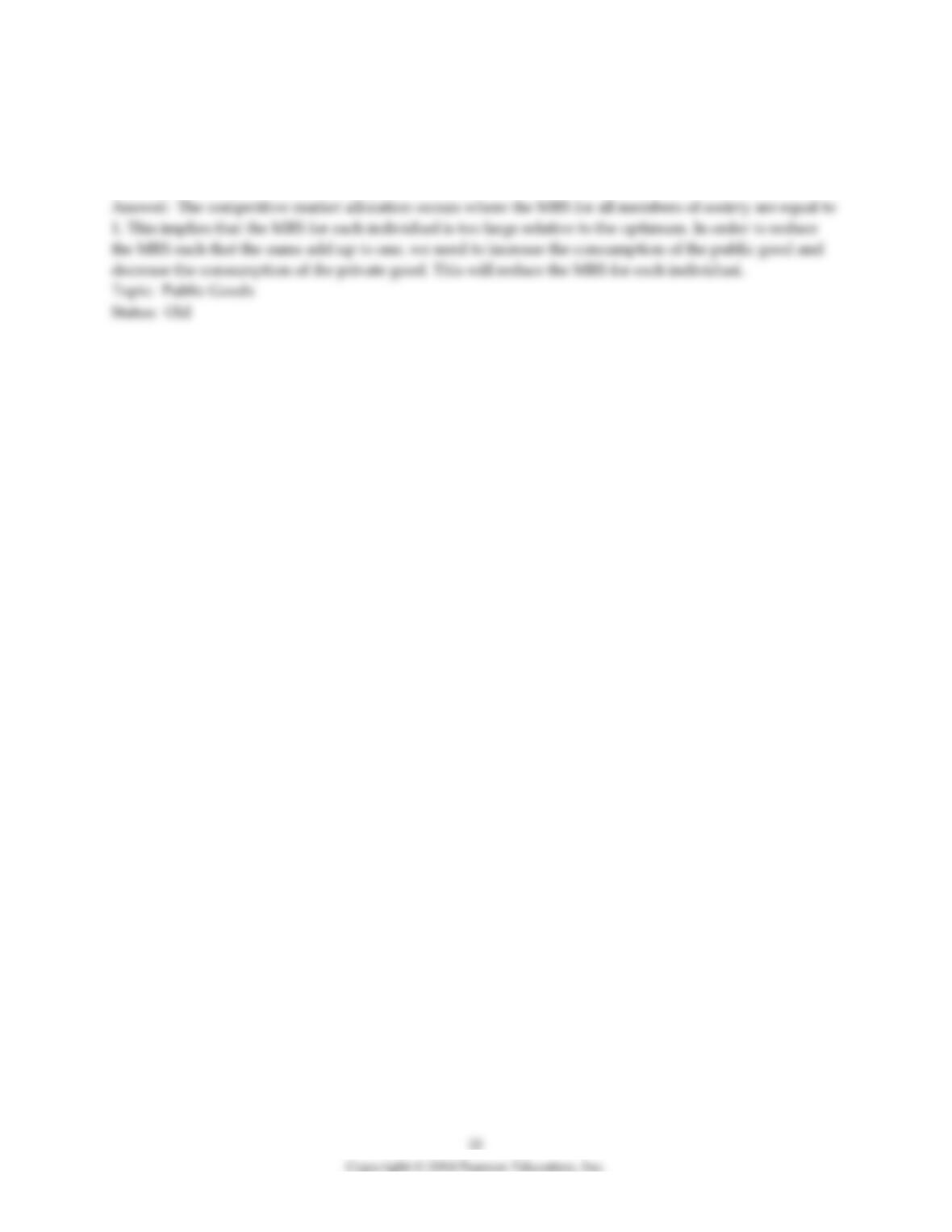
23) Two neighboring farmers must each decide whether to contribute to a fence that separates their
properties. The fence costs a total of $20. Both farmers currently have a profit of $30 each. With a fence to
keep each farmer‘s animals from wandering onto the other‘s property, both farmers would experience a
$15 rise in profits. Draw the payoff matrix and discuss the possible outcomes.
24) The optimal provision of a public good occurs when the sum of the marginal rate of substitution for
all members of society equals 1, the marginal rate of transformation. What is the relationship between the
marginal rates of substitution in the competitive market? Use this relationship to explain why too few
public goods are provided in the competitive market.