57) The Coase Theorem is the proposition that private transactions are efficient if property rights
exist, if only a ________ number of parties are involved, and if transactions costs are ________.
A) large; low
B) large; high
C) small; low
D) small; high
58) The Coase Theorem is the proposition that if the number of involved parties is low, if
property rights ________ and transactions costs are ________, then private transactions are
efficient.
A) are nonexistent; low
B) exist; high
C) are nonexistent; high
D) exist; low
59) The Coase Theorem points out that externality problems can be eliminated if the number of
parties involved is small and if property rights
A) are granted solely to consumers.
B) are granted solely to producers.
C) are eliminated.
D) are granted to either consumers or producers and transactions costs are low.
60) The Coase theorem says that which of the following is necessary to lead to an efficient use of
resources?
A) presence of transaction costs
B) existence of property rights
C) government intervention
D) All of the above answers are correct.
61) According to the Coase theorem, which of the following are necessary for the efficient levels
of pollution to be achieved?
I. Property rights are defined.
II. Transactions costs are low.
A) I only
B) II only
C) both I and II
D) neither I nor II
62) Which condition(s) must exist for the Coase theorem to hold?
I. Property rights must exist.
II. Transactions costs must be measurable.
III. A small number of parties must be involved.
A) I and II only
B) I and III only
C) II and III only
D) I, II and III
63) The Coase theorem is the proposition that if property rights exist, the number of parties is
small, and transactions costs are low
A) external costs result in deadweight losses.
B) external benefits result in deadweight losses.
C) private transactions are efficient.
D) public transactions are efficient.
64) The Coase Theorem is the proposition that private economic transactions are efficient if the
number of involved parties is small, if property rights ________, and transactions costs are
________.
A) exist; high
B) exist; low
C) do not exist; high
D) do not exist; low
65) According to the Coase theorem, part of what is needed for private transactions to be
efficient is that property rights
A) must be defined, but it does not matter who owns the property.
B) must be defined, and it is crucial as to who owns the property.
C) need not be defined as long as there are no transactions costs present.
D) need to be defined by the government to avoid producers from exploiting high transactions
costs.
66) A key contribution of Ronald Coase is that he pointed out that private transactions are
efficient when the number of parties involved is small
A) and when property rights are well defined and transactions costs are low.
B) and when property rights do not exist.
C) and that property rights are irrelevant to the existence of externalities.
D) and when corporations are not greedy.
67) The Coase theorem states that if transaction costs are low, the number of parties is small, and
property rights are well established
A) the government must intervene to eliminate any externalities in the market.
B) private transactions are efficient.
C) there will be no pollution.
D) Both answers B and C are correct.
68) A large farming operation which uses a potent fertilizer is located up river from a trout
farmer. If property rights of the river exist and transactions costs are low, the amount of pollution
will be ________.
A) efficient only if the trout farmer owns the river
B) inefficient if the farming operation owns the river
C) efficient if either the farming operation or the trout farmer own the river
D) always inefficient
69) The Coase theorem applies when property rights are given
A) to the victim of pollution but not to the polluter.
B) to the polluter but not to the victim.
C) to either the polluter or the victim.
D) neither to the polluter nor to the victim.
70) When property rights are assigned and transactions costs are low
A) all costs and benefits are taken into account by the transacting parties so the transaction is
efficient.
B) externalities will lead to market failure.
C) the marginal social benefit curve shifts leftward.
D) the marginal social cost curve shifts rightward.
71) A chemical factory and a fishing club share a lake. Producing chemicals creates water
pollution that harms the fish. Initially the lake is owned by no one. Keeping in mind the Coase
theorem, suppose transactions costs are low and the chemical factory is given ownership of the
lake. Compared to the situation with no property rights, the quantity of chemicals produced
A) will decrease.
B) will stay the same.
C) will increase.
D) changes, but the direction of the change is ambiguous.
72) A chemical factory and a fishing club share a lake. Producing chemicals creates water
pollution that harms the fish. Initially the lake is owned by no one. Keeping in mind the Coase
theorem, suppose transactions costs are low and the fishing club is given ownership of the lake.
Compared to the situation with no property rights, the quantity of chemicals produced
A) will decrease.
B) will stay the same.
C) will increase.
D) changes, but the direction of the change is ambiguous.
73) A polluted river has 20 homes on it that rent for $1,000 each per month. Homes on a similar
river that is not polluted rent for $2,000 each per month. The river is polluted because there are
two factories on the river that dump polluted water in the river. Each factory could install a filter
that would cost $5,000 each and would reduce the pollution in the water to a negligible level.
The external cost in this problem is
A) $20,000.
B) $5,000.
C) $10,000.
D) $30,000.
74) A polluted river has 20 homes on it that rent for $1,000 each per month. Homes on a similar
river that is not polluted rent for $2,000 each per month. The river is polluted because there are
two factories on the river that dump polluted water in the river. Each factory could install a filter
that would cost $5,000 each and would reduce the pollution in the water to a negligible level. In
this case
A) assigning property rights to the river to either party will result in an efficient outcome.
B) neither party is willing to bargain with the other.
C) if property rights to the river are assigned to the factory, then all the homes will be
abandoned.
D) if property rights to the river are assigned to the homeowners, then the factories will be
closed.
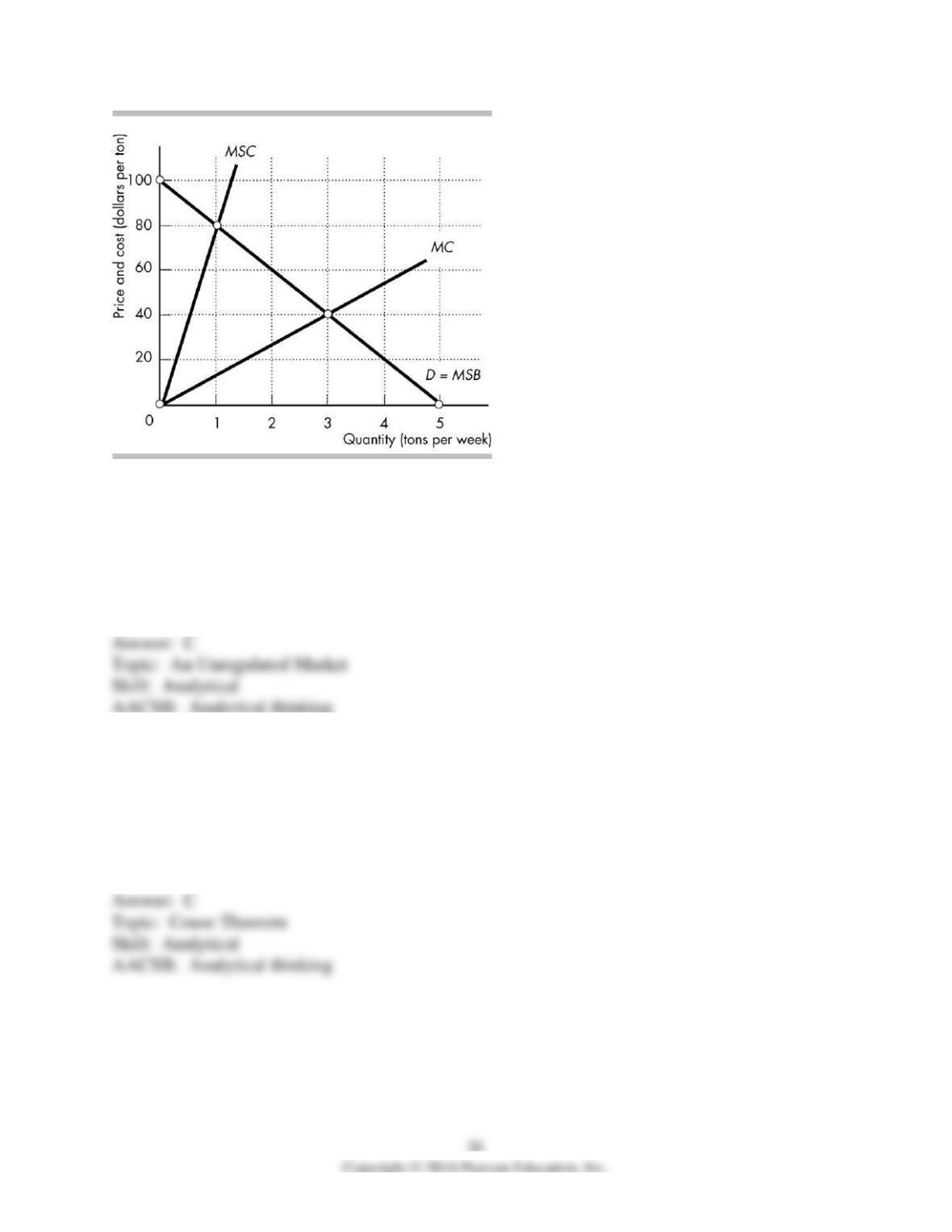
75) The figure above provides information for a factory that produces chemicals that pollute a
waterway. The waterway is used by water skiers. If no property rights exist on the waterway and
if there is no regulation of pollution, then the factory produces ________ of chemicals a week.
A) 1 ton
B) as many tons as possible
C) 3 tons
D) 5 tons
76) The figure above provides information for a factory that produces chemicals that pollute a
waterway. The waterway is used by water skiers. The efficient quantity of chemicals to produce
is ________ tons of chemicals a week.
A) 1 ton
B) as many tons as possible
C) 3 tons
D) 5 tons
77) The figure above provides information for a factory that produces chemicals that pollute a
waterway. The waterway is used by water skiers. If the waterway is owned by a water ski club
and the Coase theorem applies, then the factory will produce ________ tons of chemicals a
week.
A) 1 ton
B) as many tons as possible
C) 3 tons
D) 5 tons
78) The figure above provides information for a factory that produces chemicals that pollute a
waterway. The waterway is used by water skiers. If the waterway is owned by the factory and the
Coase theorem applies, then the factory will produce ________ tons of chemicals a week.
A) 1 ton
B) as many tons as possible
C) 3 tons
D) 5 tons
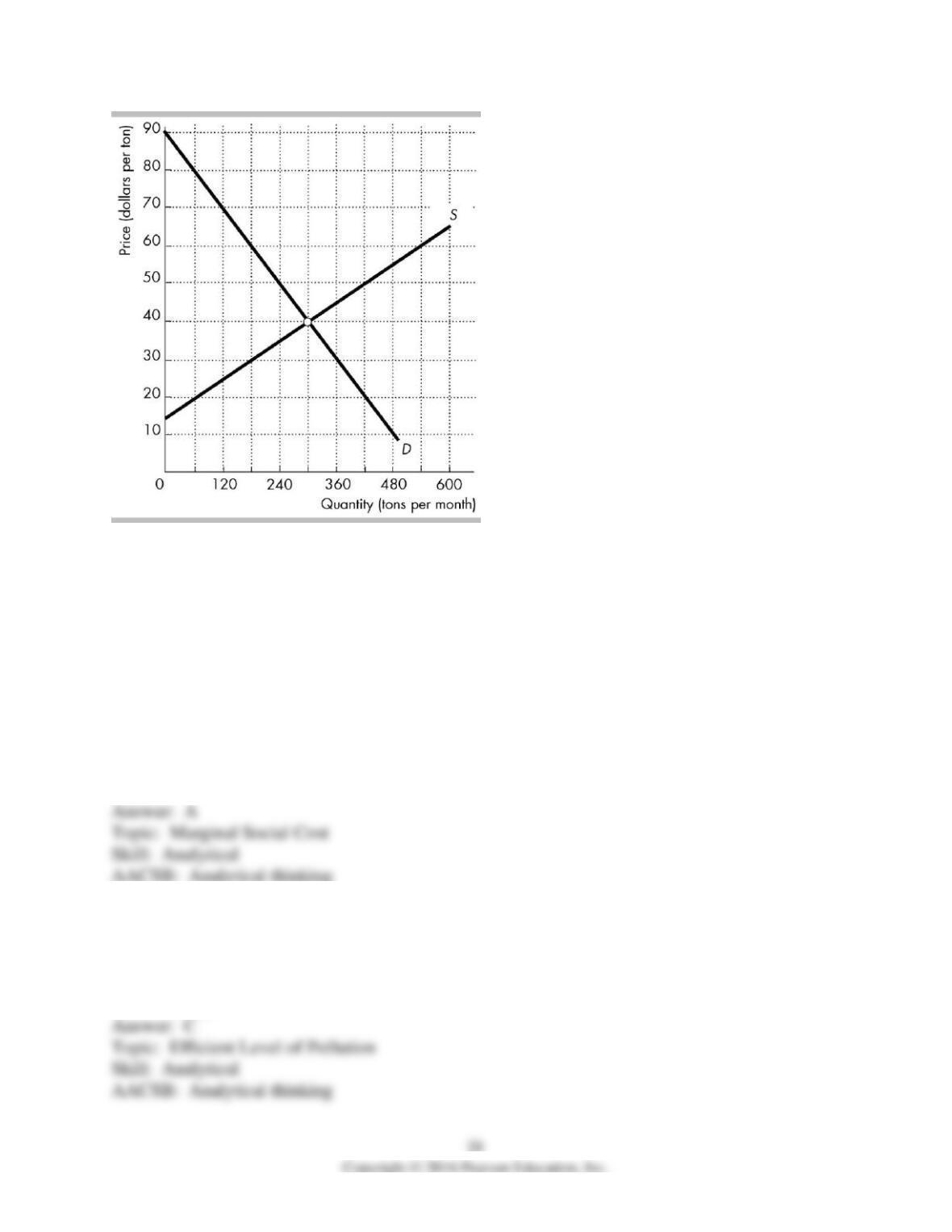
The figure shows the unregulated market for a pesticide, where S is the supply curve and D is the
demand curve. The demand curve is the same as the MSB curve. When factories produce the
pesticide, they also create waste, which they dump into a lake on the outskirts of the town. The
marginal external cost of the dumped waste is equal to the marginal private cost of producing the
pesticide.
79) In the figure above, if the output is 180 tons per month, what is the marginal social cost of
producing the pesticide?
A) $60
B) $30
C) $40
D) $50
80) In the figure above, what is the efficient quantity of pesticide to produce?
A) 300 tons per month
B) 240 tons per month
C) 180 tons per month
D) 360 tons per month
81) In the figure above, if no one owns the lake, what is the quantity of pesticide produced?
A) 300 tons per month
B) 240 tons per month
C) 180 tons per month
D) 360 tons per month
82) In the figure above, if no one owns the lake, at the equilibrium quantity what is the marginal
social cost of producing the pesticide?
A) $80
B) $40
C) $60
D) $30
83) In the figure above, if no one owns the lake, what is the equilibrium price of the pesticide?
A) $80 per ton
B) $40 per ton
C) $60 per ton
D) $30 per ton
84) In the figure above, if no one owns the lake, the market does what?
A) overproduces 120 tons of pesticide
B) underproduces 120 tons of pesticide
C) overproduces 60 tons of pesticide
D) produces the efficient quantity of pesticide
85) In the figure above, if no one owns the lake, what is the deadweight loss in the market?
A) $2,400 per month
B) $1,800 per month
C) $3,600 per month
D) zero
86) Keeping in mind the Coase theorem, in the figure above if the pesticide factories own the
lake, how much pesticide is produced?
A) 300 tons per month
B) 240 tons per month
C) 180 tons per month
D) 360 tons per month
87) Keeping in mind the Coase theorem, in the figure above, if the pesticide factories own the
lake, the market does what?
A) overproduces 120 tons of pesticide
B) underproduces 120 tons of pesticide
C) overproduces 60 tons of pesticide
D) produces the efficient quantity of pesticide
88) Keeping in mind the Coase theorem, in the figure above, if the residents of the town own the
lake, the market does what?
A) overproduces 120 tons of pesticide
B) underproduces 120 tons of pesticide
C) overproduces 60 tons of pesticide
D) produces the efficient quantity of pesticide
89) Keeping in mind the Coase theorem, in the figure above, if the residents of the town own the
lake, how much do they charge the factories to dump waste?
A) $30 per ton of pesticide produced
B) $40 per ton of pesticide produced
C) $20 per ton of pesticide produced
D) Nothing
90) In the figure above, if no one owns the lake the tax that achieves the efficient outcome is
________ per ton of pesticide produced.
A) $30
B) $40
C) $20
D) $10
91) A country has several factories that emit sulfur dioxide. The main methods that the
government can use to overcome the accompanying environment externalities include all of the
following EXCEPT
A) cap-and-trade.
B) mandating clean technology.
C) subsidies.
D) taxes.
92) The three main methods that governments use to cope with an external cost of production
include all of the following EXCEPT
A) taxes.
B) mandating clean technology.
C) cap-and-trade
D) price floors.
93) When external costs are present,
A) competitive, unregulated markets are efficient.
B) transaction costs will be high.
C) a tax might be able to create efficiency.
D) property rights have already been established.
94) The government can use taxes to
A) change production in a market with an external cost to the efficient amount.
B) change production in a market with an external benefit to the efficient amount.
C) increase production.
D) decrease price.
95) Consider a market in which there is an external cost. A tax can be used to arrive at the
efficient market equilibrium because the tax will
A) decrease supply of the good.
B) increase supply of the good.
C) decrease demand for the good.
D) increase demand for the good.
96) Taxes can yield the efficient level of pollution if the tax is set equal to the
A) marginal benefit of pollution.
B) marginal external cost of the pollution.
C) marginal social cost of the pollution.
D) equilibrium price of the pollution.
97) When the production of a good creates an external cost, by setting the tax rate equal to the
________, firms can be made to behave in the same way as they would if they bore the cost of
the externality directly.
A) marginal external cost
B) marginal social benefit
C) marginal private benefit
D) marginal social cost
98) When the production of a good creates an external cost, one method of achieving the
efficient allocation is to impose a tax such that
A) MC + tax = MSC.
B) MC – tax = MSB.
C) MB + tax = MSC.
D) MB – tax = MSB.
99) When the production of a good creates an external cost, in order for taxes to be effective in
achieving the efficient allocation of resources, the tax must be set equal to the
A) marginal private cost.
B) marginal external cost.
C) marginal social cost.
D) marginal benefit of polluting.
100) To eliminate the inefficiency resulting from an external cost of production, the government
can impose a tax on producers that is equal to the
A) MSB.
B) MC.
C) marginal external cost.
D) MSC.
101) When the production of a good creates an external cost, to achieve the efficient quantity
governments can set taxes (T) such that ________.
A) MSC = MC + T
B) MC = MSC + T
C) T = MC + MSC
D) MSC = MC – T
102) Let MC be the marginal private cost per megawatt hour (Mwh) of producing electricity
using coal. Let MSC be the marginal social cost per Mwh and T be the tax per Mwh. To achieve
efficiency, the tax should be set so that
A) MC = MSC + T.
B) MSC = MC + T.
C) MC + MSC = T
D) MC = T.
103) When external costs are present and the government imposes a tax equal to the marginal
external cost, then
A) efficiency can be achieved.
B) transaction costs will be high.
C) the marginal benefit of the external cost will fall.
D) property rights must have already been established.
104) When producing a good creates pollution, an external cost, and the government imposes a
tax equal to the marginal external cost, then
A) the amount of output moves farther away from the efficient amount.
B) transaction costs will be high.
C) the efficient amount of the good will be produced.
D) property rights must have already been established.
105) A tax equal to the external marginal cost of an activity yields the efficient level of
production because the tax
A) achieves the competitive equilibrium.
B) forces producers to face all costs of production including the external cost.
C) ensures greater profits for the firm.
D) eliminates all pollution.
Those opposed to fracking, a method of extracting natural gas through breaking up underground
rocks with chemicals and water, warn that this method might pollute nearby sources of drinking
water.
106) Any such pollution is
A) an external benefit.
B) an external cost.
C) a private cost.
D) a private benefit.
107) If this pollution occurs, the marginal social cost equals the
A) marginal external cost.
B) private marginal cost.
C) sum of the private marginal cost and the marginal external cost.
D) private marginal cost minus the marginal external cost.
108) If this pollution occurs, the market equilibrium with no government intervention extracts
________ natural gas than the efficient quantity and ________ a deadweight loss.
A) less; does not create
B) more; does not create
C) less; creates
D) more; creates
109) If this pollution occurs, one way of reaching efficient production levels is by setting a
Pigovian Tax. To achieve efficiency with this tax means that the tax must equal the
A) marginal social cost.
B) marginal private cost.
C) marginal private benefit.
D) marginal external cost.
110) Consider the production of some industrial good that creates air pollution. The table below
gives the marginal social cost (MSC), the marginal cost (MC), and the marginal social benefit
(MSB) for each level of output (Q).
Q
MSC
MC
MSB
1
3
2
11
2
6
4
10
3
9
6
9
4
12
8
8
5
15
10
7
6
18
12
6
The inefficient market quantity is ________ and the efficient market quantity is ________.
A) 4; 3
B) 6; 3
C) 3; 4
D) 4; 6
111) Consider the production of some industrial good that involves air pollution. The table below
gives the marginal social cost (MSC), the marginal cost (MC), and the marginal social benefit
(MSB) for each level of output (Q).
Q
MSC
MC
MSB
1
3
2
11
2
6
4
10
3
9
6
9
4
12
8
8
5
15
10
7
6
18
12
6
To arrive at the efficient market equilibrium the government could impose a tax of
A) $3.
B) $4.
C) $8.
D) $9.
Number of
bus rides per
week
Marginal cost of
bus company
(dollars per bus
ride)
Marginal social
cost
(dollars per bus
ride)
100
0.25
1.00
200
0.50
1.50
300
1.00
2.25
400
1.50
3.00
500
1.75
5.00
112) The demand for bus service is perfectly elastic at a price of $1.00 a ride. The table above
shows the bus company’s marginal cost and the marginal social cost of the bus service. The
competitive quantity of bus rides per week is ________.
A) 100
B) 200
C) 300
D) 500
113) The demand for bus service is perfectly elastic at a price of $1.25 a ride. The table above
shows the bus company’s marginal cost and the marginal social cost of the bus service. If the
government levies a tax on bus rides so that the bus company takes into account the marginal
social cost, the tax will be ________ a ride.
A) $0.75
B) $1.60
C) $1.25
D) $3.25
Quantity
(tons per
week)
Marginal
private cost
(dollars per
ton)
Marginal
social cost
(dollars per
ton)
Marginal
private benefit
(dollars per
ton)
10
50
70
150
20
60
100
140
30
70
130
130
40
80
160
120
50
90
190
110
60
100
220
100
114) The table above describes the market for paper. The production of paper produces pollution.
There are no external benefits. What is the quantity produced if the market for paper is
unregulated?
A) 10 tons per week
B) 60 tons per week
C) 40 tons per week
D) 30 tons per week
115) The table above describes the market for paper. The production of paper produces pollution.
There are no external benefits. What is the efficient amount of paper?
A) 10 tons per week
B) 60 tons per week
C) 40 tons per week
D) 30 tons per week
116) The table above describes the market for paper. The production of paper produces pollution.
There are no external benefits. What amount of tax per ton of paper is necessary to produce the
efficient quantity of paper?
A) $60
B) zero
C) $40
D) $100
117) The table above describes the market for paper. The production of paper produces pollution.
There are no external benefits. Now suppose a Pigovian tax is successfully implemented and the
efficient quantity of paper is produced. What is the total tax revenue collected by the government
per week?
A) $120
B) $840
C) $1,200
D) $1,800
Quantity
(tons of paper
per year)
Marginal
private benefit
(dollars per
ton of paper)
Marginal
social benefit
(dollars per
ton of paper)
800
100
100
1,600
90
90
2,400
80
80
3,200
70
70
4,000
60
60
4,800
50
50
Quantity
(tons of paper
per year)
Marginal
private cost
(dollars per
ton of paper)
Marginal
social cost
(dollars per
ton of paper)
800
40
60
1,600
50
70
2,400
60
80
3,200
70
90
4,000
80
100
4,800
90
110
118) The tables above show the marginal costs and benefits from production of paper. If the
market is perfectly competitive and unregulated, the equilibrium output is ________ of paper.
A) 1,600 tons
B) 2,400 tons
C) 3,200 tons
D) 4,000 tons
119) The tables above show the marginal costs and benefits from production of paper. If the
market is perfectly competitive and unregulated, the equilibrium price is ________ per ton.
A) $60
B) $70
C) $80
D) $90