
CHAPTER 17: MULTINATIONAL FINANCIAL MANAGEMENT
1.
Multinational financial management requires that financial analysts consider the effects of changing currency values.
a.
True
b.
False
2.
Legal and economic differences among countries, although important, do NOT pose significant problems for most
multinational corporations when they coordinate and control worldwide operations and subsidiaries.
a.
True
b.
False
ANSWER: False
3.
When the value of the U.S. dollar appreciates against another country’s currency, we may purchase more of the
foreign currency with the U.S. dollar.
a.
True
b.
False
4.
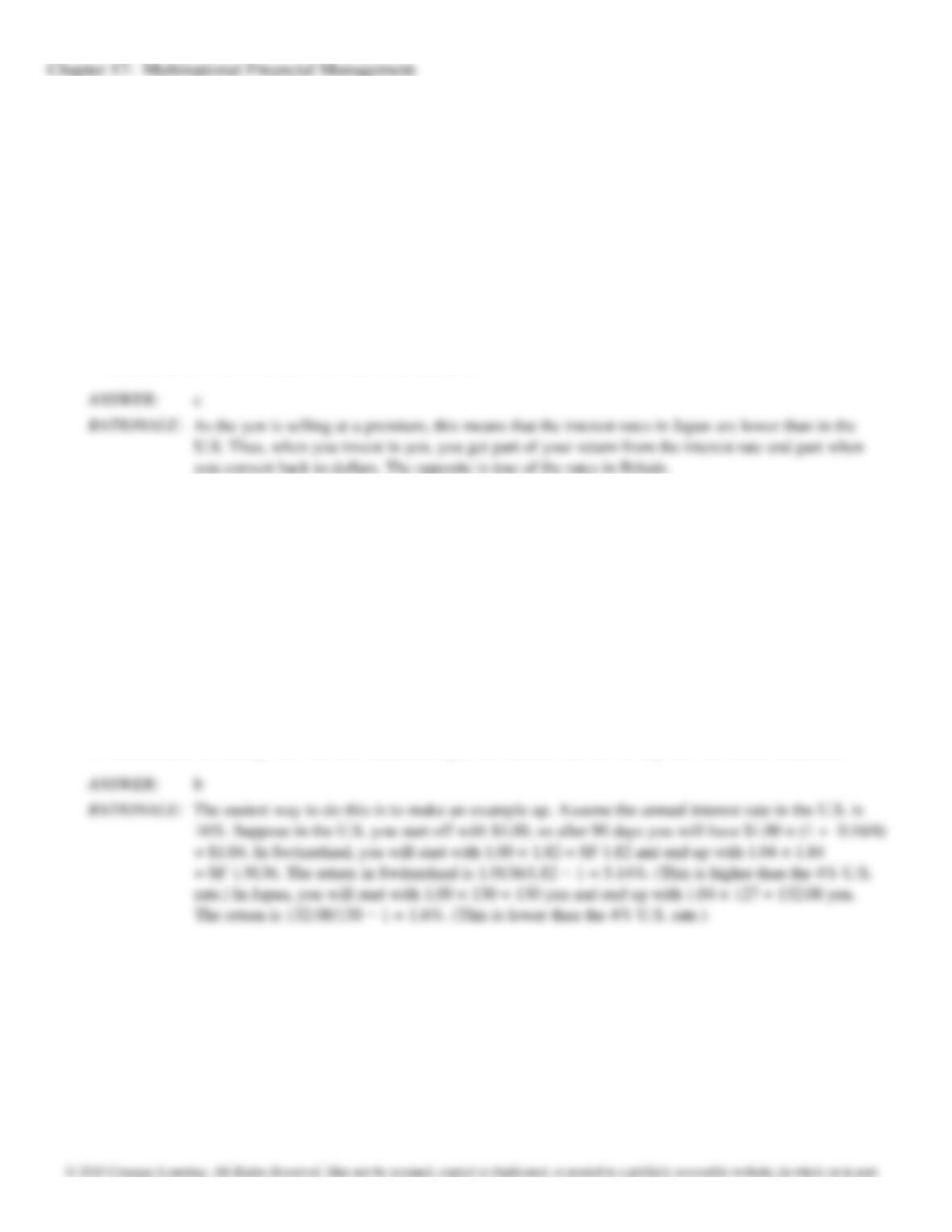
The United States and most other major industrialized nations currently operate under a system of floating exchange
rates.
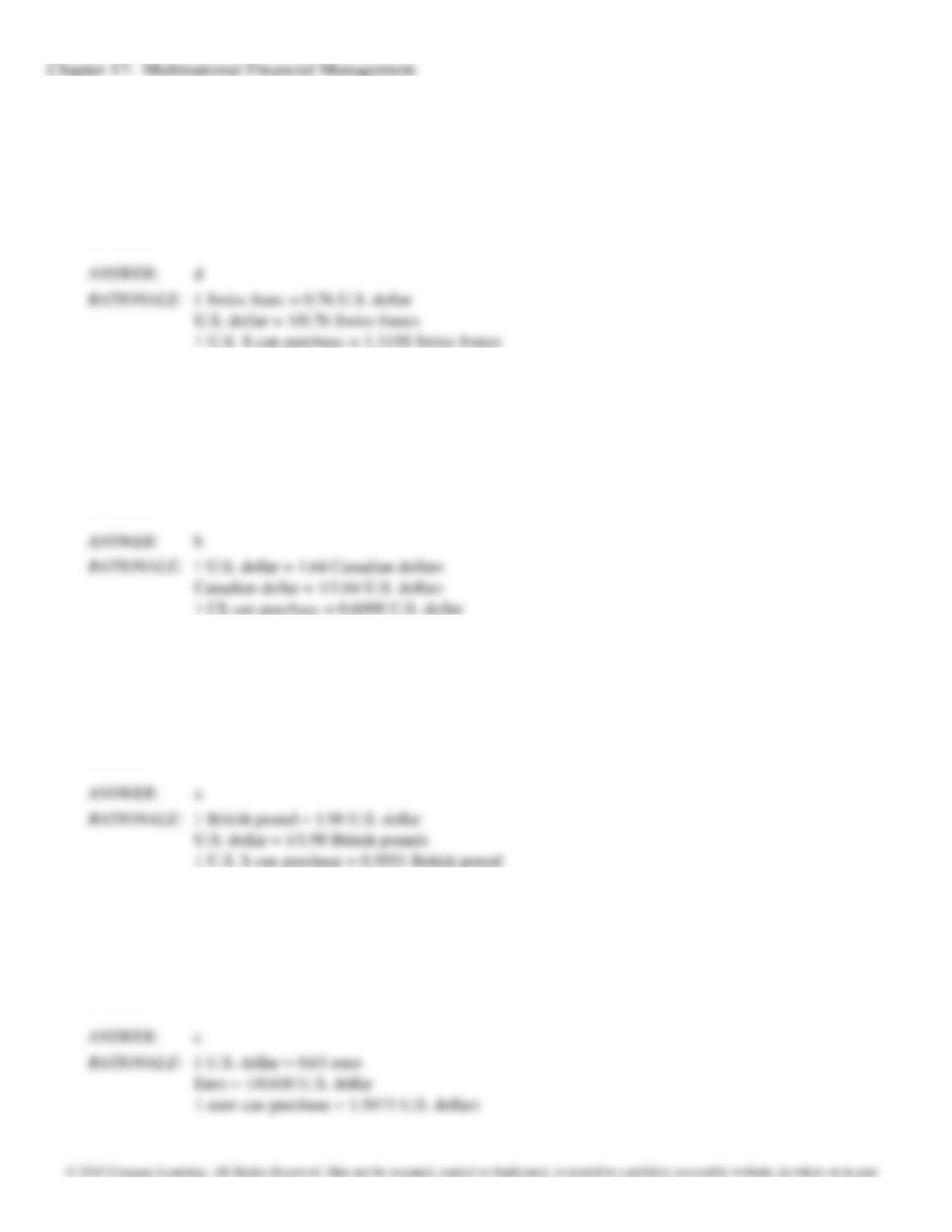
a.
True
b.
False
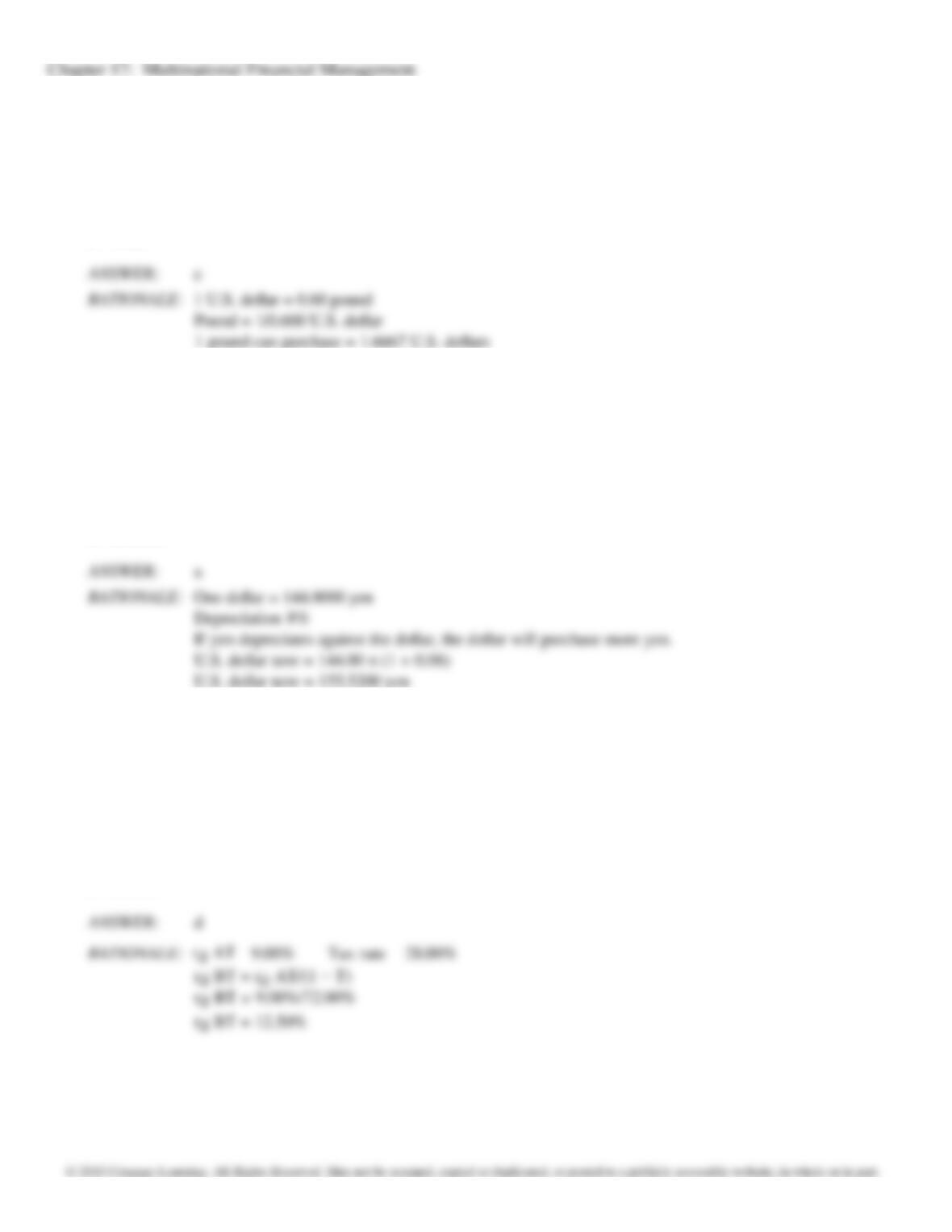
ANSWER: True
5.
Exchange rate quotations consist solely of direct quotations.
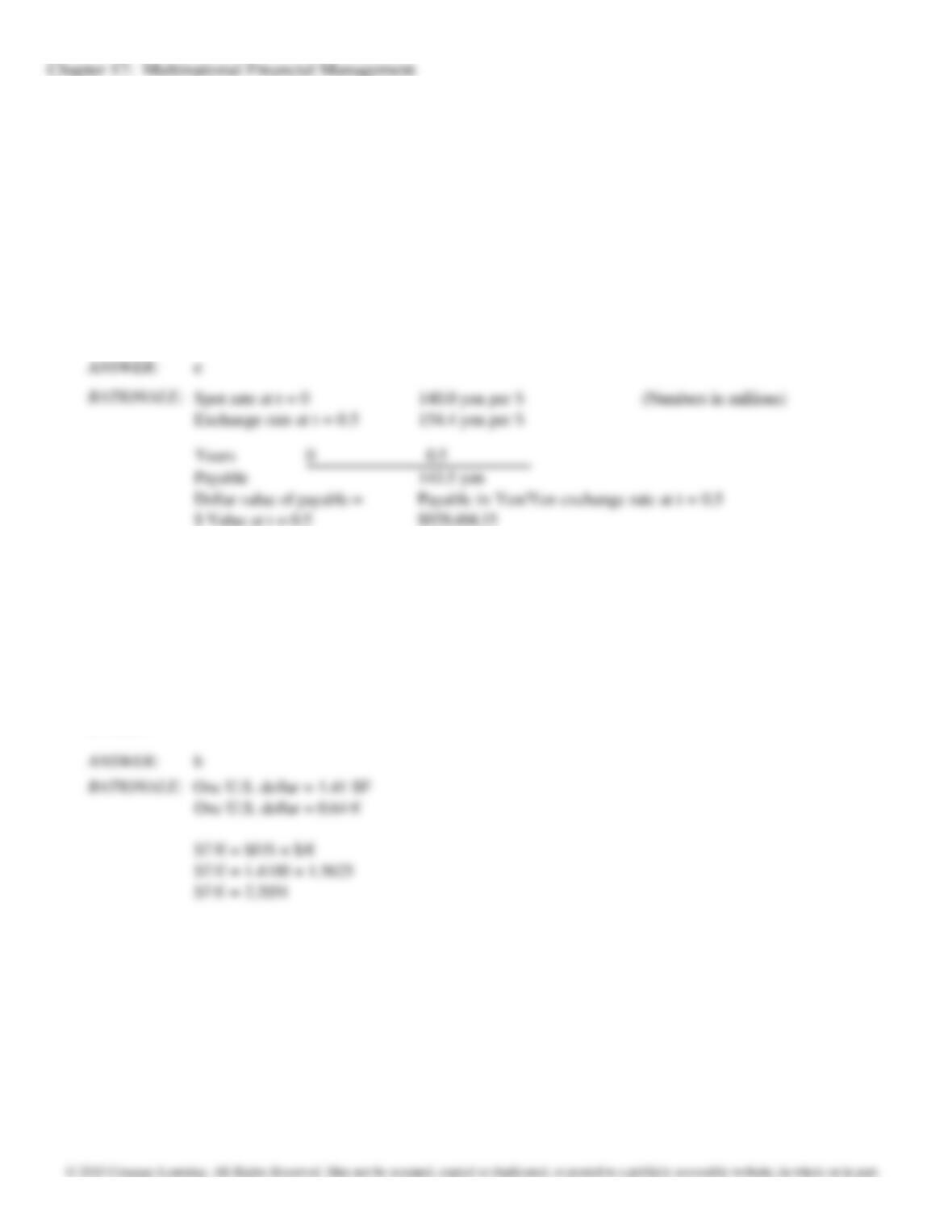
a.
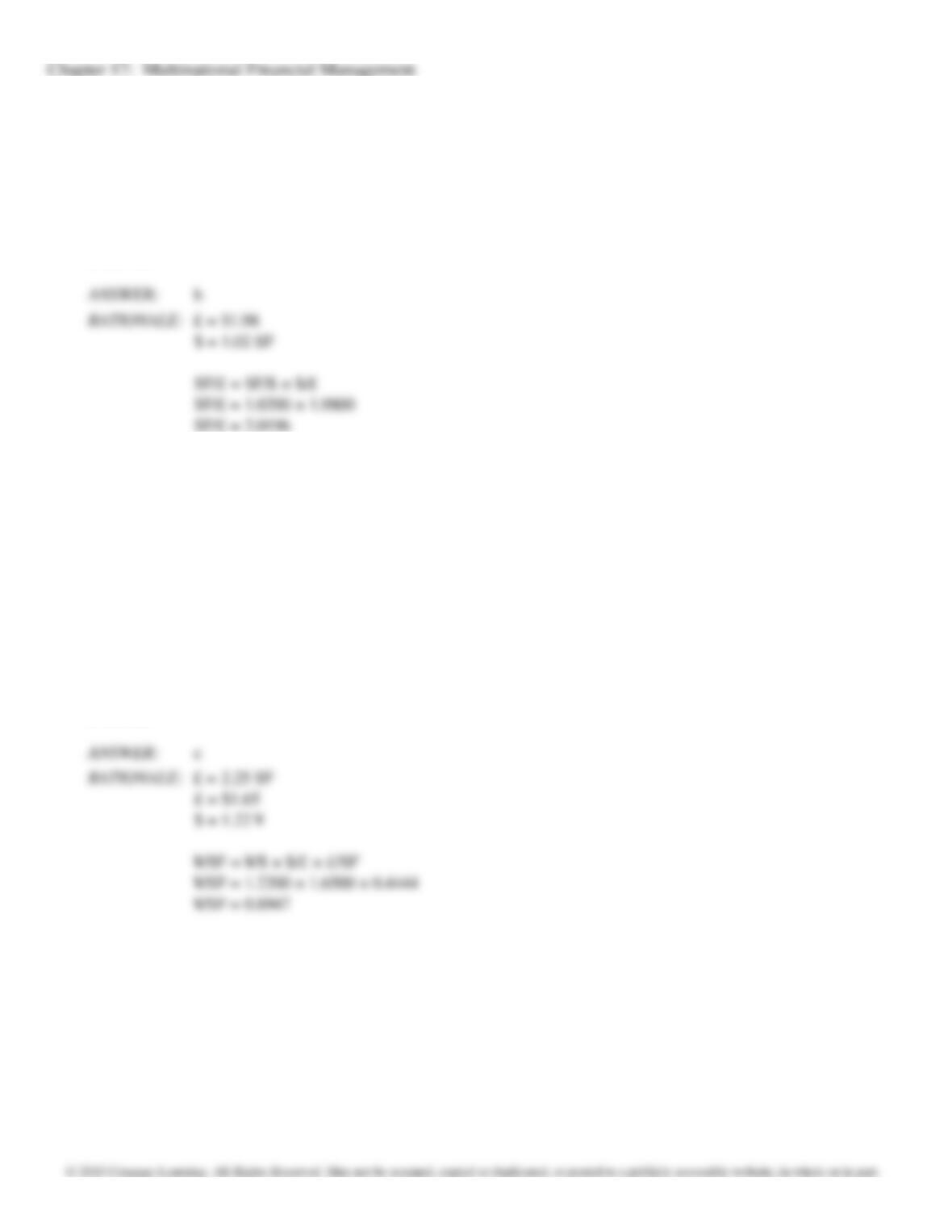
True
b.
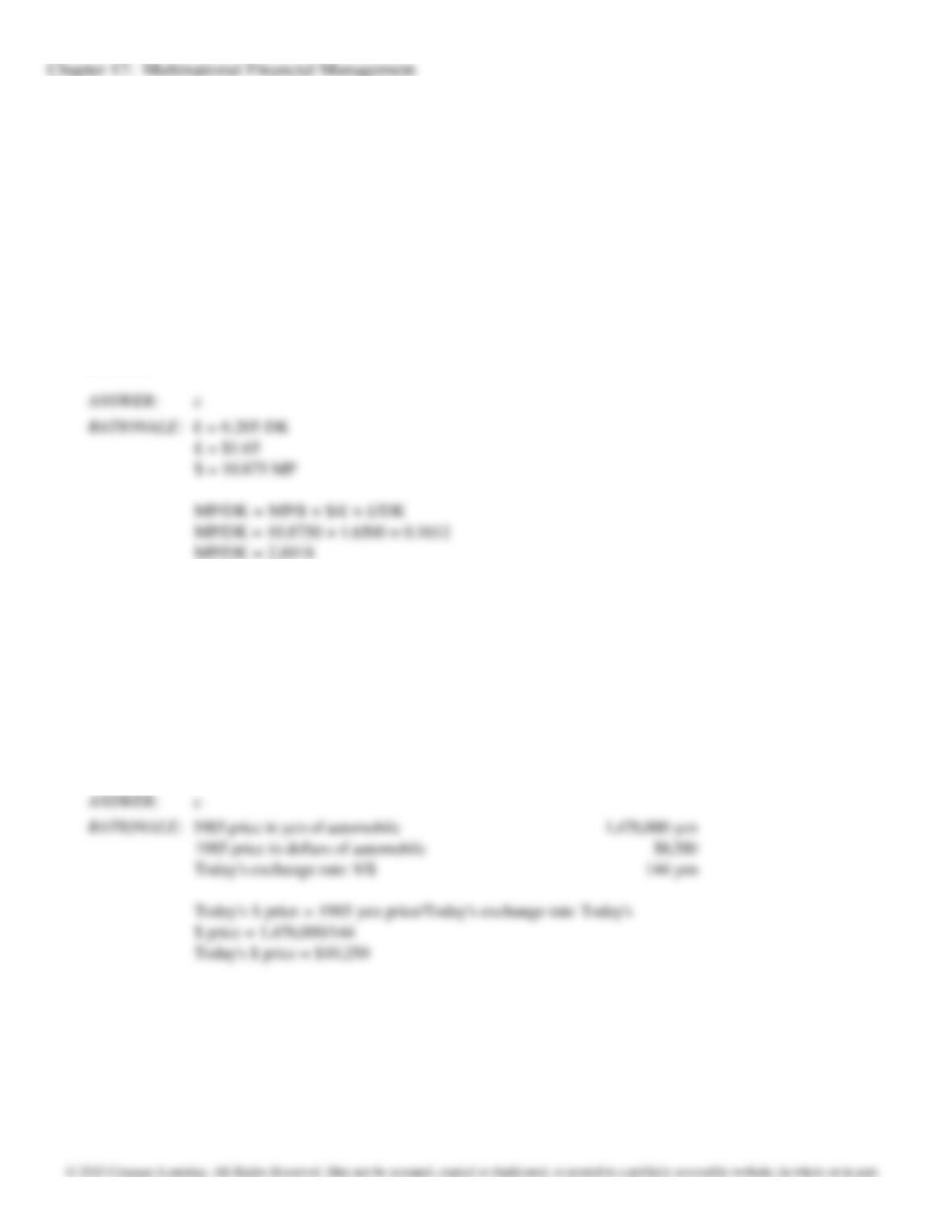
False
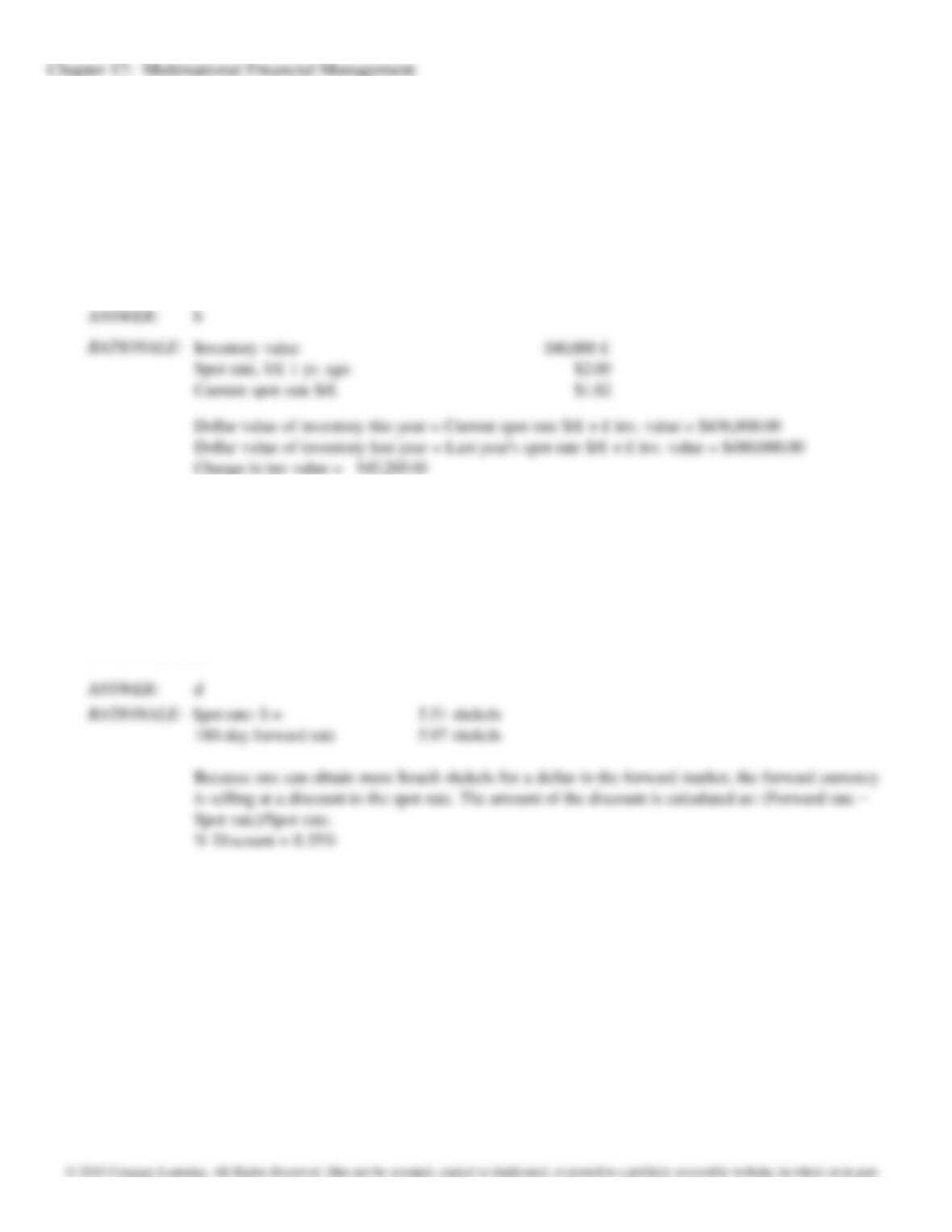
6.
Calculating a currency cross rate involves determining the exchange rate for two currencies by using a third
currency as a base.
a.
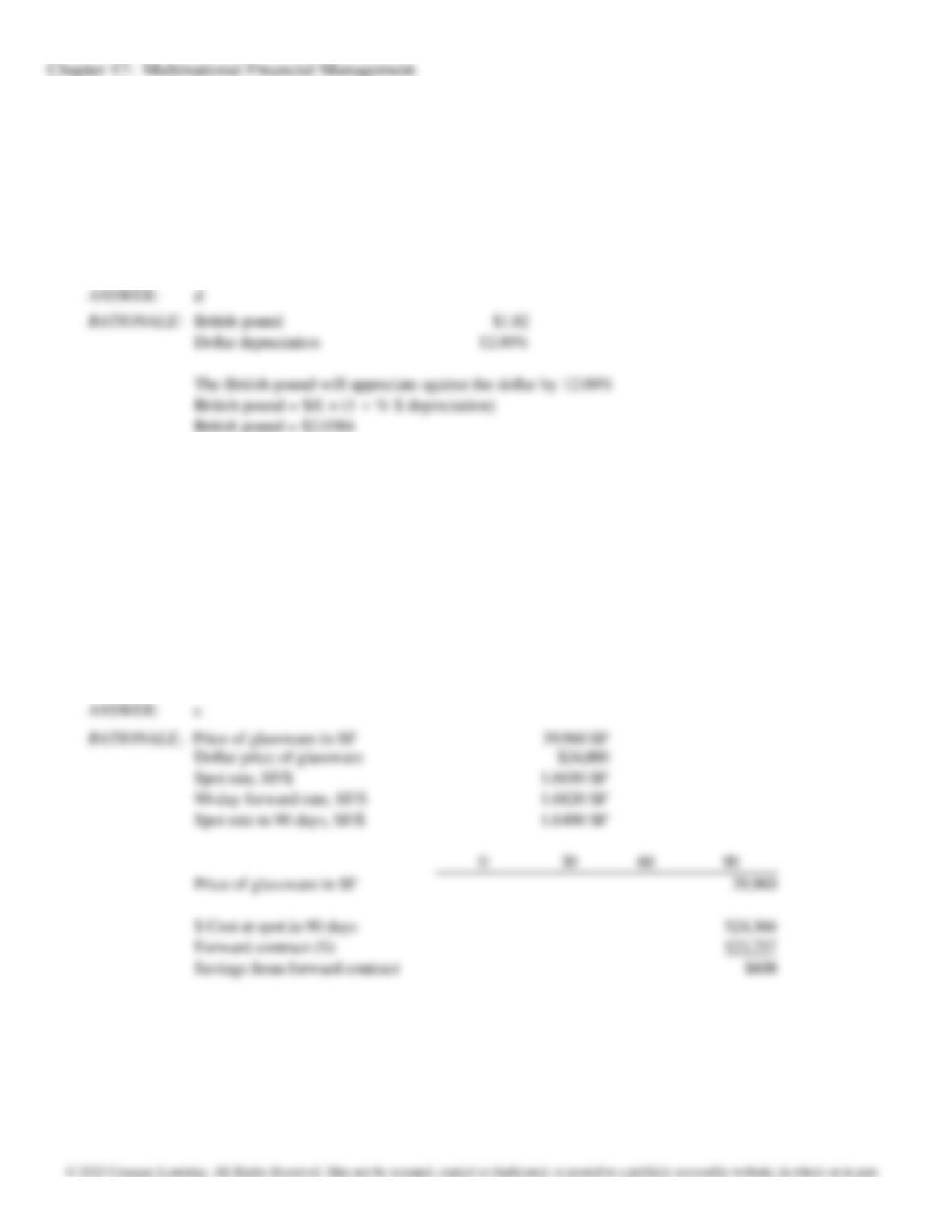
True
b.
False
7.
A Eurodollar is a U.S. dollar deposited in a bank outside the United States.
a.
True
b.
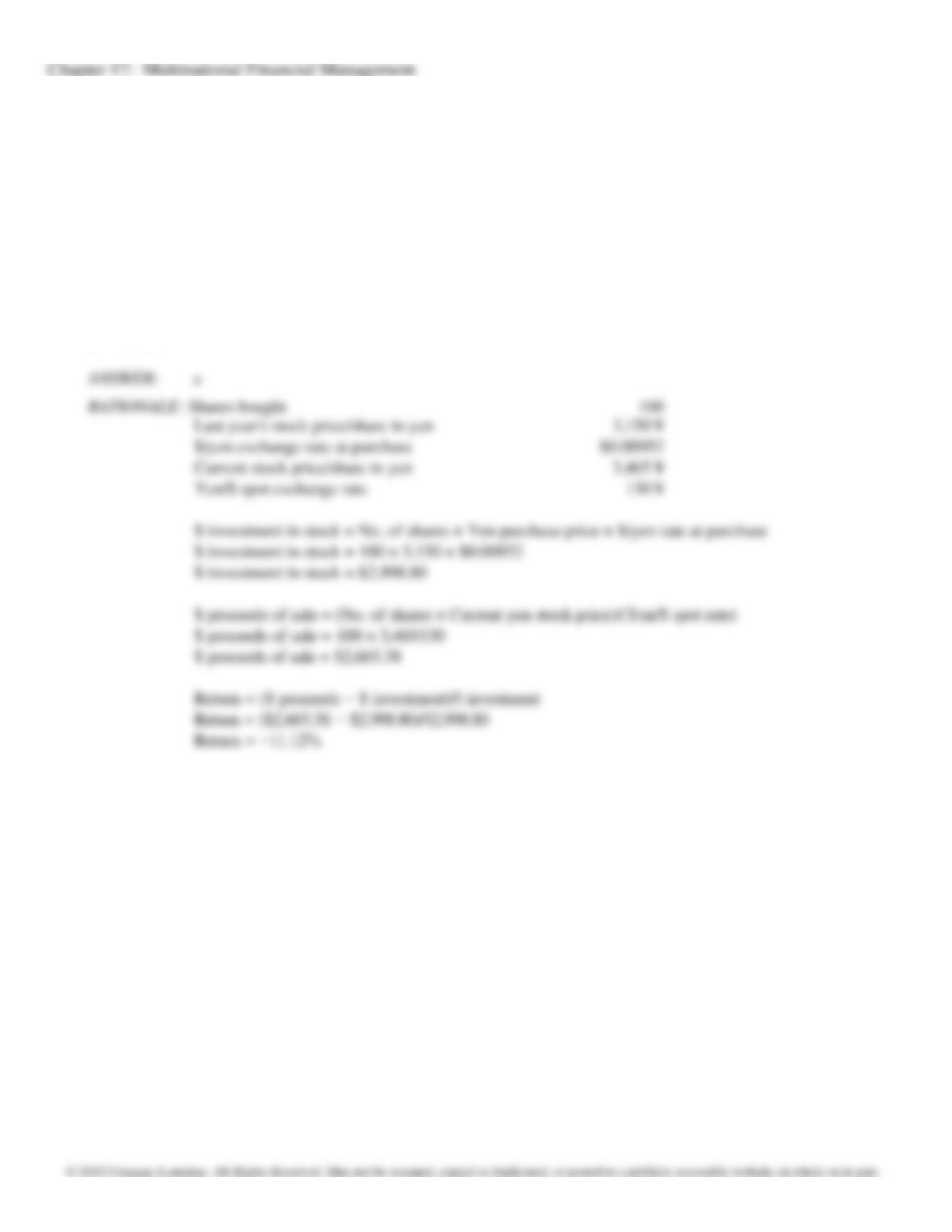
False

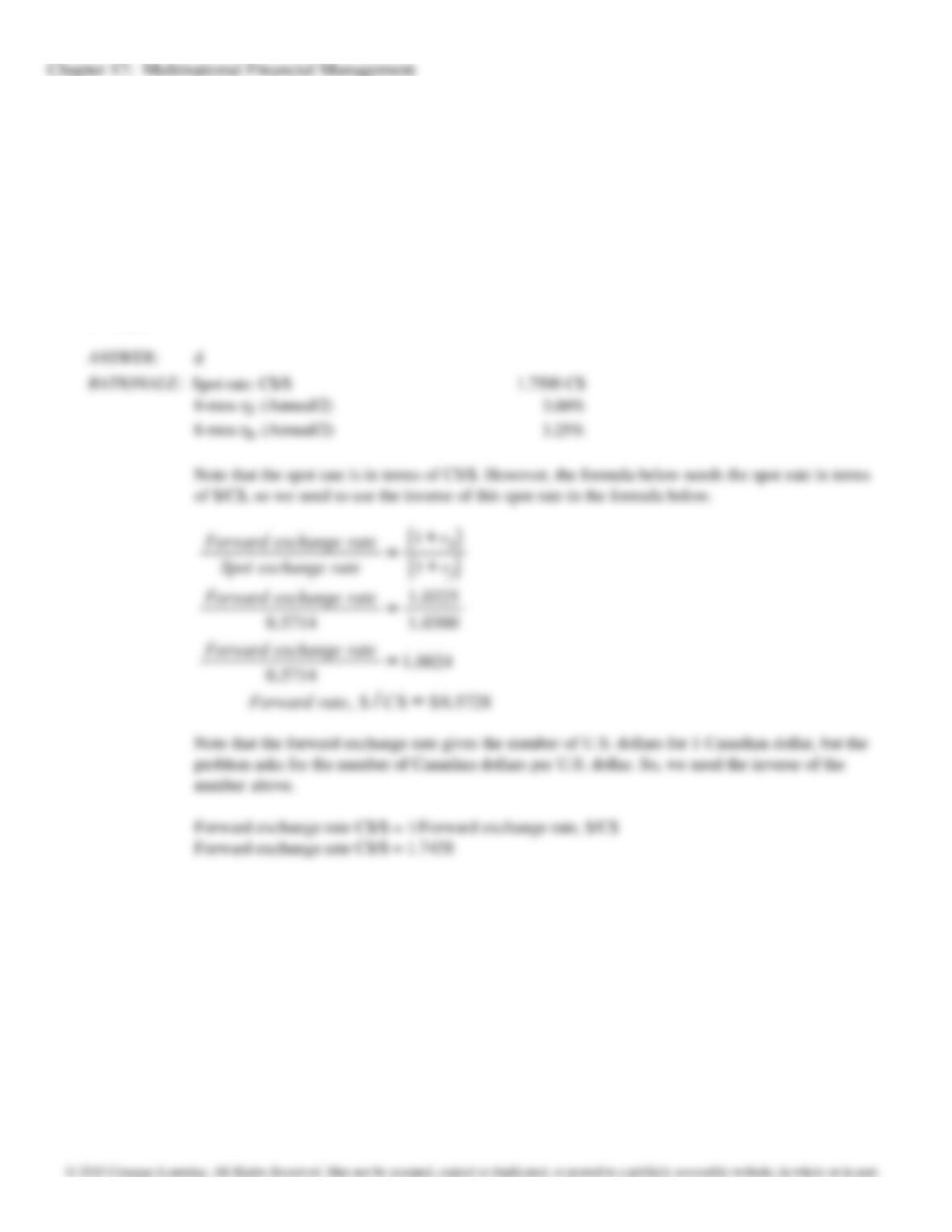
8.
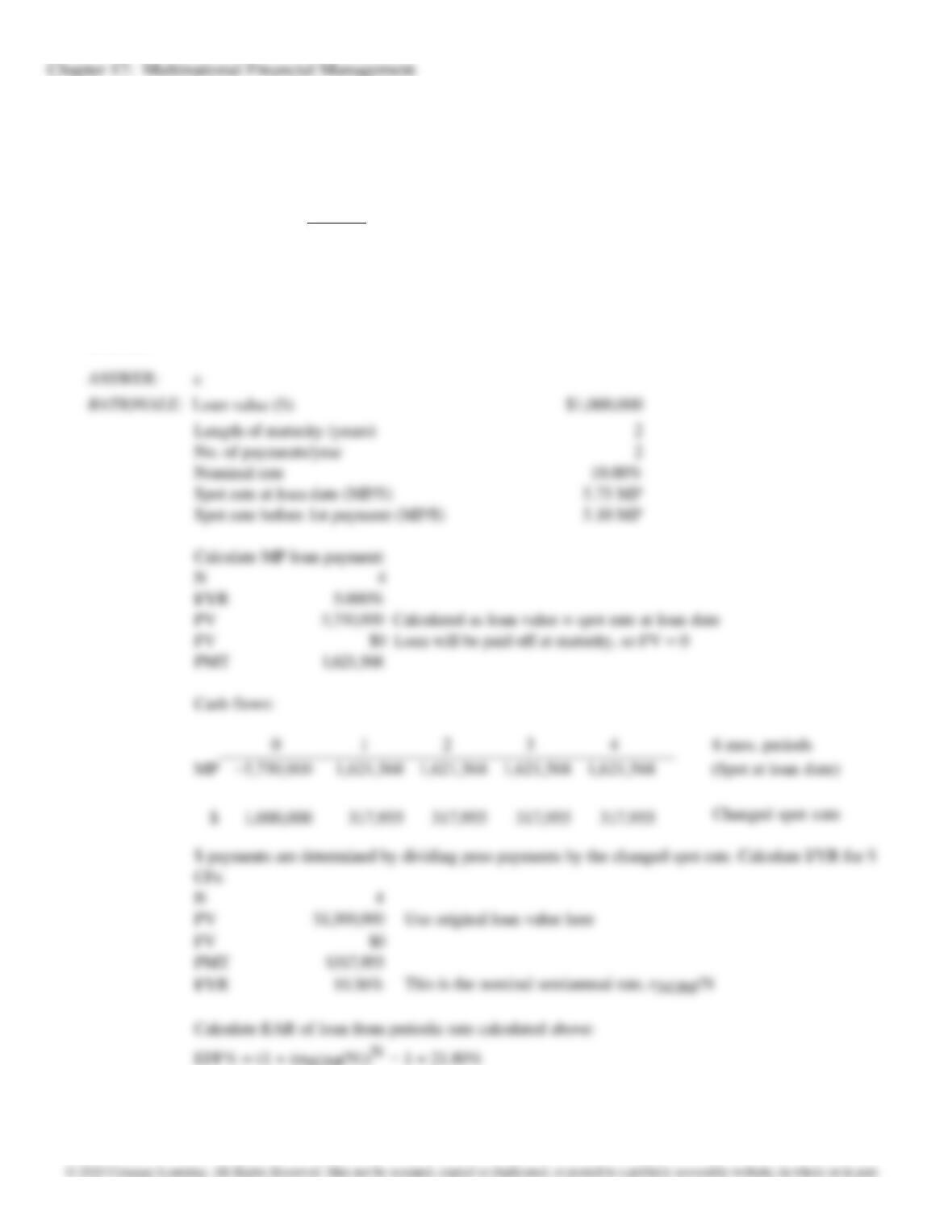
LIBOR is an acronym for London Interbank Offer Rate, which is an average of interest rates offered by London
banks to smaller U.S. corporations on all deposits.
a.
True
b.
False
ANSWER: False
9.
Exchange rate risk is the risk that the cash flows from a foreign project, when converted to the parent company‘s
currency, will be worth less than was originally projected because of exchange rate changes.
a.
True
b.
False
ANSWER: True
10.
Because political risk is seldom negotiable, it cannot be explicitly addressed in multinational corporate financial
analysis.
a.
True
b.
False
11.
Individuals and corporations can buy or sell forward currencies to hedge their exchange rate exposure. Essentially,
the process involves simultaneously selling the currency expected to appreciate in value and buying the currency
expected to depreciate.
a.
True
b.
False
12.
If an investor can obtain more of a foreign currency for a dollar in the forward market than in the spot market, then
the forward currency is said to be selling at a discount to the spot rate.
a.
True
b.
False
13.
If a dollar will buy fewer units of a foreign currency in the forward market than in the spot market, then the forward
currency is said to be selling at a premium to the spot rate.
a.
True
b.
False
ANSWER: True
14.
A foreign currency will, on average, depreciate against the U.S. dollar at a percentage rate approximately equal to
the amount by which its inflation rate exceeds that of the United States.
a.
True
b.
False
ANSWER: True

15.
The cash flows relevant for a foreign investment should, from the parent company‘s perspective, include the financial
cash flows that the subsidiary can legally send back to the parent company plus the cash flows that must remain in
the foreign country.
a.
True
b.
False
16.
The cost of capital may be different for a foreign project than for an equivalent domestic project because foreign
projects may be more or less risky.
a.
True
b.
False
17.
When considering the risk of a foreign investment, a higher risk might arise from exchange rate risk and political risk
while lower risk might result from international diversification.
a.
True
b.
False
18.
Which of the following are reasons why companies move into international operations?
a.
To take advantage of lower production costs in regions where labor costs are relatively low.
b.
To develop new markets for the firm’s products.
c.
To better serve their primary customers.
d.
Because important raw materials are located abroad.
e.
All of the above.
19.
Multinational financial management requires that
a.
the effects of changing currency values be included in financial analyses.
b.
legal and economic differences need not be considered in financial decisions because these differences are
insignificant.
c.
political risk should be excluded from multinational corporate financial analyses.
d.
traditional U.S. and European financial models incorporating the existence of a competitive marketplace not
be recast when analyzing projects in other parts of the world.
e.
cultural differences need not be accounted for when considering firm goals and employee management.

20.
In Japan, 90-day securities have a 4% annualized return and 180-day securities have a 5% annualized return. In the
United States, 90-day securities have a 4% annualized return and 180-day securities have an annualized return of
4.5%. All securities are of equal risk, and Japanese securities are denominated in terms of the Japanese yen.
Assuming that interest rate parity holds in all markets, which of the following statements is most CORRECT?
a.
The yen-dollar spot exchange rate equals the yen-dollar exchange rate in the 90–day forward market.
b.
The yen-dollar spot exchange rate equals the yen-dollar exchange rate in the 180-day forward market.
c.
The yen-dollar exchange rate in the 90-day forward market equals the yen-dollar exchange rate in the 180–
day forward market.
d.
The yen-dollar exchange rate in the 180-day forward market equals the yen-dollar exchange rate in the 90–
day spot market.
e.
The relationship between spot and forward interest rates cannot be inferred.
21.
If the inflation rate in the United States is greater than the inflation rate in Britain, other things held constant, the
British pound will
a.
appreciate against the U.S. dollar.
b.
depreciate against the U.S. dollar.
c.
remain unchanged against the U.S. dollar.
d.
appreciate against other major currencies.
e.
appreciate against the dollar and other major currencies.
22.
Which of the following statements is NOT CORRECT?
a.
Any bond sold outside the country of the borrower is called an international bond.
b.
Foreign bonds and Eurobonds are two important types of international bonds.
c.
Foreign bonds are bonds sold by a foreign borrower but denominated in the currency of the country in which
the issue is sold.
d.
The term Eurobond applies only to foreign bonds denominated in U.S. currency.
e.
A Eurodollar is a U.S. dollar deposited in a bank outside the U.S.
23.
Currently, a U.S. trader notes that in the 6-month forward market, the Japanese yen is selling at a premium (that is,
you receive more dollars per yen in the forward market than you do in the spot market), while the British pound is
selling at a discount. Which of the following statements is CORRECT?
a.
If interest rate parity holds, 6-month interest rates should be the same in the U.S., Britain, and Japan.
b.
If interest rate parity holds among the three countries, the United States should have the highest 6-month
interest rates and Japan should have the lowest rates.
c.
If interest rate parity holds among the three countries, Britain should have the highest 6-month interest rates
and Japan should have the lowest rates.
d.
If interest rate parity holds among the three countries, Japan should have the highest 6-month interest rates
and Britain should have the lowest rates.
e.
If interest rate parity holds among the three countries, the United States should have the highest 6-month
interest rates and Britain should have the lowest rates.
24.
Today in the spot market $1 = 1.82 Swiss francs and $1 = 130 Japanese yen. In the 90-day forward market, $1 =
1.84 Swiss francs and $1 = 127 Japanese yen. Assume that interest rate parity holds worldwide. Which of the
following statements is most CORRECT?
a.
Interest rates on 90-day risk-free U.S. securities are higher than the interest rates on 90-day risk-free Swiss
securities.
b.
Interest rates on 90-day risk-free U.S. securities are higher than the interest rates on 90-day risk-free
Japanese securities.
c.
Interest rates on 90-day risk-free U.S. securities equal the interest rates on 90-day risk-free Japanese
securities.
d.
Since interest rate parity holds interest rates should be the same in all three countries.
e.
Interest rates on 90-day risk-free U.S. securities equal the interest rates on 90-day risk-free Swiss securities.
25.
If one Swiss franc can purchase $0.76 U.S. dollars, how many Swiss francs can one U.S. dollar buy?
a. 0.9592
b. 1.0658
c. 1.1842
d. 1.3158
e. 1.4474
26.
If one U.S. dollar buys 1.64 Canadian dollars, how many U.S. dollars can you purchase for one Canadian dollar?
a. 0.5488
b. 0.6098
c. 0.6707
d. 0.7378
e. 0.8116
27.
If one British pound can purchase $1.98 U.S. dollars, how many British pounds can one U.S. dollar buy?
a. 0.5051
b. 0.5556
c. 0.6111
d. 0.6722
e. 0.7394
28.
If one U.S. dollar buys 0.63 euro, how many dollars can you purchase for one euro?
a. 1.0414
b. 1.1571
c. 1.2857
d. 1.4286
e. 1.5873
29.
If one U.S. dollar sells for 0.60 British pound, how many dollars should one British pound sell for?
a. 1.0935
b. 1.2150
c. 1.3500
d. 1.5000
e. 1.6667
30.
Suppose 144 yen could be purchased in the foreign exchange market for one U.S. dollar today. If the yen
depreciates by 8.0% tomorrow, how many yen could one U.S. dollar buy tomorrow?
a. 155.5200
b. 163.2960
c. 171.4608
d. 180.0338
e. 189.0355
31.
Suppose a foreign investor who holds tax-exempt Eurobonds paying 9% is considering investing in an equivalent-risk
domestic bond in a country with a 28% withholding tax on interest paid to foreigners. If 9% after-tax is the investor’s
required return, what before-tax rate would the domestic bond need to pay to provide the required after-tax return?
a. 9.11%
b. 10.13%
c. 11.25%
d. 12.50%
e. 13.75%
32.
Suppose DeGraw Corporation, a U.S. exporter, sold a solar heating station to a Japanese customer at a price of
143.5 million yen, when the exchange rate was 140 yen per dollar. In order to close the sale, DeGraw agreed to
make the bill payable in yen, thus agreeing to take some exchange rate risk for the transaction. The terms were net 6
months. If the yen fell against the dollar such that one dollar would buy 154.4 yen when the invoice was paid, what
dollar amount would DeGraw actually receive after it exchanged yen for U.S. dollars?
a. $757,005.48
b. $796,847.88
c. $838,787.24
d. $882,933.94
e. $929,404.15
33.
Suppose the exchange rate between U.S. dollars and Swiss francs is SF 1.41 = $1.00, and the exchange rate
between the U.S. dollar and the euro is $1.00 = 0.64 euro. What is the cross rate of Swiss francs to euros? (In other
words, how many Swiss francs are needed to purchase one euro?)
a. 1.9828
b. 2.2031
c. 2.4234
d. 2.6658
e. 2.9324
34.
Suppose that currently, 1 British pound equals 1.98 U.S. dollars and 1 U.S. dollar equals 1.02 Swiss francs. How
many Swiss francs are needed to purchase 1 pound?
a. 1.9691
b. 2.0196
c. 2.0701
d. 2.1218
e. 2.1749
35.
A currency trader observes the following quotes in the spot market:
1 U.S. dollar = 122 Japanese yen
1 British pound = 2.25 Swiss francs
1 British pound = 1.65 U.S. dollars
Given this information, how many yen can be purchased for 1 Swiss franc?
a. 0.8505
b. 0.8723
c. 0.8947
d. 0.9170
e. 0.9400
36.
A currency trader observes the following quotes in the spot market:
1 U.S. dollar = 10.875 Mexican pesos
1 British pound = 6.205 Danish krone
1 British pound = 1.65 U.S. dollars
Given this information, how many Mexican pesos can be purchased for 1 Danish krone?
a. 2.7490
b. 2.8195
c. 2.8918
d. 2.9641
e. 3.0382
37.
In 1985, a given Japanese imported automobile sold for 1,476,000 yen, or $8,200. If the car still sold for the same
amount of yen today but the current exchange rate is 144 yen per dollar, what would the car be selling for today in
U.S. dollars?
a. $ 8,303
b. $ 9,225
c. $10,250
d. $11,275
e. $12,403
38.
Suppose one year ago, Hein Company had inventory in Britain valued at 240,000 pounds. The exchange rate for
dollars to pounds was 1£ = 2 U.S. dollars. This year the exchange rate is 1£ = 1.82 U.S. dollars. The inventory in
Britain is still valued at 240,000 pounds. What is the U.S. dollar gain or loss in inventory value as a result of the
change in exchange rates?
a. −$38,880.00
b. −$43,200.00
c. −$47,520.00
d. −$52,272.00
e. −$57,499.20
39.
If the spot rate of the Israeli shekel is 5.51 shekels per dollar and the 180-day forward rate is 5.97 shekels per dollar,
then the forward rate for the Israeli shekel is selling at a(n) to the spot rate.
a.
6.09% premium
b.
6.76% premium
c.
7.51% discount
d.
8.35% discount
e.
9.18% discount
40.
Suppose one British pound can purchase 1.82 U.S. dollars today in the foreign exchange market, and currency
forecasters predict that the U.S. dollar will depreciate by 12.0% against the pound over the next 30 days. How many
dollars will a pound buy in 30 days?
a. $1.4860
b. $1.6511
c. $1.8346
d. $2.0384
e. $2.2422
41.
Stover Corporation, a U.S. based importer, makes a purchase of crystal glassware from a firm in Switzerland for
39,960 Swiss francs, or $24,000, at the spot rate of 1.665 Swiss francs per dollar. The terms of the purchase are net
90 days, and the U.S. firm wants to cover this trade payable with a forward market hedge to eliminate its exchange
rate risk. Suppose the firm completes a forward hedge at the 90-day forward rate of 1.682 Swiss francs. If the spot
rate in 90 days is actually 1.64 Swiss francs, how much in U.S. dollars will the U.S. firm have saved or lost by
hedging its exchange rate exposure?
a. $399
b. $444
c. $493
d. $548
e. $608
42.
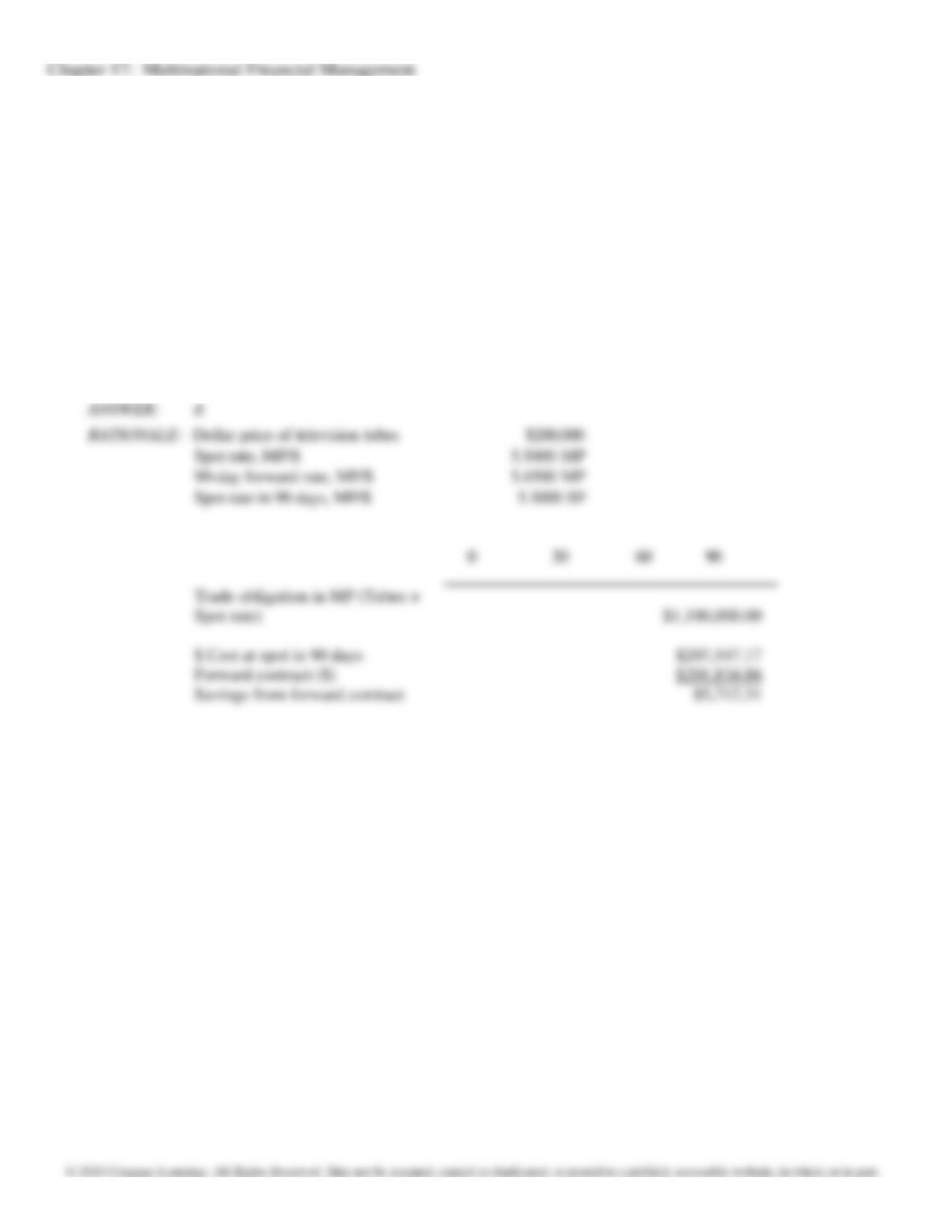
Suppose a U.S. firm buys $200,000 worth of television tubes from a Mexican manufacturer for delivery in 60 days
with payment to be made in 90 days (30 days after the goods are received). The rising U.S. deficit has caused the
dollar to depreciate against the peso recently. The current exchange rate is 5.50 pesos per U.S. dollar. The 90-day
forward rate is 5.45 pesos/dollar. The firm goes into the forward market today and buys enough Mexican pesos at
the 90-day forward rate to completely cover its trade obligation. Assume the spot rate in 90 days is 5.30 Mexican
pesos per U.S. dollar. How much in U.S. dollars did the firm save by eliminating its foreign exchange currency risk
with its forward market hedge?
a. $4,897.59
b. $5,155.36
c. $5,426.69
d. $5,712.31
e. $5,997.92
43.
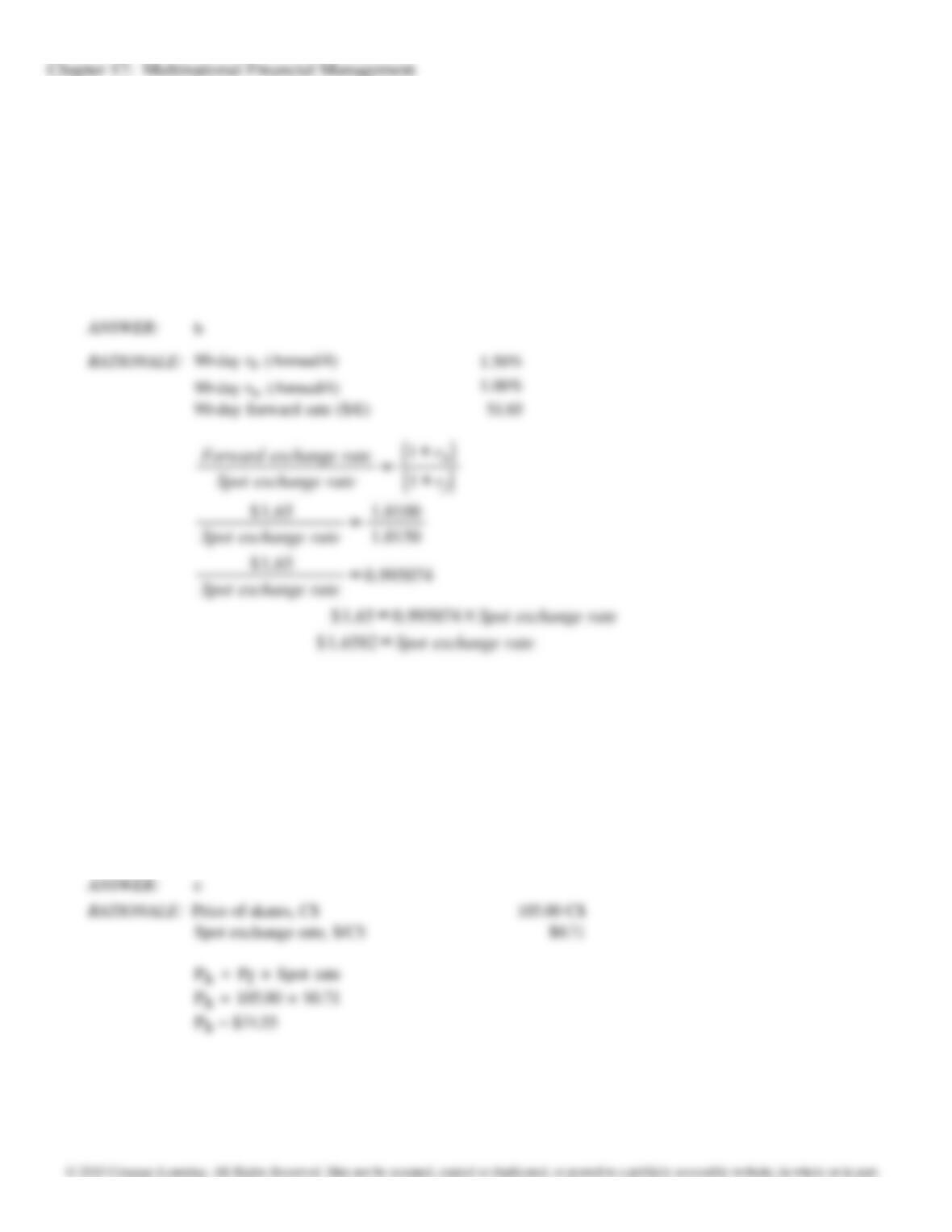
Suppose 90-day investments in Britain have a 6% annualized return and a 1.5% quarterly (90-day) return. In the
U.S., 90-day investments of similar risk have a 4% annualized return and a 1% quarterly (90-day) return. In the 90–
day forward market, 1 British pound equals $1.65. If interest rate parity holds, what is the spot exchange rate ($/£)?
a. $1.4924
b. $1.6582
c. $1.8240
d. $2.0064
e. $2.2070
44.
Suppose hockey skates sell in Canada for 105 Canadian dollars, and 1 Canadian dollar equals 0.71 U.S. dollar. If
purchasing power parity (PPP) holds, what is the price of hockey skates in the United States?
a. $60.39
b. $67.10
c. $74.55
d. $82.01
e. $90.21
45.
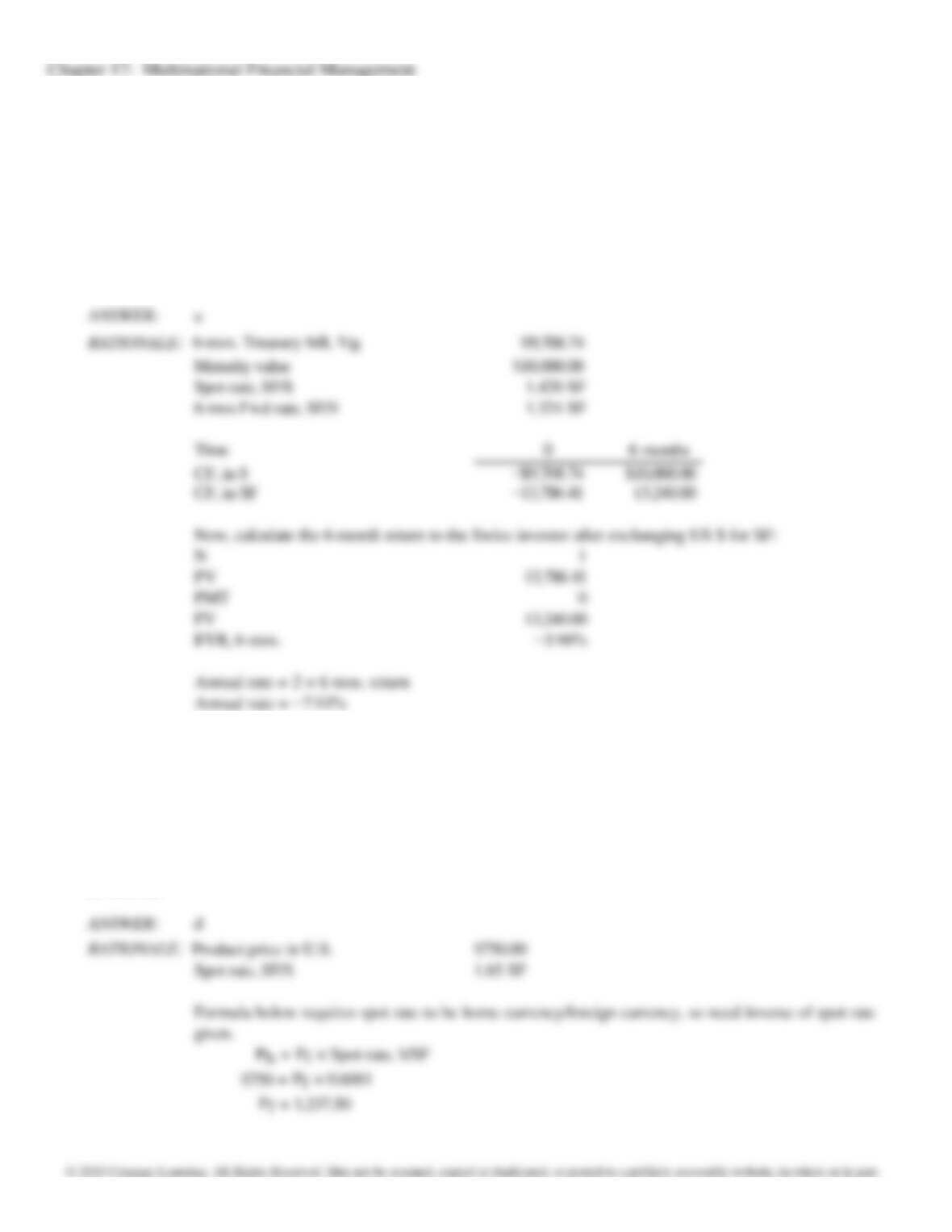
Suppose 6 months ago a Swiss investor bought a 6-month U.S. Treasury bill at a price of $9,708.74, with a maturity
value of $10,000. The exchange rate at that time was 1.420 Swiss francs per dollar. Today, at maturity, the
exchange rate is 1.324 Swiss francs per dollar. What is the annualized rate of return to the Swiss investor?
a. −7.93%
b. −7.13%
c. −6.42%
d. −5.78%
e. −5.20%
ANSWER: a
46.
A product sells for $750 in the United States. The spot exchange rate is $1 to 1.65 Swiss francs. If purchasing
power parity (PPP) holds, what is the price of the product in Switzerland?
a. 902.14
b. 1,002.38
c. 1,113.75
d. 1,237.50
e. 1,361.25
47.
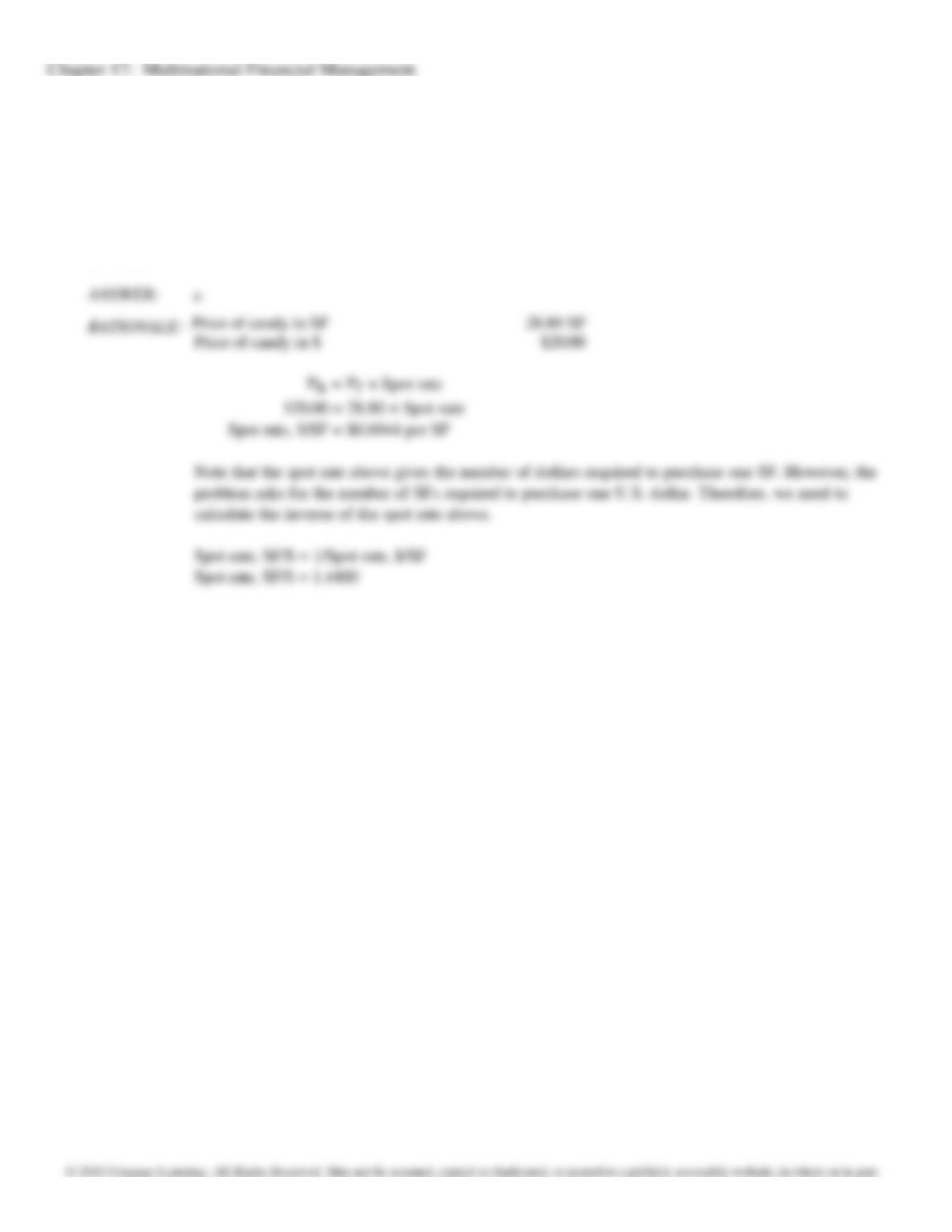
A box of candy costs 28.80 Swiss francs in Switzerland and $20 in the United States. Assuming that purchasing
power parity (PPP) holds, how many Swiss francs are required to purchase one U.S. dollar?
a. 0.9448
b. 1.0498
c. 1.1664
d. 1.2960
e. 1.4400
48.
One year ago, a U.S. investor converted dollars to yen and purchased 100 shares of stock in a Japanese company at
a price of 3,150 yen per share. The stock‘s total purchase cost was 315,000 yen. At the time of purchase, in the
currency market 1 yen equaled $0.00952. Today, the stock is selling at a price of 3,465 yen per share, and in the
currency market $1 equals 130 yen. The stock does not pay a dividend. If the investor were to sell the stock today
and convert the proceeds back to dollars, what would be his realized return on his initial dollar investment from
holding the stock?
a. −13.51%
b. −12.87%
c. −12.26%
d. −11.67%
e. −11.12%
49.
Suppose in the spot market 1 U.S. dollar equals 1.75 Canadian dollars. 6-month Canadian securities have an
annualized return of 6% (and thus a 6-month periodic return of 3%). 6-month U.S. securities have an annualized
return of 6.5% and a periodic return of 3.25%. If interest rate parity holds, what is the U.S. dollar-Canadian dollar
exchange rate in the 180-day forward market? In other words, how many Canadian dollars are required to purchase
one U.S. dollar in the 180–day forward market?
a. 1.2727
b. 1.4141
c. 1.5712
d. 1.7458
e. 1.9203
50.
Blenman Corporation, based in the United States, arranged a 2-year, $1,000,000 loan to fund a project in Mexico.
The loan is denominated in Mexican pesos, carries a 10.0% nominal rate, and requires equal semiannual payments.
The exchange rate at the time of the loan was 5.75 pesos per dollar, but it dropped to 5.10 pesos per dollar before
the first payment came due. The loan was not hedged in the foreign exchange market. Thus, Blenman must convert
U.S. funds to Mexican pesos to make its payments. If the exchange rate remains at 5.10 pesos per dollar through
the end of the loan period, what effective annual interest rate will Blenman end up paying on the loan?
a. 17.76%
b. 18.69%
c. 19.67%
d. 20.71%
e. 21.80%