Microeconomics, 12e (Parkin)
Chapter 17 Externalities
1 Externalities In Our Lives
1) An externality can be a
A) cost or a benefit.
B) benefit but not a cost.
C) cost but not a benefit.
D) marginal cost but not a total cost.
2) An externality occurs when
A) the costs of producing a good are paid entirely by the producer.
B) some of the costs of producing a good are paid by someone other than the producer.
C) the marginal social cost of an activity increases as that activity is increased.
D) Both answers A and C are correct.
3) The external benefit of a good
A) equals its consumer surplus.
B) equals its producer surplus.
C) equals its total surplus.
D) is a benefit from the good falling on people who are not the consumers of the good.
4) A cost that arises from the production of a good that is paid by someone who did not
participate in the production is called
A) a free rider.
B) an externality.
C) rent seeking.
D) a public failure.
5) Which of the following does NOT contain an externality?
A) I sell you an ice cream and you drip it all over the person sitting next to you.
B) I sell you an ice cream and it gives you a headache.
C) I sell you an ice cream and you share it with your friend.
D) I give you an ice cream and you share it with a friend.
6) An example of an activity that generates an external cost is
A) dumping soapsuds into a trout stream.
B) national defense services.
C) planting flowers along an interstate highway.
D) eating an apple.
7) An example of an externality occurs when a chemical factory
A) is producing ethanol and dumps waste in a river upstream from a popular fishing spot.
B) produces fertilizers that do not help plants grow.
C) produces fertilizers that kill plants rather than feed them.
D) overworks its employees.
8) When people decorate the exteriors of their homes with colored lights, they create ________
for the motorists who pass by.
A) an external benefit
B) a competitive good
C) a public good
D) an excludable good
9) Which of the following episodes would most likely contain an externality?
A) You cannot afford to buy groceries.
B) You decide to grow your own vegetables in your backyard where no one else can see them.
C) You decide to grow flowers in your front yard where everyone else can see them.
D) You eat all the vegetables you grow yourself.
10) In which of the following markets are external benefits most likely to exist?
A) in the market for gasoline
B) in the market for ball pens
C) in the market for flu shots
D) in the market for cigarettes
11) Which of the following illustrates the concept of external benefit?
A) Good weather increases the size of the wheat crop.
B) A new pesticide increases the size of the wheat crop.
C) A gardener enjoys his flowers.
D) Neighbors enjoy a gardener’s flowers.
12) Beautification of the national highways through the planting of shrubs and wildflowers will
A) be profitable for a private landscaping company because they can charge passing drivers.
B) benefit even people who do not help pay.
C) provide a flow of services that are rival in consumption.
D) provide a flow of services that involve excludable consumption.
13) Air pollution caused by lead
A) has never been a pollution problem.
B) is currently a major pollution problem.
C) has mostly been eliminated as a pollution problem.
D) is the number one source of pollution today.
14) An externality can be a cost or benefit arising from the production of a good that falls upon
A) consumers but not producers.
B) producers but not consumers.
C) both the consumer and the producer.
D) someone other than the consumer or producer.
Answer: D
Topic: Study Guide Question, Externality
Skill: Conceptual
AACSB: Analytical thinking
2 Negative Externalities: Pollution
1) A private cost is a cost of production that is
A) borne by the producer of a good.
B) measured in marginal terms.
C) borne by someone other than the producer of a good.
D) measured in total terms.
2) A private cost is a cost of production that is borne by the
A) consumer of the good.
B) producer of the good.
C) government.
D) consumer of the good and the government.
3) The cost of producing one more unit of a good or service that is paid by the producer
A) has to be equal to the benefit that the consumer derives from that good.
B) is equal to the cost borne by people other than the producer.
C) is the marginal private cost.
D) is the marginal external cost.
4) The cost of producing an additional unit of a good or service that is borne by the producer of
that good or service is the
A) marginal external cost.
B) marginal private cost.
C) marginal social cost.
D) None of the above answers is correct.
5) Suppose a firm produces pollution when it generates electricity. The cost of the pollution is
called the
A) marginal cost.
B) marginal private cost.
C) marginal external cost.
D) marginal social cost.
6) Which of the following is an example of an external cost?
A) taxes
B) the price of a car wash
C) pollution
D) an electricity bill
7) If an external cost exists, then who bears the external cost in an unregulated competitive
market transaction?
A) nobody
B) the federal government
C) someone other than the producers
D) the buyers of the product
8) The cost of producing an additional unit of a good or service that falls on people other than the
producer of that good or service is the
A) marginal external cost.
B) marginal private cost.
C) marginal social cost.
D) None of the above answers is correct.
9) The cost of producing a good or service that is paid by people other than the producers is
A) the marginal cost.
B) represented by the demand curve.
C) represented by the supply curve.
D) an external cost.
10) An external cost is a cost of producing a good or service that is
A) not paid by the producers.
B) paid by the producers.
C) paid by the government.
D) paid by the consumer and the government.
11) The marginal cost of production that is borne by the entire society is the
A) marginal private cost.
B) marginal social cost.
C) marginal external cost.
D) None of the above answers is correct.
12) The ________ is the cost of paid by the producer plus any cost paid by everyone else when
another unit of a good or service is produced.
A) marginal external cost.
B) marginal private cost.
C) marginal social cost.
D) None of the above answers is correct.
13) The marginal social cost is
A) equal to the marginal private cost plus the marginal external cost.
B) equal to the marginal private cost minus the marginal external cost.
C) the same as the marginal private cost.
D) the same as the marginal external cost.
14) If the marginal private cost of producing one kilowatt of power in California equals five
cents and the marginal social cost of each kilowatt equals nine cents, then the marginal external
cost equals ________ per kilowatt.
A) five cents
B) nine cents
C) four cents
D) fourteen cents
15) The difference between the marginal social cost and the marginal private cost equals the
A) cost of producing an additional unit of a good.
B) marginal external benefit.
C) marginal external cost.
D) marginal private benefit.
16) If the marginal social cost of a good equals the marginal private cost of the good, then the
marginal external cost of the good
A) is zero.
B) equals the marginal social cost.
C) equals the marginal social benefit.
D) equals the marginal private benefit.
17) If a good has zero external costs, then
A) marginal social cost equal marginal private cost.
B) marginal social cost is greater than marginal private cost.
C) marginal social cost is less than marginal private cost.
D) we need more information to determine the relationship between private and social costs.
18) Marginal social cost is the
A) difference between the marginal social benefit and the marginal private cost.
B) sum of the marginal private benefit and the marginal private cost.
C) difference between the marginal external cost and the marginal private cost.
D) sum of the marginal external cost and the marginal private cost.
19) The marginal social cost of production is the
A) marginal private cost plus the marginal external cost.
B) same as the marginal cost of any externality.
C) total cost of any externality.
D) marginal private cost minus the marginal external cost.
20) Marginal social cost is equal to the
A) sum of marginal private cost and marginal external cost.
B) sum of marginal private cost and marginal private benefit.
C) marginal cost incurred by the producer of the good.
D) marginal cost imposed on others.
21) Marginal social cost is equal to ________.
A) marginal private cost plus the marginal external cost
B) the marginal external cost
C) the value of the tax that will make the market efficient
D) the marginal cost imposed on people other than the producer of the good
22) Which of the following is TRUE?
A) MSC = MC + Marginal external cost
B) MC = Marginal external cost – MSC
C) MC = Marginal external benefit + MSC
D) MSC = Marginal external cost + marginal external benefit
23) The marginal social cost, MSC, of producing a good or service equals
A) MC + MB.
B) MB + marginal external cost.
C) MB + marginal external benefit.
D) MC + marginal external cost.
24) For a good with an external cost, the supply curve
A) represents the various quantities people can buy.
B) is the same as the marginal private cost curve.
C) is the same as the marginal social cost curve.
D) is the same as the marginal external cost curve.
25) If the marginal external cost of building a children’s playground equals zero, then the
A) marginal private cost equals the marginal social cost.
B) marginal social cost equals zero.
C) marginal private cost equals zero.
D) None of the above answers is correct.
26) If a good has an external cost, then the marginal private cost curve
A) lies below the marginal social cost curve.
B) lies above the marginal social cost curve.
C) is negative.
D) is the same as the marginal external cost curve.
27) If the production of a good creates pollution, then the
A) marginal social benefit curve lies above the marginal private benefit curve.
B) marginal social cost curve lies above the marginal private cost curve.
C) marginal social benefit curve lies below the marginal private benefit curve.
D) marginal social cost curve lies below the marginal private cost curve.
28) Consider an industry that produces an output Q with marginal private cost (MC) and
marginal social cost (MSC) as given in the table:
Q
MC
MSC
1
2
4
2
4
7
3
6
10
4
8
13
5
10
16
Which of the following is TRUE?
A) The production of each additional unit results in a larger marginal external cost.
B) The production of each additional unit results in the same marginal external cost.
C) The production of each additional unit results in a lower marginal external cost.
D) There are no marginal external costs associated with the production of this good.
29) Consider an industry that produces an output Q with marginal private cost (MC) and
marginal social cost (MSC) as given in the table:
Q
MC
MSC
1
2
4
2
4
7
3
6
10
4
8
13
5
10
16
The marginal external cost associated with the production of unit 3 is
A) 4.
B) 6.
C) 10.
D) 16.
30) When production of a good results in an external cost, the unregulated competitive market
equilibrium is inefficient because ________.
A) MSC = MC
B) MSC = MSB
C) MSC > MSB
D) MSC < MSB
31) If production of a good creates an external cost, the amount of output where the marginal
social benefit equals the marginal private cost is
A) inefficient.
B) inequitable.
C) unattainable.
D) efficient.
32) If a good has an external cost, the
A) competitive market outcome is efficient.
B) marginal private cost reflects the external cost.
C) competitive market outcome is inefficient.
D) marginal private benefit is equal to the marginal social cost.
33) Pollution occurs when lumber is produced. If the lumber market is unregulated, there would
be
A) overproduction of lumber compared to the efficient amount.
B) underproduction of lumber compared to the efficient amount.
C) sometimes overproduction and sometimes underproduction of lumber compared to the
efficient amount.
D) an external benefit to producing lumber.
34) When the marginal social cost of the production of Good A is greater than the marginal
private cost of the production of Good A, then
A) a competitive, unregulated market produces less than the efficient quantity of Good A.
B) a competitive, unregulated market produces the efficient quantity of Good A.
C) a competitive, unregulated market produces more than the efficient quantity of Good A.
D) the government should levy a tax on the production of Good A that is equal to the horizontal
distance between the two marginal cost curves.
35) When the production of a good has an external cost, the
A) marginal social cost curve lies below the marginal private cost curve.
B) marginal social benefit curve lies above the marginal private benefit curve.
C) equilibrium quantity in an unregulated, competitive market has a marginal social cost greater
than the marginal social benefit.
D) equilibrium quantity in an unregulated, competitive market has a marginal social cost less
than the marginal social benefit.
36) Generating electricity creates air pollution. This industry, if left unregulated, will produce
A) more than the efficient level of output.
B) the efficient level of output.
C) less than the efficient level of output.
D) sometimes more and sometimes less than the efficient level of output.
37) Generating electricity creates air pollution. This industry, if left unregulated, will produce at
an inefficient market equilibrium because
A) there is a deadweight loss.
B) supply is not equal to demand.
C) too little output is produced.
D) the marginal social benefit is greater than the marginal social cost.
38) Generating electricity creates air pollution. This industry, if left unregulated, will produce at
an inefficient market equilibrium where
A) marginal private cost equals marginal social benefit.
B) marginal social cost equals marginal social benefit.
C) marginal social cost equals marginal private cost.
D) marginal social benefit is greater than marginal social cost.
39) In the absence of property rights, factories will dump waste into a waterway up to the point
where ________ equals ________.
A) marginal social cost; marginal social benefit
B) marginal social cost; marginal private cost
C) marginal private cost; marginal private benefit
D) marginal private cost; marginal social cost
40) For a good whose production creates a pollution, when marginal social cost equals marginal
social benefit, then
I there is no pollution.
II resources are utilized efficiently.
A) I only
B) II only
C) neither I nor II
D) both I and II
41) Resources are efficiently utilized when production is such that marginal social benefit
A) is equal to marginal social cost.
B) exceeds marginal social cost by as much as possible.
C) is less than marginal social cost.
D) None of the above because efficiency has to do with property rights and has nothing to do
with marginal social benefit or marginal social cost.
42) The efficient quantity of output of a product with external costs of production is
A) where the demand curve and the producer’s supply curve intersect.
B) where the marginal social cost curve and marginal social benefit curve intersect.
C) as low as possible.
D) zero.
43) Producing paper creates pollution. There is no externality in the consumption of paper. The
efficient quantity of paper is when the
A) marginal social benefit of paper is equal to zero.
B) marginal social cost of the pollution from making paper is equal to zero.
C) marginal social benefit of paper is equal to the marginal social cost of paper.
D) marginal private cost of the pollution from making paper is equal to zero.
Quantity of steel
(millions of tons
per week)
Marginal social
benefit
(dollars per ton)
Marginal social
cost (dollars per
ton)
5
40
20
10
35
25
15
30
30
20
25
35
25
20
40
44) The table above shows information about the costs and benefits of a steel smelter that
pollutes the air of a city. The market is efficient when the quantity of steel produced is ________
tons per week.
A) 5
B) 10
C) 15
D) 25
45) The table above shows information about the costs and benefits of a steel smelter that
pollutes the air of a city. If the marginal external cost is $10 per ton at every quantity of steel
produced, the equilibrium quantity when the steel industry is unregulated is ________ tons per
week.
A) 5
B) 15
C) 20
D) 25
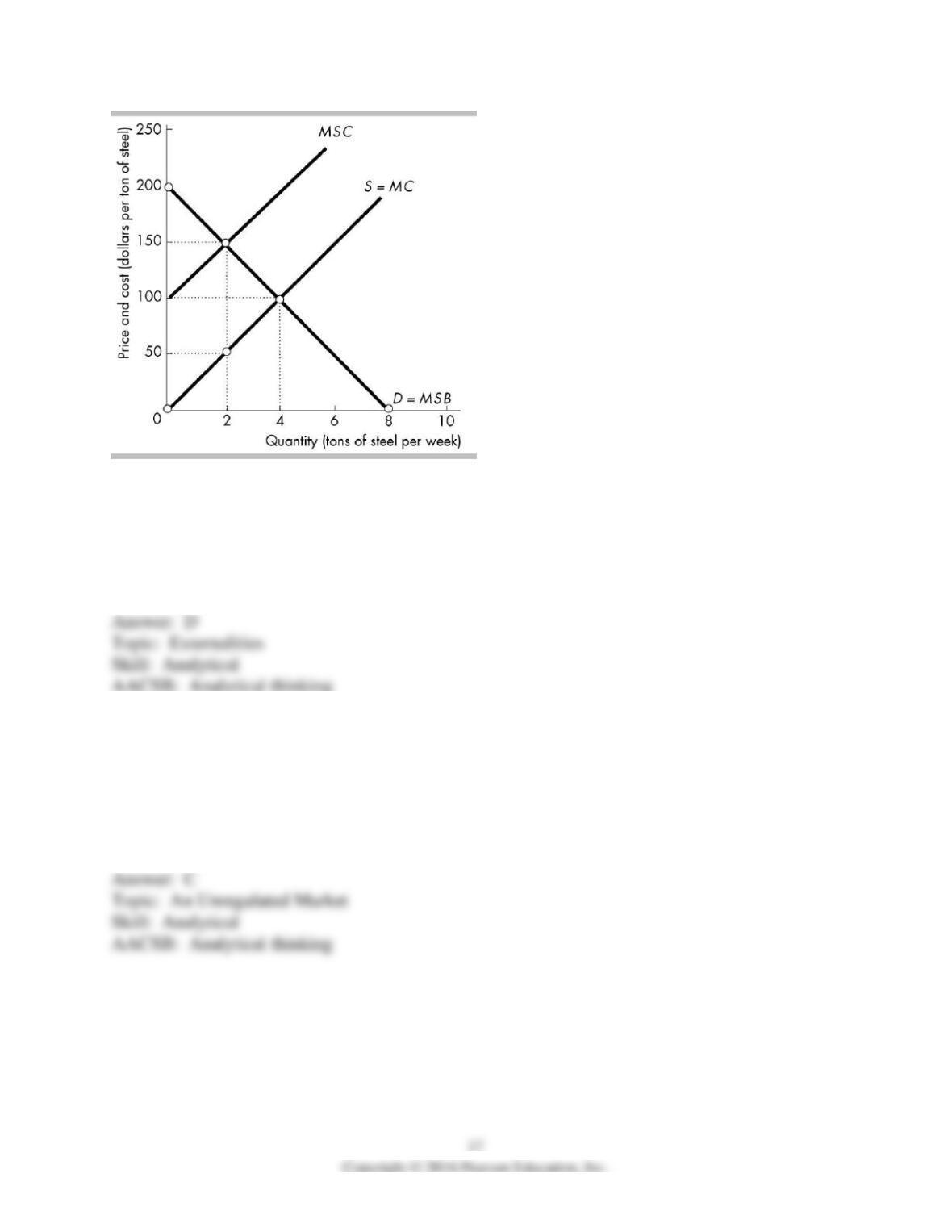
46) The above figure shows the marginal social benefit, marginal private cost and marginal
social cost of producing steel. There is a marginal external ________ of ________ per ton.
A) benefit; $200
B) benefit; $100
C) cost; $200
D) cost; $100
47) The above figure shows the marginal social benefit, marginal private cost and marginal
social cost of producing steel. If the market is competitive and unregulated, how much steel will
be produced?
A) 0 tons
B) 2 tons
C) 4 tons
D) 8 tons
48) The above figure shows the marginal social benefit, marginal private cost and marginal
social cost of producing steel. What is the efficient quantity of steel?
A) 0 tons
B) 2 tons
C) 4 tons
D) 8 tons
49) The above figure shows the marginal social benefit, marginal private cost and marginal
social cost of producing steel. If the market is competitive and unregulated, the equilibrium
quantity of steel is ________ tons and the efficient quantity of steel is ________ tons.
A) 2; 2
B) 2; 4
C) 4; 2
D) None of the above answers is correct.
50) The above figure shows the marginal social benefit, marginal private cost and marginal
social cost of producing steel. If the market is competitive, what government policy might move
the market closer to efficiency?
A) The government could subsidize the production of steel.
B) The government could tax the production of steel.
C) The government could issue vouchers to steel consumers.
D) None of the above answers is correct.
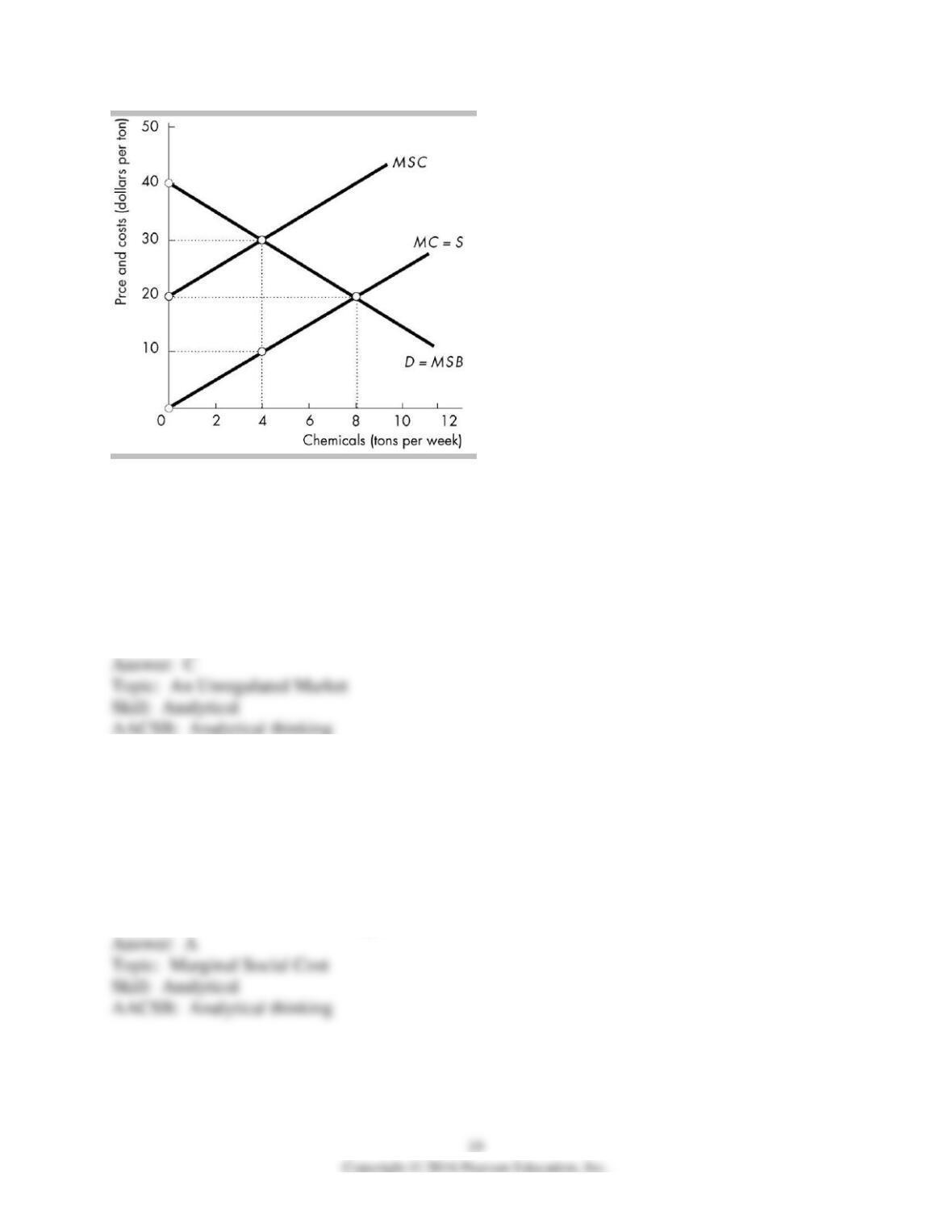
51) A chemical factory and a fishing club share a lake. Producing chemicals creates water
pollution that harms the fish. The marginal social cost, private marginal cost, and marginal social
benefit from producing chemicals are in the figure above. If polluting is legal and no one owns
the lake into which waste is dumped, then the amount of chemicals produced each week will be
A) 0 tons.
B) 4 tons.
C) 8 tons.
D) None of the above answers is correct.
52) A chemical factory and a fishing club share a lake. The marginal social costs, private
marginal costs, and marginal benefits from producing chemicals are in the figure above. The
chemicals dumped into the lake have always harmed the fish, but now they begin to damage the
fishing boats as well. As a result, the
A) marginal social cost curve shifts leftward.
B) marginal social cost curve shifts rightward.
C) marginal benefit curve shifts leftward.
D) marginal benefit curve shifts rightward.
53) In the above figure, the efficient level of chemicals produced per week is
A) 0 tons.
B) 4 tons.
C) between 5 and 7 tons.
D) 8 tons.
54) A chemical factory and a fishing club share a lake. Producing chemicals creates water
pollution that harms the fish. The marginal social cost, private marginal cost, and marginal
benefit from producing chemicals are in the figure above. Initially the lake is owned by no one.
Keeping in mind the Coase theorem, if transactions costs are low then if the chemical factory
owns the lake ________ tons of chemicals will be produced and if the fishing club owns the lake,
________ tons of chemicals will be produced.
A) 4; 4
B) 4; 8
C) 8; 4
D) 8; 8
55) Legally established titles to the ownership, use, and disposal of factors of production are
referred to as
A) property rights.
B) Coase rights.
C) pollution rights.
D) emission rights.
56) Property rights
A) apply to factors of production and to goods and services.
B) are legally established titles of ownership that are enforceable in the courts.
C) can be part of a solution to the problems of an externality.
D) All of the above answers are correct.