CHAPTER 17: Behavioral Economics and Risk Taking
MULTIPLE CHOICE
1. The hypothetical species Homo economicus is acutely aware of opportunities in the environment
and
a. strives to maximize the benefits received from each course of action while minimizing the
costs.
b. strives to minimize the benefits received from each course of action while maximizing the
costs.
c. strives to equalize the benefits received and costs incurred from each course of action.
d. takes an action only if the benefits to society of this action outweigh the costs to society of this
action.
e. never takes action because of the understanding that all individual actions are to the detriment
of society.
2. Most economic theory proceeds as though economic actors are all rational, self-interested
decision-makers. Economists refer to this hypothetical rational, self-interested decision maker as
a. Homo consumus. d. Homo economicus.
b. Homo microcus. e. Homo elasticious.
c. Homo demandcurvius.
3. The standard economic model assumes people can be approximated by ________, who is assumed
to be fully rational, calculating, and selfish; has unlimited computational ability; and never makes
systematic mistakes.
a. Homo consumus d. Homo economicus
b. Homo microcus e. Homo elasticious
c. Homo demandcurvius
4. The traditional economic model conceptualizes the economy as made up of infinitely calculating,
unemotional maximizers that have been called
a. Homo consumus. d. Homo demandcurvius.
b. Homo economicus. e. Homo elasticious.
c. Homo microcus.
5. Behavioral economics seeks to dethrone ________ and replace him with something “more
human.”
a. Homo rationalimus d. Homo sapiens
b. Homo economicus e. Homo stevejobsimus
c. Homo macrus

6. ________ is the field of economics that studies how experimental psychology influences the
decision-making process.
a. Public finance d. Sociology
b. Psychology e. Macroeconomics
c. Behavioral economics
7. Behavioral economics studies how ________ influences the decision-making process.
a. the weather pattern d. the financial sector
b. rational economic action e. macroeconomics
c. experimental psychology
8. Behavioral economics studies
a. economy-wide phenomena such as real output, inflation, unemployment, and business cycles.
b. the decision-making processes of rational, self-interested economic actors.
c. all aspects of the markets and institutions that make up the financial system.
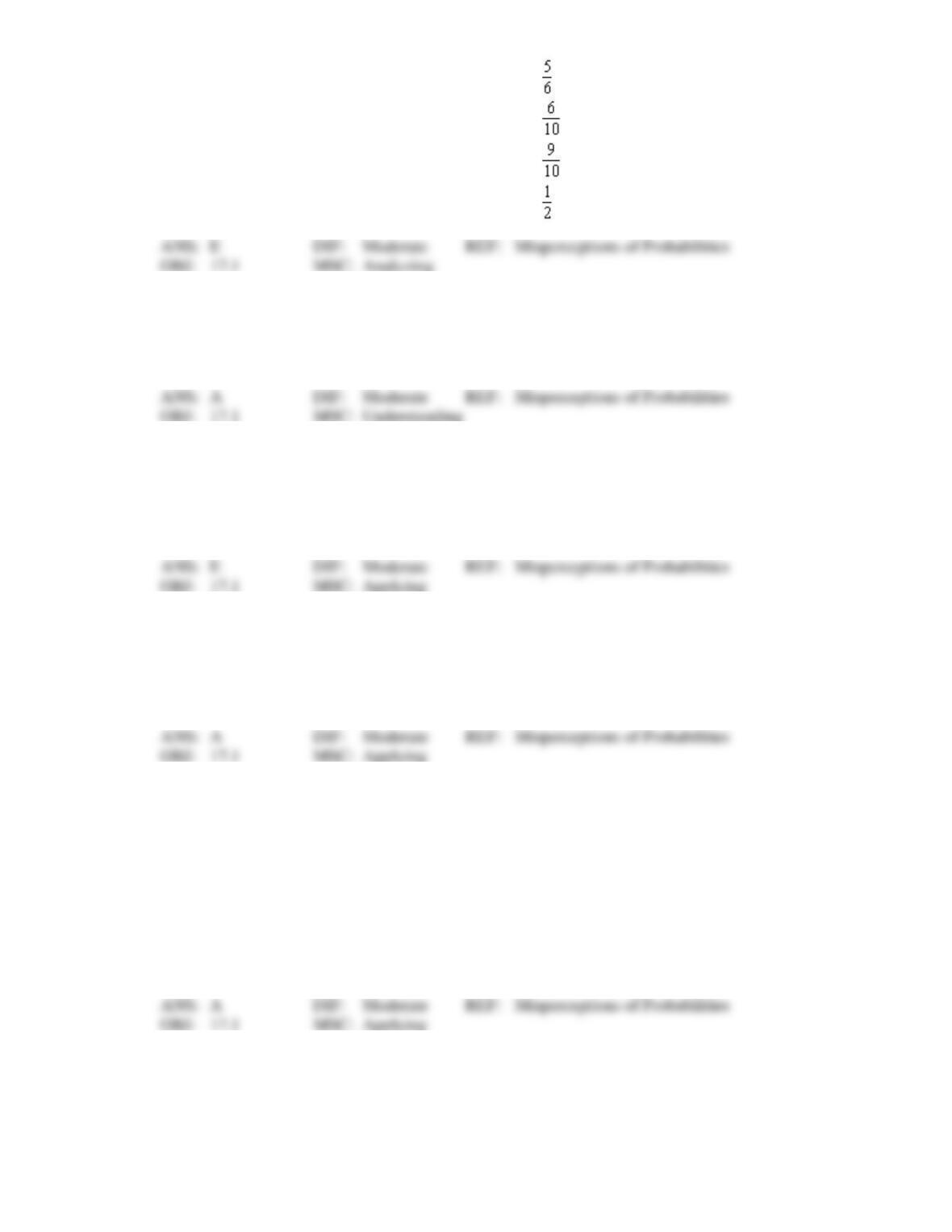
d. the implications of trade among individuals, firms, and countries.
e. how experimental psychology provides insight into the decision-making process.
9. A relatively new area in the field of economics called ________ economics studies people who
appear to make choices that do not seem rational in an economic sense.
a. business-cycle d. labor
b. financial e. entrepreneurial
c. behavioral
10. Behavioral economists draw on insights from ________ to explore how people behave in
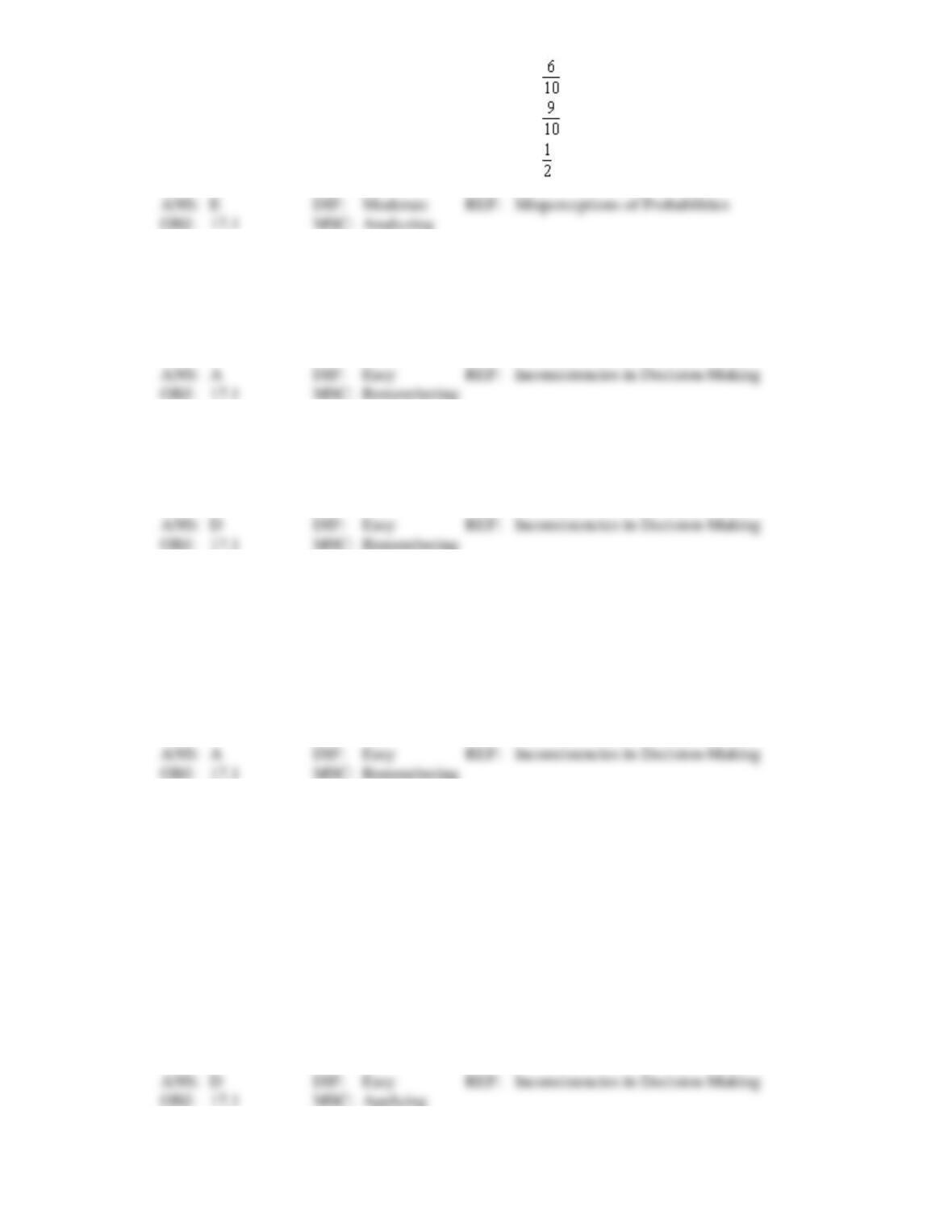
economic settings.
a. experimental psychology d. astrology
b. experimental biology e. theoretical physics
c. evolutionary biology
11. Whenever consumers make decisions without perfect information, the decision reflects
a. perfect rationality. d. unbounded rationality.
b. perfect irrationality. e. confounded rationality.
c. bounded rationality.
12. When comparing the standard models in the respective fields of economics and psychology, it is
clear that
a. both economists and psychologists always assume that people always behave in a fully rational
way.
b. both economists and psychologists always assume that people do not act in a fully rational
way.
c. neither economists nor psychologists always assume that people always behave in a fully
rational way.
d. economists generally assume that people always behave in a rational way, whereas
psychologists generally do not.
e. psychologists generally assume that people always behave in a rational way, whereas
economists generally do not.
13. In 2002, Daniel Kahneman was awarded the Nobel Prize in Economics for “having integrated
insights from psychological research into economic science, especially concerning human
judgment and decision-making under uncertainty.”
Source: “The Price in Economics 2002: Press Release,” Nobelprize.org, October 12, 2012, www.nobelprize.org/nobel_
prizes/economics/laureates/2002/press.html.
Based on this information, which academic field would Daniel Kahneman most likely identify
with?
a. economics d. English
b. industrial-organizational sociology e. behavioral economics
c. evolutionary biology
14. A consumer who adheres to bounded rationality is
a. a fully rational consumer who behaves like an all-knowing supercomputer when making
cost-benefit calculations.
b. a completely irrational consumer who is unable to use logic to compare costs and benefits.
c. neither capable of performing the problem-solving that traditional economic theory assumes
nor is inclined to do so.
d. rational only in situations that involve market prices.
e. never rational in situations that involve market prices.
15. In 1990, Richard Thaler, a behavioral economist, said the following with respect to the standard
economic model: “The problem seems to be that while economists have gotten increasingly
sophisticated and clever, consumers have remained decidedly human.” Which of the following
statements best describes what Thaler implies in this sentence?
a. The standard economic model should be dumbed down so that more citizens can understand it.
b. The standard economic model fails to account for the fact that human beings generally do not
act like Homo economicus.
c. Economists should educate citizens to become more sophisticated and clever so that their
actions better fit the standard economic model.
d. The behavioral economic model needs to be abandoned.
e. Human nature is neither clever nor sophisticated.
16. In 2011, Edward Cartwright, a behavioral economist, gave credit to the Nobel Prize–winning
economist Herbert Simon for launching what Cartwright calls the “you cannot be serious attack”
on the standard economic model. Cartwright cites a paper published by Simon in 1955, where the
author uses the standard economic model to solve elegantly how a rational person should behave.
After solving an equation for this rational person’s optimal behavior, Simon states: “My first
empirical proposition is that there is a complete lack of evidence that, in actual human choice
situations of any complexity, these computations can be, or are in fact, performed.”
Source: “A Behavior Model of Rational Choice,” Quarterly Journal of Economics (1955): 104.
This statement by Simon can be best described as a call to
a. governments for increased education spending so that more decision-makers can and will
perform the computations that Simon is referring to.
b. citizens to do their part to reduce the complexity of all human choice situations.
c. economists to replace Homo economicus in economic thinking with something more
humanlike.
d. economists to continue to use Homo economicus to guide their understanding of the complex
nature of human decision-making.
e. the United States Department of Economic Rationality to impose a new bylaw prohibiting the
use of the standard economic model in academic research papers.
17. For mathematical convenience, assuming that people are fully rational and self-interested
a. clearly does not mean that people really are fully rational and self-interested all the time.
b. clearly means that people really are fully rational and self-interested all the time.
c. is a practice never followed by economists, but is often followed by psychologists.
d. is a practice always followed by behavioral economists.
e. is a practice that is banned in most states by professional ethics laws.
18. Most state lotteries
a. have positive expected values.
b. have negative expected values.
c. have expected values equal to zero.
d. do not have expected values because state lotteries are not games of chance.
e. do not have expected values because most state lotteries are operated by government agencies.
19. Which of the following activities involves Mary playing a game of chance?
a. Mary works eight hours at Dairy Queen and earns a total of $60.
b. Mary spends $250 on a used video game console.
c. Mary wins a $1,000 Visa gift card in a competitive food-eating competition.
d. Mary wins a $500 prize in a business plan competition.
e. Mary deposits $5 in a slot machine and does not win anything.
20. Which of the following is an example of a game of chance?
a. Jeremiah plays basketball with his girlfriend.
b. Joan works eight hours at Taco Bell.
c. Jacqueline buys a lottery ticket.
d. John runs in a marathon.
e. Jalisha purchases salsa dancing shoes.
21. Suppose a casino is offering a game of chance where Teresa can bet $5 on the flip of a fair coin. If
the casino employee flips tails, Teresa loses the $5 that she bet. If the casino employee flips heads,
Teresa receives a payout of $11 (the $5 she originally bet plus another $6). If Teresa sits in the
casino and plays this game 1,000 times consecutively over a period of 12 hours, she
a. will likely end up with less money than she started with.
b. will likely end up with more money than she started with.
c. will likely end up with the same amount of money that she started with.
d. is equally likely to end up with more money or less money than she started with.
e. will definitely end up with less money than she started with.
22. Suppose a casino is offering a game of chance where Ricardo can bet $6 on the flip of a fair coin.
If the casino employee flips tails, Ricardo loses the $6 that he bet. If the casino employee flips
heads, Ricardo receives a payout of $11 (the $6 he originally bet plus another $5). If Ricardo sits in
the casino and plays this game 1,000 times consecutively over a period of 12 hours, he
a. will likely end up with less money than he started with.
b. will likely end up with more money than he started with.
c. will likely end up with the same amount of money that he started with.
d. is equally likely to end up with more money or less money than he started with.
e. will definitely end up with less money than he started with.
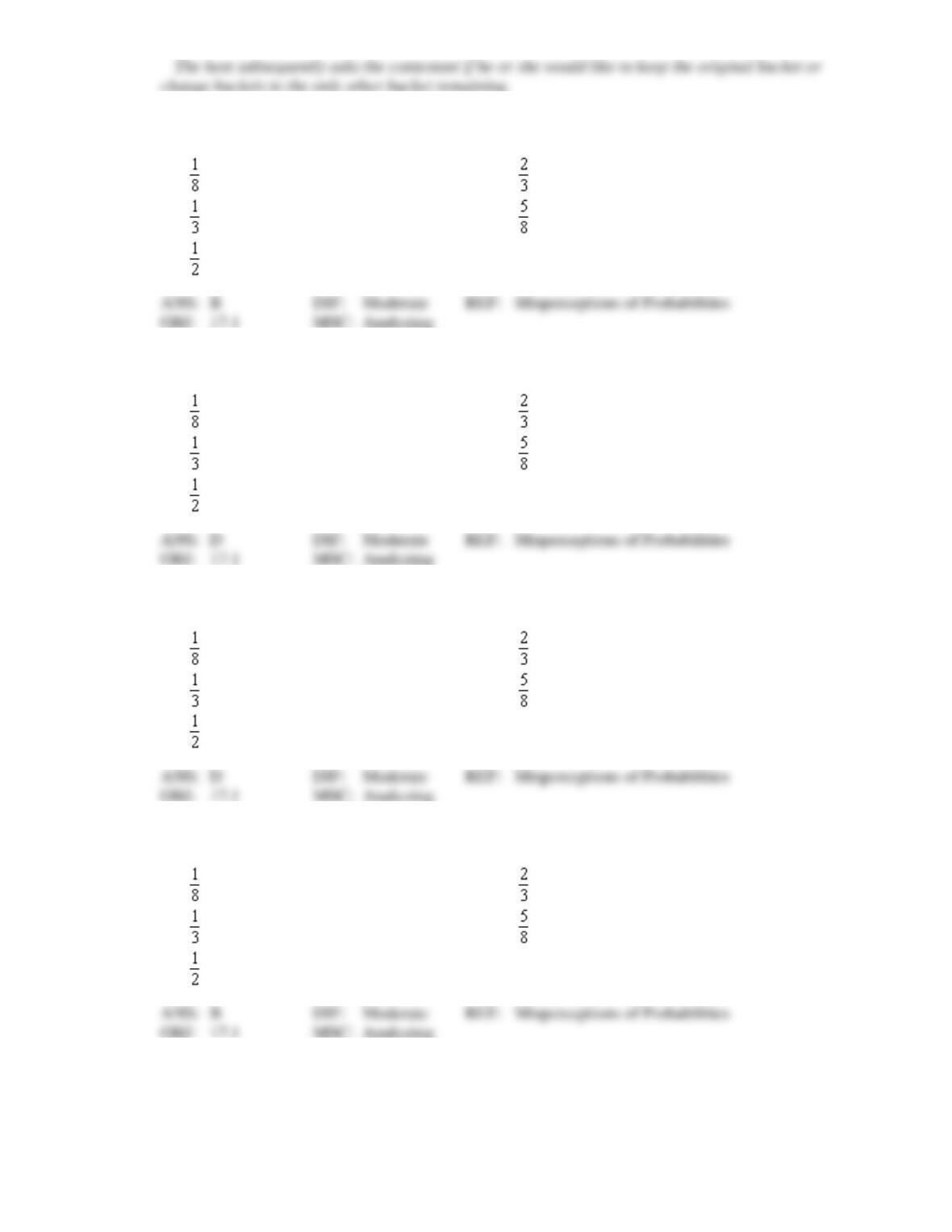
23. If the contestant does not change buckets and stays with the original bucket chosen, what is the
probability that the contestant will win the five-ounce gold bar?
a. d.
b. e.
c.
24. If the contestant does not change buckets and stays with the original bucket chosen, what is the
probability that the contestant will win the one-ounce gold bar?
a. d.
b. e.
c.
25. If the contestant changes buckets from the original bucket to the other bucket remaining, what is
the probability that the contestant will win the five-ounce gold bar?
a. d.
b. e.
c.
26. If the contestant changes buckets from the original bucket to the other bucket remaining, what is
the probability that the contestant will win the one-ounce gold bar?
a. d.
b. e.
c.
27. If the contestant changes buckets from the original bucket to the other bucket remaining, what is
the expected value of the game? Assume that the market price of gold is $1,000 per ounce.

a. $4,000 d. $5,000
b. $2,333.33 e. $1,000
c. $3,666.67
28. If the contestant changes buckets from the original bucket to the other bucket remaining, the
expected value of the game is ________; if the contestant does not change buckets and sticks with
the original bucket chosen, the expected value of the game is ________. Assume that the market
price of gold is $1,000 per ounce.
a. $4,000; $4,000 d. $5,000; $1,000
b. $2,333.33; $3,666.67 e. $1,000; $5,000
c. $3,666.67; $2,333.33
29. The contestant changes buckets from the original bucket to the other bucket remaining. This
change of buckets changes the probability that the contestant will win the five-ounce gold bar from
________.
a. to d. to
b. to e. to
c. to
30. Imagine a game show on television where one lucky contestant is presented with three
upside-down buckets that are numbered 1, 2, and 3. Under one of the buckets is a five-ounce gold
bar. Under each of the other two buckets is a one-ounce gold bar. After the game ends, the
contestant will receive the gold bar that is under his or her bucket.
The host of the game show asks the contestant to choose one of the three buckets. The
contestant chooses bucket #1. After the contestant makes a choice, the host lifts up bucket #2 to
reveal a one-ounce gold bar under it. At this point, only two buckets remain uncovered: the bucket
that the contestant originally chose (bucket #1) and the bucket that was not uncovered by the host
(bucket #3).
The host subsequently asks the contestant if he or she would like to keep the original bucket or
change buckets to the only other bucket remaining. The contestant changes buckets from the
original bucket (bucket #1) to the other bucket remaining (bucket #3). When the contestant
originally made the choice of bucket #1, the probability of the five-ounce gold bar being under that
bucket was . This means that the probability of the five-ounce gold bar being under either bucket
#1 or bucket #2 was . When the host lifted bucket #2 to reveal a one-ounce gold bar under it, the
probability of the five-ounce gold bar being under bucket #3 is now ________, while the
probability of the five-ounce gold bar being under bucket number #1 is still ________.
a. ; d. ;
b. ; e. ;
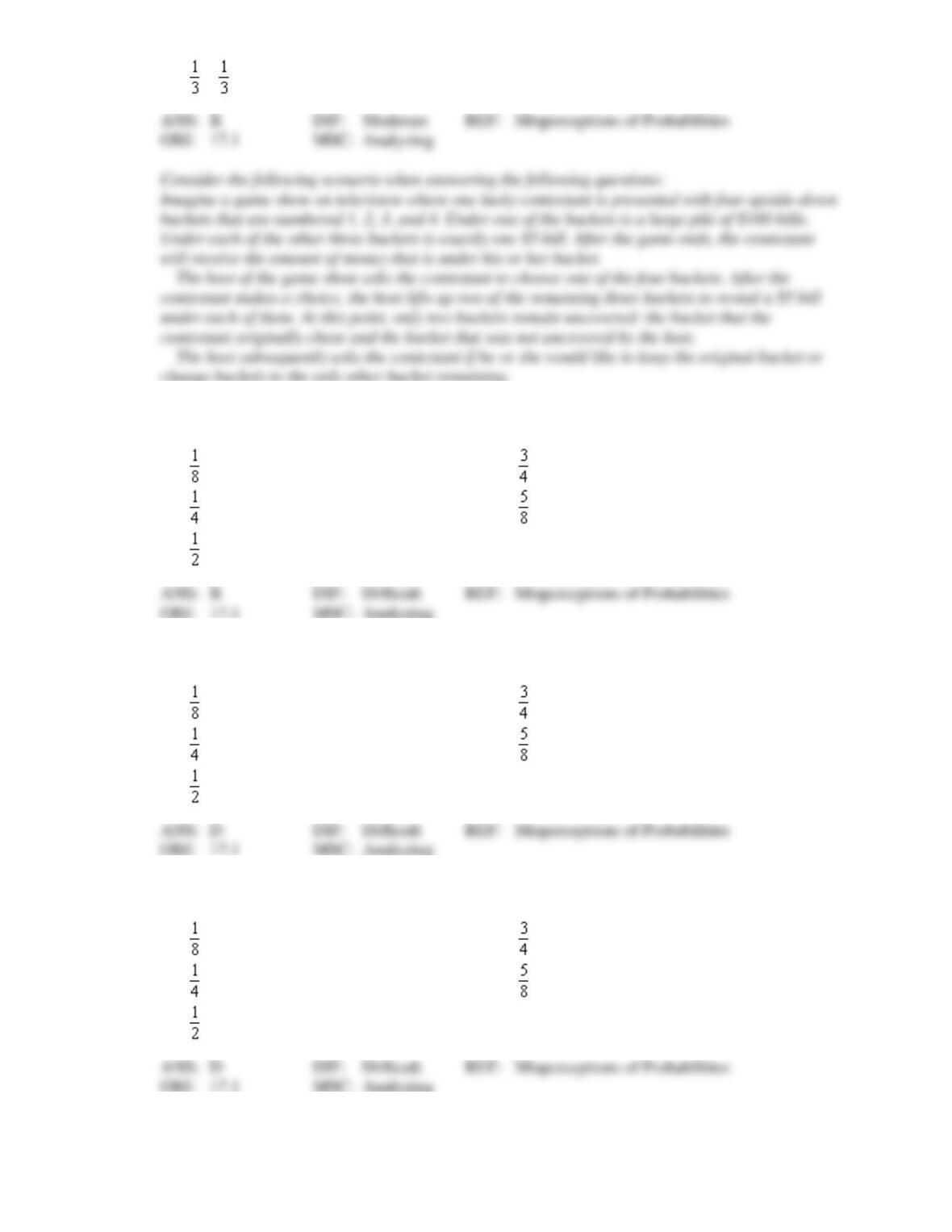
c. ;
31. If the contestant does not change buckets and stays with the original bucket chosen, what is the
probability that the contestant will win the stack of $100 bills?
a. d.
b. e.
c.
32. If the contestant does not change buckets and stays with the original bucket chosen, what is the
probability that the contestant will win exactly one $5 bill?
a. d.
b. e.
c.
33. If the contestant changes buckets from the original bucket to the other bucket remaining, what is
the probability that the contestant will win the stack of $100 bills?
a. d.
b. e.
c.
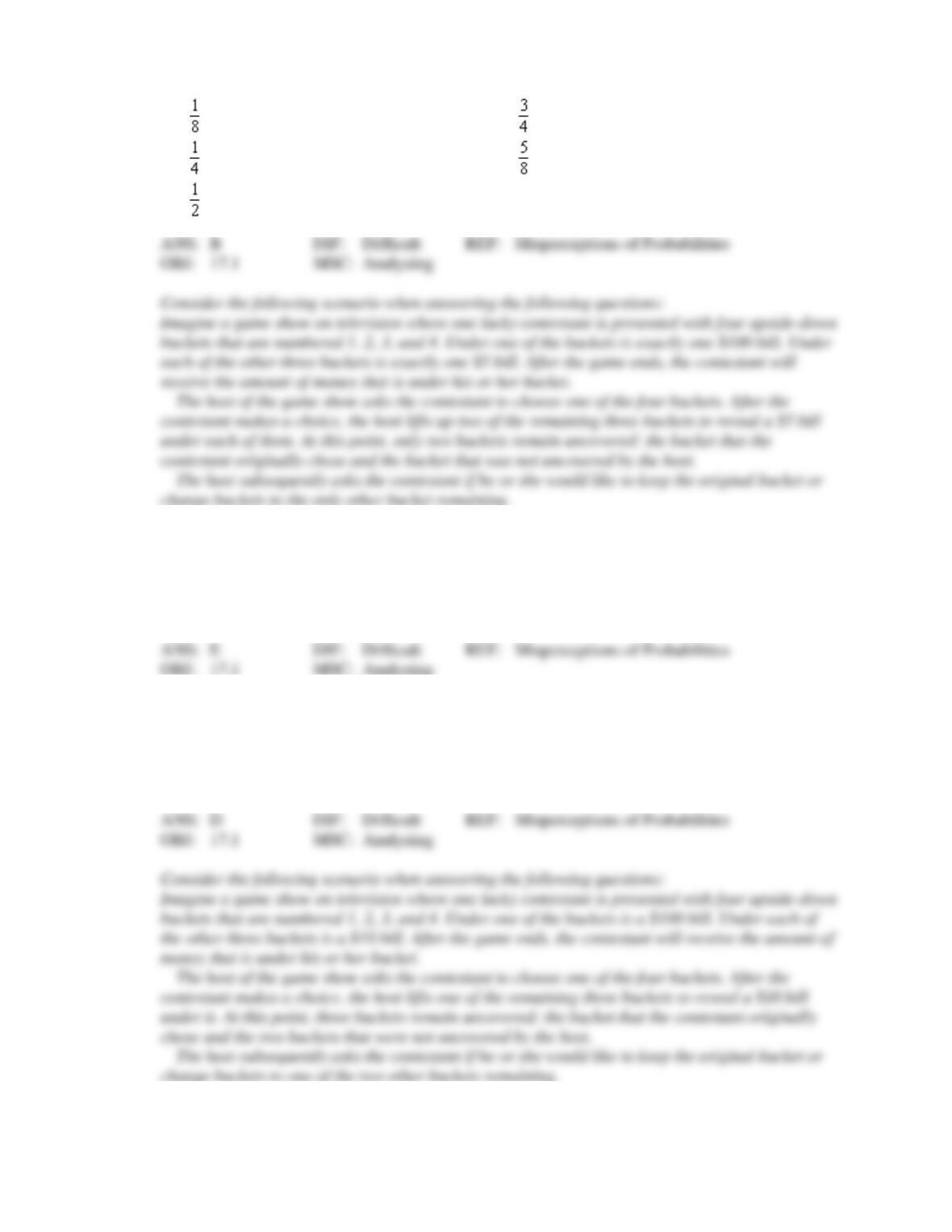
34. If the contestant changes buckets from the original bucket to the other bucket remaining, what is
the probability that the contestant will win exactly one $5 bill?
a. d.
b. e.
c.
35. If the contestant changes buckets from the original bucket to the other bucket remaining, what is
the expected value of the game?
a. $5.00 d. $28.75
b. $95.00 e. $76.25
c. $62.50
36. If the contestant does not change buckets and stays with the original bucket, what is the expected
value of the game?
a. $5.00 d. $28.75
b. $95.00 e. $76.25
c. $62.50
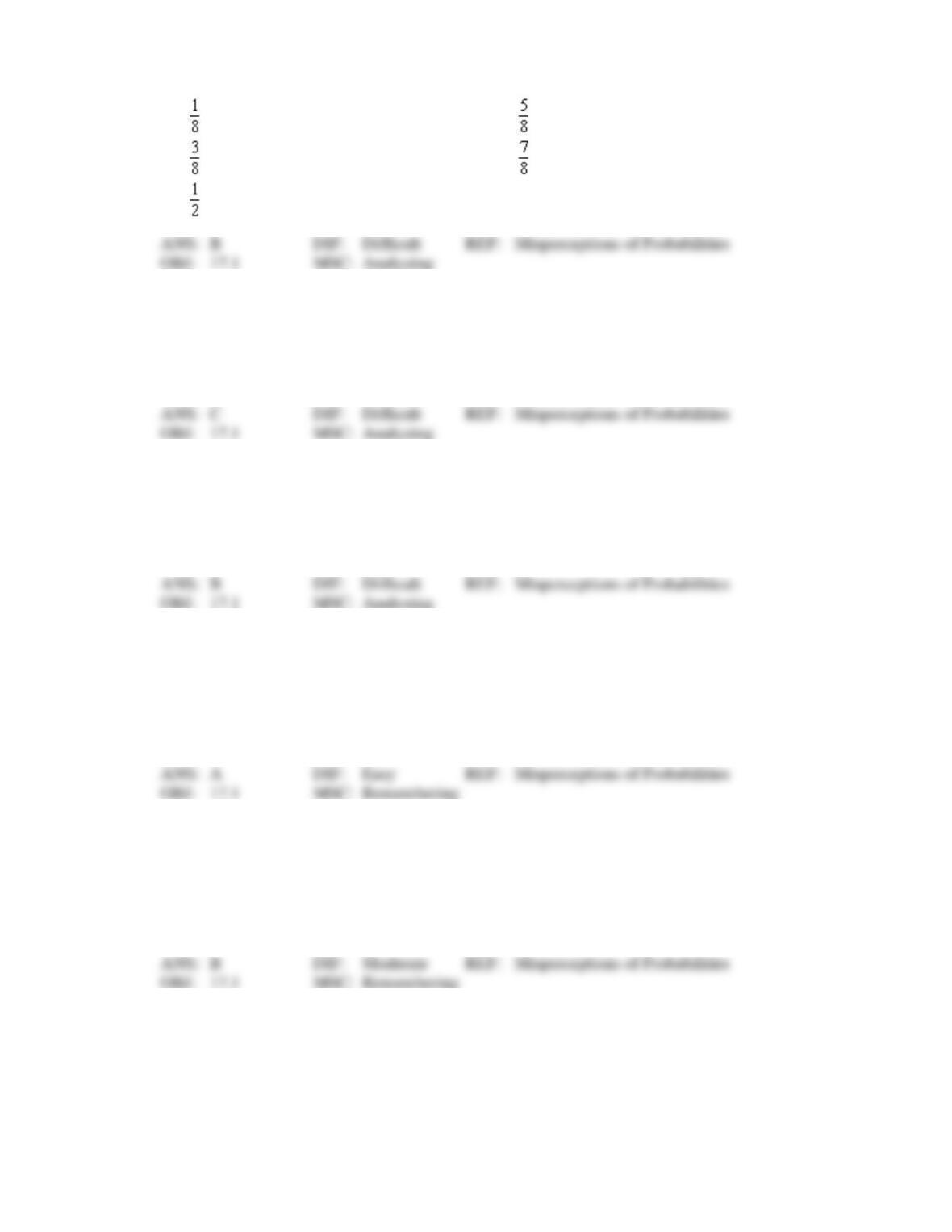
37. If the contestant changes buckets from the original bucket to one of the other buckets remaining,
what is the probability that the contestant will win the $100 bill?
a. d.
b. e.
c.
38. If the contestant changes buckets from the original bucket to one of the other buckets remaining,
what is the expected value of the game?
a. $32.50 d. $66.25
b. $40.00 e. $100.00
c. $43.75
39. If the contestant changes buckets from the original bucket to one of the other buckets remaining,
the expected value of the game rises from
a. $10.00 to $32.50. d. $66.25 to $67.50.
b. $32.50 to $43.75. e. $100.00 to $167.50.
c. $43.75 to $66.25.
40. In the context of behavioral economics, the belief that outcomes that have not occurred in the
recent past are more likely to occur soon, and that recent outcomes are unlikely to be repeated in
the near future is best referred to as the ________ fallacy.
a. gambler’s d. hot-hand
b. base-rate e. broken-window
c. existential
41. In the context of behavioral economics, the belief that outcomes that have not occurred in the
recent past are ________ likely to occur soon, and that recent outcomes are ________ to be
repeated in the near future is best referred to as the gambler’s fallacy.
a. more; likely d. less; unlikely
b. more; unlikely e. less; never going
c. less; likely
42. If 12 consecutive tosses of a fair coin have all been tails, some individuals tend to think that the
next one “must be heads.” This is an example of the ________ fallacy.
a. casino’s d. masked-man
b. dealer’s e. hot-hand
c. gambler’s
43. If 25 consecutive tosses of a fair coin have all been heads, some individuals tend to think that the
next one “must be tails.” This is an example of the ________ fallacy.
a. hot-hand d. definist
b. continuum e. gambler’s
c. broken-window
44. In the 1990s, researchers Clotfelter, Cook, and Terrel analyzed data from a particular game that
was offered in both the Maryland and New Jersey state lotteries. In the game, participants place a
bet and then guess a three-digit number. After all bets have been placed, a three-digit number is
randomly drawn by state lottery representatives. If a bettor correctly guesses the number drawn, he
or she wins a large prize. Consistent with the ________ fallacy, the researchers found clear
evidence that lottery players bet less often on a number that had won in the recent past.
a. hot-hand d. genetic
b. gambler’s e. naturalistic
c. casino’s
45. Suppose a student tosses a fair coin consecutively 10 times and gets tails each time. If the student
concludes that the next toss will be heads because heads “is due,” the student has committed the
________ fallacy.
a. hot-hand d. dealer’s
b. casino’s e. NBA
c. gambler’s
46. Miranda tosses a fair coin consecutively five times and gets heads each time. When her son Shane
asks her about the probability of getting tails on the next (sixth) toss, Miranda says the following:
“This is a fair coin, so I should toss heads approximately 50 percent of the time. Because I have
tossed heads 100 percent of the time for my first five tosses, then the probability of me tossing tails
on the sixth toss must be greater than 50 percent.” Miranda’s statement is an example of the
________ fallacy.
a. hot-hand d. dealer’s
b. association e. Showtime
c. gambler’s
47. Suppose a student tosses a fair coin consecutively 10 times and gets tails each time. Which belief
about the probability of getting heads on the next toss is NOT consistent with the gambler’s
fallacy?
a. The probability of getting heads on the next toss is .
b. The probability of getting heads on the next toss is .
c. The probability of getting heads on the next toss is .
d. The probability of getting heads on the next toss is .
e. The probability of getting heads on the next toss is .
48. The opposite of the gambler’s fallacy is the
a. hot-hand fallacy. d. dealer’s fallacy.
b. historian’s fallacy. e. mind-projection fallacy.
c. fallacy of single cause.
49. If 12 consecutive tosses of a fair coin have all been tails, some individuals tend to think that the
next one “must be tails.” This is an example of the ________ fallacy.
a. casino’s d. masked-man
b. dealer’s e. hot-hand
c. gambler’s
50. If 25 consecutive tosses of a fair coin have all been heads, some individuals tend to think that the
next one “must be heads.” This is an example of the ________ fallacy.
a. hot-hand d. definist
b. continuum e. gambler’s
c. broken-window
51. In the 1990s, researchers Clotfelter, Cook, and Terrel analyzed data from a particular game of
chance that was offered in both the Maryland and New Jersey state lotteries. In the game,
participants placed a bet and then guessed a three-digit number. After all bets had been placed, a
three-digit number was randomly drawn by state lottery representatives. If a bettor correctly
guessed the number drawn, the bettor won a large prize. The researchers found clear evidence that
lottery players bet less on a number that had won in the recent past. This finding indicates that the
________ fallacy is not at work.
a. hot-hand d. genetic
b. gambler’s e. naturalistic
c. casino’s
52. Titus and Lauren are playing a coin-tossing game where each player tosses a fair coin 20 times
consecutively. The winner of the game is the player who tosses the most consecutive tails. Titus
decides to go first and tosses tails five times in a row. Their parents, Margaret and Remi, are
observing the game and make the following observations before Titus attempts the sixth toss:
Margaret: The probability of Titus tossing tails has to be greater than 75 percent because he is on a
roll!
Remi: No, Margaret, the probability of Titus tossing tails has to be less than 25 percent
because he hasn’t tossed heads in the last five tosses and he is due to toss heads!
A behavioral economist would conclude that Margaret’s statement is an example of the ________
fallacy, and Remi’s statement is an example of the ________ fallacy.
a. continuum; hot-hand d. hot-hand; gambler’s
b. hot-hand; broken-window e. behavior; broken-window
c. gambler’s; hot-hand
53. Ricky’s statement is an example of the
a. Rickyism fallacy. d. hot-hand fallacy.
b. fallacy of single cause. e. gambler’s fallacy.
c. Sunnyvale fallacy
54. Ricky’s statement is an example of ________ fallacy, and Julian’s statement is an example of the
________ fallacy.
a. the hot-hand; hot-hand
b. the gambler’s; gambler’s
c. the hot-hand; gambler’s
d. the gambler’s; hot-hand
e. neither the gambler’s fallacy nor the hot–hand; gambler’s
55. Suppose a student tosses a fair coin consecutively seven times and gets tails each time. Which
belief about the probability of getting tails on the next toss is NOT consistent with the hot-hand
fallacy?
a. The probability of getting heads on the next toss is .
b. The probability of getting heads on the next toss is .
c. The probability of getting heads on the next toss is .
d. The probability of getting heads on the next toss is .
e. The probability of getting heads on the next toss is .
56. A ________ effect occurs when an answer depends on how a question is asked or when a decision
is influenced by the way alternatives are presented.
a. framing d. priming
b. hot-hand e. behaviorist
c. Hayekian
57. ________ occur when the ordering of the questions that are asked influences the answers.
a. Rational expectations d. Priming effects
b. Hot-hand effects e. Quasi-rational effects
c. Fairness effects
58. Priming effects
a. occur when the ordering of the questions that are asked influences the answers.
b. occur when the ordering of the questions that are asked does not influence the answers.
c. occur when a decision maker makes a rational decision based on a complete assessment of the
costs and benefits.
d. are observed only in the context of political affairs.
e. are observed only when the decision maker has an advanced graduate degree in particle
physics.
59. Suppose 1,000 students were split into two groups of 500. Both groups were first presented with an
image of a new high-end pair of jeans produced by Tommy Hilfiger, a clothing company.
The first group was given the following statement and then asked the following question: “The
normal retail price of these jeans is $100. Would you be willing to pay $75 for them?”
The second group was given the following statement and then asked the following question:
“The normal retail price of these jeans is $250. Would you be willing to pay $75 for them?”
Suppose that 24 percent of the students in the first group answered yes and that 73 percent of
the students in the second group answered yes. It is likely that more students in the second group
were willing to pay $75 for the pair of jeans because they were told the normal price was much
higher. This is an example of a ________ effect in decision-making.
a. clothing d. framing
b. marketing e. psychosomatic
c. utilitarian
60. Suppose 5,000 students were split into two groups of 2,500. Both groups were first presented with
an image of a new high-end pair of shoes produced by UGG, a footwear company.
The first group was given the following statement and then asked the following question: “The
normal retail price of these shoes is $200. Would you be willing to pay $125 for them?”
The second group was given the following statement and then asked the following question:
“The normal retail price of these shoes is $450. Would you be willing to pay $125 for them?”
Suppose that 13 percent of the students in the first group answered yes and that 63 percent of
the students in the second group answered yes. It is likely that more students in the second group
were willing to pay $125 for the pair of shoes because they were told the normal price was much
higher. This is an example of a ________ effect in decision-making.
a. bootstrapping d. framing
b. market-making e. psychosomatic
c. utilitarian
61. Suppose 600 cancer patients have identical diagnoses. The patients are separated into two groups
of 300 and asked the following questions regarding a potentially beneficial radiation therapy
treatment.
The first group was given the following statement and then asked the following question:
“Statistically, 950 out of every 1,000 cancer patients survive more than two years following the
radiation treatment. Would you be willing to undergo the radiation treatment?”
The second group was given the following statement and then asked the following question:
“Statistically, 50 out of every 1,000 cancer patients die within the two years following the radiation
treatment. Would you be willing to undergo the radiation treatment?”
Suppose that 78 percent of the patients in the first group answered yes and that 31 percent of
the patients in the second group answered yes. Because the first statement that was given to both
groups essentially states the same statistical fact in a different way, the significant difference in the
answers recorded for each group is likely an example of a ________ effect in decision-making.
a. placebo d. wording
b. Taylorian e. framing
c. utilitarian
62. Suppose 1,000 college students are separated into two groups. The first group is asked the
following questions in this order: “How happy are you with your college experience?” followed by
“How many friends have you made in college?”
The second group is asked the following questions in this order: “How many friends have you
made in college?” followed by “How happy are you with your college experience?”
Further suppose that students in the second group who reported that they had met more friends
in college reported being much happier than did similar students in the first group. This is an
example of ________ effects.
a. rationality d. financial aid
b. priming e. felinarian
c. dorm room
63. Suppose 8,000 residents at an apartment complex are separated into two groups. The first group is
asked the following questions in this order: “How happy are you with your experience at the
apartment complex?” followed by “How many social gatherings held at the apartment complex
have you been invited to?”
The second group is asked the following questions in this order: “How many social gatherings
held at the apartment complex have you been invited to?” followed by “How happy are you with
your experience at the apartment complex?”
Further suppose that residents in the second group who reported that they had been invited to
more social gatherings held at the apartment complex reported being much happier with their
experience at the apartment complex than did similar residents in the first group. This is an
example of ________ effects.
a. Kahnemanian d. market capitalization
b. Rothbardian e. priming
c. internal rate of return
64. Suppose 500 residents of a dormitory are separated into two groups. The first group is asked the
following questions in this order: “How happy are you with your experience living in the
dormitory?” followed by “How many social gatherings held in the dormitory have you been
invited to?”
The second group is asked the following questions in this order: “How many social gatherings
held in the dormitory have you been invited to?” followed by “How happy are you with your
experience living in the dormitory?”
Further suppose that residents in the second group who reported that they had been invited to
fewer social gatherings held in the dormitory reported being less happy with their experience living
in the dormitory than did similar residents in the first group. This is an example of ________
effects.
a. priming d. market capitalization
b. Kahnemanian e. Rothbardian
c. internal rate of return
65. Suppose that 84 percent of customers hearing the sales pitch from the first group purchased the
warranty and that 19 percent of the customers hearing the sales pitch from the second group
purchased the warranty. The managers concluded that ________ were likely present and changed
company policy such that all salespeople are required to recite the sales pitch given by the first
group.
a. fairness effects d. concerns about fairness
b. rational effects e. framing effects
c. electronic aptitude effects
66. Suppose that 34 percent of customers hearing the sales pitch from the first group purchased the
warranty and that 34 percent of the customers hearing the sales pitch from the second group
purchased the warranty. The managers concluded that ________ were not present, so it did not
matter how the question about purchasing the warranty was asked.
a. rational effects d. framing effects
b. electronic aptitude effects e. fairness effects
c. concerns about fairness
67. The researchers found that 401(k) participation is significantly higher under automatic enrollment.
One possible explanation for this finding is that
a. there was a large shift in the employees’ preferences for savings the day plan changes were
implemented.
b. framing effects have no influence in employee 401(k) participation decisions.
c. framing effects have a significant influence in employee 401(k) participation decisions.
d. employees will always choose whether to participate based entirely on the economic features
of the plan, not the way the decision to participate is framed.
e. employees are acting rationally in the context of standard economic models.
68. A finding of no significant difference in 401(k) plan participation after the plan change provides
evidence that employee 401(k) participation decisions are made ________, and ________ effects
do not exist in the context of 401(k) plan participation.
a. rationally; rational d. irrationally; framing
b. irrationally; priming e. rationally; fairness
c. rationally; framing
69. When people want to maintain their current lifestyles and are reluctant to change, they may exhibit
what is known as the
a. hot-hand fallacy. d. hot-hand bias.
b. gambler’s fallacy. e. gambler’s bias.
c. status quo bias.
70. In behavioral economics, ________ suggests that people place more value on avoiding losses than
attempting to realize gains.
a. prospect theory d. the availability heuristic
b. gain aversion e. the bandwagon effect
c. the ambiguity effect
71. ________ applies when a person places more value on avoiding losses than attempting to realize
gains.
a. The availability heuristic d. The halo effect
b. Prospect theory e. The availability cascade
c. The trait ascription bias
72. The ________ bias leads decision-makers to try to protect what they have, even when an objective
evaluation of their circumstances suggests that a change would be beneficial.
a. egocentric d. status quo
b. choice-supportive e. outcome
c. time-saving
73. The ________ is a cognitive bias that leads people to prefer things to change as little as possible.
a. status quo bias d. gambler’s fallacy
b. gambler’s bias e. hot-hand bias
c. hot-hand fallacy
74. In 1980, the Schlitz Brewing Company conducted several beer taste tests on live television during
NFL football games. One hundred confirmed Budweiser drinkers (who had each signed an
affidavit stating that he or she drank at least 12 bottles of Budweiser each week) were each served
a glass of both Schlitz and Budweiser in unmarked containers. After tasting both beers, the
members of the group were asked which beer they preferred. Between 45 percent and 55 percent of
the participants responded that they preferred Schlitz, even though they were confirmed Budweiser
drinkers.
Which bias can likely explain why the participants in the group displayed such strong brand
allegiance to Budweiser prior to the taste test?
a. the availability heuristic d. status quo bias
b. the trait ascription bias e. the Rupertorian effect
c. the availability cascade
75. Trevor has been purchasing Fruity Pebbles brand cereal each week for the past two years, even
though a different brand, such as Captain Crunch or Rice Krispies, would in all likelihood bring
him more utility per dollar spent. A behavioral economist would suspect Trevor is suffering from
the ________ bias.
a. choice-supportive d. time-saving
b. status quo e. outcome
c. egocentric
76. For the past five years, Benjamin has been purchasing Citizens of Humanity brand jeans each time
he needs a new pair of jeans, even though a different brand, such as RocaWear or Ecko, would in
all likelihood bring him more utility per dollar spent. A behavioral economist would suspect
Benjamin is suffering from the ________ bias.
a. egocentric d. status quo
b. choice-supportive e. outcome
c. time-saving
77. Regina and Brenda are considering playing a game called Matching Twenties. In this game,
Regina and Brenda will each place a $20 bill on the table. Both players will then toss a fair coin. If
both Regina and Brenda toss heads or both Regina and Brenda toss tails, Regina wins the $40 on
the table. If one woman tosses heads and the other tosses tails, Brenda wins the $40 on the table.
Regina decides that she is not willing to play this game because a loss of $20 to Brenda would
cause her to lose more utility than she would gain if she won $20 from Brenda. Which concept best
explains Regina’s choice not to play the game?
a. hedonic editing d. signaling
b. gain aversion e. gain-loss asymmetry
c. prospect theory
78. Mario knows that, over the long run, it is in his best interest to save at least 10 percent of his
paycheck for retirement. However, each time he receives his weekly paycheck of $1,000, he ends
up spending it all and not depositing any to a retirement account. Mario has resolved to contact his
employer’s Human Resources Department to set up a 401(k) work-sponsored retirement account
where the 10 percent would be deducted automatically from his paycheck before it is issued to him
each week. It is apparent from this information that Mario realized
a. his intertemporal decisions are inconsistent and he had to take action to make them consistent.
b. his intertemporal decisions are consistent and he had to take action to make them inconsistent.
c. it is better for him to handle sending money to a retirement account than to rely on his
employer to send the money to a retirement account on his behalf.
d. he should not be saving for retirement after all because his short-run preferences to spend his
entire paycheck are perfectly indicative of his long-run preferences.
e. he should not worry about the future anymore because it will take care of itself.
79. At the beginning of a semester, a group of five students (Marcus, Gerard, Penelope, Zendaya, and
Duane) are asked to order a snack that the teacher will deliver to the students free of charge before
the first class of the tenth week of the semester. The three choices are an apple, a banana, or a
Snickers candy bar. The teacher collects the orders and finds that two students have ordered an
apple, two students have ordered a banana, and one student has ordered a Snickers candy bar. The
four students who ordered either an apple or a banana cite health consciousness as the reason for
their choice.
Immediately before the orders are scheduled to be delivered, the teacher informs the students
that they can switch their choice and order something else from the original menu if they wish, or
they can receive what they originally ordered. Which of the following scenarios is the best
example of inconsistent intertemporal decision-making?
a. Marcus originally ordered an apple and did not change his choice when prompted.
b. Gerard ordered a banana and switched to an apple when prompted.
c. Penelope ordered an apple and switched to a banana when prompted.
d. Zendaya ordered a banana and switched to a Snickers candy bar when prompted.
e. Duane ordered a Snickers candy bar and did not change his choice when prompted.
80. The ________ game is an economic experiment in which two players decide how to divide a pot of
money.
a. prisoner’s dilemma d. ultimatum
b. hawk-dove e. hot-hand dilemma
c. behavioral economics
81. The ________ game is a common game that behavioral economists use in an experimental setting
to study how fairness enters into the rational decision-making process.
a. ultimatum d. gambler’s dilemma
b. prisoner’s dilemma e. hawk-dove
c. behavioral economics
82. Jocelyn and Rhonda are playing an ultimatum game where Jocelyn is given $100 and asked to
propose a way of splitting it with Rhonda. When Rhonda learns Jocelyn’s proposal, Rhonda
chooses whether to accept or reject the split. If Rhonda accepts the split, both players receive the
money according to Jocelyn’s split proposal. If Rhonda rejects the split, both players receive
nothing. This game will be played only once, so Rhonda does not have to worry about reciprocity
when making her choice. Traditional economic theory presumes that
a. both players are irrational and wish to minimize the payoff to the other player.
b. both players are irrational and wish to maximize their own payoff.
c. both players are rational and wish to minimize their own payoff.
d. both players are rational and wish to maximize their own payoff.