Microeconomics: Theory and Applications with Calculus, 3e (Perloff)
Chapter 17 Property Rights, Externalities, Rivalry, and Exclusion
17.1 Externalities
1) If children go to school and become productive members of society,
A) a negative externality is created by the schools.
B) a positive externality is created by the schools.
C) no externality is created by the schools.
D) an externality is created that may be positive or negative.
2) Students who talk loudly with each other in class
A) create an externality because other students cannot follow the lecture as well.
B) disturb nobody.
C) benefit the other students in class because they engage in conversation.
D) only create an externality if they talk about something unrelated to class.
3) Positive externalities are created when
A) other consumers reduce their demand for coffee and price thereby declines.
B) farmers spray pesticide in their fields and it washes into the local river after the first rainstorm.
C) your neighbor plants beautiful trees and flowers in her yard.
D) you purchase the “Mona Lisa” and lock it in a vault.
4) Negative externalities are created when
A) an increase in the price of butterfat drives up the price of ice cream.
B) a driver leaves his car in a parking space after the meter expires and receives a ticket.
C) a driver drives recklessly on a busy highway.
D) a driver pulls over to help a stranded motorist fix a flat tire.
5) The price of pie increases. Some people who purchased pie before the price increase no longer
purchase pie. This is
A) a positive externality.
B) a negative externality.
C) a positive externality for some consumers and a negative externality for others.
D) not an externality.
6) In general, an externality is created when
A) people are affected (other than by price) by a transaction which they were not part of.
B) firms produce a product of low quality and consumers don’t like it.
C) firms have to pay for pollution the environment.
D) the government subsidizes education.
7) Which of the following statements about externality is INCORRECT?
A) Pollution of a chemical plant will create negative externalities to the residents living in the
neighborhood.
B) Trees planted in the backyard of a house could create positive externalities to the pedestrians passing
under.
C) Extra output sold by a firm that lowers the market price creates negative externalities to its rivals.
D) A single action may confer positive externalities on some people, but negative externalities on others.
For the following, please answer “True” or “False” and explain why.
8) Changing the price of a good will usually result in a negative externality.
9) You are having a party and one of your guests lights up a cigar without asking. Explain why this
creates an externality.
17.2 The Inefficiency of Competition with Externalities
1) If a production process creates pollution, a competitive market produces excessive pollution because
A) the firms do not include the social cost of the pollution in their profit-maximizing decisions.
B) the firms place too high a price on society’s cost of inflation.
C) people are not injured by the pollution.
D) zero pollution is optimal.
2) Which of the following statements about private and social costs is TRUE?
A) Social costs include externalities.
B) Private cost do not include externalities.
C) Social costs are never smaller than private costs.
D) All of the above.
3) Which of the following statements about private and social costs is TRUE in the presence of negative
externalities created by pollution?
A) Competitive market produces excessive pollution.
B) The optimal amount of pollution is zero.
C) Social costs exclude externalities.
D) Social producer surplus exceeds private producer surplus.
4) In the presence of pollution, social welfare is maximized by
A) reducing output and pollution until marginal benefit of less pollution is equal to the marginal cost of
less output.
B) reducing output and pollution until the benefit curve (of less pollution) and cost curve (of less output)
intersect.
C) reducing output and pollution until the benefits of pollution reduction just cover the costs of output
reduction.
D) None of the above.
5) If a production process creates pollution, a competitive market produces excessive pollution because
A) private marginal cost of pollution exceeds its social marginal cost.
B) social marginal cost of pollution exceeds its private marginal cost.
C) the marginal benefit of pollution to the firm is zero.
D) zero pollution is optimal.
6) If a production process creates positive externalities, a competitive market produces too few positive
externalities because the producer
A) does not pay all the costs of the externalities.
B) does not receive compensation for the externalities.
C) Both A and B.
D) None of the above.
7) In the presence of no externalities,
A) social marginal cost exceeds private marginal cost.
B) social marginal cost is less than private marginal cost.
C) social marginal cost equals private marginal cost.
D) social marginal cost and private marginal cost cannot be compared.
8) If a production process generates pollution, then a competitive market will
A) produce more of the good than is socially optimal.
B) produce less of the good than is socially optimal.
C) produce the socially optimal quantity of that good.
D) produce zero output.
9) If a production process generates pollution, then a competitive market will produce more of the good
than is socially optimal because
A) firms take all costs into consideration.
B) firms incur all costs of production but ignore some of them.
C) firms ignore the costs of production that they do not incur.
D) firms set price equal to social marginal cost.
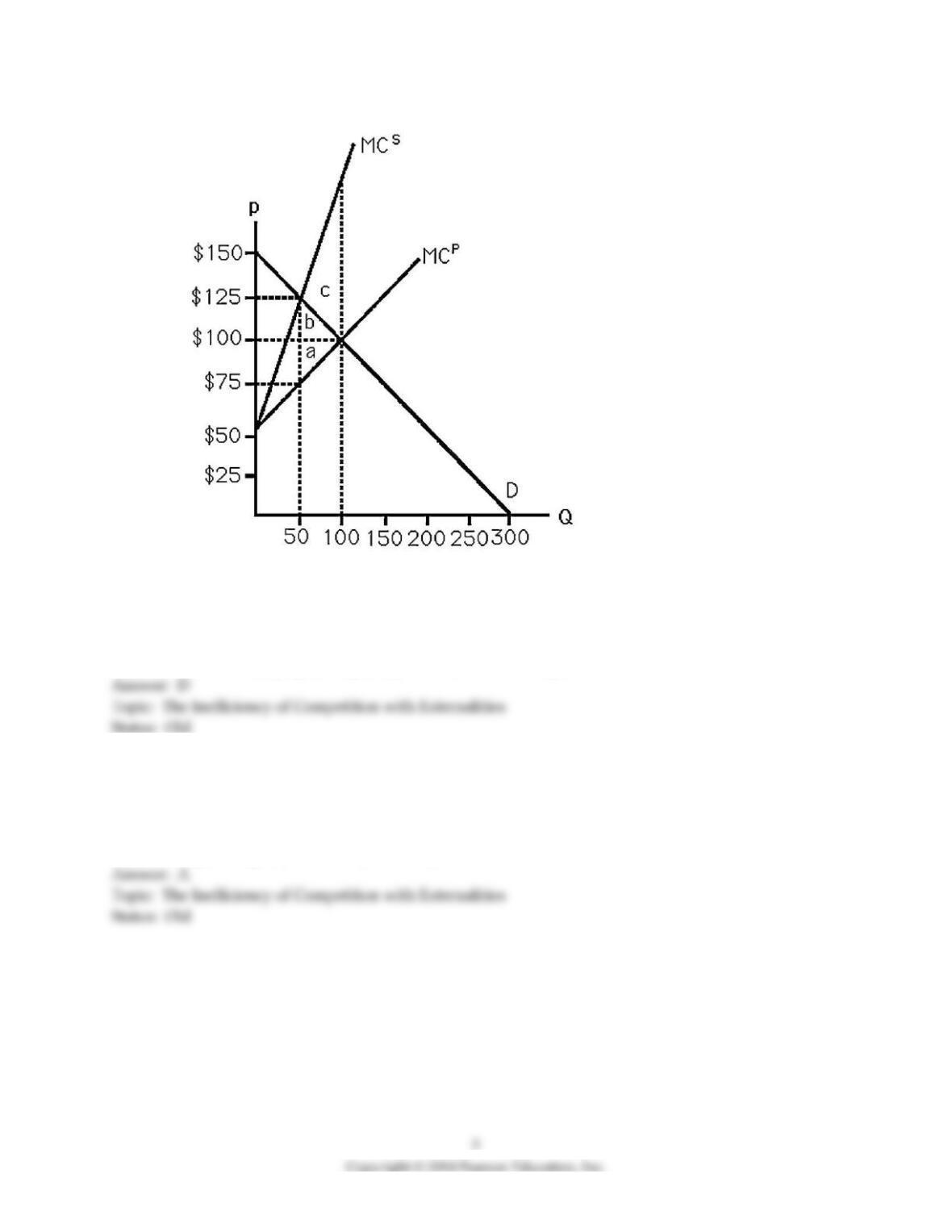
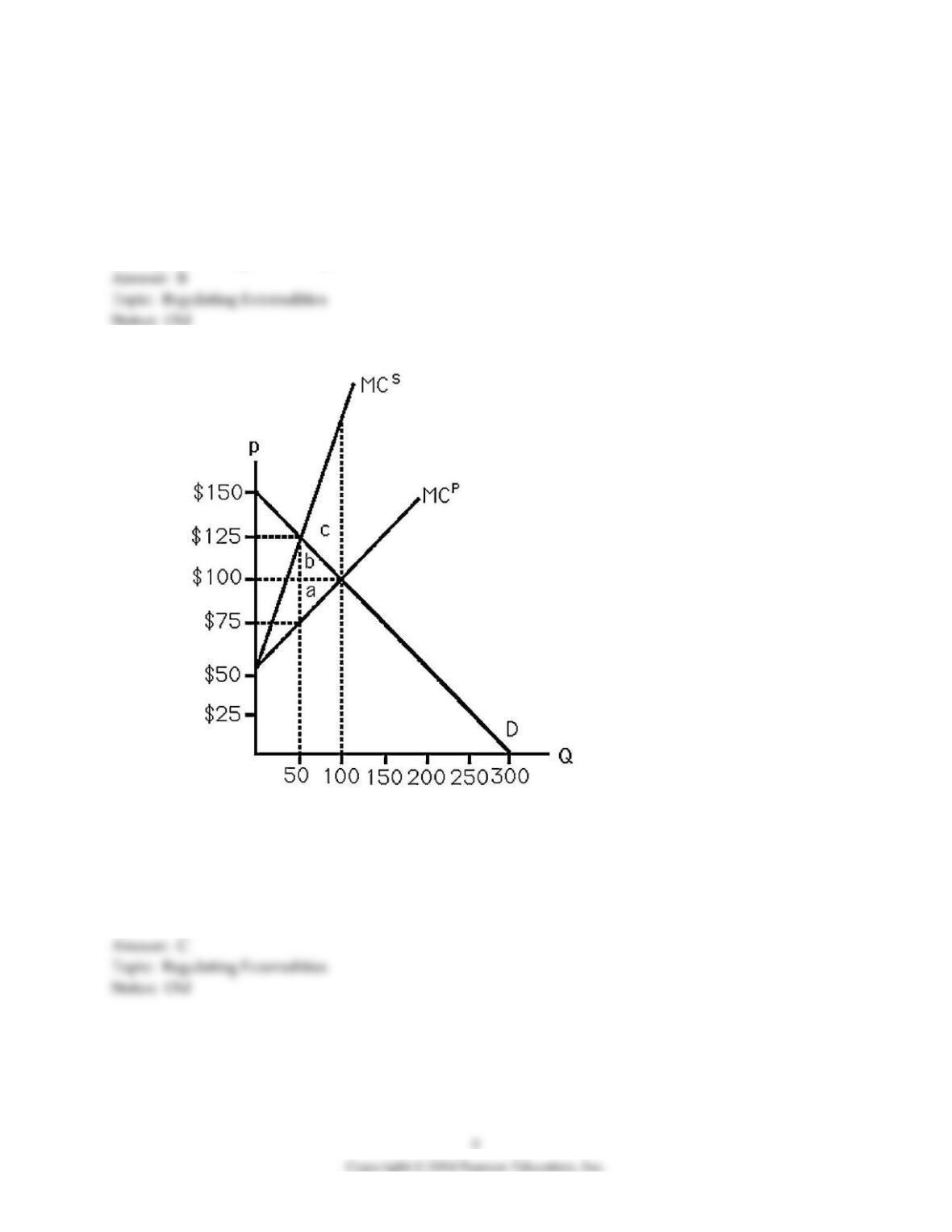
10) The above figure shows the market for steel ingots. If the market is competitive, then
A) the socially optimal quantity of steel is zero.
B) the socially optimal quantity of steel of 50 units is produced.
C) the socially optimal quantity of steel of 100 units is produced.
D) more than the socially optimal quantity of 50 units of steel is produced.
11) The above figure shows the market for steel ingots. An externality can be seen because
A) the social marginal cost exceeds the private marginal cost.
B) the private marginal cost exceeds the social marginal cost.
C) the optimal quantity of steel is zero.
D) not enough steel gets produced by the competitive market.
12) If a market is subject to a positive externality,
A) the demand curve reflecting social benefit will be to the right of the demand curve representing
private benefit.
B) there is only one demand curve.
C) the demand curve reflecting social benefit will be to the left of the demand curve representing private
benefit.
D) private benefit will exceed social benefit.
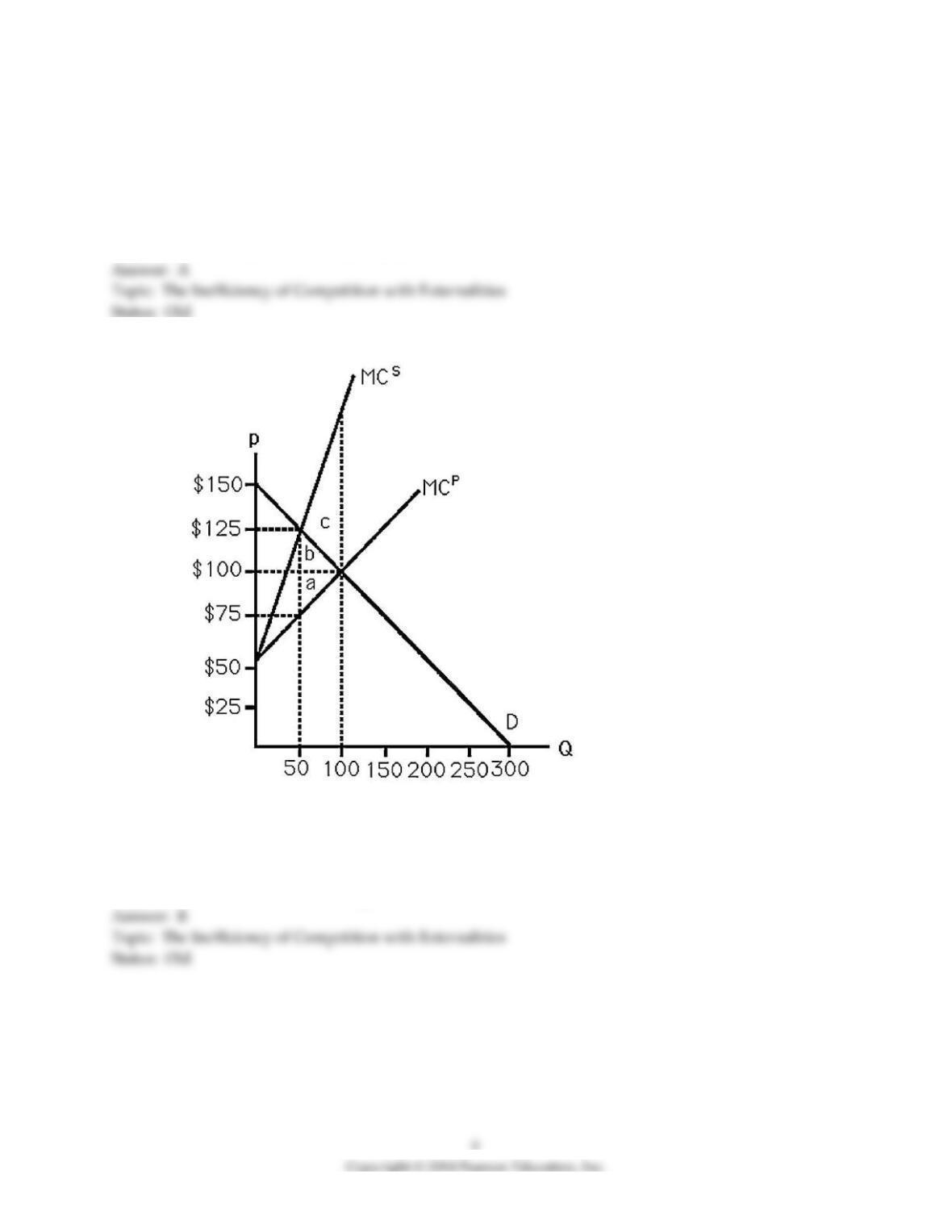
13) The above figure shows the market for steel ingots. The socially optimal quantity of steel is
A) 0 units.
B) 50 units.
C) 100 units.
D) produced if the market were competitive.
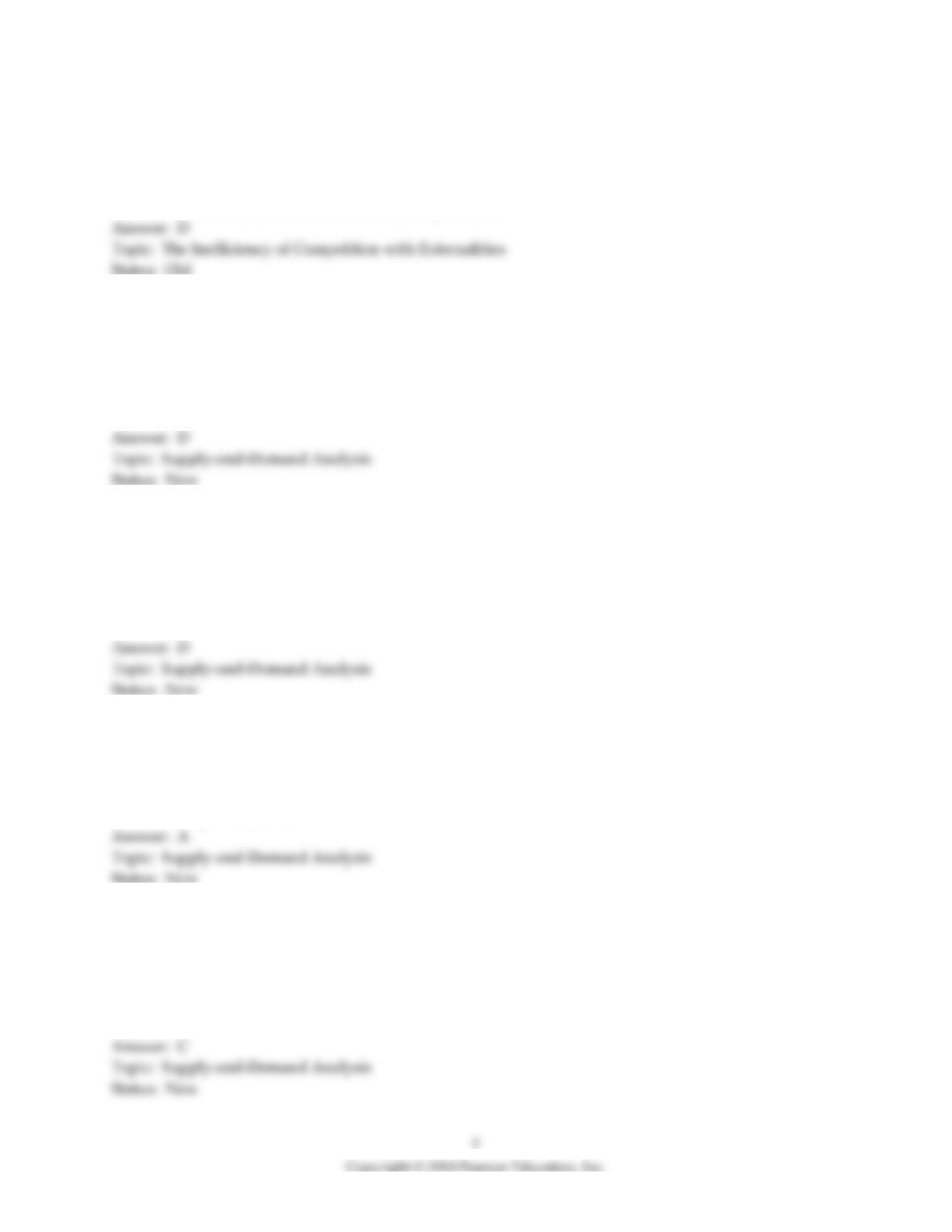
14) The above figure shows the market for steel ingots. The optimal quantity of pollution
A) is 0 units.
B) is 50 units.
C) is 100 units.
D) cannot be determined from the information provided.
15) The above figure shows the market for steel ingots. At the social optimum, the private producer
surplus is
A) $1250.
B) $1875.
C) $2500.
D) $3100.
16) The above figure shows the market for steel ingots. What is the change in externality cost if the market
switches from competitive equilibrium to social optimum?
A) a + b
B) b + c
C) c
D) a + b + c
17) The above figure shows the market for steel ingots. What is the total surplus under social optimum?
A) $2500
B) $5000
C) $6500
D) Not enough information.
18) The above figure shows the market for steel ingots. What is the change in consumer surplus if the
market switches from competitive equilibrium to social optimum?
A) $625
B) $1250
C) $1875
D) $2500
19) In a competitive market, a negative externality creates a deadweight loss because
A) the cost of the externality is double counted.
B) a harm is generated.
C) price equals social marginal cost.
D) price equals private marginal cost.
For the following, please answer “True” or “False” and explain why.
20) In the presence of a negative externality generated by producing a good, a competitive market will
produce more of that good than is socially optimal.
21) Suppose that in the market for paper, demand is p = 100 – Q. The private marginal cost is MCP = 10 +
Q. Pollution generated during the production process creates external marginal harm equal to MCe = Q.
Is social welfare greater under monopoly or under competition?
22) In terms of cost-benefit analysis, explain why a competitive market with an externality produces too
much pollution.
23) Explain why the optimal amount of pollution is often not zero.
17.3 Regulating Externalities
1) In the presence of an negative externality, a specific tax can achieve the social optimum because
A) output is reduced to zero as a result.
B) it internalizes the external cost.
C) it directly charges the producer for polluting.
D) the price of the good rises by the full amount of the tax.
2) The above figure shows the market for steel ingots. If the market is competitive, then the deadweight
loss to society is
A) a.
B) b.
C) c.
D) zero.
3) The above figure shows the market for steel ingots. If the market is competitive, then to achieve the
socially optimal level of pollution, the government can
A) outlaw the production of steel.
B) institute a specific tax of $25.
C) institute a specific tax of $50.
D) institute a specific tax equal to area b.
4) The above figure shows the market for steel ingots. If the market is competitive, then to achieve the
socially optimal level of pollution, the government can
A) outlaw the production of steel.
B) institute an ad valorem tax of 33.3%.
C) institute an ad valorem tax of 50%.
D) institute an ad valorem tax of 66.7%.
5) The above figure shows the market for steel ingots. If the market is competitive, and the government
institutes a $100 specific tax on steel, then
A) less than the socially optimal quantity of steel is produced.
B) the socially optimal quantity of steel of 50 units is produced.
C) the socially optimal quantity of steel of 100 units is produced.
D) more than the socially optimal quantity of steel is produced.
6) Which of the following belongs to the government regulation to control pollution?
A) emissions standard
B) emissions fee
C) effluent charge
D) All of the above
For the following, please answer “True” or “False” and explain why.
7) To maximize welfare in a competitive market that has a negative externality in production,
government should tax a pollution-generating good at a specific tax equal to the marginal cost of
producing the good.
8) Suppose that in the market for paper, demand is p = 100 – Q. The private marginal cost is MCp = 10 + Q.
Pollution generated during the production process creates external marginal harm equal to MCe = Q.
What specific tax would result in a competitive market producing the socially optimal quantity of paper?
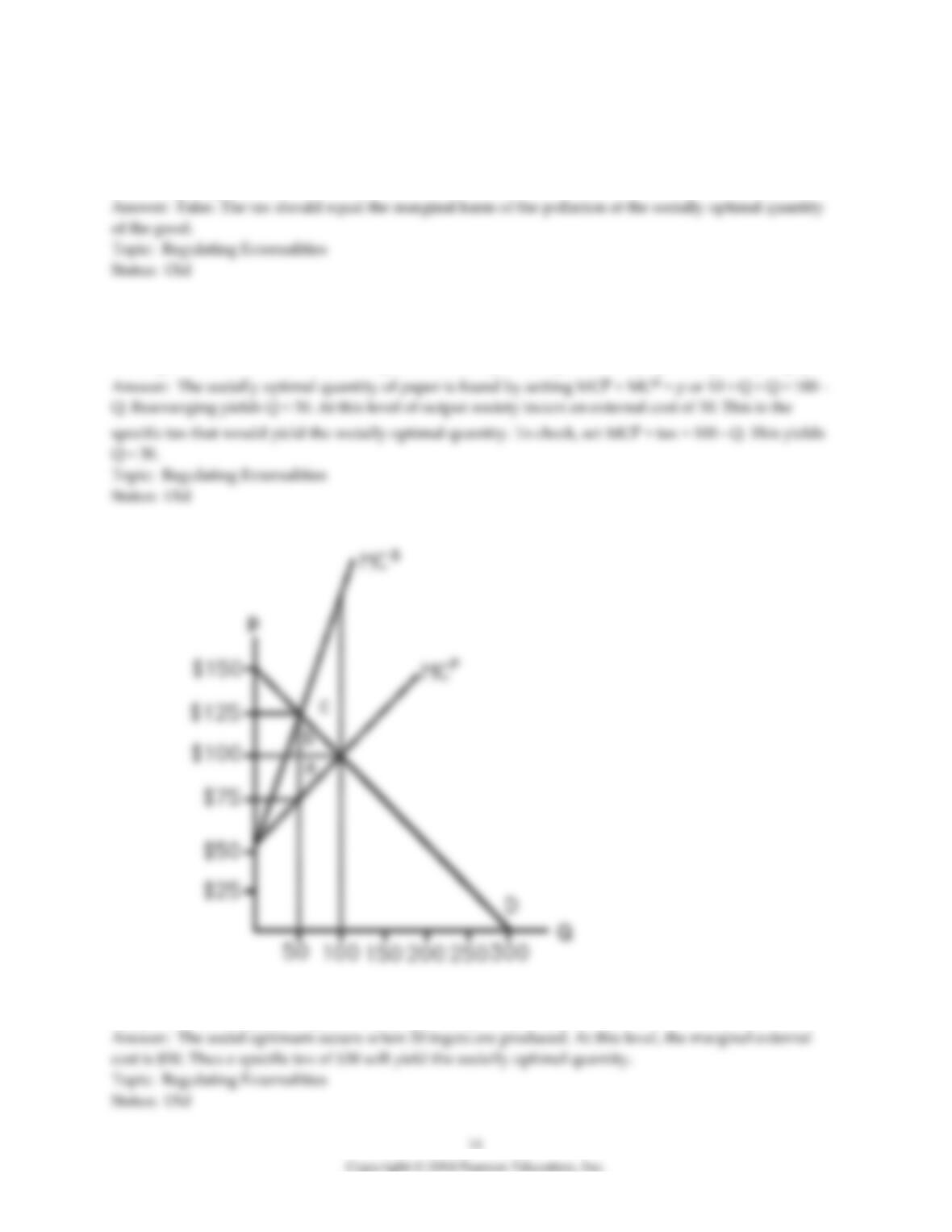
9) Suppose that the market for steel is shown in the above figure. What specific tax would result in a
competitive market producing the socially optimal quantity of steel?
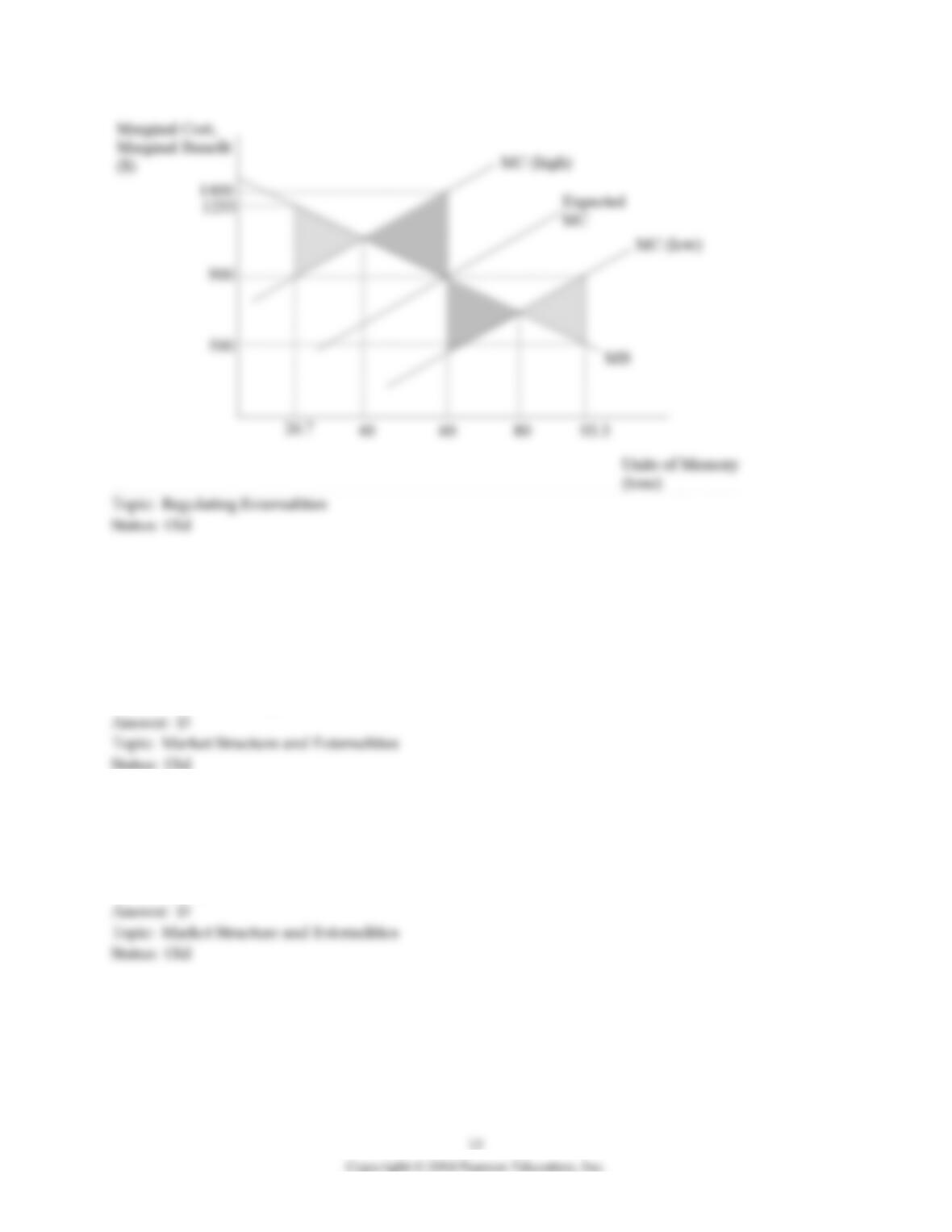
10) Suppose the government wishes to regulate mercury emissions of factories in a specific industry by
either setting an emissions standard or imposing an emissions fee (per ton of mercury). The government
is uncertain as to the marginal abatement costs, which may be high (MC1) or low (MC2).
MC1 = 15M + 500
MC2 = 15M – 500
where M is the units of mercury abated. The government believes there is a 50% chance of each of the
marginal abatement costs. The marginal benefit of abatement is known to be:
MB = 1500 – 10M
a. What is the optimal level of emissions for each of the cost curves above?
b. What is the expected marginal abatement cost (equation)?
c. What is the optimal emissions standard according to the expected abatement costs?
d. What is the optimal abatement fee according to the expected abatement costs?
e. Which regulation will result in a lower DWL in the presence of the uncertainty? Explicitly compute
the expected DWL arising from each proposal.
17.4 Market Structure and Externalities
1) In the presence of a negative externality in production, a monopoly will produce
A) more than the social optimum.
B) less than the social optimum.
C) the social optimum.
D) All of the above are possible.
2) Because a monopoly ignores external costs, it is possible that it will
A) produce the socially optimal quantity of a good.
B) produce more than the socially optimal quantity of a good.
C) produce less than the socially optimal quantity of a good.
D) All of the above.
3) A monopoly might produce less than the socially optimal amount of pollution because
A) it likes to be a good citizen.
B) it sets price above marginal cost.
C) it earns economic profit.
D) it internalizes the external costs.
4) If the social marginal cost of a good is very high relative to the private marginal cost, then a monopoly
will most likely
A) produce more than the social optimum.
B) produce less than the social optimum.
C) produce the social optimum.
D) produce zero pollution.
5) Production of a good produces pollution that is very damaging with each additional unit. A monopoly
facing a very elastic demand curve will most likely produce
A) less than the social optimum of the good.
B) more than the social optimum of the good.
C) the social optimum of the good.
D) no externality.
6) If both a monopoly and a competitive market with the same marginal cost would produce a quantity
that is greater than the social optimum in a market because of externalities, then
A) welfare is greater under monopoly.
B) welfare is greater under competition.
C) welfare is the same for both market structures.
D) the social optimum must be zero.
7) A specific tax in a monopoly market equal to the marginal harm of pollution
A) will increase welfare.
B) will decrease welfare.
C) will leave welfare unchanged.
D) All of the above are possible.
8) Monopolizing the sale of liquor
A) can lead to an increase total welfare.
B) will decrease total welfare.
C) results in a deadweight loss.
D) is anti-competitive and thus lowers total welfare.
9) A tax on a previously untaxed monopoly-produced good will necessarily lower total welfare if
A) the demand curve is relatively inelastic.
B) the demand curve is relatively elastic.
C) less than the socially optimum is produced before the tax.
D) more than the socially optimum is produced before the tax.
For the following, please answer “True” or “False” and explain why.
10) Because a monopoly will produce less of a good than a competitive market will, welfare is always
greater under monopoly than under competition in the presence of a negative externality.
11) When negative externalities from production exist, the deadweight loss from a competitive market
may be larger than with a monopoly.
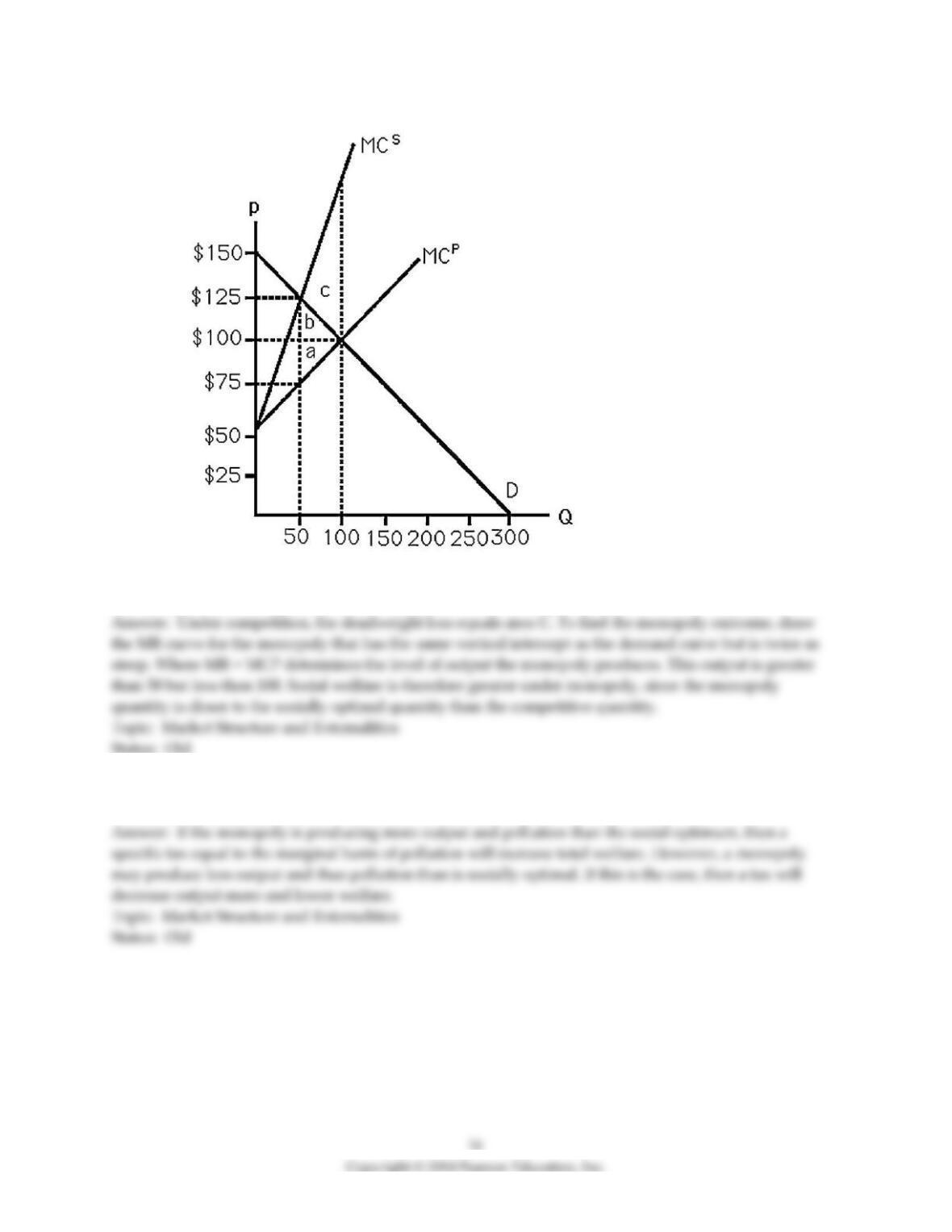
12) Suppose that the market for steel is shown in the above figure. Is social welfare greater under
monopoly or under competition?
13) Explain how a specific tax equal to the marginal harm of pollution can increase or decrease total
welfare in a monopoly market.