3) A(n) ________ in aggregate demand will result from a decrease in ________.
A) decrease; inflation
B) increase; taxes
C) increase; the budget deficit
D) increase; government purchases
4) According to the IS curve, the tax multiplier is always ________.
A) larger in absolute value than the expenditure multiplier
B) equal to the expenditure multiplier
C) smaller in absolute value than the expenditure multiplier
D) equal to one
5) The impact of a change in taxes on income is likely to be less than the effect resulting from a
change in government spending since ________.
A) the federal government typically operates in a deficit situation
B) exports and imports can only assume positive values, but net exports can be positive or
negative
C) changes in the supply of money will be necessary if government spending is increased
D) changes in taxes exert an indirect impact on total spending through changes in consumption
6) The American Recovery and Reinvestment Act of 2009 ________.
A) offered a mix of tax cuts and spending increases
B) relied primarily on monetary expansion to achieve its ends
C) was consistently opposed by the Obama Administration
D) provided direct subsidy support to troubled financial institutions such as hedge funds
7) The American Recovery and Reinvestment Act of 2009 provided ________.
A) tax cuts of $288 million and a government spending increase of $499 million
B) tax cuts of $288 million and a government spending increase of $499 billion
C) tax cuts of $288 billion and a government spending increase of $499 billion
D) tax cuts of $288 trillion and a government spending increase of $499 trillion
8) What is the relationship between fiscal multipliers and the “zero lower bound”?
A) Fiscal multipliers cannot fall below zero.
B) When monetary policy has hit the zero lower bound, fiscal multipliers are likely to be larger
than normal.
C) At the zero lower bound, a fiscal contraction is actually expansionary.
D) At the zero lower bound, fiscal policy works by shifting the aggregate supply curve, rather
than shifting the aggregate demand curve.
9) The tax multiplier is most likely to be larger than the expenditure multiplier when ________.
A) monetary policy is at the zero lower bound
B) rising inflation causes the real interest rate to decline
C) when the change in tax revenue is large relative to the change in government purchases
D) the expansionary fiscal policy is expected to be followed by higher taxes
10) Taxes on wages, such as Social Security taxes, are known as ________.
A) payroll taxes
B) lump sum taxes
C) capitol hill gains
D) cost of living adjustments (COLAs)
11) Payroll taxes levy taxes on ________.
A) consumption
B) imports
C) wages
D) exports
12) A cut in the payroll tax will tend to cause, other things the same, ________.
A) a change in aggregate demand, with no effect on supply
B) a change in both aggregate demand and supply
C) a change in aggregate supply, with no effect on demand
D) no change in either aggregate demand or supply
13) Supply-side economics focuses on ________.
A) the positive effect of tax cuts on aggregate supply
B) the impact of an increase in the rate of inflation on aggregate supply
C) the impact of changes in aggregate supply on market demand
D) the trade-off between aggregate demand and aggregate supply
14) According to supply-side theory, a cut in taxes will tend to cause ________.
A) a decline in the amount of total tax revenue collected
B) no change in the amount of total tax revenue collected
C) an increase in the amount of total tax revenue collected
D) individual workers to devote more time to leisure activities
15) According to supply-side economics, a cut in taxes will affect total tax revenue, because
________.
A) the level of productivity should fall precipitously with a tax cut
B) a tax cut will be followed by an even larger decrease in government spending
C) of the resulting increase in saving
D) of the positive impact on the level of income
16) According to supply-side theory, if one starts from a balanced budget, a cut in taxes will tend
to cause ________.
A) a budget deficit
B) no change in the federal government budget
C) a decrease in aggregate supply and an increase in aggregate demand
D) a budget surplus
15
Fiscal Policy Analysis
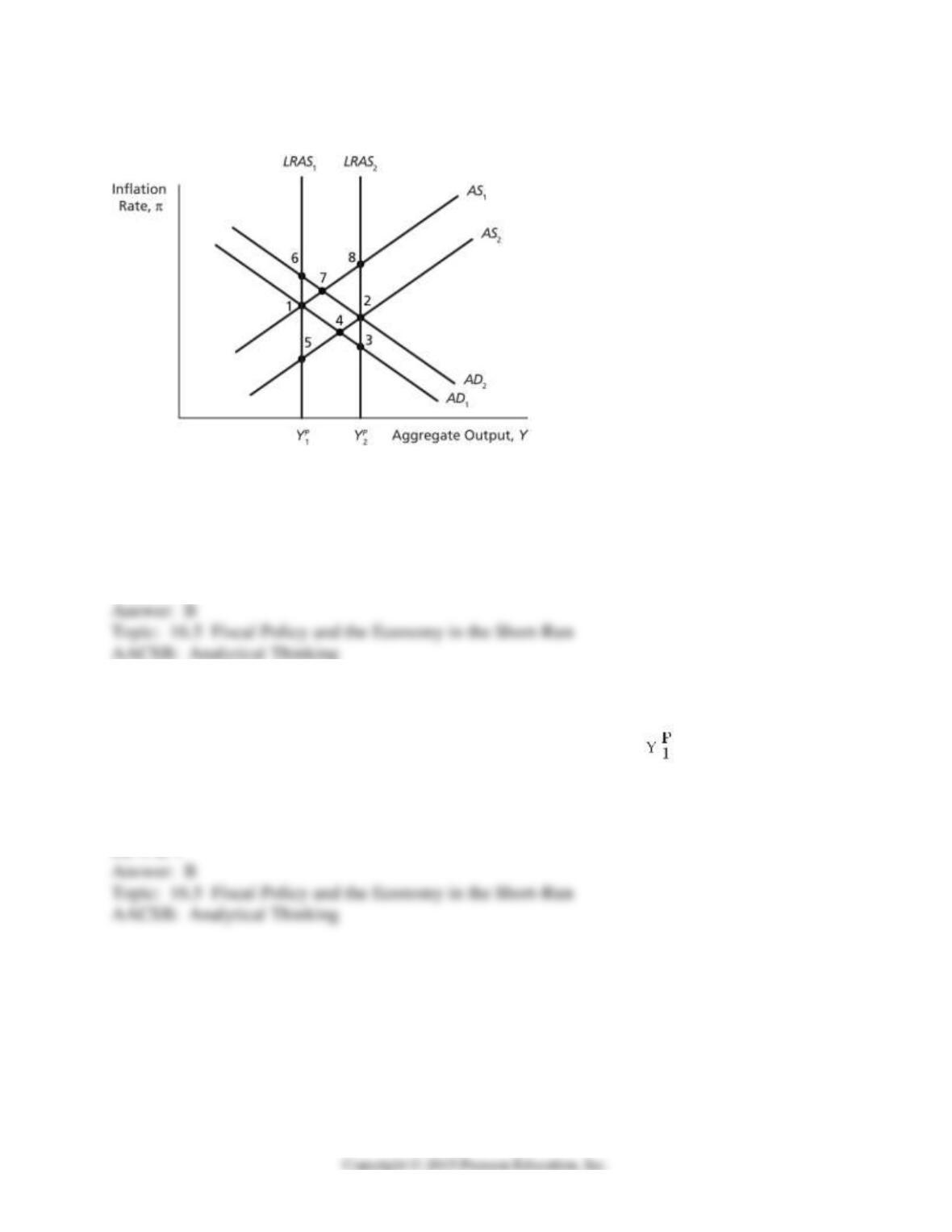
17) On the graph above, an increase in government spending, with no change in taxes, is likely to
move the economy from point 1 to point ________.
A) 8
B) 6
C) 3
D) 5
18) On the graph above, suppose the economy is at point 1. Which sequence of points best
illustrates the short-run and then long-run impacts if taxes are reduced for one year, then returned
to the original level? [Assume that potential output remains constant at .]
A) 7, 2, 5
B) 2, 4, 1
C) 2, 7, 6
D) 7, 8, 1
19) On the graph above, suppose the economy is at point 1. Which sequence of points best
illustrates the short-run and then long-run impacts of a permanent tax reduction? [Assume that
potential output remains constant at .]
A) 2, 4, 1
B) 7, 2, 5
C) 2, 7, 6
D) 7, 8, 1
20) On the graph above, a permanent tax reduction, assuming that there is a permanent effect on
aggregate supply, is likely to move the economy from point 1 to point ________.
A) 2
B) 8
C) 6
D) 3
21) On the graph above, suppose the economy is at point 6. Which sequence of points best
illustrates the short-run and then long-run impacts of an “expansionary fiscal contraction”?
A) 2, 7, 8
B) 4, 7, 1
C) 1, 4, 5
D) 1, 4, 2
22) A tax ________ is more likely to cause a permanent increase in investment and worker
productivity in an economy with a ________.
A) increase; small government budget deficit
B) decrease; large government budget deficit
C) decrease; high inflation rate
D) increase; large government budget deficit
17
23) Government austerity measures are more likely to resolve a sovereign debt crisis if
________.
A) the real interest rate falls along with inflation
B) the fiscal multipliers are especially large
C) no aid is available from other countries, so the government is not tempted to abandon the
austerity plan
D) citizens, also, adopt austerity
24) Apply the concept of tax smoothing to the debate over tax-based versus spending-based
fiscal stimulus.
25) Why might the tax multiplier be smaller than the expenditure multiplier? Under what
circumstances might the reverse be true?
16.6 Budget Deficits and Inflation
1) Government revenue generated by the issue of currency is known as ________.
A) monetizing the debt
B) triage
C) seignorage
D) hyperinflation
2) Monetizing the debt occurs when ________.
A) government securities are issued
B) government securities are sold by the central bank
C) government securities are bought by the central bank
D) tax revenues fall short of government expenditures
3) In the long-run, the inflation rate will move very closely with ________.
A) the growth rate of the money supply
B) the change in government debt
C) the growth rate of government expenditures
D) changes in tax rates
4) Monetizing the debt is undesirable given its impact on ________.
A) investment
B) nominal income
C) tariff rates
D) prices
5) Seignorage is also known as an inflation tax since ________.
A) money balances lose value in real terms
B) inflation can be caused by rising energy costs
C) higher interest rates can crowd-out investment spending
D) budget deficits entail an increase in the size of the national debt
19
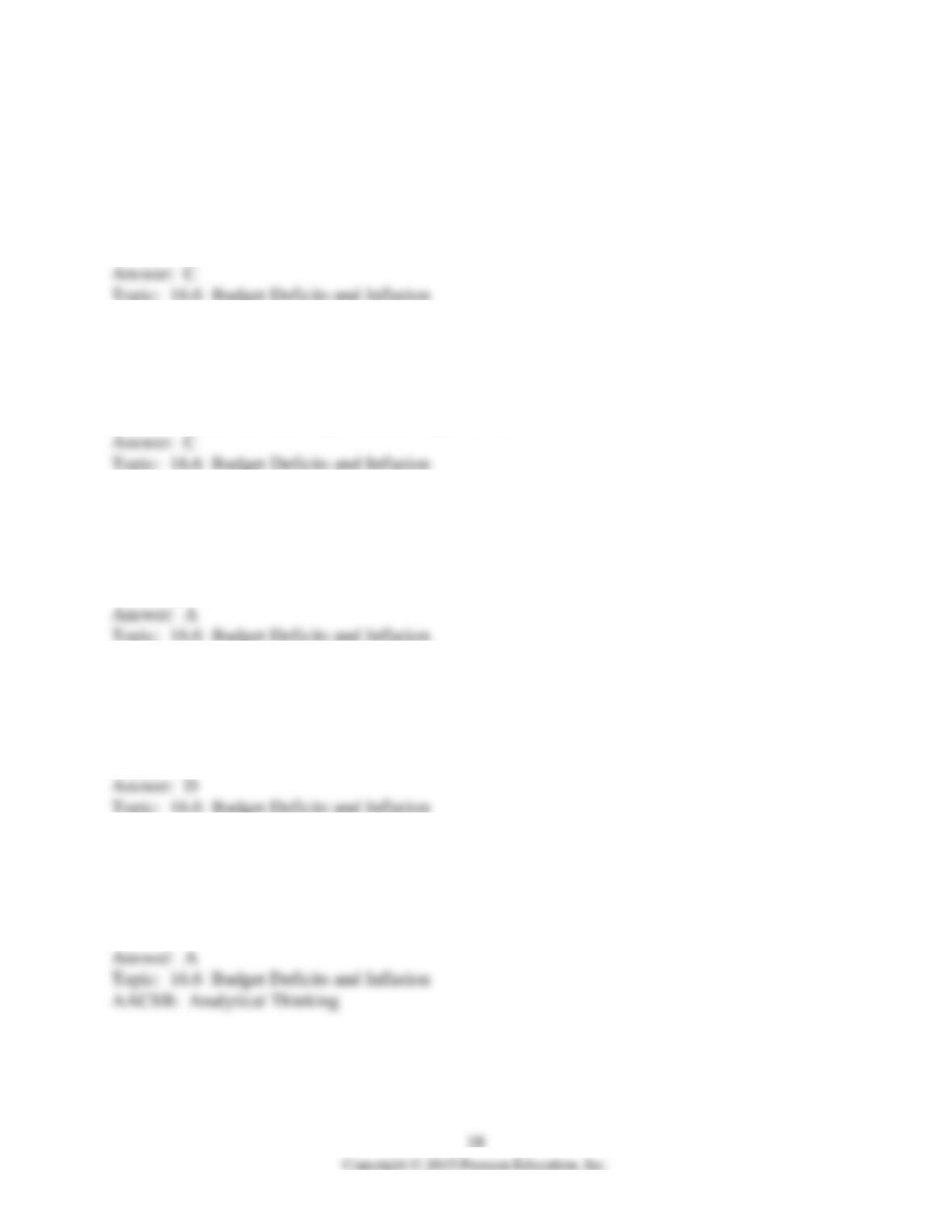
6) A measure of seignorage, in real terms, is ________.
A) π ×
B) ΔB + ΔM
C) r ×
D) Y – T – C
7) What is the relationship between debt intolerance and the inflation tax?
16.7 Budget Deficits and Ricardian Equivalence
1) According to Ricardian Equivalence theory, a tax cut ________.
A) will tend to have little economic effect
B) will tend to reduce the magnitude of the trade-off between inflation and the rate of
unemployment
C) can be an effective policy tool in the midst of an economic downturn
D) must be used in conjunction with money supply changes over the course of the business cycle
2) According to Ricardian equivalence, a long-run impact on the economy occurs when the
government ________.
A) lowers taxes
B) issues more government bonds
C) increases spending on capital goods
D) raises taxes
20
3) According to Ricardian equivalence, the key consequence of an increase in the budget deficit
that arises from a tax cut is ________.
A) a decrease in private investment
B) an increase in inflation
C) an increase in the public’s holding of government bonds
D) an increase in the supply of money
4) Which government policy is the principal focus of Ricardian Equivalence?
A) tax cuts
B) government spending increases
C) government borrowing
D) seignorage
5) Ricardian Equivalence theory is based on the view that ________.
A) the impact of a tax cut is felt primarily on domestic consumption spending
B) households tend to take future events into account when engaging in economic decision-
making
C) the price of a commodity is negatively related to the quantity of that good demanded
D) a trade-off exists between the use of monetary and fiscal policy in influencing the level of
income
6) According to Ricardian Equivalence, consumers may not respond to a tax cut ________.
A) if that tax cut is directed solely at upper income groups
B) if that tax cut is directed solely at lower income groups
C) since they understand a tax cut today will lead to a tax increase in the future
D) if they lack patriotic fervor
7) According to Ricardian Equivalence, crowding-out ________.
A) is incomplete
B) will raise the level of domestic income
C) is complete
D) does not play a role in influencing private investment levels
21
8) According to Ricardian Equivalence, a tax cut will not have a material impact on consumption
spending since ________.
A) households will simply save the monies received from the tax cut
B) the value of the tax multiplier is one
C) a tax cut must lead to an increase in prices, which leaves the real value of consumption
unchanged
D) a decrease in taxes will be balanced, under current federal law, by a government spending
increase
9) One objection to the notion of Ricardian Equivalence is that ________.
A) households will recognize that a tax cut today will only lead to a tax increase in the future
B) individuals are short-sighted in their spending decisions
C) borrowing constraints have largely been eliminated due to financial innovation in the
provisioning of consumer credit
D) households typically save most of the monies received from a tax cut
10) The evidence with respect to the validity of Ricardian Equivalence ________.
A) suggests that it matters little whether government debt is held by the central bank or by the
public
B) clearly provides support for the argument
C) clearly refutes the argument
D) is difficult to interpret, since so many factors may affect national saving
11) Ricardian Equivalence theory assumes that ________.
A) an anticipated increase in the income of future generations will reduce the amount that is
saved today on their behalf
B) government spending remains constant
C) many people are subject to borrowing constraints
D) tax cuts have a positive impact on aggregate supply
22
12) Suppose that most government spending was on capital goods that contribute to economic
growth. How would that affect the Ricardian equivalence debate?
13) What does Ricardian equivalence imply about the relative size of the expenditure and tax
multipliers?