63) Suppose a family is holding $1000 in its checking account for normal transactions, $500 in
cash for emergencies, and $1500 as a store of value when the interest rate is 4 percent. If the
interest rate rises to 10 percent, which of the following patterns of holding money would be most
likely and why?
A) Transactions demand—$1000; Precautionary demand—$350; Asset demand—$500, because
the opportunity cost of holding money has increased. The reduction money balances held as an
asset is greatest because interest-bearing assets are much more attractive when interest rates are
higher.
B) Transactions demand—$500; Precautionary demand—$500; Asset demand—$1400, because
the opportunity cost of holding money balances has risen. The reduction in money balances held
for transaction purposes falls the most because people start using credit cards more when the
opportunity cost of holding money increases.
C) Transactions demand—$1000; Precautionary demand—$500; Asset demand—$500, because
only the asset demand is responsive to changes in the interest rate.
D) Transactions demand—$800; Precautionary demand—$600; Asset demand—$1500, because
people can economize on their money balances for making transactions, but the possibility of an
emergency increases with the interest rate. People will also expect rates to go higher, so they will
hold money as an asset until the rates increase further.
64) The demand for money curve is drawn
A) holding several things constant, including GDP and interest rates.
B) holding several things constant, including the price level and interest rates.
C) with interest rates on the horizontal axis, and the curve sloping up since the “price” of holding
money varies directly with the interest rate.
D) with interest rates on the vertical axis and the curve sloping down since lower interest rates
mean the “price” of holding money has fallen.
65) When considering the demand for money curve, the interest rate
A) will have a positive relationship with the quantity of money demanded.
B) varies negatively with the transactions demand for money.
C) is the price of holding money.
D) is independent of the opportunity cost of money.
66) The opportunity cost of holding money is
A) the interest income foregone.
B) the transactions demand for money.
C) contractionary monetary policy.
D) the monetary rule.
67) The relationship between the quantity of money balances demanded and the interest rate is
A) determined by open market operations.
B) negative.
C) contractionary monetary policy.
D) the reserve requirements.
68) The demand for money curve
A) shows the relationship between money demanded and open market operations.
B) shows the relationship between the quantity of money balances demanded and the interest
rate.
C) is positively related to the interest rate.
D) varies inversely with the supply of money.
69) The reason that people may not want to hold money is
A) the precautionary demand for money and the risk of being robbed.
B) the opportunity cost.
C) the transactions demand makes it unnecessary.
D) due to the direct relationship between money demand and the interest rate.
70) The demand for money for which the purpose is making unexpected purchases or meeting
emergencies is considered to be part of
A) precautionary demand.
B) transactions demand.
C) asset demand.
D) savings demand.
71) In economics, the demand for money is basically a demand for
A) high returns.
B) status.
C) liquidity.
D) investment.
72) Holding money as a medium of exchange to purchase goods and services and make
payments is known as the
A) spending demand for money.
B) transactions demand for money.
C) precautionary demand for money.
D) asset demand for money.
73) The demand for money curve depicts
A) an inverse relationship between the quantity of money demanded and the quantity of bonds
demanded.
B) a direct relationship between the quantity of money demanded and the quantity of bonds
demanded.
C) an inverse relationship between the quantity of money demanded and the interest rate.
D) a direct relationship between the quantity of money demanded and the interest rate.
74) Which of the following will tend to occur when the interest rate increases?
A) The demand for money curve shifts leftward.
B) The demand for money curve shifts rightward.
C) There is a rightward movement along the demand for money curve.
D) There is a leftward movement along the demand for money curve.
75) Which of the following will cause a reduction in the amount of money individuals wish to
hold?
A) an increase in the interest rate
B) an increase in income
C) an increase in the price level
D) all of the above
76) The amount of money people wish to hold shows an inverse relationship to
A) their planned near-term purchases.
B) the money supply.
C) the income tax rate.
D) the interest rate.
77) The amount of money that people wish to hold to use in transactions varies directly with
A) their planned near-term purchases.
B) the money supply.
C) the income tax rate.
D) the interest rate.
78) The downward slope of the demand for money curve reflects the fact that
A) people hold more of their wealth in the form of money as the price level rises.
B) people hold more of their wealth in the form of money as the price level falls.
C) people hold more of their wealth in the form of money as the interest rate rises.
D) people hold more of their wealth in the form of money as the interest rate falls.
79) Which of the following is NOT a type of demand for holding money?
A) transactions demand
B) precautionary demand
C) asset demand
D) qualitative demand
80) Which of the following represents the opportunity cost of holding money?
A) liquidity
B) the interest rate
C) the rate of inflation
D) none of the above
81) The transactions demand for money is related to money functioning as a
A) unit of accounting.
B) medium of exchange.
C) store of value.
D) medium of deferred payment.
82) The demand for money is based on
A) the transactions demand, asset demand, and precautionary demand.
B) the demand for cash, demand for securities, and the demand for real estate.
C) the demand for consumption, demand for investment, and demand by government.
D) a demand for liquidity and wealth.
83) A person keeps $500 in his home in order to be prepared for some unforeseen future event.
This reflects his
A) speculative demand for money.
B) asset demand for money.
C) precautionary demand for money.
D) liquidity demand for money.
84) Asset demand for money is related to money functioning as a
A) unit of accounting.
B) medium of exchange.
C) store of value.
D) medium of deferred payment.
85) The interest rate is the opportunity cost
A) of investing in stocks.
B) of investing in Treasury securities.
C) of using credit cards.
D) of holding money.
86) If the interest rate increases, the
A) quantity of money demanded will remain unchanged.
B) money demand curve will shift to the right.
C) money demand curve will shift to the left.
D) quantity of money demanded will fall.
87) Warren always carries a one hundred dollar bill in case of emergencies. This is an example
of the
A) precautionary demand for money.
B) asset demand for money.
C) transactions demand for money.
D) wealth demand for money.
88) Travis always carries $100 in his wallet to pay for groceries. This is an example of the
A) precautionary demand for money.
B) asset demand for money.
C) transactions demand for money.
D) wealth demand for money.
89) Bertha holds some of her savings as currency and coins placed in her sewing basket. This is
an example of
A) precautionary demand for money.
B) asset demand for money.
C) transactions demand for money.
D) wealth demand for money.
90) The demand for money is downward sloping, because at higher interest rates
A) the opportunity cost of holding cash is lower.
B) the opportunity cost of holding money is higher.
C) the opportunity cost of holding money is decreasing.
D) the opportunity cost of holding money is constant.
91) If the interest rate increases, there is a(n)
A) increase in the demand for money.
B) decrease in the demand for money.
C) increase in the quantity of money demanded.
D) decrease in the quantity of money demanded.
92) Suppose Tim has $1,000 in cash on hand to buy collectable baseball cards at a swap meet.
Tim often sells these cards at a profit. This is an example of the
A) asset demand for money.
B) transaction demand for money
C) precautionary demand for money.
D) wealth demand for money.
93) The asset demand for money is
A) greater at high interest rates as investors can earn more on their investments.
B) greater at low interest rates, because the opportunity cost of holding money is low.
C) greater at low interest rates, because the opportunity cost of holding money is high.
D) lower at low interest rates, because the opportunity cost of holding money is high.
94) As interest rates rise, the quantity of money demanded
A) falls.
B) rises.
C) stays the same.
D) does not react to interest rate changes.
95) What is meant by the demand for money?
96) “The demand for money is infinite since everyone wants more money.” Do you agree or
disagree with this statement? Why?
97) What are three reasons people want to hold money balances?
98) What does the demand curve for money look like? Why?
16.2 How the Fed Influences Interest Rates
1) Which of the following actions by the Fed would lead to an increase in the money supply?
A) an increase in the required reserve ratio
B) an increase in the differential between the discount rate and the federal funds rate
C) an increase in tax rates
D) the purchase of government securities
2) An increase in bond prices will most likely result in
A) an increase in interest rates.
B) a decrease in the quantity demanded of money.
C) an increase in the quantity demanded of money.
D) an increase in the opportunity cost of holding money.
3) If a bond sells for $1,000 and pays $100 per year in interest, the interest rate on the bond is
A) 20 percent.
B) 10 percent.
C) 5 percent.
D) 100 percent.
4) If you initially pay $1,000 for a bond with an annual interest rate of 5 percent, but then the
market interest rate falls to 4 percent
A) the market price of the bond is still $1,000.
B) the bond’s annual interest payment remains equal to $50.
C) the market price of the bond has increased.
D) the market price of the bond has decreased.
5) The price of bonds and the interest rate are
A) inversely related.
B) positively related.
C) unrelated.
D) related, but we are not sure how.
6) An excess quantity of money demanded will lead to a rise in
A) the interest rate.
B) investment.
C) income.
D) bond prices.
7) Which of the following will lead to a decrease in the price of existing bonds?
A) a decrease in the rate of interest
B) an inward shift in money demand
C) a decrease in planned investment spending
D) a reduction in the money supply
8) An increase in the money supply typically leads to
A) a reduction in the rate of interest.
B) a decrease in the price level.
C) a reduction in the velocity of money.
D) an inward shift in money demand.
9) If the Fed purchases U.S. government securities in the open market, all of the following would
occur EXCEPT
A) an expansion of the money supply.
B) an increase in investment.
C) a fall in bond prices.
D) an increase in real Gross Domestic Product (GDP).
10) If the Fed sells bonds through its open market operations, then there is
A) an increase in the demand for bonds and a rise in the price of existing bonds.
B) an increase in the supply of bonds and a fall in the price of existing bonds.
C) a decrease in interest rates because of the increase in the supply of bonds.
D) a decrease in interest rates because of the decrease in the demand for bonds.
11) If the Fed decides to buy bonds, the result will be
A) lower bond prices and lower interest rates.
B) lower bond prices and higher interest rates.
C) higher bond prices and lower interest rates.
D) higher bond prices and higher interest rates.
12) The market prices of existing bonds are
A) not related to the interest rate.
B) directly related to the interest rate.
C) inversely related to the interest rate.
D) stated in terms of the interest rate.
13) Interest rates typically rise when
A) bond prices increase.
B) bond prices decrease.
C) the coupon payout on existing bonds increase.
D) the maturity date on existing bonds extends farther into the future.
14) Which of the following is NOT a reason the Fed changes the rate of growth of the money
supply?
A) to influence aggregate demand
B) to shift the demand for money curve
C) to influence the amount of consumption
D) to influence the amount of investment
15) The market price of existing bonds is ________ to the rate of interest prevailing in the
economy.
A) inversely related
B) directly related
C) totally unrelated
D) synonymous
16) Open market operations by the Fed cause
A) changes in the difference between the discount rate. and the federal funds rate.
B) aggregate supply to change.
C) the prices of bonds to change.
D) changes in the required reserve ratio.
17) When the Fed conducts open market operations, it
A) purchases or sells government bonds issued by the U.S. Treasury.
B) is engaging in fiscal policy.
C) also raises taxes at the same time.
D) shifts the demand for money curve.
18) A sale of bonds by the Fed generates
A) an increase in the demand for money balances.
B) a decrease in the demand for money balances.
C) an increase in the demand for bonds and a rise in bond prices.
D) an increase in the supply of bonds and a fall in bond prices.
19) The purchase of government bonds by the Fed leads to a(n)
A) increase in the supply of bonds and a decrease in bond prices.
B) decrease in the supply of bonds and an increase in bond prices.
C) increase in the demand of bonds and a decrease in the price of bonds.
D) decrease in the demand of bonds and an increase in the price of bonds.
20) An increase in the interest rate will
A) decrease the price of bonds.
B) increase the price of bonds.
C) increase or decrease the price of bonds depending upon whether the money supply has
increased or decreased.
D) leave the price of bonds unchanged.
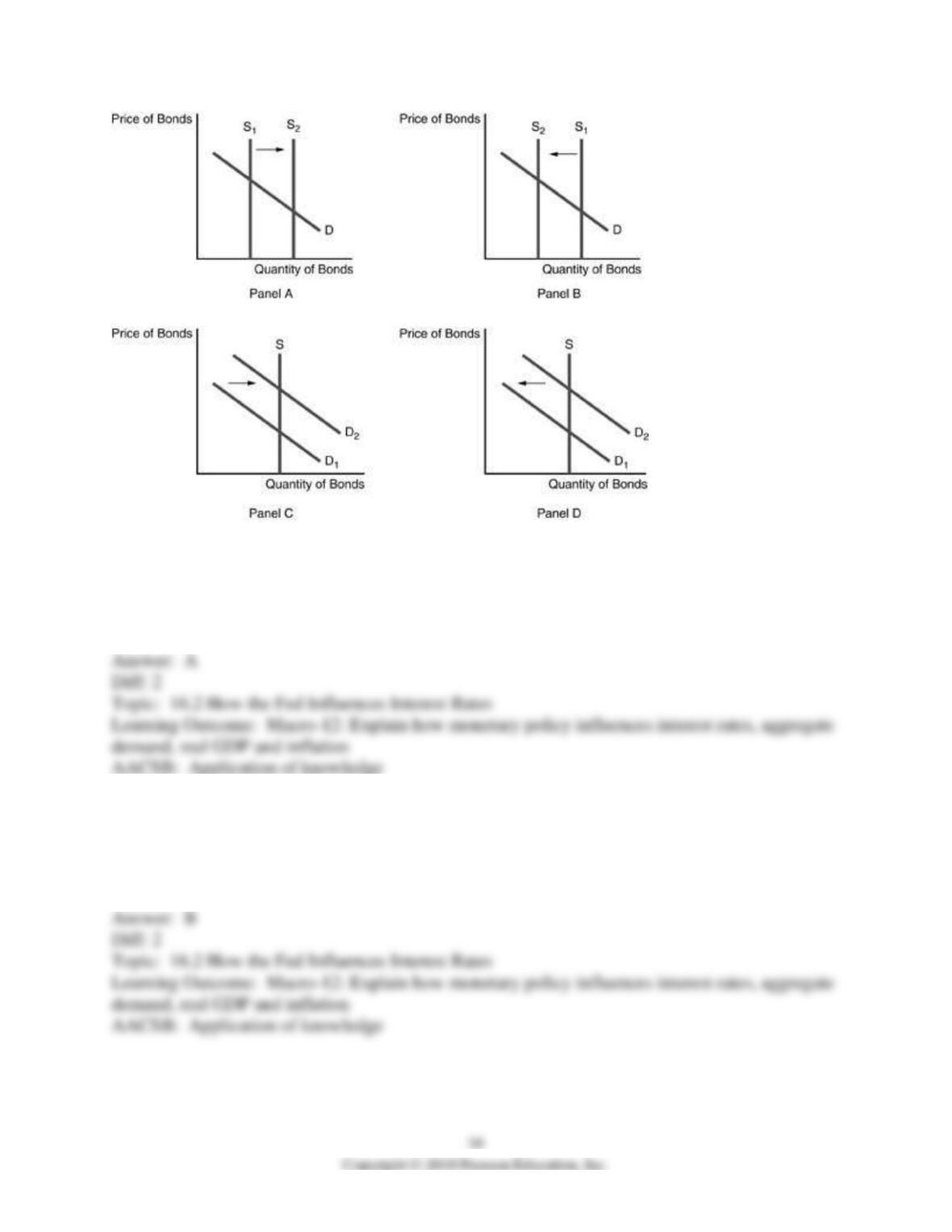
21) Refer to the above figure. Which panel is consistent with the Fed selling bonds?
A) Panel A
B) Panel B
C) Panel C
D) Panel D
22) Refer to the above figure. Which panel is consistent with the Fed buying bonds?
A) Panel A
B) Panel B
C) Panel C
D) Panel D
23) Refer to the above figure. Which panels could represent the situation if the Fed had engaged
in open market operations?
A) Panels A and B
B) Panels A and C
C) Panels B and C
D) Panels C and D
24) A bond that pays a yearly interest rate of $100 is for sale. The interest rate was 10 percent
and now is 5 percent. The price of the bond has
A) decreased from $1000 to $500.
B) increased from $1000 to $2000.
C) increased from $500 to $2000.
D) decreased from $2000 to $1000.
25) A bond is selling for $1000 and it pays $150 in interest a year. If the interest rate changes to
20 percent, then
A) the interest payment rises to $175.
B) the interest payment falls to $75.
C) the price of the bond falls to $750.
D) the price of the bond rises to $1250.