Chapter 16: Financial Planning and Forecasting
United States – BUSPROG.FOFM.BRIG.17.03 – BUSPROG: Analytic
United States – OH – DISC.FOFM.BRIG.17.05 – DISC: Financial analysis and cash flows
Additional funds needed
Bloom’s: Comprehension
6/23/2015 3:27 PM
9/2/2015 1:56 PM
28. Which of the following statements is CORRECT?
a.
The sustainable growth rate is the maximum achievable growth rate without the firm having to raise external
funds. In other words, it is the growth rate at which the firm’s AFN equals zero.
b.
If a firm’s assets are growing at a positive rate, but its retained earnings are not increasing, then it would be
impossible for the firm’s AFN to be negative.
c.
If a firm increases its dividend payout ratio in anticipation of higher earnings, but sales and earnings actually
decrease, then the firm’s actual AFN must, mathematically, exceed the previously calculated AFN.
d.
Higher sales usually require higher asset levels, and this leads to what we call AFN. However, the AFN will be
zero if the firm chooses to retain all of its profits, i.e., to have a zero dividend payout ratio.
e.
Dividend policy does not affect the requirement for external funds based on the AFN equation.
Multiple Choice
FOFM.BRIG.17.16.03 – The AFN Equation
United States – BUSPROG.FOFM.BRIG.17.03 – BUSPROG: Analytic
United States – OH – DISC.FOFM.BRIG.17.05 – DISC: Financial analysis and cash flows
AFN equation
Bloom’s: Comprehension
6/23/2015 3:27 PM
9/2/2015 1:57 PM
29. Which of the following statements is CORRECT?
a.
When we use the AFN equation, we assume that the ratios of assets and liabilities to sales (A0*/S0 and L0*/S0)
vary from year to year in a stable, predictable manner.
b.
When fixed assets are added in large, discrete units as a company grows, the assumption of constant ratios is
more appropriate than if assets are relatively small and can be added in small increments as sales grow.
c.
Firms whose fixed assets are “lumpy” frequently have excess capacity, and this should be accounted for in the
financial forecasting process.
d.
For a firm that uses lumpy assets, it is impossible to have small increases in sales without expanding fixed
assets.
e.
Regression techniques cannot be used in situations where excess capacity or economies of scale exist.
FOFM.BRIG.17.16.05 – Using Regression to Improve Forecasts
United States – BUSPROG.FOFM.BRIG.17.03 – BUSPROG: Analytic
Chapter 16: Financial Planning and Forecasting
30. Last year Godinho Corp. had $420 million of sales, and it had $75 million of fixed assets that were being operated at
80% of capacity. In millions, how large could sales have been if the company had operated at full capacity?
a.
$551.3
b.
$462.0
c.
$509.3
d.
$656.3
e.
$525.0
e
b.
c.
d.
e.
EASY
16-3 The AFN Equation
31. Kamath-Meier Corporation’s CFO uses this equation, which was developed by regressing inventories on sales over the
past 5 years, to forecast inventory requirements: Inventories = $22.0 + 0.125(Sales). The company expects sales of $275.0
million during the current year, and it expects sales to grow by 30% next year. What is the inventory forecast for next
year? All dollars are in millions.
a.
$59.4
b.
$60.0
c.
$54.7
d.
$66.7
e.
$82.0
Chapter 16: Financial Planning and Forecasting
32. Last year Wei Guan Inc. had $625 million of sales, and it had $270 million of fixed assets that were used at 65% of
capacity. In millions, by how much could Wei Guan’s sales increase before it is required to increase its fixed assets?
a.
$316.35
b.
$302.88
c.
$289.42
d.
$400.48
e.
$336.54
e
b.
c.
d.
MODERATE
16-3 The AFN Equation
b.
c.
d.
e.
EASY
16-5 Using Regression to Improve Forecasts
Chapter 16: Financial Planning and Forecasting
Multiple Choice
FOFM.BRIG.17.16.03 – The AFN Equation
United States – BUSPROG.FOFM.BRIG.17.03 – BUSPROG: Analytic
United States – OH – DISC.FOFM.BRIG.17.05 – DISC: Financial analysis and cash flows
Excess capacity
Bloom’s: Evaluation
6/23/2015 3:27 PM
9/2/2015 2:06 PM
33. Last year Handorf-Zhu Inc. had $850 million of sales, and it had $425 million of fixed assets that were used at only
85% of capacity. What is the maximum sales growth rate the company could achieve before it had to increase its fixed
assets?
a.
16.94%
b.
17.47%
c.
19.06%
d.
18.88%
e.
17.65%
e
b.
c.
d.
e.
MODERATE
16-3 The AFN Equation
Multiple Choice
FOFM.BRIG.17.16.03 – The AFN Equation
United States – BUSPROG.FOFM.BRIG.17.03 – BUSPROG: Analytic
United States – OH – DISC.FOFM.BRIG.17.05 – DISC: Financial analysis and cash flows
Excess capacity
Bloom’s: Analysis
6/23/2015 3:27 PM
9/2/2015 2:08 PM
34. Last year Jain Technologies had $250 million of sales and $100 million of fixed assets, so its Fixed Assets/Sales ratio
was 40%. However, its fixed assets were used at only 40% of capacity. Now the company is developing its financial
forecast for the coming year. As part of that process, the company wants to set its target Fixed Assets/Sales ratio at the
Chapter 16: Financial Planning and Forecasting
level, it would have had, had it been operating at full capacity. What target Fixed Assets/Sales ratio should the company
set?
a.
19.0%
b.
14.6%
c.
16.0%
d.
15.4%
e.
14.2%
c
b.
c.
d.
e.
MODERATE
16-3 The AFN Equation
Multiple Choice
FOFM.BRIG.17.16.03 – The AFN Equation
United States – BUSPROG.FOFM.BRIG.17.03 – BUSPROG: Analytic
United States – OH – DISC.FOFM.BRIG.17.05 – DISC: Financial analysis and cash flows
Finding target FA/S ratio
Bloom’s: Evaluation
6/23/2015 3:27 PM
9/2/2015 2:10 PM
35. Fairchild Garden Supply expects $700 million of sales this year, and it forecasts a 15% increase for next year. The
CFO uses this equation to forecast inventory requirements at different levels of sales: Inventories = $30.2 + 0.25(Sales).
All dollars are in millions. What is the projected inventory turnover ratio for the coming year?
a.
2.78 times
b.
2.82 times
c.
4.35 times
d.
3.79 times
e.
3.48 times
e
Inventory turnover ratio = Sales / Inventories = 3.48 times
Chapter 16: Financial Planning and Forecasting
36. Clayton Industries is planning its operations for next year. Ronnie Clayton, the CEO, wants you to forecast the firm’s
additional funds needed (AFN). Data for use in your forecast are shown below. Based on the AFN equation, what is the
AFN for the coming year? Dollars are in millions.
Last year’s sales = S0
$350
Last yr’s accounts payable
$40
Sales growth rate = g
30%
Last yr’s notes payable
$50
Last year’s total assets = A0*
$360
Last yr’s accruals
$30
Last year’s prof margin = PM
5%
Target payout ratio
60%
a.
$67.0
b.
$78.7
c.
$63.9
d.
$77.9
e.
$91.1
b.
c.
d.
e.
MODERATE
16-5 Using Regression to Improve Forecasts
Multiple Choice
FOFM.BRIG.17.16.05 – Using Regression to Improve Forecasts
United States – BUSPROG.FOFM.BRIG.17.03 – BUSPROG: Analytic
United States – OH – DISC.FOFM.BRIG.17.05 – DISC: Financial analysis and cash flows
Forecasting inv. turnover
Bloom’s: Application
6/23/2015 3:27 PM
9/2/2015 2:12 PM
Chapter 16: Financial Planning and Forecasting
b.
c.
d.
e.
MODERATE/CHALLENGING
16-3 The AFN Equation
Multiple Choice
FOFM.BRIG.17.16.03 – The AFN Equation
United States – BUSPROG.FOFM.BRIG.17.03 – BUSPROG: Analytic
United States – OH – DISC.FOFM.BRIG.17.05 – DISC: Financial analysis and cash flows
Positive AFN
Bloom’s: Application
6/23/2015 3:27 PM
9/2/2015 2:14 PM
37. Chua Chang & Wu Inc. is planning its operations for next year, and the CEO wants you to forecast the firm’s
additional funds needed (AFN). Data for use in your forecast are shown below. Based on the AFN equation, what is the
AFN for the coming year?
Last year’s sales = S0
$200,000
Last year’s accounts payable
$50,000
Sales growth rate = g
40%
Last year’s notes payable
$15,000
Last year’s total assets = A0*
$127,500
Last year’s accruals
$20,000
Last year’s profit margin = PM
20.0%
Target payout ratio
25.0%
a.
-$14,820
b.
-$23,180
c.
-$19,000
d.
-$21,280
e.
-$20,520
c
Chapter 16: Financial Planning and Forecasting
b.
c.
d.
e.
MODERATE/CHALLENGING
16-3 The AFN Equation
Multiple Choice
FOFM.BRIG.17.16.03 – The AFN Equation
United States – BUSPROG.FOFM.BRIG.17.03 – BUSPROG: Analytic
United States – OH – DISC.FOFM.BRIG.17.05 – DISC: Financial analysis and cash flows
Negative AFN
Bloom’s: Application
6/23/2015 3:27 PM
9/2/2015 2:16 PM
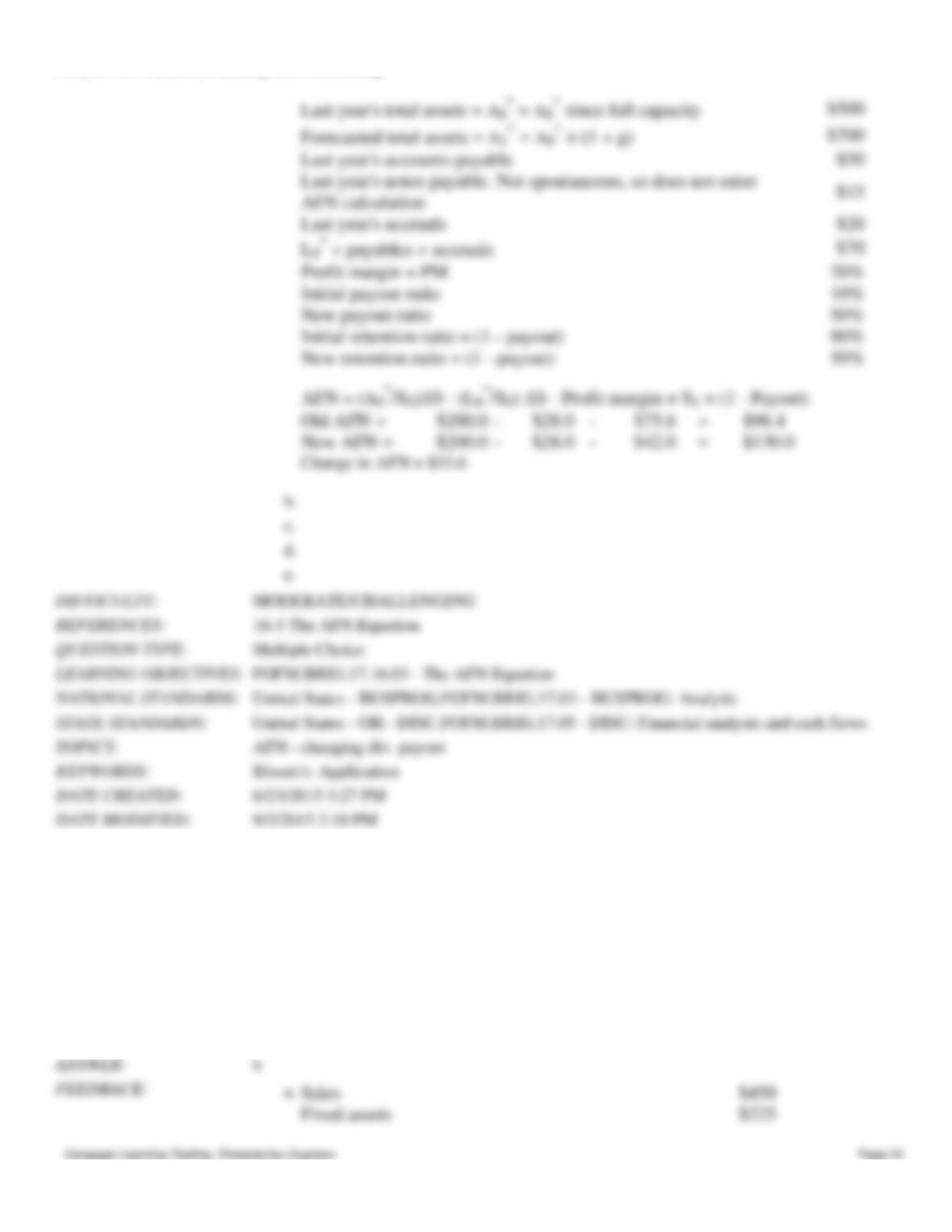
38. Howton & Howton Worldwide (HHW) is planning its operations for the coming year, and the CEO wants you to
forecast the firm’s additional funds needed (AFN). Data for use in the forecast are shown below. However, the CEO is
concerned about the impact of a change in the payout ratio from the 10% that was used in the past to 50%, which the
firm’s investment bankers have recommended. Based on the AFN equation, by how much would the AFN for the coming
year change if HHW increased the payout from 10% to the new and higher level? All dollars are in millions.
Last year’s sales = S0
$300.0
Last year’s accounts payable
$50.0
Sales growth rate = g
40%
Last year’s notes payable
$15.0
Last year’s total assets = A0*
$500.0
Last year’s accruals
$20.0
Last year’s profit margin = PM
20.0%
Initial payout ratio
10.0%
a.
$28.2
b.
$33.6
c.
$26.9
d.
$30.9
e.
$25.5
Chapter 16: Financial Planning and Forecasting
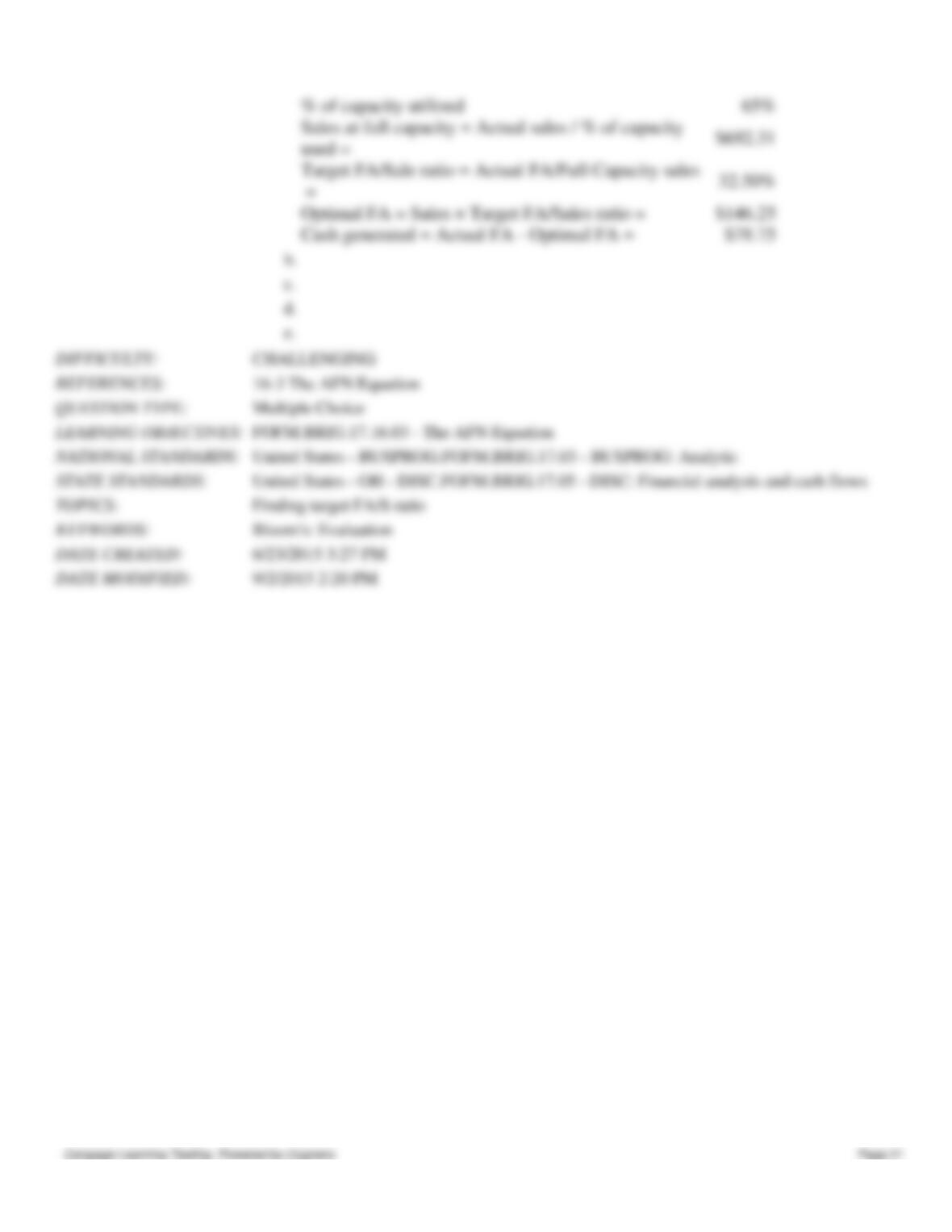
39. Last year Emery Industries had $450 million of sales and $225 million of fixed assets, so its Fixed Assets/Sales ratio
was 50%. However, its fixed assets were used at only 65% of capacity. If the company had been able to sell off enough of
its fixed assets at book value so that it was operating at full capacity, with sales held constant at $450 million, how much
cash (in millions) would it have generated?
a.
$66.94
b.
$78.75
c.
$63.00
d.
$74.81
e.
$75.60
b.
c.
d.
e.
MODERATE/CHALLENGING
16-3 The AFN Equation
Chapter 16: Financial Planning and Forecasting