Macroeconomics 2017 (Hubbard)
Chapter 16 Fiscal Policy
16.1 What is Fiscal Policy?
1) Part of the spending on the Doyle Drive project in northern California came from the American
Reinvestment and Recovery Act, which is an example of ________ aimed at increasing real GDP and
employment.
A) discretionary fiscal policy
B) an automatic stabilizer
C) contractionary fiscal policy
D) a transfer payment
2) If Congress passed a one-time tax cut in order to stimulate the economy in 2014, and tax rate levels
returned to their pre-2014 level in 2015, how should this tax cut affect the economy?
A) The tax cut would increase consumption spending less than would a permanent tax cut.
B) The tax cut would increase consumption spending more than would a permanent tax cut.
C) The tax cut would increase consumption spending by the same amount as would a permanent tax
cut.
D) The tax cut would lower the price level in 2014.
3) Fiscal policy refers to changes in
A) state and local taxes and purchases that are intended to achieve macroeconomic policy objectives.
B) federal taxes and purchases that are intended to achieve macroeconomic policy objectives.
C) federal taxes and purchases that are intended to fund the war on terrorism.
D) the money supply and interest rates that are intended to achieve macroeconomic policy objectives.
4) Which of the following would be classified as fiscal policy?
A) The federal government passes tax cuts to encourage firms to reduce air pollution.
B) The Federal Reserve cuts interest rates to stimulate the economy.
C) A state government cuts taxes to help the economy of the state.
D) The federal government cuts taxes to stimulate the economy.
E) States increase taxes to fund education.
5) Which of the following is an objective of fiscal policy?
A) energy independence from Middle East oil
B) health care coverage for all Americans
C) discovering a cure for AIDs
D) high rates of economic growth
E) homeland security
6) Automatic stabilizers refer to
A) the money supply and interest rates that automatically increase or decrease along with the business
cycle.
B) government spending and taxes that automatically increase or decrease along with the business
cycle.
C) changes in the money supply and interest rates that are intended to achieve macroeconomic policy
objectives.
D) changes in federal taxes and purchases that are intended to achieve macroeconomic policy
objectives.
7) The increase in the amount that the government collects in taxes when the economy expands and the
decrease in the amount that the government collects in taxes when the economy goes into a recession is
an example of
A) automatic stabilizers.
B) discretionary fiscal policy.
C) discretionary monetary policy.
D) automatic monetary policy.
8) The increase in government spending on unemployment insurance payments to workers who lose
their jobs during a recession and the decrease in government spending on unemployment insurance
payments to workers during an expansion is an example of
A) automatic stabilizers.
B) discretionary fiscal policy.
C) discretionary monetary policy.
D) automatic monetary policy.
9) Which of the following would not be considered an automatic stabilizer?
A) legislation increasing funding for job retraining passed during a recession
B) decreasing unemployment insurance payments due to decreased joblessness during an expansion
C) rising income tax collections due to rising incomes during an expansion
D) declining food stamp payments due to more persons finding jobs during an expansion
10) Before the Great Depression of the 1930s, the majority of government spending took place at the
________ and after the Great Depression the majority of government spending took place at the
________.
A) state and local levels; federal level
B) local level; federal level
C) federal level; state and local levels
D) federal level; state level
11) Federal government purchases, as a percentage of GDP,
A) have risen since the early 1950s.
B) have fallen since the early 1950s.
C) have remained roughly the same since the early 1950s.
D) rose from the early 1950s until the mid 1980s, and then fell.
12) Federal government expenditures, as a percentage of GDP,
A) have risen since the early 1950s to the present.
B) have fallen since the early 1950s to the present.
C) rose from 1950 to 1991, fell from 1992 to 2001, and have risen from 2001 to the present.
D) rose from 1950 to 2001 and then fell from 2001 to the present.
E) rose from 1950 to 1980, fell from 1981 to 2001, and have risen from 2001 to the present.
13) The largest and fastest-growing category of federal government expenditures is
A) grants to state and local governments.
B) interest on the national debt.
C) national park spending.
D) transfer payments.
14) From the 1960s to 2014, transfer payments
A) have risen from 25 percent to about 48 percent of federal government expenditures.
B) remained the same percentage of total federal government expenditures.
C) have declined by half as a percentage of total federal government expenditures.
D) have grown very slowly as a percentage of total federal government expenditures.
15) The three categories of federal government expenditures, in addition to government purchases, are
A) interest on the national debt, grants to state and local governments, and transfer payments.
B) interest on the national debt, defense spending, and transfer payments.
C) defense spending, budgets of federal agencies, and transfer payments.
D) defense spending, Social Security, and Medicare.
16) The largest source of federal government revenue in 2014 was
A) sales taxes.
B) corporate income taxes.
C) individual income taxes.
D) payroll taxes to fund Social Security and Medicare programs.
17) Government transfer payments include which of the following?
A) interest on the national debt
B) grants to state and local governments
C) Social Security and Medicare programs
D) national defense
18) Social Security began as a “pay-as-you-go” system, meaning that payments to current retirees were
paid
A) from taxes collected from current workers.
B) from taxes collected from retired workers.
C) as long as the government had funds available.
D) as the government collected revenues from tariffs and excise taxes in the years Social Security
payments were made.
19) Since the Social Security system began in 1935, the number of workers per retiree has
A) stayed roughly the same.
B) continually risen.
C) continually declined.
D) risen and declined with different generations.
20) Which of the following provides health-care coverage to people age 65 and over?
A) Medicaid
B) Medicare
C) Social Security
D) Health-Aid
21) The tax increases necessary to fund future Social Security and Medicare benefit payments would be
A) small, and have little effect on economic growth.
B) small, but could discourage work effort, entrepreneurship, and investment, thereby slowing
economic growth.
C) large, but would have little effect on economic growth.
D) large, and could discourage work effort, entrepreneurship, and investment, thereby slowing
economic growth.
22) Part of the spending on the Doyle Drive project in northern California came from the American
Reinvestment and Recovery Act, which is an example of discretionary fiscal policy aimed at increasing
A) real GDP and employment.
B) tax revenues and the federal budget surplus.
C) disposable income and interest rates.
D) the money supply and money demand.
23) Fiscal policy is defined as changes in federal ________ and ________ to achieve macroeconomic
objectives such as price stability, high rates of economic growth, and high employment.
A) taxes; interest rates
B) taxes; the money supply
C) interest rates; money supply
D) taxes; expenditures
24) Which of the following would be considered a fiscal policy action?
A) The Fed increases the money supply.
B) Tax incentives are offered to encourage the purchase of fuel efficient cars.
C) Spending on the war in Afghanistan is increased to promote homeland security.
D) A tax cut is designed to stimulate spending during a recession.
25) Active changes in tax and spending by government intended to smooth out the business cycle are
called ________, and changes in taxes and spending that occur passively over the business cycle are
called ________.
A) automatic stabilizers; discretionary fiscal policy
B) discretionary fiscal policy; automatic stabilizers
C) automatic stabilizers; monetary policy
D) discretionary fiscal policy; conscious fiscal policy
26) Which of the following is an example of discretionary fiscal policy?
A) an increase in unemployment insurance payments during a recession
B) an increase in income tax receipts with rising income during an expansion
C) the tax cuts passed by Congress in 2001 to combat the recession
D) a decrease in food stamps issued during an expansion or boom
27) The majority of dollars spent by government prior to the Great Depression was spending at the
________. In the post World War II period, two-thirds to three quarters of all dollars spent by
government in the United States are spent at the ________.
A) federal level; state and local levels
B) state and local levels; federal level
C) state and local levels; state level
D) local level; state level
28) Which of the following is a government expenditure, but is not a government purchase?
A) The federal government buys a Humvee.
B) The federal government pays the salary of an FBI agent.
C) The federal government pays out an unemployment insurance claim.
D) The Federal government pays to support research on AIDS.
29) As a percentage of GDP, federal expenditures ________ from 1950 to the early 1990s, ________ from
1992 to 2001, and have ________ since 2001.
A) rose; fell; risen
B) fell; fell; risen
C) rose; rose; fallen
D) fell; rose; fallen
30) Which of the following is the largest category of federal government expenditures?
A) defense spending
B) transfer payments
C) interest on the debt
D) grants to state and local governments
31) The fastest growing category of government expenditure is
A) grants to state and local governments.
B) defense spending.
C) transfer payments.
D) government purchases.
32) ________ and ________ are the largest sources of revenue collected by the federal government.
A) Individual income taxes; corporate income taxes
B) Individual income taxes; social insurance taxes
C) Corporate income taxes; excise and other taxes
D) Excise and other taxes; individual income taxes
33) Social Security
A) has not been successful in reducing poverty among elderly Americans.
B) is a system whereby current retirees are paid from taxes collected from current workers.
C) has a greater number of workers per retiree today as compared to when it started.
D) currently pays retirees benefits equal to what they paid into the system.
34) Which of the following statements about the Social Security, Medicare, and Medicaid programs is
true?
A) Spending on these three programs will rise from 9.7% of GDP currently to 10.2% of GDP by 2050.
B) Costs are being driven up by the fact that Americans are living longer and medical costs are rising
substantially.
C) Some economists have argued for decreasing taxes to help with these programs’ funding problems.
D) Some economists have argued for increasing benefits to help with these programs’ funding
problems.
35) Forecasts by the Congressional Budget Office show spending on Social Security, Medicare, and
Medicaid rising from 10.1 percent of GDP in 2015 to ________ percent of GDP in 2090, and by 2090 the
federal government will be spending, as a fraction of GDP, ________ on these three programs as it
currently spends on all programs combined.
A) 16.2 percent; nearly as much
B) 16.2 percent; half as much
C) 19.8 percent; nearly as much
D) 19.8 percent; half as much
36) A decrease in the marginal income tax rate is a fiscal policy which will increase aggregate demand.
37) The income tax system serves as an automatic stabilizer over the course of the business cycle.
38) The Social Security and Medicare programs have been a failure in terms of reducing poverty among
elderly U.S. citizens.
39) An increase in the money supply is a discretionary fiscal policy which will increase aggregate
demand.
40) Included in government expenditures are government purchases and transfer payments.
41) Prior to the 1930s, the majority of dollars spent by government was spent at the state and local
levels.
42) What is the difference between fiscal policy and monetary policy?
43) List the five categories of federal government expenditures.
44) What is fiscal policy, and who is responsible for fiscal policy?
45) What is the difference between federal purchases and federal expenditures?
46) Give an example of an automatic stabilizer. Explain how automatic stabilizers work in the case of
recession.
16.2 The Effects of Fiscal Policy on Real GDP and the Price Level
1) Congress and the president carry out fiscal policy through changes in
A) interest rates and the money supply.
B) taxes and the interest rate.
C) government purchases and the money supply.
D) government purchases and taxes.
2) Fiscal policy is determined by
A) the Federal Reserve.
B) the president and the Federal Reserve.
C) Congress and the Federal Reserve.
D) Congress and the president.
3) An increase in government purchases will increase aggregate demand because
A) government expenditures are a component of aggregate demand.
B) consumption expenditures are a component of aggregate demand.
C) the decline in the price level will increase demand.
D) the decline in the interest rate will increase demand.
4) Expansionary fiscal policy involves
A) increasing government purchases or decreasing taxes.
B) increasing taxes or decreasing government purchases.
C) increasing the money supply and decreasing interest rates.
D) decreasing the money supply and increasing interest rates.
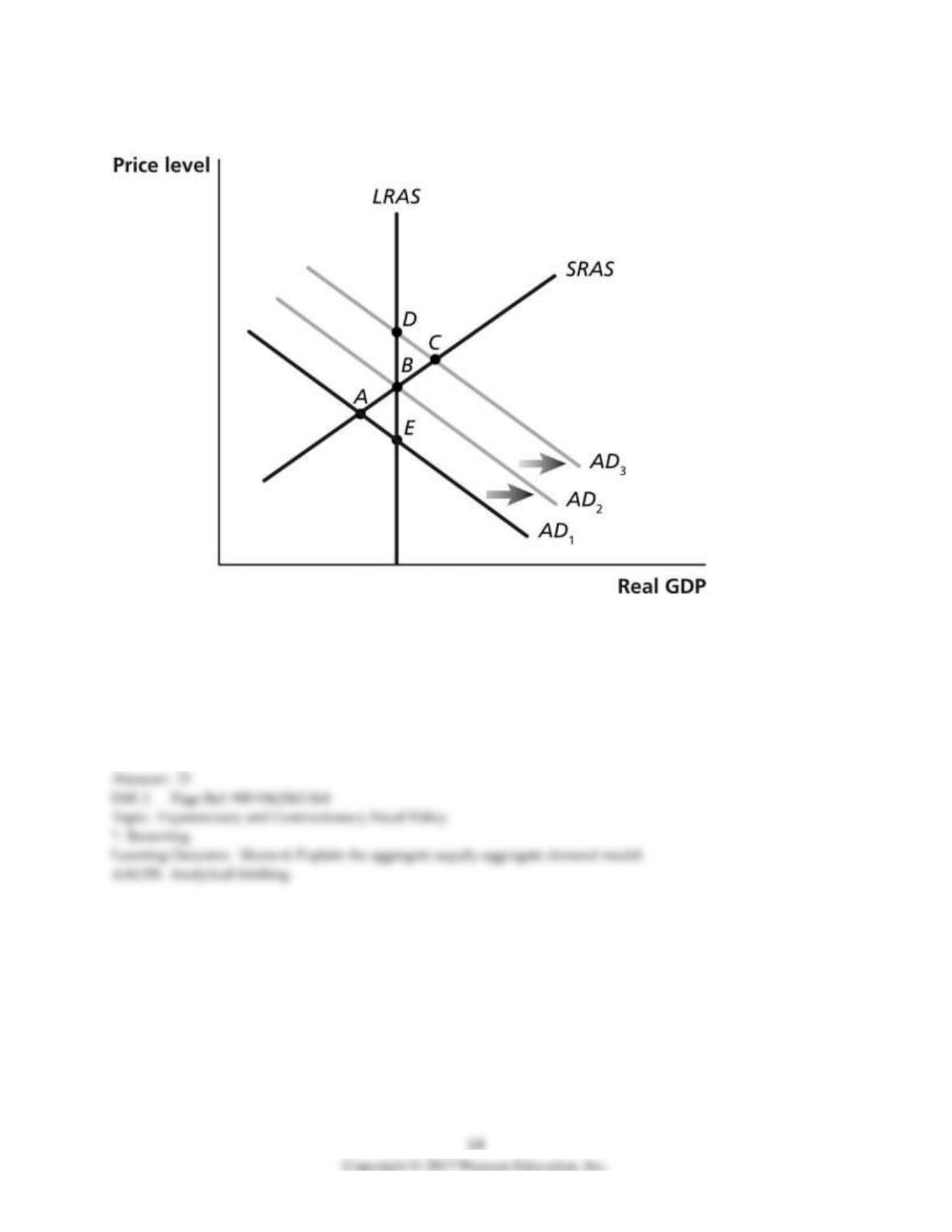
Figure 16-1
5) Refer to Figure 16-1. An increase in taxes would be depicted as a movement from ________, using the
static AD–AS model in the figure above.
A) E to B
B) B to C
C) A to B
D) B to A
E) C to D
6) Refer to Figure 16-1. Suppose the economy is in a recession and expansionary fiscal policy is
pursued. Using the static AD–AS model in the figure above, this would be depicted as a movement
from
A) A to B.
B) B to C.
C) C to B.
D) B to A.
E) A to E.
7) Refer to Figure 16-1. Suppose the economy is in short-run equilibrium below potential GDP and
Congress and the president lower taxes to move the economy back to long-run equilibrium. Using the
static AD–AS model in the figure above, this would be depicted as a movement from
A) A to B.
B) B to C.
C) C to B.
D) B to A.
E) A to E.
8) Refer to Figure 16-1. Suppose the economy is in short-run equilibrium below potential GDP and no
fiscal or monetary policy is pursued. Using the static AD–AS model in the figure above, this would be
depicted as a movement from
A) A to B.
B) B to C.
C) C to B.
D) B to A.
E) A to E.
9) Refer to Figure 16-1. Suppose the economy is in short-run equilibrium above potential GDP and
automatic stabilizers move the economy back to long-run equilibrium. Using the static AD–AS model in
the figure above, this would be depicted as a movement from
A) D to C.
B) A to E.
C) C to B.
D) B to A.
E) E to A.
10) Refer to Figure 16-1. Suppose the economy is in short-run equilibrium above potential GDP and no
policy is pursued. Using the static AD–AS model in the figure above, this would be depicted as a
movement from
A) D to C.
B) A to E.
C) C to D.
D) C to B.
E) E to A.
11) Refer to Figure 16-1. Suppose the economy is in short-run equilibrium above potential GDP and
wages and prices are rising. If contractionary policy is used to move the economy back to long run
equilibrium, this would be depicted as a movement from ________ using the static AD–AS model in the
figure above.
A) D to C
B) C to B
C) A to E
D) B to A
E) E to A
12) An increase in individual income taxes ________ disposable income, which ________ consumption
spending.
A) increases; increases
B) increases; decreases
C) decreases; increases
D) decreases; decreases
13) Tax cuts on business income increase aggregate demand by increasing
A) business investment spending.
B) consumption spending.
C) government spending.
D) wage rates.
14) Tax cuts on business income ________ aggregate demand.
A) would decrease
B) would increase
C) would not change
D) may increase or decrease
15) If the economy is falling below potential real GDP, which of the following would be an appropriate
fiscal policy to bring the economy back to long-run aggregate supply? An increase in
A) the money supply and a decrease in interest rates.
B) government purchases.
C) oil prices.
D) taxes.
16) Which of the following is considered contractionary fiscal policy?
A) Congress increases the income tax rate.
B) Congress increases defense spending.
C) Legislation removes a college tuition deduction from federal income taxes.
D) The New Jersey legislature cuts highway spending to balance its budget.
17) Expansionary fiscal policy to prevent real GDP from falling below potential real GDP would cause
the inflation rate to be ________ and real GDP to be ________.
A) higher; higher
B) higher; lower
C) lower; higher
D) lower; lower
18) Expansionary fiscal policy will
A) shift the aggregate demand curve to the left.
B) shift the aggregate demand curve to the right.
C) not shift the aggregate demand curve.
D) shift the short-run aggregate supply curve to the left.
19) Which of the following is an appropriate discretionary fiscal policy if equilibrium real GDP falls
below potential real GDP?
A) an increase in government purchases
B) an increase in the supply of money
C) an increase in individual income taxes
D) a decrease in transfer payments
20) To combat a recession with discretionary fiscal policy, Congress and the president should
A) decrease government spending to balance the budget.
B) decrease taxes to increase consumer disposable income.
C) lower interest rates and increase investment by increasing the money supply.
D) raise taxes on interest and dividends, but not on personal income.
21) A decrease in individual income taxes ________ disposable income, which ________ consumption
spending.
A) increases; increases
B) increases; decreases
C) decreases; increases
D) decreases; decreases
22) Tax increases on business income decrease aggregate demand by decreasing
A) business investment spending.
B) consumption spending.
C) government spending.
D) wage rates.
23) If the economy is growing beyond potential real GDP, which of the following would be an
appropriate fiscal policy to bring the economy back to long-run aggregate supply? An increase in
A) the money supply and a decrease in interest rates.
B) government purchases.
C) oil prices.
D) taxes.
20
24) Which of the following is considered expansionary fiscal policy?
A) Congress decreases the income tax rate.
B) Congress increases defense spending.
C) Legislation increases a college tuition deduction from federal income taxes.
D) The Arizona legislature cuts highway spending to balance its budget.
25) Contractionary fiscal policy to prevent real GDP from rising above potential real GDP would cause
the inflation rate to be ________ and real GDP to be ________.
A) higher; higher
B) higher; lower
C) lower; higher